Original Research Article
Chronic kidney disease-prevalence and determinants among type 2
diabetes mellitus patients attending a primary care setting
in central Kerala
Sajith Kumar Soman, Binu Areekal*, Rosin George Varghese, Susan John, Radhika S. Gopan,
Quincy Mariam Jacob, Amruthaa Raman Nair
INTRODUCTION
Diabetes mellitus (DM) is one of the most common metabolic diseases characterized by increased blood glucose level either due to insufficiency/absence of insulin or due to decrease in the insulin sensitivity at cellular receptor level. Depending on the aetiology, factors contributing to hyperglycaemia may include reduced insulin secretion, insulin resistance, decreased
peripheral glucose utilization, and increased glucose production.1 The number of people with diabetes has risen from 108 million in 1980 to 422 million in 2014. The global prevalence of diabetes among adults over 18 years of age has risen from 4.7% in 1980 to 8.5% in 2014. Prevalence of diabetes has been rising more rapidly in middle- and low-income countries. Currently 425 million people have diabetes in the world and 82 million people in the South East Asian Region; by 2045 this will
ABSTRACT
Background: Diabetes mellitus (DM) is one of the most common metabolic diseases characterized by increased blood glucose levels either due to insufficiency/absence of insulin or due to decrease in the insulin sensitivity. The prevalence of chronic kidney disease (CKD) in people with type 2 diabetes is three times higher than in non-diabetic population and majority of people developing end-stage renal diseases (ESRD) have Type 2 DM. The objectives of the study were to find out the prevalence of CKD, mean GFR and associated factors of CKD, in diabetics coming to a primary health care setting in Central Kerala.
Methods: A cross-sectional study among all patients attending the NCD clinic of Health Centre, Ettumanoor with confirmed diagnosis of type 2 diabetes mellitus was done between February 2017 and April 2017.
Results: The prevalence of CKD among the study population was 45.3%. The proportion of CKD was 34.9% among those with nil urinary protein, 57.1% among those with 1+ urinary protein, 88.9% for those with 2+ and 87.5% among those with 3+ urinary protein. Among those with CKD mean duration of diabetes was 121.92 months against 92.72 months among those without CKD. There was statistically significant difference between RBS values of those with CKD and without CKD (238.49 mg% versus 199.41 mg%). The proportion of CKD was found increase with duration of diabetes 5 years (31.2%), 5-10 years (47.8%), 10-15 years (52.6%) and >15 years (55%).
Conclusions: The study showed high prevalence of CKD among diabetics. The duration of diabetes, urinary protein levels and RBS value were found to have strong association with CKD in diabetics.
Keywords: Chronic kidney disease, Diabetes, Kerala
Department of Community Medicine, Government Medical College, Kottayam, Kerala, India
Received: 13 May 2018
Revised: 30 May 2018
Accepted: 31 May 2018
*Correspondence:
Dr. Binu Areekal,
E-mail: [email protected]
Copyright: © the author(s), publisher and licensee Medip Academy. This is an open-access article distributed under the terms of the Creative Commons Attribution Non-Commercial License, which permits unrestricted non-commercial use, distribution, and reproduction in any medium, provided the original work is properly cited.
rise to 151 million. There were over 72 million cases of diabetes in India in 2017.2
Diabetics around the world suffer from many complications. Raised blood glucose, a common effect of uncontrolled diabetes, may, over time, lead to serious damage to the heart, blood vessels, eyes, kidneys and nerves. Pooled data from 54 countries show that at least 80% of cases of end-stage renal disease (ESRD) are caused by diabetes, hypertension or a combination of the two. The proportion of ESRD attributable to diabetes alone ranges from 12–55%.3
Chronic kidney disease that occurs in patients with DM can be from many diverse causes, including hypertensive nephrosclerosis and unresolved acute kidney failure. The prevalence of chronic kidney disease (CKD) in people with type 2 diabetes is three times higher than in the non-diabetic population and in many parts of the world, the majority of people developing ESRD have type 2 DM.4
Patients with CKD of stages 1-3 (Glomerular Filtration Rate [GFR] >30 ml/min/1.73 m²) are frequently asymptomatic. They simply have a reduction in GFR and do not experience clinically evident disturbances in water or electrolyte balance or endocrine/metabolic derangements.5
Prevention of diabetic nephropathy is crucial. Tight control of diabetes, blood pressure treatment to systolic blood pressure of <130 mmHg, reduction of proteinuria, and treatment with drugs that inhibit the renin-angiotensin system are all associated with prevention of or delay in progression of diabetic kidney injury. For effective prevention of progression of diabetic nephropathy the diagnosis of nephropathy and CKD should be done as early as possible. In early diabetic nephropathy, aggressive control of blood sugar, blood pressure lowering and inhibition of the rennin-angiotensin system with drugs like elanapril are the major treatment strategies used currently.6 All these are possible only if CKD in diabetics is diagnosed early. The absence of symptoms in patients in the early stages of CKD necessitates the clinicians to maintain an adequate index of suspicion in all patients, especially in those with medical or socio-demographic risk factors for CKD. This can be done by eGFR calculations using MDRD formula and urine creatinine albumin ratio in patients with diabetes. Online calculators for the same is available in the worldwide web and android devices.
In those with late diagnosis, the options are limited and include hemodialysis or kidney transplantation which includes high amounts of cost and loss of quality of life. As per the study conducted in India the annual average costs of treatment for patients on medication only and for patients on hemodialysis plus medication were Rs 25,836 (US $386) and Rs 2,13,144 (US $3181), respectively (Rs =Indian rupee). Treatment cost was found to be significantly higher in patients on hemodialysis, patients
with a smoking habit, patients with comorbidities, and patients with end-stage renal disease.7
The factors associated with CKD in diabetics are also important. Their control could go a long way in controlling the risk of progression of CKD in diabetics. The studies on CKD among diabetics are rare in Kerala too. Thus the current study tries to find out the prevalence of CKD and mean GFR in diabetic patients coming to a primary health care setting in Central Kerala. It also attempts to find out associated factors of CKD in the diabetic population.
METHODS
A cross-sectional study to find out the prevalence of Chronic Kidney Disease among Type-2 Diabetes Mellitus patients was conducted in Kottayam Medical College Health Centre, Ettumanoor (UHTC of Government Medical College, Kottayam). The Health Centre caters to a population of 51,180 and covers the whole Ettumanoor Municipality. Municipality covers an area of 27.81 sq.km and has 35 wards. The study period was from 2017 February to 2017 June.
Sample size
As per the START India multicentric study among type 2 diabetes mellitus patients conducted in 30 different sites in India, the prevalence of CKD among Type 2 Diabetes Mellitus patients was found to be 48.4%.8 Taking this as ‘p’ and applying to the formula,
Sample size, N = zα2pq / d2
With absolute precision of 9.5%, which is less than acceptable 20% of p.
The minimum sample size was found to be 106.
Sampling technique
Inclusion and excluion criteria
Blood was drawn under aseptic precautions. Biomedical waste generated from the study was disposed along with hospital waste management system.
Statistical analysis
The data was properly coded and entered in Microsoft Excel. Further analysis was done using the software SPSS version 16.0. GFR was calculated using MDRD formula which is depicted below,
GFR= 175 × (Serum creatinine level in mg/dl)-1.154 × (age in years ) -0.203 × (0.742 if female) (1.21 if black)
It is considered to be superior than Cockroft – Gault equation and CKD-EPI equation for measurement of GFR in diabetic patients.9 Chronic kidney disease and its staging was based on the KDIGO clinical practice guideline for the evaluation and management of CKD 2012.10 CKD was defined operationally as eGFR <60 ml/minute.
Qualitative variables were expressed as percentages and quantitative as mean and standard deviation. For testing
associations chi square test was used for qualitative variables and t test and ANOVA for quantitative variables. Level of statistical significance was fixed at p<0.05.
RESULTS
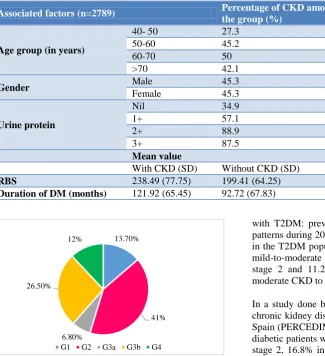
Out of the 117 participants in the study, maximum representation was in the age group 60-70 (47.9%) followed by 50-60 age group (26.5%). Both the sexes have been almost equally represented in the study adding to its validity (45.3% male and 54.7% female) (Table 1). Mean age of males in the study was 61.81years with a SD of 9.4 and that of females was 61.5 years with a SD of 7.8.The mean serum creatinine of the study sample was 1.31 mg/dl with a SD of 0.47. Mean random blood sugar was 217.11 mg% with a SD of 73.03. Mean GFR of the study group was 57.6 ml/minute with a SD of 21.45 (Table 2). The prevalence of CKD among the study population was 45.3% (95% CI-36.28%- 54.32%). As per the current study the proportion of people in stage G1 was 13.75%, G2 -41%, G3a -6.8%, G3b -26.5% and G4-12%. There was no one in the study with a GFR less than 15 ml/minute or G5 (Figure 1).
Table 1: Age sex distribution of study population.
Sex
Total
Male Female
Age group
40-50
N 5 6 11
% within age group 45.5% 54.5% 100.0%
50-60
N 15 16 31
% within age group 48.4% 51.6% 100.0%
60-70
N 22 34 56
% within age group 39.3% 60.7% 100.0%
>70
N 11 8 19
% within age group 57.9% 42.1% 100.0%
Total
N 53 64 117
% within age group 45.3% 54.7% 100.0%
Table 2: Baseline characteristics of the study population.
Variable Mean Standard deviation
Age (years) 61.64 8.56
Serum creatinine (mg/dl) 1.31 0.47
Random blood sugar (mg/dl) 217.11 73.03
GFR (ml/minute) 57.6 21.45
Duration of DM (months) 105.95 68.06
As far as the factors associated with CKD, it can be seen that proportion of people with CKD was increasing with age. The prevalence of CKD between 40-50 years was 27.3% which rose to 45.3% and 50% in the 50-60 and
relationship between increasing urinary protein and proportion of CKD. The proportion of CKD was 34.9% among those with nil urinary protein, 57.1% among those with 1+ urinary protein, 88.9% for those with 2+ and 87.5% among those with 3+ urinary protein (p=0.01). There was a statistically significant difference between random blood sugar value between those with CKD and without CKD (238.49 mg% versus 199.41 mg%) (p=0.004). The proportion of people with CKD among those who had a GRBS value less than 150 was only
30%, but in higher GRBS groups, it was found to be extremely high (150-200 GRBS–36.4%, 200-250-48.1%, 250-300-48.6% and above 300-78.6%). There was also significant difference between duration of diabetes between those with CKD and without. Among those with CKD mean duration of diabetes was 121.92 months against 92.72 months among those without CKD. The proportion of CKD was also found to be increasing with duration of diabetes 5 years (31.2%), 5-10 years (47.8%), 10-15 years (52.6%) and >15 years (55%) (Table 3).
Table 3: Factors associated with CKD in the study population.
Associated factors (n=2789) Percentage of CKD among
the group (%)
Pearson
chi-square P value
Age group (in years)
40- 50 27.3
2.02 0.568
50-60 45.2
60-70 50
>70 42.1
Gender Male 45.3 0.00 0.997
Female 45.3
Urine protein
Nil 34.9
17.21 0.001
1+ 57.1
2+ 88.9
3+ 87.5
Mean value
With CKD (SD) Without CKD (SD) T value P value
RBS 238.49 (77.75) 199.41 (64.25) 2.98 0.004
Duration of DM (months) 121.92 (65.45) 92.72 (67.83) 2.35 0.02
Figure 1: Stages of CKD in the study population. DISCUSSION
It can be seen from Table 1 that both sexes and different age groups have been adequately represented in the study group which adds to the validity of the study. As per the current study the prevalence of CKD among diabetic patients above 40 years was 45.3%. Almost 1 in 2 diabetics above 40 in the study was suffering from CKD. Majority of the patients were in the category of G2 (41%) followed by G3b and G4 (26.5% and 12%). This is similar to the multi centric START study conducted among 3000 diabetic patients by Prasannakumar et al which reported a prevalence of 48.4%.8 In a study done by Stanford et al on understanding CKD among patients
with T2DM: prevalence, temporal trends and treatment patterns during 2007–2012 show overall CKD prevalence in the T2DM population to be 38.3%.11 Most cases were mild-to-moderate CKD, with 9.1% for stage 1, 9.4% for stage 2 and 11.2% for stage 3a. Fewer than 9% had moderate CKD to kidney failure.
In a study done by Franch-Nadal et al on prevalence of chronic kidney disease in patients with type 2 diabetes in Spain (PERCEDIME2 study), prevalence of CKD in type diabetic patients was 27.9% with 3.5% in stage 1, 6.4% in stage 2, 16.8% in stage 3 and 1.2% in stages 4 and 5.12 But in the study conducted by Shay et al in India, among 824 T2DM patients 320 (38.83%) patients had CKD. The proportion of patients at various stages of CKD was Stage 1-178 (55.6%), Stage 2-67 (20.9%), Stage 3-56 (17.5%), Stage 4–3 (0.94%), Stage 5–5 (1.56%).13 The data clearly shows that CKD from diabetes is a major public health problem especially in people over 40 years. It also shows the relevance of early diagnosis of CKD among diabetic patients. Only if they are diagnosed early enough progression of CKD can be delayed.6
Among the factors associated with CKD, a higher proportion of CKD was found with increasing age even though it was not found to be statistically significant. It is logical to assume that, as the age advances the GFR will definitely decrease causing higher number of people with CKD in the higher age groups. As per the study 13.70%
41% 6.80%
26.50% 12%
conducted by Bailey et al it was found that the prevalence of CKD above 65 was found to be 61% which is comparable with the current study.14 Similar trends have also seen in the study conducted by Gatwood et al who found out that the odds of CKD tended to increase with age (OR: 1.88; 95% CI: 1.82-1.93).15
It was found that among type 2 diabetic males and females, 45.3% each were having CKD. But it was not found to have a statistically significant. Similar results were seen in a study done by Zoppini et al.16 But as per the study done by Margret et al, women with diabetes had a higher risk of CKD compared to men.17 Sex hormones are thought to play a major role in the biological mechanisms associated with variability in CKD prevalence across gender.18
While serum creatinine and blood urea levels are indicators of CKD, it is a known fact that by the time these become elevated, the renal pathology would have advanced fairly and corrective measures have a limited role. Microalbuminuria is currently noted to be one of the earliest indicators of CKD in general practice that gives a heads up regarding onset of diabetic nephropathy. In the current study it was seen that urinary protein level was significantly associated with CKD. Even though the current study looked only at macroproteinuria, microproteinuria or albumin-creatinine ratio or urinary protein-creatinine ratio is a better indicator of CKD.19 These 2 indicators may be extensively used in the primary health care setting if the early diagnosis of CKD among diabetics is to be done.
The study demonstrates a significant association between hyperglycaemic status and presence of Chronic Kidney Disease. Mean RBS in the CKD group was 238.49 mg% and in the non CKD group it was 199.49 mg%. It also shows higher the GRBS greater the risk of CKD. Among those with GRBS of 300 or above, 78.6% had CKD. This shows the relevance of aggressive control of blood sugar to prevent CKD. Glucose homeostasis is extremely altered in patients with diabetic kidney disease, who are exposed to a high risk of both hyperglycemia and hypoglycemia.20 Both high and low glycemic levels are associated with increased morbidity and shortened survival in this group of patients. Rigalleau et al have demonstrated in their study a positive correlation between Hb A1c and GFR with r=0.29, p<0.0001. As per regression analysis each 1% rise in HbA1c was associated with +6 ml/min per 1.73 m2 GFR.21
In our study, it was found that among CKD patients the mean duration of diabetes is 121.92 months with SD-65.46 which was higher when compared to non-CKD patients (mean duration- 92.72 months with SD- 67.83) (p=0.020). Another study done by Zoppini et al states that as the duration of diabetes increases, there is decline in eGFR.16 But, a study done by Rajput et al, the proportion of type 2 diabetes with CKD were almost equal for different duration of diabetes since diagnosis.22
Limitation
Albumin creatinine ratio is a better indicator than macroprotenuria in detection of CKD but was not done due to feasibility reasons.
Recommendations
Study recommends extensive use of online/android calculator for eGFR and test strips for microalbuminuria in primary health care setting for early diagnosis of CKD in diabetics.
Adequate training in this regard may be provided to primary health care physicians especially in developing countries.
Funding: No funding sources Conflict of interest: None declared
Ethical approval: The study was approved by the Institutional Ethics Committee
REFERENCES
1. Fauci AS, Braunwald E, Kasper DL, Hauser SL, Longo DL, Jameson JL, et al. Harrison's Principles of Internal Medicine. In: Alvin CP, editor. Diabetes mellitus. 16th ed. New York: McGraw Hill; 2008: 2152-2153.
2. IDF-Diabetic fact sheet –India. Available at:
https://www.idf.org/our-network/regions-members/south-east-asia/members/94-india.html 3. United States Renal Data System. International
Comparisons. In United States Renal Data System. 2014 USRDS annual data report: Epidemiology of kidney disease in the United States. Bethesda (MD): National Institutes of Health, National Institute of Diabetes and Digestive and Kidney Diseases; 2014: 188–210.
4. Tan J, Zwi LJ, Collins JF, Marshall MR, Cundy T. Presentation, pathology and prognosis of renal disease in type 2 diabetes. BMJ Open Diabetes Research Care. 2017;5:e000412.
5. Arora P. Chronic Kidney Disease Clinical Presentation. MEDSCAPE. Available at: https://emedicine.medscape.com/article/238798-clinical. Accessed on 3 March 2018.
6. Hall PM. Prevention of Progression in Diabetic Nephropathy, Diabetes Spectrum. 2006;19(1):18-24. 7. Ahlawat R, Tiwari P, D'Cruz S. Direct Cost for
Treating Chronic Kidney Disease at an Outpatient Setting of a Tertiary Hospital: Evidence from a Cross-Sectional Study. Value Health Reg Issues. 2017;12:36-40.
9. Schwandt A, Denkinger M, Fasching P, Pfeifer M, Wagner C, Weiland J, et al. Comparison of MDRD, CKD-EPI, and Cockcroft-Gault equation in relation to measured glomerular filtration rate among a large cohort with diabetes. J Diabetes Complications. 2017;31(9):1376-83.
10. Inker LA, Astor BC, Fox CH, Isakova T, Lash JP, Peralta CA, et al. KDOQI US Commentary on the 2012 KDIGO Clinical Practice Guideline for the Evaluation and Management of CKD. Am J Kidney Dis. 2014;63(5):713-35.
11. Wu B, Bell K, Stanford A, Kern DM, Tunceli O, Vupputuri S, et al. Understanding CKD among patients with T2DM: prevalence, temporal trends, and treatment patterns- NHANES 2007–2012. BMJ Open Diabetes Res Care. 2016;4:e000154.
12. Rodriguez-Poncelas A, Garre-Olmo J, Franch-Nadal J, Diez-Espino J, Mundet-Tuduri X, Barrot-De la Puente J, et al. Prevalence of chronic kidney disease in patients with type 2 diabetes in Spain: PERCEDIME2 study. BMC Nephrol. 2013;14:46. 13. Sahay R, Kalra S, Agarwal N, Baruah MP, Bandgar
T, Bantwal GM, et al. PO162 burden of chronic kidney disease among type 2 diabetics in India. Diabetes Res Clin Pract. 2014;106(1):130.
14. Bailey RA, Wang Y, Zhu V, Marcia FT. Rupnow Chronic kidney disease in US adults with type 2 diabetes: an updated national estimate of prevalence based on Kidney Disease: Improving Global Outcomes (KDIGO) staging. BMC Res Notes. 2014;7:415.
15. Gatwood J, Chisholm-Burns M, Davis R, Thomas F, Potukuchi P, Hung A, et al. Evidence of chronic kidney disease in veterans with incident diabetes mellitus. PLoS ONE. 2018;13(2):e0192712.
16. Zoppini G, Targher G, Chonchol M, Ortalda V, Negri C, Stoico V, et al. Predictors of Estimated
GFR Decline in Patients with Type 2 Diabetes and Preserved Kidney Function. Clin J Am Soc Nephrol. 2012;7(3):401–8.
17. Yu MK, Katon W, Young BA. Associations between sex and incident chronic kidney disease in a prospective diabetic cohort. Nephrol. 2015;20(7):451–8.
18. The Role of Gender in Chronic Kidney Disease | Chronic Kidney Disease, Renal Function. Scribd. Available at: https://www.scribd.com/document/ 347994726/. Accessed on 3 March 2018.
19. Hong D, Oh IH, Park JS, Lee CH, Kang CM, Kim GH. Evaluation of Urinary Indices for Albuminuria and Proteinuria in Patients with Chronic Kidney Disease. Kidney Blood Press Res. 2016;41:258-66. 20. Pecoits-Filho R, Abensur H, Betônico CCR,
Machado AD, Parente EB, Queiroz M, et al. Interactions between kidney disease and diabetes: dangerous liaisons. Diabetol Metab Syndr. 2016;8:50.
21. The Role of Gender in Chronic Kidney Disease | Chronic Kidney Disease, Renal Function. Scribd. Available from: https://www.scribd.com/document/ 347994726/The-Role-of-Gender-in-Chronic-Kidney-Disease. Accessed on 10 January 2010. 22. Rajput R, Kumar KMP, Seshadri K, Agarwal P,
Talwalkar P, Kotak B, et al. Prevalence of Chronic Kidney Disease (CKD) in Type 2 Diabetes Mellitus Patients: START-India Study. J Diabetes Metab. 2017;8(2):2–5.