Accuracy of Three Different Electronic
Apex Locators - A Pilot Study
J. PRABHAKAR
1, ALAGARSAMY VENKATESH
2and GOLD PEARLIN MARY
21Department of Conservative Dentistry and Endodontics, Tagore Dental College and Hospital, Chennai, India
2Department of Conservative Dentistry, Sree Balaji Dental College and Hospital, Bharath University, Pallikaranai, Chennai - 600100, India.
*Corresponding author E-mail: [email protected] DOI: http://dx.doi.org/10.13005/bpj/700
(Received: August 15, 2015; accepted: September 20, 2015) ABSTRACT
Accurate working length determination is a prerequisite for successful root canal treatment, reducing the chance of insufficient cleaning of the canal or of damaging the periapical tissues from over instrumentation. The use of an electronic apex locator has improved the accuracy of the working length measurement in clinical endodontics. The purpose of this in-vivo study was to compare the accuracy of three different Electronic Apex Locator (EALs). Twelve human mandibular premolar to be extracted for orthodontic treatment were selected. Teeth were divided into three groups Group 1 (n = 4) (IPex, NSK NAKANISHIINC, Tochigi, Japan) Group 2 ( n =4) (Mini Apex Locator ,Sybron Endo, Glendora,CA, USA) Group 3 ( n=4)(IROOT S,S-Denti,Korea).After determining the working length the No 10 Kfile was cut at the reference point and sealed in position using Glass Ionomer cement. Tooth is extracted and apical 3- 5mm is exposed and photographed using SLR digital camera. The distance between file tip and minor apical diameter were measured using a calibrated measurement software. (Adobe .version 9). Raw data of 12 samples were recorded and inference was made. Within the limitation of this pilot study we are able to comment that all the Electronic Apex Locators evaluated in this study performed to the recommended accuracy. Further study is important to statistically analyze above mentioned comment.
Key words: Electronic Apex Locator, EAL, Working length
INTRODUCTION
Accurate working length determination is a prerequisite for successful root canal treatment, reducing the chance of insufficient cleaning of the canal or of damaging the periapical tissues from over instrumentation1,2,3. Among clinicians, it is generally accepted that working length extends from the coronal portion of the root canal to the apical constriction. Various anatomic studies have determined the apical constriction to fall 0.5 to 1.0 mm from the apical opening of the tooth, or major foramen4,5.
intra-subject differences8, 9. Therefore, these methods for root canal measurement do not allow precise localization of apical constriction and do not guarantee that instrumentation beyond the apical foramen will be avoided14, 15.
The use of an electronic apex locator has improved the accuracy of the working length measurement in clinical endodontics13,16,15. Several in vivo and ex vivo studies have been conducted on various commercially available EALs to determine their accuracy and consistency17-20. These studies reported varying percentage of accuracy of the recent generation of EALs.The purpose of this in-vivo study was to compare the accuracy of three different Electronic Apex Locator (EALs).
MATERIALS AND METHODS
This study was approved by the ethical committee of Tagore dental college and hospital, Chennai. Patients were explained about the procedure and importance of their cooperation in the final outcome of this research study. Patients were provided with Informed Consent form in both English and Patient’s Mother tongue.
Twelve human mandibular premolar to be extracted for orthodontic treatment were selected. Patients were selected in the age group-18-25 years. The selection criteria included tooth with fully formed apices and with no caries, no coronal restorations and no signs of resorption or cracks were chosen. The teeth were radiographed and a single root, Presence of single ,straight canal without calcification was confirmed. Teeth were divided into three groups:
Group 1 (n = 4) (IPEX, NSK NAKANISHIINC, Tochigi, Japan)
Group 2 ( n =4) (MINI APEX LOCATOR Sybron Endo, Glendora,CA, USA)
Group 3 ( n=4)(IROOT S,S-Denti,Korea).
The teeth were isolated with rubber dam after anesthesia. Standard access cavity was prepared and the pulp chamber was irrigated with 3 % sodium hypochlorite. The occlusal surface of the tooth was made flat to achieve a standard reference point. After locating the canal orifice, the coronal part of the canal was enlarged with #2 to
#4 Gates-Glidden drills (Mani, Tochigi, Japan).The pulp tissues from the canal was removed with S1 Pro Taper using Anthogyr rotary hand piece upto 3 mm short of radiographic length of the tooth.
Respective EAL is used to determine the working length using No 10 K file to the assigned groups and values were recorded. After that No 10 K File is placed in the canal and cut at the coronal reference point. Then the file was sealed coronally in position using Glass ionomer cement .Tooth is extracted , cleaned and stored in distilled water.
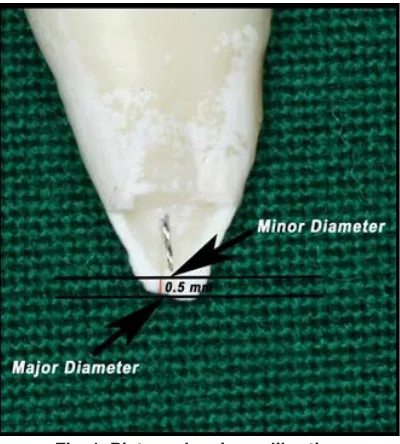
The apical 3–5 mm of the roots were carefully removed using a diamond blade and a scalpel until the instrument and the canal walls were visible. This was performed under a light, paying attention to the anatomical canal characteristics. The exposed apical portion of the apex is photographed using SLR digital camera (Nikkon, Japan). Pictures were loaded to a computer and analyzed with a calibrated measurement software.(Adobe .version 9). The distance between file tip and minor apical diameter were measured. (Fig 1).Minor apical diameter is determined by reducing 0.5mm from anatomical apex .
RESULTS AND DISCUSSION
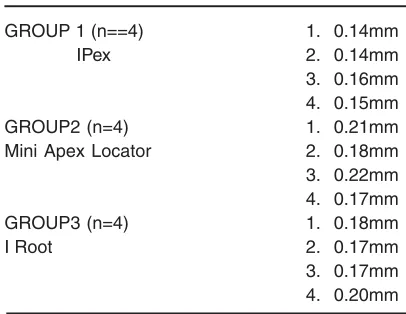
The results are presented in the table 1. The use of electronic devices to determine working length has gained increasing popularity in recent years. Custer first introduced the concept in 1916, which was later revisited by Suzuki in 1942 when Table 1: Raw data of 12 samples with measurements
between the minor diameter and file tip
GROUP 1 (n==4) 1. 0.14mm
IPex 2. 0.14mm
3. 0.16mm 4. 0.15mm
GROUP2 (n=4) 1. 0.21mm
Mini Apex Locator 2. 0.18mm 3. 0.22mm 4. 0.17mm
GROUP3 (n=4) 1. 0.18mm
I Root 2. 0.17mm
he observed that a consistent electrical resistance between an instrument in a root canal and an electrode on the oral mucous membrane could be used for measuring canal length21,22. Since that discovery, several generations of EALs have been developed to refine their accuracy.
The first generation of EALs were largely resistance based and were found to both over and underestimate working length when compared to radiographs. Second generation EALs rely on impedance measurements to measure the location within a canal. These devices often have difficulty taking accurate measurements in wet canals, and require insulative sheaths over the probe to protect them from conductive fluids. Third generational devices are largely frequency-based and use multiple frequencies to determine the distance from the end of the canal. Certain third generational devices use a ratio algorithm between two electrical currents and are designed to make accurate readings regardless of fluid electrolytes being present within the canal. Recently, fourth generation devices have arrived in the market that claim to use differing frequencies to further reduce errors23 .The Electronic apex locators used in this study were fourth generation devices.
Apical anatomy determines the termination of root canal instrumentation and filling.
The cemento-dentinal junction (CDJ), which is also described as the apical constriction23,is the anatomical and histological landmark where the periodontal ligament begins and the pulp ends24. The CDJ is highly irregular and can be up to 3 mm higher on one wall of the root compared with the opposite wall25. Furthermore, the CDJ cannot be identified clinically2. The ideal spot for working length determination in endodontic treatment is the apical constriction .As the mean foramen to apical constriction distance is approximately 0.5–1.0 mm for all tooth types4,5,26, it was chosen in this study to determine the minor apical diameter by subtracting 0.5 mm from the anatomical apex. We have used modified Altenburger et al methodology27 to evaluate the accuracy of electronic apex locator.
Two levels of accuracy for electronic apex locator are defined in the literature. A distance of 1.0 mm from the apical constriction is regarded as clinically acceptable28 However, the clinical tolerance of 0.5 mm to the apical constriction is regarded as being superior29. All the groups evaluated in this study shows the reading less than that of 0.5 mm (Table.1).It can be inferred that all the EALs evaluated in this preliminary study produces clinically acceptable accuracy. Although these modern devices are superior than conventional methods, the fact remains that still 100 percent accuracy yet to be achieved. Several studies reported that the accuracy of the recent generation of EALs was approximately 90 percent 30-33. Thus mechanical instrumentation without irrigation cannot predictably eliminate bacteria in the canal completely. A root canal irrigant is needed to aid in the debridement of the B root canals. In this study none of the groups were the file tips found exactly at the minor apical foramen or beyond the minor apical foramen.
CONCLUSION
Within the limitation of this pilot study we are able to comment that all the Electronic Apex Locators evaluated in this pilot study performed to the recommended accuracy. Fur ther study is important to statistically analyze above mentioned comment.
1. Sjo¨gren U, Hagglund B, Sundqvist G, Wing K Factors affecting the long-term results of endodontic treatment. Journal of Endodontics 16: 498-504 (1990).
2. Ricucci D., Langeland K., Apical limit of root canal instrumentation and obturation, Part II: A histological study. International Endodontic Journal 31: 394-409 (1998). 3. Chugal NM, Clive JM, Spangberg LS.,
Endodontic infection: Some biologic and treatment factors associated with outcome. Oral Surger y, Oral Medicine, Oral Pathology,Oral Radiology and Endodontics 96: 81-90 (2003).
4. Kuttler Y. Microscopic investigation of root apexes. Journal of the American Dental Association 50: 544-52 (1955).
5. Green D. A stereomicroscopic study of 700 root apices of maxillary and mandibular anterior teeth. Oral Surgery, Oral Medicine, Oral Pathology 13: 728-33 (1960).
6. Stein TJ, Corcoran JF., Radiographic ‘working length’ revisited. Oral Surgery, Oral Medicine and Oral Pathology 74: 796–800 (1992).
7. Burch JG, Hulen S., The relationship of the apical foramen to the anatomic apex of the tooth root. Oral Surgery, Oral Medicine and Oral Pathology 34: 262–7 (1972).
8. Seidberg BH, Alibrandi BV, Fine H, Logue B Clinical investigation of measuring working lengths of root canals with an electronic device and with digital-tactile sense. Journal of the American Dental Association 90: 379-87 (1975).
9. Chandler NP, Bloxham GP., Effect of gloves on tactile discrimination using an endodontic model. International Endodontic Journal 23: 97–9 (1990).
10. Ruddle CJ., Cleaning and shaping root canal systems. In:Cohen S, Burns RC, eds. Pathways of the Pulp, 8th edn. St Louis, MO: Mosby, 231–91 (2002).
11. Tamse A, Kaffe I, Fishel D., Zygomatic arch interference with correct radiographic diagnosis in maxillary molar endodontics. Oral Surgery, Oral Medicine and Oral
Pathology 50: 563-6 (1980).
12. Olson AK, Goerig AC, Cavataio RE, Luciano J., The ability of the radiograph to determine the location of the apical foramen. International Endodontic Journal 24: 28–35 (1991).
13. Pratten D, McDonald NJ., Comparison of radiographic and electronic working lengths. Journal of Endodontics 22: 173-6 (1996). 14. ElAyouti A, Weiger R, Lost C., Frequency of
overinstrumentation with an acceptable radiographic working length. Journal of Endodontics 27: 49-52 (2001) .
15. ElAyouti A, Weiger R, Lost C., The ability of root ZX apex locator to reduce the frequency of overestimated radiographic working length. Journal of Endodontics 28: 116–9 (2002).
16. Fouad AF, Reid LC., Effect of using electronic apex locators on selected endodontic treatment parameters. Journal of Endodontics 26: 364-7 (2000).
17. Fouad AF, Krell KV, McKendry DJ, Koorbusch GF, Olson RA., A clinical evaluation of five electronic root-canal length measuring instruments. Journal of Endodontics 16: 446– 9 (1990).
18. Mayeda DL, Simon JH, Aimar DF, Finley K In vivo measurement in vital and necrotic canals with the Endex apex locator. Journal of Endodontics 11: 545–8 (1993).
19. Shabahang S, Goon WWY, Gluskin AH., An in vivo evaluation of Root ZX electronic apex locator. Journal of Endodontics 22: 616-8 (1996).
20. Dunlap CA, Remeikis NA, BeGole EA, Rauschenberger CR., An in vivo evaluation of an electronic apex locator that uses the ratio method in vital and necrotic canals. Journal of Endodontics 24: 48-50 (1998). 21. Custer LW. Exact methods of locating the
apical foramen. J Natl Dent Assoc 5: 815-9 (1916).
22. Suzuki K. Experimental study on iontophoresis. Japanese Journal of Stomatology 16: 411-29 (1942).
apex locators. International Endodontic Journal 37: 425-437 (2004).
24. Grove CJ., The value of the dentinocemental junction in pulp canal surgery. Journal of Dental Research 11: 466-8 (1931).
25. Gutierrez JH, Aguayo P., Apical foraminal openings in human teeth. Number and location. Oral Surgery, Oral Medicine, Oral Pathology, Oral Radiology and Endodontics 79: 769–77 (1995).
26. Dummer PMH, McGinn JH, Rees DG., The position and topography of the apical canal constriction and apical foramen. International Endodontic Journal 17: 192–8 (1984).
27. Altenburger et al Combination of apex locator and endodontic motor for length control during root canal treatment.International Endodontic Journal, 42: 368–374 (2009). 28. Tselnik M, Baumgartner JC, Marshall, JG.
An evaluation of Root ZX and Elements diagnostic apex locators. Journal of
Endodontics 31: 507-09 (2005).
29. Wrbas KT, Ziegler AA, Altenburger MJ, Schirrmeister JF. In vivo comparison of working length determination with two electronic apex locators. International Endodontic Journal 40: 133-138 (2006). 30. Fouad AF, Rivera EM, Krell KV., Accuracy of
the Endex with variations in canal irrigants and foramen size. Journal of Endodontics 19: 63–7 (1993) .
31. Frank AL, Torabinejad M., An in vivo evaluation of Endex electronic apex locator. Journal of Endodontics 19: 177–9 (1993). 32. Weiger R, John C, Geigle H, Lost C., An in
vitro comparison of two modern apex locators. Journal of Endodontics 25: 765–8 (1999) .