neW conception of creation of “zero” ecoBuilDinGs
anD ecocities on Base of ecoloGical infrastructure
tetior a.
K.А. Timirjasev Agricultural Academy, Moscow, e-mail: [email protected]
new science “ecocitylogy” as new conception of creation of “zero” ecobuildings and ecocities is based on three principles: “zero” interference in the nature, “zero” consumption of consumable resources from state networks, “zero” emission of pollution. the basis of “zero” ecobuildings and ecocities creation is new branch in building
ecology – ecological infrastructure (it is complex of natural resources, constructions and systems, providing sup -port of environment of human life at all levels – from the whole country up to cities and to separate buildings). environment of life and environments of “zero” buildings and cities must be subject to all-embracing ecologiza-tion. all-embracing ecologization is system of upbringing of ecological thinking for respective activity and for use of ecological decisions based on ecological postulates, ecological philosophy and ethics, principles of sustainable building, adoption into account ethnical and geographical traits, social-psychological and social-economical fea-tures of inhabitants in city.
Keywords: ecocitylogy, conception, ecological infrastructure
three principles of new conception of “zero” ecobuildings and of “zero” ecocities creation include the following important parts of positive interaction of humanity with nature:
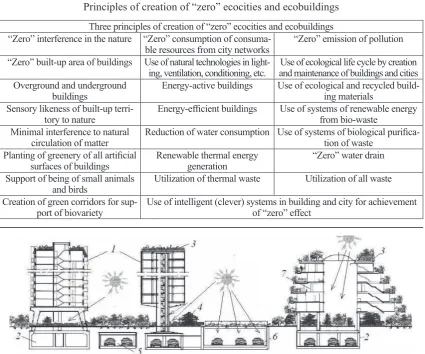
“zero” interference in the nature; “zero” con -sumption of consumable resources from city
networks; “zero” emission of pollution. Every
part consists of several factors (table 1). one of the most important factors is preservation of landscapes with soil – vegetative layer from buildings and engineering structures. the
sur-face of the ground in ecocity should be free; it may be filled by natural and cultural land
-scapes, and exempted from transport (fig. 1).
this problem can be solved by overground and underground construction.
zero” ecocities with ecobuildings may
in-clude all components of natural landscapes; all complex of protected natural territories; all
technosphere, all directions of human activi-ty – architecture, construction, industry, power, transport, water supply, removal and
process-ing of waste products; socio – psychological and socio – economic environment; ecological
satisfaction of needs of inhabitants. ideologi-cal base of “zero” ecocities creation should be ecological postulates.
Results of research and their discussion
it is possible to believe, that the “zero” ecocities with ecobuildings with equality be-tween their citizens can be created by help of
new scientific complex inclusive urban ecol -ogy, architectural ecol-ogy, building ecol-ogy, ecological infrastructure, resilience of life in city, sensory ecology, ecological philosophy, ecological ethics, socio-psychological and socio-economic decisions [1-5]. this new
sci-entific complex and its usage will allow creat
-ing ecological healthy cities and settlements, to stop retreat of nature, and to achieve a state of ecological equilibrium. urban, architectural and building ecology is interconnected scienc-es about making of settlements and buildings, which are in balance with nature, and allow creating high-quality environment in region, cities and in buildings. these purposes are achieved by ecological decision of territorial, planning, geological, geographical, biological, hygienic, architectural, technical and aesthetic problems starting with general town planning scheme and ending with construction of bio-positive buildings. solution set includes many directions of ecological construction, from bio-positive buildings for preservation of
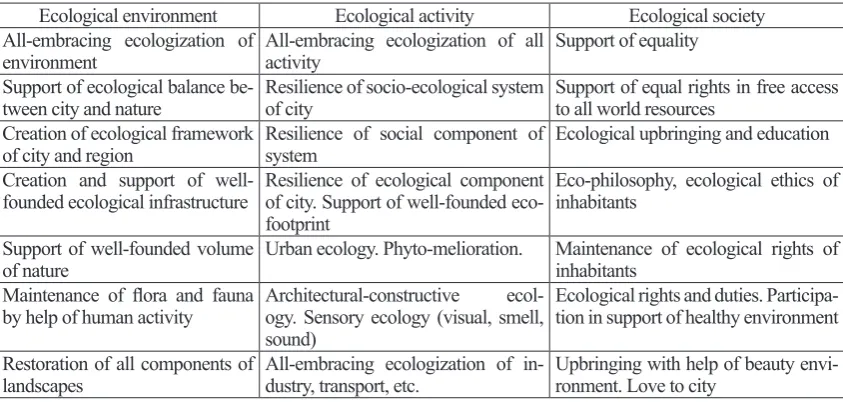
soil-veg-etable layer with flora and fauna, to backing of flora and fauna by help of creation of ecologi -cal framework, etc. (table 2) the new
scien-tific complex should help to solve problems of
“zero” ecocity and ecobuildings creation, in-cluding at gradual ecological reconstruction of
any city. This complex consists of three princi -pal directions: ecological environment, ecolog-ical activity, and ecologecolog-ical society. all these directions are equally important for forming of “zero” ecocity and ecobuildings.
New complex of interconnected sciences
biopositivity of “zero” ecocity, their life in har-mony with the natural environment as allied component is the good way of the develop-ment, allowing carrying out eternal humanity’s dream of unity with nature.
the fundamental concept of ecocities will be invariable: they will be in ecological equi-librium with nature, and thus to create ecologi-cally well-founded high quality environment life for inhabitants. But they will differ essen-tially from each other by set of individual deci-sions – from the size of city up to a degree of use of renewable resources, from a degree of preservation of the natural environment up to use of local materials, from a degree of equal-ity of inhabitants up to a level of satisfaction of needs of inhabitants, etc. a base of new
sci-entific complex is ecological infrastructure (ta
-ble 3). Ecological infrastructure is complex of
natural resources, constructions and systems, providing support of environment of human life at all levels – from the whole country up to cities, to separate buildings and engineer-ing constructions. ecological infrastructure includes interactive among themselves com-pletely natural environment, quasi-natural cultural environment – cultural landscapes
etc., artificial technical environment of cities,
socio – psychological and socio – economic medium (table 3). ecological infrastructure is the interactive among themselves mastered and natural territories, ecological framework of city and green corridors, soil – vegetative lay-er, biopositive and “clever” buildings, systems of phyto-melioration and permaculture, eco-logically restored landscapes and ecoeco-logically reconstructed buildings, favourable perceptible city environment, favourable conditions of life.
Table 1
principles of creation of “zero” ecocities and ecobuildings three principles of creation of “zero” ecocities and ecobuildings “zero” interference in the nature “zero” consumption of
consuma-ble resources from city networks “zero” emission of pollution “zero” built-up area of buildings use of natural technologies in
light-ing, ventilation, conditionlight-ing, etc. and maintenance of buildings and citiesuse of ecological life cycle by creation overground and underground
buildings energy-active buildings use of ecological and recycled build-ing materials sensory likeness of built-up
terri-tory to nature Energy-efficient buildings use of systems of renewable energy from bio-waste Minimal interference to natural
circulation of matter reduction of water consumption Use of systems of biological purification of waste
-Planting of greenery of all artificial
surfaces of buildings renewable thermal energy generation “zero” water drain support of being of small animals
and birds utilization of thermal waste utilization of all waste
creation of green corridors for
sup-port of biovariety use of intelligent (clever) systems in building and city for achievement of “zero” effect
fig. 1. scheme of “zero” ecocity with ecobuildings: 1 – overground buildings: 2 – underground parts of
urban ecology is most general science for ecological design of territories of cities and towns. it includes the decisions of eco-logical problems of big territories. the ma-jor problem of urban ecology is creation of the ecological framework of big territory. ecological framework of earth is system of large natural territories, which are intercon-nected by ecological corridors, indissoluble interrelation of which allows supporting eco-logical equilibrium, environment of life, and biovariety.
“zero” ecobuildings should be multifunc-tional, and alongside with the basic function (apartment house, industrial building, see shore construction etc.) can carry out one or several nature protection functions. “zero”
ecobuildings can use the renewable energy;
they can clean polluted air and water through surfaces of buildings contacting with air and underground water by way of setting on all
surfaces of walls of filters with compulsory
natural and improved cultural landscapes are the basis of ecological framework of city, united by “green corridors”, “green wedges” sites of nature of various areas. the ideal eco-logical framework of city should look like a net-work with “cells” of nature including all com-ponents of natural and cultural landscapes in regular intervals distributed on the area – forests, parks, rivers, lakes, meadows, hollows, heights, squares, gardens and so forth. at their absence, it is necessary to create cultural green corridors that can be accompanied by formation of new “cells” of framework if their area on territory of
city is small or if their number is insignificant.
architecturally – constructive ecology contains
two complexes of ecology knowledge’s: com
-plex of general knowledge that allows forming the ecological thinking of builders, and complex
of special ecology thinking for ecologization of building. resilient environment of life of person presupposes a presence of conditions providing long, practically endless, satisfaction of
essen-Table 2 Scientific complex for “zero” ecocity and ecobuildings creation
ecological environment ecological activity ecological society
all-embracing ecologization of
environment all-embracing ecologization of all activity support of equality support of ecological balance
be-tween city and nature resilience of socio-ecological system of city support of equal rights in free access to all world resources creation of ecological framework
of city and region resilience of social component of system ecological upbringing and education creation and support of
well-founded ecological infrastructure resilience of ecological component of city. support of well-founded eco-footprint
eco-philosophy, ecological ethics of inhabitants
support of well-founded volume
of nature urban ecology. phyto-melioration. Maintenance of ecological rights of inhabitants
Maintenance of flora and fauna
by help of human activity architectural-constructive ecol-ogy. sensory ecology (visual, smell, sound)
ecological rights and duties. participa-tion in support of healthy environment
restoration of all components of
landscapes all-embracing ecologization of in-dustry, transport, etc. upbringing with help of beauty envi-ronment. love to city
Table 3
frame of ecological infrastructure
Artificial environment with
all-embracing ecologization completely natural environment Quasi-natural (cultural) environment technological systems with their
ecologization all natural territories with natural flora and fauna created by the person green areas
traditional infrastructure with
ecologization all natural resources ecological built environment
systems warning and liquidating
needs necessary for human life, raising quality of the life, forming the harmonious social envi-ronment. for achievement of ecological equilib-rium and high quality environment of life, it is necessary to keep ecologically well-founded
ter-ritory of nature in all its biodiversity, to change interaction of person and technologies with na-ture. in “zero” ecocity may be used intelligent (“clever”) buildings, patent of a. tetior, russia,
№ 2033126) (fig. 3).
Fig. 2. “Zero” buildings: a – with use of renewable energy; b – with cleaning of polluted air and water: 1 – overground building;2 – winter garden; 3 – natural ventilation (such as a hood); 4 – solar battery; 5 – receipt of light due to reflecting a venetian blind; 6 – daylight into basement; 7 – computers for receipt of the data from devices (sensors); 8 – trees under building; 9 – solar energy for night illumination; 10 –”living machine” for black water cleaning; 11- thermal pump of system of geothermal heating; 12 – collection of “grey” water; 13 – vertical greenery; 14 – polluted air; 15 – wind turbine; 16 – canal for air;17 – filter; 18 – polluted water; 19 – pump; 20 – perforated pipe; 21 – underground part of building; “A”, “B” – details
fig. 3. plan of intellectual home with the indication of the locations of detectors (sensors) and effectors
the intelligent (“clever”) buildings super-vise constantly through system of sensors the
condition of the external and internal environ -ment and at deviation of parameters from norm
includes the effectors clearing, for example,
environment from pollution, or improving other parameters. the “clever” building should create optimum conditions for people, which are in it. automatic sensors serve for support of normal physical and psychophysiological conditions of people environment. such build-ing contains sensors (converters), located in places of the best selection of the information on parameters of physical and psychophysi-ological conditions of people (they determine blood pressure, frequency of breath and heart-beat, a timbre and loudness of a voice, a condi-tion and color of iris of the eyes, weight and growth of the person etc.). they transmit these parameters in the computer. the computer ana-lyzes normal and current parameters based on
medical expert system (MES) and at deviation
from norm, it signals about the beginning of illnesses. the computer gives out signals on
the executive mechanisms (on the basis of the
data incorporated in memory) giving in rooms medical aerosols and the appropriate additives
for smells; medicinal additives in potable wa
-ter, in water for douche or bath; creating neces -sary (raised or lowered) temperature and
hu-midity indoors; giving out on the monitor in kitchen the recommendation for a meal; cut-in
appropriate (the soothing or stimulating) mu-sic, appropriate holographic or other pictures
on walls; it allows to support in due time health
of the person and to remove a psychological pressure.
Conclusion
the building of ecological cities, providing high-quality living environment, satisfying the environmentally well-founded needs and not polluting the nature is a centuries-old dream of humanity. a theory of ecocity creation is being
developed now; its volume of realization lim -ited in different regions of the World. creation and implementation of the theory of ecocity (“ecocitylogy”) is complicated by the devel-opment of global and local ecological crisis, traditional development of entropy engineer-ing and technologies, continued pollution and displacement of nature, many undecided en-vironmental and social problems. ecocitylogy is science of future. undoubtedly, the “zero” ecocities and ecobuildings are the attractive
fu-ture of humanity. New scientific complex may
help to form new ecological thinking of future specialists – authors of “zero” ecocities. all-embracing ecologization of all directions of people activity may be the basis of creation of future realistic ecocities.
References
1. Register R. Ecocities. – Berkeley: “Hills Books”, 2002. – 290 p.
2. Kibert ch.J., sendzimir J., Guy G.B. construction
ecol-ogy. – London: “Spon Press”, 2001. – 305 p.
3. Tetior A. Building ecology. – Kiev: “Builder”, 1992. – 159 p.
4. tetior a. ecological infrastructure. – Moscow: “Koloss”,
2005. – 313 p.
5. tetior a. ecocity: problems, solutions. – tver: