Original Research Article
A cross sectional study on menstrual hygiene practices among the
village women attending a primary health centre, Tripura
Dilip Kumar Das
1, Tamal Chakraborty
2, Saumik Chakraborty
2*, Kaushik Tripura
2,
Arindam Datta
3, Anuranjita Pal
4INTRODUCTION
Menstrual cycle is a physiological phenomenon for the females through-out her reproductive life, a complex and coordinated sequence of events that involves the hypothalamus, anterior pituitary, ovary, and endometrium.1 This hormonal process goes through every month and the woman’s body prepare herself for a
probable pregnancy, a key element of human reproduction and parenting.2 In developing countries, the age of menarche is likely to be between 8 to 16 years and the age of menopause is around 50 years.3,4 Using these figures, it may be estimated that on an average a woman menstruates about 1400 days in her lifetime in a developing country.2
ABSTRACT
Background: Hygienic practices performed by the rural women during menstrual cycle is often remain unsatisfactory, resulting adverse health outcomes and poor productivity. Assessment of the practices among different population groups as well as different geographical locations thus has been a priority issue. The objective of this study is to assess the menstrual hygiene practices among the village women attending a Primary Health Centre of Sipahijala district, Tripura.
Methods: The study was conducted among 141 village women of reproductive age group (15-49 years), visited Madhupur primary health centre, Sipahijala district, Tripura for some other health conditions. Unwilling individuals were excluded from the study. Data were collected using a pre-designed pre tested schedule by interviewing the participants for basic socio-demographic variables as well as questions related to hygienic practices during menstrual period. Data were analysed using IBM SPSS version 20 and presented using principles of descriptive statistics. Ethical clearance was obtained from Institutional Ethics Committee, Tripura Medical College.
Results: Majority of the study subjects belonged to 21-30 years of age group (49.3%). Cloth was the major absorbent material (44.0%) followed by sanitary napkin (36.2%). 47.5% of the study subjects reused the material. Only 2.1% of the study subjects changed the material less than 2 times/day. More than 90% of the study subjects clean their private parts regularly. 66.0% of the study subjects disposed the material in dustbin.
Conclusions: Majority of the participants were performing satisfactory menstrual hygienic practices. However, large scale analytical studies will be helpful to draw a definite conclusion about influence of sociodemographic factors on menstrual hygiene practices.
Keywords: Menstrual hygiene, Village women, Tripura 1
Department ofObstetrics and Gynaecology, 2Department of Community Medicine, 3Department of General Medicine, Tripura Medical College, Agartala, Tripura, India
4
Tripura Medical College, Agartala, Tripura, India
Received: 11 June 2019
Accepted: 18 July 2019
*Correspondence:
Dr. Saumik Chakraborty, E-mail: [email protected]
Copyright: © the author(s), publisher and licensee Medip Academy. This is an open-access article distributed under the terms of the Creative Commons Attribution Non-Commercial License, which permits unrestricted non-commercial use, distribution, and reproduction in any medium, provided the original work is properly cited.
Though it is a natural phenomenon and also a matter of concern for human reproduction, the practices performed by the rural women during menstrual cycle is often remain unsatisfactory and unhygienic which sometimes gives rise to adverse health outcomes and poor productivity.5,6 A study by Das et al in a remote village of eastern India found that out of 207 participants, 61.4% had inadequate knowledge and 58.5% practiced unhygienic methods.7 According to Patle et al, regarding awareness as well as use of commercially available sanitary pads, the rural adolescent girls are far behind than the urban girls.8 Ignorance and lack of knowledge about scientific facts of menstrual process; superimposed by social taboos, restrictions and variety of misconceptions, are mainly responsible for this scenario.7,9,10 Women with unhygienic practices are more prone to develop reproductive tract infections and its grave consequences like infertility, carcinoma cervix, etc.11 In India, 43-88% girls wash and reuse cotton cloths rather than use disposable pads during their menstrual cycle. A study by UNICEF in Odisha reported that approximately 60% of women diagnosed with bacterial vaginosis and UTIs were found to use reusable cloth during menstrual period.12
Menstrual hygiene deals with certain healthy practices during menstruation or how hygienically the women are able to manage their bleeding during menstrual cycle. The areas of special concern include use of absorbent, type of absorbent material, frequency of changing of the absorbent material, bathing and proper care of genitalia as well as the supposed aids of vaginal douching at the end of each cycle.
Tripura, a small hilly state of India where majority of the population resides in rural areas (as per census 2011 with 73.83% rural population and 26.17% urban population).13 There is scarcity of data regarding menstrual hygiene practices among the rural women of this state. As it is a matter of concern for womens’ health, an attempt was made to generate information on this and to intervene accordingly.
Objectives
To assess the menstrual hygiene practices among the village women attending a Primary Health Centre of Sipahijala district, Tripura.
METHODS
The study was conducted among 141 village women who visited Madhupur primary health centre, Sipahijala district, Tripura for some other health conditions. Madhupur PHC is the rural health training centre of Tripura Medical College, a tertiary health care set up of Tripura. The study duration was 1 month. It was a descriptive study with cross sectional design. The study subjects were selected by purposive sampling technique method. The inclusion criterion was women of the
reproductive age group (15-49 years). Unwilling individuals were excluded from the study. Data were collected using a pre-designed pre tested schedule. Participants were interviewed for basic socio-demographic variables as well as questions related to hygienic practices during menstrual period. Before entering into Microsoft excel data sheet, completeness and consistency of the collected data was checked. Analysis was done by IBM SPSS version 20. Data were presented using principles of descriptive statistics. Ethical clearance was obtained from Institutional Ethics Committee, Tripura Medical College.
Positive responses towards practices like use of absorbent, type of absorbent material (sanitary pads or others), reuse of the pads, frequency of changing of the material, cleaning of genitalia with soap and water or plain water, frequency of washing per day, proper disposal of the absorbent material, changing of material during sleep, availability of separate toilet/bathroom facility at home, access to water, hand washing etc. were considered as good hygienic practices The questionnaire was prepared based on literature review and then translated to the local language Bengali and retranslated to English. Content validation was done through language expert.
RESULTS
Demographic profile of the study subjects
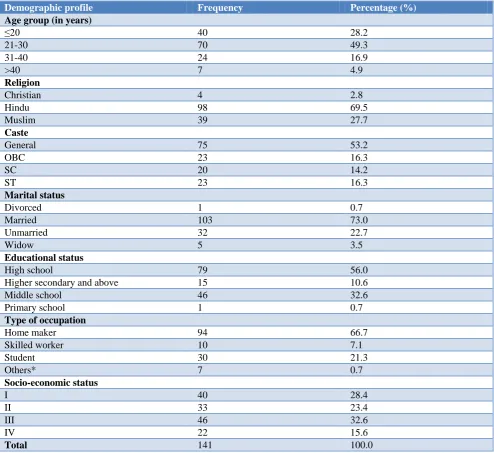
One hundred forty-one females were participated in this study. Majority of the study subjects belonged to 21-30 years of age group (49.3%). Mean age of the study participants was 26.2±7.9 years. Among the participants, majority were Hindu (98%) and belonged to general caste category (75%). 79% of them were high school pass and majority of them were married (73.0%). By occupation majority of them were homemaker (66.7%) followed by students (21.3%). Most of them (32.6%) belonged to SES class III category according to modified BG Prasad scale using AICPI for rural labour as 923 of February 2019 (Table 1).
Questions related to hygiene practices and the responses
within 1.6 km of the house hold area or having stored water). All most all individuals had separate bathroom/toilet facility at home. All most all participants took regular bath during the cycle and among them
24.8% took bath ≥2 times daily. 91.5% of the study subjects performed regular hand washing and 64.5% of the individuals were using both water and soap for this purpose (Table 2).
Table 1: Demographic profile of the study subjects (n=141).
Demographic profile Frequency Percentage (%)
Age group (in years)
≤20 40 28.2
21-30 70 49.3
31-40 24 16.9
>40 7 4.9
Religion
Christian 4 2.8
Hindu 98 69.5
Muslim 39 27.7
Caste
General 75 53.2
OBC 23 16.3
SC 20 14.2
ST 23 16.3
Marital status
Divorced 1 0.7
Married 103 73.0
Unmarried 32 22.7
Widow 5 3.5
Educational status
High school 79 56.0
Higher secondary and above 15 10.6
Middle school 46 32.6
Primary school 1 0.7
Type of occupation
Home maker 94 66.7
Skilled worker 10 7.1
Student 30 21.3
Others* 7 0.7
Socio-economic status
I 40 28.4
II 33 23.4
III 46 32.6
IV 22 15.6
Total 141 100.0
Note: Others* included agricultural, unskilled, professional and business activity.
Table 2: Questions related to hygiene practices and their responses.
N Frequency Percentage (%)
Materials used as an absorbent
Sanitary napkin
141
51 36.2
Cloth 62 44.0
Underwear 3 2.1
Both napkins and cloth 25 17.7
Reuse of the material
No
141 74 52.5
Yes 67 47.5
N Frequency Percentage (%) Drying of cloth/underwear in sunlight if re-used after washing
No
67 2 3.0
Yes 65 97.0
Use antiseptic lotion for cloth/underwear
No
67 57 85.0
Yes 10 15.0
Frequency of changing the material
<2 times/day
141 3 2.1
≥2 times/day 138 97.9
No of material requires/day
<2
141 3 2.1
≥2 138 97.9
Cleaning of private parts (>2times/day)
No
141 10 7.1
Yes 131 92.9
Materials used for cleaning private parts
Both water and soap
131 91 69.5
Water 40 30.5
Separate toilet/bathroom facility at home
No
141 1 .7
Yes 140 99.3
Method of disposal
Burning
141
8 5.6
Deep burial 13 9.2
Dustbin 93 66.0
Open field 10 7.1
Washing 17 12.1
Changing material before sleep
No
141 23 16.3
Yes 118 83.7
Access to water
Yes
141 127 90.1
No 14 9.9
Frequency of bathing during menstruation
Once
141 106 75.2
Twice or more 35 24.8
Regular hand washing
No
141 12 8.5
Yes 129 91.5
Hand washing material
Only water
141 50 35.5
Both water and soap 91 64.5
DISCUSSION
Satisfactory menstrual hygienic practices possess significant impact on womens’ health as highlighted by several studies conducted in different parts of the world.2,14 According to NFHS 4, in India, 42% use sanitary napkins, 62% use cloth, and 16% use locally prepared napkins. Overall, only 58% of women in the age group of 15-24 years used a hygienic method of menstrual protection.15
The present study conducted among 141 women of reproductive age group (15-49 years) with the aim of generating data concerning menstrual hygiene practices among the village women attending the RHTC of Tripura Medical College, Tripura. The findings of the study were discussed and interpreted under following headings.
Practices related to use of absorbent materials
al at Kannur district of Kerala also found the similar finding (72.9% and 52.5% respectively).10
Cost, unavailability of sanitary pads in the villages, privacy, disposal of the materials, lack of knowledge and information, ignorance, superstitious believes, social stigma may be the reason that rural women favour cloth than sanitary pads as an absorbent material.7,16-19
Almost half of the individual in present study reused the same material. Ignorance, obstacle to buy the material from the market and poverty may be the reason behind that. Higher proportion of the study subjects in rural area reused the absorbent material, was also mentioned by Paul et al and Paria et al in their studies (92% and 71.4% respectively).16,17 However, 97% of the individual in the current study, who reused the material, used sunlight for drying purpose after washing the cloth. A study by Prajapati et al supported the present study finding whereas a study by Kamath et al and Patle et al contradicted.8,18,20 Satisfactory practices were observed from present study regarding frequency of changing the material, no of material requires/day and changing of material before sleep. Where most of the studies revealed the same findings, a study by Maji et al reported that only 22% of the study subjects changed their sanitary pads twice in every 24 hours.7,18,21-23 Use of antiseptic lotion for cloth/underwear in present study was almost similar to the study finding of Krishnamurthy et al in rural Kolar among 171 adolescent girls.21 Sixty-six percent of the individuals in our study disposed the absorbent material in dustbin. Most of the studies found indiscriminate disposal, burning, washing and burial, in the toilet pan etc. various methods of disposal.8,16,18,22-24,26
Practices related to personal hygiene
Majority of the study subjects (92.9%) in present study cleaned their private parts >2times/day at the time of menstruation and 69.2% of them used both soap and water for cleaning purpose. A rural-urban comparative study by Thakre et al in Nagpur revealed that satisfactory cleaning practices was noted among 20.5% of the rural women only.24 56.1% of the study subjects cleaned external genitalia with soap and water in the same study. Comparatively better findings were observed from the study by Rana et al at Kheda District of Gujarat.22 Three fourth of the individual in present study bath once during menstruation. Similar finding was also revealed by Das et al.7 72.2% of the participants in study by Krishnamurthy et al took daily bath whereas according to Maji et al, the figure of daily bath was only 10%.21,23 Current study also revealed that majority of the participants did regular hand washing and 64.5% of them used both soap and water for washing purpose. A study by Borkar et al showed that for cleaning purpose, 97.5% girls used both soap and water.10 In contrast, less number of individuals performing satisfactory hand washing practices in study by Maji et al.23 Separate toilet/bathroom facility at home as well as easy access to water in our studied area may be the
reason for these healthier outcomes. According to Yasmin et al, continuous supply of water and presence of exclusive toilet in the family had significant relationship with the hygienic practices followed.25
Menstrual phenomenon is still now considered as a sensitive issue in Indian society, surrounded by wide range of restrictions, taboos, superstitious beliefs and thoughts.7,17,21,27-29 Age, socio-economic status, literacy status of the individual as well as parents, occupation of the mother, socio-economic status etc. were some of the identified determinants and above all attitude which influenced hygiene practices during menstrual period.7,8,30-34 Sources of information may also play a significant role. The findings generated from present study could possibly be explained by better educational status among the study population, improved health care seeking behaviour as well as health care delivery system and social desirability bias means survey respondents provide answers to the questions in a way that will be noticed favourably by others. Thus there may be several reasons that studies so far conducted in different geographical regions, depicting different pictures of the problem.
However, small sample size, no proper sampling technique method, puts a barrier to the generalizability of the current study findings. Despite of these limitations, the study provided hints about the on- going scenario of the state and welcoming further research.
CONCLUSION
Overall proportion of the individuals having satisfactory menstrual hygiene practices was high among the study populations. Major absorbent material was found as cloth followed by sanitary napkin. The study recommends future large scale analytical study for definite conclusion. More stressed should be given to qualitative research regarding choice and use of absorbent materials and also to find out the unknown precipitating factors which can act either in favour or disfavour of practicing satisfactory menstrual hygiene.
Funding: No funding sources Conflict of interest: None declared
Ethical approval: The study was approved by the Institutional Ethics Committee
REFERENCES
1. Hawkins SM, Matzuk MM. The menstrual cycle: basic biology. Ann N Y Acad Sci. 2008;1135:10-8. 2. Sumpter C, Torondel B. A Systematic Review of the
Health and Social Effects of Menstrual Hygiene Management. PLoS ONE. 2013:8(4):e62004. 3. Sharma K. Age at menarche in northwest Indian
4. Walker AR, Walker BF, Ncongwane J, Tshabalala EN. Age of menopause in black women in South Africa. Br J Obstet Gynaecol. 1984;91:797–801. 5. Dasgupta A, Sarkar M. Menstrual Hygiene: how
hygienic is the adolescent girl? Ind J Comm Med. 2008;33(2):77-81.
6. Singh A. Place of menstruation in the reproductive life of women in rural north India. 2006;31(1):10-14.
7. Das A, Dasgupta A, Biswas R, Ray D, Ghosal A, Sarkar T. Knowledge and practices regarding menstrual management among women in a remote village of Eastern India. Int J Biol Med Res. 2014;5(3):4190-6.
8. Patle RA, Kubde SS. Comparative study on menstrual hygiene in rural and urban adolescent. Int J Med Sci Public Health. 2014;3:129-32.
9. Garg R, Goyal S, Gupta S. India Moves Towards Menstrual Hygiene: Subsidized Sanitary Napkins for Rural Adolescent Girls—Issues and Challenges. Matern Child Health J. 2012;16:767–74.
10. Borker S, Samal IR, Bhat S. Study on Knowledge Attitudes and Practices Regarding menstrual Hygiene among Rural Women in Kerala. Global J Med Res. 2014;14(3):29-33.
11. Rathore M, Vyas L, Bhardwaj AK. Prevalence of reproductive tract infections amongst ever married women and socio cultural factors associated with it. J Indian Med Assoc. 2007;105:71-2,4,8.
12. The health impact of menstrual hygiene management on women of reproductive health and its implications for schoolgirls. WASH in Schools Empowers Girls’ Education. Available from https://www.unicef.org/wash/schools/files/MHM_v Conf_2014.pdf. Last Assessed on 28th March 2019. 13. Economic review of Tripura 2010–11. Directorate of Economics and Statistics, Planning (Statistics) Department, Government of Tripura. pp. 254– 5. Available on http://www.destripura.nic.in/review 2010_11.pdf. Last Assessed on 28th March 2019. 14. Das P, Baker KK, Dutta A, Swain T, Sahoo S, Das
BS, et al. Menstrual Hygiene Practices, WASH Access and the Risk of Urogenital Infection in Women from Odisha, India. PLoS One. 2015;10(6):e0130777.
15. National Family Health Survey (NFHS-4)2015-16. Available from http://rchiips.org/nfhs/NFHS-4Reports/India.pdf. Last assessed on 23rd May 2019.
16. Paul V, Singh P. A study on menstrual hygiene practice among rural women aged between 18-25 years in Jasra and Chaka block of Allahabad district. The Allahabad Farmer. 2018:24(1):17-8.
17. Paria B, Bhattacharyya A, Das S. A comparative study on menstrual hygiene among urban and rural adolescent girls of west bengal. J Family Med Prim Care. 2014;3(4):413–7.
18. Prajapati D, Shah J, Kedia G. Menstrual Hygiene: Knowledge and Practice among Adolescent Girls of
Rural Kheda District. Ntl J of Community Med. 2015;6(3):349-53.
19. Kansal S, Singh S, Kumar A. Menstrual Hygiene Practices in Context of Schooling: A Community Study Among Rural Adolescent Girls in Varanasi. Indian J Community Med. 2016;41(1):39–44. 20. Kamath R, Ghosh D, Lena A, Chandrasekaran V. A
study on knowledge and practices regarding menstrual hygiene among rural and urban adolescent girls in Udupi Taluk, Manipal, India. GJMEDPH. 2013;2(4):1-9.
21. Krishnamurthy L, Ranganath BG, Shruthi MN, Venkatesha M. Menstrual Hygiene Practices and Knowledge among High School Girls of Rural Kolar. Ntl J Community Med. 2016;7(9):754-8. 22. Rana B, Prajapati A, Sonaliya KN, Shah V, Patel M,
Solanki A. An Assessment of Menstrual Hygiene Practices amongst Adolescent Females at Kheda District of Gujarat State, India. Healthline Journal. 2015;6(1):23-9.
23. Maji S. A study on menstrual knowledge and practices among rural adolescent girls in Burdwan district, West Bengal. Int J Adv Res. 2016;4(9):896-902.
24. Thakre SB, Thakre SS, Ughade S, Thakre AD. Urban-Rural Differences in Menstrual Problems and Practices of Girl Students in Nagpur, India. Indian Paediatr. 2012;49:733-6.
25. Yasmin S, Manna N, Mallik S, Ahmed A, Paria B. Menstrual hygiene among adolescent school students: An in depth cross-sectional study in an urban community of West Bengal, India. IOSR-JDMS. 2013;5(6):22-6.
26. Gultie TK. Practice of Menstrual Hygiene and Associated Factors among Female Mehalmeda High School Students in Amhara Regional State, Ethiopia. Sci J Pub Health. 2014;2(3):189-95. 27. Sultan S, Sahu DS. Knowledge, attitude and
practices about menstruation and related problems in adolescent girls. Int J Reprod Contracept Obstet Gynecol. 2017;6:5235-40.
28. Chauhan P, Shaik RA, Anusha DVB, Sotala M. A study to assess knowledge, attitude and practices related to menstrual cycle and management of menstrual hygiene among school going adolescent girls in a rural area of South India. Int J Med Sci Public Health. 2019;8(2):114-9.
29. Hakim A, Shaheen R, Manisha Tak H. A cross sectional study on the knowledge, attitudes and practices towards menstrual cycle and its problems: a comparative study of government and non-government adolescent school girls. Int J Community Med Public Health. 2017;4:973-81. 30. Choudhary N, Gupta MK. A comparative study of
perception and practices regarding menstrual hygiene among adolescent girls in urban and rural areas of Jodhpur district, Rajasthan. J Family Med Prim Care. 2019;8:875-80.
India: a cross sectional study. IJCRIMPH. 2010;2(12):411-423.
32. Anchebi HT, Shiferaw BZ, Fite RO, Abeya SG. Practice of Menstrual Hygiene and Associated Factors among Female High School Students in Adama Town. J Women's Health Care. 2017;6(3):2-8.
33. Fehintola FO, Fehintola AO, Idowu A, Aremu AO, Ogunlaja OA, Ogunlaja IP. Assessment of knowledge, attitude and practice about menstruation and menstrual hygiene among secondary high school girls in Ogbomoso, Oyo state, Nigeria. Int J Reprod Contracept Obstet Gynecol. 2017;6:1726-32.
34. Sarkar I, Dobe M, Dasgupta A, Basu R, Shahbabu B. Determinants of menstrual hygiene among school going adolescent girls in a rural area of West Bengal. J Family Med Prim Care. 2017;6:583-8.