Original Research Article
Development of diabetes register in low-mid income country: survey of
healthcare professionals’ behavioural change wheel
Eunice O. Igumbor
1, Otovwe Agofure
1, Echinei J. Oshionwu
2,
Phillip T. Bwititi
3, Ezekiel U. Nwose
4*
INTRODUCTION
There has been an ongoing medical research and service development on diabetes care in Ndokwa community of Delta State, Nigeria; and one of the agenda is to develop diabetes register in the health facilities.1 Participation in community health services has challenges, for instance,
apart from age, gender, and geographical location are factors to consider in the targeted community while knowledge, attitude and practice (KAP) of the healthcare providers are also considerations. The KAP translates to their behavioural change wheel (BCW), i.e., capacity, motivation and opportunity to perform the expected duties.2,3
ABSTRACT
Background: There has been and ongoing research and development on diabetes care in Ndokwa community of
Nigeria, and one of the items to be addressed is development of diabetes register in some of the health facilities. This study assesses the behavioural change wheel of the healthcare professionals to address the willingness of the primary healthcare providers willing to scale up and sustain the diabetes register; and how glycaemic control and metabolic syndrome factors in diabetes patients were assessed.
Methods: The study adopted clinical observational approach and survey questionnaires. A descriptive cross sectional
method evaluated how glycaemic control among diabetes patients (n=42) was assessed. Clinical observations were at Catholic Hospital Abbi, while the survey of healthcare professionals (n=71) included health facilities in other communities. Data from questionnaire and test results was analysed using Microsoft Excel Data Analysis Toolpak 2010.
Results: It is observed that 62% wished they had a diabetes register. Over 50% of the patients showed presence of >2
metabolic syndrome indices. Further, ≈52% disagreed that diet, exercise, medication, quitting smoking and less stress contributed to effective control and management of diabetes.
Conclusions: Most of the respondents thought that their practice did not have a special interest in diabetes. There is
prevalence of metabolic syndrome, but the majority of healthcare professionals did not view lifestyle as effective to control diabetes. These observations highlight the need for diabetic education on healthcare professionals and patients.
Keywords: Diabetes register, Healthcare professionals, Perceptions
1
Public and Community Health department, Novena University, Kwale, Nigeria 2California Department of State Hospital, Stockton, CA, USA
3School of Biomedical Sciences, 4School of Community Health, Charles Sturt University, NSW Australia
Received: 15 October 2019
Revised: 28 November 2019
Accepted: 02 December 2019
*Correspondence: Dr. Ezekiel U. Nwose, E-mail: [email protected]
Copyright: © the author(s), publisher and licensee Medip Academy. This is an open-access article distributed under
the terms of the Creative Commons Attribution Non-Commercial License, which permits unrestricted non-commercial use, distribution, and reproduction in any medium, provided the original work is properly cited.
The problem and rationale
Given the agenda to start diabetes clinic and register at the Catholic hospital Abbi, one of the problems is that specific challenges in terms of BCW i.e., KAP are unknown. Therefore, the rationale of study proposal is to evaluate the challenges of both community participation and the healthcare professionals. For instance, previous review identified that “the task to reduce diabetes risk and improve self-management will benefit from establishment of more diabetes clinics, networks and registers in all health facilities”.4
Survey of public health academics and students has been done for type 1 diabetes, but not with regards to diabetes registry or on stakeholders in healthcare delivery.5 Hence, it needs to be investigated how and/or whether KAP of the various stakeholders (i.e., individuals living with diabetes, the healthcare professional, and hospital management) will be amenable with accept as well as operate the register.
Objectives
The aim of this part of the study series is to assess the BCW of the healthcare professionals at the health facilities. Specifically, two research objectives are to investigate the following questions: (1) given the absence of diabetes register, to what extent are the primary healthcare providers are willing to scale up and sustain diabetes register? and (2) how is glycaemic control among diabetes patients assessed; and what is the prevalence of common metabolic syndrome factors?
METHODS
Study design
The study adopted clinical observational approach, as well as questionnaire survey. The survey employed two standard validated questionnaires; including one for health literacy (Figure 1).6,7 The descriptive cross sectional method was also employed to evaluate how glycaemic control among diabetes patients was assessed and on the prevalence of common metabolic syndrome factors.
Study setting
Clinical observations were at Catholic Hospital Abbi, Ndokwa local government area of Delta State while the survey of healthcare professionals was carried out at the Catholic Hospital and in health facilities in the neighbouring rural and suburban communities in Ndokwa West and Ukwani local government areas. Delta state comprises 25 local governments including Ndokwa West and Ukwani local government areas.
Selection criteria
Survey was strictly healthcare professionals working in the health facilities. Cross sectional study included patients records collected during the monthly diabetes clinics.
Sample size
Based on estimation that one hundred and fifty (150) healthcare professionals were involved in „diabetes care‟ work at outpatient departments of Catholic Hospital Abbi (CHA), General Hospital Obiaruku (GHO), and Novena University Health Centre (NUHC). In Catholic Hospital Abbi out of 12 comprising, physician 2, nurses 5 and other healthcare providers (HCP) 5. In GHO out of 75 comprising, physician 5, nurses 20 and other HCP 50. In NUHC out of 63 comprising, physician 1, nurses 2 and other HCP 63. Equal number and same proportions as in GHO was initial estimated for Central Hospital Kwale, but request for ethical clearance was referred to the State headquarters. NUHC was the substituted. The sample size calculation was determined to be minimum of thirty-nine (n≥39), assuming 5% margin of error, 90% confidence level and 95% response rate from purposive sampling technique.8
Data collection
Clinical observation for this study was based on free monthly diabetes clinic program during September 2017 to March 2018 including the planning. For this report, data were collected between October 2017 to January 2018. The monthly diabetes clinic was set to establish diabetes mellitus and heart disease registers in the study location. The data collected included percentage of attendance, percentage of DM diagnosis by audit of diabetes register, checklist of services available or unavailable, notes from DM clinic where n≥39 primary healthcare professionals (PHP) survey, health literacy survey and perspectives of PHP.
Statistical analysis
Data generated from questionnaire and test results was analysed using Microsoft Excel Data Analysis Toolpak 2010.
RESULTS
Research question 1: given the absence of register, how are the primary healthcare providers able or willing to scale up and sustain diabetes register?
Monthly diabetes clinic and development of register
In this audit, focus on was on completeness of data that enables known DM patients to be followed-up and/or recalled. Diabetes register had 42 entries and among these, only 29 were diagnosed during the monthly diabetes clinic. Further, among the 42 entries (including the 13 cases without date of diagnosis), 15 had information regarding addresses, marital status, occupation and religion (Table 1). None (zero) had
information on next-of-kin, medications and other illness; as well as smoking status.
Table 1: Frequency of missing data in newly developed diabetes register (n=42).
N (%) Missing data
(%)
Address 14 (33.33) 66.67
Demographics 14 (33.33) 66.67
Phone number 19 (45.24) 54.76
Carer 6 (14.29) 85.71
Medical history 0 100.00
Next-of-kin address 0 100.00
Medical record # 0 100.00
Clinical observations in context of survey at CHA involved analysis on perspectives of health professional on interest, running and sustaining the diabetes clinic and register that was established and Table 2 shows that: (i) the number of respondents who described their health facilities as having a special interest in diabetes (20%) was less than those who indicated to have register of patients with diabetes in their practice (35%), (ii) those who indicated to have dedicated time for diabetes-only clinics in the hospital (20%) was less than those who indicated to have dedicated diabetes specialist staff/team (30%), (iii) those who indicated to have record of patients with diabetes in the practice (35%) was more than those who indicated that the record was used to re-call diabetes patients (29%) and (iv) one hundred and twenty four DM indicated in the hospital records, and >50 of the patients did not attend routine check-up appointments; with a median 22-patients‟ attendance per clinic (Table 2).
Analysis of the affirmative responses to determine the level of understanding of the concept of diabetes clinic and register
First, the HCP thought the activity was all about research rather than development. Thus, data entry was left for the team members from the university. 80% of respondents could not describe their practice as having a special interest in diabetes and 62% wished they had a diabetes register (Figure 2).
Survey of diabetes care
Table 2: Descriptive statistics of ‘affirmative’ responses at CHA (n=20).
Question N %
Would you describe your practice as having a special interest in diabetes? 4 20
Do you have an active register of patients with diabetes in your practice? 7 35
If yes that there is register: Is it used for call/recall of your diabetes patients? 7 35
If there is no register: If no, do you wish to have a diabetes register? 13 65
Do you have dedicated time for diabetes-only clinics in the hospital? 4 20
If yes: Do you have dedicated Diabetes specialist staff/team? 6 30
GP and nurse 18 90
Nurse alone 0 0
GP alone 1 5
Do you have specialist endocrinologist to refer diabetes patients? 6 30
If there is no diabetes clinic: do you wish to start running a diabetes clinic? 16 80
Mean SD
What is the total number of people with diabetes in your hospital? 124 19.9
What % patients are attending most or all of their routine check-ups? 48 7.5
Median number of patients seen per clinic 23 4.9
N=number of affirmative responses; %=Percentage of total respondents.
Figure 2: Percentage of affirmative respondents to service questions.
Keys: Percentage of those who indicated, Q4b: not having special interest in diabetes; Q8b: indicated to lack active DM register; Q9b: using the diabetes register; as a proportion of those who indicated to have active register; Q10: desire for diabetes register; as a proportion of those who indicated to lack diabetes register; Q11b: having diabetes-only clinic; as a proportion of those who indicated having special interest.
Research question 2: how is glycaemic control among diabetes patients assessed; and what is the prevalence of common metabolic syndrome factors?
Table 4 shows that laboratory methods for diagnosis of diabetes and monitoring of glycaemic control are by fasting or random blood glucose test and glycated haemoglobin (HbA1c) method was not unavailable. Descriptive statistics shows that 54.8% of the diabetes subpopulation was male and 45.2% females. Among the population living with diabetes, 85.7% had type 2
diabetes mellitus. Further, the sum of abnormal levels of BMI and lipid profile indices was 150%, indicating that about half of those tested had more than two abnormalities. This implies that fasting or random blood sugar test was most used test for diagnosis of diabetes and monitoring of glycaemic control by health practitioners in Ndokwa communities
What is the prevalence of each metabolic syndrome component among diabetes patients at the time of entry into diabetes register?
Evaluation of those with results of metabolic syndrome factors indicated that 8/42 (≈21.4%) patients had at least two of the three abnormalities. Another 50% had abnormal levels of BMI, HDL cholesterol or total cholesterol indicative of high level of metabolic syndrome component in diabetes patients (Figure 4).
What is the role of lifestyle change to effective management and control of diabetes?
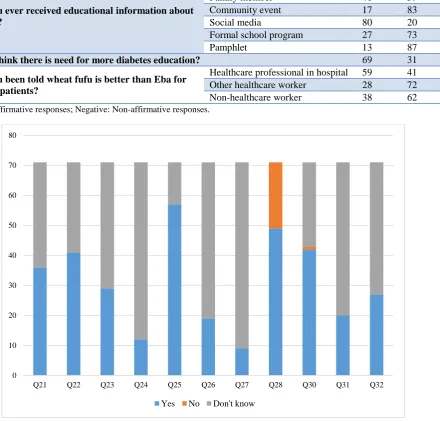
Health literacy survey of diabetes care: focused on health literacy in general practice in the hospital to determine level knowledge in regarding diabetes control with lifestyle measures. Descriptive statistics of responses to the 5-item questions under the theme „Does the following help to manage diabetes?‟ The results shows that cumulative 186/355 (≈52%) responses disagreed with the notion that diet, exercise, medication, quitting smoking or less stress contribute to effective control and management of diabetes. 53/355 (≈15%) were unsure; while 116 (32.7%) agreed that the stated lifestyle factors had the potentials to aid diabetes management and among the cumulative 116 responses in agreement, 43, 41, and 24 agreed on diet, exercise and medication respectively. Only seven and one agreed on smoking and stress factors, respectively.
0% 10% 20% 30% 40% 50% 60% 70% 80% 90%
Q4b Q8b Q9b Q10 Q11b
Table 3: Percentage distribution of respondents’ in the responses to diabetes education.
Question Mechanism Positive Negative
Have you ever received educational information about diabetes?
Healthcare worker 58 42
Family member 41 59
Community event 17 83
Social media 80 20
Formal school program 27 73
Pamphlet 13 87
Do you think there is need for more diabetes education? 69 31
Have you been told wheat fufu is better than Eba for diabetes patients?
Healthcare professional in hospital 59 41 Other healthcare worker 28 72 Non-healthcare worker 38 62 Positive: Affirmative responses; Negative: Non-affirmative responses.
Figure 3: Graphical presentation of numbers of various responses to questions.
Keys: Q21–Q32 based on survey questionnaire item numbers 21–32 (Figure 1).
Table 4: Descriptive statistics of patients in the diabetes register (n=42).
Items Number % Total (%)
Gender Females 19 45.24 100
Males 23 54.76
Diabetes status
Type 2 diabetes 36 85.71
100
Type 1 diabetes 4 9.52
Prediabetes 2 4.76
Blood sugar test RBS 19 45.24 100
FBS 23 54.76
Metabolic syndrome factors (n=28)
TC >5.5 mmol/l 16 57.14
150
HDL <1.0 mmol/l 11 39.29
BMI >30.0 kg/m2 15 53.57
0 10 20 30 40 50 60 70 80
Q21 Q22 Q23 Q24 Q25 Q26 Q27 Q28 Q30 Q31 Q32
Figure 4: Percentage levels of abnormal metabolic syndrome factors in the diabetes register.
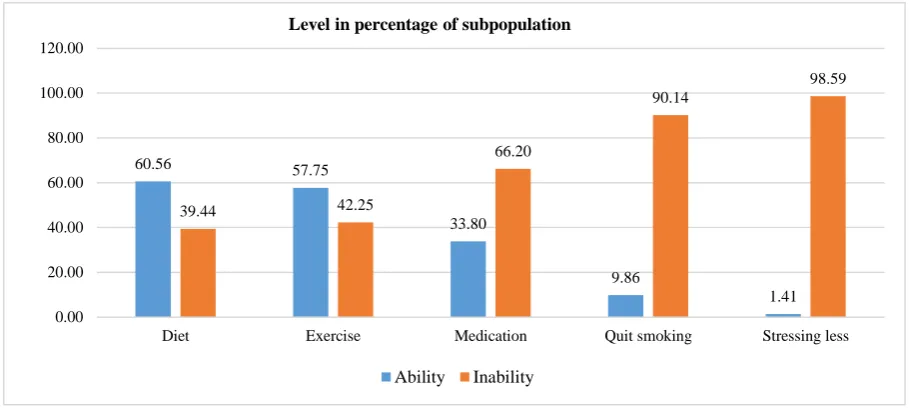
Figure 5: Percentage levels of ability/inability to control diabetes with various measures.
How do health practitioners monitor and control diabetes patients in Ndokwa communities?
Analysis of the affirmative responses to service questions performed to determined perspectives of health practitioners in Ndokwa communities regarding the question shows that 65/70 respondents indicated that Hba1c was being performed (Figure 5). This is a confounding observation. When the levels of knowledge were translated to capacity i.e., ability or inability to control diabetes with the lifestyle measures, result shows that respondents had most awareness or knowledge on diet and least on stress. Such an observation implies that the level of knowledge of the respondents on measures needed to control diabetes is inadequate.
On evaluation of responses to survey question of glycaemic control monitoring, majority of the respondents 65 (≈93%) agreed that both blood sugar level and HbA1c tests were the main means of monitoring glycaemic control and monitoring in diabetes patients. However, on the contrary, 83% disagreed that their practice as having a special interest in diabetes, 89%
responded „no‟ to “blood sugar level (fasting and/or random) test only” and absolutely all (100%) responded „no‟ to regarding the options of both HbA1c test only and other methods.
Figure 6: Response on use of only HbA1c test in monitoring glycaemic control.
4.76
7.14
9.52
19.05
7.14
23.81
0.00 5.00 10.00 15.00 20.00 25.00
BMI, HDL & TC BMI & TC TC & HDL TC, only HDL, only BMI, only % proportion
60.56 57.75
33.80
9.86
1.41
39.44 42.25
66.20
90.14
98.59
0.00 20.00 40.00 60.00 80.00 100.00 120.00
Diet Exercise Medication Quit smoking Stressing less
Level in percentage of subpopulation
Ability Inability
0% 20% 40% 60% 80% 100% 120%
CHA GHO CHK
Figure 6 also shows that 83% disagreed that their practice had a special interest in diabetes, while 89% stressed that blood sugar level (fasting or random) test only cannot be used in controlling and monitoring diabetes. All the respondents disagreed with the use of HbA1c test only. Further evaluation shows that all respondents indicated HbA1c, alone was not used for monitoring. When the responses from the three different health facilities were compared, results indicate relatively the same trend.
DISCUSSION
This BCW study sought to answer to research questions. First is “to what extent are the primary healthcare providers are willing to scale up and sustain diabetes register?” Initially, the hospital managements did not consider the diabetes register as the hospitals‟ asset. It was only viewed as mere academic research exercise. This explains why access (even to discuss ethical permission at the hospital level) was denied at the General Hospital Kwale. At the CHA, where audience was given, responsibility of data entry was left for research team to enter. After a special meeting with the management where it was clarified to be „translational research‟ vis-à-vis development, the staff showed appreciation and enthusiasm i.e., motivation that indicates positive behavioural wheel.
On the basis of monthly DM clinic: incomplete data entry during DM clinic indicates limitation in practice that could be improved with the development of register, which in turn will provide opportunity for practice.9-11 Determination of understanding of the concept of DM register indicate low level of practice, but 62% interest. This is an encouraging observation in terms of BCW i.e. most of the HCP have the motivation; hence needs the opportunity to practice, which can follow established protocols such as in Italy and Sweden.10,12 Survey of diabetes care indicate lack of knowledge and interest in further education. This is concerning as the concept and merits of diabetes are imperative, and needs to be advocated.11,13
Next was “how is glycaemic control among diabetes patients assessed; and what the prevalence of common metabolic syndrome factors is?” On the perspectives of health practitioners regarding the question „How do you monitor diabetes patients for response to their glycaemic control?‟ the result showed that approximately 93% indicated that HbA1c was being performed, although this test was neither available in the laboratory services of the hospital. Given observed lack of the test in laboratory service items, further discussion revealed that all the respondents responded according to their perceptions. Some felt the ongoing use of fasting/rounding blood sugar test suffices, while many are aware of the pitfalls of the HbA1c method. Perhaps, it is pertinent to emphasize that HbA1c result may be influenced by factors such as age, medication or test method; but still useful for monitoring diabetes control.14 Nevertheless, fasting and
post-prandial blood sugar tests have considerable correlations with HbA1c in predicting glycaemic control.15 Hence self-monitored blood sugar level diary is still a valid option with its own limitations.16
Based on clinical observational note from diabetes register at CHA, analysis focused on evaluation of prevalence of laboratory methods of diabetes diagnosis and monitoring of glucose control. Another focus was on obesity and dyslipidaemia in diabetes patients in the register as well as metabolic syndrome. In this study, obesity was defined by body mass index, while metabolic syndrome was concluded where there was an abnormality of any two parameters (BMI, HDL and total cholesterol) in addition to diabetes. Results presented in Table 4 implies that fasting or random blood sugar test was most used test for diagnosis of diabetes and monitoring of glycaemic control by health practitioners in Ndokwa communities. This is in agreement with previous report on assessment of GDM screening.17 On prevalence, results in Figure 4 show that up to 50% of the respondents have abnormal levels of BMI, HDL cholesterol or total cholesterol indicative of high level of metabolic syndrome component. This is in line with previous reports from this community.1,4
CONCLUSION
The current study observed that most of the respondents thought that their practice did not have a special interest in diabetes and most lacked of knowledge if HbA1c, an important measurement in diabetes management was carried out in their practice. It is worrying to note that the majority of healthcare professionals did not view diet, exercise, medication, quitting smoking as effective to control and manage. The observation that more than half of participating patients‟ data showed more than two abnormalities for metabolic syndrome indicates perhaps high prevalence of this disorder in the studied population. This study highlights the need for diabetic education on healthcare professionals and patients.
ACKNOWLEDGEMENTS
This is part of the project “Development of diabetes registers in low-mid income country”, which was done under the aegis of ethical approval granted to Global Medical Research and Development Organization (GMRDO) in collaboration with Public and Community Health Department, Novena University. Favour Jato, Mercy Ugorji, Sonia Ibem and Valentine Ejiofor participated in this work as part of their academic research works. The supports of staff at the Laboratory and Medical Records departments as well as management of Catholic hospital Abbi are highly appreciated.
Funding: No funding sources Conflict of interest: None declared
REFERENCES
1. Nwose EU, Richards RS, Bwititi PT, Igumbor EO, Oshionwu EJ, Okolie K, et al. Prediabetes and cardiovascular complications study (PACCS): international collaboration 4 years' summary and future direction. BMC Res Notes. 2017;10:730. 2. Johnston M. Using behaviour change theory and
techniques in implementation research. In: The 4th Biennial Society for Implementation Research Collaboration conference Seattle. 2017; SIRC 2017. 3. Dixon D, Johnston M. Health behaviour change
competency framework. Available at: www.Health scotland.com/documents/4877.aspx. Accessed on 26 November 2018.
4. Otovwe A, Oyewole OE, Igumbor EO, Nwose EU. Diabetes care in delta state of Nigeria: An expository review. Diabetes Updates. 2018;1:1-8. 5. Nwose EU, Digban KA, Anyasodor AE, Bwititi PT,
Richards RS, Igumbor EO. Development of public health program for type 1 diabetes in a university community: preliminary evaluation of behavioural change wheel. Acta Biomed. 2017;88:281-8. 6. Kenny CJ, Pierce M, McGerty S. A survey of
diabetes care in general practice in Northern Ireland. Ulster Med J. 2002;71:10-16.
7. Pierce M, Agarwal G, Ridout D. A survey of diabetes care in general practice in England and Wales. Br J Gen Pract. 2000;50:542-5.
8. Raosoft Inc. Sample size calculator. Available at: http://www.raosoft.com/samplesize.html. Accessed on 6 June 2016.
9. Cook JA. Using a diabetes register to improve care and outcomes. Collaborative support Programs of New Jersey Wellness Symposium: Diabetes preventtion and wellness self-management. Edison, NJ; 2012.
10. Svedbo Engström M, Leksell J, Johansson U-B, Gudbjörnsdottir S. What is important for you? A qualitative interview study of living with diabetes and experiences of diabetes care to establish a basis for a tailored Patient-Reported Outcome Measure
for the Swedish National Diabetes Register. BMJ Open. 2016;6:e010249.
11. O'Mullane M, McHugh S, Bradley CP. Informing the development of a national diabetes register in Ireland: a literature review of the impact of patient registration on diabetes care. Inform Prim Care. 2010;18:157-68.
12. Ballotari P, Chiatamone Ranieri S, Vicentini M, Caroli S, Gardini A, Rodolfi R, et al. Building a population-based diabetes register: an Italian experience. Diabetes Res Clin Pract. 2014;103:79-87.
13. Health Service Executive. Setting up a diabetes register using GP practice management system, Available at: https://www.hse.ie/eng/health/hl/ living/diabetes/Diabetesregister.html. Accessed on 20 February 2019.
14. Malka R, Nathan DM, Higgins JM. Mechanistic modeling of hemoglobin glycation and red blood cell kinetics enables personalized diabetes monitoring. Sci Translational Med. 2016;8:359ra130.
15. Ketema EB, Kibret KT. Correlation of fasting and postprandial plasma glucose with HbA1c in assessing glycemic control; systematic review and meta-analysis. Arch Public Health. 2015;73:43. 16. Evans M. Current methods of assessing blood
glucose control in diabetes. Br J Diabetes. 2016;16:S7-9.
17. Orru MI, Nwose EU, Bwititi PT, Igumbor EO. Screening for gestational diabetes: evaluation of prevalence in age-stratified subgroups at Central hospital Warri Nigeria. Int J Reprod Contracept Obstet Gynecol. 2018;7:63-8.
Cite this article as: Igumbor EO, Agofure O,