An Innovative Lightweight Framework for Effective
RM for Small and Medium Sized Software
Development Centers in Oman
Asma Al Balushi
Msc. Student, Dept.of Computing Al Rusayl, Muscat, Oman
Middle East College
Santhosh John
Senior Lecturer, Dept. of Post Graduate Studies Al Rusayl, Muscat, Oman
Middle East College
ABSTRACT
With the accelerated growth of the software development industry in the world, more complex and sophisticated systems are developed. Requirements Management is one of the essential and challenging tasks when developing software application Poor requirements management practices are one the factors that lead to over budget, delayed, and failure of software projects. The small and medium sized software development organizations and departments in Oman are facing challenges in requirement management. Defining,
categorizing, reviewing, documenting and changing
requirement are the main activities of requirement management that are unfortunately not well practiced/tackled in the mentioned domain. The aim of this paper is to investigate the requirement management challenges, practices, and tools that Omani software houses facing through conducting professional interviews and questionnaire with requirement engineers and programmers. The findings showed inadequate requirements management practices are used and the utilization of tools is omitted. Subsequently, a solution is provided in the form of a framework that will assist in overcoming the current issues; by incorporating the three crucial components of requirements management practices: requirements traceability, team collaboration and quality metrics for requirements specifications. This will be followed by a prototype tool to be evaluated in the future in these organizations.
Keywords
Requirements Management, Requirements Management
Tools, Requirements Traceability, Requirements
Collaboration.
1.
INTRODUCTION
Understanding users’ requirements and meeting their expectations in the initial stages of the software development projects is very essential as it is one the success factors of a quality and successful software. Studies show that the requirements that are defined poorly led to software failure. To prove this, it has been reported by the Information Architecture Group IAG Consulting in its report of "The Impact of Business Requirements on the Success of Technology Projects”: “68% of companies are more likely to have a marginal project or outright failure than a success due to the way they approach business analysis. In fact, 50% of these groups’ projects were runaway which had any 2 of: taking over 180% of target time to deliver; consuming in excess of 160% of estimated budget; or delivering under 70% of the target required functionality.” [1]. Inaccuracy in requirements analysis has a considerable and propagation
influence on system deliverables that ultimately increases the final cost and cause delays[2]. Thus, well-defined requirements are considered to be one of the critical factors of the overall success of a software product [3]. As Saavedra, Ballejos and Ale pointed out: The key measurement for a successful software application is the degree in which it meets the predictable intends that it developed for [4]. Excellent requirements should be characterized by parameters such as: consistency, correctness, traceability and verifiability. The process in which the requirements are obtained, analyzed, specified and validated with users and customers is called “Requirement Engineering” (RE). In addition, the process makes out system constraints, boundaries and limitations in which the software will be developed and implemented. It follows an iteration and collaborative approach that works in issue analysis and results documentation in various iteration increments [5]. RE is the area of software engineering where the initial stages in the software development process are executed by eliciting, understanding users’ needs and defining them in functional and non functional set of requirements that should be fulfilled. Besides, the determinations of relationships among these artifacts and to their progression across time [6]. As Zave mentioned that: RE consists of several fundamental activities: requirements elicitation,
requirements modeling/specification, requirements,
prioritization/negotiation, requirements validation and
requirements management [7]. In particular, Requirements Management (RM) is the process of obtaining, documenting and managing changes inrequirements and outlining them in a traceable manner in specific quality-featured requirements documents [8]. The aim of practicing the requirements management process is to retain and manage an understanding that is to be up to date, approved, and well documented of the related stakeholders concerned, proposed software application functionalities, dedicated resources, restrictions, technological requirements that were obtained and maintained as baselines for requirements documents.
2.
BACKGROUND AND LITERATURE
REVIEW
The challenges that the system analysts face in managing requirements can be classified as the following:
Requirements definition: Difficulty in merging changes in requirements from different team members manually for the purpose of documentation. Manual reusing of requirements is time consuming and requires extensive effort from the analysts. Moreover, it is hard to keep record of each requirement attributes. Analysts find it hard to manually keep record of the rejected and deleted requirements on baselines.
Documentations and baselines: There is a challenge in keeping documents synchronized and current. Requirements documents review process is difficult and timey due the continuous comparison required between different baselines.
Tracing requirements’ changes: Tracking the status of the requirements is a tedious task. Defining and tracing the links between functional requirements and other system elements is complicated.Analyzing the impact ofany change is unknown and problematic.
Team work and collaboration: Difficult to communicate with team members and stakeholders about certain requirements with spending time and effort in explaining, writing and distributinge-mails and memos. Modification of requirements manually is harder when working with multiple project participants since it should be disseminated all over the team members.In fact, a complete RM process needs to be incorporated with three fundamental practices: requirements traceability, stakeholders’ and project team collaboration, and evaluation of requirements’ quality metrics. Requirements traceability are tasks concerned with all the changes occur in the base requirements and their relationships and impact on the dependent requirements and other software artifacts such as analysis , designs , models, use cases ,source code generated ,test cases , or test results [9]. Accordingly, managing traceability requires complete team support and collaboration in transparent and visible means where changes allowed, issues and requests raised; associated stakeholders are identified and notified about the changes and the respective actions to be taken [10]. Equally important, to ensure that the requirements are fully measured during this stage: evaluating requirements based on quality metrics for the requirements specification should be considered. Hence, incorporating all these practices under one centralized software tool minimize the failure occurrence of the software product and make RM process more reliable and faster [8]. Literature shows numerous benefits of existing RM tools in the market. Moreover, it recommends software development organizations to adopt the usage of these tools in order to develop successful products. However, some of these tools are complicated that they are suitable for complex and sophisticated software applications with thousands of requirements. On the other hand, the remaining RM tools merely cover the needs of the smaller size software organizations. Despite the fact that the basic functionalities of the RM processes are incorporated in the mentioned tools, however, features such as adequate traceability, sufficient team collaboration and quality metrics for the requirements specifications documents are not fully utilized.
Due to the accelerated growth in software applications industry in Oman, system analysts should be capable of coping with this advance by managing their software requirements successfully. The absence of RM good practices
and tools led to continuous software projects delays, over budgeting and failure. The work on requirements is done on isolated tools with insufficient requirements traceability, lack of project team and stakeholders’ collaboration and suitable evaluation of quality of these requirements specifications. Requirement management tools has been proven to be a key alternative for managing the complexity of requirements tasks by providing useful and flexible environment to the system analysts and requirements engineers. [11]. Matt Light stated, the Research Director of Gartner: “Requirements management can be simplified if initial requirements definitions are captured in a database-based tool to enable collaborative review… traceability and versioning/change control” [12].
There are diverse RM tools reviewed in the literature and on the empirical testing on software consulting websites and white papers beside the existed commercial registered and trial versions [13]. According to (Gea et al.) on their evaluation of RE tools, there is no single comprehensive tool that pertain to all the RM features required, some of these tools are sophisticated tool with high price ranges like Cradle , inteGREAT, GMARC, Rational Doors etc. Other tools vary in supporting certain areas of requirements engineering processes depending on the users’ need such as Caliber RM, Avenqo PEP, that cover elicitation area; Polarion Requirements and Psoda cover the analysis area. Therefore, careful evaluation is required in order to judge fairly on fitness of the tool for the organization [14]. Hence, Software development organizations have to justify the selection of any of such tool. Besides, the requirement specifications quality measurements are either should be run by interfacing with other separate modules such as Quality Center in HP and Requirements Quality Analyzer for IBM or not fully covered in all the tools [15].Figure 1 shows the results of RM tool
evaluation comparison based on coverage of RE
functionalities [14].
Thus, there is a need for a new framework supported by a tool that suit the expectations of the software practitioners in the region which emphasis on simplicity of use, requirements
definition, traceability, and team collaboration and
specification quality assurance.
Figure 1: RM tool evaluation comparison based on coverage of RE functionalities [14]
3.
METHODS
3.1
The research process
A good literature review was conducted on RM and RM tools to build a comprehensive base in the subject and to explore the gaps and limitations in the field. Two research methods were chosen in order to investigate the challenges that small and medium sized software development organizations faces in Oman. Besides, the RM practices followed and the automated tools used. The methods are: professional interviews and questionnaires. The selection of the methods was based on the principle of extracting data from the former method that are used consequently as input for the latter ones.
3.1.1
. Professional Interviews:
The purpose of selecting this method is to get insights of the issues and challenges in requirements management activities in Oman. The recent RM practices, quality models followed and automated tools used in managing the requirements of software developed. Professional interviews were conducted with 18 of system analysts and senior programmers in software developments organizations and departments both in public and private sectors. Face-to-face and e-mail based semi structured interviews were conducted based on the availability of the interviewees.
3.1.2
Questionnaire:
The purpose of designing a questionnaire for this research is to list and evaluate the features that were extracted from the interviews based on interviewees needs to be available in RM tools. This prioritized list will be used later on designing a proper tool that fulfills their needs as RM tool. The targeted audiences were asked to prioritize the importance of the diverse features to be in RM tools. All of 16 features listed in the questionnaire were identified from the interviews beside two questions about the sector of the respondents and the number of working experience years. The online link of the questionnaire was sent to 40 respondents of system analysts and programmers working in software organizations from both public and private sector. Only 33 respondents answered back the questionnaire.
4.
RESULTS AND DISCUSSION
The key analysis examined the outcomes of the interviews one by one where these outcomes are categorized based on people, processes, and technology:
Processes: The majority of the interviewees clearly indicated that the practices followed for formal and informal RM processes are being in line with the organizations’ procedures without knowing whether they are following any international standard due to the unawareness of such standards. Others, especially the private sector organizations, follow or intending to practice the known international standards of International Organization for Standardization (ISO), the Capability Maturity Model (CMM) or the typical Project Management Professional (PMP) practices. However, the level of their targeted involvement is at very starting level. In addition, the common understanding of proper requirements management mainly is toward the whole software development Life cycle (SDLC) practices rather than to requirements management processes in specific.
Technology: As stated by in the interviewees, there are no RM tools implemented in the software development organizations. They use simple excel, or word files that are shared among the teams and other stakeholders, some extend to project management tools. Few, reached to higher level of using small ALM applications or some commercial modeling tools. While suggestion of implementing RM specialized tools have a wide consent from user side. Basic features were identified based on their needs in addition to additional functionalities.
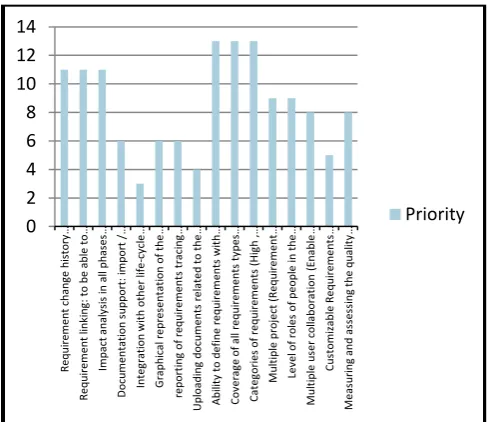
For the questionnaire, Figure2 shows the prioritized list of features ranked by the respondents
Figure 2: The prioritized list of features ranked by the respondents
The respondents gave the requirements architecture the highest votes. This is not surprising at all, since they are facing issues related to storing, identifying, classifying the requirements in a centralized database. The criteria of the ability to define requirements, coverage of requirements types, and the requirements categorization got the highest votes of 13. Moreover, the criteria that fall under the ‘Change and Traceability’ category, scored relatively high as well. The criteria of: Requirement change history traceability, Requirements linking, and Impact analysis in all phases scored 11. It seems that the respondents have given a reasonable attention to ‘Review and Collaboration’ category. This indicates that the software development communities do face challenges related to lack of communication and collaborative environment that need to be automated and knowledge be shared. The features of: Requirement Management tool that allows for multiple project RM , Level of roles of people in the change management processes, and Enable Team-work and Inter-disciplinary collaboration within the Project Team Members has been voted for the highest third category criteria with score from 8-9. Likewise, Measuring and assessing the quality characters of requirements specifications, shown as fairly ranked with score of 8. It is quite clear that the measurements of the quality of the requirements specification are among the priorities of the system analysts as well as programmers. However, it is worth to mention that the respondents did not emphasize on the customized framework availability in the tool. This may point out the respondent willingness of having a standardized and
formal workflow to follow when practicing RM processes instead a flexible one. The criteria of: Customizable
Requirements Management framework got only 5.
Surprisingly, the overall presentation and document support were not among the high priority of the respondents, although these features illustrate the performance and the status of the requirements and the final output of the whole process of managing requirements. This may give good reason for the lack of awareness of the benefits gained form such tools where reporting and overall evaluation is necessary in this stage. This can be also derived from the fact that manual processes shortage in providing such reporting. The scores varied form 4-6. The least vote went to the integration criteria with 3 votes only. This was expected, because systems analysts and programmers actually do not use widely the other types of automated modeling, testing, ALM, or RM tools in their daily work.
5.
THE PROPOSED FRAMEWORK
The proposed requirement management framework was derived from a well proven IBM collaboration framework and
integrated with specifications quality measurements
utilization and basic RM functionalities. The collaboration model emphasizes the cooperative working manner of the associated stakeholders in the requirement management process where the participants are allowed to request, perform, approve, reject changes, and with ability to be notified in formal and informal means. The purpose of this framework is to create a unified workspace for development, where the operational and uncreative tasks are automated or eliminated to reach to an environment that encourages fruitful, healthy, creative communications among the projects’ stakeholders. The basic four element of collaboration are: Supporting informal collaboration, Managing changes, Promoting awareness, and managing knowledge. These elements should be constantly applied throughout the requirement management processes based on the right level of authorization given prior in the project definition phase; requirement owners, approvers, executers, or as monitors.
The other core part of the framework is the formula for the specifications quality. In order to measure the quality of the requirements, various attributes are evaluated such as; ambiguity, Correctness, Completion, Understandability,
Verifiability, Consistency, Modifiability, Preciseness,
Traceability, etc. Metrics are measurements that are derived from a software resource, product or process. They provide a quantitative evaluation of the degree to which the measured element possesses specific attributes. They tend to give valuable description to the elements in which they help the project stakeholders’ indication of the quality level. The discussed quality attributes, are essential attributes for the requirement that will be shown in Software Requirements Specifications Document (SRS). There are precise well known formulas that are proven to measure the attributes. Likewise, these elements should be constantly applied throughout the requirement management processes whenever the project managers, requirements engineers, developer or quality assurance managers want to see the performance of the requirements in terms of quality. As the quality element of this framework represent the base of the software development success factor.
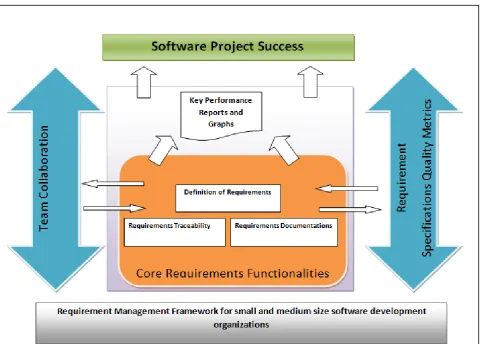
Definition of Requirements: Relevant information about the requirements should be managed and manipulated in a comprehensive manner, which enables mutual understanding of requirements between all stakeholders considering requirements types, status, owners, categories, etc. In addition, searching, filtering and sorting of requirements should be allowed.
Requirements linking and Traceability: Linking requirements with different relation types should be allowed. That consequently allows sufficient tracing of requirements if changes occur based on change requests of the users with visible requirements history and status reporting which in turn demonstrate the actual status of the project to various
stakeholders. Version and baseline control should be supported where releases are defined when required.
Other Features: Document inspection should be integrated with the spell and grammar checking, and glossary dictionaries. In addition to the availability of requirements document generation, status and quality reports and graphs for better decision making. Overall, the framework emphasizes on the importance of gathering the team collaboration, quality verification of requirements and requirement management basic functionalities. All in one drive the requirement processes to contribute effectively in the success of the software project. Figure 3 shows the final RM proposed framework.
Figure 3: The final RM proposed framework
6.
CONCLUSION AND FURTHER
WORK
This paper has investigated the prospect of congregating the team collaboration and specifications quality metrics in the context of requirements management processes suitable for small and medium sized software development organizations in Oman. That is based on the interviews and questionnaire conducted among the systems analysts and senior programmers in some of software development organization in public and private sector. Therefore, proposed a framework that meets the expectations of these entities. Our future work
7.
REFERENCES
[1] IAG Consulting, "Waterfall vs. Agile – a knowledge
problem, not a requirements problem," 19 7 2012. {Online}. Available: https://zenexmachina.wordpress. com/tag/gartner/. {Accessed 30 8 2014}.
[2] T. H. A. Balushi, P. R. F. Sampaio and P. Loucopoulos,
"Eliciting and prioritizing quality requirements
supported by ontologies: a case study using the ElicitO framework and tool," Expert Systems, vol. 30, no. 2, pp. 129-151, 5 2013.
[3] H. F. Hofmann and F. Lehner, "Requirements
Engineering as a Success Factor in Software Projects," IEEE Software, pp. 58-66, 8 2001.
[4] R. Saavedra, L. Ballejos and M. Ale, "Software
Requirements Quality Evaluation: State of the art and research challenges," in 14th Argentine Symposium on Software Engineering, 2013.
[5] K. Mahalakshmi, D. R.Prabhakar and D. V.
Balakrishnan, "Kernel Optimization For Improved Nonfunctional Requirements Classification," Journal of Theoretical and Applied Information Technology, vol. 60, no. 1, pp. 64-72, 2 2014.
[6] G. Ge´nova, J. M. Fuentes, J. Llorens, O. Hurtado and
V. Moreno, "A framework to measure and improve the quality of textual requirements," Requirements Eng-Springer-Verlag London Limited, 2011.
[7] P. ZAVE, "Classification of Research Efforts in
Requirements Engineering," ACM Computing Surveys, vol. 29, no. 4, pp. 315-321, 1997.
[8] M. J. Ali, "Metrics for Requirements Engineering," in
Master's Thesis, 2006.
[9] O. Lopez, "Requirements Management," Journal of
Validation Technology, pp. 78-86, 2011.
[10] V. Sinha, B. Sengupta and S. Chandra, "Enabling
Collaboration in Distributed Requirements
Management," IEEE Software, pp. 52-61, 2006.
[11] A. Finkelstein and W. Emmerich, "The Future of Requirements Management Tools," 2000.
[12] I. Accompa, "Why Use Requirements Management
Software?," 2012. {Online}. Available:
http://web.accompa.com/requirements-management-software. {Accessed 4 6 2014}.
[13] M. Shahid, S. Ibrahim and M. N. Mahrin, "An
Evaluation of Requirements Management and
Traceability Tools," World Academy of Science, Engineering and Technology, vol. 5, pp. 538-543, 2011.
[14] J. M. C. d. Gea, J. Nicolás, J. L. F. Alemán, A. Toval, C. Ebert and A. Vizcaíno, "Requirements Engineering Tools," IEEE SOFTWARE, pp. 96-91, 2010.
[15] R. R. Sud and J. D. Arthur, "Requirements Management Tools A Qualitative Assessment,"
{Online}. Available:
http://www.eprints.cs.vt.edu/archive/00000656/01/RM _Tools.pdf. {Accessed 4 6 2014}.
[16] M. U. Bokhari and S. T. Siddiqui, "Metrics for
Requirements Engineering and Automated
![Figure 1: RM tool evaluation comparison based on coverage of RE functionalities [14]](https://thumb-us.123doks.com/thumbv2/123dok_us/1317585.1639581/3.595.57.299.71.476/figure-rm-tool-evaluation-comparison-based-coverage-functionalities.webp)