Quality management framework for evaluating academic libraries in Kenya
Beatrice A Odera-Kwach
1and Patrick Ngulube
2Department of Information Science and UNISA School for Graduate Studies, University of South Africa
[email protected]; [email protected]
Received 10 January 2011 Accepted 12 June 2011
The purpose of this study was to identify the performance measurements used for the evaluation of quality in Kenyan university libraries, with the aim of determining the perceptions of university librarians towards performance measurement. The study established that the majority of the university librarians considered 25 of the 26 performance indicators important. More than 60% of them considered 11 of the 20 performance indicators very important. The study recommends the use of nine performance criteria and 26 indicators for the evaluation of the quality of university libraries.
Keywords: Impact assessment, performance measurement, performance criteria, performance indicators, outcome assessment, Kenya
1 Introduction
Traditionally, performance indicators in libraries focused on input, such as the workstation-to-user ratio or opening hours, rather than output. This has recently provoked renewed interest in service impact and impact assessment. Impact assessment takes a wider perspective and examines the contribution that the library is making to organisational or societal success. For example, academic libraries need to consider how they might measure their impact on learning and knowledge creation and transfer, and public libraries would benefit from measures relating to social inclusion, learning, and digital citizenship (Rowley 2005:516).
The quality of library services is a major concern for university libraries and Poll (2005:2) argues that:
As the expenses and workload for new information resources and services are rising, libraries need to justify the investment in them and to prove the efficiency and positive influences of the new resources and services.
The statement by Lindauer (1998:546) that the future vitality of libraries in academic institutions will depend on whether they can continually prove their value to the overall educational endeavour still applies today. The single most important challenge facing the academic library manager is implementing constructive change and improving library performance. The question then becomes, who decides on the quality level, and who evaluates it and assesses the “fitness to purpose” of the library?
The quality landscape for public services is dynamic. Not only do individual accreditation bodies and funding bodies continually develop their quality regimes and expectations, but new agendas also emerge to match the changes in services and service objectives. Key areas for development in libraries and other public sector organisations are impact assessment and digital service delivery (Rowley 2005:517).
Specifically, library and information managers and their staff must seek to balance the tension between processes, measures, and activities that promote quality enhancement, while at the same time responding to expectations, targets, and systems defined by external stakeholders, some of whom have the ultimate power of the funding body (Rowley 2005:516).
The assessment of university libraries should be defined and shaped by its connections and contributions to institutional goals and desired educational outcomes, and it should focus on the library’s teaching and learning role. Identifying specific performance indicators for measuring and documenting the library’s impact on key institutional outcomes should also be prioritised (Lindauer 1998:547).
How can academic libraries demonstrate that they are not only efficient and effective in meeting internal goals and objectives, but also in meeting those of their parent institutions? The literature clearly states that “The real problem is that libraries need to identify the performance measurements and indicators that relate to outcomes and impacts and then devise a way of regularly or continuously gathering the data.” (Wallace 2001:65).
1. Beatrice A Odera-Kwach (MPhil) is employed by the Commission for Higher Education (CHE) in Kenya and is also a PhD candidate in the Department of Information Science at the University of South Africa.
SA Jnl Libs & Info Sci
2 The concept of performance measurement
The definition of performance measurement and indicators varies. According to Poll and Boekhorst (1996:16), performance measurement means the collection of statistical and other data describing the performance of a library. Nicholson (2004:165-166) defined performance measures as the determination of the magnitude of quantity, while evaluation is the process of determining the merit, worth, or value of something, or the product of that process. Ambroži (2003:65) observed that evaluation was part of the strategic planning process, and had practical significance primarily in collecting data, which is used in the process of problem solving and decision-making.
Sinikara (2006:2) broadened the concept of performance measurement and included the idea of change, pointing out that:
Evaluation embraces change and encourages libraries to treat change as a positive force. By engaging in planning and research, librarians have a better idea of the future and they can meet that future with relevant, effective and efficient services and activities. The single most important challenge facing the academic library manager is securing constructive change and improvement in library performance.
This study adopted the definition of Lindauer (1998:549) that reads:
Performance measures are broad, managerial tools that encompass measurement of inputs (indicators of the resources essential to provide service; outputs (indicators of the services resulting from the use of those resources); and impacts (the effects of theses outputs on other variables or factors).
Poll and Boekhorst (1996:18) stated that:
An often-cited description of what constitutes a performance indicator was given by Orr in 1973 that performance indicator should be appropriate, informative, valid, reproducible and practical, fit for being used for comparative purposes.
According to Winkworth (1997:93), the purpose of performance measurement was to influence people, including their behaviour and their decision-making. Derfert-Wolf, Gorski and Marcinek (2005: 4) stated that performance measurement may be used for strategic planning, decision making, new service planning and control after its implementation, an accreditation, quality control, monitoring process, and benchmarking. Voorbij (2009:59) stated that:
The primary goal of benchmarking is to assist in improving the performance of an organization. The benchmarking philosophy says that we only discover how good we are by comparing our results with others, and that we can improve our performance by learning best practice from outstanding organizations in the same sector.
Brophy (2008:16) suggested blending methods such as ethnography, externally moderated, reflective self-evaluation and narrative-based practices in library performance measurement. Turk (2007:177) also suggested that combining traditional and alternative library performance indicators leads to library evaluation frameworks that focus on multiple perspectives. These include service effectiveness, service efficiency and service quality, together with usability aspects of performance measurement.
According to Dalrymple (2001:31), it is possible to develop indicators by asking the following questions: 1. Does the library survey its constituents on a regular basis?
2. Does the library examine what proportion of its user base interacts with the library in a given period? 3. Does the library assess the effect of its instructional programme on students’ learning?
4. Does the library monitor and examine users’ success in obtaining needed materials?
5. Does the library explore users’ understanding of the role of the library in their teaching, learning, and research? 6. How does the library ensure that students who are part of the learning community have access to appropriate materials at a location far from the campus?
3 Statement of the problem
This study sought to find out what university librarians thought about performance measurement with the aim of demonstrating the applicability of a quality management framework and a performance evaluation model for the evaluation of university libraries in Kenya. The study aimed to achieve the following three objectives:
1. To identify the performance measures used for the evaluation of quality in Kenyan academic libraries; 2. To investigate the perceptions of university librarians regarding performance measurement; and
3. To demonstrate the applicability of quality management frameworks in the evaluation of university libraries. 4 Literature review
The literature on performance measurement until the late 1980s was very obscure and too statistical, with complex statistical presentation. It had few clear objectives or models of reality. The literature since the late 1980s was less mechanical, more explanatory, and nearer to real decisions, with some recognition of real audiences (Winkworth 1997:93).
Pritchard (1996:5) looked at the development approaches to academic library effectiveness and noted that there was a vast amount of literature on performance and output measures. According to Pritchard (1996:5), the literature focused on the development of practical manuals for library statistics and evaluation, setting relevant criteria, and the need to evaluate libraries based on performance, outcomes, and user satisfaction.
Poll (2008:28) outlined the trends in performance measurement over the last decade and stated that the literature can best be followed by looking at the papers presented at the Biannual Northumbria Conference on Performance Measurement in Libraries and Information Services. Poll further stated that during the first conference, in 1995, people were still busy inventing and testing new indicators, while the 1997 conference saw participants questioning the traditional performance indicators. The subsequent conferences focused more and more on new tools, such as management information systems, and methods such as total quality management. The effects of performance assessment and measurements on the electronic library were major discussion topics at these conferences. The other topics considered during the conferences were:
1. Stakeholder perceptions of library quality 2. Benchmarking;
3. Electronic indicators; 4. The balanced scorecard;
5. Qualitative measures like user surveys or focus groups; 6. Cost measures; and
7. Above all measures, indicators showing the impact or outcome of library services.
In the literature review, the type of measurements compiled by academic libraries mostly included input and output data gathered in the form of statistics (American Library Association 2004:2; American Library Association 1998:3; Cullen 2001:9; Gozo 2007:1; Hernon 2002a:55; Matthews 2007:23; Melo & Sampaio 2007:1; Weiner 2005:433).
Inputs and outputs have been defined in the literature by various authors including Cullen (2001:9), Dugan and Hernon (2002:376), Hernon (2002a:55), and Melo and Sampaio (2007:1). This study adopted the definition of the American Library Association that states:
Inputs are generally regarded as the raw materials of a library - the money, space, collection, equipment, and staff – out of which a program can arise. Outputs serve to quantify the work done, that is, number of books circulated, number of reference questions answered. (American Library Association 2004:2)
Both inputs and outputs are invaluable measures for making administrative and operational decisions concerning the provision of library services, including staff deployment, setting hours of operations, and devising collection development policies (American Library Association 1998:3). In the USA, input and output data were gathered before the 1990s and most libraries did not ask themselves about the validity, usefulness, and benefit of collecting the data. Not until the Association of Research Libraries (ARL) moved away from collecting input and output data, and moved towards outcomes measures in 1998, did the growth of new initiatives in developing new alternative metrics emerge (American Library Association 1998:3; American Library Association 2004:2; Brophy 2008:7; Turk 2007:177; Voorbij 2009:59).
SA Jnl Libs & Info Sci
(American Library Association 1998:5; American Library Association 2004:2; Dalrymple 2001:31; Dugan & Hernon 2002:377; Lindauer 1998: 548; Melo & Sampaio 2007:1; Poll & Payne 2006:548; Saunders 2008:308; Turk 2007:180).
Many authors in the reviewed literature focused on the effect the library had on student learning and teaching. Information literacy skills were viewed as directly affecting student outcomes, because students gain skills such as critical thinking, computer literacy, problem solving, and lifelong learning (Dalrymple 2001:31; Dugan & Hernon 2002:377; Harvey 2004:15; Hernon 2002b:224; Lindauer 1998:549; Matthews 2007:127; Saunders 2008:309; Weiner 2005:433).
Poll and Payne(2006:549) found that research had shown that outcomes:
are not always predicable; are generally rather an addition to previous experience than a radical change in attitude; will be higher if a gain in skills and competencies or a change in behavior seems promising to the user; and often become visible only in long-term development.
Dugan and Hernon (2002:376) noted that, as the need to measure accountability moved beyond surveys and anecdotes, the effort to demonstrate effectiveness increasingly focused on efficiency and quality measures (service quality and learning impacts). Institutional effectiveness is concerned, in part, with measuring institutional efficiency, such as fiscal accountability, and educational quality and improvement, including student learning (Melo & Sampaio 2007:1).
The accrediting bodies are asking for evidence of the quality, accessibility, relevance, availability, and delivery of resources and services, regardless of the location of the library’s customers (Matthews 2007:83). The need to incorporate outcomes assessment based on evidence of organisational planning and improvement was also addressed by the ALA (1998:5), Lindauer (1998:548), and Hernon (2002:229).
Poll (2001:710) argues that the two most interested stakeholder groups are the population the library is set to serve, and the institution to which it belongs. Thus, the best place to start developing quality within an organisation is the performance and attitude of individuals directed towards quality (Melo & Sampaio 2007:2).
In the last decade, measures have been developed to assess the quality of library services, as well as the cost-efficiency of institutions services and the performance. Nevertheless, the extent of use and quality of performance do not yet prove that users benefited from their contact (Poll 2005:2). According to Poll and Payne (2006:552):
High satisfaction could mean that the library has been effective in conveying the view: it is well worth using a library. Nevertheless, this does not mean that there is a change in skills, competences and behavior. User satisfaction would rather be seen as giving a good basis for such changes in furthering receptivity and thus rendering outcomes possible.
The question of whether performance measurements work or are effective in evaluating university libraries was raised by Town (1997:81). The author saw a gap between the performance measurements and the objectives for which they were designed, that is, to demonstrate good performance and identify success. Town (1997:81) argued that the current data collection methods and structures obscure rather than illuminate performance, and provide a misleading picture of what performance is or should be.
Wallace (2001: 65) stated that libraries should identify the performance measurements and indicators that relate to outcomes and impacts, and then devise a way to regularly or continuously gather the data. In the author’s opinion, a methodology for determining library outcomes and their impact was needed.
5 Methodology
The study was based on the philosophy of pragmatism, and the mixed method research approach was used for data collection and analysis. This study adopted a sequential mixed model design because more than one methodology was used and data was collected in two phases. The sequential mixed model design applied in this study was based on the typology of the mixed model design discussed by Johnson and Onwuegbuzie (2004:19). In the first phase, a questionnaire was sent to all the heads of university libraries in Kenya. The questionnaire was used to collect quantitative and qualitative data for the first phase of the sequential mixed model method study. The questionnaire included questions on the characteristics of the respondents and general information on the university libraries. Open-ended and closed-ended questions were included to gather facts on performance measurement in Kenyan university libraries. These included the types of input, output, and outcome measures collected.
The survey instrument listed the 9 performance criteria and 26 indicators. Respondents were asked how important they believed each measure was. The survey used ranking-type questions, and asked respondents to rank the importance of each performance criteria and indicator from not important, somewhat important, important, and very important.
instrument revisions. This enabled the researcher to avoid bad responses, distortion of data, and subjectivity of responses. The testing was important to establish the content validity of the instrument and to improve questions, formats, and scales (Creswell 2003: 158).
The data from the questionnaires was analysed and the key results that needed explanation were identified for a follow-up interview. A total of 27 (87%) of 31 potential respondents completed and returned the questionnaires. The overall response rate of 87% was high, and ensured that the survey results were representative of the survey population. The total response rate included all 11 (100%) private chartered universities, 7 (78%) of the 9 universities with letters of interim authority,3 all 4 (100%) registered private universities and 5 (71%) of the 7 public universities.
Based on the findings from the questionnaire survey, five heads of university libraries were purposely selected for the interview. They included respondents from two private chartered universities, two private universities with letters of interim authority (LIA), and one public university. The data from the two phases was analyzed using descriptive and correlation coefficient analysis with a statistical computer program for social sciences.
6 Results and discussion
Most of the respondents, 16 (59%) of the 27, held leadership positions with the title of university librarian. The majority of the librarians were qualified professionals with a master’s degree, and a few held doctorate degrees in library and information studies. The majority of the positions were in private registered, private chartered, and public universities. The private universities with LIA had fewer librarians with substantive positions.
Overall, only 60 professional librarians were available to manage the vast information resources and serve users in the university libraries in Kenya. The majority of the professional librarians were in public universities and private chartered universities. There were 74 professional librarians with a master’s degree, while 9 held doctorate degree qualifications. The number of professional staff providing information services in the university libraries was found to be inadequate.
The findings showed that the institutions represented in the sample varied considerably in terms of information resources available, users, and number of qualified staff.
The study established that university librarians (79%) collected library statistics. Only 44% of the universities used the data for planning, decision-making, to improve service delivery, budgeting, report writing, and collection development. The study also ascertained that the collection of library statistics was done independently at the institutions. In addition, the study found that 56% of the university libraries conducted customer satisfaction surveys. The majority of the public universities conducted customer satisfaction surveys, in contrast to the private universities. The data collection methods used were questionnaires and interviews.
The study ascertained that university libraries did not collect much outcome data. The outcome data they did collect was generally for the purpose of service quality and customer satisfaction. The study further established that the outcome measurements collected by the university librarians were actually descriptive inputs, and not student learning outcomes. The study established that the university librarians regarded the skills, knowledge, understanding, and attitudes and values outcome measurements as important.
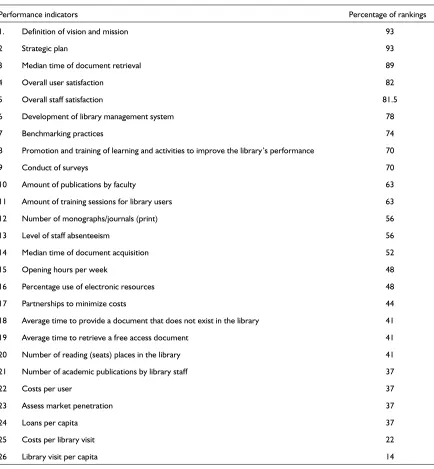
The study established that the majority of the university librarians considered 25 of the 26 performance indicators important, as shown in Table 1. More than 60% of them considered 11 of the 20 performance indicators very important. Therefore, the study ascertained that the majority of the university librarians had a positive attitude towards performance measurement. The findings showed that the indicators rated very important by the majority of the university librarians were those of leadership, planning and strategy, customer perspective, staff outcomes, impact on society, and process and change management, as shown in Table 1. Their positive attitudes showed that they would promote and support the use of performance measurement as a basis for assessing university libraries. The performance measures identified by the university librarians as important in this study constitute a significant body of potential methods for assessing the effectiveness of university libraries.
The study further established that less than 40% of the university librarians considered six performance indicators (number of academic publications by library staff, cost per user, cost per library visit, library visit per capita, loans per capita, and assess market penetration) not very important, as shown in Table 1. The low opinions expressed by university librarians regarding the key areas in performance measurement of academic libraries indicates a lack of knowledge of the importance of performance indicators for managing resources and partnerships, managing internal processes, and performance financial perspective criteria. This further shows that there is a need to sensitise university librarians to the importance of these performance indicators.
SA Jnl Libs & Info Sci
The study established that the highest ranked performance criterion was leadership, followed by planning and strategy, customer perspective, staff outcomes, impact on society, and process and change management, as shown in Table 2. The study also found that the lowest ranked performance criterion was the financial perspective, as shown in Table 2.
Table 1 Performance indicators ranked very important – high and low importance
Performance indicators Percentage of rankings
1. Definition of vision and mission 93
2 Strategic plan 93
3 Median time of document retrieval 89
4 Overall user satisfaction 82
5 Overall staff satisfaction 81.5
6 Development of library management system 78
7 Benchmarking practices 74
8 Promotion and training of learning and activities to improve the library’s performance 70
9 Conduct of surveys 70
10 Amount of publications by faculty 63
11 Amount of training sessions for library users 63
12 Number of monographs/journals (print) 56
13 Level of staff absenteeism 56
14 Median time of document acquisition 52
15 Opening hours per week 48
16 Percentage use of electronic resources 48
17 Partnerships to minimize costs 44
18 Average time to provide a document that does not exist in the library 41
19 Average time to retrieve a free access document 41
20 Number of reading (seats) places in the library 41
21 Number of academic publications by library staff 37
22 Costs per user 37
23 Assess market penetration 37
24 Loans per capita 37
25 Costs per library visit 22
26 Library visit per capita 14
Table 2 Performance criteria of high and low importance
Performance Criteria Average of Percentages
1 Leadership 80
2 Planning and strategy 79
3 Staff outcomes 69
4 Customer perspective 60
5 Process and change management 59
6 Impact on society 54
7 Management of resources and partnerships 47
8 Management of internal processes 43
The study ascertained that the high ratings awarded to the performance indicators by the university librarians did not translate into usage. In other words, they had utilised only 7 of the 26 performance indicators. The findings showed that the utilisation of performance measurement in universities was very limited. This was shown by the fact that, of the 26 performance indicators, only 7 had been utilised and by less than half of the university libraries in this study. The results showed that there were factors that hindered using performance measurement in university libraries. The three major barriers to assessment identified by Oakleaf and Hinchliffe (2008:160) were time, resources, and lack of understanding of assessment. The other significant barrier is a lack of a culture of assessment. The results confirmed that there was no culture of assessment in university libraries in Kenya.
Mathews (2007:6) stated that the major reasons for a lack of a culture of assessment were the perception that one cannot measure what a library does, lack of leadership, the library not having control over outcomes, the possibility of using such information being used against the library, lack of skills, the move to increased demand for electronic resources and services, old mental models, and a preference for the status quo.
Conclusions and recommendations
The library statistics collected by university libraries were from customer satisfaction surveys. Universities in Kenya collected library statistics independently for their own use. Standardised instruments for data collection in Kenyan university libraries were not available, so we used questionnaires and interviews as data collection instruments.
We found a lack of understanding of outcome measurement amongst Kenyan university librarians. The outcome measurements provided tended to be descriptive inputs rather than student learning outcomes.
The university librarians identified the key performance criteria for measuring the quality of university libraries. They established that the performance indicators of high importance were leadership, planning and strategy, customer perspective, staff outcomes, impact of society, and process change management. The study concluded that the librarians’ general perception was that performance measurement was important for assessing quality in university libraries. The positive views showed that the librarians would promote and support the use of performance measurements as a basis for assessing university libraries.
The study established that the high perceptions of performance measurement did not translate into usage. The usage of the performance indicators by the university librarians was very limited. The study concluded that there were factors that hindered the use of performance measures in university libraries in Kenya. It is also evident that there is no culture of assessment in Kenya university libraries.
The types of measurements used were only descriptive inputs of the libraries. From the findings, it was evident that no statistics were collected nationally to enable benchmarking. It was also evident from the findings that there were no specific performance indicators to facilitate self-assessment and benchmarking between university libraries.
As stated by Ninh et al., (2010:705), standards need to be supplemented by a systematic performance measurement system to provide guidance to individual universities. It was evident from the findings that there were no specific performance indicators for measuring and documenting the impact of libraries on key institutional outcomes. The performance measurements for assessing the effectiveness of quality assurance processes at the university libraries were also not evident. The standards used for evaluating university libraries only covered inputs, as opposed to outputs and outcomes.
The study recommends that university librarians in Kenya move away from measurements of satisfaction to that of student learning. As stated by Poll and Payne (2006:548), the quantity of use and the quality of performance do not yet prove that users benefited from their interaction with a library. Measuring impact means going a step further, and trying to assess the effect of services on users. The Commission for Higher Education should also organise workshops and sensitise university librarians to the role of outcomes of an academic library, and how they relate to input and output data.
The study further recommends that the university librarians take advantage of the availability of library-related data through computerised library systems. In order to overcome the barriers that hinder the assessment of the impact of university libraries on students’ learning, as mentioned by Hiller, Kryllidou, and Self (2008:227); Turk (2007:178); Matthews (2007:6), and Ambroži (2003:76), such as a lack of skills, time, and resources, the study recommends that universities in Kenya should recruit additional professional library staff.
The study recommends sensitising university librarians to the importance of performance indicators in the assessment of university libraries. The sensitisation should focus on indicators for the management of resources and partnerships, management of internal processes, and performance financial perspective criteria. The study proposes that the Commission for Higher Education coordinate the sensitisation of university librarians.
SA Jnl Libs & Info Sci
Kenya. The study also recommends that the university librarians should develop assessment methodologies that focus on performance indicators and measure student learning outcomes.
References
Ambroži, M. 2003. A few countries measure impact and outcomes – most would like to measure at least something. Performance Measurement and Metrics, 4(2): 64 – 78.
American Library Association (ALA). 1998. Task Force on Academic Library Outcomes Assessment Report. [Online]. http:// www.ala.org/acrl/acrlpubs/whitepapers/ALA. (Accessed 8 February 2007).
American Library Association (ALA). 2004. Standards for libraries in higher education. [Online]. http://ala.org/ala/acrl/ acrlstandards/ALA. (Accessed 11 August 2008).
Brophy, P. 2008. Telling the story: qualitative approaches to measuring the performance of emerging library services. Performance measurement and Metrics, 9(1): 7 – 17.
Creswell, J.W. 2003. Research design: qualitative, quantitative and mixed methods approaches. 2nd edition. California: Sage. Cullen, R. 2001. Setting standards for library and information service outcomes, and service quality. Proceedings of the
4thNorthumbria International Conference on Performance Measurement in Libraries and Information Services held on 12 – 16 August 2001, Pittursburg Pennsylvania. [Online]. http:/www.libqual.org/documents/admin/cullen1.pdf. (Accessed 9 May 2007). Dalrymple, P.W. 2001 Understanding accreditation: the librarian’s role in educational evaluation. Portal: Libraries and the
Academy, 1(1): 23 – 32.
Derfert-Wolf, L., Gorski, M. & Marcinek, M. 2005. Quality of academic libraries – funding bodies, librarians and users perspective: a common project of Polish libraries on comparable measures. Proceeding of the World Library and Information Congress: 71th IFLA General Conference and Council, August 14 – 18th 2005, Oslo, Norway. [Online]. http://www.ifla.org. (Accessed 7 June 2007).
Dugan, R.E. & Hernon, P. 2002. Outcomes assessment: not synonymous with inputs and outputs. Journal of Academic Librarianship, 28(6): 376 – 380.
Gozo, J. 2007. The fast track in library evaluation: the South African experiences in higher education libraries. Proceedings of the World Library and Information Congress: 73rd IFLA General Conference and Council; 19 – 23 August 2007, Durham, South Africa. [Online]. http://www.ifla.org/. (Accessed 5 December 2007).
Harvey, L. 2004. The power of accreditation: views of academics in accreditation models in higher education: experiences and perspectives. ENQA Workshop Reports (3):5 – 19. [Online]. http://www.enqa.eu/pub_review.lasso. (Accessed 3 July 2009). Hernon, P. 2002a. Outcomes are key but not the whole story. The Journal of Academic Librarianship, 28(1):54 – 55.
Hernon, P. 2002b. Quality: new directions in the research. The Journal of Academic Librarianship, 28(4):224 – 231.
Hiller, S., Kryllidou, M. & Self, J. 2008. When the evidence is not enough: organizational factors that influence effective and successful library assessment. Performance Measurement and Metrics, 9(3):223 – 230.
Johnson, R.B. & Onwuegbuzie, A.J. 2004. Mixed methods: a research paradigm whose time has come. Educational Researcher, 33(7):14 –26.
Lindauer, B.G. 1998. Defining and measuring the library’s impact on campus wide outcomes. College and Research Libraries, 56(11):546 – 570.
Materu, P. 2007. Higher education quality assurance in Sub-Saharan Africa: status, challenges, opportunities and promising practices. (African Region Human Development) (World Bank Working Paper, 124). Washington D. C.: The World Bank.
Matthews, J.R. 2007. Library assessment in higher education. Libraries Unlimited: Westport, Connecticut.
Melo,L.B. & Sampaio, I.C. 2007. Quality measures for academic libraries and information services: two implementation initiatives – mixed model CAF-BSC-AHP and PAQ-SIBi-USP. [Online]. http://eprints.rdis.org. (Accessed 5 May 2007).
Nicholson, S. 2004. A conceptual framework for the holistic measurement and cumulative evaluation of library services. Journal of Documentation, 60(2):164 – 182.
Ninh, T.K.T., Tanner, K., Johanson, G. & Denison, T. 2010.Systematic performance measurement for university libraries in Vietnam. Library Management, 31(8/9):702 – 716.
Oakleaf, M. & Hinchliff, L.J. 2008. Assessment cycle or circular file: Do academic libraries use information literacy assessment data? Proceedings of the 2008 Library Assessment Conference: Building Effective, Sustainable, Practical Assessment. Seattle, Washington, August 4 – 7, 2008, pp. 159 – 164.
Poll R. 2001. Performance, processes and costs: managing service quality with the balance score card. Library Trends, 49(4):709 – 717.
Poll, R. 2005. Measuring the impact of new library services. Proceedings of World Library and Information Congress: 72nd IFLA General Conference and Council. August 20 - 24, 2006. [Online]. http://www.ifla.org/. (Accessed 9 May 2007).
Poll, R. 2008. Ten years after: measuring quality revised. Performance Measurement and Metrics, 9(1):26 – 37.
Poll, R. & Boekhorst P. 1996. Measuring quality: international guidelines for performance measurement in academic libraries. IFLA Section of University Libraries. Munich: K.G.Saur. (IFLA publications; 76).
Poll, R. & Payne, P. 2006. Impact measures for libraries and information services. Library Hi Tech, 21(4):547 – 562.
Pritchard, S.M. 1996. Determining quality in academic libraries: perspectives on quality in libraries. Library Trends, 44(3):572-594.
Rowley, J. 2005. Making sense of the quality maze: perspectives for public and academic libraries. Library Management, (26)89:508 – 518.
Saunders, L. 2008. Perspectives on accreditation and information literacy as reflected in the literature of Library and Information Science. The Journal of Academic Librarianship 34(4): 305 – 313.
Town, S. 1997. Performance or measurement. Proceedings of the 2nd Northumbria International Conference on Performance Measurement in Libraries and Information Services held on 7 – 11 September 1997, Northumberland. Northumberland, England: University of Longhirst, pp. 81 – 91.
Turk, N. 2007. Building a culture of quality assurance in the libraries of the University of Ljubljana. New Library World, 108(3/ 4):177 – 182.
Voorbij, H. 2009. Academic library benchmarking in the Netherlands: a comparative study. Performance Measurement and Metrics, 10: 59 – 72.
Wallace, V.E. 2001. Outcome assessment in academic libraries: library literature in the 1990’s. College & Undergraduate Libraries, 8(2):59 - 71.
Weiner, S. 2005. Library quality and impact: is there a relationship between new measures and traditional measures? The Journal of Academic Librarianship, 31(5):432 – 437.