Abstract—The presence of new mobile computing devices rise the tendency to use ad hoc networks in which each device connects to its neighbor without the need to connect to a fixed infrastructure network. Broadcasting is sending data packet from a source node to the rest of nodes in the networks; it is characterized by no acknowledgement packets and no request or clear to send dialogue packets. Broadcasting suffer from redundant rebroadcast, contention and collision, these drawbacks lead to increase the delay and the number of dropped packets caused by contention (i.e. degrade in the quality of service). Anew distance based broadcasting algorithm is proposed to enhance broadcasting in wireless mobile ad hoc networks, this algorithm is analyzed and tested using GloMoSim network simulator, the simulated results are used to compare with another two distance based broadcast algorithms.
Index Terms—AoDV, BA, CWZ, MANETs, SNIR.
I. INTRODUCTION
Mobile Ad hoc Networks (MANETs) are infrastructure less networks that are formed and torn down on demand [1]. Nodes in MANETS are either source, data end-point (receiver), or intermediate node (router) that forwards the packets. MANETs are characterized by the following features [2]:
Wireless links change rapidly and they have to repair frequently.
Many control packets are produced due to links break.
General wireless routing protocols are not suitable to MANETs.
A. Routing Protocols in MANETs
Routing protocols that are proposed to fulfill the necessity of route discovery in MANETs can be fall into two categories: proactive (table driven) protocols and reactive (on-demand) protocols [3]. Proactive routing protocols discover and maintain the routes to all destinations through periodically exchanging link state information among participating nodes [4]. Proactive routing protocols suffer from the bandwidth and consumption of network resources. These features in MANETs bring new challenges for protocols and algorithms design.
Reactive routing protocols discover and maintain route upon request, reactive routing protocols can be classified based on route selection into two kinds: source based and destination based. In source based routing, the source selects the best route from multiple route replies. Ad hoc on demand
Manuscript received April 20, 2014; revised July 10, 2014.
Basim Alhadidi and Faisal Y. Alzyoud, and Ayman Alawin are with the AlBalqa’ Apllied Science University, Salt, Jordan (e-mail: [email protected]).
Hasan Aldabbas is with Philadelphia University, Amman, Jordan.
Distance Vector (AoDV) is an example of source based routing protocol [5]. In destination based routing, the destination of the route request selects the best route based on some predefined criteria and then sends the route reply back to the source along the route which is just found. An example on destination based routing ABR [6]. Reactive routing protocols suffer from route discovery latency (i.e. request plus reply time).
B. Broadcast Algorithms
The main goal for the proposed rebroadcasting algorithms is to minimize the number of nodes that are required to make rebroadcasting, Constant-Width Zones (CWZ), is proposed to alleviate the redundant rebroadcast (overlaying) problem through defining a constant upper limit for the width of all rebroadcast zones and, consequently, reducing the number of forwarding hosts [7]. Border Aware (BA) broadcasting algorithm is used to reduce extra network traffic [8], BA uses random backoff as a “blind” scheme as it cannot tell thedirection of packet. BA is an efficient broadcast scheme for wireless ad hoc network and it was proposed to solve broadcast storm problem in a fully distributed manner.
C. Broadcast Storm Problem
Broadcast storm problem refers to overlaying (redundant and rebroadcast), contention and collisions. Many approaches have been proposed to solve broadcast storm problem. Williams el al. [9] categorized broadcast protocols into four families: simple flooding, probability based methods, area based methods and neighbor knowledge methods. Broadcast scheduling is proposed to minimize latency [10]. A good broadcast scheme must be simple adaptive to topologies changing, adaptive to network densities and adaptive to node movement. The proposed algorithm in the next section will deal with random back off in distance based approach.
II. PROPOSED SOLUTION FOR BROADCASTING
In this section, a smart and simple efficient broadcast scheme will be introduced. Border nodes of the sender will be more suitable and coverage for rebroadcast than closer nodes to the sender; therefore, there must be a suitable way to determine the distance between sender and receiver; this can be done through using the relation between the receiving power and the distance between sender and receiver. Signal to Noise Interference Ratio (SNIR) can be used to estimate the distance between any node and the sender by assuming the homogeneity in wireless network nodes (i.e. using the same fixed transmission power). 1-hop scheme performance has very limited improvement in most network conditions [11], but the proposed solution for broadcasting will prove
A Moderated Distance Based Broadcasting Algorithm for
MANETs
that 1-hop approach is very helpful.
In 1.5 hop approach, a node knows its neighbor depending on the received hello messages instead of sending the list of neighbors broadcast messages as it is done in 2-hop approach [12].
A. Distance Calculation
The distance between sender and receivers can be calculated using the free space propagation model [13]. The distance d can be calculated as the radius of circle with area S.
2
( r / 4 )
rx tx
p p G
S (1)where rx
p
: Received Power,tx
p
: Transmitting Power, rG
: Receiving Gain antenna,
: Wave Length,S
: Area.The calculated distance using free space model is not accurate; because the received power is the result of combination between large scale fading and small scale fading. Therefore, one of the major work is to make the proposed algorithm robust even when the estimation is in accurate, this is done by calculating X and Y coordination of the used simulator [14], [15].
2 2
( , ) ( ) ( )
d A B XBXA YBYA (2)
B. Quantized Back off
Quantized back off is not blind and can tell the direction of packet by linking the distance information to the back off scheduling. The algorithm works as follow: assume t time is required to broadcast a message by a node to all its 1-hop neighbors, the back off window size is flexible depending on the density of network, this is one of the modifications that is done by the proposed work on the distance based approach. Also, assume that the transmission range of the sender equals to R. Then the distance between the sender and the receiver will be divided in logarithmic fashion, so the nearest node to the sender will have common neighbors and these neighbors will be covered by the first transmission, so more levels will be given to the node far away from the sender. Transmission range will be divided into discrete number of levels (L)
depending on the degree of the transmitting node, starting from 8 levels, where L= 23 =8, so 3 bits are needed to represent the level. The level calculations will be explained in the next section
C. Levels Calculations
There are two ways to calculate the step ∆: uniform way and non-uniform way. In, uniform way equal space levels are given and this is calculated by the following equation:
/ 28
R
whereas, in non-uniform way "quantization", the transmission range can be divided into 8 segments, each
segment equals to 16 steps. The step is calculated by the following equation:
8
/ 2
1
R
For example, segment1=128∆, segment2=64∆, segment3=32 ∆ and so on. The transmission range is divided into 28-1= 255 units, so every node falls into a distance level between 1 and 8, the next step is to determine the back off slot S for each node, this is done by coding function which will give the level of 3 bits code starting from 001 to 111, the binary number indicates that the receiver with the larger distance level rebroadcast earlier than smaller distance level, so the number of levels will be dynamic. But there is an important factor "safe guard period" which will be discussed in the next section.
D. Safe Guard Period Calculations
Guard period can be defined as the difference between any two consecutive back off time slots, so the reaction between the rebroadcast back off and MAC layer back off needs to be tuned. The difference between consecutive back off time slots must satisfy the following conditions [16]:
Jitter time or time variance must not be negative and it must be greater than message-interval divided by two.
Jitter time should not be greater than message interval divided by four.
Maximum jitter should not be greater than message interval divided by two.
To achieve the goal of efficiency, the number of redundant transmissions must be reduced and this is done through efficient rebroadcast scheduling.
III. NEW DISTANCE BASED BROADCASTING ALGORITHM
DESCRIPTION
Distance Based Broadcasting Algorithm(DBBA)is based on checking both the broadcast message and the degree of the sender node. The degree of the sender node is calculated to decide how many levels are exit between the sender and the received nodes. The sender calculates its degree to the receiver node, and sends it along the message to be rebroadcast through constructing a neighbor table that is updated periodically each time a node receives a hello message, and then this node will update its sent and seen table to rebroadcast the message after it is received again. The details description ofDBBA is explained in Fig. 1.
IV. SIMULATION TOOL
Message received
Message sent Check Sent Table
Check received Degree Drop new Message
Set Max. no. of levels
Get Distance
Yes No
Calculate Backoff
Backoff expired OR seen times
= 2
Rebroadcast message
Update sent Table Yes
Buffer the message
Drop buffered Message No
Calculate Level
New level = 1
Degree ? Yes
No
= 1
T1 < Backoff = 2
Update seen Table
In seen table ?
Update seen Table No > 2
Set T1 to Backoff Yes
T1 expired ?
Yes
Yes No
No
Fig. 1. Details description of DBBA algorithm.
A. Simulation Design and Environment
The simulation environment was made using transmission range of 100 meters and random distribution of nodes within network. First, the simulated network contains 100 nodes and up to 500 nodes that are placed randomly with a fixed-size L
× L, where L × L can be of size R × R, 1.5 R × 1.5 R, 2 R × 2 R, 2.5 R × 2.5 R, 3 R × 3 R, 3.5 R × 3.5 R and 4 R × 4 R where R
represents the length of communication radius which is set to be 100 meters. The speed of transmission was set to be 2 Mbps and all the simulations were run for 100 second. To increase the certainty of simulation, ten different seeds were run and averaged to generate different network topologies.
B. Performance Metrics
Glomosim was used to examine the following metrics for the proposed DBBA and compare it with other used broadcast algorithms:
Efficiency: how many redundant rebroadcast that DBBA can save.
Reach ability: how many nodes that DBBA can cover.
Latency Time (Delay): the time which is needed for the packet to reach the desired destination.
Quality: the minimization number of collisions.
V. RESULTS AND ANALYSIS
In this section, DBBA will be tested and compare to Border Aware broadcasting algorithm (BA) [8], and Constant Width Zone broadcasting algorithm (CWZ) [7]. These tests will be hold using three different coverage areas. First by using a fixed area of 100 × 100 meters with number of nodes varying from 10 to 100, then by using a fixed area of 200 × 200 meters with number of nodes varying from 10 to 100, and then by using fixed number of nodes with area ranging between 100 and 400 meters. Finally, the mobility effect will be studied.
A. Results Comparison Using Coverage Area of 100 ×100 Meters
Fig. 2 shows that DBBA has little enhancement of reachability over BA and CWZ scheme in this network configuration, it is noticed from Fig. 2 that 80% to 90% of nodes can be reached by the first transmission, and the reach ability increased with the increase number of nodes (i.e. node density).
rebroadcast message. It is seen from Fig. 3 that DBBA has almost double rebroadcast saving over CWZ, while BA has rebroadcast saving approach to DBBA rebroadcast saving, when the number of nodes equal to 50 nodes. But DBBA has better saving than BA as the number of nodes increase, and this express the effectiveness of DBBA at large number of nodes. Reachability Comparison 0% 20% 40% 60% 80% 100% 120%
5 25 35 45 55 65 75 85 95 100 No. of Nodes
R e a c h a b ili ty P e rc e n ta g e
DBBA CWZ BA
Fig. 2. Reachability comparison using coverage area of 100 × 100 meters.
Rebroadcast Saving Comparison
0% 10% 20% 30% 40% 50% 60% 70% 80% 90%
5 25 35 45 55 65 75 85 95 100 No.of Nodes R e b ro a d ca st Sa vi n g Pe rce n ta g e DBBA CWZ BA
Fig. 3. Rebroadcast saving comparison using coverage area of 100 × 100 meters.
B. Results Comparison Using Coverage Area of 200 × 200 Meters
It is noticed from Fig. 4 that DBBA has better reach ability over BA and CWZ, and the reach ability increases with the increase number of nodes as every node informs its neighbor rapidly. Reachability Comparison 0% 20% 40% 60% 80% 100% 120%
5 25 35 45 55 65 75 85 95 100 No. Of Nodes
R e a c h a b ili ty P e rc e n ta g e
DBBA CWZ BA
Fig. 4. Reach ability comparisonusing coverage area of 200 × 200 meters.
Fig. 5 shows that all in all cases DBBA has almost better rebroadcast saving over CWZ, and DBBA is superior to BA when the number of nodes exceeds 40 nodes, this indicates that the number of collision will be minimized by rebroadcast saving.
Rebroadcast Saving Comparison
0% 10% 20% 30% 40% 50% 60% 70% 80% 90%
5 25 35 45 55 65 75 85 95 100
No.of Nodes R e b ro a d ca st Sa vi n g Pe rce n ta g e DBBA CWZ BA
Fig. 5. Rebroadcast saving comparison using coverage area of 200 × 200 meters.
C. Results Comparison Using 100 Nodes in Different Coverage Areas
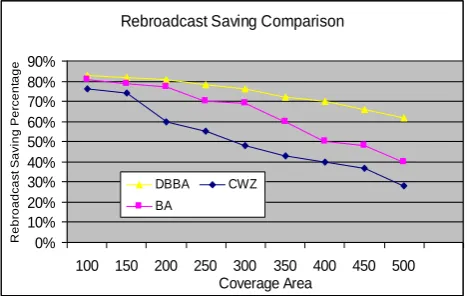
Ten hundred nodes where placed in coverage areas of 100 × 100 meters, 100 × 100 meters, 150 × 150 meters, 200 × 200 meters, 250 × 250 meters, 300 × 300 meters, 350 × 350 meters, and 400 × 400 meters to investigate reach ability and rebroadcast saving. It is clear from Fig. 6 that DBBA is the superior among the tested broadcast algorithms, DBBA has a stable reach ability of about 99% for all the simulated areas, while BA and CWZ reach ability is unstable and decreases as the area size reaches 400 meter; this is due to the high efficiency of DBBA broadcasting.
Fig. 6 represents rebroadcast saving comparison for DBBA, BA and CWZ. The results are too confusion because equations do not balance results dimensionally. So you must use different coverage areas. DBBA is the superior and it has a rebroadcast saving of about 90 % using coverage area of 150 × 150 meters.
Rebroadcast Saving Comparison
0% 10% 20% 30% 40% 50% 60% 70% 80% 90%
100 150 200 250 300 350 400 450 500
Coverage Area R e b ro a d ca st Sa vi n g Pe rce n ta g e DBBA CWZ BA
Fig. 6. Rebroadcast saving comparison using different coverage areas.
D. End-to-End Delay and Average number of Collisions Comparison using Different Coverage Areas
End-to-End delay and average number of collision play important parameters determining the efficiency of broadcasting as these parameters determine the Quality of Service (QoS). It is obvious from Fig. 7 that DBBA has the least average number of collision among the tested algorithms, which means that DBBA guarantees less number of dropped packets and more QoS for the received signals compared to both BA and CWZ.
layer back offs of DBBA, but this extra amount can be managed and will not be obvious in the density networks.
Average Number of Collision
0 20 40 60 80 100 120 140
100 150 200 250 300 350 400 450 500 Coverage Area
N
o
.
o
f
C
o
lli
s
io
n
p
e
r
N
o
d
e
DBBA CWZ
BA
Fig. 7. Average number of collisions for100 nodes using different coverage areas.
Time Latency (s)
0 0.5 1 1.5 2 2.5 3 3.5
100 150 200 250 300 350 400 450 500 Coverage Area
A
ve
ra
ge
E
nd-to-E
nd
D
el
ay (s
)
DBBA CWZ
BA
Fig. 8. End-to-end delay sensed for 100 nodes using different coverage areas.
E. Effect of Mobility on DBBA Performance
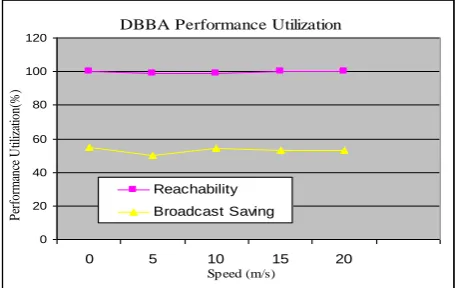
Mobility hasan inverse impact on broadcasting algorithms, so different speeds of 0, 5, 10, 15, and 20 m/s have been tested for DBBA, BA and CWZ algorithms to check the reachability and broadcast saving for DBBA and other tested algorithms. It is seen from Fig. 9 that DBBA does not affect from mobility increasing; this is due to the dynamic nature of level selections of DBBA, so DBBA is suitable for MANETs applications.
DBBA Performance Utilization
0 20 40 60 80 100 120
0 5 10 15 20
Sp eed (m/s)
P
erfor
m
anc
e U
til
iz
at
ion(
%)
Reachability Broadcast Saving
Fig. 9. DBBA performance comparison using different mobility speeds.
VI. CONCLUSION AND FUTURE WORK
DBBA is a fully distributed algorithm that depends on
small part of topology information; as DBBA use less control overhead and DBBA is able to adapt dynamic network topologies changes as it is seen from the tested results, whereas distance-based schemes have to sacrifice one goal to achieve the other, so DBBA accomplishes efficiency and reach ability without compromising any of them. DBBA also save energy by reducing the unnecessary rebroadcast in the highest network density and reduce the number of the MAC layer carrier sensing so DBBA is appropriate to MANETs applications. It is recommended to use DBBA with Ad hoc on Demand Distance Vector (AoDV) routing protocol; since AODV is easy and extendable routing protocol [17]. After using DBBA with AoDV the QoS parameters can be checked and compared with the original AoDV. Finally, artificial intelligence can be used with DBBA to reduce back off time through optimal level selection.
REFERENCES
[1] M. Abolhasan, T. Wysocki, and E. Dutkiewicz, “A review of routing protocols for mobile ad hoc networks,” Ad Hoc. Networks, pp. 1-22, 2004.
[2] A. Schumacher, S. Painilainen and T. Luh, “Research study of MANET routing protocols,” Department of Computer Science University of Helsinki, Finland, Helsinki, 2004.
[3] J. Novatnack, L. Greenwald, and H. Arora, “Evaluating Ad hoc routing protocols with respect to quality of service,” in Proc. IEEE International Conference on Wireless and Mobile Computing,
Networking and Communications (WiMob'2005), 2005, vol. 3, pp.
205-212.
[4] M. S. Azad et al., “Performance comparison of proactive and reactive multicast routing protocols over wireless mesh networks,”
International Journal of Computer Science and Network Security, vol.
9, no. 6, pp. 55-62, June 2009.
[5] C. Perkins, E. Belding-Royer, and S. Das, “Ad hoc on demand distance vector (AODV) routing,” Request for Comments: 3561, Category:
Experimental,July 2003.
[6] E. M. Royer and C.-K. Toh, “A review of current routing protocols for ad hoc mobile wireless networks,” IEEE Personal Communications, vol. 6, no. 2, pp. 46–55, April 1999.
[7] D. Liarokapis, A. Shahrabi, and C. Raeburn, “Constant-width zones broadcast algorithm in mobile Ad-hoc networks,” Lecture Notes in
Computer Science, vol. 5186, pp. 159-168, 2008.
[8] C. Zhu, M. J. Lee, and T. Saadawi, “A border-aware broadcast scheme for wireless ad hoc network,” in Proc. IEEE Consumer
Communications and Networking Conference, Jan. 2004, pp. 134-139.
[9] B. Williams and T. Camp, “Comparison of broadcasting techniques for mobile ad hoc networks,” in Proc. the 3rd ACM International Symposium on Mobile Ad Hoc Networking & Computing, 2002, pp. 194–205.
[10] L. Tan, X. L. Zhan, and J. Li, "A novel tree-based broadcast algorithm for wireless ad hoc networks," International Journal of Wireless and
Mobile Computing, vol. 1, no. 2, pp. 156-152, 2006.
[11] B. Williams and T. Camp, “Comparison of broadcasting techniques for mobile ad hoc networks,” in Proc. the 3rd ACM International Symposium on Mobile Ad Hoc Networking & Computing, 2002, pp. 194–205.
[12] W. Peng and X. Lu. “On the reduction of broadcast redundancy in mobile ad hoc networks,” in Proc. the 1st ACM International Symposium on Mobile Ad Hoc Networking & Computing, 2000, pp. 129-130.
[13] T. S. Rappaport, Wireless Communications, Prentice Hall PTR, 1996. [14] A. Saravanan and T. Manikandan, “Guaranteed delivery based on
1-hop neighbor information and reducing the redundancy in transmission,” International Journal of Recent Trends in Engineering, vol. 1, no. 1, May 2009.
[15] J. Li and P. Mohapatra, “a novel mechanism for flooding based route discovery in ad hoc networks,” Wireless Networks, vol. 12, no. 6, pp. 771-787, November 2006.
[16] Y. Zhang and W. Li, “An integrated environment for testing mobile ad-hoc networks,” in Proc. the Third ACM International Symposium
on Mobile Ad Hoc Networking and Computing (MobiHoc), 2002, pp.
104-111.
Basim Alhadidi is presently a full professor at the Computer Information Systems Department at Al-Balqa’ Applied University, Jordan. He earned his PhD degree in 2000, in engineering science (computers, systems and networks). He received his MSc degree in 1996 in engineering science (computer and intellectual systems and networks). He published many research papers in many topics such as: computer networks, image processing, and artificial intelligence. He is a reviewer for several journals and conferences. He was appointed in many conferences as a keynote speaker, reviewer, track chair and track co-chair.
Faisal Y. Alzyoud received his Ph.D. degree with