IJSRSET185305 | Published : 28 April 2018 | March-April-2018 [(5) 3 : 38-42]
Themed Section : Engineering and Technology © 2018 IJSRSET | Volume 5 | Issue 3 | Print ISSN: 2395-1990 | Online ISSN: 2394-4099
38
Performance of Mobile sink Node based Geographic routing
protocol in Wireless Sensor Networks
Baranidharan.V1, Kiruthiga Varadharajan 2, Mahalakshmi.G3
1Assistant Professor, Bannari Amman Institute of Technology, Sathy, Tamil Nadu, India 2PG Scholar, Annamalai University, Chidamabara, Tamil Nadu, India
3UG Scholar, Bannari Amman Institute of Technology, Sathy, Tamil Nadu, India
[email protected], [email protected]2,[email protected]3
ABSTRACT
The sensor nodes in wireless sensor networks are very tiny, smaller in size, low cost and low energy consumption. They may prone to many failures. To ensure reliable multi-hop multipath communication between all the other nodes the routing protocols between all other nodes, the routing protocols are used in WSN. The geographic routing protocols is more capable routing protocols among the various others routing protocols in WSN due to its simplicity and scalability. The aim of this paper is to analyse the mobility sink in geographic routing and to observe its performance metrics such as Average energy consumption, End-to-End delay and Packet delivery ratio through the extensive simulations and graphical representation.
Keywords: Geographic Routing, Lifetime, Initial Battery Capacity and End To End Delay
I. INTRODUCTION
Recent innovations in the technology led to the use of many battery and low cost sensor nodes and have a diverse field of the application of WSN. Those sensor nodes are mainly involved in the collecting the data related to the environmental temperature, humidity soil fertility of the boilers in chemical industries etx. In these areas, the human interventions are very less. These nodes are placed/deployed in a phase which is not easily accessed by the human directly. These sensor networks provides a solution to any real time problems in the areas of infrastructure maintenance, disaster management, military sensing, traffic management etc.
The sensor nodes are deployed in an ad-hoc manner in the area of the concern and somewhere nearby the networks also contains a mobile sink nodes that collects the data from the all others sensor nodes
for the further analysis. The deployment of all the sensor nodes will result into an unknown and unusual topology, which will be a problematic issue, there are some factors that govern the design of various sensor nodes like geographic area, cost for production, construct in hardware, scalability, fault tolerance etx, Sensor networks many have either static or mobile nodes the static nodes are placed in a predefined position the mobile nodes are placed randomly. Reliability and power consumption are the key concern of wireless sensor networks. The main aim of the paper is to analyse the scenarios with mobility sink through an extensive simulation of widely used approach called geographic routing this routing shows the various factor affecting the functioning of the entire networks.
challenge the WSN. Section II summarizes the concept of geographic routing with mobility based sink and its routing protocols. In section III shows the results and simulation based on concerned protocols. The paper is concluded in section IV with future work.
II. GEOGRAPHIC ROUTING WITH MOBILITY BASED SINK
As described in Introduction, the sink receives & collects the data information from all the other sensor nodes for further analysis consider the mobile based NPF is a scenario of the sink to route the packets from the source to destination, the geographical routing will takes location in to an consideration this geographic routing is approach to the sensor networks the data aggregation is an important process in the sensor networks the data aggregation is a helpful way to decrease the number of transmission packets of various source nodes.
A. Routing Protocols
In a WSN setup, the ore energy is consumed by the communication unit in the sensor nodes. In practice the multi-hop transmission from the source to destination requires a maximum energy. In greedy forwarding strategies, the data transmission for the one to other nodes depends upon the distance. ie. The node sends the packets to the neighbours, the far away in border area of the transmission range will leads to greater probability mobility of the packets due to the signal attenuation.
Figure 1. Sensor Network Scenario
The distance between a node S and projection A of the neighbour node A on to the line connecting S and destination D is defined Here the node A is the neighbour of the node S with most forward progress the neighbour having a positive progress are having a tremendous nodes in forward direction. In the above figures, the neighbours A, B, C, D, E and F are in forward direction the G nodes is in backward direction.
B. Problems with Geographic Routing Protocols
The chief energy consumed in sensor is communication unit multi hop communication is very much essential for transmitting data from the source to destination (sink) the energy consumption increases with decrease the communication distance. The communication distance can be reduced by using mobility based sink by programming the each sensor nodes. Programming of the each sensor nodes to route the data from the node to this sink for further transmission. There is a big issue in being a multiple dynamic/mobility sink is that the deployment to be decided. The data relying load can be balanced by the nodes. This type of problem is called as facility location problem, where the given number of facilities and customs the optimal of the facilities to be equally burdened. These protocols are also have a node probability induced error known and Link and Loop problems.
III. CONCERNED PARAMETERS
01 to 10. Sensor numbers define the total number of sensors present in the given topology, while transmission time defines the time taken in the network for data transmission from the source to its destination.
IV. SIMULATION AND GRAPHS
Through some extensive simulations we have analysed effect of the specific parameters on the given sensor networks and how the variations in these parameters change the performance and what their consequences are is measured. The simulator takes the consideration that uses the NFP algorithm this simulator takes into the consideration of various factors and parameters mentioned in section 3 the graphs are explains the effect of these parameters on each other.
A. Average Energy Consumption
Energy consumption is the most critical concern in the WSNs. One of the main purposes in this paper is to achieve energy conservation while balancing the energy consumption among sensor nodes, so as to extend the lifetime of the network. In the literature, several definitions about the lifetime of the WSN has been proposed, including the time until the first sensor node dies, the time until half of the sensor nodes die and the time until the last sensor node dies. As the communication range of the sensor nodes is limited and much smaller compared with the sensing area, the WSN is disconnected if all the key nodes in the vicinity of the sink drain their energy. Therefore, this paper defines the lifetime of the network as the time until all the key sensor nodes in the vicinity of the sink die.
Figure 2. Average energy consumption
B. Packet Delivery Ratio (PDR)
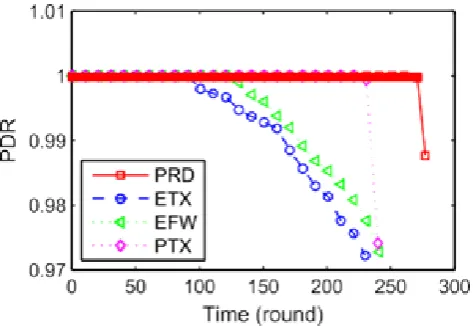
Packet delivery ratio is the ratio of the number of packets successfully received by the sink to the total number of packets sent by the sensor nodes. It is important to guarantee packet delivery ratio when designing a WSN.
Figure 3. Packet Delivery Ratio (PDR)
As all the four metrics select sensor nodes with the best link quality to act as father nodes, the packet delivery ratio is nearly 100% at the beginning of the lifetime in the simulations. Then the packet delivery ratio decrease distinctly in all the four metrics. However, both of the packet delivery ratios in ETX and EFW show a much earlier decrease than the ones in PRD and PTX.
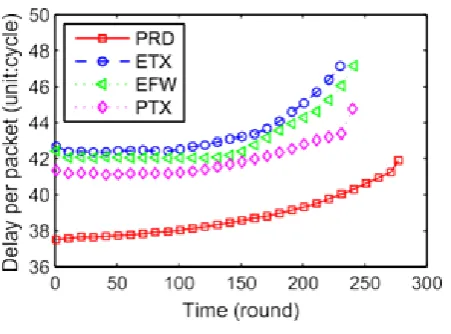
The end-to-end delay is the total delay of a data packet from the source node to the sink, including the processing delay, the queuing delay, the transmission delay, and the propagation delay. In the WSN, as the data packet size is small and the distance between two pair of sensor nodes is very short considering that the propagation speed is almost the velocity of light, we can assume that the time spent for each attempt to transmit one packet to the next hop is a constant. We define cycle as the time needed to transmit one packet to the next hop. This paper uses the cycles needed to transmit one packet of data from its source to its destination, including the retransmissions, to measure the end-to-end delay in the simulations. In the real WSNs, the end-to-end delay can be measured with time stamp counter.
Figure 4. End-to-End Delay
The average end-to-end delay needed to deliver one packet data to the sink during the network lifetime. The end-to-end delay keeps almost stable at the beginning of the network lifetime, and then increase slowly. In ETX and EFW, the end-to-end delay increases mainly because that the length of the routing path increases when some of the sensor nodes die. The increase of the end-to-end delay is that sensor nodes tend to choose father sensor nodes with higher residual energy, whereas in PRD sensor nodes with higher residual energy as well as lower end-to-end delay are preferred to be selected as father nodes. When some sensor nodes that are the optimal choices
the length of the routing path and thus the increase of end-to-end delay. The end-to-end delays of ETX, EFW and PTX are similar with each other in each round, because none of them attempt to select paths with lower delay. Nevertheless, PRD effectively chooses paths with the lowest delay, contributing to the best performance of end-to-end delay compared with ETX, EFW and PTX. Moreover, the performance of end-to-end delay in PRD is improved by about 11% compared with ETX.
V. CONCLUSION
This paper proposes a novel link-delay aware energy efficient routing metric called PRD for the routing path selection tailored for WSNs deployed in harsh environments, where the networks are exposed to extremely long end-to-end delay and unbalanced energy consumption among sensor nodes. PRD captures the predicted remaining deliveries within one unit of delay, which reflects the ability of each sensor node to forward packets. PRD also takes the end-to-end delay into consideration. The main purposes of PRD are to balance the energy consumption of the sensor nodes and extend the network lifetime, as well as controlling the end-to-end delay. Large-scale simulations are conducted to evaluate the performance of PRD. The results indicate that PRD outperforms traditional metrics such as ETX, EFW and PTX in terms of end-to-end delay, energy consumption and network lifetime performance, while guaranteeing high packet delivery ratio.
VI.
REFERENCES[1]R. C. Carrano, D. Passos, L. C. S. Magalhaes, and C. V. N. Albuquerque, “Survey and taxonomy of duty cycling mechanisms in wireless sensor networks,”
IEEE Commun. Surveys Tuts., vol. 16, no. 1, pp. 181– 194, 1st Quart., 2013.
Lee, “Compressive sensing: From theory to applications, A survey,” J. Commun. Netw., vol. 15, no. 5, pp. 443–456, 2013.
[4]J. Yan, M. Zhou, and Z. Ding, “Recent advances in energy-efficient routing protocols for wireless sensor networks: A review,” IEEE Access, vol. 4, pp. 5673– 5686, 2016.
[5]N. A. Pantazis, S. A. Nikolidakis, and D. D. Vergados, “Energy-efficient routing protocols in wireless sensor networks: A survey,” IEEE Commun. Surveys Tuts., vol. 15, no. 2, pp. 551–591, 2nd Quart., 2013.
[6]O. Gnawali, R. Fonseca, K. Jamieson, D. Moss, and P. Levis, “Collection tree protocol,” in Proc. 7th ACM Conf. Embedded Netw. Sensor Syst., 2009, pp. 1–14. [7]D. S. De Couto, D. Aguayo, J. Bicket, and R. Morris,
“A high-throughput path metric for multi-hop wireless routing,” Wireless Netw., vol. 11, no. 4, pp. 419–434, 2005.
[8]R. Draves, J. Padhye, and B. Zill, “Routing in multi-radio, multi-hop wireless mesh networks,” in Proc. ACM 10th Ann. Int. Conf. Mobile Comput. Netw., 2004, pp. 114–128.
[9] G. Mao, B. Fidan, and B. D. O. Anderson, “Wireless sensor network localization techniques,” Comput. Netw., vol. 51, no. 10, pp. 2529–2553, 2007.
[10]S. Lin, J. Zhang, G. Zhou, L. Gu, J. A. Stankovic, and T. He, “ATPC: Adaptive transmission power control for wireless sensor networks,” in Proc. ACM 4th Int. Conf. Embedded Netw. Sens. Syst., 2006, pp. 223–236.
[11]R. Khoshkangini, S. Zaboli, and M. Conti, “Efficient routing protocol via ant colony optimization (ACO) and breadth first search (BFS),” in Proc. IEEE Int. Conf. Cyber, Phys. Soc. Comput., 2014, pp. 374– 380.