Original Research Article
A study of knowledge and behaviour regarding blood donation among
medical college students of Ajmer, Rajasthan, India
Bharat Meharda
1, Mahesh Keswani
1*, Pradeep Kumar Choudhary
1, Ankit Mehra
2INTRODUCTION
Human blood is an essential element of the human life and there are no substitutes for it.1 It is specialized body fluid in humans that delivers necessary substances such as nutrients and oxygen to the cells and transports metabolic waste products away from that same cells.2
Blood is the most donated tissue in medical practice and a veritable tool in many live-saving situations when used judiciously.3 Human blood is only manufactured by human beings and blood donation is the only way of acquiring blood to meet emergency requirements in cases of road traffic accidents, complications of pregnancy and childbirth, various anaemic disorders and surgical emergencies.4 About 80% of maternal deaths are due to obstetric complications of pregnancy and the most common cause of maternal deaths is the obstetric haemorrhage and it can be save by blood transfusion.5
Millions of lives are saved each year through blood transfusions but yet the quality and the safety of blood transfusion is still a concern particularly in the developing countries.6 The World Health organization recommended that donated blood should be tested for HIV, Hepatitis B, Hepatitis C, Syphilis, Malaria and other infections because these diseases can be transmitted to the recipients.7The need for blood is growing day by day as a result of the advancement in the clinical medicine and unavailability of blood is vital for good quality health services.8 In many developing countries majority of voluntary donors are replacement donors who donate blood for their friends, relatives and other alternative is paid donors which have a significant risk of transfusion transmitted infections.9
Blood can save millions of lives. Even though people do not donate blood regularly there is a constant effort to balance the supply and demand of blood.10 It is estimated
ABSTRACT
Background: Blood is specialized body fluid in humans that delivers necessary substances such as nutrients and oxygen to the cells and transports metabolic waste products away from that same cells.
Methods: The study was conducted among undergraduate medical students of J.LN. Medical College, Ajmer, Rajasthan, India in March 2019. It was a descriptive cross‑sectional study among 1st professional MBBS students.
Results: The study participants included age range of 17-20 years. 96 (78.04%) study participants were knows blood group “O” is a universal donor and 94 (76.42%) were know blood group “AB” is universal recipient. majority of study participants 48 (45.28%) not donate due to fear of procedure.
Conclusions: Role of health care personnel and medical students of a medical college for blood donation are pivotal.
Keywords: Blood, Donation, Knowledge, Behaviour
1
Department of Community Medicine, 2Department of Dermatology, J.L.N. Medical College, Ajmer, Rajasthan, India
Received: 15 April 2019
Accepted: 29 May 2019
*Correspondence:
Dr. Mahesh Keswani,
E-mail: [email protected]
Copyright: © the author(s), publisher and licensee Medip Academy. This is an open-access article distributed under the terms of the Creative Commons Attribution Non-Commercial License, which permits unrestricted non-commercial use, distribution, and reproduction in any medium, provided the original work is properly cited.
meet a nation’s most basic requirements for blood.3
National AIDS Control Organization’s (NACO) statistics show that the annual rate of blood donation in India is about 6.8 million units, against the requirement of 12.8 million units.11 College students particularly from medical college can be a very good source of quickly accessible for blood if they are motivated and are willing to be voluntary blood donors.
Objectives
To assess the knowledge towards blood donation among undergraduate medical students.
To assess the behaviour towards blood donation among undergraduate medical students.
METHODS
The study was conducted among undergraduate medical students of J.LN. Medical College, Ajmer, Rajasthan, India in March 2019. It was a descriptive cross‑sectional study among 1st professional MBBS students. A pretested structured questionnaire was used as a study tool. Appropriate changes were made in the schedule taking into account the experiences of the pretest. The questionnaire consisted of 2 sections. Section A was designed to collect socio‑demographic information and Sections B contained question regarding knowledge and behaviour towards blood donation.
Total 150 students were in the 1st professional MBBS and 123 students were present on the day of administration of questionnaire. All 123 students
expressed their consent to participate in the study so all were enrolled in the study. All participants were given a briefing about objective of the study and assured confidentiality in collection of personal data. There was health awareness session for the students and they were given proper knowledge about the importance of blood donation. Data was analyzed and results were expressed as using proportional percentage.
RESULTS
Table 1 shows that the study sample consisted of 68 males and 55 females. The study participants included age range of 17-20 years. Majority of male participants belonged to 18 years 39 (57.35%) followed by 19 years 20 (29.41%), 20 years 6 (8.82%) and 17 years 3 (4.41%) and Majority of female subjects belonged to 18 years 29 (52.72%) followed by 19 years 18 (32.72%), 20 years 5 (9.90%) and 17 years 3 (5.45%).
Table 2 shows that 96 (78.04%) study participants were knows blood group “O” is a universal donor and 94 (76.42%) were know blood group “AB” is universal recipient. 121 (98.37%) were know regarding 4 type of blood group and 107 (86.99%) were know own blood group. 98 (79.67%) were know 45 kg is minimum weight to donate blood and 104 (84.55%) were know appropriate age for donate the blood that is 18 years to 60 years. 101 (82.11%) were know after 90 days blood can be donate if donated once, only 41 (33.33%) study participants know that 350 ml. blood is collected in one donation and all 123 (100%) study participants were know that blood must be tested for HIV, Hepatitis B, Hepatitis C, Syphilis and Malaria before blood collection.
Table 1: Age and gander wise distribution of study subjects (n=123).
Age (years)
Male Female Total
Number Percentage (%) Number Percentage (%) Number Percentage (%)
<17 03 4.41 03 5.45 06 4.87
18 39 57.35 29 52.72 68 55.28
19 20 29.41 18 32.72 38 30.89
>20 06 8.82 05 9.09 11 8.94
Total 68 100 55 100 123 100
Table 2: Knowledge regarding blood donation among study subjects (n=123).
Correct knowledge regarding blood donation Number Percentage (%)
Which blood group is universal donor? 96 78.04
Which blood group is universal recipient? 94 76.42
Types of blood groups are? 121 98.37
Do you know your blood group? 107 86.99
What is the minimum weight to donate blood of donor? 98 79.67
What is the appropriate age to donate blood of donor? 104 84.55
How much ml. blood is collected in one donation? 4 1 33.33
Can blood collect without being tested for certain diseases? 123 100
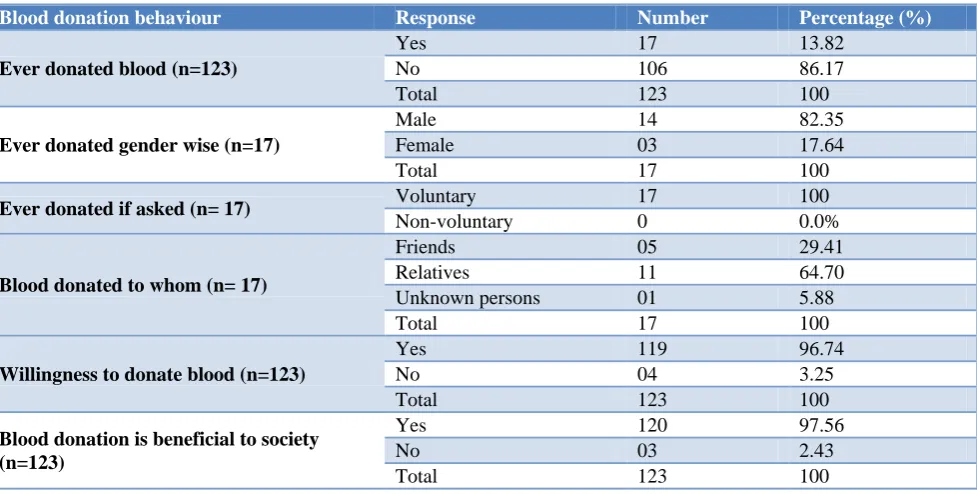
Table 3: Distribution of study subjects among ever donated blood and behaviour towards blood donation. (n=123)
Blood donation behaviour Response Number Percentage (%)
Ever donated blood (n=123)
Yes 17 13.82
No 106 86.17
Total 123 100
Ever donated gender wise (n=17)
Male 14 82.35
Female 03 17.64
Total 17 100
Ever donated if asked (n= 17) Voluntary 17 100
Non-voluntary 0 0.0%
Blood donated to whom (n= 17)
Friends 05 29.41
Relatives 11 64.70
Unknown persons 01 5.88
Total 17 100
Willingness to donate blood (n=123)
Yes 119 96.74
No 04 3.25
Total 123 100
Blood donation is beneficial to society (n=123)
Yes 120 97.56
No 03 2.43
Total 123 100
Table 4: Distribution of study subjects who never have donated blood for reasons of unwillingness to donate (n=106).
Reasons for not donating blood among non-donor students Number Percentage (%)
No support from family 10 9.43
Fear of procedure 48 45.28
Fear of weakness 05 4.71
Fear of contracting any disease 08 7.54
Why to donate to unknown 03 2.83
No one asked them 32 30.18
Total 106 100
Table 5: Source of information regarding blood donation among study subjects (n=123).
Source of information regarding blood donation Number Percentage (%)
School & college 64 52.03
Blood donation camps 09 7.31
Internet 41 33.33
Television 52 42.27
Family / Friends 28 22.76
News paper 37 30.08
Table 3 shows that out of 123 study participants only 17 (13.82%) were ever donated blood. Out of 17 who ever donated blood 14 (82.35) were male and 3 (17.64%) were female. Out of 17 all 100% donated blood voluntary. Majority of blood recipient were relatives 11 (64.70%) followed by friends 5 (29.41%). Out of 123 study participants 119 (96.74%) were willing to donate blood and only 4 (3.25%) were not willing to donate blood. Out of 123 study participants 120 (97.56%) were believe that blood donation is beneficial to society.
Table 4 shows that majority of study participants 48 (45.28%) not donate due to fear of procedure followed by 32 (30.18%) not asked them for blood donation, among 10 (9.43%) study subjects were not supported by family for blood donation and only 3 (2.83%) were think that there is no need to donate blood to unknown person.
DISCUSSION
All the study participants did not have a complete knowledge regarding the various aspects of voluntary blood donation. Study participants had a good knowledge of blood donation whereas poor blood donation behaviour was observed in the present study. Correct knowledge and positive behaviour for the blood donation in community is essential. In this study 123 students of 1st professional MBBS participated. The study participants included age range of 17-20 years.
79.67% participants had knowledge regarding the minimum necessary body weight for blood donation ie 45 kg. Similar study done by Desai et al found 80% study participants know minimum necessary body weight for blood donation whereas study done by Alfouzan found only 40.10%.12,13 Majority 84.55% of study participants were aware of the appropriate age for blood donation ie 18 years to 60 years. Similar findings observed studies conducted by Desai et al 78.20% and Chauhan et al95% of the students had correct knowledge regarding appropriate age for blood donation.12,14 13% of study participants did not know own blood group. This was similar to study conducted by Solanki et alin the Udaipur city Rajasthan.15
Majority 86.17% of study participants had not been donated blood. A similar study carried out in Sikkim5 indicates 87.3% never were donated blood whereas study done by Meinia et al reported 56.70% study participants never donated blood.16 Majority of 96.74% participants were willing to donate blood as comparing the study done by Bachhotiya et alin medical students where 93.77% study participants were willing to donate blood.17 Most of the students 97.56% felt that blood donation is beneficial to society similar finding found in study done by Solanki et al.15
45.28% study participants were respond that most common reasons for not donating blood among the non-donors were the fear of procedure of blood donation and 30.18% were no one asked them to donate. These findings are similar to studies done by Solanki et al and Manikanandan et al.15,18 The main source of information regarding blood donation among the participants was educational institute followed closely behind by television. The least informative source was blood donation camps. Chauhan et al has reported similar results like most informative regarding blood donation was educational institute followed by television.14
CONCLUSION
Role of health care personnel and medical students of a medical college for blood donation are pivotal. In this study knowledge regarding blood donation among study subjects were good whereas initiation of blood donation is very low so blood donation by the medical students should be regular basis for creating awareness on blood
donation and set an example for others. There should be celebration on 14 June world blood donor day and 17 April world haemophilia day at grass route level for increase the awareness among general masses in the society and it would be increase the volunteer blood donors.
ACKNOWLEDGEMENTS
Authors acknowledge the immense help received from the scholars whose articles are cited and included in references of this manuscript. The authors are also thankful to 1st professional MBBS students of J.L.N. Medical College, Ajmer, Rajasthan.
Funding: No funding sources Conflict of interest: None declared Ethical approval: Not required
REFERENCES
1. Bala SS, Handoo S, Jallu AS. Gender differences in blood donation among donors of Kashmir valley. IOSR J Dental Med Sci. 2015;14(2):116-9.
2. Singh Neelam, Semwal B.C., Maurya Krishna,
Khatoon Ruqsana, Paswan Sarvan. Artificial blood: Atool for survival for humans. Int Res J Pharmacy 2102;3(5):119-23.
3. World Health Organization. A global framework for
action. Towards 100% voluntary blood donation.
Available at https://www.who.int/bloodsafety/
publications/9789241599696_eng.pdf. Accessed 9 April 2019.
4. World Health Organization. Global database on blood safely: report Available at https://www.who. int/bloodsafety/GDBS_Report_2001-2002.pdf. Accessed 11 April 2019.
5. Shenga N, Pal R, Sengupta S, Pal S. Correlates of voluntary blood donation among the people in a hill
capital in India. Int J Green Pharmacy.
2009;3(2):167-74.
6. World Health Organization. Universal Access to
Safe Blood Transfusion. Available at
https://www.who.int/bloodsafety/StrategicPlan2008-2015AccessSafeBloodTransfusion.pdf. Accessed on 13 April 2019.
7. World Health Organization. Guidelines on
Assessing Donor Suitability for Blood Donation.
Available at https://www.who.int/bloodsafety/
publications/BDSelection_WHOGuideAssessingDo norSuitability4BloodDonation.pdf. Accessed on 13 April 2019.
8. Gupta A. The status of blood banking in India. Health Millions. 2000;26(2):35-8.
9. Wake D, Cutting W. Blood transfusion in
developing countries: problems, priorities and practicalities. Tropical Doctor. 1998;28:4-8.
technology university: a comparative cross sectional study. BMC Hematol. 2017;17(20):1-10.
11. National AIDS control Organization (NACO).
Assessment of NACO Supported blood banks A
Preliminary Report 2016. Available at:
http://naco.gov.in/sites/default/files/Assessment%20 of%20NACO%20supported%20BBs%20in%20Indi a.pdf. Accessed on 14 April 2019.
12. Desai KN, Satapara V. A study on knowledge, attitude, and practice on blood donation among health professional students in Anand: Gujarat. J Applied Hematol. 2014;5(2):51-3.
13. Alfouzan N. Knowledge, attitudes, and motivations towards blood donation among king Abdulaziz medical city population. Int J Family Med. 2014;539670:1-8.
14. Chauhan R, Kumar R, Thakur S. A study to assess the knowledge, attitude and practices about blood donation among medical students of a medical college in north India. J Family Med Primary Care. 2018;7(4):693-7.
15. Solanki SL, Mali A. Study on Blood Donation Among Medical Students of Udaipur City, Rajasthan. Int J Current Res Rev. 2018;10(16):1-4.
16. Meinia SK, Kumar Y, Meinia A, Singh G, Dutt N. A study to assess the knowledge, attitude, and practices about voluntary blood donation amongst the undergraduate medical students in Solan, north India. Int J Med Sci Public Health. 2016;5(1):2550-4.
17. Bachhotiya A, Arora VK, Mahashabde P. Evalution
of intervention on voluntary blood donation among 1st prof medical and dental students of index medical college, Indore (MP), India. National J Community Med. 2014;5(2):223-6.
18. Manikanandan S, Srikumar R, Ruvanthika PN. A study on knowledge attitude, and practice on blood donation among health professional students in Chennai, Tamil Nadu, South India. Int J Sci Res Publications. 2013;3(3):1-4.
Cite this article as: Meharda B, Keswani M,
Choudhary PK, Mehra A.A study of knowledge and