Effects of Solvent on the Structure and Properties of
Titanium Dioxide Nanoparticles and Their Antibacterial Activity
Muhammad, Bilal*
+; Bibi, Ambreen; Javed, Ali; Irfana, Shahid
Department of Chemistry, Kohat University of Science & Technology, Kohat-26000 (Khyber Pakhtunkhwa) PAKISTAN
Adnan, Muhammad
Department of Botany, Kohat University of Science & Technology, Kohat-26000 (Khyber Pakhtunkhwa) PAKISTAN
Syed Shah, Hassan; Ullah Khan, Asad
Islamia College University, Peshawar, (Khyber Pakhtunkhwa) PAKISTAN
ABSTRACT: Titanium dioxide is semiconductor metal oxide having many applications in photocatalytic activities, cosmetics and in the food industry. It exists in three major crystalline forms: anatase, rutile and brookite. The solvents play a major role in the synthesis, stability and morphology of the metal oxide nanoparticles. It affects both the phas, and particle size of metal oxide.
The main focus of the present study is to establish the effects of solvent on the phase of TiO2
nanoparticle. Titanium dioxide (TiO2) nanoparticles have been synthesized by the sol-gel method
using different solvents. The XRD results showed that the average crystallite size of all the samples
was in the range of 5-25 nm. TiO2 nanoparticles prepared in different solvents gave different FT-IR peaks.
AFM data clarified that the majority of samples showed spherical shape with average particle size ranging from 10-68 nm. The nanoparticles prepared in diethanolamine, acetic acid and propionic acid solvents showed comparatively good antibacterial activity due to the rutile phase of the nanoparticles. the pH of the solvent also influences titanium dioxide structure and antibacterial properties.
KEYWORDS: Solvents effect; Titanium dioxide Nanoparticles; sol-gel method; Phase of TiO2.
INTRODUCTION
Nanotechnology expressed huge advances, as it has a broad range of applications in the field of catalysis, electronics, optical fibers, agricultural, bio-labeling and in other research areas [1-3]. It also has wide-ranging medical as well as therapeutic applications [4, 5].
The nanoparticle may be organic (carbon nanotubes) and inorganic (magnetic, noble metal and semiconductor) [6]. The most commonly in use nanomaterials are metal and metal oxide [7, 8]. Nanoparticles are formed naturally (photochemical reactions, volcanic eruptions, woods fires,
*To whom correspondence should be addressed.
+E-mail: [email protected]
262 Research Article erosion, flora and fauna) as well as in the laboratory [9, 10].
Among the metal oxide, titanium dioxide got great attraction because of its low cost, special physio-chemical properties and thermal stability [11]. It has many applications which include bactericidal, self-cleaning building materials like bathroom floor and hygienic ware, etc [12]. Titanium dioxide (TiO2) exists in three major
crystalline forms: anatase, rutile, and brookite [13]. Anatase, rutile and brookite have high refractive index values which are 2.488, 2.609 and 2.583 respectively. Among them, rutile is highly stable and brookite is unstable while anatase is metastable phase [14]. The anatase is considered as the most photochemically active phase of titanium dioxide (TiO2) [15, 16]. Currently,
TiO2 is synthesized by physical, chemical and biological
routes. Physical routes comprise physical techniques like mechanical milling and laser ablation etc. Chemical routes for nanoparticle synthesis involve the use of chemicals while biological routes include the use of different plants and microorganism [11]. Nanoparticles obtained by chemical routes consist of different processes such as reverse micelle method, sol-gel method, hydrothermal method, impregnation, ion exchange, precipitation and co-precipitation, solvothermal and chemical vapor deposition methods. The most feasible method for titanium dioxide synthesis is the sol-gel method, because of its ability to control the surface to bulk ratio. The method has greater advantages over other methods which include high purity, excellent homogeneity of the nanostructure materials, the low temperature required and other reaction conditions, which can also be simply controlled[17-21].
The sol-gel process occurs in three steps, hydrolysis, condensation and growth or gelation [22]. The solvents play an important role in the synthesis of nanoparticles. The precursor can react with a variety of solvents in a specific way and produced different products. Its influence on the phase and shape of the particles. Different phases of titanium dioxide could be formed in different solvents. The supercritical carbon dioxide (CO2) solvent leads to the formation of the anatase phase
of titanium oxide nanoparticles, while the use of methanol or the combination of methanol and ethanol as a solvent leads to the synthesis of the rutile phase [23]. Similarly, the use of isopropoxide and glycerol solvent in the synthesis of titanium oxide nanoparticles favor the tetragonal structure of anatase [24].
The synthesis of the anatase phase from amorphous titania using ethyl alcohol and sol-gel technique is also revealed [25].
However, the detail influence of the solvent on the structure of TiO2 is not reported. Therefore, the aim of
this work is, to synthesis titanium oxide nanoparticles using different solvents and checks its potential use against different bacterial strains.
EXPERIMENTAL SECTION Materials
Methanol (99.9%) and propionic acid (99.9%), were purchased from Fisher scientific (England). Trisodium citrate dehydrate (99.0%), acetonitrile (99.9%), acetone (99.8%), diethanolamine (98%), n-hexane (99.0%), acetic acid (99.8%) and diethyl ether (99.9%) were obtained from Merck (Germany). Ammonia solution (28-30%) was purchased from Analar BDH (England). Titanium dioxide (98.0%) was purchased from BDH limited pool England.
Preparation of Titanium dioxide
TiO2 nanoparticles were prepared in different solvents
(water, methanol, acetone, n-hexane, acetic acid, propionic acid, diethyl ether acetonitrile, Ammonia and diethanolamine) using the sol-gel method. 1g of TiO2
was dissolved in a given solvent and stirrer it. In some solvents where TiO2 was not completely soluble,
it was firstly dissolved in a small quantity of water and then poured in a given solvent. The prepared solution was stirred for some time. Meanwhile, 4g trisodium citrate (C6H5Na3O7.2H2O) was dissolved in that solvent
in which TiO2 solution was prepared, which was then
drop wise added into the TiO2 solution to maintain the
ratio of titania and trisodium citrate as 1:4. The stirring was continued for 2 hours to obtain a homogenous mixture. The homogenous mixture was heated at below the boiling point of the given solvent at different temperature as given in Table 1. The heating and stirring were continued until the solvent was completely removed. The prepared materials were then heated at 110oC in a conventional
oven for 24 h to obtain titania nanoparticles [26]. The pH and color of the solution at the start and end of the reaction were monitored.
Characterization of Prepared TiO2
using FT-IR spectroscopy, Powder X-Ray Diffraction (PXRD) and Atomic Force Microcopy(AFM). Functional groups of the prepared nanoparticles were analyzed by FTIR Bruker, Pensor 27. The analysis was performed at room temperature and the sample was analyzed in terms of wave number ranging from 4000-400cm-1 using KBr
method. PXRD was performed using Rigaku D/Max-2400. X-Ray diffractometer (Cu Kα radiation, λ = 1.54 Å). The flat-palate sample was analyzed using 40 kV voltage and 40 mA current. The average crystallite size was calculated using the Scherer formula.
t = Kλ / βCosθ
Where t is the average crystallite size, λ the x-ray wavelength, β the Full Width at Half Maximum (FWHM) of the diffraction peak (radian), K is a coefficient (0.89). All the peaks were obtained in the range of 10-70 two theta positions [16]. Morphological characterization was performed using Atomic force microcopy (Jeol SPM 5200). The AFM was run at a frequency Si cantilever of 125 mm length, force constant 42 N m-1 and resonance
frequency 330 kHz were used.
Antibacterial assay
The synthesized titanium dioxide nanoparticles were screened against four bacterial strains (ATCC. Escherichia coli, MDR. Escherichia coli, ATCC. Pseudomonas aeruginosa, and MDR. Pseudomonas aeruginosa) using Agar well diffusion method [27]. Ceftriaxone (CRO) was used as a standard drug throughout the experiments. Distilled water (W) was used as a negative control. The experiments were performed at various concentrations. The equipment was autoclaved and sterilized at 121 ˚C for 30 minutes. In each petri plate, 25 mL of prepared nutrient media (MHA) was poured and allowed to cool. With the help of sterile swabs /wire loops, the bacterial strains were spread on the nutrient agar plates and solidified. Each Petri plate was punched in 6 wells with a sterile borer of 6 mm diameter. The suspensions of synthesized titanium dioxide nanoparticles were prepared in distilled water with a different concentration such as 25mg/mL, 50mg/mL, 100mg/mL, 150mg/mL, 200mg/mL and 250mg/mL. Then 30µl stock solutions (titanium dioxide nanoparticles suspension) were added to each respective well except the one well to which distilled water was added as a negative control. In order to avoid contamination,
all the steps were carried out in the laminar flow hood and then plates were incubated for 24h at 37°C in incubator. After the stipulated time period, the zones formed were measured with a scale and recorded. Three replicates were preserved for each pathogen strain and the mean diameter value was expressed in millimeters [28].
RESULTS AND DISCUSSION
Titanium dioxide nanoparticles were prepared from trisodium citrate dihydrate and titanium dioxide using different solvents. Each solvent has unique properties and polarities. Therefore different solvents have a great influence on the phase (anatase, brookite and rutile) and crystallite size of titanium dioxide nanoparticle. Acidic or basic characteristics of different solvents favor the formation of different phases of TiO2. The colors of
synthesizing titanium dioxide nanoparticles also depend on the solvent as shown in Fig. 1.
Among different solvents, the diethanolamine sample gave a significant change in color. The color of the solution was slowly changed from white to brown and then brown to dark brown as shown in Table-1. A similar result is also reported in the literature [29]. However, no significant change in color was observed in the samples using other solvents.
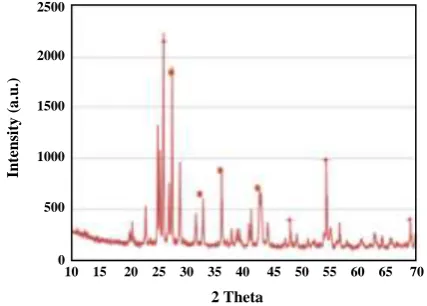
Pure TiO2 sample was heated and then analyzed
by PXRD as given in Fig. 2. The peaks at two theta positions of 26, 38, 41, 48, 54, 55, 62 and 69 degree were observed which indicate the formation of anatase phase [30] while the peaks at two theta positions of 28, 44, 54, 57, 65 and 66 degree showed the formation of rutile phase of titanium dioxide nanoparticles [31, 32]. This indicates that TiO2 heated gave a mixture of two phases of TiO2 i.e.
anatase and rutile.
264 Research Article Table 1: pH and color of TiO2 nanoparticles with different solvents.
Sample name Name of solvent ٭Start pH ٭End pH Start colour End colour Heating
C)
o
Temperature(
A Ammonia 11.7 8.77 White Off white 20
B Methanol 10.2 9.36 White White 45
C n-Hexane 8.90 8.95 Off white Pure white 40
D Distilled water 8.30 9.80 White Off white 70
E Diethanolamine 12.1 10.4 Off white Dark brown 220
F Acetic acid 2.89 3.15 Pinkish white White 102
G Acetonitrile 8.93 9.55 White White 65
H Acetone 7.39 7.66 White White 40
I Propionic acid 3.98 4.46 White White 110
J Diethyl ether 8.32 8.76 White White 25
Start of pH represents when the solvent and TiO2 were mixed and end of the pH represent when evaporation of solvent was near to complete from solution
Fig. 1: Synthesized samples of titanium dioxide nanoparticles A (ammonia), B (methanol), C (n- Hexane), D (distilled water), E (diethanol ammine), F (acetic acid), G (acetonitrile), H (acetone), I (propionic acid), J (diethyl ether).
Fig 2: X-Ray diffraction patterns of heated TiO2 .( Anatase
Rutile).
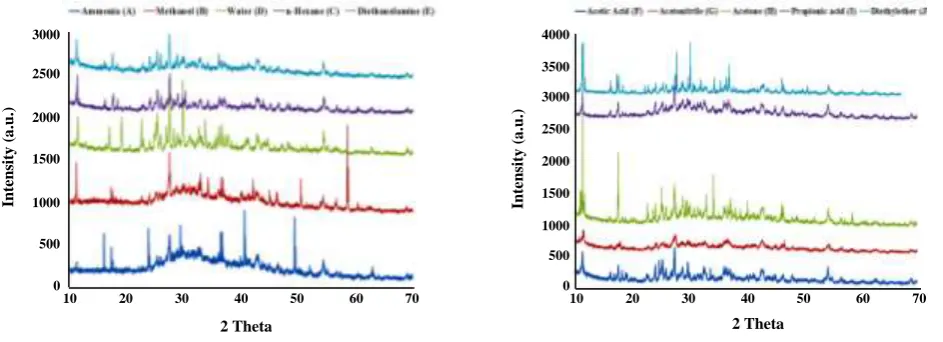
the formation of both phases of titanium dioxide (brookite and rutile) nanoparticles. The n-hexane sample shows the formation of anatase and rutile phases of titanium dioxide (TiO2). The water sample consists of
three phases (anatase, rutile and brookite) of titanium dioxide (TiO2). The peaks at two theta position of 16 – 19
indicate the formation of sodium titanium oxide (Na2O.3TiO2) and sodium titanium hydrogen oxide
hydrate (NaHTi4O9.3H2O) [35]. The acetic acid sample
demonstrates all the three phases of titanium dioxide nanoparticles (anatase, brookite and rutile). In the acetonitrile sample, broad peaks were observed which show an amorphous and rutile phase. In acetone sample all the three phases of titanium dioxide (TiO2) nanoparticles
2500
2000
1500
1000
500
0
In
te
n
si
ty
(
a
.u
.)
10 15 20 25 30 35 40 45 50 55 60 65 70
Fig 3: X-Ray diffraction patterns of titanium dioxide prepared in different solvents the samples (A to J) detail are described in Table 1.
were found. The peak at two theta positions of 40-41 degrees denoted the titanium hydride in the sample [36].
From the above discussion, it was found that different phases of TiO2 were stabilized in different solvents,
depending upon the pH and polarity of solvents. Furthermore, the sample prepared in different solvents gave different crystallite sizes of nanoparticles. The average crystallite size of all samples of titanium dioxide NPs was in the range of 5 – 25 nm. The solvent having pH 7 or below gave a small crystallite size and all the three phases of TiO2 [37]. The small particle size may be due to the
disintegration of the particles in these solvents. It was found in the literature that at different pH the composition of TiO2 gave different forms of titania [38].
For H+,
TiO2 + nH+ ↔TiO2Hn
For OH-,
TiO2 + nOH- ↔ TiO2(OH)n n-
The sample prepared in solvents having pH above 8 gave the brookite and rutile phase of TiO2. The largest crystallite size
was observed in ammonia and acetone samples. This can be correlated to the low boiling point (bp) of the solvent. The samples were dried in the oven about 8-10oC below the boiling point of particular solvents.
The acetone and ammonia have low bp. Therefore the pH and low boiling point contribute to high crystallite size of the TiO2 nanoparticles. The smallest crystallite size
was shown by the acetonitrile sample. The smallest crystalline size of acetonitrile might be due to the highest polarity and a polar aprotic behavior of acetonitrile.
Fig 4: FT-IR spectrum of sample heated TiO2 . (Pure sample).
FT-IR analysis
Absorption bands of titanium dioxide nanoparticles prepared in different solvents are labeled on the basis of literature. Pure titanium oxide was heated at 110oC
for two hours and then analyzed by the FT-IR as shown in Fig. 4. The band at 3427 cm-1 and 1639 cm-1 represent
the stretching and bending vibration of water [37]. The presence of O-Ti- O bond vibration was clearly evident from the band at 819, 871 and 981 cm-1 [39].
Furthermore, the band at 711 cm-1 represents the Ti-O-O
bonds [40]. The band present at 1396 and 1469 cm-1
confirmed the stretching vibration of pure Ti-O-Ti bonds [41]. The band at 78 cm-1 and 1153 cm-1 indicate
the Ti-O-C bond [42].
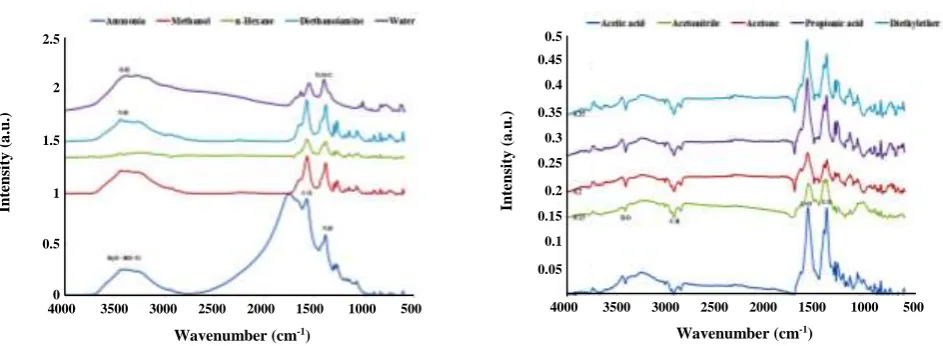
It was obvious from Fig. 5 (B) that the Ti-O-C and C-O of alcohol (methanol) band appears at 1078-1191 and 1278 cm-1 respectively [43]. In Fig.-5 (E) the bands
3000 2500 2000 1500 1000 500 0 In te n si ty ( a .u .)
10 20 30 40 50 60 70
2 Theta
10 20 30 40 50 60 70
2 Theta 4000 3500 3000 2500 2000 1500 1000 500 0 In te n si ty ( a .u .)
500 1000 1500 2000 2500 3000 3500 4000
266 Research Article Fig 5: FTIR spectra of titanium dioxide sample in different solvents. The sample (A to J) detail are described in Tab. 1.
at 3442 cm-1 and 3257 cm-1 designated the presence
of N-H stretching vibration of diethanolamine and O-H of water [44]. The band appears at 1078 characterizes the symmetric stretching of C-O group [45]. The C-O band of acetic acid sample appeared at 1155 cm-1. The band
at 1575 cm-1 denoted the C=O bond of acetic acid. The band
at 1303 and 1386 cm-1 assigned the C-O-O symmetric
and asymmetric stretching vibration [46, 47].
The band found in sample (acetone) at 2613 -3635 cm-1 showed that water and methyl groups of acetone
bands overlap with one another [48]. The C=O band appeared at 1681 cm-1 [45, 46]. In diethyl ether sample
the band at 1163 to 1313 cm-1 denoted the C-O bond
of ether [49]. From these results, it can be concluded that different solvents interacted in a different way with TiO2 and this interaction may be influenced on the phase
and particle size of TiO2 nanoparticles.
Atomic force microscopy analysis
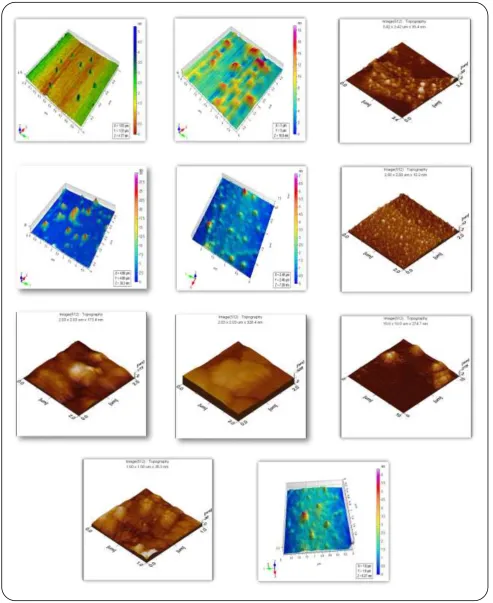
The AFM results of heated titanium dioxide nanoparticles are presented in Fig. 6. It is clear that most of the particles of heated titanium dioxide samples were spherical in shape with an average particle size of 45nm and were different in size and shape. In ammonia, methanol, water and diethanoamine samples have small particles and were spherical in shape. The crystallite size of the acetonitrile sample was 10 nm and exists in the pure rutile form of titanium dioxide [50, 51]. In acetic acid and diethylether samples, particles were agglomerated however, no cracked or holes were found. AFM results indicate that average particles sizes vary from
sub micrometric to micrometric in dimension. In other samples, particles were agglomerated to form the column and irregular shape.
Antibacterial activity of synthesized titanium dioxide nanoparticles
To check the antibacterial activity of titanium dioxide samples prepared in different solvents, the agar well diffusion method was used. Results showed that few of the synthesized samples show activity against gram negative bacteria (E.coli and Pseudomonas aureginosa). The inhibitory concentration of titanium dioxide nanoparticles depends on the bacterial strains. Different concentration of TiO2 nanoparticles
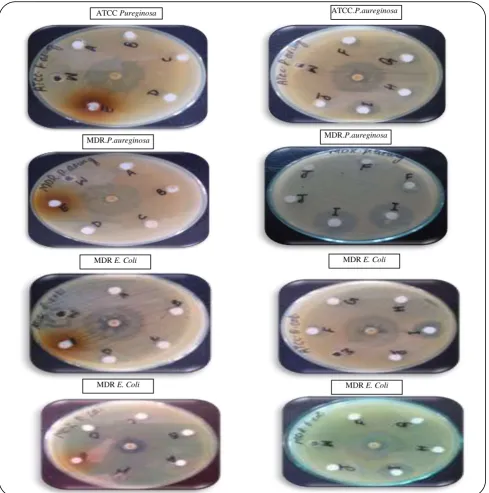
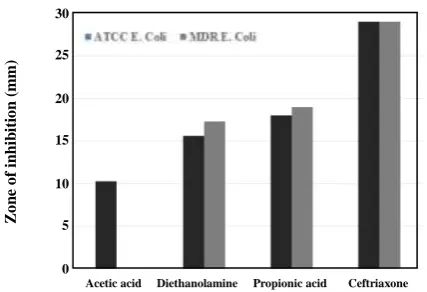
(25 mg/mL, 50mg/mL, 100mg/mL, 200 mg/mL and 250 mg/mL) were assessed against different strains. According to present studies, the minimum concentration of titanium dioxide required to kill the E.coli and Pseudomonas aureginosa strains were about 250 mg/mL. Among different solvents, the propionic acid, acetic acid and diethanolamine samples showed activity against E.coli and P. aureginosa while other solvents samples give negative results as shown in Fig. 7. The propionic acid sample showed the highest activities against all the mentioned pathogens as shown in Fig. 8 and Fig. 9. The rutile phase of titanium dioxide obtained in these samples may be the main reason for its active nature. This may be the synergetic effect of solvent with nanoparticles which stabilized the titanium oxide in different crystal form which is active against different pathogens.
2.5
2
1.5
1
0.5
0
In
te
n
si
ty
(
a
.u
.)
4000 3500 3000 2500 2000 1500 1000 500
Wavenumber (cm-1)
0.5
0.45
0.4
0.35
0.3
0.25
0.2
0.15
0.1
0.05
In
te
n
si
ty
(
a
.u
.)
4000 3500 3000 2500 2000 1500 1000 500
Fig. 6: AFM 3D images of different samples of titanium dioxide nanoparticles, A (ammonia), B (methanol), C (n- Hexane), D (distilled water), E (diethanol ammine), F (acetic acid), G (acetonitrile), H (acetone), I (propionic acid),
268 Research Article Fig. 7: Antibacterial activity of different samples of titanium dioxide nanoparticles,) against P. aeruginosa and
E.Coli. The sample (A to J) detail are described in Tab. 1.
CONCLUSIONS
In this research work, the effect of different solvents on the morphology (different phase and crystal size of TiO2) was studied. The results show that the solvents
have a great role in the synthesis of different phases of TiO2 nanoparticles. The polarity and acidity of the
solvent are made it a good choice for a reaction.
The PXRD results showed that the average crystallite
size of all the samples was in the range of 5-25 nm. Furthermore, it was found from the XRD results that the solvent having pH 7 or below gave small crystallite size and all the three phases of TiO2, while the solvents
having pH above 8 gave the brookite and rutile phase of TiO2.
Ammonia and acetone samples gave the largest crystallite size while using acetonitrile, acetic acid and propionic acid solvents produced the smallest crystallite size.
ATCC Pureginosa ATCC.P.aureginosa
MDR E. Coli MDR E. Coli
MDR E. Coli MDR E. Coli
Fig 8: Antibacterial activity of TiO2 nanoparticles against
E.coli.
Fig 9: Antibacterial activity of TiO2 nanoparticles against P.
aureginosa.
The FT-IR analyses support the XRD results and all the desired peaks for different phases of titanium oxide prepared in a different solvent were obtained. The solvent interaction with titanium oxide is supported by the presence of hydroxyl group which appeared in all protic, water and pure samples while other samples it was disappeared.
The AFM data also showed that most of the particles have a spherical shape with average crystallite size ranging from 10-68 nm. The TiO2 nanoparticles prepared
in ammonia, methanol, water and diethanoamine samples have small spherical particles about 10 nm, while larger particle sizes were found in acetic acid and diethylether solvent.
It was concluded from the antibacterial results that the diethanolamine, acetic acid, and propionic acid solvents showed comparatively good antibacterial activity due to the rutile phase and pH of these solvents which modify the properties of titanium dioxide.
Received : Jan. 14, 2018 ; Accepted : Jun. 18, 2018
REFERENCES
[1] Kavitha K.S., Baker S., Rakshith D., Kavitha H.U., Yashwantha Rao H.C., Harini B.P., Plants as Green Source Towards Synthesis of Nanoparticles, Int. Research J. Bio. Sci., 2(6): 66-77 (2013).
[2] Abhilash M., Potential Applications of Nanoparticles, Int. J. Pharm. Biol. Sci., 1(1): 1-12 (2010).
[3] Nagarajan S., Arumugam K. K., Extracellular Synthesis of Zinc Oxide Nanoparticle Using
Seaweeds of Gulf of Mannar, India,
J. Nanobiotechnol, 11(1): 1-39 (2013).
[4] Shi H., Magaye R., Castranova V., Zhao J., Titanium Dioxide Nanoparticles: A Review of Current Toxicological Data, Particle and Fibre Toxicology, 10(1): 1-33 (2013).
[5] Ahmad R., Meryam S., TiO2 Nanoparticles as an
Antibacterial Agents against E. Coli, Int. J. Innov Res. Sci. Eng. Technol., 2(8): 3569-3574 (2013). [6] Ragupathy S., Raghu K., Studies on Preparation of
TiO2 Nanoparticles and Its Loaded Groundnut Shell
Activated Carbon and Their Antibacterial Activity Article, Int. J. Adv. Res. Biol. Sci., 1(9): 08–13 (2014).
[7] Mazloum-Ardakani M., Khoshroo A.R., Synthesis of TiO2 Nanoparticle and Its Application to Graphite
Composite Electrode for Hydroxylamine Oxidation, J. Nanostruct, 3(3): 269-275 (2013).
[8] Tavares K.P., Caloto-Oliveira Á., Vicentini D.S., Melegari S.P., Matias W.G., Barbosa S., Kummrow F.,
Acute Toxicity of Copper and Chromium Oxide Nanoparticles to Daphnia Similis, Ecotoxicol. Environ. Contam, 9(1): 43-50 (2014).
[9] Al-baker S.M., Al-Gasha’al F.A.S., Alqudami A.Q.,
Evaluation of Antibacterial Activity of Metal Nanoparticles Against Different Pathogenic Bacteria, Glob. J. Adv. Eng. Technol. Sci., 2(2): 1-6 (2015).
[10] Khashan k.S., Sulaima G.M., Ameer F.A.A., Marzoog T.R., Synthesis, Antibacterial Activity of TiO2 Nanoparticles Suspension Induced by Laser
Ablation in Liquid, Eng. &Tech. Journal, 32(5): 877-884 (2014). 30 25 20 15 10 5 0 Z o n e o f in h ib it io n ( m m)
Acetic acid Diethanolamine Propionic acid Ceftriaxone
35 30 25 20 15 10 5 0 Z o n e o f in h ib it io n ( m m)
270 Research Article [11] Banu S., Vishnu V., Jamuna K., Kurian G.A.,
Physiochemical Investigation and Biovaluation of TiO2 Nanocrystals Synthesized by Chemical and Green
Route, Int. J. Pharm. Pharm. Sci., 6(11): 396-400(2014). [12] Periyat P., McCormack D.E., Hinder S.J., Pillai S.C.,
One-Pot Synthesis of Anionic (Nitrogen) and Cationic (Sulfur) Codoped High-Temperature Stable, Visible Light Active, Anatase Photocatalysts, J. Phys. Chem. C, 113(8): 3246-3253 (2009). [13] Kobayashi M., Kato H., Kakihana M., Synthesis of
Titanium Dioxide Nanocrystals With Controlled Crystal- and Micro-Structures from Titanium Complexes, Nanomaterials and Nanotechnology, 3(23): 1-10 (2013).
[14] Tao P., Li Y., Rungta A., Viswanath A., Gao J., Benicewicz B.C., Siegel R.W., Schadler L.S., TiO2
Nanocomposites with High Refractive Index and Transparency, J. Mater. Chem, 21(46): 18623-18629 (2011).
[15] Visai L., De Nardo L., Punta C., Melone L., Cigada A., Imbriani M., Arciola C.R., Titanium Oxide Antibacterial Surfaces in Biomedical Devices, Int. J. Artif. Organs, 34(9): 929-946 (2011).
[16] Guoqiang Z., Wenying W., Baofeng Z., Li Y.,
Preparation and Photocatalytic Properties of Fe3+Doped TiO
2 Nanoparticles, European Chemical Bulletin, 2(12): 1045-1048 (2013).
[17] Chen L., Rahme K., Holmes J.D., Morris M.A., Slater N.K., Non-Solvolytic Synthesis of Aqueous Soluble TiO2 Nanoparticles and Real-Time Dynamic
Measurements on the Nanoparticle Formation, Nanoscale res. lett., 7(297): 1-10 (2012).
[18] Kondratiev V.I., Kink I., Romanov A.E., Low Temperature Sol-Gel Technique for Processing Al-Doped Zinc Oxide Films, Mater. Phys. Mech., 17: 38-46 (2013).
[19] Ullattil S.G., Periyat P., Sol-Gel Synthesis of Titanium Dioxide. In: Pillai S., Hehir S. (Eds) “Sol-Gel Materials for Energy, Environment and Electronic Applications. Advances in Sol-Gel Derived Materials and Technologies”, Springer, Cham, (2017).
[20] Atheel H.A., Ahmad Z.A., Ismail N., TiO2-Zeolite
Y Catalyst Prepared Using Impregnation and Ion-Exchange Method for Sonocatalytic Degradation of Amaranth Dye In Aqueous Solution, World. Acad. Sci. Eng. Technol., 7(6): 375-383 (2013).
[21 Sanaz N., Mehrnaz G., Solvothermal Synthesis of M‐doped TiO2 Nanoparticles for Sonocatalysis of
Methylene Blue and Methyl Orange (M = Cd, Ag, Fe, Ce, and Cu), J. Chin Chem Soc. 64(6): 640-650 (2017).
[22] Horowitz F., Dawnay E.J.C., Fardad M.A., Green M., Yeatman E.M., Towards Better Control of Sol-Gel Film Processing for Optical Device Applications, J. Nonlinear Optic. Phys. Mat., 06(01): 1-18 (1997).
[23] Edusi C., Sankar G., Parkin I.P., The Effect of Solvent on the Phase of Titanium Dioxide Deposited by Aerosol-Assisted CVD, Chem. Vap. Deposition, 18(4-6): 126-132 (2012).
[24] Trung T., Won-Jei C., Chang-Sik H., Preparation of TiO2 Nanoparticles in Glycerol-Containing
Solutions, Mater. Lett., 57(18): 2746-2750 (2003). [25] Shahab M.U., Tabish T.A., Zaman B., Zahra T.,
Kamran M., Characterization and Synthesis of Nanosized TiO2 Particles, Int. J. Eng., 3: 313-16 (2013). [26] Hema M., Yelil A.A., Tamilselvi P., Anbarasan R.,
Titania Nanoparticles Synthesized by Sol-Gel Technique, Chem. Sci. Trans., 2: 239-245 (2013). [27] Ramesh P., Muthukkumarasamy S., Dhanabalan K.,
Sadhasivam T., Gurunathan K., Synthesis and Characterization of Ag and TiO2 Nanoparticles and
Their Anti-Microbial Activities, Dig. J. Nanomater. Biostruct., 7(4): 1501-1508 (2012).
[28] Reddy Yadav L.S., Manjunath Kavitha K., Nagaraju G., Investigation of Hydrogen Generation and Antibacterial activity by Ionic liquid aided synthesis of TiO2 nanoparticles, Journal of Science: Advanced Materials and Devices (accepted) (2018).
[29] Eiji I., Yoshinori H., Hiroyoshi O., Hagino J., Koizum N., Dielectric Properties of Ethanolamines, Bulletin of the Institute for Chemical Research, Kyoto University, 46(5): 239-247(1969).
[30] Shirke B.S., Korake P.V., Hankare P.P., Bamane S.R., Garadkar K.M., Synthesis and Characterization of Pure Anatase TiO2 Nanoparticles, J. Mater. Sci.: Mater. Electron., 22(7): 821-824 (2011).
[31] Chen H.-S., Su C., Chen J.-L., Yang T.-Y., Hsu N.-M., Li W.-R., Preparation and Characterization of Pure Rutile TiO2 Nanoparticles for Photocatalytic
[32] Pawar S. G., Patil S. L., Chougule M. A., Jundhale D.M., Patil V.B., Microstructural, Optical and Electrical Studies on Sol Gel Derived TiO2 Thin Films, Archives of Physics Research, 1(1): 57-66 (2010). [33] Coronado D.R., Gattorno G.R., Espinosa-Pesqueira M.E.,
Cab C., Phase Pure TiO2 Nanoparticles: Anatase,
Brookite and Rutile, Nanotechnology, 19(14): 1-10 (2008).
[34] Ali B., Direct and Template‐Free Synthesis of One‐Dimensional Nanostructures of Sodium Trititanate and Sodium hexatitanate, J. Am. Ceram. Soc., 100(8): 3375-3379 (2017).
[35] Štengl V., Bakardjieva S., Šubrt J., Večerníková E., Szatmary L., Klementová M., Balek V., Sodium Titanate Nanorods: Preparation, Microstructure Characterization and Photocatalytic Activity, Appl. Catal. B Environ., 63(1): 20-30 (2006).
[36] Rasooli A., Boutorabi M. A., Divandari M., Azarniya A., Effect of High Heating Rate on Thermal Decomposition Behavior of Titanium Hydride (TiH2) Powder In Air, Bull. Mater. Sci., 36(2): 301-309 (2013).
[37] Sohn J., Lee S.H., Cheon P., Kim H., Acidic Properties and Catalytic Activity of Titanium Sulfate Supported on TiO2, Bull. Korean Chem. Soc., 25(5): 657-664 (2004).
[38] Sarala D.K., Shanth K. A., Srinivas R.K., Effect of pH on Synthesis of Single Phase Titania (TiO2)
Nanoparticles and its Characterization, Particulate Science and Technology: An International Journal, 33(3): 219-223 (2014).
[39] Gökdemir F.P., Yüzbaşıoğlu V.E., Keskin B., Özdemir O., Kutlu K., Formation of TiO2 Thin
Films by a Modified Sol-Gel Route and Characterization of Structural, Optical and Electrochromic Properties, Advanced Materials Letters, 5(7): 367-371(2014).
[40] Vetrivel V., Rajendran K., Kalaiselvi V., Synthesis and Characterization of Pure Titanium Dioxide Nanoparticles by Sol- Gel Method, Int. J. Chemtech. Res. 7(3): 1090-1097 (2015).
[41] Daniela C.L.V., Vilma C.C., Eduardo H.M.N., Antônio C.S.S., Massimo G., Vasconcelos W.L.,
Infrared Spectroscopy of Titania Sol-Gel Coatings on 316L Stainless Steel, Materials Sciences and Applications, 2: 1375-1382 (2011).
[42] Kavitha T., Rajendran A., Arulnandhi D., Synthesis and Characterization of Nanosized TiO2 Powder
Derived from a Sol–Gel Process in Acidic Conditions, International Journal of Engineering Sciences & Emerging Technologies, 4(2): 90-95 (2013). [43] Corobea M.S., Stoenescu M., Miculescu M.,
Raditoiud V., Fierascu R.C., Sirbu I., Vuluga Z., Voicu S.I., Titanium Functionalizing and Derivatizing for Implantable Materials Osseointegration Properties Enhancing, Dig. J. Nanomater. Biostruct., 9(4): 1339-1347 (2014). [44] Rajendra S. K., Kashinath B., Ingale N.L.,
Developement of Ammonia Sensor Using Nano-Titanium Blended Hydroxyapatite Nanoceramics, International Journal of Pure and Applied Research In Engineering and Technology, 3(9): 135-142 (2015).
[45] Wojtoniszak M., Zielinska B., Kalenczuk R., Mijowska J., Photocatalytic Performance of Titania Nanospheres Deposited on Graphene in Coumarin Oxidation Reaction, Materials Science-Poland, 30(1): 32-38 (2012).
[46] Hafizah N., Jamal P., Karim M.I.A., Sopyan I., TiO2
Powder Photocatalyst from Sol-Gel Route and Its Immobilisation with Cement for Photocatalytic Phenol Removal, The Journal of the Institution of Engineers, 70(4): 49-56 (2010).
[47] Boccuzzi F., Chiorino A., Martra G., Gargano M., Ravasio N., Carrozzini B., Preparation, Characterization, and Activity of Cu/TiO2 Catalysts.
I. Influence of the Preparation Method on the Dispersion of Copper in Cu/TiO2, J. Catal., 165(2): 129-39 (1997).
[48] Ljubica M. N., Marija M., Paula F., Paula M.V.,
Synthesis and Characterization of One-Dimensional Titanate Structure, Processing and Application of Ceramics, 2(2): 109-114 (2008).
[49] Oja I., Mere A., Krunks M., Solterbeck C.-H., Es-Souni M., Properties of TiO2 Films Prepared
by the Spray Pyrolysis Method, Solid State Phenom., 99-100: 259-264 (2004).
[50] Morris Hotsenpiller P.A., Bolt J.D., Farneth W.E., Lowekamp J.B., Rohrer G.S., Orientation Dependence of Photochemical Reactions on TiO2
272 Research Article [51] Haoyong Y., Zhensheng J., Shunli Z., Shoubin W.,