© Universiti Tun Hussein Onn Malaysia Publisher’s Office
IJIE
Journal homepage: http://penerbit.uthm.edu.my/ojs/index.php/ijie
The International
Journal of
Integrated
Engineering
ISSN : 2229-838X e-ISSN : 2600-7916
Improving Convolutional Neural Network (CNN)
A
rchitecture
(miniVGGNet) with Batch Normalization and Learning Rate
Decay Factor for Image Classification
Asmida Ismail
1,3*, Siti Anom Ahmad
1, Azura Che Soh
1, Khair Hassan
1,
Hazreen Haizi Harith
21Department of Electrical and Electronic Engineering, Faculty of Engineering, UPM, Serdang, 43400, MALAYSIA
2Department of Biological and Agricultural Engineering, Faculty of Engineering, UPM, Serdang, 43400, MALAYSIA
3Department of Engineering Technology, Faculty of Technical Vocational, UPSI, Tanjung Malim, 35900 MALAYSIA
*Corresponding Author
DOI: https://doi.org/10.30880/ijie.2019.11.04.006
Received 25 April 2019; Accepted 8 July 2019; Available online 5 September 2019
1. Introduction
Classification is a systematic arrangement in groups and categories based on its features. Image classification came into existence for decreasing the gap between the computer vision and human vision by training the computer with the data. The image classification is achieved by differentiating the image into the prescribed category based on the content of the vision [1].
In traditional classification approaches, image features are normally carefully hand-crafted to maximize distinction capability. A lot of hand-crafted designed features have been explored before (such as Local Binary Pattern, LBPs [2], histogram of gradient oriented, HOG [3], SIFT and SURF [4]) and achieved excellent success in computer vision tasks. However, these hand-designed features are not learned from the nature of data and subjective to the perception of the designers. Sometimes there is not the optimal feature required for a given task [5]. Besides, classifiers (such as the
k-Abstract: The image classification is a classical problem of image processing, computer vision, and machine learning. This paper presents an analysis of the performance using Convolutional Neural Network (CNN) for image classifying using deep learning. MiniVGGNet is CNN architecture used in this paper to train a network for image classification, and CIFAR-10 is selected dataset used for this purpose. The performance of the network was improved by hyper parameter tuning techniques using batch normalization and learning rate decay factor. This paper compares the performance of the trained network by adding batch normalization layer and adjusting the value of learning rate decay factor for the network architecture. Based on the experimental results, adding batch normalization layer allow the networks to improve classification accuracy from 80% to 82%. Applying learning rate decay factor will improve classification accuracy to 83% and reduce the effects of overfitting in learning plot. Performance analysis shows that applying hyper parameter tuning can improve the performance of the network and increasing the ability of the model to generalize.
nearest neighbor [6] and SVM [7]) are generic and not robust to the different varieties of the data. These traditional approaches represent a shallow architecture, which is severely challenged by the non-linear complexity of the features.
Recently, deep learning researchers have proposed to learn feature representations in a hierarchy from pixels to classifiers through multiple layers (deep) architecture [8, 9]. The study of image classification using deep learning was explored in this paper. Deep learning is a subdivision of machine learning algorithms, which are excellent in identifying patterns, and usually, require more data.
The most popular technique used to improve the accuracy of image classification is the Convolutional Neural Network (CNN) [10]. CNN is an efficient and effective recognition, identification and classification algorithm which is globally used in image processing and pattern recognition [11].
The deep learning method can learn to extract the feature from large-scale dataset automatically compared to hand-crafted feature extraction based method. The deep architecture allows the system to learn to represent features by itself based on the nature of the data, rather than the subjective nature of human perception [5]. And it achieves excellent performance in image classification and recognition in recent years AlexNet [12] proposed in 2012, have eight trainable layers demonstrates extraordinary performance on ImageNet dataset and can classify up to1000 object. Since then, CNN architecture was used because of its excellent performance and showed the trend to become more profound. The VGGNet [13] proposed in 2014 has up to 19 trainable layers. Deeper architectures are proven to improve classification performance. In this paper, a smaller version of VGGNet called miniVGGNet was used as architecture to train the network for image classification. Hyper parameter tuning method is used to improve the performance of the network. Adding batch normalization layer to the network and tuning the value of learning rate decay factor will improve the performance of the network by increasing the value of classification accuracy and reduce the effect of the overfitting in the learning plot.
This paper is organized as follows: Section II explains the overall methodology to build image classification model using deep learning convolutional neural network. Section III explains on results and discussions, and the last section IV concludes the paper.
2.
Methods
Dataset
Pre-processing
Testing Training
Model
Evaluation Result
Built Model (Train Network)
Training & Validation Result
Hyper Parameter Tuning
Split Dataset
Fig. 1: Image classification algorithm – process to build image classification model using deep learning convolutional neural network.
2.1 Dataset
The first step of building a deep learning network is to gather an initial dataset. The images need to be labelled and linked with each image. These labels should come from a finite set of classes. The number of images for each category should be approximately uniform (i.e., the same number of examples per class). In this paper, CIFAR-10 dataset is selected for the classification purpose.
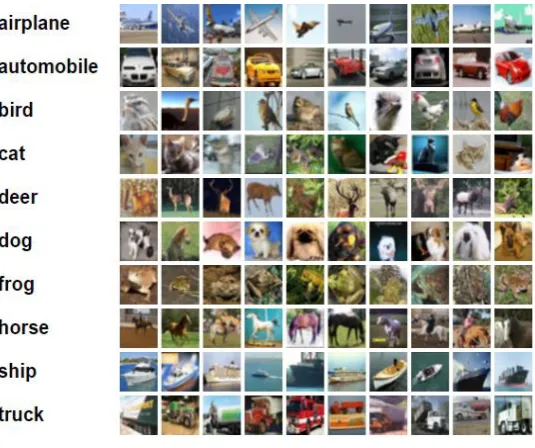
Fig. 2: Classes in the CIFAR-10 dataset
Fig. 2 shows the image classes in CIFAR-10 dataset as well as ten random images from each class. CIFAR-10 is standard benchmark dataset for image classification in the computer vision and machine learning literature. CIFAR-10 consists of 60,000 32 x 32 x 3 (RGB) images resulting in a feature vector dimensionality of 3072. As the name suggests, CIFAR-10 consists of 10 classes, including airplanes, automobiles, birds, cats, deer, dogs, frogs, horses, ships, and trucks. The dataset consists of 50000 training images and 10000 test images. The test images are randomly selected from each class.
2.2 Pre-processing
Image
loaded from
disk
Image resize
to 32 x 32
pixel
Channels
ordered
Output
image
Fig. 3: Image pre-processing pipeline
There are some pre-processing steps that might carry out before training deep learning model. Fig. 3 shows the image pre-processing pipeline. The image will load from the disk and resize to 32 x 32 pixels. This step is to ensure that the images have the same size and aspect ratio. To start constructing the model, the images presented to the input layer should be square. After the image is resized, the next step is applying channel ordering. For inputs to the CNN, the depth is the number of channels in the image or the number of filters in a layer. The dimension ordering specified the shape of the input and used to learn multi-level features in the image.
2.3 Split Dataset
Initial dataset needs to split into two parts: a training set and a testing set. A training set is used by the classifier to “learn” what each class looks like by making predictions on the input data and then correct the data by itself when predictions are wrong. A testing set is used to evaluate the performing of classifier after the classifier has been trained [15].
2.4 Train the Network
From the training set of images, the network will be trained. From the training process, the network will learn how to recognize each of the categories in labeled data. When the model makes a mistake, it learns from this mistake and improves itself. In this paper, CNN architecture used to build a classification model is miniVGGNet architecture. The network architecture detailed is described in the next section below.
2.4.1 CNN Architecture
VGGNet, (sometimes referred to as simply VGG), was first introduced by Simonyan and Zisserman in their 2014 paper, Very Deep Learning Convolutional Neural Networks for Large-Scale Image Recognition [13]. VGGNet is unique in that it uses 3 x 3 kernels throughout the entire architecture. The use of these small kernels is arguably what helps VGGNet generalize to classification problems outside what the network was originally trained on.
In VGGNet, multiple CONV => ACT layers were arranging before applying a single POOL layer. This multiple CONV => ACT layer allows the network to extract more features from the image before reducing the size of an input volume via the POOL operation.
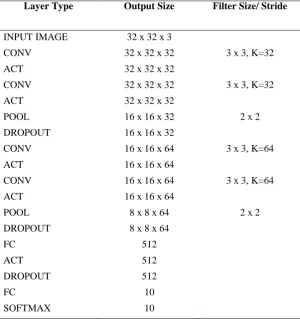
In general, miniVGGNet consists of two sets of CONV => ACT => CONV => ACT => POOL layers, followed by a set of FC => ACT => FC => SOFTMAX layers. 32 filters with each of size 3 x 3 will learn on the first two CONV layers. The following CONV layers will learn 64 filters, with each of size 3 x 3. POOL layers will perform max pooling over a 2 x 2 window with a 2 x 2 stride and activation function (ACT) used in this architecture is RELU [15].
The network architecture is detailed in Table 1, where the initial input image size is assumed to be 32 x 32 x 3 and will be training on CIFAR-10 dataset.
Table 1: Summary of miniVGGNet architecture. Output volume sizes are included for each layer, along with convolutional filter size/pool size.
Layer Type Output Size Filter Size/ Stride
INPUT IMAGE 32 x 32 x 3
CONV 32 x 32 x 32 3 x 3, K=32
ACT 32 x 32 x 32
CONV 32 x 32 x 32 3 x 3, K=32
ACT 32 x 32 x 32
POOL 16 x 16 x 32 2 x 2
DROPOUT 16 x 16 x 32
CONV 16 x 16 x 64 3 x 3, K=64
ACT 16 x 16 x 64
CONV 16 x 16 x 64 3 x 3, K=64
ACT 16 x 16 x 64
POOL 8 x 8 x 64 2 x 2
DROPOUT 8 x 8 x 64
FC 512
ACT 512
DROPOUT 512
FC 10
3.
Results and Discussion
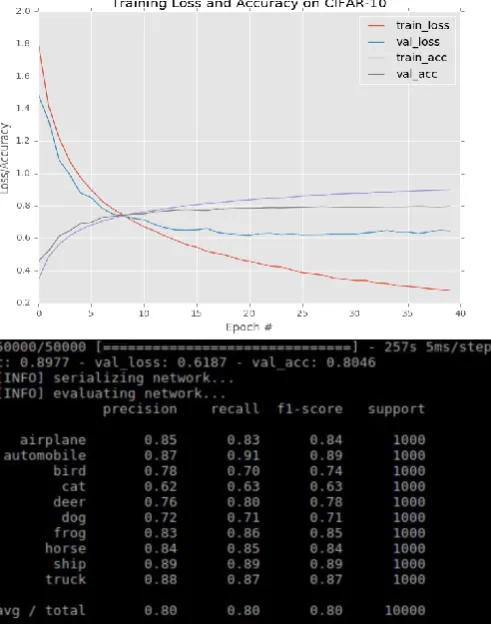
The result for the training and validation will be shown in the graph of training loss and accuracy and validation loss and accuracy. The percentage of evaluation accuracy will be shown from the python terminal. The network was trained on miniVGGNet architecture on CIFAR-10 dataset and the result shown in Fig.4.
Fig. 4: miniVGGNet trained on CIFAR-10
Fig. 4 shows miniVGGNet network architecture trained on CIFAR-10 data. The value of the classification accuracy is 80%, and the loss accuracy plot shows that the loss starts to increase past epoch 30, indicating that the network is overfitting to the training data. There is show the validation accuracy has become quite saturated by epoch 25.
The performance of the network can be improved using hyper parameter tuning technique. This technique was discussed in the next section of this paper.
3.1. Hyper Parameter Tuning
The machine learning model can require different constraints, learning rates or weights to extrapolate different data patterns. These measures are called hyper parameters, and these parameters need to be tuned in order to improve the model accuracy and optimally solve the machine learning problem. Hyper parameter tuning finds an ordered list of elements of hyper parameter - the optimal model which minimizes a predefined loss function on given independent data. In this paper, the value of the learning rate decay factor was adjusted, and batch normalization layers were applied to the networks to compares the performance of the trained network.
3.1.1. Batch Normalization
Introduced by Ioffe and Szgedy in their 2015 paper, Batch Normalization: Accelerating Deep Network Training by Reducing Internal Covariate Shift [14], batch normalization layers (BN), are used to normalize the activations of a given input volume before passing it into the next layer in the network. BN layer usually inserted after an activation layer.
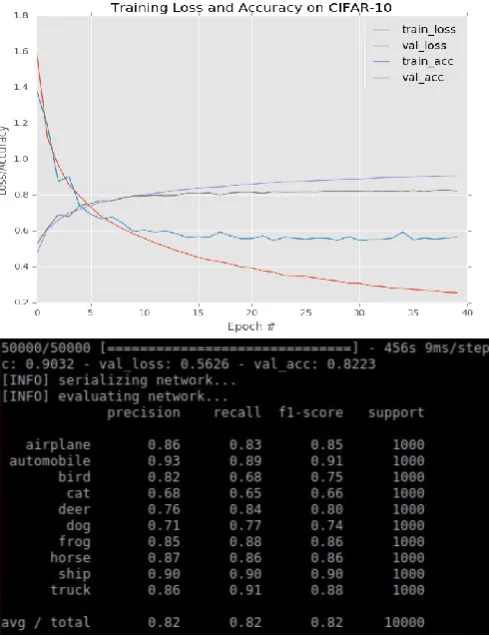
Fig. 5: miniVGGNet trained on CIFAR-10 with batch normalization
Based on the result shown in Fig. 5, the miniVGGNet implementation with batch normalization is more stable while both loss and accuracy start to flatline past epoch 35. After training complete, the classification accuracy increase by 2% from 80% without batch normalization (Fig. 4) to 82% with batch normalization implementation.
3.1.2. Learning Rate Decay Factor
Adding decay to the learning rate will help alleviate the effects of overfitting when training the network. By adjusting the learning rate value on an epoch-to-epoch basis, the loss will reduce; accuracy will increase, and the total amount of time takes to train a network will decrease. Learning rate α controls the “step” make along the gradient. Larger values of α imply that it's taking bigger steps while smaller values of α will make a tiny step.
The Keras library provides LearningRateScheduler class to define a custom learning rate function and then have it automatically applied during the training process. This function should take the epoch number as an argument and then compute the desired learning rate based on a define function. In this paper, a piecewise function that will drop the learning rate by a certain factor F after every D epoch was defined. The equation will look as in (1):
(1)
Where is the initial learning rate, F is the factor value controlling the rate in which the learning rate drops, D is the "drop every" epochs value, and E is the current epoch. The larger the value of factor F is, the slower the learning rate will decay. Conversely, the smaller the factor F is, the faster the learning rate will decrease.
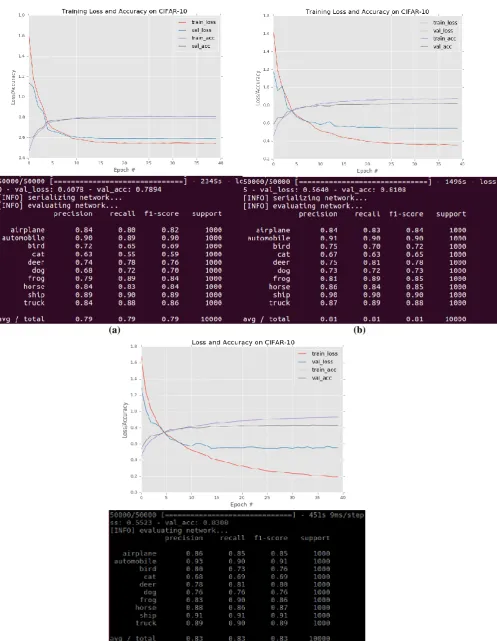
(a) (b)
(c)
Based on the result shown in Fig. 6 (a), the network obtains only 79% classification accuracy with learning rate decay factor 0.25. The learning rate is dropping quite aggressively after epoch 15, meaning that the network is taking a tiny step along the loss landscape. Notice the accuracy/loss plotting of the network using a faster learning rate drop with factor 0.25 stagnate past epoch 15 as the learning rate is too small.
As the value factor increase to 0.5 and 0.75, the learning rate will decay slowly, the classification accuracy increase from 81% to 83%. Notice the accuracy/loss plotting of the network continues to learn after epoch 25-30 until stagnation occurs.
Table 2: Summary of the result showing the classification accuracy with and without batch normalization
Table 3: Summary of the result showing the classification accuracy by applying learning rate decay factor
Table 2 shows the result by applying batch normalization to the network. The classification accuracy will increase by 2% when applying BN to the network compared without BN. Table 3 shows the results when applying the learning rate decay factor. The larger factor of learning rate decay will increase the value of classification accuracy.
4.
Conclusion
In this paper, the analysis of the performance of convolutional neural network (CNN) for image classifying using miniVGGNet architecture on CIFAR-10 dataset was presented. By applying batch normalization layer to the network, the classification accuracy of the models increased. Applying learning rate decay schedulers to the network architectures will help to prevent overfitting and allows the model to obtain significantly higher classification accuracy.
Acknowledgement
The author would like to express their deep gratitude toward the Control and Signal Processing group Faculty of Engineering University Putra Malaysia for their support and encouragement during this work. This research is supported by Putra Graduate Initiative (IPS) grant.
References
[1] M Manoj krishna1, M Neelima, M Harshali, M Venu Gopala Rao,” Image classification using Deep learning”,
International Journal of Engineering & Technology, 7 (2.7) (2018), pp.614-617.
https://www.researchgate.net/publication/325116934
[2] T. Ojala, M. Pietikainen, and T. Maenpaa. “Multiresolution gray-scale and rotation invariant texture classification with local binary patterns”. In: Pattern Analysis and Machine Intelligence, IEEE Transactions on 24.7 (2002), pp: 971–987
[3] Navneet Dalal and Bill Triggs. “Histograms of Oriented Gradients for Human Detection”. Proceedings of the 2005 IEEE Computer Society Conference on Computer Vision and Pattern Recognition (CVPR’05). Washington, DC, USA: IEEE Computer Society, - Vol.1 – Vol.01 (2005), pp: 886–893
[4] Ethan Rublee et al. “ORB: An Efficient Alternative to SIFT or SURF”, Proceedings of the 2011 International Conference on Computer Vision. ICCV ’11. Washington, DC, USA: IEEE Computer Society, 2011, pp:2564– 2571.
[5] Nguyen, K, Fookes, C., & Sridharan, S. Improving deep convolutional neural networks with unsupervised feature
learning. Proceedings - International Conference on Image Processing, ICIP, (2015),
https://doi.org/10.1109/ICIP.2015.7351206
[6] Guo G., Wang H., Bell D., Bi Y., Greer K., “KNN Model-Based Approach in Classification”, Meersman R., Tari
Z., Schmidt D.C. (eds) On The Move to Meaningful Internet Systems 2003: CoopIS, DOA, and ODBASE. OTM 2003. Vol.2888 (2003). pp: 986-996, https://doi.org/10.1007/978-3-540-39964-3_62
Without BN With BN
Classification
Accuracy 80% 82%
Learning Rate Decay Factor
0.25 0.5 0.75
Classification
[7] Anagnostopoulos, G.C. “SVM-Based Target Recognition From Synthetic Aperture Radar Images using Target Region Outline Descriptors”. Nonlinear Analysis: Theory, Methods & Applications, Vol.71, Issue.12, (2009), pp:2934–2939, https://doi.org/10.1016/j.na.2009.07.030
[8] Yoshua Bengio, "Learning Deep Architectures for AI", Foundations and Trends® in Machine Learning, Vol.2, (2009), pp: 1-127. http://dx.doi.org/10.1561/2200000006
[9] J. Schmidhuber, “Deep learning in neural networks: An overview,” Neural Networks, Vol. 61, (2015), pp. 85 –
117, https://doi.org/10.1016/j.neunet.2014.09.003
[10] D. P. Sudharshan, S Raj, “Object Recognition in Images using Convolutional Neural Network”, 2018 2nd
International Conference on Inventive Systems and Control (ICISC), pp: 718-722,
https://doi.org/10.1109/ICISC.2018.8398893
[11] Safiyah, R. D., Rahim, Z. A., Syafiq, S., Ibrahim, Z., & Sabri, N, “Performance Evaluation for Vision-Based Vehicle Classification Using Convolutional Neural Network “,International Journal of Engineering and Technology(UAE), Vol.7, (2018), pp: 86-90. https://doi.org/10.14419/ijet.v7i3.15.17507
[12] Krizhevsky, A.; Sutskever, I.; Hinton, G.E, “Imagenet Classification with Deep Convolutional Neural Networks”,
Proceedings of the Neural Information Processing System (NIPS), Harrahs and Harveys,Lake Tahoe, NV, USA, Vol.2 (2012), pp: 1097-1105.
[13] Simonyan, K., Zisserman, A, “Very Deep Convolutional Networks for Large-Scale Image Recognition”,
Conference paper at ICLR 2015, arXiv:1409.1556, https://arxiv.org/pdf/1409.1556.pdf
[14] Sergey Ioffe and Christian Szegedy. “Batch Normalization: Accelerating Deep Network Training by Reducing Internal Covariate Shift”. In: CoRR abs/1502.03167 (2015), pp: 189-193 URL: http://arxiv.org/abs/1502.03167