© Universiti Tun Hussein Onn Malaysia Publisher’s Office
IJIE
Journal homepage:http://penerbit.uthm.edu.my/ojs/index.php/ijie
The International
Journal of
Integrated
Engineering
Performance Evaluation of AODV and MDORA Protocols in
Different Cases of Vehicles Movement
Ahmed Ghanim Waddy
1,2 *,
Dania Mohammed
21Al-Furat Al-Awast Technical University, Kufa, Al-Najaf, 00964, IRAQ
2Middle Technical University/ Baghdad, 0096, IRAQ.
DOI: https://doi.org/10.30880/ijie.2019.11.08.018
Received 2 September 2018; Accepted 18 November 2018; Available online 30 December 2019
Abstract: Most important topics that have been under discussion are how to manage traffic at intersections and how to maintain road safety. Vehicular Network (VANETs) is the most significant solutions to solve this problem. And to routing packets between vehicles, many protocols have been proposed. And from this protocols are the MDORA protocol and AODV protocol. This work provides a comparison between the two MDORA and AODV protocols in two cases at variable speed of vehicles, the first in the case of vehicles movement in several directions, and the second in the case of vehicles movement in one direction. The comparison results of the MDORA protocol are worse than the AODV protocol (E2E, PDR, communication overhead), while the comparison results in the second case of the MDORA protocol are better than the AODV, because in the MDORA algorithm there was a condition is choose the vehicles that moved with the same direction when to routing packets to the destination vehicle.
Keywords:E2E, PDR,VANETs, MDORA, AODV.
1. Introduction
the source vehicle, and direction of the source vehicle. At the same time, the source vehicle operates temporarily during the transmission process hello message, During the interim period of operation if no vehicle is received from neighboring vehicles hello message Does the source vehicle re-send hello message, When the next vehicle receive hello message starts to start compared, if in the same direction as the source vehicle, sends a response message to the source vehicle. But if it is opposite to the source vehicle, it will ignore a hello message. The response message contains information, the type of the message, the neighbor ID, the identifier of the message. In an algorithm MDORA two factors are used:
A. Distance
This is the distance factor where the distances between the vehicles are calculated and through this factor is chosen the closest vehicle. The following equation calculates the distance factor between vehicles:
Distance = …………. (1)
Where
S: source node, D: distance node, n: neighbor node
B. Communication Lifetime
This is the lifetime of the communication and calculates the maximum duration of the vehicle's stay within the range of communication. Calculates the communication life time through the following equation:
Communication Lifetime = ……….. (2) Where
a=vh-vz , b=xh-xz , c=yh-yz v : velocity
h,z : vehicles
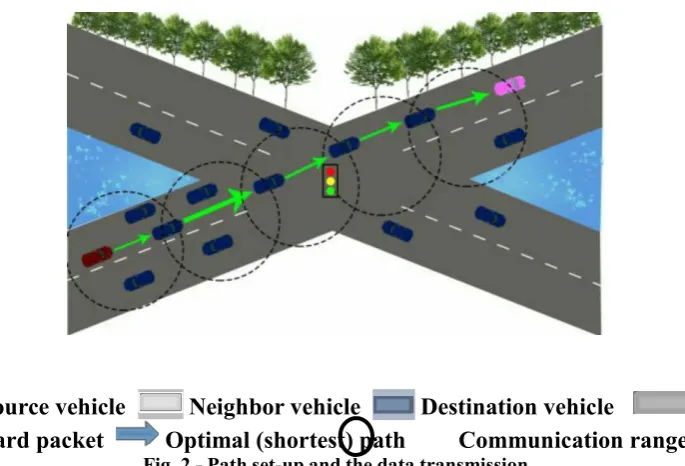
Source vehicle
Neighbor vehicle
Destination vehicle
Hello message
Response message
Communication range
Fig. 1 - Path discovery
2.2 Path Set-Up and the Data Transmission
A- Path Discovery
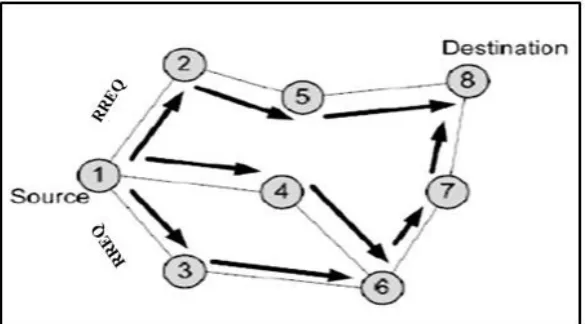
When the exporter node needs a new path for the destination node and does not have that path, the reason is that the requested path has not been used before, or that it has been used but it has become expired. The source node broadcast a message requesting the path RREQ to the rest of the nodes. After the RREQ is broadcast, the source node waits for get it a message to respond to the RREP request from a node over a specified period of time. If it does not receive a response during the period, it either re-transmits the route request message again or assumes that there is no known route and modern route for the requested destination node, when the route request message arrives for a node and it does not have modern route and correct route for the interface node specified in the message, it re-broadcasts the route request message (RREQ), as shown in Fig.4.
Fig. 3 - Broadcast Route Request Messages
B- Path maintenance
Fig. 4 - Route Replay Messages
It occurs when the node detects a path to a neighboring contract is no longer valid. It deletes that route from its routes table, and then broadcasts an announcement that the routes not valid for all adjacent nodes that are currently using that route. Each node that receives this message re-transmits it to its neighboring nodes until the message eventually reaches the source node that created the packets sent by that Route, and from there It either cancels data transmissions or retries the route request, by sending a new route request message (RREQ).
4. Simulation Parameter
Control message size
64 Bytes
5. Discussing the outcome
This part displays the results in two cases when comparing the MDORA protocol and the AODV protocol in these following points (E2E delay, PDR, and communication overhead).
5.1 The first case is the movement of the vehicles in several directions
End to end (E2E) delay is difference between time packet to send from the source vehicle and time when package is received in destination vehicle which measured in milliseconds. In the Fig.7 shows end to end delay.
Fig. 6 - E2E Delay in first case
Communications overhead can be characterized "quantity of control messages" that are sent by the MDORA protocol (Hello message, response message) and the controlled messages that are sent from a AODV protocol (route request message, route replay message, route error message) that create and maintain the path between the vehicles., and is measured in bytes. In the Fig.9 shows communication overhead.
Fig. 8 - Communication Overhead in first case
5.2 The second case is the movement of the vehicles in one direction
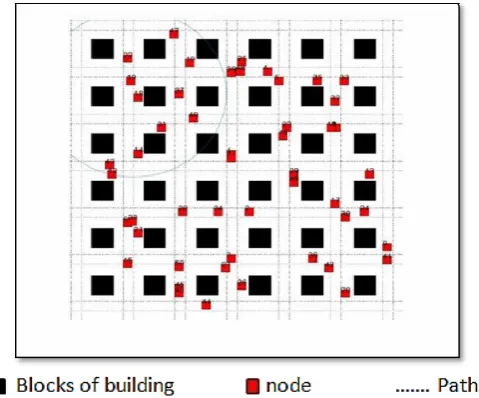
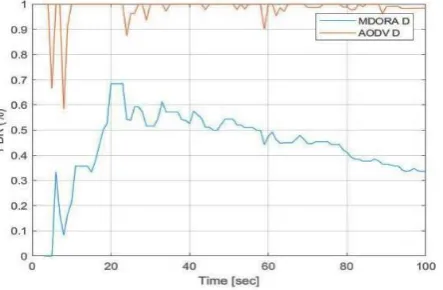
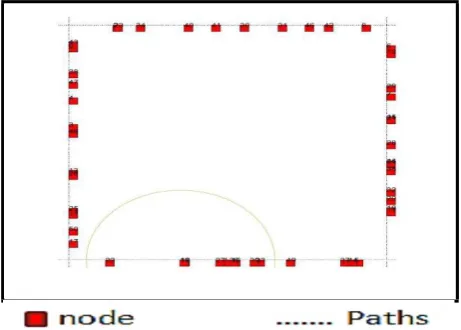
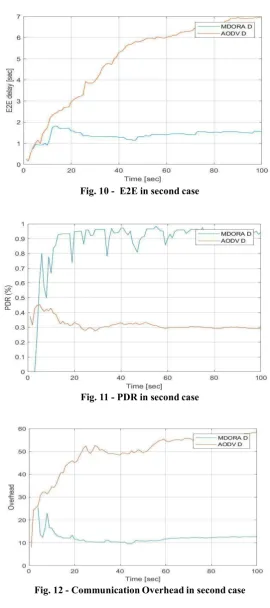
Present the results of the comparison between the protocol MDORA and AODV in the case of variable vehicles velocity. In this case, a single path was selected the vehicles moving through it, and be the movement of the vehicles in one direction. Simulation environment in the second case show in the Fig. 10, show E2E delay as shown in Fig. 11, the packet ratio in Fig. 12, and communication overhead in Fig.13.
Fig. 10 - E2E in second case
Fig. 11 - PDR in second case
6. Conclusion
This work adopted MDORA protocol and AODV protocol, and the comparison was done between this protocols, the first case is comparison results between the MDORA and AODV protocols in case of movement of vehicles at variable velocity, and movement of vehicles in several directions. The obtained results demonstrate AODV protocol is more efficient compared MDORA protocol in these following points (E2E delay, PDR, communication overhead). The second case is comparison results between the MDORA and AODV protocols in case of movement of vehicles at variable speeds, and movement of vehicles in one direction only. Also for MDORA protocol, the obtained results are better than the AODV protocol in E2E delay, PDR, and communication overhead. It follows from this that MDORA protocol works well if applied to a single-way traffic environment because in the MDORA algorithm there is a condition that it only selects vehicles which moves with him in the same direction when routing packet to the destination vehicle.
References
[1] W Chen, RK Guha, TJ Kwon, J Lee, YY Hsu, A survey and challenges in routing and data dissemination in vehicular ad hoc networks. Wirel. Commun. Mob. Comput. 11, 787–795 (2011)
[2] SAA Shah, M Shiraz, MK Nasir, RBM Noor, Unicast routing protocols for urban vehicular networks: review, taxonomy, and open research issues. J. Zhejiang University SCIENCE C 15, 489–513 (2014)
[3] Y Chen, M Fang, S Shi, W Guo, X Zheng, Distributed multi-hop clustering algorithm for VANETs based on neighborhood follow. EURASIP J. Wirel. Commun. Netw. 2015,1 –12 (2015)
[4] OA Mahdi, AW Abdul Wahab, I Idris, M Yamani, S Khan, YRB Al-Mayouf et al., A comparison study on node clustering techniques used in target tracking WSNs for efficient data aggregation. Wireless Communications and Mobile Computing, 2016. doi:10.1002/wcm.2715
[5] BT Sharef, RA Alsaqour, M Ismail, Vehicular communication ad hoc routing protocols: a survey. J. Netw. Comput. Appl. 40, 363–396 (2014)
[6] B Karp, H-T Kung, GPSR: greedy perimeter stateless routing for wireless networks, in Proceedings of the 6th annual international conference on mobile computing and networking, 2000, pp. 243–254
[7] T Clausen, G Hansen, L Christensen, G Behrmann, The optimized link state routing protocol, evaluation through experiments and simulation, in IEEE Symposium on Wireless Personal Mobile Communications, 2001
[8] M Altayeb, I Mahgoub, A survey of vehicular ad hoc networks routing protocols. Int. J. Innov. Appl. Stud. 3, 829– 846 (2013)