ANALYSIS OF MULTIMEDIA TECHNOLOGY IN A
COMPUTER AIDED DESIGN TRAINING
ENVIRONMENT
Warren Davies
1, Kathryn Cormican
2 1CADcraft Design, Kilcooley, Loughrea, Galway, Ireland
2
College of Engineering & Informatics, National University of Ireland, Galway, Ireland.
ABSTRACT
Innovation in computer and information technology, changing student requirements coupled with a need for
modern teaching techniques all act as drivers towards the proliferation of high quality multimedia training
material.Our research reports on principles that should be adhered to when designing multimedia training
material in a Computer Aided Design (CAD) environment. We also examine the effects of individual differences
and learning styles in the learning process. The most effective forms of multimedia and delivery platforms are
also identified. Finally, the factors inhibiting the use of multimedia are established and recommendations are
made. We found that principles of multimedia learning are valid from the student’s perspective however the
instructors did not uphold all the principles. Age and gender had little effect on preferences and opinions.
Individual learning styles have an effect on the preferred formats and delivery processes. Our sample revealed
that computer based material is the most popular and effective way to learn from and that computer technology
is the most effective delivery platform. Prohibitive costs, perceived lack of skill and insufficient support are
factors inhibiting the use of multimedia material.
Keywords: Best Practice, Computer Aided Design, Delivery Platforms, Design Goals, Learning
Styles, Multimedia Formats, Principles Of Multimedia Learning
I. INTRODUCTION
Computer-aided design (CAD) is the use of computer systems and design software to assist in the generation, modification, or optimization of a design [1]. CAD systems allow engineers to manipulate information, such as material specifications, design processes, product dimensions, and tolerances. The engineer is able to use CAD to simulate real world dynamics to take the design of a product from its initial concept through to the prototype and completion stages. The pedagogy of computer aided design training is similar to that of any high end user software package in its context and cognitive structure. Increasingly, instructors who teach the principles of computer aided design have turned their attention to using multimedia techniques to provide students with high quality representations of these principles and models. According to Agnew et al. [2] multimedia design “offers new insights into the learning process of the designer and forces him or her to represent information and
knowledge in a new and innovative way”. Stemler[3] contends that multimedia technologies allow designers to
create “interactive and animated graphical presentations to communicate dynamic information” in the belief
increase the learner’s ability to absorb and assimilate material [5]. Effective designs help learners to focus on relevant information, organize the information into a coherent mental representation, and integrate it with previously gained knowledge. However poorly designed material has a negative impact as too much information can overwhelm and confuse the learner [6] and many applications often contain interactions which are largely gratuitous and do little to support effective learning [7].It seems that there is a lack of empirical evidence on how multimedia works or which environments are best suited to this media. It is also unclear from existing research if the introduction of multimedia material enhances the learning experience or improves student performance. Moreover, there are few comprehensive guides available to developers to influence the effective implementation of multimedia in learning environments. Finally, existing research on the principles of learning by multimedia material is inconclusive. It is now becoming increasingly apparent that these issues must be addressed. The goal of our research is to develop an understanding of what multimedia means in the context of a computer aided design learning environment. We explore empirically established learning principles, such as those outlined in the cognitive theory of multimedia learning and apply them to the computer integrated design training environment. This context lends itself well to the use of multimedia in any computer software package training. We test the validity of best practice design principles from a teachers and a students’ perspective. We also identify the effect that individual learning styles and human factors have on learning preferences. In addition we analyse the delivery tools that are available and determine which formats students and instructors prefer to use. Finally, we determine barriers that exist regarding the use of multimedia technology. The nature of this study is clearly multifaceted; (a) exploratory to set the scene and determine the significant issues that arise, (b) descriptive to establish facts and principles and (c) analytical to determine the variables and relationships that arise. As a result of this many research methods are used to collect data including interviews; group discussions; surveys and empirical tests. The research is important for many reasons. It analyses the issues that must be addressed when considering the introduction of multimedia into the training environment. The findings inform the teacher or course designer about the best available tools that offer value to the teacher and student. Consideration of these principles can help form the basis of an implementation strategy for the use of multimedia technology and an alignment between best practice and stakeholder requirements. It can also aid in creating a set of design rules to guide the teacher in the development of a multimedia training toolkit. The remainder of the paper is organized as follows. First a discussion on the concept of multimedia and the principles of multimedia learning is synthesized and presented. In this section we discuss individual differences and learning styles. Second the research approach employed in this study is outlined. Third, the findings from the analysis are presented and discussed. The paper concludes with a summary of the study, a series of recommendations and suggestions for future work.
II. PRINCIPLES OF MULTIMEDIA
learning is because multimedia provides the learner with more cognitive paths that can be followed to retrieve the learned information. However cognitive load must also be considered when looking at the learning rationale [6]. This theory proposes that the processing capabilities of the visual and verbal working memories are limited and can become overloaded thus reducing learning capacity. People have the ability to integrate information from different sensory modalities such as the eye, ear and nose to create a meaningful experience. Therefore, the instructional designer is faced with the need to choose between several combinations of modes and modalities to promote meaningful learning [11]. Mayer [10] has conducted extensive research in this area. His research has identified specific principles for designing learning material. Previous studies have found that these principles can improve learner retention (i.e. the ability to remember what was presented) and learner transfer (i.e. the ability to apply what was learned to solve problems). These principles are now discussed in more detail.
2.1 Generative Learning Principle
Mayer[10]developed a multimedia principle that concludes that students learn more from a combination of words and pictures than from words alone. Studies by Yilmaz-Soylu&Akkoyunlu[12] support this principle and refer to it as “the generative theory of multimedia learning”. Here relevant graphics should be included to
supplement written text to improve learning. The theoretical rationale for this is that when presented with both words and pictures students are able to construct verbal and pictorial models and make connections between them. If words are used alone a verbal model is built up as the students read the text but they are less likely to make the same connections limiting the learning. Empirical data in tests conducted by Mayer[10] show that students who received a combination of text and pictures did better in retention of knowledge tests than those who received only text or pictures. In six out of nine tests students performed better when receiving the information in a combined format. In addition it was found that students also did better on transfer of knowledge tests when information was received in combination with nine out of ten tests resulting in improved performance. Moreno and Valdez [13] found that students learn better when provided with visual and verbal knowledge representations rather than visual or verbal representations alone.
2.2 Spatial Contiguity Principle
The second principle that Mayer proposes is known as the spatial contiguity principle and it states that students learn better when words and pictures are presented near to each other on a page or screen. According to Tempelman-Kluit[14] “when images and text are provided close together, connections linking the two types of
information will be made more easily and mental models leading to meaningful learning will occur.” The
rationale given for this principle is that learners do not have to exert effort in searching for the information thus reducing the load on the individuals working memory. Mayer [10]found that in retention tests students achieved a 42% improvement in performance when presented with text and pictures placed near to each other rather than apart. This improvement was also evident in transfer tests where students achieved a much higher score with the 68% of students improving their performance.
2.3 Temporal Contiguity Principle
et al.[15] also concluded in their research that visual elements should be “synchronized with corresponding
narration”. A higher rate of transfer to long term memory will occurif verbal and visual information are
presented at the same time rather than with one representation following another [14].
2.4 Coherence Principle
The coherence principle states that unnecessary verbal or visual information should be eliminated because they tempt the learner to focus on the irrelevant information at the expense of the critical information. In retention and transfer tests carried out by Mayer students performed better when irrelevant information was removed from the learning material. There was also an 80% increase in student performance in retention and transfer when irrelevant detail is excluded. Unnecessary information impedes learning as it interferes with the integration of information. When pointless information is included students are required to organize the material. In other words, learners’ attention is diverted away from the main theme which can result in a lower performance in retention and transfer tests. There is substantial evidence to suggest that irrelevant information impairs learning[16, 17]. In light of this only educationally relevant pictorial and verbal information should be included.
2.5 Modality Principles
This principle states that words should be put in spoken form rather than in printed form when a graphic or image is the primary focus of the lesson. In four out of five tests Mayer [10]found that students who received animation with narration as opposed to text in the animation did better in both retention and transfer tests. The rationale for this principle rests in the dual coding theory [15]. Dual-coding theory proposes that both visual and verbal information is used to represent information in a learner’s mind and students’ process information in both visual and verbal channels simultaneously. If the learner uses his or her visual channel to process any images or animations, presenting on-screen text to convey verbal information merely divides the learner’s visual attention and reduces the efficacy of the lesson. Studies showed that students who learn with concurrent narration and animations outperform those who learn with concurrent on-screen text and animations [17]. The effect is attributed to the student using reduced mental effort when learning as written text interferes with the process of organization within the visual channel. In light of this, only key words should be placed on the screen to maintain the focus of the lesson on the diagram.
2.6 Redundancy Principle
According to cognitive processing theory learners can only process a small amount of information. Too much information or information that is not clearly presented, or relevant, may lead to cognitive overload which has a negative impact on learning. People learn better from animation and narration than from animation, narration, and on on-screen text [10]. In two out of two tests both retention and transfer were improved when the online text was removed from the material. In this view learning is diminished if animation, narration and on screen text are used together because the learners working memory is overloaded and he or she cannot cope with this. In light of this designers should ensure that on-screen text does not duplicate narration.
2.7 Personalization Principle
learn better when the content is conversational, without being overly friendly, rather than when it is delivered with a formal approach [18]. Other studies suggest that students prefer to learn from multimedia material that is prepared by the instructor, claiming that this strengthens the familiarization effect between the two parties [19]. Student’s motivation is improved and they work much harder to understand material when they are engaged in the social interaction effectof using personalized material [20]. In light of this the instructor may consider preparing the learning material themselves based on the needs of their students rather than using external generic sources.
2.8 Individual Differences Principle
individuals. They are good team members and like working in groups. They tend to have leadership qualities and are prepared to take a risk.
III. RESEARCH METHODOLOGY
Data was collected from both instructors (n=29) and (n=216) students in a computer aided design training environment in Ireland. Purposive or judgmental sampling was used in combination with non-random sampling in order to identify participants with deep insight into the area multimedia in computer aided design training. All stakeholders operated in the sphere of adult education only. Only experienced computer aided design instructors were included in the sample frame. Students who have not participated in computer aided design courses were excluded from the research. Participation in the research was voluntary and individual responses are strictly confidential. Mixed methods were used to collect data in order to enhance triangulation. Semi-structured interviews allowed a deep insight to be gained into current practices and process. Surveys allowed us to empirically measure opinions, practices and results. Data from experiments was analyzed to validate the generative theory of multimedia learning. Templates ensured that the research protocol was consistent and all interviews were recorded. Interviews were written up within 24 hours and the reports were sent back to the respondents for review. Clarifications and amendments were made where necessary. This activity verified the accuracy of the technique and increased the reliability of the study. Quantitative data was analyzed using SPSSx and excel. A chain of evidence was maintained to ensure that logical relationship existed between goals of the research, the protocol used, the raw data, and the conclusions drawn from results. Consequently we can be reasonably confident that an objective researcher following the same process would arrive at the same or similar conclusions.
IV. RESEARCH RESULTS
4.1 Principles of Multimedia Learning
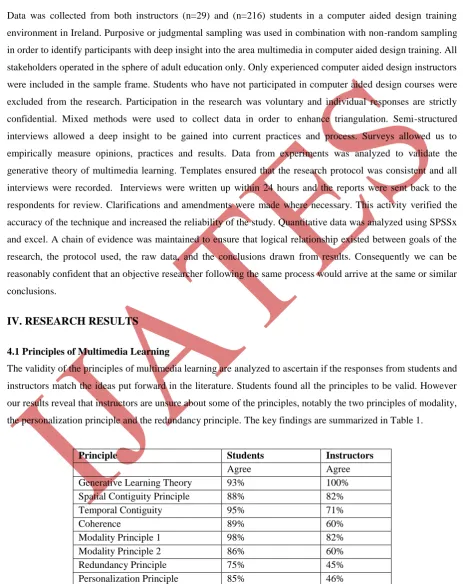
The validity of the principles of multimedia learning are analyzed to ascertain if the responses from students and instructors match the ideas put forward in the literature. Students found all the principles to be valid. However our results reveal that instructors are unsure about some of the principles, notably the two principles of modality, the personalization principle and the redundancy principle. The key findings are summarized in Table 1.
Principle Students Instructors
Agree Agree
Generative Learning Theory 93% 100% Spatial Contiguity Principle 88% 82%
Temporal Contiguity 95% 71%
Coherence 89% 60%
Modality Principle 1 98% 82% Modality Principle 2 86% 60% Redundancy Principle 75% 45% Personalization Principle 85% 46%
Table 1: Analysis Of Principles Of Multimedia Learning
This principle states that students learn better when presented with a combination of words and pictures than from words or pictures alone. Both the students and instructors agree that this principle is valid. In the retention of information test carried out on the student sample, those that received information in the picture and word format out performed those who did not. Students who were presented with the combined format averaged a score of 8/10 while those who did not averaged 6/10. There was a slight improvement with pictures only (6.5/10) over words only (6.35/10). Therefore, when developing multimedia material, words and pictures should be combined in any presentation.
4.3 Principle Of Spatial Contiguity
This principle states that students learn better when words and pictures are presented near to each other rather than being placed apart. Both the students and instructors found this principle to be valid. When developing multimedia material, words and pictures should be placed near to each other.
4.4 Principle Of Temporal Contiguity
This principle suggests that students learn better when words and pictures are presented together rather than in succession. The student sample in our study found this principle to be valid. However the instructors were not as convinced as the students with many unsure of the principle. When developing multimedia material the words and pictures should be placed together in accordance with the best practice procedure proposed by this principle.
4.5 Principle Of Coherence
This principle states that learning is reduced when irrelevant words and pictures are introduced. While both the students and instructors found this principle to valid a large number of instructors were unsure about the validity of the principle. Overall our finding suggests that irrelevant words and pictures should be excluded when developing multimedia material.
4.6 The Modality Principles
The first principle of modality states that when animation and narration are used together the student’s learning is enhanced compared to when animation is used alone. This principle is based on results from retention and transfer tests that show a higher performance when the two are combined together. Both the students and instructors in our study found this principle to be valid. While it is easier to dub screen capture videos with sound rather than adding narration as a screen capture these results suggest that when developing videos the narration should be recorded as well. When choosing videos from third parties, instructors should ensure that they contain sound and the student has a means of playing back the sound. A second modality principle states that the combination of animation and narration is superior to a combination of animation and text. The rationale behind this principle is that the presentation of animation and on screen text together overloads the visual channel while the use of narration spreads the workload between both the auditory and visual channels. Our study upholds this principle.
4.7 The Redundancy Principle
the working memory. When developing videos, these combinations should be avoided unless the student can control what appears and choose which functions to use. For example they may want to turn the text off if it does not suit them.
4.8 The Principal Of Personalisation
Moreno[19] states that students prefer to learn from multimedia material that is prepared by the instructor. Student’s motivation is improved and they work much harder to understand material when they are using personalized material [20]. The students in our study believed that their learning was enhanced when digital videos were prepared by the instructor. This effect can be attributed to more focused material being used. However, we found that the majority of instructors found the principle to be either invalid or they were unsure.
4.9 Multimedia Formats
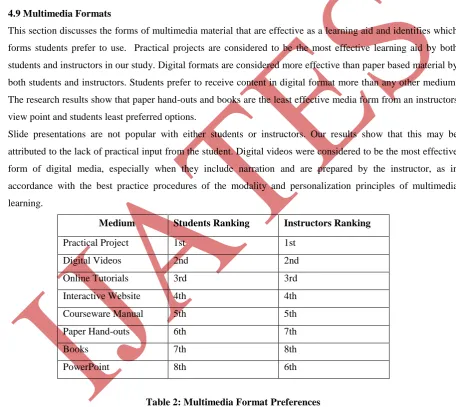
This section discusses the forms of multimedia material that are effective as a learning aid and identifies which forms students prefer to use. Practical projects are considered to be the most effective learning aid by both students and instructors in our study. Digital formats are considered more effective than paper based material by both students and instructors. Students prefer to receive content in digital format more than any other medium. The research results show that paper hand-outs and books are the least effective media form from an instructors view point and students least preferred options.
Slide presentations are not popular with either students or instructors. Our results show that this may be attributed to the lack of practical input from the student. Digital videos were considered to be the most effective form of digital media, especially when they include narration and are prepared by the instructor, as in accordance with the best practice procedures of the modality and personalization principles of multimedia learning.
Medium Students Ranking Instructors Ranking
Practical Project 1st 1st
Digital Videos 2nd 2nd
Online Tutorials 3rd 3rd
Interactive Website 4th 4th Courseware Manual 5th 5th
Paper Hand-outs 6th 7th
Books 7th 8th
PowerPoint 8th 6th
Table 2: Multimedia Format Preferences
4.10 Multimedia Delivery Platforms
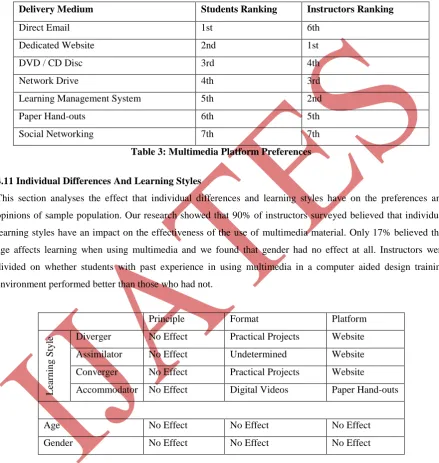
need to log in and due to poor experiences using such systems in the past. This was in contrast to instructors who found that websites and online learning systems were the most effective tools to use to deliver material indicating a move towards the use of computer based learning aids as suggested in the literature. However instructors did not like the idea of emailing students material due to management of that information issues. Interestingly our study found that both students and instructors did not consider social networking platforms to be beneficial.
Table 3: Multimedia Platform Preferences
4.11 Individual Differences And Learning Styles
This section analyses the effect that individual differences and learning styles have on the preferences and opinions of sample population. Our research showed that 90% of instructors surveyed believed that individual learning styles have an impact on the effectiveness of the use of multimedia material. Only 17% believed that age affects learning when using multimedia and we found that gender had no effect at all. Instructors were divided on whether students with past experience in using multimedia in a computer aided design training environment performed better than those who had not.
Table 4: Individual Differences Effect Chart
We were unable to determine if past experience had an effect on student preferences as most of our sample had participated on computer aided design courses that had used multimedia in the past. We in our study we found that individual learning styles, age and gender had no effect on the validity of the principles of multimedia learning. In contrast we found variations existed when we examined the preferred formats and platforms. Although age and gender had no effect on format choices or delivery platforms we found that learning style differences do have an effect. In line with Kolb’s (1984) suggestion that assimilators like to gather information, our research showed that this group liked multiple formats equally. We also found that divergers and convergers
Delivery Medium Students Ranking Instructors Ranking
Direct Email 1st 6th
Dedicated Website 2nd 1st
DVD / CD Disc 3rd 4th
Network Drive 4th 3rd
Learning Management System 5th 2nd
Paper Hand-outs 6th 5th
Social Networking 7th 7th
Principle Format Platform
L
ea
rn
in
g
Sty
le Diverger No Effect Practical Projects Website
Assimilator No Effect Undetermined Website Converger No Effect Practical Projects Website
Accommodator No Effect Digital Videos Paper Hand-outs
Age No Effect No Effect No Effect
preferred practical exercises. We found an interesting anomaly with Kolb’s (1984) learning cycle theory in that our research shows that accommodators prefer to watch a task on video rather that learning by practical experience. This group also preferred old style handouts to new technology formats.
4.12 Factors Inhibiting The Use Of Multimedia Material
The research identified cost, lack of skills and the instructor development time required as the major inhibitors to the use of multimedia material. These findings correspond to the issues highlighted in the literature. Resistance to change, lack of available materials, slow internet speeds and a reluctance to recognize the increased work load are also significant factors that inhibit the implementation of multimedia material.
Other retarding factors in multimedia use are that it creates extra workload for the teacher in addition to that laid out in tightly controlled curriculums. The preparation of material involves learning new and often technically difficult skills. The lack of funding especially in the state sector is often the reason for poor take up of multimedia.
Our research discussions and interviews found that there were a number of barriers to the full exploitation of multimedia and technology in the classroom.These finding can be summarized as:
There is often no coordinated management structure to help develop multimedia.
Information about techniques and access to it is limited.
Senior educational managers are not taking a strategic approach to change.
Educators lack confidence and competence in information technology.
There is insufficient hardware equipment.
There are not enough application software packages.
There is insufficient time to develop material.
V. CONCLUSIONS
occur is students prefer to have material emailed to them directly which instructors do not favor. Instructors on the other hand prefer using learning management systems. Our study found that social networking platforms are not considered beneficial by either students or instructors.
Based on our findings we can recommend the following to designers:
The principles of multimedia material should be embedded when developing multimedia material. Designers
and instructors should familiarize themselves with these principles. Best practice guidelines should also be created to enable this.
New technologies should be examined by instructors and tested in their training environment to determine if
they meet the needs of the learner.
Instructors should obtain training in multimedia development and delivery tools as the research identifies this
as a major inhibitor to the use of multimedia technology.
We recommend that course managers take a blended learning approach rather than a distance learner
approach to their courses. Multimedia material should be used to supplement classroom based training, not replace it.
Learning management systems are considered useful as a hosting platform for multimedia learning. However
we found that web pages provided a more efficient portal for viewing data. We recommend combining the two platforms with the learning management system used solely for administration and management of the course.
This research opens up avenues for future research projects. There is a need for additional experimental testing of the principles of multimedia learning in other learning environments. Any research in this area would require rigorous attention to the testing techniques. Although it is clear what effect multimedia use has in retention and transfer tests it is not clear how the use of multimedia affects specific course objectives. This could be examined in more detail. There is a need for further research on the relationships between the use of verbal and visual communication, in the use of interactivity functions of multimedia and the role of assessment and evaluation in the process. Finally further research could be conducted in the area of past experience effects on learning.
REFERENCES
[1] Narayan, K. L., Rao, K.M., Sarcar, M.M.M., Computer Aided Design and Manufacturing (Prentice Hall, New Delhi, 2008).
[2] P.W. Agnew, A.S Kellerman, J. Meyer, Multimedia in the Classroom(Boston: Allyn& Bacon, 1996). [3] Stemler, L. K. (1997) Educational characteristics of multimedia: A literature review, Journal of
Educational Multimedia and hypermedia 6, 1997, 339-360.
[4] S. Cairncross and M. Mannion, Interactive multimedia and learning: Realising the benefits. Innovations in
Education and Teaching International, 38(2), 2001, 156-164.
[5] N. Issa, R.E Mayer, M. Schuller., E. Wang, M.B. Shapiro andD.A. DaRosa, Teaching for understanding in medical classrooms using multimedia design principles. Medical Education, 47, 2013, 388–396.
[6] P. Chandlerand J. Sweller, Cognitive load theory and the format of instruction.Cognitive Instruction, 8(4),
1991, 293–332.
[7] F. Aldrich, Y. Rogers, and M. Scaife, Getting to grips with interactivity: Helping teachers assess the educational value of CD-Roms, British Journal of Educational Technology, 29(4), 1998, 321–332.
[8] P. Ayres and J. Sweller,The split attention principle in Multimedia learning,The Cambridge handbook of multimedia learning, (New York: Cambridge UniversityPress, 2005, 135-146).
[9] R. Mayer, Multimedia Learning, (Cambridge University Press, New York, 2001).
[10]R. Moreno and R.E. Mayer,A coherence effect in multimedia learning: The case for minimizing irrelevant sounds in the design of multimedia instructional messages. Journal of Educational Psychology, 97, 2000, 117-125.
[11]M. Yilmaz-Soylu and B. Akkoyunlu, The effect of learning styles on achievement in different learning environments, The Turkish Journal of Educational Technology, 8(4), 2009.
[12]R. Moreno and A. Valdez, Cognitive load and learning effects of having students organize pictures and words in multimedia environments: The role of student interactivity and feedback. Journal of Educational
Technology Research and Development, 53(3), 2005, 35-45.
[13]N. Tempelman-Kluit, Multimedia learning theories and online instruction. College & Research Libraries,
67(4), 2006, 364-369.
[14]C.L. Yue, E.L. Bjork andR.A. Bjork, Reducing Verbal Redundancy in Multimedia Learning: An Undesired Desirable Difficulty? Journal of Educational Psychology, 105(2), 2013, 266.
[15]S.F. Harp and R.E. Mayer, How seductive details do their damage: a theory of cognitive interest in science learning. Journal of Educational Psychology, 90, 1998, 414–34.
[16]R.E. Mayer and R. Moreno, R., Aids to computer-based multimedia learning, Journal of Learning and
instruction, 12(1),2002, 107-119.
[17]R.C. Clark andR.E. Mayer, E-Learning and the science of instruction: proven guidelines for consumers and designers of multimedia learning (Jossey-Bass/Pfeiffer Edition, 2003).
[18]R. Moreno, Decreasing cognitive load for novice students: Effects of explanatory versus corrective feedback in discovery-based multimedia. Instructional Science, 32, 2004, 99–113.
[19]B. Reeves and C. Nass,The Media Equation, (Cambridge University Press, New York, 1996).
[20]J.E Kemp,G.R. Morrison, and S.M Ross, Designing effective instruction (2nd ed.) (Upper Saddle River, NJ.: Prentice-Hall, 1998)
[21]M. Volmanand E. van Eck, Gender equity and information technology in education: The second decade,
Review of Educational Research 71(4), 2001, 613-634.