Working Memory Training Improves Cognitive
Function in VLBW Preschoolers
WHAT’S KNOWN ON THIS SUBJECT: Preterm born children have cognitive problems that include deficits in working memory. Computer-based working memory training has been reported to improve cognitive function in children.
WHAT THIS STUDY ADDS: A computer-based working memory training program designed for preschoolers seems effective in very low birth weight children, not only on working memory tasks, but also by having a generalizing effect regarding memory and learning.
abstract
BACKGROUND AND OBJECTIVE: Preterm born children perform poorer than term peers on tests of attention and executive functions including working memory tests. Our aim was to evaluate if preterm born preschoolers with very low birth weight (VLBW) would benefit from a computerized working memory training program and if the training would have a generalizing effect on memory, learning, atten-tion, behavior, and anxiety.
METHODS:A prospective intervention study with a stepped wedge de-sign where 20 VLBW preschoolers aged 5 to 6 years participated. The children trained with the Cogmed JM program for 10 to 15 minutes a day, 5 days a week over a 5-week period. Extensive neuropsycholog-ical assessment and parental questionnaires regarding behavior and anxiety were performed before and 4 weeks after intervention.
RESULTS:The children improved significantly on trained (mean Start Index 42.1 [SD 6.3]), mean Max Index 60.6 [SD 5.7]), and nontrained working memory tasks (Spatial Span backward; 2.3 [before] to 3.6 [af-ter training] [confidence interval {CI}22.2 to20.4] and Spatial Span total score; 6.4–8.3 [CI 23.7 to 20.1]). A generalization effect was found on auditory attention (49.6–58.2 [CI215.5 to21.6]), phonolog-ical awareness (9.3–12.6 [CI25.2 to21.4]), visual (memory for faces 20.0–24.9 [CI 27.4 to 22.5]), as well as verbal memory (narrative memory; 12.9–17.5 [CI 27.1 to 22.0], and sentence repetition 15.7– 17.7 [CI23.3 to 20.7]).
CONCLUSION:This study shows that VLBW preschoolers benefit from a computerized working memory training program. We speculate that such training before starting school may prevent or reduce cognitive problems that impact educational achievement. Pediatrics 2013;131: e747–e754
AUTHORS:Kristine Hermansen Grunewaldt, MD,a,bGro
Christine Christiansen Løhaugen, PhD,a,cDordi Austeng,
MD, PhD,a,dAnn-Mari Brubakk, MD, PhD,a,band Jon
Skranes, MD, PhDa,b
aDepartment of Laboratory Medicine, Children’s and Women’s
Health, Norwegian University of Science and Technology, Trondheim, Norway;bDepartments of Pediatrics, and
dOphthalmology, St. Olav University Hospital, Trondheim, Norway;
andcDepartment of Pediatrics, Sørlandet Hospital, Arendal,
Norway
KEY WORDS
working memory training, preterm birth, VLBW children, cognition, intervention
ABBREVIATIONS
ADHD—attention-deficit/hyperactivity disorders CI—confidence interval
ELBW—extremely low birth weight FSIQ—full intelligence quotient VLBW—very low birth weight
Dr Grunewaldt coordinated and organized the study, collected data, conducted the analyses, drafted the initial manuscript, and approved thefinal manuscript as submitted; Dr Løhaugen performed all neuropsychological examinations, contributed to the interpretation of data, critically reviewed and revised the manuscript and approved thefinal manuscript as submitted; Dr Austeng performed the ophthalmological examinations, reviewed and critically revised the manuscript and approved the
final manuscript as submitted; Mr Brubakk contributed to the design of the study, critically reviewed and revised the manuscript and approved thefinal manuscript as submitted; and Mr Skranes conceptualized and designed the study, contributed in the interpretation of data, critically reviewed and revised the manuscript, and approved thefinal manuscript as submitted.
This trial has been registered at www.clinical trials.gov (identifier NCT01518452).
www.pediatrics.org/cgi/doi/10.1542/peds.2012-1965
doi:10.1542/peds.2012-1965
Accepted for publication Nov 14, 2012
Address correspondence to Kristine Hermansen Grunewaldt, MD, Department of Laboratory Medicine, Children’s and Women’s Health, Norwegian University of Science and Technology, 7489 Trondheim, Norway. E-mail: [email protected]
PEDIATRICS (ISSN Numbers: Print, 0031-4005; Online, 1098-4275).
Copyright © 2013 by the American Academy of Pediatrics
(Continued on last page)
especially after the introduction of antenatal steroids and surfactant treatment.1,2 Despite the increased survival, the number of children with brain pathology and neuroimpairments is still very high, especially among the most immature children.3–5 Cognitive and behavioral deficits are reported to last into adolescence and early adult-hood.6,7 Very preterm born children perform more poorly than term born peers on tests of attention and execu-tive functions,8,9 and these skills are essential for a child’s ability to learn, to plan their actions, to solve problems and to develop language as well as mathematical skills.10Deficits in these domains may therefore impact aca-demic achievements,4,11 and interven-tion strategies to minimize the long-term cognitive impact of prematurity should be prioritized.
Working memory is defined as our ability to temporarily store and at the same time manipulate information“ on-line” over short periods of time.12 Working memory is considered to be a prerequisite for other executive func-tions such as reasoning and plan-ning and to predict intelligence and academic success.13,14 Impairment in working memory has been linked to learning disabilities15 and has been reported to have a strong influence on cognitive functioning in childhood in preterm born individuals.4,16 Several studies have shown that a computerized working memory training program (Cogmed RM) improves working mem-ory skills in children with attention-deficit/hyperactivity disorders (ADHD),17,18 in children after traumatic brain injuries19 and in children treated with chemo-therapy because of leukemia.20 Our group has reported beneficial effects of Cogmed RM in extremely low birth weight (ELBW, birth weight ,1000 g)
weight (VLBW) preschoolers. If effec-tive, such training could have a major impact by improving these children’s school performance. The aim of the current study was to determine whether a group of preterm born VLBW preschoolers would benefit from a computerized working memory train-ing program (Cogmed JM) designed for children aged 4 to 6 years. In ad-dition, we wanted to evaluate if such training would have a generalized beneficial effect on memory and learn-ing, as well as behavior, attention, and anxiety.
METHODS
Participants
In 2005–2006, a total of 79 VLBW chil-dren were admitted to the NICU, Trondheim University Hospital in Nor-way. Of 75 surviving infants, 11 children were too young to participate in the study (,5 years of age at study start). Other exclusion criteria were living in another region, severe cerebral palsy with totally impaired bilateral hand functions (Gross-Motor-Function-Classification-System level V), epilepsy, or blindness. According to these crite-ria, 29 (45%) children were excluded. A total of 35 children aged 5 to 6 years met the inclusion criteria and were invited to participate in the current study (Fig 1). Twenty-two children con-sented to participate, but 2 children did not show up for initial testing; hence, a total of 20 of the 35 eligible children (57%) participated in the intervention study. Mean birth weight was 1099 g (SD 311), mean gestational age was 28.8 weeks (SD 2.8), and mean age at intervention was 5.8 years (SD 0.5).
Nonresponders
The clinical characteristics of partici-pants and nonresponders are described
steroids among participants.
Study Design
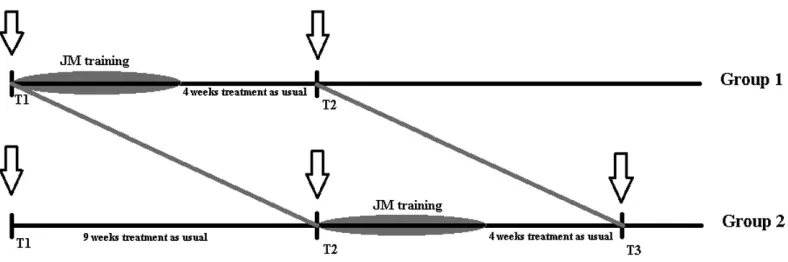
A Stepped Wedge randomized trial de-sign22was chosen to split the partic-ipants into 2 groups for sequential rollout of the intervention. The partic-ipants were randomly assigned to 2 equal groups; however, owing to fa-miliar courses, 1 child had to switch training group to be able to complete the training. There were no significant differences in the clinical character-istics between the 2 groups at start of the study (Table 1). Both groups were tested with cognitive and neuro-psychological tests at time point 1-T1 (Fig 2). Then the participants in group 1 started the training program, while those in group 2 waited. When group 1 had completed the training period, both groups were retested∼1 month after ended training in group 1 (time point 2-T2). Group 2 then started the working memory training. At last, group 2 was tested at time point 3-T3
∼1 month after ended training. Owing to the small study sample, we then combined the results from pre- and posttraining testing in both groups to look at training effects in the whole sample. However, we also looked at possible training effects by separate group analyses from T1 to T2 and for group 2 also from T2 to T3.
Intervention Program
minutes, 5 days a week for 5 weeks was performed by the child. Three tasks were administered to the child each day. The exercises became more difficult as
the child’s skills improved, and the diffi -culty level of the training was adjusted by the software based on the child’s performance. After each training, the
parents uploaded the results to a se-cure Internet site. Once a week, the principal investigator contacted the family to give advice based on the up-loaded results.
Visual Acuity
An experienced ophthalmologist as-sessed visual acuity in all children with Lea Symbols 15 Line Distance Chart before training.
Socioeconomic Status
Socioeconomic status was calculated according to the Hollingshead 2-factor index of social position (mean educa-tional levels and current employment of both parents or from a single parent).23
Neonatal Data and Additional Diagnoses
Neonatal data and additional diagnoses were retrieved from the medical journals at the Trondheim University Hospital.
Outcome Measures
Effect on the trained tasks (included in the computer program) was assessed TABLE 1 Clinical Characteristics of the Study Population
Totaln= 20, Mean (SD)
Group 1n= 9 Mean (SD)
Group 2n= 11 Mean (SD)
Gestational age, wk 28.8 (2.8) 29.4 (2.3) 28.2 (3.1)
Birth weight, g 1099 (311) 1212 (203) 1005 (360)
Male gender,n(%) 6 (30) 3 (33) 3 (27)
Multiple births,n(%) 2 (10) 0 2 (18)
Apgar 1 min 6.9 (2.7) 7.8 (1.6) 6.1 (3.2)
Apgar 5 min 8.7 (1.5) 9.1 (0.9) 8.4 (1.9)
Mechanical ventilation, days 9.7 (40) 0.3 (1.0) 17.4 (54.0)
CPAP, days 30.7 (31) 23.0 (19.4) 36.9 (38.8)
Intraventricular hemorrhage grade 1,n(%)
3 (15) 0 3 (27)
Intraventricular hemorrhage grade 2,n(%)
2 (10) 2 (22) 0
Septicemia,n(%) 2 (10) 0 2 (18)
Patent ductus arteriosus,n(%) 4 (20) 1 (11) 3 (27)
Indomethacin treatment,n(%) 1 (25) 0 2 (18)
Surgery,n(%) 2 (50) 1 (11) 1 (9)
BPD/O2at GA 36 wk,n(%) 6 (30) 1 (11) 5 (45)
Cerebral palsy,n(%) 2 (10) 1 (11) 1 (9)
Maternal education, y 14.9 (1.0) 14.8 (0.7) 15.0 (1.3)
Single-parent household,n(%) 3 (15) 0 3 (27)
Socioeconomic status 3.8 (0.7) 3.6 (0.7) 4.0 (0.6)
Full IQ 93 (8) 95 (8) 92 (8)
Verbal IQ index 96 (10) 98 (7) 94 (11)
Performance IQ index 94 (8) 95 (8) 93 (8)
Processing speed IQ index 101 (10) 102 (8) 100 (12)
Mann-WhitneyUtest,x2-test. CPAP, continuous positive airway pressure; BPD, bronchopulmonary dysplasia; GA, gestational age.
FIGURE 1
Flowchart describing the recruitment procedure. CP, cerebral palsy.
through a training/improvement index provided by Cogmed. This showed the improvement achieved in each partic-ipant during training. Cogmed JM Start Index is based on the average perfor-mance on days 2 and 3 from 4 of the tasks in the program, whereas the Max Index is based on the average of the best 2 trials over the course of training. A Training/Improvement Index is then calculated by subtracting the Start In-dex from the Max InIn-dex.
The Wechsler Preschool and Primary Scale of Intelligence, third edition,24 was performed at time point T1 to as-sess general cognitive ability. The ef-fects of training on nontrained working memory tasks were assessed with standard neuropsychological tests of verbal (Digit Span) and visual (Spatial Span board task) working memory. Generalization effects to functions like attention/executive, language, learn-ing, and memory were assessed by subtests from the NEPSY (second edi-tion).25 The Stepped Wedge design allowed for the analysis of any practice (test-retest) effect on the neuro-psychological tests from T1 to T2 in the group with delayed training (group 2). Tests that showed significant improve-ments were excluded in the further analyses when evaluating training effect.
To assess any change in the child’s behavioral, attention, and anxiety level before and after training, the parents
completed 2 questionnaires: The ADHD Rating Scale-IV for assessing hyperac-tivity and inattention,26and the Preschool Anxiety Scale to measure symptoms of different anxiety disorders.27
Ethics
Written informed consent was obtained from the parents, and the study was approved by the Regional Committee of Medical Research Ethics (REK number 2011/532-7). The study was also regis-tered at www.ClinicalTrials.gov
(identi-fier NCT01518452).
Statistical Analyses
Statistical Package for Social Sciences, version 19 (IBM SPSS Statistics, IBM Corporation, Armonk, NY) was used for the statistical analyses. Differences in group means for normally distributed variables were compared with the Studentttests, whereas not normally distributed outcome measures were analyzed by using the Mann-Whitney
U test.x2 test was used as appropri-ate to compare differences in pro-portions between groups. Wilcoxon signed rank test for 2 related samples was used to compare scores at the different time points: T1 versus T2 (group 2) and pretraining versus posttraining (groups 1 and 2). This test was also used to analyze changes in scores in separate group analysis from before to after training. Correlation
analyses with the use of the Pearson correlation coefficient were performed to describe the relationship between the improvement index and IQ and total anxiety score, respectively. Two-tailed
Pvalues of #.05 were considered to be statistically significant.
RESULTS
Clinical characteristics of the study population are listed in Table 1. No sig-nificant group differences were seen. Three children developed retinopathy of prematurity, and 1 child needed laser treatment during the neonatal period. However, all participating children had visual acuity$ 0.8 tested binocularly; hence, none of the children had any problems performing the training. None of the children had a diagnosis of ADHD. All children completed the 25-day training period and were tested at all scheduled time points.
General Cognitive Ability
Practice (Test-Retest) Effects
In group 2 that was tested twice before training, a practice (test-retest) effect was found for the NEPSY subtasks Vi-sual Attention Total Points and Statue and for the Digit Span Total score. These tasks were therefore excluded from further analysis in the combined group, but included in the separate group analysis.
Trained Working Memory Tasks
The children improved significantly (P,.001) on trained working memory tasks measured in the Cogmed pro-gram. Mean Start Index was 42.1 (SD 6.3), mean Max Index was 60.6 (SD 5.7). The mean Improvement Index was 18.4 (range, 8–30). The 2 children with ce-rebral palsy had a mean Improvement Index of 20.0.
Nontrained Working Memory Tasks
After training, the VLBW children showed improvement on the Spatial Span tasks Number of Item Backward (P= .01) and Total Correct Score (P= .03) (Table 2). No significant changes were found for the Digit Span tests.
Attention/Executive and Language Function
After training, the children showed improvement on the attention and ex-ecutive function tasks, auditory atten-tion and response set (P= .012). They also improved on phonological pro-cessing (P = .004) and repetition of nonsense words (P = .017) that are
expressions of phonological aware-ness. Improvement was also found on tasks regarding visual (memory for faces, P = .001) as well as verbal memory and learning (narrative memory, P= .003 and sentence repe-tition,P= .005) (Table 3)
ADHD Rating Scale
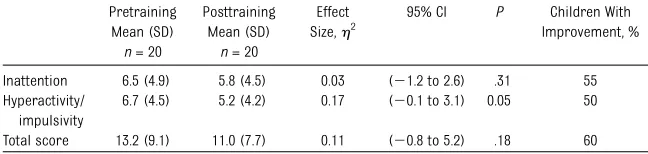
The children had normal scores on the ADHD rating scale before training. There were no significant effects on ADHD rating scale scores after training, but there was a slight reduction in hyperactivity/impulsivity scores after training (P= .05). No change was seen in mean attention score before and after training (Table 4).
Preschool Anxiety Scale
The Preschool Anxiety Scale did not show any mean values in the clini-cal area before and after training. After training, the parents reported significant reduction in separation anxiety and total anxiety (Table 5). When performing correlation analy-ses nonsignificant correlations were found between Improvement Index and reduction in general anxiety (r= 20.14,P= .6) and reduction in phys-ical injury fear (r=20.12,P= .6) after training.
Separate Group Analyses
The results of the separate group analysis, which are presented in the Supplemental Information, supported the combined group results.
DISCUSSION
This study is thefirst to investigate the effect of computerized working mem-ory training in a group of preterm born VLBW preschoolers. The mainfindings were that the VLBW preschoolers im-proved significantly on trained and nontrained working memory tasks, and transfer effects were observed as im-provement on auditory attention, pho-nological awareness, and visual as well as verbal memory.
Strengths and Limitations
Strength of this study was the compli-ance of the participating children and their families during the study period. All 20 children completed the whole training program of 25 days, and there were no dropouts during the follow-up examinations. Further strength was the comprehensive neuropsychologi-cal assessment performed in all chil-dren by a neuropsychologist who was blinded to the group randomization. A possible limitation of this study might be selection bias of the participating children. However, when comparing participants and nonresponders the 2 groups seemed comparable (Supple-mental Table 6). A possible confounder is the fact that we cannot exclude the positive effect highly motivated par-ents and children have on training and test results. We did not include a healthy term born control group in this study, because several studies confirm the positive effect of working memory training in different clinical
TABLE 2 Training Effects on Nontrained Visual and Verbal Working Memory Tasks
Pretraining Mean (SD)n= 20
Posttraining Mean (SD)n= 20
Effect Size,h2 95% CI of the Difference
P Children With Improvement, %
Spatial span
Forward 4.2 (1.6) 4.7 (2.3) 0.05 (21.7 to 0.6) .27 55
Backward 2.3 (1.6) 3.6 (2.2) 0.34 (22.2 to20.4) .01 70
Total 6.4 (3.0) 8.3 (4.2) 0.20 (23.7 to20.1) .03 75
Digit span
Forward 5.5 (1.5) 5.5 (1.5) 0.001 (20.6 to 0.5) .93 40
Backward 1.25 (1.4) 1.7 (1.1) 0.13 (20.9 to 0.1) .10 35
Wilcoxon signed rank test for 2 related samples.
and healthy control groups including preschoolers.18,20,21,28 It would have been interesting to include a matched preterm born VLBW group acting as a control group that did not train. However, for ethical reasons, we had to offer the program to all participants.
None of the participants in this study had severe brain injury, and all of them obtained IQ scores within normal levels. No correlation was seen between Im-provement Index and FSIQ (Supple-mental Fig 3). This may indicate that effects of training are independent of IQ level, which is promising, because many VLBW children will have below-average IQs. This result is also sup-ported by thefindings in our study of working memory training in ELBW adolescents, in whom those with low IQ benefitted as well as those with normal IQ.21
All participating children improved on trained working memory tasks de-livered through the computer program. As far as we know, no studies report a specific value for the Improvement Index in the Cogmed JM version for preschool-aged children. We found a
mean value of 18.4 with a range of 8 to 30. However, in studies where the Cogmed RM version was used, children with ADHD had mean Improvement In-dex of 28 (SD 12) (Cogmed America Inc 2009), and the study of ELBW adoles-cents21 reported mean Improvement Index of 32.7 (SD10.2). The lower Im-provement Index found in the current study may reflect less strenuous train-ing, simpler tasks, and the shorter training period per day for the pre-schoolers.
Studies in healthy preschool-aged children have shown that working memory training leads to significant improvement also on nontrained working memory tasks,29 as well as showing transfer effects on auditory and visual attention.28 The results in our group of VLBW children are con-sistent with thesefindings. Seventy-five percent of the children improved sig-nificantly on visual (Spatial Span), but not on verbal (Digit Span) working memory tasks (Table 2). Although other studies18,21 have shown improvement also on verbal working memory tasks like Digit Span after completed training at school age, we did notfind this in our
preschoolers. The reason may be that the preschool version of the Cogmed program does not include verbal working memory tasks.
In our study, 70% to 80% of the children improved significantly on auditory at-tention, phonological processing, and repetition of nonsense words assessing phonological awareness. Phonological awareness plays a central role in the prereading linguistic ability30 and is also important for developing mathe-matical skills.10 Recent studies show that working memory training in chil-dren at school age increases the reading comprehension,31,32and a pos-itive training effect regarding phono-logical awareness could therefore be a valuable support for learning to read in preterm born children. In the VLBW preschoolers, working memory train-ing improved visual as well as verbal memory and learning, which was also found in our study with ELBW adoles-cents.21 These are all tasks that are similar to what is presented in the school environment, and we speculate that preschool training may therefore have positive effect on later academic ability and school performance.
Studies performed in school-aged children show that working memory training reduces hyperactivity and improves attention.18,21 In our study, we found a slight improvement in hyperactivity/impulsivity, but no change on attention. One reason for this dis-crepancy might be the longer training time (∼45–50 minutes a day) in the
Visual attention total time 233.5 (41.0) 212.6 (44.3) 0.16 (22.0 to 43.8) .12 30 Auditory attention and response set 49.6 (28.8) 58.2 (30.4) 0.26 (215.5 to21.6) .01 75
Phonological processing 9.3 (5.5) 12.6 (4.7) 0.42 (25.2 to21.4) .00 80
Comprehension of instructions 17.3 (2.8) 18.4 (2.8) 0.12 (22.4 to 0.3) .11 60
Repetition of nonsense words 28.9 (8.1) 34.5 (10.7) 0.25 (210.4 to20.9) .02 70
Memory for faces 20.0 (6.2) 24.9 (5.7) 0.49 (27.4 to22.5) .00 80
Narrative memory 12.9 (5.0) 17.5 (5.9) 0.43 (27.1 to22.0) .00 75
Sentence repetition 15.7 (4.3) 17.7 (4.1) 0.35 (23.3 to20.7) .01 75
Wilcoxon signed rank test for 2 related samples.
TABLE 4 ADHD Rating Scale Before and After Training
Pretraining Mean (SD)
n= 20
Posttraining Mean (SD)
n= 20
Effect Size,h2
95% CI P Children With Improvement, %
Inattention 6.5 (4.9) 5.8 (4.5) 0.03 (21.2 to 2.6) .31 55 Hyperactivity/
impulsivity
6.7 (4.5) 5.2 (4.2) 0.17 (20.1 to 3.1) 0.05 50
Total score 13.2 (9.1) 11.0 (7.7) 0.11 (20.8 to 5.2) .18 60
Cogmed RM version for schoolchildren, whereas the preschoolers only train for 10 to 15 minutes a day. In addition, the children in our study had normal behavioral scores before training, which certainly causes limitations for improvement effects by training. Larger studies including VLBW preschoolers with clinical ADHD scores at pretraining may reveal whether working memory training will reduce such scores.
Studies report increased risk of anxiety disorders in preterm born children at school age,33,34and behavioral problems including anxiety have been reported in preterm children as early as 3 to 5 years of age.35In our study, none of the par-ticipating children had anxiety symp-toms in the clinical range before training. However, after training, there
was a significant decrease in separation anxiety and anxiety total score. One ex-planation for this may be natural de-velopment with increased maturity leading to less separation anxiety. We also speculate that increased working memory capacity may enable the child to understand more complex explan-ations providing a better understanding of the world. Owing to the small number of participants and the lack of signifi -cant correlation between improvement index and total anxiety score, addi-tional studies will be needed to answer whether working memory training re-duces anxiety in VLBW preschoolers.
Clinical Implications
Our study shows that computerized working memory training in a group of
VLBW children at ages 5 to 6 years has a beneficial effect on trained and non-trained visual working memory tasks as well as generalizing effects on visual and verbal learning and memory func-tions. The study indicates that working memory training may be an effective intervention to be considered for use in preterm born children before they start school. We speculate that this may pre-vent or reduce cognitive problems that impact educational achievement and possibly also social function in these children. However, larger studies are needed to confirm ourfindings before a general recommendation of working memory training as an interventional tool for preterm born children at pre-school age should be given.
REFERENCES
1. Foix-L’Hélias L, Marret S, Ancel PY, et al; EPIPAGE Study Group. Impact of the use of antenatal corticosteroids on mortality, ce-rebral lesions and 5-year neurodevelop-mental outcomes of very preterm infants: the EPIPAGE cohort study. BJOG. 2008;115 (2):275–282
2. Carlo WA, McDonald SA, Fanaroff AA, et al; Eunice Kennedy Shriver National Institute of Child Health and Human Development Neonatal Research Network. Association of antenatal corticosteroids with mortality and neurodevelopmental outcomes among infants born at 22 to 25 weeks’gestation. JAMA. 2011;306(21):2348–2358
3. Marlow N, Wolke D, Bracewell MA, Samara M; EPICure Study Group. Neurologic and developmental disability at six years of age after extremely preterm birth. N Engl J Med. 2005;352(1):9–19
4. Larroque B, Ancel PY, Marret S, et al; EPIPAGE Study group. Neurodevelopmental disabili-ties and special care of 5-year-old children born before 33 weeks of gestation (the EPIPAGE study): a longitudinal cohort study. Lancet. 2008;371(9615):813–820
5. Volpe JJ. Brain injury in premature infants: a complex amalgam of destructive and developmental disturbances. Lancet Neu-rol. 2009;8(1):110–124
6. Kulseng S, Jennekens-Schinkel A, Naess P, et al. Very-low-birthweight and term small-for-gestational-age adolescents: attention revisited.Acta Paediatr. 2006;95(2):224–230 7. Løhaugen GC, Gramstad A, Evensen KA, et al. Cognitive profile in young adults born preterm at very low birthweight.Dev Med Child Neurol. 2010;52(12):1133–1138 8. Mulder H, Pitchford NJ, Hagger MS, Marlow
N. Development of executive function and
attention in preterm children: a systematic review. Dev Neuropsychol. 2009;34(4):393– 421
9. Aarnoudse-Moens CS, Duivenvoorden HJ, Weisglas-Kuperus N, Van Goudoever JB, Oosterlaan J. The profile of executive function in very preterm children at 4 to 12 years. Dev Med Child Neurol. 2012;54(3): 247–253
10. Krajewski K, Schneider W. Exploring the impact of phonological awareness, visual-spatial working memory, and preschool quantity-number competencies on mathe-matics achievement in elementary school:
findings from a 3-year longitudinal study.J Exp Child Psychol. 2009;103(4):516–531 11. Alloway TP, Alloway RG. Investigating the
predictive roles of working memory and IQ in academic attainment. J Exp Child Psy-chol. 2010;106(1):20–29
TABLE 5 Preschool Anxiety Scale (T scores) Before and After Training
Pretraining Mean (SD)n= 20
Posttraining Mean (SD)n= 20
Effect Size,h2
95% CI of the Difference
P Children With Improvement, %
Obsessive compulsive disorder 48.3 (10.1) 46.0 (7.7) 0.07 (21.6 to 6.1) .18 45
Social anxiety 49.4 (9.8) 48.0 (7.7) 0.05 (21.5 to 4.3) .40 60
Separation anxiety 51.3 (13.6) 48.2 (10.3) 0.25 (0.5 to 5.7) .03 55
Physical injury fears 48.6 (9.3) 46.9 (7.7) 0.15 (20.2 to 3.6) .08 45
Generalized anxiety 51.2 (13.5) 48.9 (10.9) 0.09 (21.2 to 5.8) .17 40
Total score 50.0 (12.5) 47.1 (9.2) 0.22 (0.3 to 5.5) .02 65
Wilcoxon signed rank test for 2 related samples.
attention, and executive functions: con-structing a unifying theory of ADHD. Psy-chol Bull. 1997;121(1):65–94
14. Gathercole SE, Pickering SJ. Working memory deficits in children with low ach-ievements in the national curriculum at 7 years of age.Br J Educ Psychol. 2000;70 (pt 2):177–194
15. Stewart AL, Rifkin L, Amess PN, et al. Brain structure and neurocognitive and behav-ioural function in adolescents who were born very preterm.Lancet. 1999;353(9165): 1653–1657
16. Mulder H, Pitchford NJ, Marlow N. Proces-sing speed and working memory underlie academic attainment in very preterm chil-dren. Arch Dis Child Fetal Neonatal Ed. 2010;95(4):F267–F272
17. Klingberg T, Forssberg H, Westerberg H. Training of working memory in children with ADHD.J Clin Exp Neuropsychol. 2002;24 (6):781–791
18. Klingberg T, Fernell E, Olesen PJ, et al. Computerized training of working memory in children with ADHD—a randomized, controlled trial. J Am Acad Child Adolesc Psychiatry. 2005;44(2):177–186
19. Westerberg H, Jacobaeus H, Hirvikoski T, et al. Computerized working memory train-ing after stroke—a pilot study. Brain Inj. 2007;21(1):21–29
Oncol Nurs. 2011;28(1):27–33
21. Lohaugen GC, Antonsen I, Håberg Aet al. Computerized working memory training improves function in adolescents born at extremely low birth weight.J Pediatr. 2011; 158(4):555–561
22. Brown CA, Lilford RJ. The stepped wedge trial design: a systematic review.BMC Med Res Methodol. 2006;6:54
23. Hollingshead AB.Two Factor Index of Social Position. New Haven, CT: Yale University; 1958
24. Wechsler D. WPPSI-III Technical and In-terpretive Manual. San Antonio, TX: The Psychological Corporation; 2002
25. Korkman M, Kirk U, Kemp S. NEPSY: A De-velopmental Neuropsychological Assess-ment. Manual. San Antonio, TX: The Psychological Corporation; 1998
26. DuPaul G, et al.ADHD Rating Scale-IV. Check-lists, Norms, and Clinical interpretation. New York, NY: The Guilford Press; 1998 27. Spence SH, Rapee R, McDonald C, Ingram
M. The structure of anxiety symptoms among preschoolers.Behav Res Ther. 2001; 39(11):1293–1316
28. Thorell LB, Lindqvist S, Bergman Nutley S, Bohlin G, Klingberg T. Training and transfer effects of executive functions in preschool children.Dev Sci. 2009;12(1):106–113
verbal reasoning in 4-year-old children: a controlled, randomized study. Dev Sci. 2011;14(3):591–601
30. Melby-Lervåg M, Lyster SA, Hulme C. Pho-nological skills and their role in learning to read: a meta-analytic review.Psychol Bull. 2012;138(2):322–352
31. Chein JM, Morrison AB. Expanding the mind’s workspace: training and transfer effects with a complex working memory span task. Psychon Bull Rev. 2010;17(2):193–199 32. Loosli SV, Buschkuehl M, Perrig WJ, Jaeggi
SM. Working memory training improves reading processes in typically developing children. Child Neuropsychol. 2012;18(1): 62–78
33. Johnson S, Hollis C, Kochhar P, Hennessy E, Wolke D, Marlow N. Psychiatric disorders in extremely preterm children: longitudinal
finding at age 11 years in the EPICure study. J Am Acad Child Adolesc Psychiatry. 2010; 49(5):453–463.e1
34. Johnson S, Marlow N. Preterm birth and childhood psychiatric disorders. Pediatr Res. 2011;69(5 pt 2):11R–18R
35. Delobel-Ayoub M, Arnaud C, White-Koning M, et al; EPIPAGE Study Group. Behavioral problems and cognitive performance at 5 years of age after very preterm birth: the EPIPAGE Study. Pediatrics. 2009;123(6): 1485–1492
(Continued fromfirst page)
FINANCIAL DISCLOSURE:The authors have indicated they have nofinancial relationships relevant to this article to disclose.
DOI: 10.1542/peds.2012-1965 originally published online February 11, 2013;
2013;131;e747
Pediatrics
Austeng, Ann-Mari Brubakk and Jon Skranes
Kristine Hermansen Grunewaldt, Gro Christine Christiansen Løhaugen, Dordi
Working Memory Training Improves Cognitive Function in VLBW Preschoolers
Services
Updated Information &
http://pediatrics.aappublications.org/content/131/3/e747 including high resolution figures, can be found at:
References
http://pediatrics.aappublications.org/content/131/3/e747#BIBL This article cites 29 articles, 2 of which you can access for free at:
Permissions & Licensing
http://www.aappublications.org/site/misc/Permissions.xhtml in its entirety can be found online at:
Information about reproducing this article in parts (figures, tables) or
Reprints
DOI: 10.1542/peds.2012-1965 originally published online February 11, 2013;
2013;131;e747
Pediatrics
http://pediatrics.aappublications.org/content/131/3/e747
located on the World Wide Web at:
The online version of this article, along with updated information and services, is
http://pediatrics.aappublications.org/content/suppl/2013/02/05/peds.2012-1965.DCSupplemental Data Supplement at:
by the American Academy of Pediatrics. All rights reserved. Print ISSN: 1073-0397.