Conceptualizing Programme Evaluation
Salochana Hassan, Ph.D., Cape Peninsula University of Technology, South AfricaABSTRACT
The main thrust of this paper deals with the conceptualization of theory-driven evaluation pertaining to a tutor training programme. Conceptualization of evaluation, in this case, is an integration between a conceptualization model as well as a theoretical framework in the form of activity theory. Existing examples of frameworks of programme evaluation from the literature have been conjugated to yield a conceptualization model for the evaluation of the tutor training programme at the Cape Peninsula University of Technology in South Africa. In order to take the study to a higher level of deep analysis, this paper argues for the application of activity theory in the research design and subsequent data collection and analysis. Since evaluation can be a daunting and complex task, the adoption of theory was intended to provide a fulcrum for the study and therefore, this paper argues, becomes an integral part of evaluation. In addition, the application of activity theory in programme evaluation has not been well explored elsewhere and therefore, this paper transcends this limitation by making a case for the use of activity theory in programme evaluation, in particular, tutor training programmes.
Keywords: Programme Evaluation; Theory-Driven Evaluation; Tutor Training Programme; Activity Theory; Conceptualization Model for Evaluation.
INTRODUCTION
he advantages of tutorials in improving the teaching and learning experience of tutees are well documented. In the midst of the challenges faced by lecturers who have to cope with large classes, tutorials provide a mechanism of enhancing deep learning in small groups (Hanley (1996; Underhill and McDonald 2010). Bruffee (1993) claims that tutors can engage in a conversation with tutees and provide support in translating the terms of the communities they are trying to enter so that they may incorporate the practices of that group. Tutors themselves stand to benefit from the tutor-tutee relationship. Tutors may learn by teaching (Topping 1998) while developing and enhancing communication, interpersonal and organizational skills (Falchikov 2001). Undoubtedly, these skills do not come naturally to tutors and therefore, tutor training programmes play a pivotal role in training and developing tutors.
The main purpose of this paper is to propose a conceptualization model for evaluation of a tutor training programme as well as a theoretical framework, namely critical theory, for the design of the study. In particular, second and third generation activity theory (Engeström 2001) guides the discussions of the activity systems of a tutor training programme. The application of activity theory in conceptualizing the evaluation of tutor training programmes is sparse and therefore this paper addresses an important gap in the literature on programme evaluation.
The context of the study is the Cape Peninsula University of Technology (CPUT) in South Africa, where the tutor training programme is dichotomized into a centralized and decentralized model with the former being managed by Fundani: Centre for Higher Education Development and the latter by the respective Faculties, in particular the Faculty of Engineering. To date, a comparison of the two models at CPUT has not been undertaken.
LITERATURE BACKGROUND ON TYPES OF EVALUATION STUDIES AND THEIR PURPOSES
approaches adopted by other researchers, an exploration of the relevant literature was deemed to be a good starting point. A poignant question at this stage was: Why evaluate in the first place?
A response to this question was sought from Patton (1997) who offers three main reasons for undertaking an evaluation, namely; 1) To make a judgment, 2) For improvement and 3) To generate knowledge. Judgment-orientated evaluations are intended to determine the effectiveness and success of the programme and to what extent the objectives and goals have been achieved. Improvement-orientated evaluations are intended to establish the programme’s strength and weaknesses and whether the programme has been implemented properly or not, so as to enhance the quality of the programme. Knowledge-orientated evaluations focus on an understanding of how programmes work and how people change their attitudes and behavior because of successful interventions.
The primary focus of the evaluation described in this paper is improvement-orientated and is, therefore, formative in that the study seeks to determine how the tutor training programme can be improved. Patton (1996) argues that evaluation should be broadly conceptualized as a knowledge-generating activity and that it is too “rich and varied” to be compartmentalized into a “single dichotomy”. Therefore, the secondary focus of the evaluation will be knowledge-orientated as part of a comparative study between the centralized and de-centralized models.
Rossi and Freeman 1993 provide a three-pronged description of the types of evaluation studies (see table 1) which encompasses conceptualization, monitoring and effectiveness of a programme. The evaluation study conceptualized within this paper encompasses all three types of evaluation illustrated in table 1.
Table 1: Types Of Evaluation Studies
Type Purpose
Conceptualization and design of interventions
Focuses on whether a programme is designed in such a way that it addresses identified needs adequately.
Monitoring of programme implementation
To determine whether the programme has been implemented properly and whether the programme provides evidence within a context of accountability.
Assessment of programme effectiveness
Establishes the degree to which a programme produces the desired outcome.
Other authors such as Posavac and Carey (1992) support the monitoring of programme implementation as shown in table 1, by their take on “evaluation of process”. Patton (2002), on the other hand, argues for utilization-focused evaluation which is based on the principle that evaluation should be judged by its utility and actual use. The implication for evaluators is that the evaluation process and design of any evaluation should be done with consideration of how everything that is done will ultimately affect use.
A further investigation of the relevant literature yielded additional guidance in terms of how evaluation can be approached. For example, programme evaluation approaches as synthesized by Fitzpatrick, Saners and Worthen (2004) are encapsulated as follows:
Objectives-orientated approach which emphasizes the explicit statement of programme goals, objectives and the extent to which they have been met (Tyler 1991).
Expertise-orientated approach is one where the evaluator relies on his/her judgment about the worth of the object of evaluation.
Participant-orientated approach places emphasis on the needs of the progamme participants.
Empowerment evaluation involves the participants in the evaluation process (Fetterman 2002).
A CONCEPTUALIZATION MODEL FOR PROGRAMME EVALUATION
Mouton and Babbie (2001) advise that evaluation requires a frame of reference in order to guide the collection of data and interpretation of empirical findings. Taking cognisance of this, this paper draws on aspects of the following frameworks and model:
The RUFDATA framework which stands for the following elements: Reasons and purposes, Uses, Focus, Data and evidence, Audience, Timing and Agency (Saunders 2000).
Winberg’s ( 2011) levels of analysis in evaluations, namely: 1) an analysis of the conceptual core of the programme, 2) its design, 3) factors affecting its implementation, and 4) its outcomes.
Jacobs’s (2000) model for the evaluation of educational innovation.
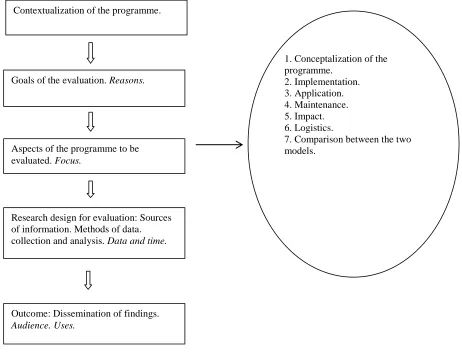
For the purposes of conceptualizing a model for the evaluation described in this paper, the aforementioned frameworks and model have been adapted and integrated to yield the following conceptualization model:
Figure 1. A Model For The Evaluation Of The Tutor Training Programme (An Adaptation Of The Frameworks Of Winberg (2011), Saunders (2000) And Jacobs’s (2000) Model)
Contextualization of the programme.
1. Conceptalization of the programme.
2. Implementation. 3. Application. 4. Maintenance. 5. Impact. 6. Logistics.
7. Comparison between the two models.
Goals of the evaluation. Reasons.
Aspects of the programme to be evaluated. Focus.
Research design for evaluation: Sources of information. Methods of data. collection and analysis. Data and time.
THEORY-DRIVEN PROGRAMME EVALUATION USING ACTIVITY THEORY
The conceptualization model shown in figure 1 was framed by critical theory to render the evaluation theory-driven. The advantage of applying theory in evaluations can be gleaned from the literature. For example, Chen (1990) states that theory provides guidelines for analyzing a phenomenon as well as for understanding the significance of research findings. Programme theory also clarifies the link between the operational features of a programme and its effects. An important point of departure in theory-driven evaluation is to make the programme theory explicit (Renger 2010). This section of the paper attempts to achieve that through a discussion on how activity theory is applied in the design of an evaluation study of a tutor training programme.
Activity theory proposes a very specific notion of context in that the activity itself is the context. What takes place in an activity system which is composed of object, actions, and operation, is the context. Context is created through an activity involving people and artifacts. Context is neither an outer container nor shell inside of which people behave in certain ways. Rather, context is both internal to people—involving specific objects and goals—and, at the same time, external to people, involving artifacts, other people and specific settings (Nardi 1996).
The importance of contextualization for evaluation of a programme is further portrayed in the statement made by Chen (1990:45): “The worthiness of a programme is difficult to judge without having information on the contextual and/or intervening factors that help to make that programme a success or failure”. In addition, Ross (2010:489) contends that “context evaluation encompasses identifying the target population and the needs or problems to be addressed”. In this paper, the historical background and context of the two models for the tutor training programme is an important point of departure for the evaluation study.
For Engeström (2001), activity theory is underpinned by five principles: 1) The first principle is that the unit of activity is mediated through tools or artifacts and is object orientated, that is, focused on a goal or purpose; 2) The second principle is the multi-voic-edness of activity systems in that the division of labour creates different positions for participants; 3) The third principle refers to historicity because activity systems take shape and get transformed over lengthy periods of time. For example, the history of the theoretical ideas and tools that have shaped the activity; 4) The fourth principle is the central role of contradictions as the point of departure for change and development, and 5) The fifth principle anticipates expansive learning and the dialectical resolutions of contradictions. The fourth and fifth principles are the mechanisms though which activity systems transform and are closely aligned with the concept of “expansive learning”. “Expansive learning activity produces culturally new patterns of activity” (Engeström 2001:139). These principles have been taken into account in the design of the research questions for the evaluation study as discussed later in this paper.
First generation activity theory was introduced by Vygotsky in response to the defects of stimulus-response behaviourism. He argued that human behaviour is not simply prompted by stimuli but is mediated through artifacts (Bakhurst 2009). Activity theory as developed by Engeström (1987; 1996) takes the object-oriented, tool mediated collective activity system as its unit of analysis, thereby bridging the divide between the subject and the societal structure (Daniels 2001) and therefore, second generation activity theory distinguishes between “action” and “activity”. An action is conducted by an individual/group to achieve a particular goal. An “activity” is undertaken by a community and has an “object” and a “motive”. Thus, action is individual while activity is collective. Third generation activity theory examines the relations between activity systems and addresses issues of representations, voice, emotion, identity and difference (Bakhurst 2009).
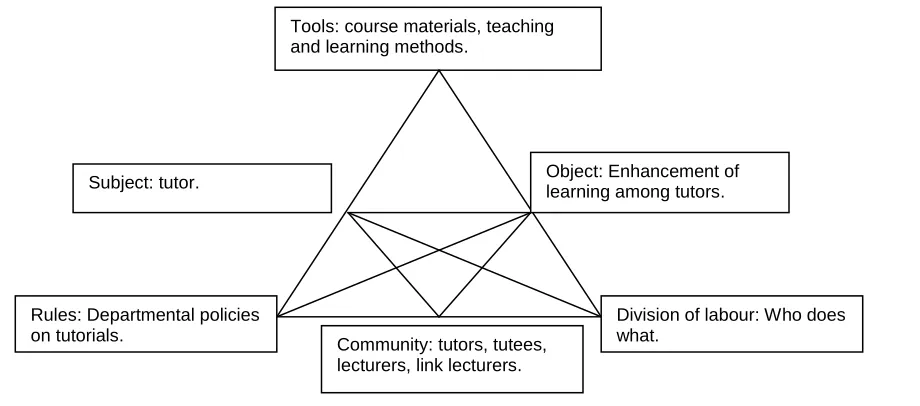
of practice and refers to horizontal division of tasks between members and the vertical division of power and status (Engeström 2001).
Figure 2. Second Generation Activity System Showing The Components Of The Application Of Tutor Training
Third generation activity theory allows people from different activity systems to work together as the object starts to interact; in the process expansive learning is produced (Engeström 2001). The notions of ‘knotworking, co-configuration and boundary crossing” are realized when activity systems interact (Avis 2009). According to Kuutti (1991) activities may overlap in that different subjects engaged together in a set of coordinated actions may have multiple or conflicting objects. In both the centralized and de-centralized models of the tutor-training programme, within the context of this paper, there is a common object, that is, training of tutors, which opens up possibilities of expansive learning. The subjects are the tutor training co-ordinators while the tools are the teaching and learning methods and materials. The community comprises the tutors and tutor-training co-ordinators. The rules refer to policies for tutor training and the division of labour pertains to what each person is responsible for doing.
For Vygotsky (1978) humans use tools to change the world and are themselves transformed through tool use. The study described in this paper focuses on the transformation that takes place in the identities of the tutors as they shift from being students to being collaborative members of the teaching community. Tutors have to adjust their identity to the new situation they find themselves in when they start to tutor students. By developing their own expertise through tutor training programmes, tutors can make a difference to the learning that happens in the classroom.
RESEARCH DESIGN
An integration of the conceptualization model given in figure 1 as well as the aspects of activity theory discussed above was applied in compiling a framework for the evaluation study shown in table 2. The framework contains a focus of the evaluation aligned with the relevant questions and the accompanying research methodology.
Tools: course materials, teaching and learning methods.
Object: Enhancement of learning among tutors. Subject: tutor.
Division of labour: Who does what.
Rules: Departmental policies on tutorials.
Table 2. Framework For Evaluation Of The Tutor Training Programmes
Within The Centralized (Fundani:CHED) And Decentralized Models (Faculty Of Engineering).
Focus of evaluation Research questions Research methodology
Contextualization What is the historical nature and comparative context of the two models? Why have we ended up with these models and what can we do to improve them?
Document analysis; semi-structured face-to-face interviews.
Conceptualization
What are the aims and objectives of the programmes in both models? What is the conceptual understanding of tutor training within the two models? Is the programme conceptualized and designed in such a way that it addresses the real needs of the intended beneficiaries?
Document analysis; observation of tutor training programmes; semi
structured interviews.
Implementation. Roles, division of labour of tutor training coordinators, link lectures and tutors
Has the programme been properly implemented and managed? What kind of training is being offered? What teaching and learning methods are adopted and what course materials are being used? What tools are being used in the training and are they appropriate in achieving the outcome? What are the roles of the tutor training coordinators, tutors and link lecturers?
Observation of tutor training programmes; semi
structured interviews.
Application. Roles, division of labour of tutors, tutees and lecturers
How do tutors support the learning of tutees? What are the roles of the tutors, tutees and lecturers? What are the relative positions of power between tutors, tutees and lecturers?
Observation of tutorials facilitated by tutors. Interviews; self
administered questionnaires. Maintenance What support (formal and non-formal) is there for tutors? What
systems do we have administratively and academically to support these tutors?
Self administered questionnaires.
Impact /outcome Have the outcomes been achieved? To what degree was the programme implemented as planned? To what degree did the programme accomplish its intended outcomes, that is, improvement in the capacity of tutors and tutees? Does the programme serve the target group? What is the impact of tutor support on the quality of tutees’ learning? What are the perceptions of tutors and tutees regarding tutor training programmes and tutorials respectively?
Self administered questionnaires.
Logistical and administrative matters
Is the necessary infrastructure in place to support programme implementation? Were the programme outcomes obtained in the most cost-efficient manner? Are funds spent for the intended purpose? What are the logistical constraints of the tutor training programme? (For example, funding, selection and appointment of tutors, record keeping).
Face-to-face interviews.
Community of practice Who is the community that is involved in the activity system? Do programme coordinators, tutors, link lecturers, lecturers and tutees work as a team?
Face-to-face interviews.
Rules Is tutor training and implementation in line with policy? What is the academic culture within which the tutor training programme is implemented and applied? What are the administrative rules? What are the selection criteria and admission requirements for tutors?
Document analysis, face-to-face interviews.
The research approach described in this study employs qualitative and quantitative methods and focuses predominantly on document analysis, observation, face-to-face, semi-structured interviews and the administration of questionnaires.
According to Kushner (2000) interviews will also help relay the narratives of key participants and would contribute towards personalizing the evaluation process.
From the interviews, data will be recorded, transcribed and then analysed using coding, categorization and the identification of themes. Interviews will allow respondents to provide clarity with respect to their responses. Self-administered questionnaires will be designed using a Likert scale and the data gathered will be statistically analysed. Self-administered questionnaires will allow for more respondents to be involved in the study and make data collection relatively easy.
A purposive sample will be drawn of respondents who will be involved in the study. A research sample that are likely to have the necessary knowledge of tutor training and are able to reflect meaningfully on the scope of the study will be drawn (see Morse 1994).
CONCLUSION
The position taken in this article is that tutor training programmes are activity systems which are object-orientated and mediated through tools. Within each activity system are interconnecting relationships between the subject, the object, tools, rules, community of practice, and division of labour (Engeström, 1999) as they relate to components of the tutor training programme. In essence, within the activity system, tutors undergo transformation from being students to becoming members of a community within the academe. Further, the intersection of the objects of third generation activity systems of both the centralized and de-centralized tutor training programmes at the Cape Peninsula University of Technology provides a mechanism for expansive learning (Engeström 2001) to emerge. This theoretical framing has provided a basis for programme evaluation and will be employed in conjunction with a conceptualization model for evaluation, as part of a quality assurance initiative.
AUTHOR INFORMATION
Salochana Hassan, Ph.D., Cape Peninsula University of Technology, South Africa. The author currently works in the area of academic staff development. In particular,she has extensive experience in the field of academic staff development and has facilitated numerous workshops pertaining to innovative methods of teaching and learning, and assessment. She has also developed and co-ordinates the Teaching Development Programme for new academic staff at the CPUT.
She has presented several conference papers and posters at national and international level in the field of problem-based learning (PBL), outcomes-problem-based education, research-problem-based learning, quality assurance, policy development, academic staff development, medical education and science education. She has also published journal articles on PBL and academic staff development. Salochana Hassan, Ph.D., Cape Peninsula University of Technology, Center for Higher Education Development, PO Box 652, Cape Town, South Africa. E-mail: [email protected]
REFERENCES
1. Avis, J. (2009). Transformation or transformism: Engstrom’s version of activity theory. Educational Review, 61(2), 151–165.
2. Bakhurst, D. (2009). Reflections on activity theory. Educational Review, 61(2), 197–210.
3. Bruffee, K. (1993). Collaborative learning, higher education, interdependence and the authority of knowledge. Baltimore, MD: John’s Hopkins University Press.
4. Chen, H. (1990). Theory-driven evaluations. Sage publications; California. 5. Daniels, H. (2001). Vygotsky and pedagogy. New York: Routledge.
6. Engeström, Y. (1987). Learning by expanding: An activity theoretical approach to developmental research. Helsinki, Orienta-Konsultit Oy.
7. Engeström, Y. (1996). Perspectives on activity theory. Cambridge: Cambridge University Press. 8. Engeström, Y. (1999). Activity theory and individual and social transformation. In Y. Engeström, R.
9. Engeström, Y. (2001). Expansive learning at work: Toward an activity theoretical re-conceptualization. Journal of Education and Work, 14(1), 133–156.
10. Falchikov, N. (2001). Learning together. Peer tutoring in higher education, London: Routledge Falmer. 11. Fetterman, D. M. (2002). Empowerment evaluation: Building communities of practice and a culture of
learning. American Journal of Community Psychology, 30(1), 89–102
12. Fitzpatrick, J. L., Saners, J. R., & Worthen, B. R. (2004). Program evaluation: Alternatives, approaches, and practical guidelines (3rd ed.). Boston: Pearson Education Inc.
13. Hanley, P. (1996). Mentor development in a university orientation programme: The first James Cook experience. Proceedings of the 2nd Pacific Rim Conference on the First year in Higher Education, Transition to Active Learning, Ormond College, University of Melbourne, 3-5 July:243-247. 14. Jacobs, C. (2000). The evaluation of educational innovation. Evaluation, 6(3), 261–280. 15. Kushner, S. (2000). Personalizing evaluation. London: Sage.
16. Kuutti, K. (1991). Activity theory and its applications to information systems research and development. In H.E. Nissen (Ed.), Information Systems Research, (pp. 529–549). Amsterdam: Elsevier Science Publishers. 17. McConney, A. & Maor, D. (2009). The evaluation of a pilot mentoring programme for beginner science
and maths teachers: Summative project evaluation report. School of Education. Murdoch University. Perth Western Australia.
18. Morse, J.M. (1994). Designing funded qualitative research. In N.K. Denzin & Y.S. Lincoln (Eds.). Handbook of qualitative research, Thousand Oaks, California: Sage Publications.
19. Mouton, J. & Babbie, E. (2001). The practice of social research, Cape Town: Oxford University Press. 20. Nardi, B.A. (1996). Studying context: A comparison of activity theory, situated action models and
disctributed cognition. In B.A. Nardi (Ed.), Context and consciousness: a theory and human computer interaction, (pp. 35-52). Cambridge, MA: MIT Press.
21. Patton, M. Q. (1996). A world larger than formative and summative. Evaluation Practice, 17(2), 331–345. 22. Patton, M.Q. (1997). Utilization-focussed evaluation. 3rd Ed. Thousand Oak, CA; Sage Publications. 23. Patton, M. (2002). Utilization-focussed evaluation. Evaluation in education and human services, 49, 425–
438.
24. Posavac, E.J. & Carey, R.G. (1992). Program evaluation: methods and case studies. Engelwood Cliffs: Prentice Hall.
25. Renger, R. (2010). Constructing and verifying programme theory using source documentation. Canadian Journal of Programme Evaluation, 25(1), 51–67.
26. Ross, M.E. (2010). Designing and using programme evaluation as a tool for reform. Journal of Research on Leadership Education, 5(12.7), 481–506.
27. Rossi, P.H. and Freeman, H.E. (1993). Evaluation: A systematic approach. Newbury Park, CA: Sage. 28. Saunders, M. (2000) Beginning an evaluation with RUFDATA: theorising a practical approach to
evaluation planning. Evaluation, 6(1), 7–21.
29. Topping, K. (1998). The effectiveness of peer tutoring in further and higher education: A typology and review of the literature. In S. Goodlad (Ed.), Students as tutors and mentors, London: Kogan Page. 30. Tyler, R. W. (1991). General statement on program evaluation. In M. W. McLaughlin & D. C. Phillips
(Eds.), Evaluation and education: At quarter century (pp. 1–2). Chicago: The University of Chicago Press. 31. Underhill, J. & McDonald, J. (2010). Collaborative tutor development: Enabling a transformative paradigm
in a South African University. Mentoring and Tutoring: partnership in Learning, 18(2), 91-106.
32. Vygotsky, L.S. (1978). Mind in society: Development of higher psychological processes. Ed. M. Cole, V. John-Steiner, S. Scribner and E. Souberman (ed. and trans.). Cambridge, MA: Harvard University Press. 33. Winberg, C. (2011). The elephant in the room: evaluating postgraduate research in higher education. In M.