141 |
P a g e
PROPOSED ARCHITECTURE FOR LOGISTICS
SYSTEM THROUGH VIRTUALIZATION
Shivani Dubey
1, Sunayana Jain
21
School of Technology,Ansal University ,(India)
2
IT Department, IMS Ghaziabad, (India)
ABSTRACT
A virtual machine is placed on a physical infrastructure with in a data center of a cloud operator. The virtual
resources are moved from one physical machine to another physical machine at different locations, but at the
same time multiple physical machines cannot access same type of virtual resources from one data center to
another data center. In cloud computing, virtual resource move automatically to operator’s infrastructure access the service user’s demand. The multiple virtual machine over on a single physical server creates the
performance challenges for access, thus the multiple virtual resources at the same time are used from one data
center to another data center. This paper defines traditional techniques of logistics and ICT technologies, which
are used to maintain the process of logistics management and presents virtualized cloud technologies. The
paper proposes virtualized logistic system and has aim to integrate the virtualization techniques to provide
better execution, real time data reduction, better performance and cost reduction to make suitable for multiple
virtual machine.
Keywords: ICT in Logistics, Virtualization, Virtualized Logistics System
I. INTRODUCTION
Logistics involves a multitude of supplier, manufacturers, carriers and logistics partner. Logistics partner is a
coordinator for many different types of service which includes distribution, information system financial
services etc. Logistics partner assembles the resources, capabilities and technologies of own organization and
other organization to design the solution for supply chain. The major problem of logistics partner is storage of
multiple data at small space and manipulates the cost of transmission data from one location to another location
[1]. Cloud computing and its virtualization techniques are essential to business and has strongly influenced
organizational process as well as logistics. The logistics cloud system is based on virtualization techniques to
evaluate the physical infrastructure and each verified user accessed the services with their devices from various
data center at different location.
1.1 Traditional Techniques, ict Technologies and Cloud Virtualization Technologies
Logistics management is improved by using different techniques and ICT technologies to maintain and control
142 |
P a g e
Table 1: Techniques for Improving Process of Logistics Management
Techniques Description
Pareto Analysis Identification of major elements of business corporation
Market Segmentation Design of suitable logistics processes ensure that customer needs are met or not
CustomerService
Studies
Identification of key service requirements on which to design suitable logistics
processes
Relationship Mapping Helps the major relationships and highlights the complexity within a particular
process thus indicating the need for redesign
Process Chart Representation of different types of activity (storage, movement, action, etc.)
Value/Time Analysis Identification of actual value of process added to product
Table 2: ICT Technologies for improving process of logistics Management [3]
ICT Technologies Description
EDI (electronic data interchange) Reduces bureaucracy, streamlining and logistics cost
RFID (radio frequency identification) Helps logistics activities (picking, vehicle loading, unloading,
order tracking and routes distribution)
APS (advanced planning & scheduling) Reduces cost, improves product margin and lower inventories
WMS (warehouse management system) Manages operational and administrative activities for
warehousing process
GIS (geographic information system) Visualization of key processes and data sharing
GPS (global positioning system) Helps to routing and tracking
Wi-Fi (wireless fidelity) Exchange data or information wirelessly in logistics network
ERP (enterprise resource planning) Improves productivity, transparency and financial management
Cloud infrastructure supports, analyze and make meaningful interpretation for multiple data accessibility in
virtualization. The cloud is a father of next generation techniques which solve the issues in logistics
management related to data distribution and quick responses in less time. The paper defines different IT
technologies over the cloud virtualization techniques.
Table 3: Types of Virtualization Technologies [4]
Virtualization Technologies Description
System Level Virtualization
(Performance Level)
Emulates a computer similar to real physical one. (Examples: VMware,
Xen, KVM)
Process Level Virtualization Virtual machine runs one application and one process. (Example: Java
virtual machine)
Operating System Virtualization Virtual machine runs a set of domains. (Example: Open VZ, Solaris
143 |
P a g e
II. VIRTUALIZATION CLOUD COMPUTING
Virtualization is used to divide the resources of computer into multiple execution platforms by using multiple
technologies like software, hardware, operating system, timesharing, etc. Virtualization provides facility to
multiple applications to be run on single server. These applications utilize the resources of the physical server.
This ability to run multiple applications on a single server can reduce capital spending on server
hardware.Overall IT systems are changed by using of cloud to improve business applications and business
models. There are main characteristics of virtualization in cloud computing [5]:
• Partitioning: Many applications and operating systemsare supported in a single physical system by
partitioningthe available resources.
• Isolation: A virtual machine is isolated from its host physical system and other virtualized machines, if one
virtual machine crashes, it doesnot affect the other virtual machines and data isnot shared between one
virtual container and another virtual container.
• Encapsulation: A virtual machine can be represented in a single file. The encapsulated process could be a
business service. This encapsulated virtual machine can be presented to an application as a complete entity.
Therefore, encapsulation can protect each application so that it doesn’t interfere with another application.
III. PROPOSED VIRTUALIZED LOGISTICS SYSTEM
Virtualization makes economically feasible to secondary servers for maintaining and keeping the back up of
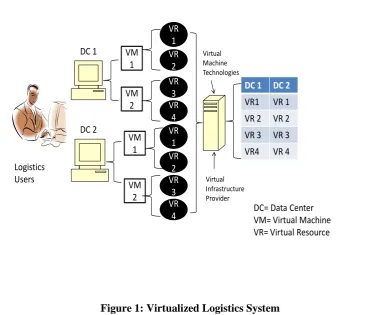
primary servers. In the virtualized logistics cloud system, the service broker, which can be centralized and
distributed, manage all the services for users.
VM 1 VM 2 VR 1 VR 2
DC 1 DC 2
VR1 VR 1
VR 2 VR 2
VR 3 VR 3
VR4 VR 4
VR 3 VR 4 VR 1 VR 2 VR 3 VR 4 VM 1 VM 2 DC 1 DC 2 Logistics Users
DC= Data Center VM= Virtual Machine VR= Virtual Resource Virtual Machine Technologies Virtual Infrastructure Provider
144 |
P a g e
The above system is designed to analyze the process of data distribution on the different data center and thenvirtual machines transfer that data on the different location by using virtual technologies. There are five main
functions in the given system:
• Logistics User: Logistics user is a person who has authorization to use services provided by a cloud service
provider using a request mechanism.
• Cloud service provider: It provides services to a logistics user. It is used for mapping logistics user’s request
to a virtual infrastructure. Cloud service provider distributes the data according to the location of data
center, where logistics user wants to send the request.
• Virtual Resource: It is a virtual process which is used for storing and networking that is placed on a
physical resource of a virtual infrastructure provider.
• Virtual Infrastructure Provider: It installs the services on virtual infrastructure by using its own hardware,
where the virtual infrastructure is run.
• Virtual Infrastructure: It collects the multiple data from multiple data center and update it into a table set by
using different virtualized techniques and applications.
III. BENEFITS OF VIRTUALIZED LOGISTICS SYSTEM
Cloud computing expert maintains and updates all the applications and services that each logistics user requires.
All the logistics user and logistics partner at different location are constantly interconnected. By adopting
virtualized logistics system, any company can focus on their business supply chain under the virtualization
techniques to run faster and cost efficiently [6]. There are lots of benefits for logistics user to adopt the proposed
solution:
• Logistics user uses light weight portable device to access his virtual machine which runsin the cloud
network by using cloud service provider.
• Logistics user has several security demands on the virtual resource to follow his company policy. If
logistics user is moving from one location to another location, the cloud service provider takes care of
moving the logistics user’s virtual resource with him and keep latency down and also take care for choosing
a specific virtual infrastructure provider.
• The data centers process logistics user demand of intensive calculation and updation from time to time.
IV. CONCLUSION
In any company, the need of operation and technologies are increasing that provide logistics user ability to
access and analyze operational data. The logistics techniques and ICT technologies are not sufficient enough for
the distribution of multiple data at multiple locations simultaneously. Virtualization gives an application direct
access to live data across multiple systems. The role of Virtualized logistics system is to collect the multiple data
from multiple data centers from different locations and from the various live data systems and maintain it to the
application in a single table set.Virtualized Logistics System compute and maintain the storage and network
components for virtual resources at different data center on different locations which are interconnected using
145 |
P a g e
REFERENCES
Website
[1] J. Bendkowski, M. Kramarz: Logisty kastosowana. Wydawnic two Politechniki Śląskiej, Gliwice 2006, p.
484.
Book
[2] Alan Rushton, Hand book of Logistics & Distribution Management, Kogan Page Publishers
Journal Paper
[3] Vladimir Ilin, Dragan Simic, Vasa Svircevic and Nenad Saulic, Cloud Computing Applications in Global
Logistics Information System Infrastructure, Journal of Traffic and Transportation Engineering, Dec.
2013, Volume 1, No. 1 (Serial No. 1), pp. 30-38, ISSN 2328-2142, USA
Proceeding Paper
[4]O Laadan, J Nieh, Operating system virtualization: practice and experience, Proceedings of the 3rd Annual
Haifa Experimental, 2010 - dl.acm.org
Journal Paper
[5] Pankaj Sareen, Cloud Computing: Types, Architecture, Applications, Concerns, Virtualization and
Role of IT Governance in Cloud, International Journal of Advanced Research in Computer Science
and Software Engineering, vol.3, issue.3, March 2013
[6] Arkadiusz Kawa, Milena Ratajczak-Mrozek ,Cooperation between Logistics Service Providers based
![Table 2: ICT Technologies for improving process of logistics Management [3]](https://thumb-us.123doks.com/thumbv2/123dok_us/9239827.1459622/2.595.69.531.90.474/table-ict-technologies-for-improving-process-logistics-management.webp)