COMPOSITE MODEL OF WEB PAGE PREDICTION
USING PAGE RANKING ALGORITHM AND
MARKOV MODEL
Priyanka Bhart
1, Diwakar Shukla
2, Dayal Sharan Saini
3, Aman Gaur
41
Asst. Prof.,
2,3,4Student, Dept. of Computer Applications,
National Institute of Technology Kurukshetra, India)
ABSTRACT
As the recent Advent of the internet and various technologies, most of the people are heading towards it and
because of that the amount of data is also increased. The web mining technology provides the efficient way
through which user can get the appropriate page that in less time. Prediction of the next page will save user's
time and improve the quality of work on the web. In this paper webpage prediction concept has been
implemented through Markov model and page ranking algorithm. The k means algorithm is one of the simplest
and finest ways for solving the problems of clustering by dividing the various webpages into clusters. Page Rank
algorithm is also used for assigning the probabilities to each page depend upon no. of time that page is been
accessed. Markov model has played a key role on clusters for finding out the no of occurrences of the webpage
under various web-sessions and also for predicting the next webpage through the current web page. Various
type of matrix (such as transition, similarity etc.) is one of the roots of webpage prediction concept.
Keywords-
K-means clustering algorithm, Markov model, Page ranking Algorithm, Transition
Probability, Web page prediction.
I. INTRODUCTION
In today's world, the web is one of the important sources for our daily life. The Internet contains lots of
information and data which can be used for the public as well as private. It connects through various public and
private networks. The advantage of the internet is that it can be used from anywhere and anytime. Nowadays the
Internet can be used for the variety of things such as Banking, Travelling, Communication, Search maps,
sending and receiving emails etc. When any user accesses a webpage more than one time than for their
convenience the data is saved in web log files. Now If next time the user accesses the same page then instead of
loading the same page again the browser will open the page directly from the data that is saved in log files. This
process is only for the betterment of the user by saving the time and also for an appropriate page at given time.
This paper focuses on Page Ranking Algorithm and Markov Model through which Web page Prediction is done.
II. RELATED WORK
Web mining emphasizes on knowledge extraction from the web pages. Web usage mining is focused on
examining and mining of text, graphs, and pictures from a Web page to find out the importance of the search
query. Many of the authors usually proposed their work on identifying the user's web page prediction. Most of
the models developed in the literature to understand user's behavior. Eirinaki et al. [1] propose a method that
includes link analysis, such as the page rank measure, into a Markov model. Schechter et al. [2] employ a
tree-based data structure that depicts the collection of paths inferred from the log data to predict the next page access.
Fosler-Lussier et al. [3] described working on Hidden Markov model using transition matrix. Ahmad and Sultan
[4] proposed a system model which involves web mining techniques with an e-commerce application.
III. APPROACH
The final output in predicting next webpage consisting of a set of steps. Each step has it is own significance.
Preprocessing, clustering, Makov model, User session are major steps among them. The Approach is discussed
below.
3.1. Preprocessing
Preprocessing is performed because the dataset have many special characters (like „@‟, „.‟, „;‟ etc.),
prepositions, articles etc. so that data will be reduced by removing these things. This data will be used for
clustering. Emanate by preprocessing to outflow words (for example, “framing“ is converted “frame”). Given
figure 1 is showing how preprocessing is performed.
3.2. K-Means Algorithm
K-Means algorithm is an advanced algorithm that gains its name from its method of operation. This data mining
or machine learning algorithm is well-known to cluster observation into groups of related observation without
any prior knowledge. It is used to divide a set observation into k groups of clusters, where k is an input
parameter. Then it randomly selects k points as the centroid of clusters. Recalculate the centroid or mean by
assigning observation to their closest cluster centroid by using Euclidean distance function.
This iterative approach of clustering algorithm improves the revised centroid of clusters. Iteration remains
persistent until the clusters converge.
In this paper, web sessions are clustered using K-Means Clustering Algorithm, for creating a group of webpages
in the form of cluster, which has been used for predicting next web page.
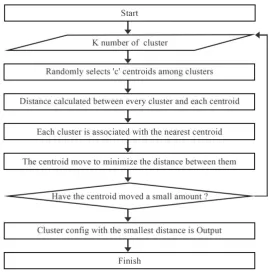
3.2.1 Algorithmic steps of K-Means clustering
Let X = {x1,x2,x3,……..,xn} be the set of data points and K = {k1,k2,…….,kc} be the set of centroids. 1. Randomly select „c‟ cluster centroid.
2. Calculate the Euclidian distance between
each data point and cluster centroid.
3. Assign the data point to the cluster centroid whose distance from the cluster centroid is a minimum of all the
cluster centroid.
4. Recalculate the new cluster centroid.
5. Recalculate the distance between each data point and newly obtained cluster centroid.
6. If no data point reassigned then stop, otherwise repeat from step 3.
3.3. Markov Model
Markov model is a stochastic model used to represent the probability distribution over a sequence of
observation. It deals with temporal or sequential data i.e. data that are ordered. A Russian mathematician Andry
Markov (1856-1922) provided a way to model the dependencies of current information with previous
information. It is composed of states, transaction scheme between states and emission of outputs (discrete or
continuous). Markov model is widely used for developing algorithms for predicting the next web page from
Table 1. markov models
Markov chains are the mathematical system that jumps from one state to another. The next state of the process
only depends on the previous state and not the sequence of states. This principle makes the calculation of
conditional probability easy and enables this algorithm to be applied in a number of scenarios.
Let's take an example, A student has two subjects - Science and Mathematics. He has to cover the syllabus of
both the subjects in a limited time. Following are the conclusion drawn by him for his strategy to complete the
syllabus:
P(S->S): Probability of a student staying with the Science = 0.7
P(S->M): Probability of a student switching from Science to Mathematics = 0.3
P(M->M): Probability of a student staying with Mathematics = 0.9
P(M->S): Probability of a student switching from Mathematics to Science = 0.1
Above four statements made by the student can be drawn in a simple transition diagram.
3.4. User Session
The computer knows who you are and which application you have started and when you end. But the internet
doesn‟t know this whole information: the web server doesn‟t know anything about the user because the HTTP
address doesn't maintain state. Session variables solve this Condition by storing user details to be used across
various pages (e.g. username, favorite color, etc.). By default, session variables last till user closes the browser.
So session variables hold information about one single user, and are available to all pages in one application.
The user has the main advantage that he can check the last page that he has visited with the help of sessions.
Now consider a user‟s session and the sequence in which he has visited the web page each after another and
with the help of these sessions we can generate 1st order and 2nd order Transition Probability Matrix. In the Given example below, we consider a user session(US1) in which user has visited various categories
pages(laptop(L) ,camera(C), Sports(SP), Shoes(SH) US1:{L,C,SP,SH}. Now here we‟ll apply Markov Model
for predict next page from the previous movement executed by the user. For the 1st order Markov Model Page, SH corresponds to state S4. For the 2nd order, page SH, SP is used to predict next web page. Web prediction becomes easy only when the Transition Probability Matrix (TPM) is executed in proper manner. For perceiving
the Highest Probability of a page, TPM will be used.
In the example, consider the 1st web session‟s pages L, C, SP. Now SP is associated with the session US3. So after analyzing the 1st order Markov Model, Which is given in table 2, L is the Predicted Page that is used by the user.
System state is fully observable System state is partially observable
Markov chain Hidden Markov model
Markov decision model Partially observable Markov decision process
In table 3 some process are executed by using 2nd order of Markov model taking two pages. Some of those are described in the table 2.
Consider some Web sessions
US1 :{L, C, SP}
US2 :{C, SP, L, SH}
US3 :{SP, L, C, SH}
US4 :{C, SH}
US5 :{SH, SP, L, C}
1st order L C SP SH
S1={L} 0 2 0 2
S2={C} 0 0 2 2
S3={SP} 3 0 0 0
S4={SH} 0 0 1 0
Table 2. 1st order transition probability matrix
2nd order L C SP SH
{L,C} 0 0 1 1
{L,SH} 0 0 0 0
{C,SP} 1 0 0 0
{C,SH} 0 0 0 0
{SH,L} 0 1 0 2
{SP,SH} 1 0 0 0
Table 3. 2nd order transition probability matrix
3.5. Page
Rank
Page Rank algorithm used by Google search engine to determine the rank of web pages. It has been named after
Larry Page, Google's co-founder, and president. Google uses Page Rank to adjust results so that sites that are
having higher value will goes up in the results page of a user's search accordingly. Google's page rank is based
on backlinks. The more links your page gets, the higher its page rank score will be. Page ranking has an
important role in web searching because today the web has millions of web pages and to search a right page
between them is not an easy task. The number of times the user visited the page, Page Rank of the given page
will increase. This number is divided by the total number of pages the user has browsed. The web page is treated
as a directed graph G = (V, E), where V is the set of vertices or nodes, i.e., The set of all pages, and E is the set
of all pages in the graph, i.e. Hyperlinks [7]. The order to rank the pages Google work by Finding all pages
matching the keywords of the search. Rank accordingly using the page factors such as keywords. Calculate in
the inbound anchor text, Then Google adjusts the results by Page Rank scores.
3.6. Proposed
Alogorithm
1. Gather all the web-sessions from weblog containing visited web pages.
3. Using K-Means algorithm, cluster the web-sessions for getting the group of webpages cluster wise.
4. Find the probability of accessing a web-page in a web-session by the following formula:-
Let,
X = Total No. of access of a web page within a session
Y = Total No. of access of a web page within a session
Now, Probability = X / Y
5. Evaluate the Page Rank (PR) for each web page by the rule given below:-
PR = μ * (A / B) + (1 - μ) * C
Where μ is the dumping factor (μ is very small, so we usually take it as 0.85)
A = Probability of the current web page.
B = Sum of total no. of outbound links.
C = Probability of the next page
6. The mean is calculated:
Maximum PR=Maximum web-page Ranking among the candidate webpages from the current webpage.
Minimum PR=Minimum web-page Ranking among the candidate webpage.
Now remove the webpages whose page rank value is less than the Mean value.
IV. CONCLUSION
Web page prediction improves the user‟s experience on the web. It helps the user in finding the suitable web
page in the least time and also optimize the search results. Markov Model and Page Ranking algorithm are
considered here for Web Page Prediction. Here, in the Preprocessing, Special Characters are eliminated so that
they can help in making clusters. After pre-processing the k means provides an efficient way for creating the
clusters. With the help of Page Ranking Algorithm, Probability of each webpage can be defined easily. The
mean value is considered to find the maximum visited page. Transition Probability Matrix is calculated between
web-page to predict the most suitable Pages. However to work with higher versions of Markov model many
features should be considered.
REFERENCES
[1] Eirinaki, M., Vazirgiannis, M., Kapogiannis, D. Web Path Recommendations based on Page Ranking and
Markov Models. Proceeding Proceedings of the 7th annual ACM international workshop on Web
information and data management, 2005, pp. 2-9.
[2] S. Schechter, M. Krishnan, and M. Smith, Using Path Profiles to Predict HTTP Requests,” Computer
Networks and ISDN Systems, vol. 30, 1998, pp. 457-467.
[3] Fosler-Lussier, E.. Markov Models and Hidden Markov Models-A Brief Tutorial. International Computer
Science Institute. 1998
[4] Ahmad Tasnim Siddiqui and Sultan Aljahdali. International Journal of Computer Applications. Vol.69,
[5] Dutta, R., Kundu, A., Dattagupta, R., Mukhopadhyay, D. An Approach to Web Page Prediction Using
Markov Model and Web Page Ranking. Journal of Convergence Information Technology. 2009.
[6] Anitha Elavarasi, S and Akilandeswari, J. Survey on clustering algorithm and similarity measure for
categorical data. International Journal On Soft Computing, Vol.4, Isuue 02. 2014
[7] Phyu, T. 2013. Proposed Approach For Web Page Access Prediction Using Popularity And Similarity
Based Page Rank Algorithm, International Journal of Scientific & Technology Research, Vol.2, Issue 3.
[8] Kumar, S., Kalra, M. Web Page Prediction Techniques: A Review. International Journal of Computer