Page | 1
IRRIGATION PLANNING OF UPPER WARDHA
PROJECT USING FUZZY LINEAR PROGRAMMING
Ashwin Gawai
1, Akshya Rakshakar
2, Girish Kawale
3, Hiradas Lilhare
4 1,2,3,4Department of Civil Engineering, G.C.O.E.C/R.T.M.N.U, (India)
ABSTRACT
Fuzzy Linear Programming (FLT) irrigation planning model is developed for evaluation of management
strategies for the case study of Upper wardhaproject ,Maharashtra, India. Three conflicting objective net
benefits, crop production and labor employment are considered in the irrigation planning scenario. The present
paper demonstrates how vagueness and imprecision in the objective function value can be quantified my
membership functions in a fuzzy multi objective framework. Uncertainty in the inflows is considered by
stochastic programming. Fuzzy Linear Programming (FLP) solution yields net benefits 1484 million Rupees,
0.5496 million tons of crop production, 76583.25 ha. Irrigation with degree of truth (λ) 0.6126,0.444,0.6085
respectively for three models . Analysis of results indicated that net benefits, crop production and labor
employment in FLP have increased by 2.82%, 1.08% and decreased by 14.01% respectively as Comparedred to
ideal values in the crisp Linear Programming (LP) model. Comparison of result indicated that the methodology
can be extended to the other similar situations.
Keywords -
Fuzzy Linear Programming, Fuzzy Set Theory, Irrigation Planning, Linear
Programming, Optimization
I. INTRODUCTION
1.1. General
India is bestowed with rich water resources, but more than 80% of the rainfall over the country fall in 4 monsoon months from June to September, during which heavy flood occurs in some places, and at some places there will be shortage of rainfall. The excess water therefore should be used properly for meeting shortage at some places.
Water full fills our domestic needs water full fills our agricultural power and other needs. Increasing population and industrallisation, urbanization and decreasing forest cover needs to increase in not only the demand for water but also damage potential due to flood and drought. Proper management and optimum utilization of water is required.
Uncertainty makes various planning and official problems more complex in the form of unexpected drought and flood and etc.
Fuzzy logic is an important emerging technology for design and development of complex systems. Fuzzy logic is a multivalued logic developed to deal with vague data. Fuzzy set theory is an alternative approach to handle such vagueness.
1.2. Problem Statement
Page | 2
consequently its yield. As water is most affecting factor for the crop yield, knowledge of water production relation is the key for selection of most adequate water management plans in irrigated areas.
For case study, UPPER WARDHA IRRIGATION COMMAND AREA is selected which is located in Wardha and Amravati district, Maharashtra state. Project is having irrigable command area of 75000 ha. In Amaravati and Wardha districts. The UPPER WARDHA RESERVOIR also supplies 79.719MCM of water for drinking and 46.4 MCM of water for industries.
River WARHDHA rises from hilly area near MULTAi in BETUL district of Madhyapradesh and enters in Maharashtra state after traveling 45km from its origin .Location of Upper Wardha Reservoir is at a distance of 134km from the origin .river then transfer through border of Wardha and Yavatmal district acorn d then enter in Chandrapur where it meets Wainganga river and it is known as Pranchitar. Principle tributaries of Wardha river includes Jam, Kar,Maddu among them having drainage basin of 2233sq.km.
1.3 Objectives of Study
1. To study application of fuzzy linear programming (FLP) to water resources planning. 2. To develop mathematical model for :
a. Maximization of irrigation area of upper Wardha command.
b. maximization of net benefits from irrigation command area of Upper Wardha Project. c. maximization of crop production in the irrigation command area of Upper Wardha project.
3.To compare the performance of linear programming (LP) and fuzzy linear programming (FLP)
II. DETERMINISTIC OPTIMIZATION MODELS
2.1 General
During last 35 years many successful applications of optimization technique has been made in irrigation planning studies. The choice of the method depends on characteristics of irrigation system being considered, on the availability of the data, on the objectives and constraints specified. In general the available method can be
classified as fallows:
1. Linear Programming 2. Dynamic Programming 3. Non-Linear Programming 4. Simulation.
Each of the above technique can be used for stochastic and deterministic environment. All these techniques require objective function, decision variable and constraints.
2.1.1 Linear Programming Model
Linear programming is considered as one of the most widely used techniques in Water resources. It is an optimization method applicable for the solution of problems in which the objective function and constraints appear to linear function of decision variables. LP is used to solve problems of many declines. Dorfman(1962) demonstrate how LP could be used with three Version of model, each with increasing complexly.
Page | 3
General form of LP problem
Max or min f(x1,xx,...xn)=c1x1+c2x2+...cnxn(4.1)
Subjected to constraints
a11x1+a22x2+...a1xn = b1
a21x1+a22x2+...a2nxn=b2 (4.2)
am1x1+am2x2+...amnxn=bm
x1,x2...xn≥ 0
i = 1,2 , ---m
j = 1,2,---n
bi – resources (constraints right side limitation)
Cj – cost cofficient
aij- constraints (technological) coefficient
2.2 Model Assumption
Following assumptions are made while formulating mathematical model .
1. Direct pumping from reservoir is not considered . 2. Evaporation losses from canal are assumed to be 5% .
3. Variation of labor,crops , fertilizers market rate is not considered.
4. For calculation of net benefit , labor charges are not taken into consideration . 5. Crops variation are not consideration in model formulation .
6. Machinery , labor and fertilizer are assumed to be available as when required in the command area . 7. Water requirement for crop is independent of its growth stage.
8. As net irrigation requirement of Tur is less , therefore water requirement of Tur is not taken into consideration.
2.3 Linear Programming Irrigation Planning Model
2.3.1 Irrigation Planning Model –
i With Objective As maximization Of Net Benefit From Upper
Wardha Command Area
The objective function of the model is taken as the maximization of the net benefit from irrigation command area of Upper Wardha Project. benefit from the irrigation depends on cropping pattern , total land available under irrigation water and agriculture setup.To get maximum net benefit , summation of all associated cause is deducted from gross revenue for particular crop.
Net Return (NR)=Gross Return – Cost of production
Page | 4
Subjected To The Following Constraints
Crop Area Constraints
Total land allotted for the particular crop i in j season should be selected on the basis of maximum area fixed for the crop for irrigation command of Upper WardhaProject.The maximum and minimum limits for the eleven crops selected given in the table no.4 , based on the soil condition ,climate of the basin ,suitability of the crop dietary requirement , distribution of bio-diversity .
9000≤X1≤13500
2925≤X2≤4575
9562.5≤X3≤1293.5 (4.4)
11025≤X4≤11475
5625≤X5≤6875
1425≤X6≤1575
3187.5≤X7≤4312.5
10500≤X8≤19500
3825≤X9≤4675 (4.4)
76504675
7650≤X10≤10350
3825.5≤X11≤5175.5
Command Area Constrains
Total land available in any season must not exceed the total irrigation command area (75000 ha) i.e land available for cultivation.
Kharif season constraint ∑ Xi≤75000 for i=1,2,4,7,8,9,10
Rabbi season constraint
∑ XI≤75000 for i=3,4,5,6,7,8,9,10
Hot weather Constraint
∑XI≤75000 for i=9,10,11
Page | 5
Total water available for Upper Wardha command area is 803.522 MCM out of which 79.719 MCM is supplied for domestic use and 46.4 MCM is for industrial use. As the seepage from the dam is maximum, seepage losses from dam is considered to be 20% of the total annual 75% dependable inflow .In addition ,an evaporation loss is taken as 20% of total annual 75% dependable inflow. Hence, total water available for all crop in a year should be less than or equal to Net water available for irrigation.
∑ Fi*Xi≤ w for i =1,2,4,7,8,9,10
Total water used for all crops in a year (4.6)
Fi* Xi ≤ W
2.3.2 Irrigation Planning Model-
Ii With Objective As Maximization Of Crop Yield For Upper Wardha Command Area
The objective function of this model is maximization the crop yield from irrigation command area of Upper Wardha Project and the constraints of this model are same as that of model-I.
Objective Function :
AX Z =
11
1 i
X i*Yi(2)
Subjected to the constraints mentioned in model-1
2.3.3 Irrigation Planning Model-
Iii With Objective As maximization Of Irrigation Area For Upper Wardha Command Area
This objective supports the concept of extensive irrigation for social well beings. The present
objective function prefers crop requiring less water for complete growth. Hence, additional area can
be brought under irrigation. Objective function of this model is maximization of irrigation area of
Upper Wardha Command.
Objective Function :
MAX Z=
11
1 i
X
i(2.1)
Subjected to the constraints mentioned in model-2
2.3.4 Model Notations
X
i- Area under i
thcrop in ha.
NR
i- Net return in rupees for i
th
Page | 6
GR
i- Gross return in (=R
i*Y
i)
Y
i- Average yield of i
thcrop for one hectare land
R
i- Price of unit quantity of i
th
crop in rupees per quintal.
(For sugarcane crop rate is rupees per one thousand kg)
CW
j- Cost of water in j
th
season as per WALMI Publication
No. 22 in rupees per 1000 m
3NIR
i- Net irrigation requirement in m
3per ha for i
thcrop.
CF
i- Cost of fertilizer in Rs per ha for i
th
crop.
i - Number of crops (i= 1,2,...11)
J- Number of season . (j=1,2,3)
X
1- Hybrid jowar .
X
2- Groundnuts.
X
3- Wheat.
X
4- Soyabean and other pulse
X
5- Gram
X
6-Sunflower
X
7-Chilly
X
8- Cotton
X
9-Sugarcane
X
10-Orange
X
11-Groundnuts (H.W)
F
i- Depth of water requirement for i
thcrop.
W - Net water availability in June month.
W- Net water availability for irrigation.
III. FUZZY LOGIC OPTIMIZATION MODEL
3.1 General
Page | 7
1965, fuzzy theory received a wide scope of attention specially in Japan for automatic control, in increasingly commercially available product such as camera where fuzzy logic is used in automatic focusing; and washing machine which automatically adjust the washing cycle.
3.2 Fuzzy Set Theory
Fuzzy set theory is a mathematical method developed to improve over the simplified model. They are specially used when insufficient data exit to characterize uncertainty. Fuzziness represents situation where membership function in set can not be define on yes or no basis because of boundaries of the set are not clear.
3.2.1 Fuzzy Set
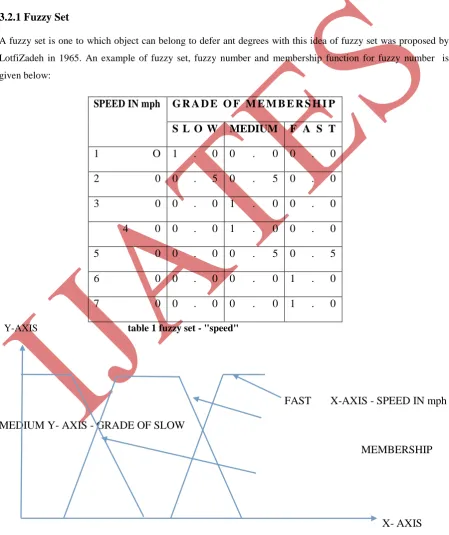
A fuzzy set is one to which object can belong to defer ant degrees with this idea of fuzzy set was proposed by LotfiZadeh in 1965. An example of fuzzy set, fuzzy number and membership function for fuzzy number is given below:
SPEED IN mph G R A D E O F M E M B E R S H I P
S L O W MEDIUM F A S T
1
O 1
.
0 0
.
0 0
.
0
2
0 0
.
5 0
.
5 0
.
0
3
0 0
.
0 1
.
0 0
.
0
4
0 0
.
0 1
.
0 0
.
0
5
0 0
.
0 0
.
5 0
.
5
6
0 0
.
0 0
.
0 1
.
0
7
0 0
.
0 0
.
0 1
.
0
Y-AXIS table 1 fuzzy set - "speed"
FAST X-AXIS - SPEED IN mph
MEDIUM Y- AXIS - GRADE OF SLOW
MEMBERSHIP
X- AXIS
Page | 8
3.3 Application of Fuzzy Logic
1. Water resources allocation problem
2.Irrigation planning problem
3. Reservoir operation problem
4.Water quality management problem
5.River basin planning problem.
3.4 Fuzzy Linear Programming
The classical model of linear programming can be stated as
Maximize f(x)=CT X
Such that (5.4)
Ax ≤ b
x ≥ 0
In brief Fuzzy Linear Programming is divided into six steps
I. Solve the problem as linear programming problem by taking only one out of objective at a time.
II. From the results of step I determined the corresponding value of every object at each solution derived.
III. From step II , best (Zu) and worst (ZL) values for each value of objective can be calculated.
IV. Formulate the linear membership function.
V. Formulate the equivalent linear programming model for the fuzzy multi objective problem.
VI. Determine the compromise solution along with the degree of truth (λ).
IV.CONCLUSION
Irrigation planning model-1
A. Linear programming model gives 1733.11 million rupees of net benefit in case of fuzzy linear programming model it is 1484 million rupees which is 14.36% less as compare to LP.
B. Net benefit per ha on average is 19925.34 rupees in case of linear programming and 19363.06 for FLP .Net benefit per ha is 2.82% more in case of LP.
C. Optimal solution of FLP model is obtained at 0.6126 degree of truthness. D. Irrigation intensity in case of LP is 115.97% and 102.18% in case of FLP.
Irrigation planning model - 2
1. Linear programming model gives o.6056 million tonnes of crops of net benefit in case of f uzzy linear programming model it is 0.5496 million tonnes which is 14.36% less as compare to LP.
2. Crop yield per ha in case of LP model is 7.30 tonnes and 7.38 tonnes in case FLP,which is greater than LP model by 1.08.
Page | 9
4. Irrigation intensity in case of LP is 110.38% and 99.22% in case of FLP.
Irrigation planning model - 3
I. Linear programming model gives 89070.2 ha of irrigation area and in case of fuzzy linear programming model it is 76583.25 ha which is 14.01% less as compare to LP.
II. Optimal solution of FLP model is obtained at 0.6085degree of truthness. III. Irrigation intensity in case of LP is 118.76% and 102.11% in case of FLP.
REFERENCES
[1] ShrinivasRaju K and NageshKu,mar D. , irrigation planning of Shri Ram Sagar Project using multi objective FLP,The Indian Society For Hydrualics.
[2] Shashi Kumar K and MujumdarP.P.,fuzzyoptimisation model for water quality management of river system . J. Water Resorces Planning And Management ,ASCE,1998
[3] Mohan S . ,fuzzy linear programming modeling for water resources allocation , J. Water Work Association