Open Access
Research
Deceleration during 'real life' motor vehicle collisions – a sensitive
predictor for the risk of sustaining a cervical spine injury?
Martin Elbel*
†1, Michael Kramer
†1, Markus Huber-Lang
1, Erich Hartwig
2and
Christoph Dehner
1Address: 1Center of Surgery, Department of Orthopedic Trauma, Hand, Plastic and Reconstructive Surgery, University of Ulm, Steinhövelstrasse 9,
89075, Ulm, Germany and 2Department of Trauma Surgery, Deaconesses Hospital, Karlsruhe – Rüppurr, Academic Teaching Hospital of Freiburg
University, Diakonissenstrasse 28, 76199, Karlsruhe, Germany
Email: Martin Elbel* - [email protected]; Michael Kramer - [email protected]; Markus Huber-Lang - [email protected]; Erich Hartwig - [email protected]; Christoph Dehner - [email protected] * Corresponding author †Equal contributors
Abstract
Background: The predictive value of trauma impact for the severity of whiplash injuries has mainly been investigated in sled- and crash-test studies. However, very little data exist for real-life accidents. Therefore, the predictive value of the trauma impact as assessed by the change in velocity of the car due to the collision (ΔV) for the resulting cervical spine injuries were investigated in 57 cases after real-life car accidents.
Methods: ΔV was determined for every car and clinical findings related to the cervical spine were assessed and classified according to the Quebec Task Force (QTF).
Results: In our study, 32 (56%) subjects did not complain about symptoms and were therefore classified as QTF grade 0; 25 (44%) patients complained of neck pain: 8 (14%) were classified as QTF grade I, 6 (10%) as QTF grade II, and 11 (19%) as QTF grade IV. Only a slight correlation (r = 0.55) was found between the reported pain and ΔV. No relevant correlation was found between
ΔV and the neck disability index (r = 0.46) and between ΔV and the QTF grade (r = 0.45) for any of the collision types. There was no ΔV threshold associated with acceptable sensitivity and specificity for the prognosis of a cervical spine injury.
Conclusion: The results of this study indicate that ΔV is not a conclusive predictor for cervical spine injury in real-life motor vehicle accidents. This is of importance for surgeons involved in medicolegal expertise jobs as well as patients who suffer from whiplash-associated disorders (WADs) after motor vehicle accidents.
Trial registration: The study complied with applicable German law and with the principles of the Helsinki Declaration and was approved by the institutional ethics commission.
Published: 8 March 2009
Patient Safety in Surgery 2009, 3:5 doi:10.1186/1754-9493-3-5
Received: 19 January 2009 Accepted: 8 March 2009
This article is available from: http://www.pssjournal.com/content/3/1/5
© 2009 Elbel et al; licensee BioMed Central Ltd.
Background
Whiplash injuries remain a barely understood phenome-non. The economic damage caused by whiplash amounts to some 10 billion Euros a year in Europe [1] and 29 bil-lion US Dollars a year in the USA [2]. As whiplash occurs as a result of motor vehicle accidents (MVAs), questions inevitably arise regarding who is liable for these costs.
Biomechanical considerations have been based on the assumption that damage to a given material only occurs when the energy that acts on this material is high enough. Thus, energy doses below a defined threshold have been considered harmless [3,4]. In this context, the parameter delta v (ΔV), which describes the velocity change of a motor vehicle during a collision with another vehicle, has become a widely accepted criterion for the energy that acts on the vehicle during a collision [5].
In numerous sled or car crash-test studies, volunteers were subjected to acceleration forces in order to define a thresh-old below which a cervical spine injury could be excluded [6-15]. The results of these studies are rather inconclusive and sometimes contradictory. Thus the scientific commu-nity has not yet reached consensus regarding the thresh-old value for cervical spine injuries after whiplash. Nonetheless, ΔV threshold values were adopted very early in the history of insurance law as a criterion to accept or deny the claim settlement for whiplash-associated disor-ders (WADs) [16].
Up until now, all volunteer crash-test studies precisely defined the subject's sitting position. While waiting for the collision, the subjects maintained an upright body and head position, with an optimally adjusted headrest. It is obvious that the real-life sitting position in traffic may significantly differ from this laboratory position in one or several points. Furthermore, an increased risk of injury has been observed for various factors such as the seat and headrest settings [11,17-20], the distance between head and headrest [21-23], the head rotation, and the collision type [24]. The inherent variability of these factors makes it unclear how easily the results from laboratory crash tests can be transferred to real-life accident situations. In order to elucidate these issues, this study analyzes the correla-tion between ΔV and cervical spine injuries in real-life accidents and questions whether ΔV is a valid predictor for cervical spine injuries following whiplash.
Methods
The study included 57 patients after a car collision. The patients were recruited either by an engineer's office for vehicle damage assessment and claims adjustment (n = 46) or by the first consultation of an emergency room (n = 11). We obtained the approval of the local independent
ethics board and all patients gave their written informed consent to participate in the study.
Clinical Data
The clinical data were collected within 48 h after occur-rence of the accident. Neck pain was determined on a vis-ual analog scale (VAS) ranging from 0 (no pain) to 100 (maximal pain). The neck disability index (NDI) was used to assess disability problems related to neck pain. The NDI includes 10 items that attempt to describe the impact of neck pain: pain intensity, personal care, lifting, reading, headaches, concentration, work, driving, sleeping and rec-reation [25]. Subjects are requested to choose for each item, the statement that best describes their current situa-tion; the statements represent different grades of severity. A total score which ranges from 0 to 50 was finally derived as the sum of the ten items.
All subjects who reported neck pain were physically and radiologically examined. The physical examination included investigation of the cranial nerves as well as of the motor and sensory function of spinal nerves C5–C8. Areas that were painful upon application of pressure were also examined. Furthermore, the range of motion (ROM) of the cervical spine in flexion/extension, rotation and lat-eral flexion was measured. In addition, X-rays of the cervi-cal spine were taken in two planes. A CT scan was additionally taken if pathological findings were noted. The clinical and radiological findings were used to classify the whiplash injury according to the Quebec Task Force (QTF) system [26] (Table 1). The medical investigator was blinded concerning the technical data. Patients were informed of all results from the clinical examination excluding the QTF values.
Technical Data
In addition to the clinical findings, the ΔVs of their respec-tive accident vehicles were determined for all patients. The damage on all vehicles involved in the accidents was examined by a certified engineer who was experienced in the assessment of such damage. The ΔV and the collision type (frontal, rear-end, side collision, multiple collisions, rollovers) were determined on the basis of the damage sustained by the vehicles. Depending on the available data, the ΔV was analyzed either by calculation and graphic illustration [27] or with the EES method [28]. The engineer was blinded concerning the clinical examination results.
Statistics
Spearman's correlation coefficient. The specificity and sensitivity were calculated for the hypothesis that no cer-vical spine injuries occur below a particular ΔV threshold and that injuries can occur above this threshold. P-values below 0.05 were considered significant.
Results
We enrolled 57 individuals (25 males and 32 females) in the study; these individuals had been the occupants of 51 cars (Table 2). The median age was 33 (range 3 to 90 years) for the males and 30 (range 18 to 59 years) for the females.
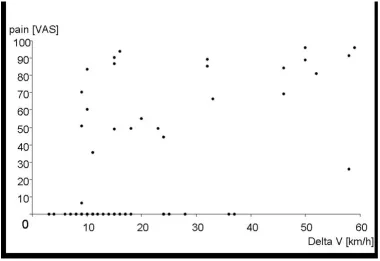
A total of 25 (44%) patients complained about pain in the neck. VAS pain scores of 7 to 96 (median = 71) were reported. Fifteen patients reported an immediate onset of pain, four individuals reported a time to onset of minutes to hours, and four patients reported a time to onset of hours to one day. The Pearson's correlation coefficient of r = 0.55 indicated a moderate correlation between the pain that was subjectively reported and ΔV (Fig. 1).
A total of 25 (44%) patients complained pain related neck disability. NDI scores of 4 to 49 (median = 24) were reported. The Pearson's correlation coefficient of r = 0.46 indicated no relevant correlation between the NDI and ΔV (Fig. 2).
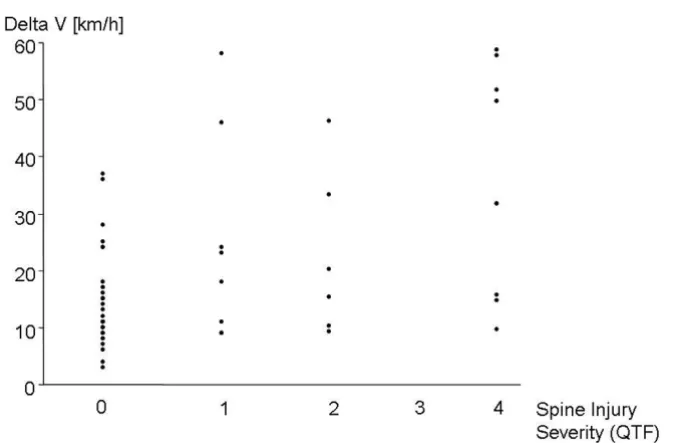
Thirty-two patients (56%) were classified as QTF grade 0. Eight patients (14%) presented with QTF grade I, 6 patients (10%) with QTF grade II, and 11 patients (19%) with QTF grade IV. No QTF grade III injuries were scored. The Spearman's correlation coefficient of r = 0.45 indi-cated no relevant correlation between ΔV and the QTF grade of cervical spine injury (Fig. 3).
Rear-end collision (n = 21, 36%) was the most frequent collision type, followed by side collisions (n = 19, 33%) and front collisions (n = 13, 23%); there were also three multiple collisions and one rollover. For the rear-end col-lisions, individuals with and without cervical spine inju-ries were found in a ΔV range between 9 km/h and 37 km/ h. This range was 15 km/h to 28 km/h for frontal
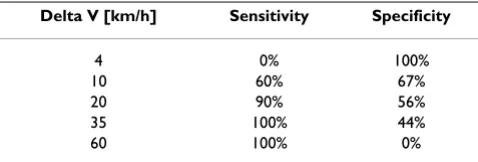
colli-sions and 9 km/h to 36 km/h for side collicolli-sions. Within these ranges, the percentage of positive and false-negative results varied greatly, depending on the prede-fined cut-off values (Tables 3, 4 and 5). Therefore, for all collision types it was impossible to define a ΔV value that excluded the occurrence of cervical spine injury with acceptable sensitivity while simultaneously predicting the occurrence of cervical spine injury with acceptable specif-icity.
Discussion
This study provides evidence that, in real-life accidents, cervical spine injuries may occur at low ΔV values, while it is possible to escape unscathed from collisions with high
ΔV values. In particular, the correlation between ΔV and the occurrence of WADs was very low for any of the colli-sion types. Therefore it is impossible to make meaningful statements about the existence of WAD based solely on assessment of the ΔV value. This finding might be of importance for the surgeon's assessment and patient's safety after a car accident. Diagnostic and therapeutic management should not be based solely on information related to trauma impact.
The results of the present study support the findings of numerous sled and car-crash experiments. In those exper-iments, neck problems were noted after rear-end colli-sions with ΔVs as low as 7 km/h [14,29-31]. In four other studies [8,32-34], neck problems occurred at a ΔV < 10 km/h. The neck problems were defined as QTF grade I and QTF grade II, persisting from hours to several weeks in all studies. In contrast, four studies reported rear-end colli-sions with ΔV values of 13.1 km/h to 50 km/h where the occupants escaped without any signs of injury [4,9,35,36]. In other crash-test studies, frontal impacts at ΔV less than 12 km/h caused no injuries [34]. However, different find-ings were obtained in our study and in a study that per-formed a retrospective analysis of 24 real-life frontal collisions [37]. In that study, 18 of the 24 subjects were classified as QTF grade II. It is noteworthy that 8 of these had neck problems for more than one year. The ΔVs in these cases ranged from 3 km/h to 23 km/h. The authors also reported that one subject suffered a prolapsed disk at Table 1: Clinical classification of whiplash-associated disorders according to the Quebec Task Force
QTF Grade Clinical Symptoms
0 No complaint about the neck, no physical signs
I Neck complaint of pain, stiffness or tenderness only, no physical signs II Neck complaint and musculoskeletal signs *
III Neck complaint and neurological signs ** IV Neck complaint and fracture or dislocation
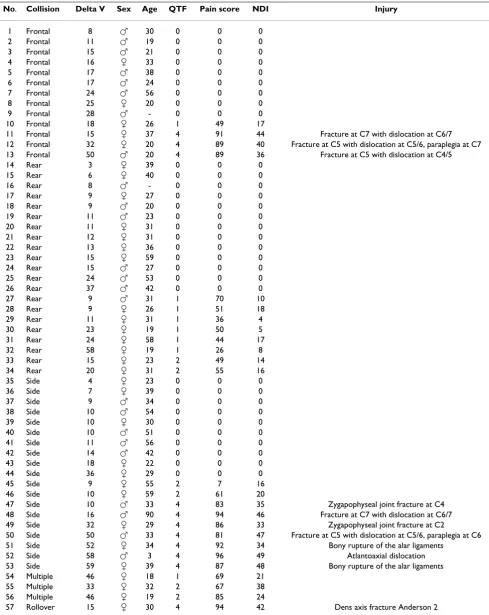
Table 2: Collision type, delta V, sex, age, QTF grade, pain score, neck disability index (NDI) and description of injury in cases of QTF grade IV in all studied subjects.
No. Collision Delta V Sex Age QTF Pain score NDI Injury
1 Frontal 8 씹 30 0 0 0 2 Frontal 11 씹 19 0 0 0 3 Frontal 15 씹 21 0 0 0 4 Frontal 16 씸 33 0 0 0 5 Frontal 17 씹 38 0 0 0 6 Frontal 17 씹 24 0 0 0 7 Frontal 24 씹 56 0 0 0 8 Frontal 25 씸 20 0 0 0 9 Frontal 28 씹 - 0 0 0 10 Frontal 18 씸 26 1 49 17
11 Frontal 15 씸 37 4 91 44 Fracture at C7 with dislocation at C6/7 12 Frontal 32 씸 20 4 89 40 Fracture at C5 with dislocation at C5/6, paraplegia at C7 13 Frontal 50 씹 20 4 89 36 Fracture at C5 with dislocation at C4/5 14 Rear 3 씸 39 0 0 0
15 Rear 6 씸 40 0 0 0 16 Rear 8 씹 - 0 0 0 17 Rear 9 씸 27 0 0 0 18 Rear 9 씹 20 0 0 0 19 Rear 11 씹 23 0 0 0 20 Rear 11 씸 31 0 0 0 21 Rear 12 씸 31 0 0 0 22 Rear 13 씸 36 0 0 0 23 Rear 15 씸 59 0 0 0 24 Rear 15 씹 27 0 0 0 25 Rear 24 씹 53 0 0 0 26 Rear 37 씹 42 0 0 0 27 Rear 9 씹 31 1 70 10 28 Rear 9 씸 26 1 51 18 29 Rear 11 씸 31 1 36 4 30 Rear 23 씸 19 1 50 5 31 Rear 24 씸 58 1 44 17 32 Rear 58 씸 19 1 26 8 33 Rear 15 씸 23 2 49 14 34 Rear 20 씸 31 2 55 16 35 Side 4 씸 23 0 0 0 36 Side 7 씸 39 0 0 0 37 Side 9 씹 34 0 0 0 38 Side 10 씹 54 0 0 0 39 Side 10 씸 30 0 0 0 40 Side 10 씹 51 0 0 0 41 Side 11 씹 56 0 0 0 42 Side 14 씹 42 0 0 0 43 Side 18 씸 22 0 0 0 44 Side 36 씸 29 0 0 0 45 Side 9 씸 55 2 7 16 46 Side 10 씸 59 2 61 20
47 Side 10 씹 33 4 83 35 Zygapophyseal joint fracture at C4 48 Side 16 씹 90 4 94 46 Fracture at C7 with dislocation at C6/7 49 Side 32 씸 29 4 86 33 Zygapophyseal joint fracture at C2
50 Side 50 씹 33 4 81 47 Fracture at C5 with dislocation at C5/6, paraplegia at C6 51 Side 52 씸 34 4 92 34 Bony rupture of the alar ligaments
52 Side 58 씹 3 4 96 49 Atlantoaxial dislocation 53 Side 59 씸 39 4 87 48 Bony rupture of the alar ligaments 54 Multiple 46 씸 18 1 69 21
55 Multiple 33 씸 32 2 67 38 56 Multiple 46 씸 19 2 85 24
C5/6 at a ΔV of 11–15 km/h. The occupant had not been wearing his seat belt and the airbag had deployed. He also had a frontal laceration as a sign of direct head impact. It was assumed that these factors caused the structural injury of the cervical spine at a low ΔV. The occurrence of struc-tural injuries at ΔV values of less than 20 km/h had been
considered improbable in expert discussions. However, we also observed a luxation fracture at C5/6 resulting from a frontal collision at a ΔV of 15 km/h and a facet joint fracture at C4 due to a side collision at a ΔV of 10 km/h (Table 1). Both occupants had been wearing their seat belts, there had been no head contact, and the airbag
Pain score (VAS) for all subjects (n = 57) as a function of delta V (km/h)
Figure 1
Pain score (VAS) for all subjects (n = 57) as a function of delta V (km/h).
Neck disability index (NDI) for all subjects (n = 57) as a function of delta V (km/h)
Figure 2
had not deployed. In both cases, it is unclear which fac-tors, either alone or in combination, were responsible for these structural injuries at considerably low ΔV. In accord-ance with other studies mentioned below, these results are indicative that multiple factors may influence the risk of injury in each individual case. Due to the additive effects of various protective factors, high-energy impacts may be absorbed without injury, while the additive effects of unfavorable factors could explain injuries sustained in low-energy impacts. Some factors have been described to influence the risk of injury, such as sex [38,39], head posi-tion [40], sitting posiposi-tion [24,41], distance between head and headrest [21-23] and seat construction [11,17-19]. The duration of the crash pulse is also thought to signifi-cantly contribute to the risk of cervical spine injury. These authors stated that an earlier acceleration peak during deformation of the colliding cars was correlated with a higher probability of cervical spine injury [24]. However,
it remains unclear to what extent each one of these factors influences the risk of cervical spine injury.
The current data exclude the assumption of a linear corre-lation between ΔV and the risk of suffering a whiplash injury. It is tempting to speculate that the development of a cervical spine injury after whiplash is more like a com-plex system such as those described in chaos theory [42]. Complex systems cannot be simplified into linear correla-tions. Even small variations of the initial conditions can affect the end result so that it is no longer predictable, such as in the case of the "butterfly effect": the flapping of a butterfly's wings can ultimately result in a different weather pattern [43]. Taken together, it can be concluded that ΔV is an irrelevant predictive value for cervical spine injury after a MVA. Nevertheless further studies will be necessary to evaluate the development of pain
chronifica-Delta V for all subjects (n = 57) as a function of the spine injury severity (QTF grade) (QTF 0: n = 32, QTF I: n = 8, QTF II: n = 6, QTF IV: n = 11)
Figure 3
Delta V for all subjects (n = 57) as a function of the spine injury severity (QTF grade) (QTF 0: n = 32, QTF I: n = 8, QTF II: n = 6, QTF IV: n = 11).
Table 3: Specificity and sensitivity for specific delta V threshold values in frontal collisions (n = 13).
Delta V [km/h] Sensitivity Specificity
8 0% 100% 15 33% 75% 20 67% 50% 35 100% 25%
Table 4: Specificity and sensitivity for specific delta V threshold values in rear-end collisions (n = 21).
Delta V [km/h] Sensitivity Specificity
tion in dependence of the ΔV to investigate its possible predictive value as "long-term" parameter.
Conclusion
The ΔV value as measured in the trauma impact does not represent a conclusive predictor for cervical spine injury in real-life motor vehicle accidents. This could be important for surgeons and patients in their medicolegal assessment of WADs.
Competing interests
The authors declare that they have no competing interests.
Authors' contributions
ME drafted the manuscript and performed the medical examination. MK participated in the study coordination and helped in the medical examination. MHL helped to draft the manuscript. EH participated in the study design and its coordination. CD performed the statistical analysis and helped to draft the manuscript. All authors read and approved the final manuscript.
Acknowledgements
This study was funded by the Research Institute for Rehabilitation Medicine, University of Ulm, Germany.
References
1. Radanov B, Dvorak J, Valach L: Cognitive deficits in patients after soft tissue injury of the cervical spine. Spine 1992, 17:127-131. 2. Freeman MD, Croft AC, Rossignol AM, Weaver DS, Reiser M: A review and methodologic critique of the literature refuting whiplash syndrome. Spine 1999, 24:86-96.
3. Niederer P, Walz F, Muser M, Zollinger U: Was ist ein "schwerer", und was ist ein "leichter" Verkehrsunfall? Schweizerischen Aerz-tezeitung 2001, 82:1535-1539.
4. Meyer S, Hugemann W, Weber M: Zur Belastung der Halswirbel-säule durch Auffahrunfälle – Teil 1. Verkehrsunfall und Fahrzeugtechnik 1994, 32:15-21.
5. Becke M, Castro WHM: Zur Belastung von Fahrzeuginsassen bei leichten Seitkollisionen. Teil II. Verkehrsunfall und Fahrzeugtechnik 2000, 12:225-228.
6. Rosenbluth W, Hicks L: Evaluating low-speed rear-end impact severity and resultant occupant stress parameters. J Forensic Sci 1994, 39:1393-1424.
7. Davidsson J, Flogard A, Lövsund P, Svensson MY: BioRid P3-Design and Performance Compared to Hybrid III and Volunteers in Rear Impacts at Delta V = 7 km/h. SAE Paper 1999,
99SC16:253-256.
8. Kaneoka K, Ono K, Inami S, Ochiai N, Hayashi K: The human cer-vical spine motion during rear-impact collisions: a proposed cervical facet injury mechanism during whiplash trauma.
Journal of Whiplash & Related Disorders 2002, 1:85-97.
9. Blouin JS, Descarreaux M, Belanger-Gravel A, Simoneau M, Teasdale N: Attenuation of human neck muscle activity following repeated imposed trunk-forward linear acceleration. Exp Brain Res 2003, 150:458-464.
10. Siegmund GP, Sanderson DJ, Myers BS, Inglis JT: Awareness affects the response of human subjects exposed to a single whiplash-like perturbation. Spine 2003, 28:671-679.
11. Watanabe Y, Ichikawa H, Kayama O, Ono K, Kaneoka K, Inami S:
Influence of seat characteristics on occupant motion in low-speed rear impacts. Accident Analysis & Prevention 2000,
32:243-250.
12. Kumar S, Narayan Y, Amell T: Role of awareness in head-neck acceleration in low velocity rear-end impacts. Accident Analysis & Prevention 2000, 32:235-241.
13. Magnusson ML, Pope MH, Hasselquist L, Bolte KM, Ross JS, Goel VK, Lee JS, Spratt K, Clark CR, Wilder DG: Cervical electromyo-graphic activity during low-speed rear impact. European spine journal 1999, 8:118-125.
14. Matsushita T, Sato TB, Hirabayashi K, Fujimura S, Asazuma T, Taka-tori T: X-Ray study of the human neck motiondue to head inertia loading. In Proceedings of the 37th Stapp Car Crash Confer-ence; Fort Lauderdale, USA SAE technical paper series SoAE; 1994:55-64.
15. Ono K, Kaneoka K, Wittek A, Kajzer J: Cervical injury mecha-nism based on the analysis of human cervical vertebrae motion and head-neck-torso kinematics during low speed rear impacts. Proceedings 41st Stapp Car Crash Conference; November 13–14; Lake Buena Vista, USA 1997:339-356.
16. Ayasse H: Ayasse, H., 1992. Das Schleudertrauma der Halswirbelsäule aus der Sicht der Schadenssachbearbeitung.
Zeitschrift für Versicherungsrecht, Haftungs- und Schadensrecht 1992,
28:1185-1202.
17. Svensson MY, Lovsund P, Haland Y, Larsson S: The influence of seat-back and head-restraint properties on the head-neck motion during rear-impact. Accident Analysis & Prevention 1996,
28:221-227.
18. Welcher JB, Szabo TJ: Relationships between seat properties and human subject kinematics in rear impact tests. Accident Analysis & Prevention 2001, 33:289-304.
19. Eichberger A, Geigl BC, Moser A, Fachbach B, Steffan H: Compari-son of different car seats regarding head-neck kinematics of volunteers during rear end impact. Proceedings of the Interna-tional Conference on the Biomechanics of impacts; Dublin 1996:153-164. 20. Mühlbauer M, Eichberger A, Geigl B, Steffan H: Analysis of Kine-matics and acceleration behavior of the head and neck in experimental rear-impact collisions. Neuro-Orthopedics 1999,
25:1-17.
21. Farmer CM, Wells JK, Werner JV: Relationship of head restraint positioning to driver neck injury in rear-end crashes. Accident Analysis & Prevention 1999, 31:719-728.
22. Jakobsson L, Norin H, Jernström C, Svensson S, Johnsen P, Isaksson-Hellman I, Svensson M: Analysis of different head and neck responses in rear-end car collisions using a new humanlike mathematical model. SAE 1994, 13-0007:.
23. Song D, Uriot J, Trosseille P, Mack C, Tarriere C, Got C, Domont A:
Modelling and Analysis of Interactions between occupant, seatback and headrest in rear impact. Proceedings of the Interna-tional Conference on the Biomechanics of Impact (IRCOBI); Dublin, Ireland 1996:165-185.
24. Kullgren A, Krafft M, Nygren A, Tingvall C: Neck injuries in frontal impacts: influence of crash pulse characteristics on injury risk. Accid Anal Prev 2000, 32:197-205.
25. Vernon HT, Mior S: The Neck Disability Index: a study of relia-bility and validity. J Manipulative Physiol Ther 1991, 14:409-415. 26. Spitzer WO, Skovron ML, Salmi LR, Cassidy JD, Duranceau J, Suissa
S, Zeiss E: Scientific monograph of the Quebec Task Force on Whiplash-Associated Disorders: redefining "whiplash" and its management [see comments] [published erratum appears in Spine 1995 Nov 1;20(21):2372]. Spine 1995,
20:1S-73S.
27. Appel H, Krabbel G, Vetter D: Unfallrekonstruktion. In Unfallfor-schung, Unfallmechanik und Unfallrekonstruktion Kippenheim: Informa-tions Ambs GmbH; 2002:143-183.
28. Zeidler F: Erfahrungen aus 25 Jahren Unfallforschung bei Merzedes-Benz. Methodik, Maßnahmen, Effizienz. Verkehr-sunfall und Fahrzeugtechnik 1995, 33:246-250.
Table 5: Specificity and sensitivity for specific delta V threshold values in side collisions (n = 19).
Delta V [km/h] Sensitivity Specificity
Publish with BioMed Central and every scientist can read your work free of charge
"BioMed Central will be the most significant development for disseminating the results of biomedical researc h in our lifetime."
Sir Paul Nurse, Cancer Research UK
Your research papers will be:
available free of charge to the entire biomedical community
peer reviewed and published immediately upon acceptance
cited in PubMed and archived on PubMed Central
yours — you keep the copyright
Submit your manuscript here:
http://www.biomedcentral.com/info/publishing_adv.asp
BioMedcentral 29. Brault JR, Wheeler JB, Siegmund GP, Brault EJb: Clinical response
of human subjects to rear-end automobile collisions. Arch Phys Med Rehabil 1998, 79:72-80.
30. Eichberger A, Steffan H, Geigl BC, Svensson MY, Boström O, Leinz-inger P, Darok M: Evaluation of the applicability of the neck injury criterion (NIC) in rear end impacts on the basis of human subject test. Proceedings of the International Conference on the Biomechanics of impacts 1998:1-14.
31. McConnell WE, Howard RP, Guzman HM, Bomar JB, Raddin JH, Ben-edict JV, Smith HL, Hatsell CP: Analysis of human test subject kinematic responses to low velocity rear end impacts. In Pro-ceedings of the 37th Stapp Car Crash Conference; San Antonio, USA series Stp; 1998:21-30.
32. Anderson RD, Welcher JB, Szabo TJ, Eubanks JJ, Haight WRR: Effect of Braking on Human Occupant and Vehicle Kinematics in Low Speed Rear-End Collisions. 16th International Technical Con-ference on the Enhanced Safty of Vehicles 1998, Paper No. 980298:1-13.
33. Szabo TJ, Welcher JB: Human subject kinematics and electro-myographic activity during low speed rear impacts. In Pro-ceedings of the 40th Stapp Car Crash Conference; Albuquerque, USA SAE; 1996:295-315.
34. Nielsen G, Gough J, Little D, West D, Baker V: Repeated Low Speed Impacts with Utility Vehicles and Humans. Accident Reconstruction Journal 1996, 9:24-38.
35. Ewing CL, Thomas DJ, Lustick L, Muzzy WH III, Willems G, Majewski PL: The Effect of Duration, rate of onset and peak sled accel-eration on the dynamic response of the human head and neck. Proceedings of the 20st Stapp Car Crash Conference; Dearborn, USA 1976:3-41.
36. West DH, Gough JP, Harper GTK: Low speed rear-end collisions testing using human subjects. Accident Reconstruction Journal 1993, 5:22-26.
37. Jakobsson L, Norin H, Bunketorp O: In-depth study of whiplash associated dissorders in frontal impacts: influencing factors and consequences. Proceedings of the International Conference on the Biomechanics of impacts 2002:1-12.
38. Evans L: Ade Dependence of Female To Male Fatality Risk From the Same Crash: An Independent Reexamination.
43rd Annual Proceedings of the Assosciation for the Advancement of Auto-motive Medicine Conference; Barcelona, Sitges 1999:225-238.
39. Garces GL, Medina D, Milutinovic L, Garavote P, Guerado E: Nor-mative database of isometric cervical strength in a healthy population. Med Sci Sports Exerc 2002, 34:464-470.
40. Winkelstein BA, Nightingale RW, Richardson WJ, Myers BS: Cervi-cal facet joint mechanics: Its Application to whiplash injury.
Proceedings of the 43rd Stapp Car Crash Conference; San Diego, USA 1999:243-252.
41. Sturzenegger M, Radanov BP, Di Stefano G: The Effect of accident mechanisms and initial findings on the long-term course of whiplash injury. Journal of Neurology 1996, 242:443-449. 42. Gleick J: Chaos: The Amazing Science of the Unpredictable.
London: Vintage Random House; 1998.