R E S E A R C H
Open Access
Length of stay, costs, and complications in
lumbar disc herniation surgery by standard
PLIF versus a new dynamic interspinous
stabilization technique
Manuel Segura-Trepichio
1,4*, David Candela-Zaplana
1, José Manuel Montoza-Nuñez
1, Antonio Martin-Benlloch
2and Andreu Nolasco
3Abstract
Background:The number of lumbar spine surgeries has been increasing during the last 20 years, which also leads to an increase in hospital costs and complications related to surgery. Therefore, there is a greater concern about the costs and safety of the techniques and implants used.
Methods:Patients (aged from 18 to 50 years) presenting with lumbago /sciatica (ICD-10-CM M54.3, M54.4)
due to lumbar disc herniation lasting more than 12 weeks, were included. Patients with disc herniation larger than size-2 or size-3 according to the MSU Classification were eligible for participation. Intervention was divided in two groups. In Group 1, patients underwent microdiscectomy and Interspinous Dynamic Stabilization System (IDSS). Meanwhile, in Group 2, patients received discectomy and posterior lumbar interbody fusion (PLIF). The primary outcome measure was the length of stay and costs during hospital admission. We also evaluated several other outcome parameters, including 90- day readmission rate, 90-day complication rate, and re-operations rate. The study was an observational prospective cohort study carried out from January 2015 to August 2016 in which two surgical techniques were compared. Our hypothesis was that a less aggressive procedure, such as discectomy and DSS, will decrease the length of stay and costs, and that it will also reduce the rate of complications with respect to PLIF.
Results:A total of 67 patients (mean age 39.8 ± 8.4 years) were included. Patients in the PLIF group had a length of stay increase of 109% (4.52 ± 1.76 days vs 2.16 ± 1.18 daysp< 0.001) and an in-hospital cost increase of 71% (1821.97 ± 460.41€ vs. 1066.20 ± 284.34€ p < 0.001). The reduction of one day of stay is equivalent to a reduction of total in-hospital costs of 12.5%. Patients in the IDSS cohort had no significant differences regarding PLIF cohort in the 90-day readmission rate (12.9% vs 11.1% € p> 0.999, respectively), 90-day re-operation rate (12.9% vs 11. 1% € p > 0.999) and 90-day complication rates (35.5% vs 52.8% € p> 0.156). Dural tear and urinary tract infection rates were higher in the PLIF cohort (13.9% vs 3.2%.p= 0.205 and 11.1% vs 0%p= 0.118, respectively). Implant related complications were the most frequent in both IDSS and PLIF groups (32.3% vs 38.9%p= 0.572).
(Continued on next page)
* Correspondence:[email protected]
1
Departamento de Cirugía Ortopédica y Traumatología, Hospital Universitario del Vinalopó, Alicante, Spain
4Department of Orthopedic Surgery, Vinalopó University Hospital, Elx/ Elche,
03203 Alicante, Spain
Full list of author information is available at the end of the article
(Continued from previous page)
Conclusions:Patients who underwent IDSS had a significant decrease of the length of stay and costs in relation to PLIF group. No significant differences were found in 90-day readmission and reintervention rates for both groups. Although differences were not significant, dural tear and urinary tract infection rates were lower in the interspinous group. IDSS or PLIF after discectomy, did not protect against subsequent 90-day re-operation or readmission compared to discectomy alone.
Keywords:Lumbar disc herniation, Discectomy, Lumbar fusion, Length of stay, In-hospital costs, Surgical safety, Readmission, Reintervention, Complications, Prospective cohort study
Background
Low back pain and sciatica due to lumbar disc hernia-tion has become a major public health problem [1]. The prevalence of symptomatic herniated lumbar disc is about 1–3%, with the highest prevalence among people aged 30–50 years. [2] Annually, it is estimated that 2.75 out of 1000 people with episodes of low back pain will suffer an episode of hospitalization [3]. Along with this, the number of lumbar spine surgeries has been increas-ing durincreas-ing the last 20 years, which also leads to an in-crease in hospital costs and complications related to surgery [4, 5]. Traditionally, the surgical treatment of the lumbar disc herniation has been discectomy [6]. Howe-ver,although relief of sciatica, postoperative low back pain persist in some cases and iatrogenic instability fol-lowing lumbar discectomy can lead to a reoperation. Re-operation rates of 12–14%% have been reported [7, 8]. To prevent this complication, discectomy associated with posterior lumbar interbody fusion (PLIF) has been used [9–11] Some authors report better results with fu-sion than with discectomy alone [12], while others state that fusion is rarely indicated because satisfactory results can be obtained by disc excision alone [13, 14]. A less aggressive technique between discectomy and fusion may be the discectomy associated with an interspinous dynamic stabilization system (IDSS) [15–17].The evi-dence whether to perform a PLIF or an IDSS in associ-ation with disc excision remains controversial and inconsistent with low number of cases. Therefore, no de-finitive conclusions could be made. Safe surgery, accord-ing to recent surgical safety strategies, is related to the occurrence of adverse events after the surgery and the rate of reoperation (related to initial procedure) in the first 90 days [18, 19]. IDSS are characterized by less in-vasiveness compared to PLIF, thus, it seems to offer higher surgical safety in terms of early postoperative am-bulation decreasing medical complications rates and sur-gical wound infection rate [20]. Additional advantages of a less invasive procedure could be the reduction of hos-pital stay and consequently the reduction of hoshos-pital cost [21].
The present study was undertaken to further clarify whether the intervention (IDSS vs. PLIF) associated with
discectomy modifies the length of stay (LOS) and in-hospital costs, in patients with lumbar disc herniation,. A secondary goal was to determine how these surgical procedures modify 90-day readmission, reintervention and complication rates.
Methods
Study design
This is an observational prospective cohort study includ-ing patients with lumbago / sciatica (ICD-10-CM M54.3, M54.4 / ICD-9-CM 724.3) due to lumbar disc herniation (Intervertebral disc disorder with myelopathy, lumbar region (ICD-10-CM M51.06 / ICD-9-CM 722.73) [22, 23] All patients were operated in a single institution from January 2015 to August 2016.
Our hypothesis is that the patients undergoing discec-tomy plus IDSS will have a decrease in the mean LOS and costs compared to that obtained with discectomy plus PLIF. A less aggressive procedure such as discec-tomy plus IDSS will also decrease the rate of surgical complications with respect to discectomy plus PLIF.
Inclusion criteria
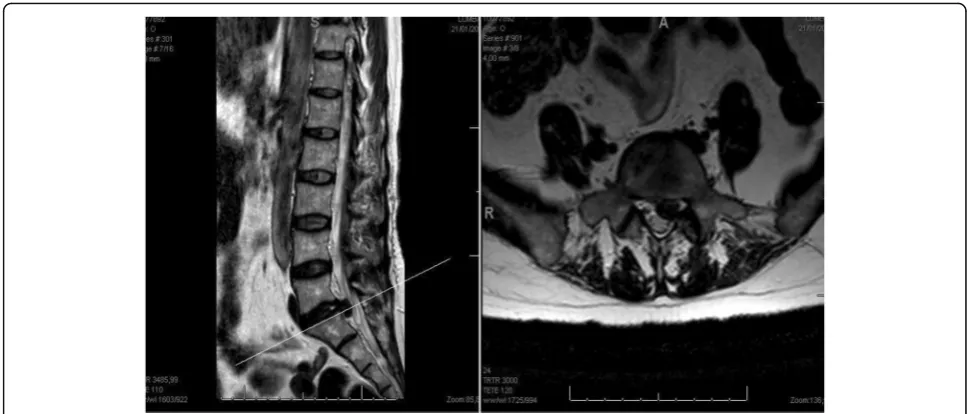
Voluminous 1–2 level lumbar disc herniation, (size-2 or size-3 herniations according to the MSU Classification) [24]. (Fig. 1) Age 18–50 years, body mass index (BMI) 18.5–35.0 kg/cm2, failure of nonoperative management for 12 weeks. Exclusion criteria included presence of previous lumbar spine surgery, spondylolisthesis, scoli-osis greater than 10 degrees and degenerative disc changes Pfirman grade 4 or 5 (collapse of the disc space). [25, 26].
Operative techniques
The first cohort included all patients who underwent open discectomy with limited disc excision using microscope assisted surgery (ICD-10-PCS 0SB20ZZ / ICD-9-CM 80.50, 80.51) [22, 23]. After disc excision, the In-Space Synthes® implant was mounted underneath the supraspi-nous ligament. The second cohort consisted of patients who underwent open wide discectomy (ICD-10-PCS 0SB20ZZ / ICD-9-CM 80.50, 80.51) followed by posterior lumbar interbody fusion (PCS 0SG3071,
PCS 0SG30Z1, ICD-10-PCS 0SG0071 / ICD-9-CM 81.07) with autologous tissue substitute [22, 23].
All individual participants gave their informed consent to be included in the study and the trial was approved by the Hospital Ethics Committee.
Demographic evaluation
In both groups, demographics (sex, age), BMI, tobacco consumption, and Charlson comorbidity index (CCI) were recorded. [27]
Surgical safety
The 90-day complication rates were assessed with the following data:
Major medical complications: such as mortality, re-spiratory failure (pneumonia or unplanned reintubation), pulmonary embolism, acute renal failure, myocardial in-farction, and cerebrovascular accident.
Minor medical complications: including deep venous thrombosis, urinary tract infection, peripheral nerve in-jury, and ileus.
Surgical complications: including cerebrospinal fluid leakage, seroma, wound infection and dehiscence rates and post operative anemia <8 g/dl were also assessed.
Implant related complications
In the interspinous group, the implant was evaluated in anterior and lateral radiographs. Anchorage wings com-plications, rupture and dislocation were recorded (Fig. 2). In the PLIF cohort, pedicle screw misplacement was assessed. Five types of misplacement were recorded, namely medial cortical perforation (MCP), lateral cor-tical perforation (LCP), anterior corcor-tical perforation of
vertebral body (ACP), endplate perforation (EPP), and perforation of neural foramen (FP). Screw misplacement was considered positive, if screw violation was greater than 2 mm misplacement, and negative if screws were fully contained into the pedicle. [28] Computed tomog-raphy (CT) and radiographs were performed.(Fig. 3). The presence of a radiolucent rim of 1 mm or more sur-rounding the screw which is framed by radio-optic dense bone “double halo signal “in both radiographs projec-tions, was considered as screw loosening. [29]
Incidence of 90 day re-operation
Re-operation is considered as a bad outcome and there-fore used as an outcome measure. The incidence of spinal re-operation in both groups was measured. In
Fig. 1Rm T2. Sagital and Axial. Patient with 1 level lumbar disc herniation. Included either for group 1(discectomy and interspinous) or group 2 (discectomy and PLIF)
addition, 90 -day readmission rates due to any reason were calculated.
Length of stay (L.O.S) and in-hospital costs
Data were obtained from digital history. Costs during hos-pital admission were calculated by an electronic hoshos-pital billing system. In order to asses only the cost during hos-pital admission, the price of the interspinous device in group 1(1500€) or the price of the pedicle screws, cage and rods in group 2 (3000€) were excluded. The following items per patient were added: 1) Human resources spent on surgery (Surgeon, anesthesiologist, nurses). 2) Expenses in surgical or medical material (serums, gauze, sutures, drainages, medication) 3) The cost spent on the stay (laundry, catering) 4) Complementary tests performed during the stay(for example, blood tests, x rays, etc). Knowing the value of these items, the individual costs of all operated patients in both groups were calculated.
Statistics
Student’s t tests were used to compare L.O.S and in-hospital costs between groups, whereas the chi-square and exact Fisher test were used to compare complications and readmission rates, and also, to compare proportions of patients in each cohort with given demographics or co-morbid conditions. To estimate the association between categorical variables and the intervention groups the odds ratio (OR) and its 95% confidence interval (CI) was calcu-lated. Through multivariate analysis (Binary Logistic re-gression and Multiple Linear rere-gression) confounding factors were controlled. For all analyses significance was set atp< 0.05.
Sample size: Based on our primary outcome, to detect a mean difference of 1 day in the mean LOS with a statis-tical power of 0.80, and a two-sided alpha of 0.05 a sample size of 28 patients per group was calculated. Based on pre-vious studies a standard deviation of 0.5 days for IDSS group and 1.8 days for PLIF group was assumed for sam-ple size calculation [30, 31].
Results
Patient demographics and Comorbidities
The present study included 67 patients with lumbar disc herniation. No patient was lost during follow-up. In Group 1, 31 patients underwent lumbar discectomy plus IDSS, meanwhile in Group 2, 36 patients received lumbar discec-tomy plus PLIF. All assessed demographics and comorbidi-ties are summarized in Table 1. There were no significant differences between groups in terms of mean age and mean BMI. Proportions of females, smokers, and comorbidities were similar in both groups. In group 1 a higher proportion of single- instrumented level was found. A more detailed profile of CCI by groups is described in Table 2.
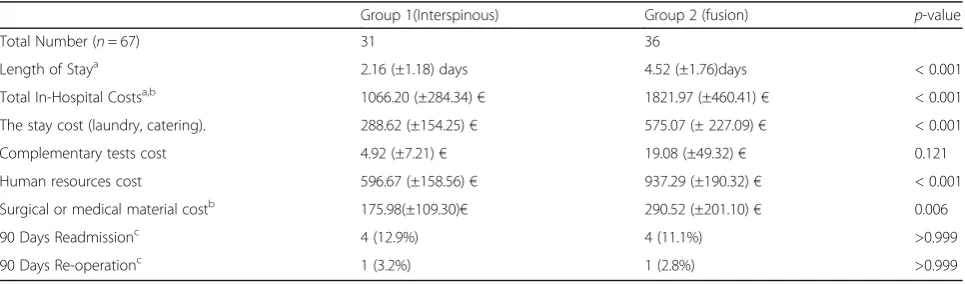
Length of stay, 90-day admission rates, 90-day re-operations and in- hospital costs
Length of stay was significantly lower in the interspinous group when compared to fusion group (2,16 ± 1.18 days vs. 4.52 ± 1.76 p< 0.001). Costs were significantly lower
Fig. 3Lumbar CT scan. L5-S1 Fusion complication, anterior cortical perforation of vertebral body. S1 right side (blue arrows)
Table 1Demographic and Co-Morbidity profile
Group 1 (Interspinous)
Group 2 (Fusion)
p-value
Total Number (n= 67)
31 36
Demographics
Agea 38.2 (±9.3) 41.2 (±7.4) 0.144
Femaleb 13 (41.9%) 19 (52.8%) 0.376
BMIa 26.1 (±3.6) 26.5 (±3.8) 0.566
Smokingb 13 (41.9%) 13 (36.1%) 0.625
Charlson comorbidity index scoringb
CCI = 0 25 (80.6%) 30 (83.3%) 0.775
CCI≥1 6 (19.4%) 6 (16.7%)
Instrumented levelsb
1 level 25 (80.6%) 18 (50%) 0.009
2 levels 6 (19.4%) 18 (50%)
a
Mean and standard deviation b
Number of patients and percentage by groups
in interspinous group as compared to fusion patients (1066.20 ± 284.34 € vs. 1821,97 ± 460.41 € p< 0.001 re-spectively.). Interspinous cohort had no significant less 90-day re-admission and 90-90-days re-operation rates com-pared to the fusion cohort (OR 1.18 95% CI: 0.27–5.19 p> 0.999 and OR 1.16 95% CI: 0.07–19.46 p > 0.999 re-spectively). LOS represented 27% (282.62 € / 1066 €) of the total in-hospital cost in the IDSS group and 31% (575.07€/ 1821.97€) in the PLIF group. In-Hospital data concerning length of stay, in-hospital costs, re-admission and re-operations rates, are summarized in Table 3.
90-day medical complications, surgical complications and implant related complications
Interspinous group patients had no significant differ-ences in the rate of total complications in regard to fu-sion group patients (OR 0.67 CI: 0.38–1.18 p= 0.156) Table 4. In the fusion group a non significant higher rate of urinary tract infection and dural tear was observed (OR 1.96 CI: 1.54–2.51 p= 0.11and OR 1.64 CI: 1.06–
2.53 p= 0.2 respectively). Regarding to the implant re-lated complications, the interspinous group had no sig-nificant lower rate respect to the fusion group. (OR 0.85 CI: 0.48–1.49p= 0.57). In group 1 the most frequent im-plant related complication was anchorage wings compli-cations (22.6%), followed by implant rupture (6.5%). In group 2, was the anterior cortical perforation of verte-bral body (27.7%) (Figs. 2 and 3). No major medical complications were found in any of the 2 groups.
Multivariate analysis
A more thorough assessment of the association between intervention (interspinous vs. fusion) and complications, LOS, and costs, was performed via multivariate analysis. It included other variables such as: Instrumented levels, age, sex and CCI. These analysis showed that the inter-spinous group was independently associated with lower length of stay −2.36 days (95% CI: -3.11-1.62 p< 0.001), lower costs −755.77 € (95% CI: -983.12 -565.59 p < 0.001) and had no significant differences in the rate of total complications in regard to fusion group OR 0.51 (95% CI: 0.16–1.6p= 0.25).
Discussion
Due to the increase in surgical procedures performed in patients with degenerative disc disease, there is a greater concern about the safety of the techniques and implants used [4]. Our study found no major complications, in-cluding death, in either group. In this sense, the reviewed literature reports more medical complications in fusion techniques than in interspinous surgical proce-dures. Puvanesarajah et al. reported up to 11.2% of major medical complications, 10% of urinary tract infec-tion and 1.4% of deep venous thrombosis, after 1–2 lum-bar spinal fusion surgery [18]. Whereas in a recent interspinous dynamic stabilization systematic review Leet al, reported no complications such as myocardaial infarction, pulmonary embolism, cerebrovascular
Table 2Charlson comorbidity index- clinical conditions by groupsa,b
Comorbidity clinical conditions Group 1 (Interspinous)
Group 2(Fusion)
Total Number (n= 67) 31 36
Peripheral vascular disease 1 (3.2%) 0
Chronic pulmonary disease 1 (3.2%) 1 (2.8%)
Mild liver disease 1 (3.2%) 0
Diabetes without complication 2 (6.5%) 2 (5.6%)
Tumors 1 (3.2%) 3 (8.3%)
a
The following clinical conditions were not present: Myocardial infarct, Congestive heart failure, Cerebrovascular disease, Dementia, Connective tissue disease, Ulcers, Diabetes with complications, Leukemia, Paraplegia or Hemiplegia, Moderate or severe Renal disease, Lymphoma, Moderate or severe liver disease, Malignant Tumor. Metastasis. Acquired immune deficiency syndrome (AIDS)
Number of patients and percentage by groups b
Number of patients and percentage by groups
Table 3Length of stay, In- hospital costs, 90 day re-admission and re-operations rates and Interspinous vs fusion group
Group 1(Interspinous) Group 2 (fusion) p-value
Total Number (n= 67) 31 36
Length of Staya 2.16 (±1.18) days 4.52 (±1.76)days < 0.001
Total In-Hospital Costsa,b 1066.20 (±284.34)€ 1821.97 (±460.41)€ < 0.001
The stay cost (laundry, catering). 288.62 (±154.25)€ 575.07 (± 227.09)€ < 0.001
Complementary tests cost 4.92 (±7.21)€ 19.08 (±49.32)€ 0.121
Human resources cost 596.67 (±158.56)€ 937.29 (±190.32)€ < 0.001
Surgical or medical material costb 175.98(±109.30)€ 290.52 (±201.10)€ 0.006
90 Days Readmissionc 4 (12.9%) 4 (11.1%) >0.999
90 Days Re-operationc 1 (3.2%) 1 (2.8%) >0.999
a
Mean and standard deviation b
Implant price, interspinous device (1500€) or PLIF pedicle screws and cage (3000€)not included c
accident, acute renal failure, mortality, deep venous thrombosis, ileus or urinary tract infection in patients who underwent interspinous dynamic stabilization sur-gery.32Regarding major or minor medical complications in our study, both techniques proved to be safe.
The most frequent complications were implant related complications in both groups. On the one hand, studies on IDSS,such as Diam, Wallis, and Coflex; reported an implant related complication rate up to 32.3% [32]. On the other hand, Gelais et al. in a systematic review, re-ported that rates of screw malposition in fusion surgery, vary considerably, they found the percentage of screws fully contained in the pedicle ranged from 28 to 85% [28]. In our study, we must highlight the rupture of an anchor-ing wanchor-ing of the In-Space Synthes® device This complica-tion has to be monitored, since if the 4 anchorage wings were ruptured, it could cause intracanal migration of the implant through the laminotomy site. In the fusion group, the most frequent alteration was the slight anterior protu-sion of the screw at S1vertebral body. We must take into account that anterior cortical penetration during sacral screw insertion carries a risk of neurovascular injury [33, 34]. Foxx et al., found 33 screws in contact with a major vessel in 182 patients and none of them suffered symp-toms or sequelae [35]. In our patients, the majority of the implant related complications did not require clinical treatment or significantly affected treatment outcomes. The dural tear rate was lower in IDSS cohort than fusion cohort (3.2% and 13.9%p= 0.2 respectively). This agrees with what has been published in other studies, where the incidence in lumbar decompressive surgery varies widely (1–17%) and in general increases with the complexity of the spinal procedures performed [36, 37].
One of the main concerns after a discectomy is the need for reintervention. In this sense with the addition of IDSS or fusion after discectomy our reintervention rates (3.2% in IDSS and 2.8% in fusion group) are similar to those published with discectomy alone. Heinddel et al. revealed a rate of additional lumbar surgeries fol-lowing single-level discectomy of 3.9% within 3 months, and 12.2% within 4 years [7]. Our short-term results re-vealed that the addition of IDSS or fusion does not pro-tect against reintervention regarding simple discectomy. There are studies that reported even a higher percentage of reintervention in patients with lumbar spinal stenosis operated with decompression plus IDSS compared to traditional decompressive surgery [38–41] In addition, to know if adding fusion reduced the reintervention rate in relation to the decompression alone a previous ran-domized controlled trial had been performed dividing patients into 3 groups: decompression surgery, decom-pression plus posterolateral fusion, and decomdecom-pression plus transforaminal interbody fusion. Revision surgery was performed in 3 patients, one in each group [42]. In this sense, one of the limitations of our study is not to have a control group with discectomy alone, to analyze if the reintervention rate varies with the addition of IDSS or fusion.
From a socioeconomic perspective, possibly the most significant finding of this study involved comparison of length of stay and in-hospital costs between the 2 groups. Patients in the fusion group had a length of stay increase of 109% compared to the interspinous group and an in-hospital costs increase of 71%. This result in which fusion increases length of stay and costs has been observed in previous investigations [42]. Hallett et al.
Table 490-days medical complications, surgical complications and implant related complications. Interspinous vs fusion group
Group 1(Interspinous) Group 2 (Fusion) p-value
Patients (n= 67)a 31 36
Any complication 11(35.5%) 19 (52.8%) 0.156
Surgical Complicationsb 1(3.2%) 6(16.7%) 0.113
Dural tear 1 (3.2%) 5 (13.9%) 0.205
Seroma 0 1(1.5%) >0.999
Implant Related Complications 10(32.3%) 14 (38.9%) 0.572
Anchorage wings complications 7(22.6%) Anterior screw 10(27.7%)
Broken implant 2 (6.5%) Lateral screw 3 (8.3%)
Dislocated implant 1 (3.2%) Broken screw 1(2.8%)
Screw loosening 0 (0.0%)
Medical complicationsc Minor
Urinary tract infection 0 4 (11.1%) 0.118
a
Number of patients and percentage by groups b
There was no case of Fistula, Wound infection, Wound dehisence, Nerve injury, Blood transfusion c
There was no case of Myocardaial Infarction, Pulmonary embolism, Cerebrovascular accident, Acute Renal Failure, Mortality, Deep venous thrombosis, Ileus
found that posterolateral fusion increased 100% of the average stay (2 to 4 days) and 43% of costs (6617 to 9490 pounds) compared to decompression. A more detailed analysis of the costs showed that the catering and laundry expenses accounted for 27% of the total in-hospital cost in the IDSS group and 31% in the Fusion group.
The length of stay within our two study groups was similar to that published in other studies where the LOS ranged from 1.08 to 5.92 days [30].. The shortening of one day of stay resulted in a 12.5%.reduction of total hospital costs, these outcomes varied widely from those of Taheri et al., where it is reflected that the shortening of one day of stay had only a 3.4% effect on total costs [43].
IDSS cohort and PLIF cohort had similar 90 day re-admission rate (12.9% and 11.1% respectively). This is a readmission rate higher than those of Modhia et al., who reported 9.7% and 7.2% readmission rate, and Bernatz JT et al., who reported a 30-day readmission rate be-tween 4.2% and 7.4% [44, 45]. In this sense, our study reflected that IDSS or fusion did not protect against sub-sequent 90 day readmission rate compared to decom-pression alone.
Limitations
The 90 days follow-up is sufficient to calculate variables such as, the stay, the cost, and the perioperative compli-cations that happen within the first 90 days after surgery. Although, some long term complications related to the implant could be underestimated.
Another limitation of our study is the absence of a third control group with microdiscectomy alone. There-fore, we recommend studies that compare the 3 surgical techniques to verify if the instrumentation with inter-spinous device or fusion brings some benefit with re-spect to microdiscectomy alone. Due to ethical considerations allocation to intervention groups was not randomized. However, the resulting groups were similar in almost all the main characteristics which minimized possible biases. In addition, the use of multivariate ana-lysis allowed us to control any confounding factors that could modify the association between intervention (interspinous or fusion) and complications, LOS, and costs.
Conclusion
Patients who underwent microdiscectomy and interspin-ous dynamic stabilization system reduced their hospital stay and the in hospital costs, and there were no signifi-cant differences in the rate of total complications in com-parison to PLIF group. These results support that the Fusion does not give benefits regarding microdiscectomy-IDSS in terms of surgical safety, complications, costs and
readmissions in the 90 days after surgery. Interspinous dy-namic stabilization or fusion after discectomy did not pro-tect against subsequent 90-day readmission or reintervention compared to discectomy alone.
Abbreviations
ACP:Anterior cortical perforation of vertebral body; BMI: Body mass index; CCI: Charlson comorbidity index; CI: Confidence interval; CT: Computed tomography; EPP: Endplate perforation; FP: Perforation of neural foramen; ICD-10-CM: International classification of diseases, tenth revision, clinical modification; ICD-9-CM: International classification of diseases, ninth revision, clinical modification; IDSS: Interspinous dynamic stabilization system; LCP: Lateral cortical perforation; LOS: Length of stay; MCP: Medial cortical perforation; OR: Dds ratio; PLIF: Posterior lumbar interbody fusion
Acknowledgments
This research is part of the doctoral dissertation of S-TM.
Funding
Not applicable.
Availability of data and materials
The datasets used and/or analyzed during the current study available from the corresponding author on reasonable request.
Authors’contributions
Design of study protocol: S-TM, M-BA, and NA. Collection of samples: C-ZD, M-NJM. Acquisition of study data: S-TM and N.A. Data analysis: S-TM, NA and M-B.A. Interpretation of data: S-TM, C-ZD and NA. Drafting of manuscript: S-T. M, and N.A. Final approval of manuscript: all authors.
Ethics approval and consent to participate
All individual participants gave their informed consent to be included in the study and the trial was approved by the Hospital Ethics Committee.
Consent for publication
All individual participants gave their informed consent to publish.
Competing interests
The authors declare that they have no competing interests. The authors declare that they have no financial or personal relationship with any institution or manufactures of spinal implants related to the content of this publication that could cause a conflict of interest.
Publisher’s Note
Springer Nature remains neutral with regard to jurisdictional claims in published maps and institutional affiliations.
Author details
1Departamento de Cirugía Ortopédica y Traumatología, Hospital Universitario
del Vinalopó, Alicante, Spain.2Departamento de Cirugía Ortopédica y
Traumatología, Hospital Universitario Dr Pesset, Valencia, Spain.3Unidad de
investigación para el análisis de las desigualdades en salud y la mortalidad FISABIO-UA, Universidad de Alicante, Alicante, Spain.4Department of
Orthopedic Surgery, Vinalopó University Hospital, Elx/ Elche, 03203 Alicante, Spain.
Received: 3 August 2017 Accepted: 13 November 2017
References
1. Ehrlich GE. Low back pain. Bull World Health Organ. 2003;81:671–6. 2. Jordan J, Konstantinou K, O'Dowd J. Herniated lumbar disc. BMJ Clin Evid.
2009;2009. Review. PubMed PMID: 19445754; PubMed Central PMCID: PMC2907819.
4. Weinstein JN, Lurie JD, Olson PR, Bronner KK, Fisher ES. United States’trends and regional variations in lumbar spine surgery: 1992-2003. Spine (Phila Pa 1976). 2006;31:2707–14.
5. Aizawa T, Kokubun S, Ozawa H, et al. Increasing incidence of degenerative spinal diseases in Japan during 25 years: the registration system of spinal surgery in Tohoku University spine society. Tohoku J Exp Med. 2016;238: 153–63. doi:10.1620/tjem.238.153.
6. Weinstein JN, Tosteson TD, Lurie JD, et al. Surgical vs nonoperative treatment for lumbar disk herniation:the spine patient outcomes research trial (SPORT): a randomized trial. JAMA. 2006;296:2441–50.
7. Heindel P, Tuchman A, Hsieh PC, et al. Reoperation rates after single-level lumbar Discectomy. Spine (Phila Pa 1976). 2017;42:E496–501. doi:10.1097/ BRS.0000000000001855.
8. Osterman H, Sund R, Seitsalo S, et al. Risk of multiple reoperations after lumbar discectomies: a population-based study. Spine. 2003;28:621–7. 9. Parker SL, Mendenhall SK, Godil SS, et al. Incidence of low back pain after
lumbar Discectomy for herniated disc and its effect on patient-reported outcomes. Clin Orthop Relat Res. 2015;473:1988–99. doi:10.1007/s11999-015-4193-1.
10. Kong DS, Kim ES, Eoh W. One-year outcome evaluation after interspinous implantation for degenerative spinal stenosis with segmental instability. J Korean Med Sci. 2007;22:330–5.
11. Zeng ZY, Wu P, Song YX, et al. Unilateral pedicle screw fixation combined with contralateral percutaneous translaminar facet screw fixation and lumbar interbody fusion for the treatment of lower lumbar diseases: an analysis of complications. Zhongguo Gu Shang. 2016;29:232–41. 12. Satoh I, Yonenobu K, Hosono N, Ohwada T, Fuji T, Yoshikawa H. Indication
of posterior lumbar interbody fusion for lumbar disc herniation. J Spinal Disord Tech. 2006;19(2):104–8.
13. Takeshima T, Kambara K, Miyata S, Ueda Y, Tamai S. Clinical and
radiographic evaluation of disc excision for lumbar disc herniation with and without posterolateral fusion. Spine (Phila Pa 1976). 2000;25(4):450–6. 14. Wang JC, Dailey AT, Mummaneni PV, Ghogawala Z, Resnick DK, Watters WC
3rd, Groff MW, Choudhri TF, Eck JC, Sharan A, Dhall SS, Kaiser MG. Guideline update for the performance of fusion procedures for degenerative disease of the lumbar spine. Part 8: lumbar fusion for disc herniation and radiculopathy. J Neurosurg Spine. 2014;21(1):48–53.
15. Xu D, Xu HZ, Chen YH, et al. Discectomy and discectomy plus Coflex fixation for lumbar disc herniation, a clinical comparison study. Zhonghua Wai Ke Za Zhi. 2013;51:147–51.
16. Arrotegui I. Using a new implant: U-force N6 to level L5 S1 to avoid lumbar instability after single discectomy. Acta Ortop Mex. 2015;29:309–12. 17. Floman Y, Millgram MA, et al. Failure of the Wallis interspinous implant to
lower the incidence of recurrent lumbar disc herniations in patients undergoing primary disc excision. J Spinal Disord Tech. 2007;20:337–41. 18. Puvanesarajah V, Werner BC, Cancienne JM, et al. Morbid obesity and
lumbar fusion in patients older than 65 years: complications, readmissions, costs, and length of stay. Spine (Phila Pa 1976). 2017;42:122–7. doi:10.1097/ BRS.0000000000001692.
19. Phan K, Kim JS, Somani S,et al. Impact of age on 30-day complications after adult deformity surgery. Spine (Phila Pa 1976). 2016;[Epub ahead of print]. 20. Vaughn AM, Guzauskas AC, Metzner WRT. Early postoperative ambulation.
Am J Surg. 1950;80:523–30.
21. Harrington JF, French P. Open versus minimally invasive lumbar microdiscectomy: comparison of operative times, length of hospital stay, narcotic use and complications. Minim Invasive Neurosurg. 2008;51(1):30–5. doi:10.1055/s-2007-1004543. PubMed PMID: 18306129.
22. http://www.icd10data.com/ICD10CM/Codes/M00-M99/M50-M54/M51-/M51. 06. Accessed 16 Nov 2017.
23. http://www.icd9data.com/2015/Volume3/76-84/81/default.htm#81.07. Accessed 16 Nov 2017.
24. Mysliwiec LW, Cholewicki J. Winkelpleck MD, et al MSU classification for herniated lumbar discs on MRI: toward developing objective criteria for surgical selection. Eur Spine J. 2008;19:1087–93. doi:10.1007/s00586-009-1274-4.
25. Fujiwara A, Tamai K, Yamato M, et al. The relationship between facet joint osteoarthritis and disc degeneration of the lumbar spine: an MRI study. Eur Spine J. 1999;8:396–401.
26. Pfirrmann CW, Metzdorf A, Zanetti M, et al. Magnetic resonance classification of lumbar intervertebral disc degeneration. Spine (Phila Pa 1976). 2001;26:1873–8.
27. Mirza SK, Deyo RA, Heagerty PJ, et al. Towards standardized measurement of adverse events in spine surgery: conceptual model and pilot evaluation. BMC Musculoskelet Disord. 2006;7:53.
28. Gelalis ID, Paschos NK, Pakos EE, et al. Accuracy of pedicle screw placement: a systematic review of prospective in vivo studies comparing free hand, fluoroscopy guidance and navigation techniques. Eur Spine J. 2012;21:247– 55. https://doi.org/10.1007/s00586-011-2011-3.
29. Dakhil-Jerew F, Jadeja H, Cohen A, et al. Inter-observer reliability of detecting Dynesys pedicle screw using plain X-rays: a study on 50 post-operative patients. Eur Spine J. 2009;18:1486–93. doi:10.1007/s00586-009-1071-0.
30. German JW, Adamo MA, Hoppenot RG, et al. Perioperative results following lumbar discectomy: comparison of minimally invasive discectomy and standard microdiscectomy. Neurosurg Focus. 2008;25:E20. doi:10.3171/FOC/ 2008/25/8/E20.
31. Gruskay JA, Fu M, Bohl DD, et al. Factors affecting length of stay after elective posterior lumbar spine surgery: a multivariate analysis. Spine J. 2015;15:1188–95. doi:10.1016/j.spinee.2013.10.022.
32. Lee SH, Seol A, Cho TY, et al. A systematic review of Interspinous dynamic stabilization. Clin Orthop Surg. 2015;7:323–9. doi:10.4055/cios.2015.7.3.323. 33. Woo EJ, Ogilvie RA, Krueger VS, et al. Iliac vein compression syndrome from
anterior perforation of a pedicle screw. J Surg Case Rep. 2016;2016(2): rjw003. doi:10.1093/jscr/rjw003.
34. Ergur I, Akcali O, Kiray A, Kosay C, Tayefi H. Neurovascular risks of sacral screws with bicortical purchase: an anatomical study. Eur Spine J. 2007;16(9): 1519–23. doi:10.1007/s00586-007-0326-x.
35. Foxx KC, Kwak RC, Latzman JM, et al. A retrospective analysis of pedicle screws in contact with the great vessels. J Neurosurg Spine. 2010;13:403–6. doi:10.3171/2010.3.SPINE09657.
36. Kalevski S, Peev N, Haritonov D. Incidental Dural tears in lumbar decompressive surgery: incidence, causes, treatment, results. Asian J Neurosurg. 2010;5:54–9.
37. Galarzay Vicentini M, Gazzeri R, De la Rosa P, et al. 164 failure rates and complications of Interspinous process decompression devices: a European multicenter study. Neurosurgery. 2016;63(Suppl 1):166. doi:10.1227/01.neu. 0000489733.39222.60.
38. Stromqvist BH, Berg S, Gerdhem P, Johnsson R, Moller A, et al. X-stop versus decompressive surgery for lumbar neurogenic intermittent claudication: randomized controlled trial with 2-year follow-up. Spine (Phila Pa 1976). 2013;38:1436–42.
39. Richter A, Halm HF, Hauck M, et al. Two-year follow-up after decompressive surgery with and without implantation of an interspinous device for lumbar spinal stenosis: a prospective controlled study. J Spinal Disord Tech. 2014;27: 336–41. doi:10.1097/BSD.0b013e31825f7203.
40. Moojen WA, Arts MP, Jacobs WC, et al. Interspinous process device versus standard conventional surgical decompression for lumbar spinal stenosis: randomized controlled trial. BMJ. 2013;347:f6415.
41. Wu A-M, Zhou Y, Li Q-L, et al. Interspinous spacer versus traditional Decompressive surgery for lumbar spinal Stenosis: a systematic review and meta-analysis. PLoS One. 2014;9:e9714. doi:10.1371/journal.pone.0097142. 42. Hallett A, Huntley JS, Gibson JN. Foraminal stenosis and single-level
degenerative disc disease: a randomized controlled trial comparing decompression with decompression and instrumented fusion. Spine (Phila Pa 1976). 2007;32:1375–80.
43. Taheri PA, Butz DA, Greenfield LJ. Length of stay has minimal impact on the cost of hospital admission. J Am Coll Surg. 2000;191:123–30.
44. Modhia U, Takemoto S, Braid-Forbes MJ, et al. Readmission rates after decompression surgery in patients with lumbar spinal stenosis among Medicare beneficiaries. Spine (Phila Pa 1976). 2013;38:591–6. doi:10.1097/ BRS.0b013e31828628f5.
45. Bernatz JT, Anderson PA. Thirty-day readmission rates in spine surgery: systematic review and meta-analysis. Neurosurg Focus. 2015;39:E7. doi:10. 3171/2015.7.FOCUS1534.