Abstract
The need to advance towards a methodology that strengthens self-directed learning and competen-cy development among students has become a key focus of university teaching in recent years. This focus has given rise to new methodological strategies that have been enhanced by the use of informa-tion and communicainforma-tion technologies (ICTs). Within the progress of these methodological strategies, the creation of educational resources that help to meet their objectives has become an important part of the work done by university lecturers. Along those lines, a group of lecturers in the Department of Physiology at the University of Alcalá (UAH), Spain, has created a series of educational resources using visual online tools for practical teaching in the Human Physiology subject. These resources were used for the first time in the 2011/12 academic year in the Human Physiology subject, taught in the first year of the bachelor’s degree course in Physical Activity and Sports Sciences. This article presents the resources created and the methodology used. The results obtained from their use are also assessed; these results refer to the students’ satisfaction with the resources, and the contribution that the re-sources and the methodology made to the students’ learning. A survey was conducted to ascertain the students’ opinions, and a comparative analysis was performed of the grades obtained by the students in the practical part of the subject and their impact on the overall grade, and those obtained in the previous academic year when the resources had not been used. The results show that the stu-dents were satisfied with both the educational resources and the methodology used, and that there was a significant improvement in the grades obtained in comparison to the previous academic year.
Keywords
human physiology, educational resources, methodological innovation, assessment
Elaboración y empleo de materiales didácticos para la mejora
de la enseñanza práctica en la asignatura de Fisiología Humana
en el grado de Ciencias de la Actividad Física y del Deporte.
Evaluación de resultados
Resumen
La necesidad de caminar hacia una metodología que potencie el aprendizaje autónomo y el desarrollo de las competencias en el alumno se ha convertido en estos últimos años en un elemento clave en la ense-ñanza universitaria. Esta constante ha impulsado el auge de nuevas estrategias metodológicas que se han visto dinamizadas por el uso de las nuevas tecnologías. Dentro del progreso de estas metodologías, la ela-boración de materiales didácticos que favorezcan estos objetivos ha sido y sigue siendo una pieza impor-tante de trabajo entre los docentes universitarios. En esta línea, un grupo de profesores del Departamento de Fisiología de la universidad hemos elaborado una serie de materiales didácticos empleando herramien-tas visuales y virtuales, para la enseñanza práctica de la asignatura Fisiología Humana. Estos materiales
Recommended citation
se utilizaron por primera vez durante el curso 2011-12 en la asignatura Fisiología Humana de primer curso del grado de Ciencias de la Actividad Física y del Deporte (CCAFyDE). En este trabajo presentamos los mate-riales elaborados y la metodología utilizada. También evaluamos el resultado obtenido tras su empleo en cuanto a la satisfacción del alumno y a la contribución que estos materiales y tal metodología han tenido para el aprendizaje de los estudiantes. Para ello se realizó una encuesta entre los alumnos y un análisis comparativo de las calificaciones obtenidas en la parte práctica de la asignatura y de su impacto en el conjunto de la nota total de esta misma, con respecto a las notas obtenidas por los estudiantes del curso anterior, en el que no se utilizaron estos materiales. Los resultados indican una aceptación satisfactoria por parte de los alumnos tanto de los materiales didácticos como de la metodología empleada, así como una mejora significativa en sus calificaciones con respecto al curso anterio
Palabras clave
Fisiología Humana, materiales didácticos, innovación metodológica, evaluación
Introduction
Forseveralyears, Spanishuniversitieshavebeengrapplingwithchangeprocesseswithinthecontext
of the European Higher Education Area (EHEA). Of particular importance in those processesis
advancementtowardsthekindofteachingthatstrengthensself-directedlearningandcompetency
development among students, where competencies are understood as a combination of skills,
knowledgeandattitudesthataresuitedtothejobsthatstudentswilleventuallydo. Itistherefore
crucialtocreatenewteachingmethodologiesthataredynamicenoughtocopewithcontinuous
improvement. Inparticular, thesemethodologiesshouldensurethattheteaching-learningprocesses
strengthenthestudents’responsible, active roleandgreaterparticipation inthedevelopmentof
knowledgeandskills(Zabalza, 2003-4), whichwillultimatelyenablethemtocreatetheirownlearning
processes(PrudenciaGutiérrezetal., 2011).
This requiresthe development ofnew waysof creating andconveyinginformation, such as
strengthening the use of online, digitaland audiovisual tools, etc., and ultimatelycreating new
methodologiesandimprovingtheuseofnewtechnologiesappliedtoteaching(Salinas, 2004). The
processrequiresstudentstotakeamoreactivepartintheirownlearningprocesses, anditshould
therefore aim to strengthen their communication, information-searching and teamwork skills
(Zabalza, 2003-4;Bartolomé Pina, 2008; AdellSegura & CastañedaQuintero, 2010). Inaddition, it
shouldconsiderstrategiesthatstrengtheninteractionbetweenlecturersandstudents, andamong
students, asthatseemstobeanaspectthatinformationandcommunicationtechnologies(ICTs)
haveyettoresolve(Flores & De Arco, 2012).
Theneedforinnovationhasgraduallydevelopedoverthepastfewyears, duringwhichtimemany
variedinitiativeshavebeenimplementedinarangeofdisciplines(AreaMoreira, 2005;Margalefetal.,
2007;PrudenciaGutiérrezetal., 2011). Theseexperienceshaveshownthatusingnewstrategiesand
methodologiestofacilitateandimprovethestudents’learning, toteachthemtolearnandtodevelop
Forseveralyears, thedevelopmentofneweducationalresourcesindigitalformathasbeenoneof
theinnovationsthatmanylecturershavestrengthenedthemost. Theuseoftheseresourceshasbeen
foundtoyieldgoodresultswithregardtounderstandingandacquiringtherequiredknowledge, as
wellas reinforcingothercompetencies(Carranza & Celaya, 2003). In addition, ithas beenshown
thathavingeducationalresourcesavailableinmultimediaorotherpresentationformatsisasimple,
practicalwayofconveyinginformation, ofmakingitaccessibletostudents, thusaidingthestudents’
understanding andstrengtheningtheirself-directedwork. Overtheyears, guidelinesand criteria
havebeengivenforcreatingsuchresources. Astheprocessisdependentonexperienceinandthe
rapiddevelopmentofnewtechnologies, theresourceshavebeenadaptedtofostertheacquisition
ofthecompetenciesthateachdisciplinerequires(AreaMoreira, 2005;Prendesetal., 2008).
Inscientificdisciplinesingeneral, andinasubjectlike HumanPhysiologyinparticular, innovation
inteachingthroughtheuseofeducationalresourceshasbeenongoingforseveralyearsinawide
varietyofinitiatives(García & Lauretta, 2008;GallegoFernándezetal., 2008;Pagés, 2007;Pagésetal.,
2011;Prendesetal., 2008).
Inthe fieldof HumanPhysiology, practicalteachingiscrucialintermsofensuringthatstudents
learnthesubjectproperly. Practicalteachingallowsstudentstocomeintodirectcontactwiththe
realaspectsofthesubjectmatter, andwiththeobservationandanalysismethodsthroughwhich
knowledge is acquired. Furthermore, it represents a complement and an extension to theory
classes, togetherformingawhole. Well-designed, high-qualitypracticalclassescanhelptoarouse
orconfirmthestudents’interestinor enthusiasmorpassion forthesubject, astheycanprovide
astimulatingfeelingofdiscoveryandsubstantiation. Inaddition, practicalteachinginthe Human
Physiologysubjectenablescompetenciesotherthancognitiveonestobeacquired. Theseinclude
the development of abilities and skills such as teamwork, the capacity to summarise, and the
abilitytoproduceandinterpretresults, allofwhichwillbecrucialtostudentsintheirworkinglives.
Regardingthescheduledpracticalsforthissubject, thestudentscustomarilyhavetodopractical
exercisesselectedbythelecturers, whowillhaveexplainedthetheoryandproceduretobefollowed
beforehand. Asaresult, thestudentsaresimplyactorsfollowingascriptwrittenbythelecturers. This
methodofpracticalteachinghasbeenfoundtobepassiveandnotverystimulating;ithasalsobeen
shownnottofosterthedevelopmentofthenecessarycompetenciesamongstudents.
Bearingtheaboveinmind, andfrom ourexperience ofpracticalteachinginthis subject, we
feltthatitwasnecessarytointroduceaninnovativechangeinthemethodologyusedforpractical
teachingthatwouldstrengthenthestudents’activeparticipation. Thischangeinvolvedestablishing
aworkprocedurethatwouldincorporatenewtechnologiesandfosterresearchandself-directed
learning. Tothatend, aseriesofeducationalresourcesweredevelopedtoencouragethestudentsto:
R Approachtheirlearningthroughamoreactiveandparticipatorymethodology.
R Becomemoreindependentintheirwork, particularlyintheirpreparationof, criticalattitudes
towardsanddiscussionsaboutit.
R Adoptalearningmethodthatinducesthemtoconductresearchandintegrateknowledge, to
relatedifferentaspectsofit, andtobecapableofdrawingonandapplyingittosituationsthat
These resources were made available to the students on the university’s virtual learning
environment(VLE)whileundertakingthesubject, sothattheycouldworkonthembeforedoing
theirpracticals. Afterdoingtheirpracticals, thestudents’levelsofsatisfactionwiththeresourcesand
themethodologywereassessed, aswastheimpactofusingtheresourcesinthelearningprocess
byanalysingthegradesobtainedbythestudentsandcomparingthemtothoseobtainedinthe
previousacademicyearwhentheresourceshadnotbeenused.
Objective
Thisstudyhadatwo-foldobjective:
R Firstly, tocreateaseriesofeducationalresources(scriptsandvideos)andmakethemavailable
tothestudentsviaBlackboard–theuniversity’sVirtualClassroomVLE–tosupportthemin
doingtheirpracticalactivities. Thecontextinwhichthepracticalsweredonewasthe Human
Physiologysubject, taughtinthefirstyearofthebachelor’sdegreecourseinPhysical Activity
andSportsSciences.
R Secondly, to assess the impact of implementing the resources by conducting a survey
tocollectthestudents’opinionsofthem, andbyperformingacomparativeanalysisofthe
grades obtainedby thestudentsandthoseobtained in theprevious academicyearwhen
theresourceshadnotbeenused, inordertoestimatetheextenttowhichtheresourceshad
helpedtoimprovepracticalteachinginthesubjectaswhole.
Description and criteria for creating the educational
resources
WithintheframeworkoftheEHEA, theproportionofEuropeanCredit Transferand Accumulation
System(ECTS)creditsallocatedtolaboratory practicalsinaccordance withtheuniversity’scriteria
forthenewbachelor’sdegreecourseinPhysical ActivityandSportsSciencesisaround fivepercent
ofthesubject’ssixECTScredits. Thesecreditsaresplitbetween five90-minutepracticals. Forthe
purposesofthis study, theeducationalresourcesweremadeavailableforuseinthreepracticals,
whichwereselectedinaccordancewiththecriteriaofusefulnessandrelevancetothetheoretical
contentofthesubject:
R Measuringbloodpressure.
R Interpretingelectrocardiogram(ECG)results.
R Interpretingspirometryresults.
R Anaudiovisualtutorial(imageswithvoiceover)specifyingthefollowing(theoriginalSpanish
texthasbeentranslatedintoEnglishhere):
A series of different practicals will be done throughout the academic year. They cover important
aspects of human physiology and will enable you [the student] to get a pretty good idea of some of
the procedures used to measure bodily functions. At the start of each academic year, you will find the
specific practicals to be done in the Assignments folder for practicals.
The following video gives a clear, concise explanation of how to prepare for and do the practicals
in this subject. For each practical, you [the student] will need to do some prior research, which will be
assisted by a script that will guide you through both the research process and the learning process.
The script comprises several sections, the content of which is detailed below:
– The objectives pursued by the Physiology practical and related theoretical areas of the
syllabus.
– Informationon theoretical content for which resources are available (in audiovisual and
textformat), relating tothebasictheoreticalconceptsthatstudentsneedtobeawareof
beforedoingthepractical. Thestudentsareresponsibleforwatchingandworkingwiththese
resources, althoughtheycanlookforothersthemselves.Bibliographicsourcesareprovided
forthatpurpose.
– A protocol:astep-by-stepexplanationofhowtodothepracticalworkisgiven.
– Guidelinesforproducingtheresults:howtoprocessandanalysethedata, howlongitshould
takeandhowtopresenttheresults.
– A testtoassessthequalityoftheresourcesandtheusemadeofthembythestudents.
R A scriptinPDFformatforeachpractical, containingthefollowingsections:
– A preparatoryquestionnaireaboutthetheoreticalconceptsofthepractical, whichwillguide
thestudentsthroughtheresearchprocessrelating toinformationsearchingbeforedoing
thepractical.
– Theconceptualbasis, whichcontextualisesthepracticalwithinthesubjectcontent.
– A protocolthatthestudentsneedtofollowtodothepractical.
– A chronologicaldescriptionofhowthepracticalprogresses.
– A guideforpresentingtheresultsthatthestudentsobtain:tabulatingresults, performing
statisticalanalysesanddesigninggraphics.
R A slide-show presentation of the script content toensure thatthe students have a tool
thatprovidesthemwithaquickrefresher oftheinformationthattheyneedtoassimilate.
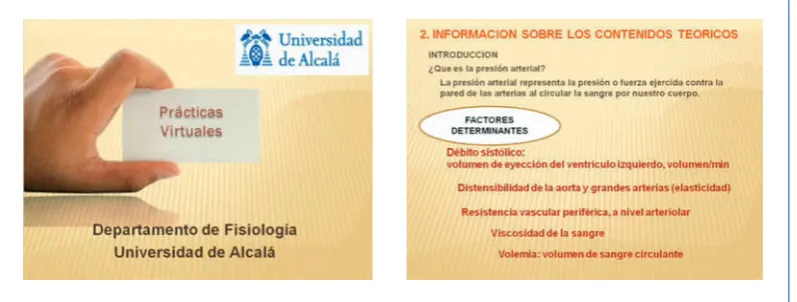
Scientificvideosareincluded, whichgivedetailedexplanationsofthepracticalprocedures
tobecarriedout. Someexamplesoftheimagesfromthevideoscreatedforthepracticalsare
R Links to web sites containing scientific content, which the students may find useful in
preparing for the practicals, although their use is not compulsory. In order to get these links,
the following activities were carried out: a) searching in official, reliable sources of information
(PubMed, EBSCO, library, other universities and libraries, networks of virtual learning objects,
etc.); b) filtering and selecting suitable links for the practical (done by a peer academic advisor);
c) reviewing, summarising and adding value to the linked resources (done by the teaching
staff ). The final list of links to websites is summarised in Table 1.
Table 1. Websites selected for their scientific content
BLOOD PRESSURE
http://www.nejm.org/doi/full/10.1056/NEJMvcm0800157#figure=preview.gif http://www.sumanasinc.com/webcontent/animations/content/bloodpressure.swf http://www.medindia.net/animation/blood-pressure.swf
http://mrhardy.wikispaces.com/Blood+Pressure.swf
http://catalog.nucleusinc.com/interactive/high_blood_pressure.swf http://web.diabetes.org/link/link_for_life/03screen3.swf http://www.seh-lelha.org/swf/hipertension.swf Online course: http://www.csuchico.edu/atep/bp/bp.swf
ELECTROCARDIOGRAM
Electrocardiogram:
http://healthlibrary.epnet.com/GetContent.aspx?token=0fcfa67b-a10e-40af-bef6-3c0b92e23cdf&chunkiid=104075
Electrical conduction system of the heart:
http://www.nhlbi.nih.gov/health/health-topics/animate/flash-electrical.swf http://www.bhf.org.uk/swfs/hearthealth/ecg.swf
http://www.orthosports.info/multimedia/electrocardiogram/Electrocardiogram.swf
Cardiac cycle:
http://chs.sd57.bc.ca/~jbleecker/science/bi12ppt/Bio12_2/C13_Circulatory%20System_Newer/ cardiac.swf
http://www.wisc-online.com/objects/ap2304/ap2304.swf
SPIROMETRY
http://qs1252.pair.com/monarchm/elsevier/mao_v2/www-convert/rich_media/62l0209/player. swf?1294931209000
http://www.iesvirgen.com/images/stories/dep_biologia/Biolopage/Materiales/spirometry_spa. swf
Method
Description of the student sample
Thisstudywasconductedonstudentstakingthe HumanPhysiologysubject, asix-creditbasic-training
typecoursetaughtinthe firstyearofthebachelor’sdegreecourseinPhysical ActivityandSportsSciences.
Theresultswereanalysedfor102studentsinthe2011/12academicyear(27femaleand75male), andfor
97inthe2010/11academicyear(26femaleand71male). Ofthestudentsinthe2011/12academicyear, 91
(22femaleand69male)answeredthesurveyontheresourcescreated. Theageintervalwas18-33years.
Description of the instrument
Creating, conductingandanalysingthesurveytoascertainthestudents’opinionsoftheteaching-learning
processinthe HumanPhysiologysubjectusingtheresourcesdescribedabove. Thesurveywasdesigned
in collaborationwiththe university’s TeachingSupport Service and adaptedto practical resources.
The survey hadfour sections, each containingseveral questions. The studentscould choose
a single answertoeach questionfrom the following options: totallydisagree, somewhat agree,
moderatelyagree, stronglyagree, totallyagree. Weassessedthefollowingsections:
R Timeandeffortputintopreparationbythestudents(onequestion).
R Resourcepreparation(threequestions).
R Qualityofresourcesprovided(fivequestions).
R Knowledgeandskillsacquiredthroughthemethodology(threequestions).
The data collected from the survey were tabulated and analysed to obtain the respective
percentagesforeachofthequestionsposed.
Procedure
Theeducationalresourcesweremadeavailabletothestudentsenrolledatthestartofthesubject
viaBlackboard–theuniversity’sVirtualClassroomVLE–toguideandsupportthemindoingthese
practicals.
The processthatthe studentshadtofollowtodo thepracticals properlywas:toreviewthe
resourcesforeachpractical, tocreatetherequestedresourcesandtostudythetheoreticalpartofthe
practicalsothattheywouldhavethenecessaryknowledgetodothepracticalontheday.
Whilethepracticalswerebeingdone, twolecturerswereonhandtoansweranyqueriesthatthe
studentshadaboutimplementingtheprotocols.
Itwascrucialtohaveaseriesofparametersavailableinordertodeterminewhethertheprocedures
usedintheteaching-learningprocesswereeithersuitableorneededchanging. Parameterslikethese
Teaching-practiceassessmenthasbeenshowntobeoneofthemostpowerfulformativestrategies
forimproving thequalityoftheteaching-learning process, whichenables resource, training and
infrastructurerequirementstobeascertained, andthestudents’needstobeidentified.
Bearing these premises in mind, a survey was conducted after the students had done the
practicals, andtheresultsobtainedfromitwereanalysed.
Results analysis
1. Analysis of the student survey
Thedatacollectedfromthesurveyweretabulatedandanalysedtoobtaintherespectivepercentages
foreachitemdescribedinthe ‘Descriptionoftheinstrument’section.
Time and effort put into preparation by the students
Thetimeandeffortputinbythestudentswasassessedastimeinvestedinpreparingforthepractical
usingtheeducationalresourcescreated.
Chart1showsthatnearlyhalfofthestudentsspentanhourontheirpreparation. Thepercentages
ofstudentswhospenttwoormorehourswereverylow. Itshouldbenotedthatapercentageofthe
studentsdidnotspecifyhowmuchtimetheyhadspent, whichindicatesthattheyeitherdidcount
thetimeordidnotspendanytimeworthyofmention.
NK/NA 0 h 0.5 h 1 h 2 h 5-6 h Over 10 h
14.2%
3.3% 3.3%
3.3%
3.3%
47.2% 23.1%
Chart 1. Time and effort put into preparation by the students (percentage of the number of students)
Resource preparation
Regardingthestudents’needsinordertoprepareforthepracticals, theopinionsshownin Table2
Table 2. Resource preparation (percentage of the number of students)
RESOURCE PREPARATION (%) Totally
disagree Somewhat agree Moderately agree Strongly agree Totally agree
A supplementary personal explanation had to be given by the lecturers before doing the practical.
3.3 6.6 39.6 41.8 8.8
The practical work was complemented by contributions made in theory classes and seminars.
0.0 7.7 25.3 48.4 18.7
The time and effort put into preparing for the practicals complemented the theory classes.
1.1 4.4 33.0 49.5 12.1
Regardingtheworkdoneinthepracticalsbeingcomplementedbytheoryclassesandseminars,
ahighpercentageofthestudentsagreed(48.4%stronglyagreedand18.7%totallyagreed). These
percentagesindicatethatthestudentsperceivedgoodcomplementaritybetweenwhatwascovered
inthetheoryclassesandwhatwasdoneinthepracticals. Regardingtheneedforanexplanationto
begivenbythelecturersbeforedoingthepractical, amoderatepercentageofthestudentsagreed
(41.8%stronglyagreedand39.6%moderatelyagreed). Thismayberelatedtothesmallamountof
timethatthestudentssaidtheyhadspentonpreparation(asshownChart1).
R Quality of resources provided
Table 3. Quality of resources provided (percentage of the number of students)
QUALITY OF RESOURCES PROVIDED (%) Totally
disagree Somewhat agree Moderately agree Strongly agree Totally agree
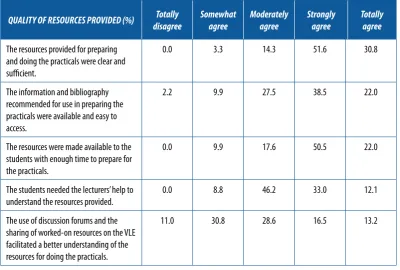
The resources provided for preparing and doing the practicals were clear and sufficient.
0.0 3.3 14.3 51.6 30.8
The information and bibliography recommended for use in preparing the practicals were available and easy to access.
2.2 9.9 27.5 38.5 22.0
The resources were made available to the students with enough time to prepare for the practicals.
0.0 9.9 17.6 50.5 22.0
The students needed the lecturers’ help to understand the resources provided.
0.0 8.8 46.2 33.0 12.1
The use of discussion forums and the sharing of worked-on resources on the VLE facilitated a better understanding of the resources for doing the practicals.
A very high percentage of the students agreed that the resources were suitable, clear and
sufficienttoprepareforthepracticals(51.6%stronglyagreedand30.8%totallyagreed), thatthere
wasenough time toprepare them(50.5%strongly agreedand22%totallyagreed)andthatthe
necessaryinformationandbibliographywereeasytoaccess(38.5%stronglyagreedand22%totally
agreed).
However, thestudentsmoderatelyagreedwiththeneedtogetthelecturers’helptounderstand
the resources, which required a prior explanation (46.2% moderatelyagreed and 33% strongly
agreed).
RegardingtheuseofdiscussionforumsontheVLE, thepercentageofagreementwasnothigh
(30.8% somewhat agreed and 28.6% moderately agreed). It should be noted that this resource
wasnotwidelyusedbythestudents, andthatitdidnotconstituteasubstantiveelementofthe
methodology. Thelowlevelofagreementcanthereforebeconsiderednormal.
R Knowledge and skills acquired through the methodology
Anotheroftheimportantissuesintheassessmentofthemethodologywastodeterminethelevelof
knowledgeandskillsacquiredthroughthemethodology. Theresultsareshownin Table4.
Table 4. Knowledge and skills acquired through the methodology (percentage of the number of students)
Knowledge and skills acquired through the methodology (%)
Totally disagree Somewhat agree Moderately agree Strongly agree Totally agree
The methodology fosters the students’ motivation to do the practicals properly.
0.0 3.3 17.6 53.8 25.3
This activity fosters relationships between the students, enabling the work done to be shared and discussed.
0.0 3.3 18.7 45.1 33.0
The preparatory work for the practicals strengthened the students’ capacity to search for and select resources.
0.0 12.1 45.1 37.4 5.5
A highpercentageofthestudentsagreedthatthemethodologyfosteredtheirmotivation to
dothepracticalsproperly(53.85%stronglyagreedand25.3%totallyagreed), fosteredrelationships
between the students and discussions (45.15% strongly agreed and 33% totally agreed) and
strengthenedtheircapacitytosearchforandselectresources(45.1%moderatelyagreedand37.4%
stronglyagreed).
2. Comparative analysis of the grades obtained by the students
Inordertoassessthestudents’assimilationofcontentafterusingtheresources, atest-typeexam
wasset. Theexamcontaineddifferentquestionstodeterminetheusemadeoftheresourcesbythe
Withtheaimofgettingamorecomprehensiveassessmentoftheusefulnessoftheresources
usedbythestudentsinthepracticals andthemethodologyfollowedbythem, weperformeda
comparativeanalysisusingStudent’s t-testtocomparethemeansofthegrades obtainedinthe
practicalexambythestudentswhoworkedwiththeresourcesinthe2011/12academicyearand
thoseobtainedinthe2010/11academicyearwhenasimilarexamhadbeensetbutthemethodology
hadnotbeenapplied.
Chart2showsthegradesobtainedinthepracticalexamforbothacademicyears.
Chart 2. Grades obtained in the practical exam by the students in the 2010/11 academic year (n=97) and the 2011/12 academic year (n=102), whose means were 5.62 and 6.66, respectively. The data were analysed using Student’s t-test to
compare means: t=3.82456; p=0.00017591.
0 2 4 6 8 10
2011/12 Academic year
2010/11 Academic year
A significantimprovementwas foundinthegradesobtainedbythestudentsinthe2011/12
academicyear(n=102students)in comparisontothoseobtainedin the2010/11academicyear
(n=97students), asthemeanswere6.66and5.62, respectively(t=3.82456andp=0.00017591).
Inordertorefinethesedata, weperformedacomparativeanalysisofthegradesobtainedinthe
wholesubjectaftercontinuousassessment, andofthecontributionthatthepracticalexamgrade
hadmadetothe finalgrade. Chart3showsthemeansofthegradesobtainedinthewholesubjectin
eachoftheacademicyears(2011/12, n=102studentsand2010/11, n=97students). Theywere6.34
and5.07, respectively. A significantimprovementwasfoundinthegradesobtained(t=6.47811and
Finally, weanalysed thecontributionthat thepracticalshadmadetothetheoreticalcontent
grade. Chart4showsthemeansofthegradesobtainedinthetheoreticalcontentassessment. A
significantimprovementwasfoundinthegradesobtainedinthe2011/12academicyear(5.84)in
comparisontothoseobtainedinthe2010/11academicyear(4.43). Thiswouldseemtosuggestthat
makingbetteruseofthepracticalsledtoanimprovementintheassimilationoftheoreticalcontent.
ThisstudywasassessedusingStudent’st-testtocomparemeans(n=102in2011/12andn=97in
2010/11;wheret=8.25498andp=0).
Chart 3. Grades obtained in the subject by the students, after continuous assessment, in the 2010/11 academic year (n=97) and the 2011/12 academic year (n=102), whose means were 5.07 and 6.34, respectively. The data were analysed
using Student’s t-test to compare means: t=6.478114; p=1.7828E-7.
0 2 4 6 8 10
2011/12 Academic year
2010/11 Academic year
0 2 4 6 8 10
2011/12 Academic year
2010/11 Academic year
Chart 4. Grades obtained in the theoretical content assessment by the students in the 2010/11 academic year (n=97) and the 2011/12 academic year (n=102), whose means were 4.43 and 5.84, respectively. The data were analysed using
Conclusions
Theresultsobtainedinthisexperienceofworkingwithstudentsonpracticalteachinginthe Human
Physiologysubjecthaveenabledustoapproachand, insodoing, moveforwardintheuseofnew
teachingmethodologieswithneweducationalresources.
R Ontheonehand, theresultsobtainedfromthestudentsurveyindicatedthestudents’high
levelofsatisfactionwiththeuseofthesenewtoolsandwiththemethodologyfollowed.
R Ontheotherhand, asignificantimprovementwasfoundintheacademicresultsobtainedby
thestudents, notonlyintheassessmentforthepracticals, butalsointheoverallassessmentfor
allthecontentandcompetencies.
The firststageofourwork, whichwastheprocessofcreatingtheresources, gaverisetoaconsiderable
improvementinourexperienceaslecturers, specificallywithregardtoorganisingalltheinformation
forthepracticalsessionsthatwehaddeveloped, andthenarrangingitinvideoandslide-showformat
tomakeitaccessibletothestudents. Thiscreationprocessenabledustoreconsiderimportantaspects
ofboth thecontent anddesign ofthepracticals, andtheimportance ofconveyinginformation
is such away as tofacilitate the students’self-directed learning processthrough the resources.
Intermsofimplementingthestudents’useoftheseresourcesandtheirsubsequentassessment
bymeansofasurvey, thisworkenabledustointeractmorecloselywiththestudentsintheteaching
-learningprocedures, andtobecomeawareofthestudents’perceptionsoftheresourcesthatthey
hadusedandhowusefultheyhadbeentothemintheprocess.
Inaddition, thisstudyenabledapreliminaryassessmenttobedoneofthewayinwhichtheuse
ofnewtechnologiesandnewresourcesinlearninghelpstomotivatethestudents’attentionand
strengthentheirself-directedwork, tofacilitatetheircomprehensionandacquisitionofknowledge,
andtoobtainbetterresultsinthesubjectingeneral. Thiscouldbededucedfromthecomparative
analysisofthegradesobtainedinthesubjectinthe2011/12academicyearincomparisontothose
obtainedinthepreviousacademicyear.
Regardingtheneedforexplanationstobegivenbythelecturerstoenablethestudentstobetter
understandtheresourcesandworkouthowtodothepracticals(whichapercentageofthestudents
requested), twoproblemsbecameapparent:
R Ontheonehand, thesmallamountoftimethatahighpercentageofthestudentshadspent
onpreparingforthepracticals. Thisindicatedthatthestudentshadnotfullyassumedtheirpart
oftheself-directedwork, whichnewteachingmethodologiesimply.
R Ontheotherhand, thisneedforexplanationsmeantthatwehadtoconsiderimprovingthose
resourcestomakethemmorecomprehensibleandaccessibletothestudents.
One oftheelementsonwhichthere was alowlevelofagreement wastheusefulness ofusing
elementinthedevelopmentofthemethodologyusedinthisexperienceand, asaresult, thestudents
didnotconsidertheuseofthisresourceapriority. Theimportanceofthistooltothedevelopment
ofcompetenciessuchasgroupworkandgroupconstructionofknowledgehadneverthelessbeen
noted. Thismadeusthinkabouttheimportanceofincorporatingitasakeytoolinfutureexperiences.
In turn, these considerations present two challenges: helping to strengthen the students’
responsible, independentroleintheteaching-learningprocess, andimprovingeducationalresources
thatfacilitatethestudents’work.
In short, considering this experience as a whole, and within the teaching-learning process
involvingpracticalteachingin HumanPhysiology, theuseofeducationalresourcesbasedonnew
technologiesrepresents animportantadvanceinboththestudents’motivationandwork, andin
theiracademicresults. Inaddition, itoffersimportantadvantagesforlecturersandstudentsalike:
creatingresourcesenrichesthelecturers’knowledgeandteachingskills, andthestudents’useof
thoseresourcesstrengthenstheircapacitiesandskills. Moreover, itoptimisestimespentonstudying
andcomplementsthesubjectcontent, whichleadstobettergrades. Finally, theseresourcescanbe
usedinpracticalsforthissubjectonotherbachelor’sdegreecourses, andcanbeimprovedbytaking
intoaccounttheopinionscollectedfromthestudentsurvey. Theirusehasenormouspotentialfor
boththelecturers’pedagogicalpracticeandthestudents’knowledgeandcompetencyacquisition.
Acknowledgments
ThisworkwasfundedbytheprojectsUAH/EV428andUAH/EV451oftheUAH’sprogrammeProyectos
para el fomento y la innovación en el proceso de enseñanza aprendizaje [Projectsfordevelopmentand
innovationintheteaching-learningprocess].
References
Adell, J., & Castañeda, L. (2010). Losentornospersonales deaprendizaje(PLE):unanuevamanera
deentenderelaprendizaje [Personallearningenvironments(PLE):anewwayofunderstanding
learning]. InR. RoigVila & M. Fiorucci(Eds.). Claves para la investigación en innovación y calidad
educativas, la integración de las tecnologías de la información y comunicación y la interculturalidad
en las aulas [Keystoresearchineducationalinnovationandquality, theintegrationofinformation
andcommunicationtechnologiesandinterculturalityinclassrooms].
Area, M. (2005). Internetylacalidaddelaeducaciónsuperiorenlaperspectivadelaconvergencia
europea [The Internet and the quality of higher education in the outlook of European
convergence]. Revista Española de Pedagogía, 63(230), 85-100.
Bartolomé, A. (2008).Entornos de aprendizaje mixto en educación superior [Blended learning
environments at higher education].Revista Iberoamericana de Educación a Distancia (RIED),
Carranza, M., & Celaya, G. (2003). Unaestrategiaparafavorecerlacomprensiónyelaprendizajeenlas
cienciasmorfológicas:presentacionesenPowerPoint [A strategytoimprovethecomprehension
andlearninginmorphologicalscience:Powerpointpresentation]. RELIEVE,9(2),139-159. Retrieved
fromhttp://www.uv.es/RELIEVE/v9n2/RELIEVEv9n2_3.htm.
Flores, O., & De Arco, I. (2012). Lainfluenciadelas TICenlainteraccióndocenteydiscenteenlosprocesos
formativosuniversitarios [The ImpactofICTsonLecturerandStudentInteraction inUniversity
EducationProcesses]. RUSC. Universities and Knowledge Society Journal, 9(2),31-47. Retrievedfrom
http://rusc.uoc.edu/ojs/index.php/rusc/article/view/v9n2-flores-arco/v9n2-flores-arco
Gallego, R., Palés, J. L., Escanero, J. F., & Sánchez-Barceló, E. (2008). Innovación educativa en la
universidad: laenseñanzade la fisiologíaen elgrado de Medicina [Educationalinnovation in
universities:physiologyteachingonthebachelor’sdegreecourseinMedicine]. Educació. Informes
i Dossiers 8. PublicacionsdelaUniversitatdeValència.
García, E., & Lauretta, D. (2008). Consideracionesmetodológicasyorganizativasparalapreparaciónyel
desarrollodevideoconferencias(VC)conmetodologíaCLIL [Methodologicalandorganisational
considerationsforthedevelopmentofvideoconferencesbasedontheCLILdidacticalapproach
inaEuropeancooperationperspective]. Revista Iberoamericana de Educación a Distancia (RIED),
11(1), 107-134.
Margalef, L., Iborra, A., Pareja, N., Castro, B., Domínguez, S., García, I., & Jiménez, S. (2007). Tejiendoredes
deaprendizajeyreflexión:unapropuestadeinnovación enlalicenciaturadepsicopedagogía
[Weaving learningand reflectionnetworks:aninnovation proposal on thebachelor’sdegree
courseinPyschopedagogy]. PULSO,30,123-142.
Prenes, M. P., Martínez, F., & Gutiérrez, I. (2008). Producción de materialdidáctico: losobjetos de
aprendizaje [Theproductionofeducationalmaterials:learningobjects]. Revista Iberoamericana
de Educación a Distancia (RIED),11(1),81-106.
Pagés, T., Blasco, J., Viscor, G., Gallardo, M. A., Carbonell, T., Ibarz, A., Alva, N., & Fernández, J. (2011).
Aplicaciónde metodologíasactivaspara conseguirunaprendizaje profundo [Applyingactive
methodologiestoachievedeeplearning]. Buenas prácticas docentes en la universidad. Modelos
y experiencias en la Universidad de Barcelona [Bestteachingpracticesinuniversities:modelsand
experiencesintheUniversityofBarcelona] (pp. 165-178). EditorialOctaedro.
Pagés, T. (2007). Experienciaeneldiseñoyusodeplataformavirtual, paraelaprendizajedeFisiología
[ExperienceinthedesignanduseofavirtualenvironmentforPhysiologylearning]. Revista de
Educación en Ciencias de la Salud(R.E.C.S.), 4(1).
Prudencia, E., Yuste, R., Cubo, S., & Lucero, M. (2011). Buenasprácticasen eldesarrollo detrabajo
colaborativo en materias TIC aplicadas a la educación [Collaborate on ICT work applied to
education]. Revista de Currículum y Formación del Profesorado, 15(1),180-194.
Salinas, J. (2004). Innovación docente y uso de las TIC en la enseñanza universitaria [Teaching
innovationandtheuseofICT inuniversityeducation]. RUSC. Universities and Knowledge Society
Journal, 1(1). Retrievedfromhttp://www.uoc.edu/rusc/dt/esp/salinas1104.pdf
Zabalza, M. A. (2003-2004). Innovación en la enseñanza universitaria [Innovation in university