R E G U L A R A R T I C L E
Open Access
Modeling social dynamics in a collaborative
environment
Gerardo Iñiguez
1, János Török
2, Taha Yasseri
3*, Kimmo Kaski
1and János Kertész
2,4*Correspondence:
3Oxford Internet Institute, University
of Oxford, Oxford, OX1 3JS, United Kingdom
Full list of author information is available at the end of the article
Abstract
Wikipedia is a prime example of today’s value production in a collaborative environment. Using this example, we model the emergence, persistence and resolution of severe conflicts during collaboration by coupling opinion formation with article editing in a bounded confidence dynamics. The complex social behavior involved in editing articles is implemented as a minimal model with two basic elements; (i) individuals interact directly to share information and convince each other, and (ii) they edit a common medium to establish their own opinions. Opinions of the editors and that represented by the article are characterised by a scalar variable. When the pool of editors is fixed, three regimes can be distinguished: (a) a stable mainstream article opinion is continuously contested by editors with extremist views and there is slow convergence towards consensus, (b) the article oscillates between editors with extremist views, reaching consensus relatively fast at one of the extremes, and (c) the extremist editors are converted very fast to the mainstream opinion and the article has an erratic evolution. When editors are renewed with a certain rate, a dynamical transition occurs between different kinds of edit wars, which qualitatively reflect the dynamics of conflicts as observed in real Wikipedia data.
Keywords: social dynamics; mathematical modeling; peer-production; Wikipedia; bounded confidence; opinion dynamics; mass-collaboration; social conflict
1 Introduction
Cooperative societies are ubiquitous in nature [], yet the cooperation or the mutual as-sistance between members of a society is also likely to generate conflicts []. Potential for conflicts is commonplace even in insect species [] and so is conflict management through policing and negotiation in groups of primates [, ]. In human societies cooperation goes further not only in its scale and range, but also in the available mechanisms to promote conflict resolution [, ]. Collaborative and conflict-prone human endeavors are numer-ous, including public policy-making in globalized societies [, ], open-source software development [], teamwork in operating rooms [], and even long-term partnerships []. Moreover, information communication technology opens up entirely new ways of collaboration. With such a diversity in system size and social interactions between indi-viduals, it seems appropriate to study this phenomenon of social dynamics in the frame-work of statistical physics [, ], an approach benefiting greatly from the availability of large scale data on social interactions [, ].
As a relevant example of conflicts in social cooperation we select Wikipedia (WP), an intriguing example of value production in an online collaborative environment []. WP is a free web-based encyclopedia project, where volunteering individuals collaboratively write and edit articles about any topic they choose. The availability of virtually all data concerning the visiting and editing of article pages provides a solid empirical basis for investigating topics such as online content popularity [, ] and the role of opinion-formation processes in a peer-production environment [].
The editing process in WP is usually peaceful and constructive, but some controversial topics might give rise to extreme cases of disagreement over the contents of the articles, with the editors repeatedly overriding each other’s contributions and making it harder to reach consensus. These ‘edit wars’ (as they are commonly called) result from complex online social dynamics, and recent studies [] have shown how to detect and classify them, as well as how they are related to burstiness and what are their circadian patterns in editing activity [].
Although collaborative behavior might appear without direct interactions between in-dividuals, communication tends to have a positive effect on cooperation and trust []. Indeed, more immediate forms of communication (voice as opposed to text, for example) have been seen to increase the level of cooperation in online environments []. In WP, direct communication is implemented via ‘talk pages’, open forums where editors may dis-cuss improvements over the contents of articles and exchange their related opinions []. Discussions among editors are not mandatory [], but there is a significant correlation between talk page length and the likelihood of an edit war, indicating that many debates happen in articles and talk pages, simultaneously [, ].
Overall, a minimal model aimed at reproducing the temporal evolution of a common medium (i.e. a product collectively modified by a group of people, like an article in WP) requires at least the following two ingredients:
(i) agent-agent dynamics: Individuals share their views and opinions about changes in the article using an open channel accessible to all editors (the talk page or some other means of communication), thus effectively participating in an
opinion-formation process through information sharing.
(ii) agent-medium dynamics: Individuals edit the article if it does not properly
summarize their views on the subject, thus controlling the temporal evolution of the article and coupling it to the opinion-formation mechanism.
We describe the opinion-formation process taking place in the talk page by means of the well-knownbounded confidencemechanism first introduced by Deffuantet al.[], where real discussions take place only if the opinions of the people involved are suffi-ciently close to each other. Conversely, we model article editing by an ‘inverse’ bounded confidence process, where individuals change the current state of the article only if it dif-fers too much from their own opinions. Particularly, we focus our attention on how the coupling between agent-agent and agent-medium interactions determines the nature of the temporal evolution of an article. This we consider as a further step towards the theo-retical characterization of conflict in social cooperative systems such as WP [].
2 Model
Let us first assume that there is a system ofN agents as potential editors for a collective medium. The state of an individualiat timetis defined by its scalar, continuous opinion xi(t)∈[, ], while the medium is characterized by a certain valueA(t) in that same inter-val. The variablexrepresents the view and/or inclination of an agent concerning the topic described by the common medium, whileAis the particular position actually represented by the medium.
Although it may seem too reductive to describe people’s perceptions by a scalar variable x, many topics can actually be projected to a one-dimensional struggle between two ex-treme, opposite options. In the Liancourt Rocks territorial dispute between South Korea and Japan [], for example, the valuesx= , represent the extreme position of favoring sovereignty of the islets for a particular country. Other topics are of course multifaceted, generating discussions that depend on the global affinity of individuals and multiple cul-tural factors []. While this complexity could be tackled by the use of vectorial opinions [, ], our intention here is not to describe extremism as realistically as possible, but to study the rise of collaborative conflict even in the simplest case of binary extremism.
In the case of WP, the scalar variableArepresents the opinion expressed by the written contents of an article, which carries the assumption that all agents perceive the medium in the same way. Real scenarios of public opinion might be more complex, given the tendency of individuals to attribute their own views to others and thus perceive false consensus [], usually out of a social need to belong []. Even so, we considerAto be a sensible description of a WP article, one that could initially be measured by human judgment in the form of expert opinions, or in an automated way by quantifying lexical features and the use of certain language constructs. We note, however, that the actual value ofAis not the main concern of our study. Instead, we are interested in how opinion differences in collaborative groups may eventually lead to conflict, specifically when such opinion differences are perceived with respect to a common medium that all individuals modify collectively.
2.1 Agent-agent dynamics
For the agent-agent dynamics (AAD) we consider a generic bounded-confidence model over a complete graph [, ], that is, a succession of random binary encounters among all agents in the system. We initialize every opinionxi() to a uniformly-distributed random value in the interval [, ]. The initial medium valueA() is chosen uniformly at random from the same interval. This way, even an initially moderate mediumA∼/ may find discord with extreme opinions at the boundaries. For each interaction we randomly select two agentsi,jand compare their opinions. If the difference in opinions exceeds a given thresholdTnothing happens, but if|xi–xj|<Twe update as follows,
(xi,xj)→
xi+μT[xj–xi],xj+μT[xi–xj]
. ()
The dynamics set by Eq. () has received a lot of attention in the past [], starting from the mean-field description of two-body inelastic collisions in granular gases [, ]. Its final, steady state is comprised bync∼/(T) isolated opinion groups that arise due to the instability of the initial opinion distribution near the boundaries. Furthermore,nc in-creases asT→ in a series of bifurcations []. In the limitμT→ corresponding to a ‘stubborn’ society, the asymptotically final value ofncalso depends onμT[, ]. The bounded-confidence mechanism has been extended in many ways over the years, consid-ering interactions between more than two agents [], vectorial opinions [, –], and coupling with a constant external field [].
2.2 Agent-medium dynamics
For the agent-medium dynamics (AMD) we use what could be thought of as an asym-metric, inverse version of the bounded-confidence mechanism described above. When the opinion of a randomly chosen agentiis very different from the current state of the medium, namely if|xi–A|>A, we make the update,
A→A+μA[xi–A], ()
where A,μA∈[, ] are the tolerance and convergence parameters for AMD. In other words, individuals that come across a version of the medium portraying a radically dif-ferent set of mind will modify it by the relative amountμA, where the threshold to define similarity is given byA. Conversely, if|xi–A|<Awe update,
xi→xi+μA[A–xi] ()
meaning that individuals edit the medium when it differs too much from their opinions, but adopt the medium’s view when they already think similarly. Observe that the maxi-mum meaningful value ofμTis / (i.e. convergence to the average of opinions), while the maximumμA= implies changing the medium (opinion) so that it completely reflects the agent’s (medium’s) point of view.
The previous rules comprise our model for the dynamics of conflicts in WP given afixed agent pool, that is, without agents entering or leaving the editing process of the common medium. In a numerical implementation of the model, every time steptconsists ofN up-dates of AAD given by Eq. () and of AMD following Eqs. () and (), so that time is effec-tively measured in number of edits and the broad inter-event time distribution between successive edits (observed in empirical studies []) does not have to be considered di-rectly. Given a fixed agent pool, AAD favors opinion homogenization in intervals of length Tand can thus create several opinion groups for low tolerance, while AMD makes the medium value follow the majority group. Then, for a finite system there is a nonzero prob-ability that any agent outside the majority group will be drawn by the medium to it, and the system will always reach consensus after a transient regime characterized by fluctuations in the medium value [].
during the process or writing an article may destroy consensus and lead to a steady state of alternating conflict and consensus phases, which we take into account by introducing thermal noise in the model. Along with any update of AAD/AMD, one editor might leave the pool with probability pnewand be substituted by a new agent with opinion chosen
uniformly at random from the interval [, ]. The quantity /(Npnew) then formally acts
as the inverse temperature of the system, signaling a dynamical phase transition between different regimes of conflict [].
3 Results
3.1 Fixed agent pool
In the presence of a fixed agent pool (pnew= ) with finite sizeN, the dynamics always
reaches a peaceful state where all agents’ opinions lie within the tolerance of the medium. To show this, let us calculate the probability that an unsatisfied editor i changes the mediumAfornconsecutive times, such that afterwards|xi–A|<Aand the agent can finally stop its stream of edits. For fixedxiand following Eq. (), the final distance between editor and medium is|xi–A|= ( –μA)n|xi–A|, so the inequality|xi–A|<Ais satis-fied ifn>lnA/ln( –μA). The probability of agentinot participating in AAD forntime steps is ( – /N)n, while the probability of choosing it for AMD is /Nn. Then the total probability of this stream of edits is ( – /N)n/Nn, which for largeNandμA∼ might be very small, but always finite. After editorigets into the tolerance interval of the medium, it will not perform additional edits and will eventually adopt the majority opinion close to the medium value. Similar events with other unsatisfied agents will finally result in full consensus and put an end to the dynamics.
The existence of a finite relaxation time τ to consensus (for finite systems) contrasts drastically with the behavior of the bounded confidence mechanism alone, where con-sensus is never attained forT< / []. In other words, the presence of agent-medium interactions promotes an agreement of opinions that would otherwise not exist in the agent-agent dynamics, even though it may happen after a very long time (i.e.τ). If we think of the medium as an additional agent with maximum tolerance (in the sense that it always interacts with the rest no matter what) and against which agents have a different toleranceA(as opposed toT), this result is reminiscent of previous observations for a bounded-confidence model with heterogeneous thresholds [, ]. There, even a small fraction of ‘open-minded’ agents with relatively high tolerance may bridge the opinion difference between the rest of the agents and lead to consensus.
In order to analyze all possible typical behaviors of the fixed agent pool dynamics, we perform extensive numerical simulations in systems of size ranging fromN= to ,
letting the dynamics evolve for a maximum time τmax= . We then characterize the
Figure 1 Temporal evolution of opinions and medium. (A, B, C)Time series of both the density distributionP(x) of agents’ opinionsx(color map) and the medium valueA(line) forT= 0.2 and severalμA values, signaling the three different regimes found in the dynamics.(D, E, F)The same but forT= 0.04. Simulations correspond toA= 0.1 andN= 104.
x= , . The medium opinion stays on average at the center of the opinion space, close to the mainstream group(s), and although continuously contested by editors with extremist views, it remains stable and leads to a very slow convergence towards consensus. The reason for a long relaxation time in regimeIis intuitively clear: for lowμA any change in AMD is small and thus both medium and extremist opinions fail to converge quickly. When the toleranceTdecreases the effect is even more striking; even though the number of opinion groups is larger (according to the approximationnc∼/[T]), the article is quite stable and remains close to the mainstream view.
In regimeIIidentified with intermediate values ofμA(Figure (B) and (E)), the fixed pool dynamics produces quasi-periodic oscillations in the medium valueA, which appear after an initial stage of opinion group formation and end up very quickly in total consen-sus. Quite surprisingly, the final consensual opinion is notx∼/ (as in regimeI) or that of the initial mainstream group, but some intermediate value closer to the extremist groups at the boundaries. This is indicative of a symmetry-breaking transition: asμAincreases, a symmetric stationary state atx∼/ is replaced by a final state close to or . The os-cillations in regimeIIcan initially be understood as a struggle over medium dominance among the different opinion groups created by AAD. The AMD mechanism couples the medium dynamics with these groups, exchanging agents between them and thus modify-ing their positions, until the majority group wins over the rest and consensus is achieved. For smallToscillations are more well-defined and last for longer, while extremist groups tend to diffuse towards the mainstream.
Figure 2 Distributions of relaxation time. (A, B, C)Cumulative distributionPc(τ) of the relaxation timeτ necessary to reach consensus and thus end the dynamics, for different values of the medium
convergenceμA. Insets: ProbabilityP(τ>τmax) that the relaxation time is larger thanτmax= 104(the
maximum time allowed in the numerical simulations), as a function ofNfor selected values ofμA. The symbolsI,IIandIIIdenote the three different regimes found in the dynamics. Simulations correspond to
T= 0.2,A= 0.1 andN= 104, with averages over 104realizations.
The regimes of the fixed agent pool dynamics can be quantified on average by taking a look at the cumulative distributionPc(τ) of the relaxation timeτ (Figure ). In regimeI the tail ofPc(τ) is quite flat, getting flatter asμAdecreases. In contrast, the distribution has a power-law and an exponential tail in regimesIIandIII, respectively, signaling shorter relaxation times. The only exception is the transition betweenIIandIII, whereτmight be as large as inI. SincePc(τ) tends to be broad, the average value ofτis not very meaningful and we opt instead for the probabilityP(τ>τmax) that the relaxation time is larger than a
fixed maximum time. Numerically, we estimateP(τ >τmax) as the fraction of realizations
of the dynamics that have not reached consensus afterτmaxtime steps, out of a large total of
realizations. In regimesIIandIII,P(τ>τ
max) remains small asNincreases, indicating
thatτ is roughly independent of system size. On the other hand,P(τ >τmax) scales with
N forIand for the boundary betweenIIandIII, even reaching for appropriate values ofμAandN. A corollary is that even modestly-sized systems may only reach consensus after an astronomical time, if the medium convergence value is appropriate.
The transition between regimes becomes even clearer when we consider the effect of the medium toleranceA, resulting in a phase diagram forP(τ >τmax) in (A,μA) space (Figure (A)). It turns out that regimesIandIIcover most of the lowAvalues, while the lineμA= –A/(/ –A) roughly signals the transition to regimeIII, which covers a broad area of largeA. AsNincreases, the transition toIfrom eitherIIorIII(Figure (B) and (C)) becomes sharper: a consensual final state reached after a very short time gives way to a stationary state that remains stable for really long times. Such features of the phase diagram remain qualitatively unchanged if we substituteP(τ>τmax) with another measure
giving robust statistics, such as the median relaxation time of the dynamics.
Finally, we can consider the symmetry-breaking transition between regimesIandIIby taking a look at the density distributionP(A) of the final medium value (Figure (A) and (B)). After eitherτ orτmaxhas passed, the majority of opinions are in consensus withA,
makingP(A) a good approximation for the final opinion distributionP(x) as well. In regime
Figure 3 Phase diagram for a fixed agent pool. (A)Phase diagram in (A,μA) space of the probability P(τ>τmax) that the relaxation time is larger thanτmax= 104, in a system of sizeN= 104. Points give the
(A,μA) values used in Figure 2, corresponding to regimesI,IIandIII.(B, C)Cross sections of the phase diagram along the dashed lines in(A)for varyingN. Simulations correspond toT= 0.2, with averages over 104realizations.
Figure 4 Symmetry-breaking transition. (A, B)DistributionP(A) of the final medium valueAreached after
a time min(τ,τmax) has elapsed, for varyingN. The selectedμAvalues represent regimesI(A)andII(B). (C)Standard deviationσ(A) of the final medium value as a function ofμA, for several values ofN. This order parameter signals a symmetry-breaking transition between regimesIandII. Simulations correspond to
T= 0.2,A= 0.0375 andτmax= 104, with averages over 104realizations.
τ >τmax. In regimeII, however,P(A) becomes bimodal, meaning that the medium is more
likely to end up close to the extremes rather than in the center. WhenNis large, the main peaks inP(A) correspond to consensual final states withτ ≤τmax, while the secondary
peaks are made up of long-lived realizations with long relaxation time. Larger values of
τmax, although computationally expensive, would therefore let us see a strictly bimodal
ed-itor groups: a mainstream atx∼/ and two extremists with opinions close to the bound-aries. The solution shows stability for the medium at the mainstream opinion whenμAis small, but becomes unstable and oscillating forμAA±.. The bifurcation transition is very sensitive on the position of the extremists, depending not only on (μA,A) but also on the initial conditions. This is in part the cause of the ‘noisy’ landscape of regimeIIin Figure (A), which appears regardless of the measure used to draw the phase diagram.
3.2 Agent renewal
In real systems the pool of collaborators is usually not fixed: Editors come and go and very often the number of editors fluctuates in time as external events may incite more or less attention. To keep things simple we only focus on systems with a fixed number of editors (N agents), but we allow agent replacement with probabilitypnew= . In our numerical
simulations this happens prior to editing, and new agents have initially random opinions coming from a uniform distribution.
IfA< / there is always an opinion range outside the article tolerance region [A–A, A+A] and new agents may enter such range and edit the article. From WP data we know that even peaceful articles have few disputes now and then so such a scenario is realistic. This is thus in contrast with the case of a fixed opinion pool, where consensus is theoret-ically always achieved.
A stronger statement can be shown [], namely that if
A>A∗=
–μA
()
then consensus is always reached after a finite number of steps, but ifA<∗Athere are realizations that do not reach consensus ever. We show here an example: if the medium value isA=∗A, then forA=A∗–εan editor atx= will disagree with the article and change it by =∗AμA, so the new medium value would beA= –A∗. Afterwards an agent atx= can restore the article to its previous state and avoid consensus.
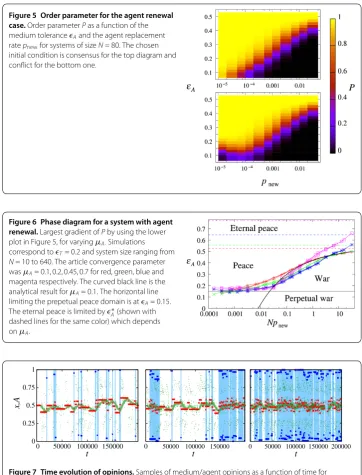
The lack of full consensus does not mean that the system is always in a conflict state. There are periods whenAremains unchanged and these peaceful times are ended by con-flicts in which the opinion of the article is continuously disputed between agent groups of different opinion. If the dispute is settled (i.e. all agents are satisfied by the article) a new peaceful period may start. The ratio of these peaceful and conflicting periods changes with the parameters and may be considered as a good candidate for an order parameter. Thus we define the order parameterPas the relative length of the peaceful periods.
The order parameter is plotted for two different initial conditions in Figure . The top figure shows the value of the order parameterPfor a ‘peaceful’ initial condition when all agents had the opinionxi= /. The bottom figure was instead obtained for a system with ‘conflict’ initial conditions, namely one with % of agents divided between two extremist groups of opinions and (and the rest atxi= /) before the start of the dynamics.
Figure 5 Order parameter for the agent renewal
case.Order parameterPas a function of the
medium toleranceAand the agent replacement ratepnewfor systems of sizeN= 80. The chosen
initial condition is consensus for the top diagram and conflict for the bottom one.
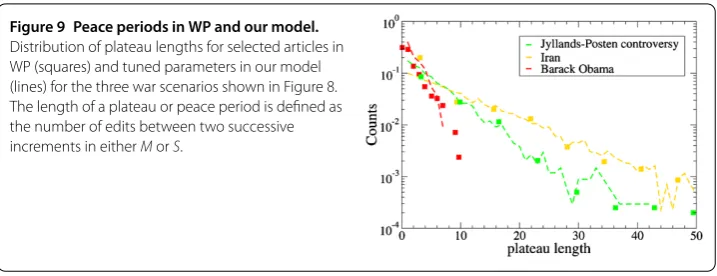
Figure 6 Phase diagram for a system with agent
renewal.Largest gradient ofPby using the lower
plot in Figure 5, for varyingμA. Simulations correspond toT= 0.2 and system size ranging from N= 10 to 640. The article convergence parameter wasμA= 0.1, 0.2, 0.45, 0.7 for red, green, blue and magenta respectively. The curved black line is the analytical result forμA= 0.1. The horizontal line limiting the prepetual peace domain is atA= 0.15. The eternal peace is limited byA∗(shown with dashed lines for the same color) which depends onμA.
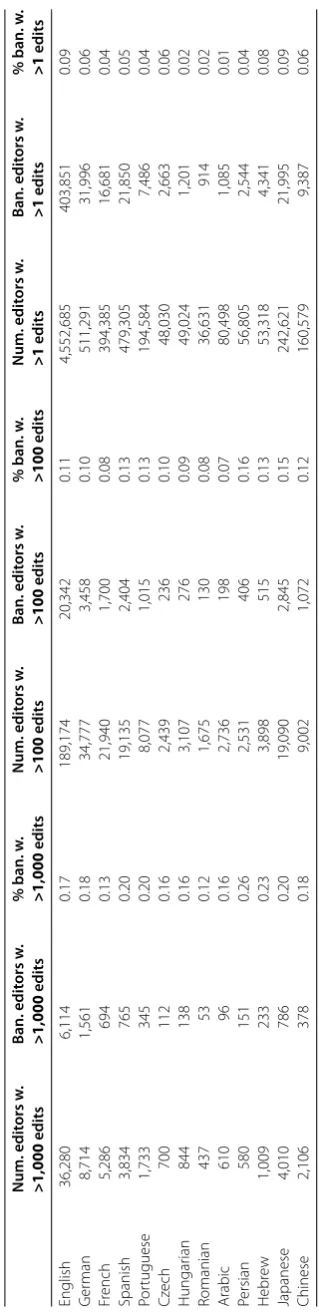
Figure 7 Time evolution of opinions.Samples of medium/agent opinions as a function of time for
A= 0.42, and for three different regimes represented bypnew= 0.001, 0.002, 0.003 (from left to right
respectively). Colour coding is as follows: Red points (opinion of the article), green dots (agents who are satisfied with the article), blue points (agents whose opinion is outside the medium tolerance interval), and light blue background (conflict regions).
The above transition is the result of a competition between two timescales. New agents arrive outside of the article’s tolerance interval with an ‘insertion’ timescaleτins∝Npnew.
In order to haveP> the conflicts must be resolved before a new extremist agent arrives. Let us note that the convergence is very fast if there is only one extremist group. The problem is solved by displacing the article opinion by the required amount, which can be done in few (Nindependent) steps. This is what happens in the left panel of Figure . On the other hand, if we have two extremist groups on both sides of the opinion interval the relaxation is much slower and this is manifested in a much longer relaxation time. Thus, at the transition the insertion timescale is equal to the relaxation time of the case with two extremist groups, which is analogous to the fixed agent pool version of the model.
The task here is to determine the relaxation time of the fixed pool version of the model and relate it toτins. For large values of the medium tolerance (A> /), the relaxation time can by calculated analytically [],
τ(e) =c(μA)N
e+e(n– )n–ee(n– )( +n)
, ()
wheree=A∗–A,e=A∗– /,ndenotes the integer part ofe/e(which is actually the
number of steps the medium can make in one direction) andcis a constant depending onμA.
The above approach works well forA> . andμA< . (regimeIIIof the fixed pool case). If the mainstream group gets dissatisfied either by the large jump (μAis too large) or by the small tolerance (Atoo small) of the article, the reasoning presented in [] breaks down and new effect comes into play, namely the relaxation times of the fixed pool system becomes be enormous (regimeI).
As we enter regimeIof the fixed pool dynamics the relaxation time increases sharply (see Figure (B) and (C)). This means that if the system gets into a conflict state it will remain there for ever, which happens for,
A,lim=
–
T
. ()
This is why, starting from a conflict initial condition, the lower phase diagram in Figure showsP= forA< .. On the other hand, in order to initiate such a conflict one needs to have a situation where two extremists appear on both ends of the opinion space outside of the article tolerance interval. If we have a single extremist then the consensus will be reached within a few time steps, independently ofN. So the probability that we create a long-lasting conflict state decreases proportionally to the agent replacement probability. This is why we see only peace on the finite-time realizations leading to the upper phase diagram in Figure . Had we waited long enough, a conflict would have been formed for
A< / –T/ and would have persisted further on.
In summary, the typical behavior of our model in the presence of agent renewal may be divided into four distinct regimes:
(i) Eternal peace(A>A∗): The system reaches consensus very fast and remains there for ever.
(iii) War(A>–T and below the phase transition line): The system is mainly in a state of disagreement.
(iv) Perpetual war(A<–T): In this regime and in the thermodynamic limit N→ ∞no consensus may exist.
3.3 The case of Wikipedia
Although the model described and analyzed above is simplified enough to be extendable to various cases of collaboration, we specially intend to use it to explain some of the empirical observations regarding edit wars in WP.
Wikipedia is huge, not only in its number of articles and users but in the number of times articles are edited. In most cases articles are not written in a collaborative way, i.e., they have single authors or a few authors who have written and edited different parts of the article without any significant interaction []. In contrast, a few cases show signifi-cant constructive and/or destructive interactions between editors. The latter situation has been named ‘edit war’ by the WP community and defined as follows: “An edit war occurs when editors who disagree about the content of a page repeatedly override each other’s contributions, rather than trying to resolve the disagreement by discussion” [].
To start an empirical analysis of such opinion clashes and the way they are entangled with collaboration, we need to be able to locate and quantify edit wars.
.. Controversy measure
An algorithm to quantify edit wars and measure the amount of social clashes for WP arti-cles has been introduced and validated before [], and then used to study extensively the dynamical aspects of WP conflicts []. An independent study [] has also shown that this measure is among the most reliable in capturing very controversial articles.
We quantify the ‘controversiality’ of an article based on its edit history by focusing on ‘reverts’ (i.e. when an editor completely undoes another editor’s edit and brings the article back to the state just before the last version). Reverts are detected by comparing all pairs of revisions of an article throughout its history, namely by comparing the MD hash code [] of the revisions. Specifically, a revert is detected when two versions in the history line are exactly the same. In this case the latest edit (leading to the second identical revision) is marked as a revert, and a pair of editors, referred to as reverting and reverted editors, are recognized.
is defined as the number of edits performed by him or her, and the weight of a mutually reverting pair is defined as the minimum of the weights of the two editors. The contro-versialityMof an article is then defined by summing the weights of all mutually reverting editor pairs, multiplying this number by the total number of editorsEinvolved in the ar-ticle. Overall,
M=E
all mutual reverts
minNd,Nr, ()
whereNr,Ndare the number of edits for the article committed by the reverting/reverted editor. This measure can be easily calculated for each article, irrespective of the language, size, and length of its history.
Before starting our discussion about the empirical dynamics of conflict and its compar-ison with theoretical results, a remark on the most controversial articles in WP. We have calculatedMfor all articles in different languages, from the start of each language WP up to March . In Table we show the list of the top- most controversial articles. A more complete and detailed analysis of the lists of the most controversial WP articles in different languages and differences and similarities between them can be found elsewhere [].
.. Dynamics of conflict and war scenarios
MeasuringMcan not only lead us to rank the articles based on their cumulative con-troversy measure, but also enables us to follow edit wars in time as they emerge and get resolved, by investigating the evolution ofMas time passes and the article develops. In the top row of Figure we show the time evolution ofMfor three different sample arti-cles.
Based on the wayMevolves in time, we may categorize almost all controversial articles into three categories:
(i) Single war to consensus: In most cases controversial articles can be included in this category. A single edit war emerges and reaches consensus after a while, stabilizing quickly. If the topic of the article is not particularly dynamic, the reached consensus holds for a long period of time (top left in Figure ).
(ii) Multiple war-peace cycles: In cases where the topic of the article is dynamic but the rate of new events (or production of new information) is not higher than the pace to reach consensus, multiple cycles of war and peace may appear (top center in Figure ).
(iii) Never-ending wars: Finally, when the topic of the article is greatly contested in the real world and there is a constant stream of new events associated with the subject, the article tends not to reach a consensus andMincreases monotonically and without interruption (top right in Figure ).
Figure 8 War scenarios for WP and our model.Top: Empirical controversy measureMas a function of the number of article edits in three different war scenarios. From left to right, sample articles are ‘Jyllands-Posten Muhammad cartoons controversy’, ‘Iran’, and ‘Barack Obama’; and correspond to the regimes of ‘single war’, ‘war-peace cycles’, and ‘never-ending war’ respectively. Bottom: Theoretical conflict measureSin the case of agent renewal, reproducing the qualitatively analogue evolution of WP articles with parameter values
N= 640,T= 0.2 andμA= 0.1, as well asA= 0.35, 0.42, 0.30 andpnew= 0.001, 0.001, 0.002 for the three war
scenarios, respectively. Continuous lines correspond to selected single runs of the model, while the shading indicates the density ofSover an ensemble of 104realizations.
and weights them by the maturity of the editor. This process can actually be repeated for the model: The editor maturityTiis then defined as the number of time steps an agent has been in the pool of editors (a quantity constantly reset by agent replacement), and a conflict event is considered as the time an editor modifies the article, since this implies the agent is not satisfied with the state of the medium.
Thus a theoretical counterpartSto the WP controversy measureMmay be defined as follows: LetS= at the beginning of the dynamics. Then in each updatet∗(out of theN that constitute a time step in the dynamics), when editorichanges the state of the article by the amount=|A(t∗+ ) –A(t∗)|we incrementSbyTi, whereTimeasures the time ihas been in the editorial pool. Examples of the temporal evolution ofS(lower row in Figure ) closely reproduce the qualitative behavior ofMfor different war scenarios. To further compare empirical observations in WP with our model predictions, we measure the typical length of a constant ‘plateau’ in the MandStime series, i.e. the number of edits between two successive increments. As seen in the distribution of plateau length for WP and the model (Figure ), a statistical agreement for all three war scenarios is clear.
Figure 9 Peace periods in WP and our model.
Distribution of plateau lengths for selected articles in WP (squares) and tuned parameters in our model (lines) for the three war scenarios shown in Figure 8. The length of a plateau or peace period is defined as the number of edits between two successive increments in eitherMorS.
the modeling setup, namely having two active extremist groups with roughly % of the total number of editors.
4 Discussion and conclusion
Here we have studied through modeling the emergence, persistence and resolution of conflicts in a collaborative environment of humans such as WP. The value production process takes place through interaction between peers (editors for WP) and through di-rect modification of the product or medium (an article). While in most cases this pro-cess is constructive and peaceful, from time to time severe conflicts emerge. We modeled the dynamics of conflicts during collaboration by coupling opinion formation with article editing in a generalized bounded-confidence dynamics. The simple addition of a common value-production process leads to the replacement of frozen opinion groups (typical of the bounded-confidence dynamics) with a global consensus and a tunable relaxation time. The model with a fixed pool shows a rich phase diagram with several characteristic behaviors: (a) an extremely long relaxation time, (b) fast relaxation preceded by oscillating behavior of the medium opinion, and (c) an even faster relaxation with an erratic medium. We have observed a symmetry-breaking, bifurcation transition between regimes (a) and (b), as well as divergence of the relaxation time in the transition between regimes (b) and (c).
If the pool is not fixed and editors are exchanged with new ones at a given rate, we obtain two different phases: conflict and peace. A conflict measure can be defined for the modeled system and be directly compared to its empirical counterpart in real WP data. It is then possible to follow the temporal evolution of this measure of controversy and obtain a good qualitative agreement with the empirical observations. These results lead us to plausible explanations for the spontaneous emergence of current WP policies, introduced to moderate or resolve conflicts.
Competing interests
The authors declare that they have no competing interests.
Authors’ contributions
All authors designed the research and participated in the writing of the manuscript. GI and JT contributed equally to this work. GI and JT performed the numerical calculations and analytical approximations. TY analyzed the empirical data.
Author details
1Department of Biomedical Engineering and Computational Science, Aalto University School of Science, Aalto, FI-00076,
Finland.2Institute of Physics, Budapest University of Technology and Economics, Budapest, H-1111, Hungary.3Oxford
Internet Institute, University of Oxford, Oxford, OX1 3JS, United Kingdom.4Center for Network Science, Central European
University, Budapest, H-1051, Hungary.
Acknowledgements
The authors acknowledge support from the ICTeCollective EU FP7 project. JK thanks FiDiPro (TEKES) and the DATASIM EU FP7 project for support. JT thanks the support of European Union and the European Social Fund through project FuturICT.hu (grant no.: TAMOP-4.2.2.C-11/1/KONV-2012-0013).
Received: 17 March 2014 Accepted: 18 July 2014
References
1. Axelrod R, Hamilton WD (1981) The evolution of cooperation. Science 211(4489):1390 2. Schelling TC (1980) The strategy of conflict. Harvard University Press, Cambridge
3. Ratnieks FLW, Foster KR, Wenseleers T (2006) Conflict resolution in insect societies. Annu Rev Entomol 51(1):581-608 4. de Waal FBM (2000) Primates—a natural heritage of conflict resolution. Science 289(5479):586-590
5. Flack JC, Girvan M, de Waal FBM, Krakauer DC (2006) Policing stabilizes construction of social niches in primates. Nature 439(7075):426-429
6. Melis AP, Semmann D (2010) How is human cooperation different? Philos Trans R Soc B 365(1553):2663-2674 7. Rand DG, Arbesman S, Christakis NA (2011) Dynamic social networks promote cooperation in experiments with
humans. Proc Natl Acad Sci USA 108(48):19193-19198
8. Quirk PJ (1989) The cooperative resolution of policy conflict. Am Polit Sci Rev 83(3):905-921
9. Buchan NR, Grimalda G, Wilson R, Brewer M, Fatas E, Foddy M (2009) Globalization and human cooperation. Proc Natl Acad Sci USA 106(11):4138
10. Lerner J, Tirole J (2002) Some simple economics of open source. J Ind Econ 50(2):197-234
11. Rogers D, Lingard L, Boehler ML, Espin S, Klingensmith M, Mellinger JD, Schindler N (2011) Teaching operating room conflict management to surgeons: clarifying the optimal approach. Med Educ 45(9):939-945
12. Minson JA, Liberman V, Ross L (2011) Two to tango: effects of collaboration and disagreement on dyadic judgment. Pers Soc Psychol Bull 37(10):1325-1338
13. Castellano C, Fortunato S, Loreto V (2009) Statistical physics of social dynamics. Rev Mod Phys 81(2):591-646 14. Helbing D (2010) Quantitative sociodynamics: stochastic methods and models of social interaction processes, 2nd
edn. Springer, Berlin
15. Onnela J-P, Saramäki J, Hyvönen J, Szabó G, Lazer D, Kaski K, Kertész J, Barabási A-L (2007) Structure and tie strengths in mobile communication networks. Proc Natl Acad Sci USA 104(18):7332-7336
16. Ratkiewicz J, Fortunato S, Flammini A, Menczer F, Vespignani A (2010) Characterizing and modeling the dynamics of online popularity. Phys Rev Lett 105(15):158701
17. Yasseri T, Kertész J (2013) Value production in a collaborative environment. J Stat Phys 151(3-4):414-439 18. Mestyán M, Yasseri T, Kertész J (2013) Early prediction of movie box office success based on Wikipedia activity big
data. PLoS ONE 8(8):e71226
19. Ciampaglia G (2011) A bounded confidence approach to understanding user participation in peer production systems. In: Datta A et al (eds) Social informatics. Lecture notes in computer science, vol 6984. Springer, Berlin, pp 269-282
20. Yasseri T, Sumi R, Rung A, Kornai A, Kertész J (2012) Dynamics of conflicts in Wikipedia. PLoS ONE 7(6):e38869 21. Yasseri T, Sumi R, Kertész J (2012) Circadian patterns of Wikipedia editorial activity: a demographic analysis. PLoS ONE
7(1):e30091
22. Kollock P (1998) Social dilemmas: the anatomy of cooperation. Annu Rev Sociol 24(1):183-214
23. Jensen C, Farnham SD, Drucker SM, Kollock P (2000) The effect of communication modality on cooperation in online environments. In: Proceedings of the SIGCHI conference on human factors in computing systems. CHI’00. ACM, New York, pp 470-477
24. Wikipedia: Talk page guidelines. Retrieved Feb 23, 2014, from http://en.wikipedia.org/wiki/Wikipedia:Talk_page_ guidelines
25. Wikipedia: Using talk pages. Retrieved Feb 23, 2014, from http://en.wikipedia.org/wiki/Wikipedia:Using_talk_pages 26. Kaltenbrunner A, Laniado D (2012) There is no deadline: time evolution of Wikipedia discussions. In: Proceedings of
the eighth annual international symposium on Wikis and open collaboration. WikiSym’12. ACM, New York 27. Deffuant G, Neau D, Amblard F, Weisbuch G (2000) Mixing beliefs among interacting agents. Adv Complex Syst
3(4):87-98
28. Török J, Iñiguez G, Yasseri T, San Miguel M, Kaski K, Kertész J (2013) Opinions, conflicts, and consensus: modeling social dynamics in a collaborative environment. Phys Rev Lett 110(8):088701
29. Wikipedia: Liancourt Rocks dispute. Retrieved May 21, 2014, from http://en.wikipedia.org/wiki/Liancourt_Rocks_ dispute
30. Axelrod R (1997) The dissemination of culture. A model with local convergence and global polarization. J Confl Resolut 41(2):203-226
32. Sznajd-Weron K, Sznajd J (2005) Who is left, who is right? Physica A 351(2):593-604
33. Wojcieszak M, Price V (2009) What underlies the false consensus effect? How personal opinion and disagreement affect perception of public opinion. Int J Public Opin Res 21(1):25-46
34. Morrison KR, Matthes J (2011) Socially motivated projection: need to belong increases perceived opinion consensus on important issues. Eur J Soc Psychol 41(6):707-719
35. Weisbuch G, Deffuant G, Amblard F, Nadal J-P (2002) Meet, discuss, and segregate! Complexity 7(3):55-63 36. Ben-Naim E, Krapivsky PL (2000) Multiscaling in inelastic collisions. Phys Rev E 61(1):R5-R8
37. Baldassarri A, Marini Bettolo Marconi U, Puglisi A (2002) Influence of correlations on the velocity statistics of scalar granular gases. Europhys Lett 58:14
38. Ben-Naim E, Krapivsky PL, Redner S (2003) Bifurcations and patterns in compromise processes. Physica D 183(3-4):190-204
39. Laguna MF, Abramson G, Zanette DH (2004) Minorities in a model for opinion formation. Complexity 9(4):31-36 40. Porfiri M, Bollt EM, Stilwell DJ (2007) Decline of minorities in stubborn societies. Eur Phys J B 57(4):481-486 41. Hegselmann R, Krause U (2002) Opinion dynamics and bounded confidence models, analysis, and simulation. J Artif
Soc Soc Simul 5(3):2
42. Fortunato S, Latora V, Pluchino A, Rapisarda A (2005) Vector opinion dynamics in a bounded confidence consensus model. Int J Mod Phys C 16(10):1535-1551
43. Jacobmeier D (2005) Multidimensional consensus model on a Barabási-Albert network. Int J Mod Phys C 16(4):633-646
44. Lorenz J (2008) Fostering consensus in multidimensional continuous opinion dynamics under bounded confidence. In: Managing complexity: insights, concepts, applications. Springer, Berlin, pp 321-334
45. González-Avella JC, Cosenza MG, Eguíluz VM, San Miguel M (2010) Spontaneous ordering against an external field in non-equilibrium systems. New J Phys 12:013010
46. Lorenz J (2010) Heterogeneous bounds of confidence: meet, discuss and find consensus! Complexity 15(4):43-52 47. Kimmons R (2011) Understanding collaboration in Wikipedia. First Monday 16:12
48. Wikipedia: Edit warring. Retrieved Feb 23, 2014, from http://en.wikipedia.org/wiki/Wikipedia:Edit_warring
49. Sumi R, Yasseri T, Rung A, Kornai A, Kertész J (2011) Edit wars in Wikipedia. In: 2011 IEEE third international conference on privacy, security, risk and trust (PASSAT) and 2011 IEEE third international conference on social computing (SocialCom), pp 724-727
50. Sepehri Rad H, Makazhanov A, Rafiei D, Barbosa D (2012) Leveraging editor collaboration patterns in Wikipedia. In: Proceedings of the 23rd ACM conference on hypertext and social media. HT’12. ACM, New York, pp 13-22 51. Rivest RL (1992) The MD5 message-digest algorithm. Internet Request for Comments, RFC 1321
52. Halfaker A, Kittur A, Riedl J (2011) Don’t bite the newbies: how reverts affect the quantity and quality of Wikipedia work. In: Proceedings of the 7th international symposium on Wikis and open collaboration. WikiSym’11. ACM, New York, pp 163-172
53. Yasseri T, Spoerri A, Graham M, Kertész J (2014) The most controversial topics in Wikipedia: a multilingual and geographical analysis. In: Fichman P, Hara N (eds) Global Wikipedia: international and cross-cultural issues in online collaboration. Scarecrow Press, Lanham
54. Wikipedia: Banning policy. Retrieved Feb 23, 2014, from http://en.wikipedia.org/wiki/Wikipedia:Banning_policy
doi:10.1140/epjds/s13688-014-0007-z