R E S E A R C H
Open Access
Reliability and capability based
computation offloading strategy for
vehicular ad hoc clouds
Bo Li
1, Ziyi Peng
1, Peng Hou
1, Min He
1*, Marco Anisetti
2and Gwanggil Jeon
3,4Abstract
In the Internet of Vehicles (IoV), with the increasing demand for intelligent technologies such as driverless driving, more and more in-vehicle applications have been put into autonomous driving. For the computationally intensive task, the vehicle self-organizing network uses other high-performance nodes in the vehicle driving environment to hand over tasks to these nodes for execution. In this way, the computational load of the cloud alleviated. However, due to the unreliability of the communication link and the dynamic changes of the vehicle environment, lengthy task completion time may lead to the increase of task failure rate. Although the flooding algorithm can improve the success rate of task completion, the offloading expend will be large. Aiming at this problem, we design the partial flooding algorithm, which is a comprehensive evaluation method based on system reliability in the vehicle computing environment without infrastructure. Using V2V link to select some nodes with better performance for partial flooding offloading to reduce the task complete time, improve system reliability and cut down the impact of vehicle mobility on offloading. The results show that the proposed offloading strategy can not only improve the utilization of computing resources, but also promote the offloading performance of the system.
Keywords: Vehicle self-organizing cloud, Computing offloading, Task waiting time, Resource utilization, Partial flooding
Introduction
The rapid development of smart city systems has pro-moted the development of the IoV. Today, many in-vehicle applications are applicable to mobile robots and autonomous driving. But this type of service requires a lot of complex data processing and calculations. By acquiring the corresponding computing resources from the cloud computing center, the unmanned vehicle can realize advanced application services such as environ-ment recognition and driving cooperation, and form a vehicle-mounted cloud computing VCC (Vehicular Cloud Computing)[1,2]. However, a large number of computing tasks and frequent data transmission may cause the cloud device to be overloaded, so that the calculation cannot be completed in time. The Vehicular Ad Hoc Cloud com-bines mobile vehicles into a distributed, self-organizing
*Correspondence:[email protected]
1School of Information Science and Engineering, Yunnan University, Kunming 650500, Yunnan, China
Full list of author information is available at the end of the article
cloud computing environment. These nodes communi-cate with each other through the VENET (Vehicular Ad Hoc Network)[3,4]. Part of powerful computing vehi-cles provide computing resources for other vehivehi-cles. They can share a certain amount of tasks for cloud devices and reduce the cloud network load and resource waste.
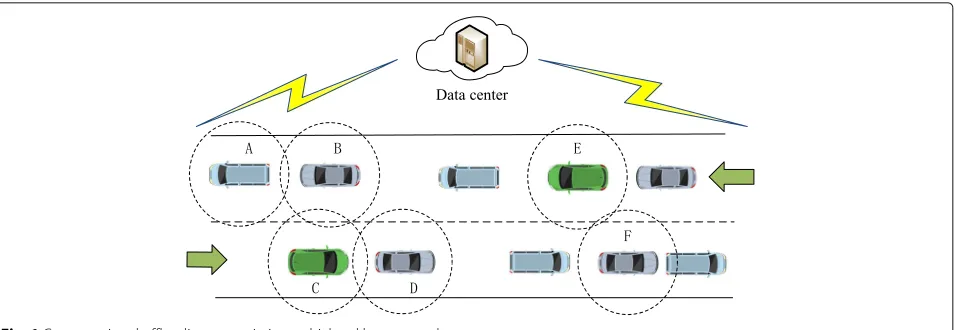
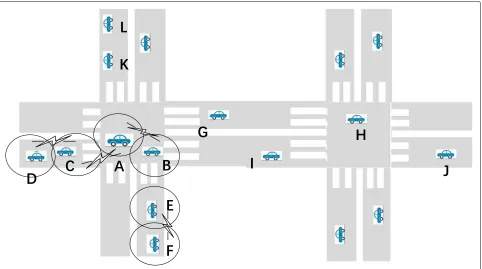
In the vehicle environment, a computationally inten-sive task must to be processed at a deadline. The vehi-cle can communicate with other equipment by V2V (Vehicle to Vehicle)[5], V2I (Vehicle to Infrastructure)[6] or V2C (Vehicle to Cloud)[7]. Then mapping the task to a node with more resources to reduce the hardware require-ments. This method is called offloading. In the case of no infrastructure, the in-vehicle task can only be mapped to other devices with richer resources through V2V. The offloading scenario is shown in Fig.1. Within the range of node connectivity, each node directly or indirectly in the form of single or multiple hops to offload tasks to high performance nodes.
Fig. 1Computational offloading scenario in a vehicle ad hoc network
In the dynamic environment of in-vehicle computing, the task completion time, resource utilization and sys-tem stability, is the optimization target. To optimize the above objectives, The contributions of this paper are as follows: in the network environment where computing and communication are integrated, in order to ensure the Quality of Service(QoS), we propose the partial flooding algorithm that considers node reliability and computing power. The offloading network is equivalent to a serial-and-parallel system, and the system reliability is utilized as an evaluation indicators to determine the number of offloading nodes, and after that select which nodes to exe-cute task based on the computing power of the nodes and their link reliability. The partial flooding algorithm outperforms the existing schemes in terms of execution latency and offloading efficiency. It reduces the proba-bility of network interruption and improves the resource utilization of the system.
The rest of this paper is organized as follows. In “Related work” section, we review the related work. “System model and problem formulation” section describes the vehicle self-organizing system and formulate the optimization problem to maximize the system computation capac-ity and minimize the offloading nodes number. In “The optimal solution” section, we promote the system perfor-mance by jointly optimizing the two parameters of link reliability and node computing power. Simulation results are presented in “Performance evaluation” section and the entire paper is concluded in “Conclusion” section.
Related work
Offloading in vehicle network is different from tradi-tional offloading. Due to the mobility of various nodes in the vehicular self-organizing network, the computational offloading is largely restricted by the change of network structure. To cope with the impact of the dynamic change of vehicle position on the offloading performance, there
Although the above algorithm optimizes the computa-tional offloading in the vehicular self-organizing network environment by reducing the task completion time, the impact on the stability of the performance of the offload-ing system is not taken into account in the previous work.
System model and problem formulation
In this section, we firstly introduce the computational offloading scenario and system models in the vehicu-lar self-organizing network. Afterwards, we interpret the V2V offloading process. Finally, we develop an optimiza-tion problem to improve the system performance and minimize the number of nodes being offloaded.
The model of computing offloading
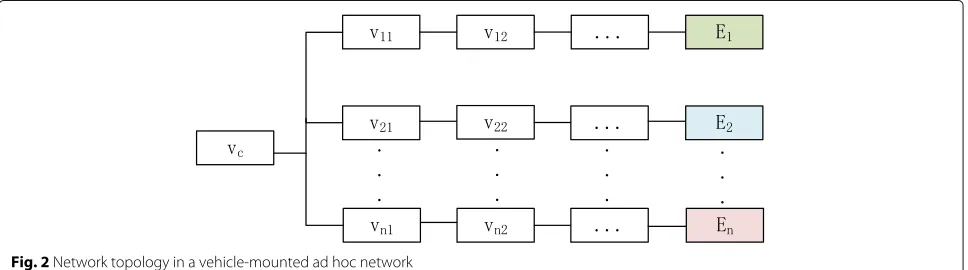
When there are multiple resources available, the network topology in the vehicular ad hoc network is equivalent to the communication system shown in Fig.2below.
The system consists ofnhigh-performance nodesE,vij
represents thejthhop node in the multi-hop link between the source nodeiand the target node. The vehicle termi-nal devicevccan perform a plurality of selection policies
to offloading. For example, one node may be selected as a proxy resource or the task may be offloaded to all available node. Otherwise, just some of nodes with better performance may be selected to perform the offloading. When there is a V2V link between the target node and the source node, similar to the literature[16], in this paper, the end-to-end equivalent bandwidth is calculated as follows.
BW = MB
HM (1)
MBis the base bandwidth in the VANET, andHMis the number of hops between end-to-end communications. Due to the dynamic change of the position of the vehi-cle node with time, the communication link between the source node and the target node will also change, so the equivalent bandwidth at each moment is uncertain.
System model
The vehicle node model is represented by the setVi:
Vi= {Ri,Fi,RWi} (2)
Ridenotes the communicable radius of the vehicle node
i, and the vehicles communicate with each other through DSRC (Dedicated Short Range Communications), the coverage area is a circular area with radiusRi,Fipresents
the computing power of the vehicle node, andRWi
rep-resents the read and write capabilities of the hardware that the node is configured with. The task model can be represented by a collection:
Q= {Di,C,Do,Td} (3)
Direpresents the amount of uploaded data of the task,C
is the amount of calculation of the task,Dorepresents the
amount of downloaded data of the task, andTdrepresents
the deadline of the task, that is, the maximum completion time that the task can tolerate, which is proportional to the calculation amountCof the task. Provided that the task is not completed within theTdperiod, the task is declared
to fail, and the task is counted as a failed task.
Offloading process
In the scenario, the source node that generates the task has a certain computing power. If the task is not offloaded, the time when the task runs locally is expressed as:
tlocal= C Flocal
(4)
Iftlocal>Td, it means that the task cannot be completed
by the local device within the deadline. In this case, we can consider offloading the task to the high-performance node to perform the operation. As to Docker uses lightweight virtualization technology for resource isola-tion and encapsulates various environmental dependen-cies into web applications, it can be easily ported and rede-ployed. Therefore, the Docker container-based offload-ing system can effectively reduce resource consumption. The system deployment steps are as follows. S1: Locally, package Java or other application tasks into Docker
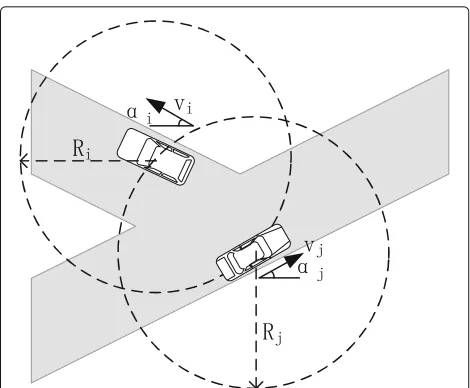
Fig. 3Schematic diagram of adjacent vehicle nodes
image files and upload them to the Docker repository; S2: The high-performance node creates a container based on the uploaded Docker image, runs the Docker instance, and implements interactive access. According to the sys-tem deployment steps, the computing offloading can be divided into three processes of uploading, executing, and downloading. The execution process of each part is as follows.
(1) Upload Process
The time the task is packaged locally into a Docker image file is relevanted to the read/write speed of the hard disk, so the packaging time is symbolized by:
tpack=
Di
RWlocal (5)
Assume that when the task is uploaded, the bandwidth of V2V maintain stability for a certain period of timetx,
then the amount of data transmitted during this period can be expressed as:
Dux =tx×BWx (6)
At a certain moment i, the hop count has changed n times, and at the time j the nth change occurs, if the following formula is satisfied:
n−1
x=0
tx×BWx+(i−j)×BWn=Di (7)
It means that at timej, the task upload is completed, and from the start of the uploading time to the timej, the entire time spanttransis recorded as the transmission time
of the task. The upload time of the task is recorded as:
tup=tpack+ttrans (8)
(2) Execution Process
When the task is offloaded to the target node idc, its
execution time in the container is:
tex =
C Fidc
(9)
We do not consider the dynamic changes in the com-puting power of the vehicle, assuming that the comcom-puting power provided by each vehicle is stable.
(3) Download Process
When the task calculation is completed, the target node returns the calculation result to the source node, which is similar to the upload process of the task. At a certain momentα, the hop count has changed n times, and the time at the nth change isβ. If
n−1
x=0
tx×BWx+(α−β)×BWn=Do (10)
At this point, the task download is completed, and the entire period is recorded astdown. The total completion
timetsumand total communication timetcomof the task
are respectively expressed as:
tsum=tup+tex+tdown (11)
tcommu=tup+tdown (12)
Problem analysis
In order to comprehensively and objectively evaluate the importance of each link in the communication network, the concept of communication link reliability[17–20] is introduced in the partial flooding algorithm. The two fac-tors of link reliability and node computing power, on the condition that the completion time is guaranteed, the reli-ability of the system is improved. Since the offloading includes two sub-processes of communication and com-putation, to optimize the system, the problem can be split into two sub-problems. One is to solve the reliability of the communication link of the node, and the other issue is to systematically evaluate the offloading performance according to the computing power and link reliability, and finally solve the two sub-problems comprehensively, so that the offloading strategy finally selected can improve the offloading performance and save some resource costs.
Link reliability analysis
in the link to be broken. Route failure is a vital factor affecting the reliability of the offloading system. During the task uploading or downloading process, the link break-age will inevitably lead to data retransmission, which greatly increases the network overhead and task comple-tion delay. Therefore, selecting a target node with a V2V link with higher reliability is also an important problem that needs to be solved.
Networked vehicles can obtain the position information of each vehicle in the network through GPS positioning system[21]. The moving speed and heading information of each vehicle can also be acquired by using sensors[22](for instance, speed sensor, acceleration sensor, etc.) equipped with the vehicle. Therefore, if the motion parameters of two adjacent nodes (such as speed, direction, available communication distance, etc.) are known we can pre-dict the connection time between the two nodes to judge the reliability of the communication link. In the scenario shown in Fig. 3, at time t, the position of node i can be expressed as(xi(t),yi(t)), its communication radius is
Ri, the velocity isvi(t), and the node motion direction is αi. Similarly, the motion states of adjacent nodes can be
obtained.
Considering the traveling speed of the vehicle in the road, the motion state information of the vehicle is refreshed at intervals of 1s, and thus it is known that the distance between the two nodes aftertsatisfied the following relationship:
Dij(t+t)=
(xi(t+t)−xj(t+t))2+(yi(t+t)−yj(t+t))2
(13)
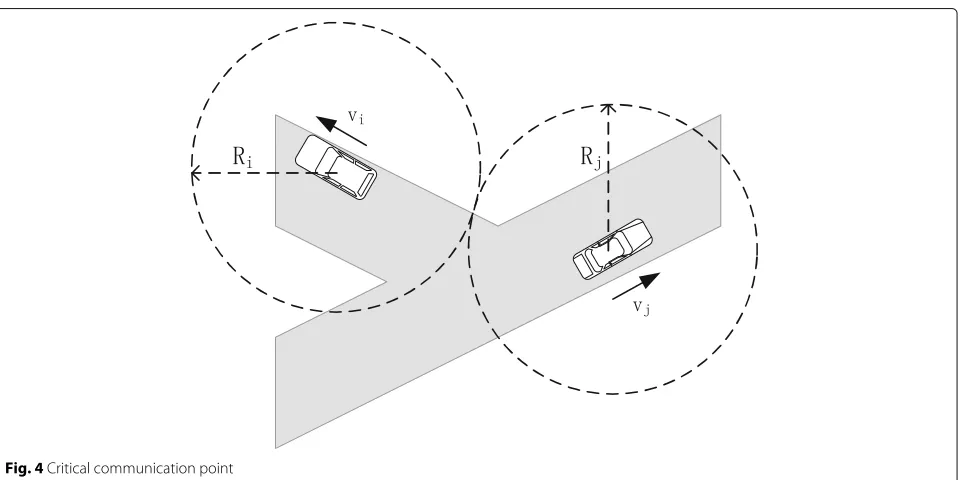
When the distance between the two nodes satisfies Dij(t+t)=Ri+Rj, and the next moment the distance
meetsDij>Ri+Rj, as shown in Fig.4. The communicable
range of nodeiand nodejno longer intersects. The max-imum communication distance between the two nodes is reached, marked as the critical communication point.
Thus, based on the motion state information of the node, the available connection time between the nodes can be calculated:
t=
vi2+vj2
(Ri+Rj)2−(vi·y−vj·x)2−(vi·x+vj·y) vi2+vj2
(14)
vi=vi(t)cosαi−vj(t)cosαj vj=vi(t)sinαi−vj(t)sinαj x=xi(t)−xj(t)
y=yi(t)−yj(t)
(15)
To deal witht, as an indicator to evaluate the link com-munication quality, the reliability of link between nodes is introduced:
Pij=
Cij(t)
Cij(T)
(16)
T represents the time between the nodesi andjto ensure that the offloading task is completed, andt rep-resents the time actually available duringT.Cij(T)and
Cij(t) represent the amount of data that this link can
transmit inT andt, respectively. It is defined as the product of the bandwidthBW and the corresponding link time. Link reliability can be further expressed as:
Pij=
Cij(t)
Cij(T) =
BW×t BW ×T =
t
T,Tt <1
1,Tt ≥1 (17)
The value range ofPijis [0, 1]. The larger the value, the
better the link reliability. When the available connection time is greater than the task required, it means that the link disconnection does not occur during the task trans-mission, and the reliability between the two nodes is set to 1. Assuming that the source node generates the task computing demand at a certain moment, the vehicle sends a request to the nearby computing resources through the Internet of vehicles broadcast[23], and the nearby vehi-cles with powerful computing capability send a reply to the source node after receiving the request, including their own computing power and storage capacity. After that, the source node establishes the link reliability model for nhigh performance nodes in the system according to the received reply information, which is used for the complete evaluation of the reliability of the whole system.
In the vehicle self-organizing network, when the source node and the target node require communicating indi-rectly through the multi-hop mode, the communication link can be regarded as a serial system, as shown in Fig.5. Each can be viewed as a single hop link between each pair of neighboring nodes. The reliability of the tandem system with a total hop count ofJito the target nodeEi
can be expressed as:
PEi=
Ji
j=1
Pij (18)
Pij represents the reliability of thejthhop link to the
edge serverEi. It can be seen from the above formula that
to ensure the reliability of the system, the reliability of each subunit is higher and the number of series is less, and the system is more stable. When only one multi-hop communication link still cannot guarantee the reliability that the whole system needs to meet, the partial flooding algorithm proposed in this paper assumes that the num-ber of all available edge servers isN, and onlyK(>0,≤N) nodes are offloaded, and the system reliability is:
Ps=1− K
i=1
[ 1−PEi] (19)
The reliability definition of the parallel system can be derived that the better the reliability of each subunit, the better the reliability of the system. Contrary to the series system, the more parallel branches, the higher the
stability that the system can achieve. In the vehicular self-organizing network environment, the communication network based on the partial flooding algorithm equiv-alent to a serial-and-parallel system, that is, each target node and the source node may need to go through mul-tiple hops before proceeding indirect communication. If the system selectsknodes as the target node andJi
rep-resents the serial cascade hop count of theithbranch, the reliability of the serial-to-parallel system can be expressed by the following formula:
Ps=1− K
i=1
[ 1−
Ji
j=1
Pij] (20)
Problem formulation
The current researches on the strategy focuses on offload-ing tasks is selectoffload-ing a node for offloadoffload-ing. In the in-vehicle dynamic environment, the randomness of node motion may cause the communication link to be bro-ken, affecting the completion time of the task; though the flooding strategy can greatly reduce the impact of vehi-cle node mobility on computing offload, for it occupies too much system resources, it will cause a certain waste of resources. Therefore, selecting the appropriate number of offloading nodes can improve the reliability of the system while reducing the completion time of the task.
According to the above definition, the smaller the series numberJiis, the more reliable the system is. The smaller
the parallel countkis, the less reliable the system is. The more the number of offloading nodes selected, the more reliable the system and the better the performance, but the problem of excessive resource usage will be brought about. However, if the number of target nodes is too small, the reliability of the system is reduced, which may result in the task being impossibly completed within the speci-fied deadline. To balance the performance of the system and the resource performance, each of the offloading can get a certain gain, first, it is necessary to ensure the mini-mum number of the series, and each parallel branch of the communication link can be solved by the minimum hop algorithm [24]. Furthermore, based on the above analysis, we attach importance to the selection of the number of offloaded nodes and how to choose, in order to improve the success rate of task completion, and reduce the sys-tem resource consumption, then the problem can be expressed as:
Fig. 6Multi-resource execution computing offloading
P1 :argmin
k
(Ps−PT)
s.t.Ps≥PT (a)
Tsum≤Td (b)
(21)
In the formula, arg min represents the value of the variable when the objective function takes the minimum value, that is, the value of the selected number of nodes k can minimize the difference between the system reli-abilityPs and the set certain thresholdPT. The smaller
the number of offloading nodes selected, the smaller the system overhead. The constraint condition (a) guarantees that the reliability of the offloading system must be greater than the set system reliability threshold, that is to say, the influence of the reliability of the system on the offload-ing cannot be neglected for the minimum value obtained; the constraint condition (b) Considering the performance of each resource, required that the time Tsum for the
selectedknodes to complete the task is enough to meet the deadline, to reduce the failure rate of the task. Where Tsum includes the communication time of the task,
exe-cution time and the waiting time of the task when the communications link is broken, namely:
Tsum=tsum+twait (22)
The optimal solution
To satisfy constraint conditions (a) and (b), the influence of node computing power and communication link reli-ability on offloading should be considered. System insta-bility can weaken the performance of the entire system to some extent. If the selected node has strong computing power, but the communication link reliability of the node is poverty, the constraint condition (a) cannot be met. At this time, the increase of the communication time may cause the performance of the offloading system to fail to achieve the expected offloading effect. Selecting a node
with a stable communication link performs the offloading, but the computing power of the node is small, and the task may not be completed within the deadline, and the constraint condition (b) cannot be met, causing the task failed. Partial flooding algorithm not only needs to con-sider the computing power of the node, but also needs the reliability of the communication link as another parameter indicator that affects the offloading, and makes a compre-hensive evaluation of the system. Since the value of the communications link reliability, PEi ranges from 0 to 1,
whenPEi = 1, the source node can transmit the task to
the target node within the available communication time, and the communication quality will not affect the offload-ing. The entire offloading process is equivalent to static offloading; when 0<PEi <1, the communication link is
unstable, and the offloading performance will change with the link reliability. Therefore, the impact of the reliability of the communication link on the offloading performance is Expressed as:
Cs=Ci×PEi, 0<PEi≤1 (23)
In the above formula, Ci is equal to the computing
power of nodei; Cs is the node performance size after
equivalent processing of link reliability and node com-puting power. In order to solve the minimum value ofk satisfying the condition, theCsof each node are sorted in
descending order, and the node with the higher ranking indicates that the comprehensive performance is better. Therefore, the nodes are selected in the order of com-prehensive performance, and Ps and Tsum are updated
the number of offloading nodes has little effect on the system performance, on the contrary, the effect of sev-eral offloading nodes on system resource utilization has been increased. It is obvious that the number of nodes selected based on the partial flooding algorithm can meet the requirements of performance and reduce the waste of resources of the entire system.
If all the R times are combined and the above con-straints are still not met, task selection executes locally; if k nodes are selected, based on the flooding concept, the task is uploaded to the selected node for computing. Finally, the result is returned from the fastest completed node to the source node. At this point, the node that has not been completed discards the task cleans up the mem-ory space and prepares for the next task. The algorithm flow is shown in Algorithm 1.
Algorithm 1 The offloading algorithm based on partial flooding.
Input: The set of available resources,En; The set of node
reliability,PEi; The set of node computing power,Ci; Output: The optimal number of offloading nodes,k∗;
The system reliability,Ps; The task completion
time,Tsum;
1: foreachEi ∈Endo
2: Cs(i)=Ci×PEi;
3: end for
4: Sort nodes according to the obtainedCs(i)in descend-ing order;
5: Selectkby sorting results; 6: initialk=1 andPs=Cs(1);
7: whilePs<PT,Tsum>Tddo
8: k←k+1.
9: updatePsandTsum;
10: end while 11: k∗=k. 12: returnk∗.
The computational complexity of the partial flood-ing algorithm is O(n2). Compared with the flooding algorithm, the partial flooding algorithm reduces the scope of flooding and thus decrease the system overhead. When there are multiple resources available, in the par-tial flooding algorithm, as one of the reference data for evaluating the number of offloading nodes, the resource validityueis defined as:
ue=
uac
usum
(24)
uac indicates the size of the resource consumed by the
proxy resource whose execution result is adopted, and
usumindicates the total resource size consumed in the
sys-tem during the entire offloading process. Resource over-head can be divided into the communication overover-head and the computational overhead. The communication overhead of nodeiis the size of the network bandwidth occupied during the offloading process, indicating the amount of data actually passing through a certain network during the communication timetcom:
ucom=BWi×tcom_i (25)
The node i computational overhead is the computa-tional resource size consumed during the computation timetex:
uex=Fi×tex_i (26)
Generally, the ratio of the communication time of the task to the calculation (execution) time of the task is defined as the Communication Computation Rate (CCR), which can be expressed as:
CCR= (D/BW)
(C/Fi) =
tcom
tex
(27)
According to the CCR definition, when the calculation amountC of the task is determined, the data amount of the task can be derived by the above formula. Then we can get the weight of the communication process and the execution process when the task is offloaded:
ωc=
tcom
tcom+tex
(28)
ωe=
tex
tcom+tex
(29)
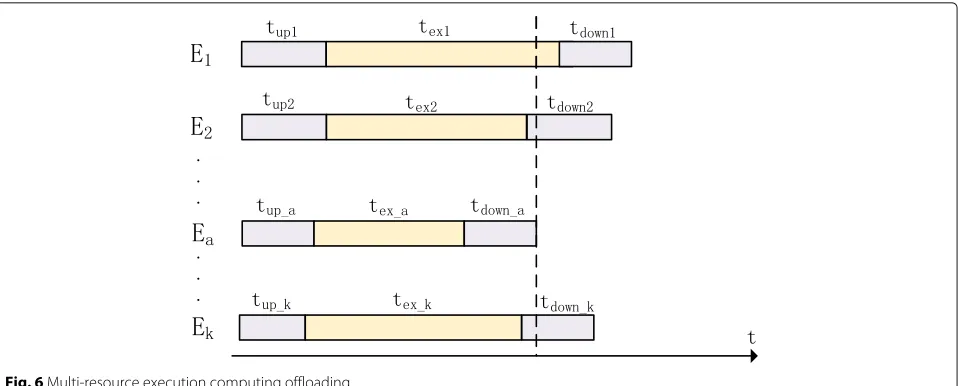
For different nodes, the offloading overhead is as shown in the figure below.tupandtdownare the task upload time
and download time of the node respectively,tcom=tup+
tdown.
It is assumed that k nodes are selected as proxy resources to perform computational offloading since the execution result is downloaded from node a that first completed the calculation to the source node. When the result is successfully downloaded, the offloading is com-plete. Therefore, the actual useful resource consumption in the whole process is the computational overhead of nodeaand the communication overhead of task upload-ing and downloadupload-ing, and the resource utilization of the system can be obtained by the following formula:
ue=ωc× k BWa×tcom_a
i=1
BWi×tup_i+ k
i=1
BWi×tdown_i
+ωe× kFa×tex_a
i=1 Fi×tex_i
(30)
ωc and ωe are the weighting values of the
calculating the CCR, when the task on the node a is completed, the node 2 and the nodekhave not yet com-pleted the task download. Then, the download time of this type of the node is from the task download time of the node to the task completion time of the node a. For nodes like node 1, since the node a task is com-pleted, they have not started the task download process, and the download time tdown = 0. Similarly, for the
execution time, when the task is completed at node a, node 1 has not completed the calculation. Thereafter, the execution time of the node is the time from the start of the calculation of the node to the task completion time of the node a, and if the node has not started the calculation, the execution time tcom = 0. The largerue
is, the less resources is wasted during the offloading pro-cess and the higher the resource utilization. Compared to the flooding offloading algorithm, the partial flood-ing algorithm reduces the number of offloadflood-ing nodes and improves resource utilization under the condition of guaranteeing constraints.
Performance evaluation
In this section, we will present simulation results to the performance enhancement of the proposed partial flood-ing algorithm based on link reliability and computflood-ing power. Commonly used node movement models can be divided into geographically restricted and geographically
unrestricted. To accurately simulate the simulation sce-nario under the unmanned scene, this paper uses the Manhattan network model as the moving model of the vehicle node, as shown in Fig.7.
In the Manhattan model, the movement of the vehi-cle is limited by surrounding roads or else traffic lights at buildings and intersections. When the vehicle arrives at the intersection, the probability that the vehicle keeps on moving in the same direction can be recorded asp1,
while the probability of traveling left and right arep2and
p3, respectively. In this paper, the experimental simulation
environment simulates the environment of urban roads. The simulation area is 2500m×2500m, and one intersec-tion is set every 500m in the x-axis and y-axis direcintersec-tions. The intersection traffic light length is generated according to a certain proportion, and there are 30 vehicle nodes in the setting scene. In the predicted scene, the initial turn-ing probability of the vehicle is: straight linep1=0.5, left
turnp2 = 0.25, right turnp3 = 0.25. Vehicles can
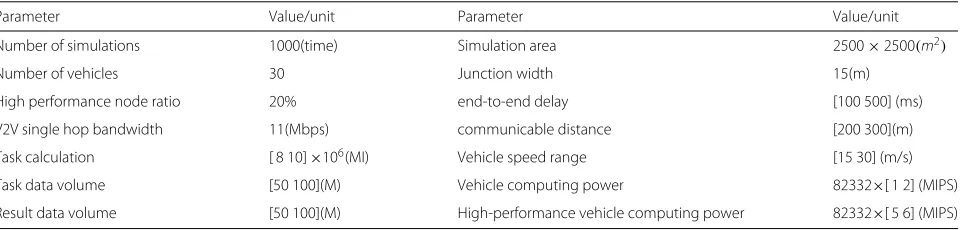
com-municate by multi-hop. The parameter settings are shown in Table1.
The experimental data of this experiment are the sys-tem reliabilityPs, the task offloading timetsum(including
the task communication time and the task computation time), the time twait of the node waiting for the link
when the link is disconnected, the task completion time tfinish, and the resource utilization rateue. among them,
Table 1Simulation parameter table
Parameter Value/unit Parameter Value/unit
Number of simulations 1000(time) Simulation area 2500×2500(m2)
Number of vehicles 30 Junction width 15(m)
High performance node ratio 20% end-to-end delay [100 500] (ms)
V2V single hop bandwidth 11(Mbps) communicable distance [200 300](m)
Task calculation [ 8 10]×106(MI) Vehicle speed range [15 30] (m/s)
Task data volume [50 100](M) Vehicle computing power 82332×[ 1 2] (MIPS)
Result data volume [50 100](M) High-performance vehicle computing power 82332×[ 5 6] (MIPS)
tfinish =tsum+twait. To evaluate the efficiency of the
par-tial flooding algorithm, we compared it to the following scenarios.
Minimum hop algorithm: At the time of task generation, the hop count of the current source node to the target node is calculated, and the node with the smallest hop count is selected as the target node for offloading.
Path prediction algorithm: By predicting the motion tra-jectory of the node in the future time, the node with the shortest task completion time is judged, and it is selected as the target node.
As shown in Fig. 8, compared with the traditional offloading algorithm based on the MH algorithm and the prediction based offloading algorithm, the partial flooding algorithm selects a group of nodes with better offloading performance as target nodes. According to the content of the system reliability mentioned above, it can be seen that the partial flooding algorithm is effectively improved in link reliability. The selected set of offloading nodes con-stitutes a string-and-parallel system that is more reliable than the tandem system that selects only one node. For the flooding algorithm, since the task is offloaded to all nodes to perform computation, the increase in parallel branches
increases the reliability of the system. However, the flood-ing algorithm will lead to excessive waste of resources. For the comparison of system resource utilization, a detailed analysis will be made below.
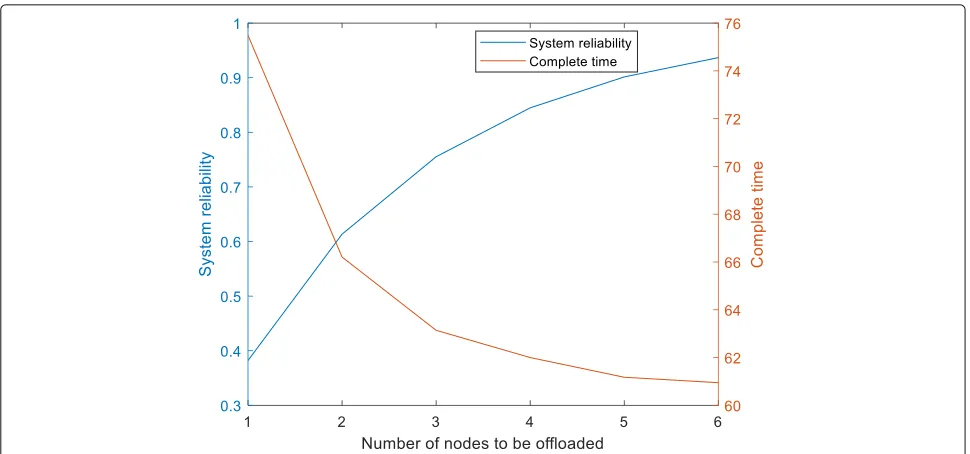
Figure 9 shows that the reliability of the communica-tion system increases as the number of offloading nodes. And the task completion time decreases as the number of nodes. It can be seen from the figure that the number of nodes is selected from 2 to 4, the rate of system reliabil-ity is gradually reduced, and the rate of task completion time is gradually reduced. Although with the number of nodes selected for offloading increasing, the system is more reliable and the task completion time is smaller, the system performance improvement effect is not obvious, and the system resource occupancy rate is proportion-ally increased. Therefore, the number of offloading nodes is controlled to be about two to four depending on the set threshold of system reliability. Compared with the tra-ditional algorithm that only offloads tasks to one node, the proposed algorithm not only improves the system reliability but also reduces the task completion time.
As shown in Fig. 10, for the three items task offload-ing time, waitoffload-ing time and completion time, the proposed
Fig. 9Resource utilization and complete time comparison
partial offloading algorithm based on the traditional algo-rithm has different degrees of improvement compared with the traditional computing offloading algorithm.
Specifically, as for the completion time of the task, since the accuracy based on the prediction algorithm is affected by the random motion of the vehicle, the pre-diction result may be inaccurate with the actual situation. This will result in the selected node not being the actual optimal node. Therefore, the partial flooding algorithm is improved by 35.04% compared with the path prediction algorithm, and the minimum hopping algorithm is the shortest distance of the current time. In a dynamic environment, the distance between nodes
can vary greatly. And the performance of the selected node may not be globally optimal. Therefore, the perfor-mance comparison and minimum hopping algorithm pro-posed in this paper improve the performance by 35.82%. For the offloading time of the task, a group of nodes with strong communication stability is selected as the candidate offloading node based on the partial flooding algorithm. It reduces the risk of the communication link disconnected when the task is transmitted. Compared with the algorithm such as MH and path prediction, the performance of the partial flooding algorithm is improved by 46.52% and 44.06%, respectively, which ensures the stability of the V2V communication link. The time at
Fig. 11Resource utilization comparison
which the task waits for the upload and download to start depends on the task generation time and the task execution time where the node at the completion time is calculated on the proxy resource. There is not much difference in the algorithm.
By comparing these three performance indicators, it prove that the partial offloading algorithm can effectively improve the offloading performance. At the same time, the experimental results illustrate the performance dif-ference between the partial offloading algorithm and the flooding algorithm is not large, and the advantage of the completion time of the flooding offloading algorithm is retained.
In multi-user multi-tasking systems, resource utiliza-tion is one of the important factors affecting sys-tem offload performance. Compared with the flooding
offloading strategy, we only select some better-performing nodes as the target nodes for offloading, which improves the system reliability, further, optimizes the effectiveness of resource utilization.
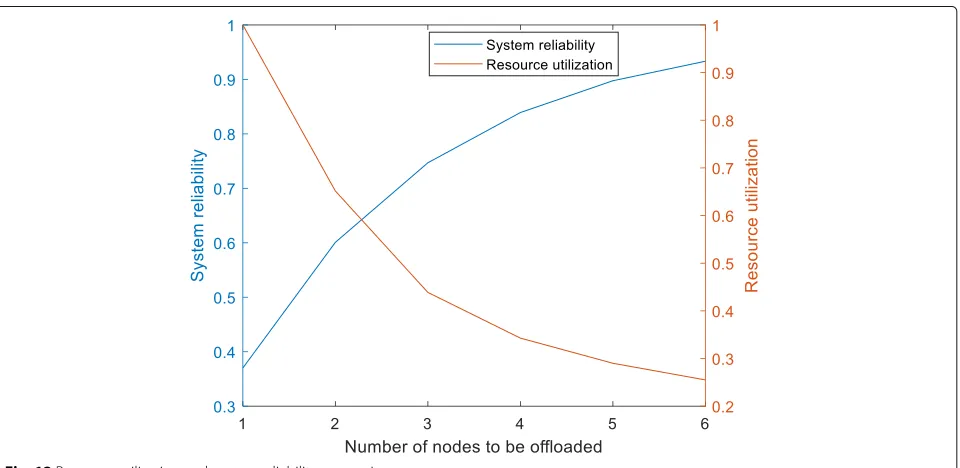
As shown in Fig. 11, it is verified by multiple exper-iments that the resource utilization rate of the partial flooding algorithm corresponds to the case where the number of selected offloading points in Fig.12is 2 or 3. In comparison with the flooding offloading strategy, while ensuring the completion time of the task, the number of selected nodes is reduced, which saves the comput-ing resources and communication resources required in the offloading process. The algorithm proposed in this paper improves the resource availability of the system, and the offloading nodes that execute the task will have a greater probability of being the final adopted node. Since
the traditional algorithm only occupies one computing resource, although its resource utilization rate is higher than the partial flooding algorithm, the system reliabil-ity is much lower than the partial flooding algorithm, as shown in the figure below.
From the analysis in Fig. 12. Although the partial flooding algorithm reduces the reliability of the system, its resource utilization rate is 43.71% higher than that of the flooding algorithm. For the traditional algorithm (MH algorithm and path prediction algorithm) that only offloads to one node, the partial flooding algorithm estab-lishes a parallel system, which has greatly improved the system reliability. That is to say, the partial flood-ing strategy based on link reliability and node comput-ing power balances the two performance parameters of resource utilization and reliability of the system. At this point, the offloading performance reaches an equaliza-tion, which not only improves the reliability of the system, but also ensures that the task is completed within the deadline, and reduces the resource utilization of the system. From the user’s point of view, the user ter-minal can receive the result of the application execu-tion more quickly, and improve the QoS. In addiexecu-tion, from the perspective of the proxy resource, the waste of resources is reduced, and the execution cost is greatly reduced.
Conclusion
This paper studies the computational offloading strategy in vehicle self-organizing network and optimizes the tra-ditional computing offloading strategy. Compared with the algorithm only offloading to one node, the partial flooding algorithm proposed in this paper improves the reliability of the system. At the same time, the influ-ence of the high-speed motion of the vehicle node on the execution and offloading is reduced. It also reduces task completion time and enhances the user experience. Different from the flooding algorithm, since the partial flooding algorithm considers the performance param-eters such as system reliability and node computing ability, only the appropriate number of target nodes are selected for execution and offloading. Therefore, the par-tial flooding algorithm consumes less computational and communication resources than the flooding algorithm during the offloading process, which greatly reduces the waste of system resources. The results show that the partial flooding algorithm proposed in this paper can guarantee the delay-sensitive task to complete in the deadline, improve resource utilization, balance the sys-tem performance and resource availability, and effec-tively improve the offloading performance of the whole system.
In future research, we will consider multi-target offload-ing strategies with infrastructure to reduce the execution
energy consumption of task execution, maximize sys-tem offloading performance, and minimize computation completion time to optimize overall offloading overhead.
Acknowledgements
There is no acknowledgement.
Authors’ contributions
BL, ZP, and PH are the main researcher, MH, MA and GJ are coauthor. All authors read and approved the final manuscript.
Authors’ information
Bo Li is a Professor at Yunnan University, received his Ph.D. degree in Information and Communication Engineering from Huazhong University of Science and Technology, China, in 2005.
Ziyi Peng and Peng Hou are master students under the advising of Bo Li. Min He is an Associate Professor at Yunnan University, received her Ph.D. degree in Computer Science from University of Electronics Science and Technology of China, in 2006.
Marco Anisetti is an Associate Professor at the Università degli Studi di Milano. He received his Ph.D. degree from Ottawa University in Computer Science in 2006.
Gwanggil Jeon is an Assistant Professor with the Department of Embedded Systems Engineering, Incheon National University, Incheon, Korea. He received his Ph.D. degree from the Department of Electronics and Computer Engineering, Hanyang University, Seoul, Korea, in 2008.
Funding
This work has been institutionally supported by the National Natural Science Foundation of China with grant number 61562092 and the Science and Technology Plan of Yunnan Province with grant number 2014AB016.
Availability of data and materials
There is no supporting data available.
Competing interests
The authors declare that they have no competing interests.
Author details
1School of Information Science and Engineering, Yunnan University, Kunming
650500, Yunnan, China.2Dipartimento di Informatica (DI), Università degli
Studi di Milano, Via Celoria 18, Milano 20133, (MI), Italy.3School of Electronic
Engineering, Xidian University, Xi’an 710071, China.4Department of Embedded
Systems Engineering, Incheon National University, Incheon 22012, Korea.
Received: 25 September 2019 Accepted: 28 November 2019
References
1. Ahmed B, Malik AW, Hafeez T, Ahmed N. Services and simulation frameworks for vehicular cloud computing: a contemporary survey. EURASIP J Wirel Commun Netw. 2019;2019(1):4.
2. Aliyu A, Abdullah AH, Kaiwartya O, Cao Y, Usman MJ, Kumar S, Lobiyal DK, Raw RS. Cloud computing in vanets: Architecture, taxonomy, and challenges. Iete Tech Rev. 2018;5(5):523–547.
3. Wu H-T, Horng G-J. Establishing an intelligent transportation system with a network security mechanism in an internet of vehicle environment. IEEE Access. 2017;5:19239–19247.
4. Arif M, Wang G, Bhuiyan MZA, Wang T, Chen J. A survey on security attacks in vanets: Communication, applications and challenges. Veh Commun. 2019100179.https://doi.org/10.1016/j.vehcom.2019.100179. 5. Abbas F, Fan P, Khan Z. A novel low-latency v2v resource allocation
scheme based on cellular v2x communications. IEEE Trans Intell Transp Syst. 2018;20(6):2185–2197.
7. Lin X, Li J, Yang W, Wu J, Zong Z, Wang X. Vehicle-to-cloudlet: Game-based computation demand response for mobile edge computing through vehicles. In: 2019 IEEE 89th Vehicular Technology Conference (VTC2019-Spring). IEEE; 2019. p. 1–6.https://doi.org/10.1109/ vtcspring.2019.8746335.
8. Naresh M, Raje A, Varsha K. Link prediction algorithm for efficient routing in vanets. IEEE; 2019. p. 1156–1161.https://doi.org/10.1109/iccmc.2019. 8819723.
9. Kim W, Kang CM, Son YS, Lee S-H, Chung CC. Vehicle path prediction using yaw acceleration for adaptive cruise control. IEEE Trans Intell Transp Syst. 2018;19(12):3818–3829.
10. Ye M, Guan L, Quddus M. Mpbrp-mobility prediction based routing protocol in vanets. IEEE; 2019. p. 1–7.https://doi.org/10.1109/commnet. 2019.8742389.
11. Lei T, Wang S, Li J, Yang F. A cooperative route choice approach via virtual vehicle in internet of vehicles. Springer; 2016. p. 194–205.https:// doi.org/10.1007/978-3-319-51969-2_16.
12. He X, Zhao H, Yu BJ, Zhu J. Design and implementation of minimum hop routing algorithm with reliability assurance for wsn. In: Advanced Materials Research, vol. 268. Trans Tech Publ; 2011. p. 975–980.https:// doi.org/10.4028/www.scientific.net/amr.268-270.975.
13. Fan SP, Bao-Ying MA, Gao CG, Yao NM, University MN. Minimum hop routing algorithm for clustering wireless sensor networks. J Chin Comput Syst. 2014;35(8):1775–1779.
14. Le HQ, Al-Shatri H, Klein A. Efficient resource allocation in mobile-edge computation offloading: Completion time minimization. IEEE; 2017. p. 2513–2517.https://doi.org/10.1109/isit.2017.8006982.
15. Toh C-K, Bunchua S. Performance evaluation of flooding-based and associativity-based ad hoc mobile multicast routing protocols. IEEE; 2000. p. 1274–1279.https://doi.org/10.1109/wcnc.2000.904815.
16. Li J, Blake C, De Couto DSJ, et al. Capacity of ad hoc wireless networks. In: Proceedings of the 7th annual international on mobile computing and networking. New York: ACM; 2001. p. 61–69.
17. Eiza MH, Ni Q. An evolving graph-based reliable routing scheme for vanets. IEEE Trans Veh Technol. 2013;62(4):1493–1504.
18. Chaturvedi SK. Network reliability: measures and evaluation. New York: John Wiley & Sons; 2016.
19. Khanna G, Chaturvedi S, Soh S. Reliability evaluation of mobile ad hoc networks by considering link expiration time and border time. Int J Syst Assur Eng Manag. 2019;10(3):399–415.
20. Ünlü B, Özceylan B, Baykal B. Ipbm: an energy efficient reliable interference-aware periodic broadcast messaging protocol for manets. Wirel Netw. 2019;25(5):2769–2787.
21. Ylianttila M, Mäkelä J, Pahlavan K. Analysis of handoff in a location-aware vertical multi-access network. Comput Netw. 2005;47(2):185–201. 22. Su W, Lee S-J, Gerla M. Mobility prediction and routing in ad hoc wireless
networks. Int J Netw Manag. 2001;11(1):3–30.
23. Zhang Y, Zhao J, Cao G. Roadcast: a popularity aware content sharing scheme in vanets. ACM SIGMOBILE Mob Comput Commun Rev. 2010;13(4):1–14.
24. Peng S, Chai R, Chen Q, Qin Y. Minimum end-to-end transmission delay based routing algorithm for vanets. IEEE; 2017. p. 176–181.https://doi. org/10.1109/icait.2017.8388910.
25. Hussain S, Keung J, Khan AA, Ahmad A, Cuomo S, Piccialli F, Jeon G, Akhunzada A. Implications of deep learning for the automation of design patterns organization. J Parallel Distrib Comput. 2018;117:256–266. 26. Chianese A, Marulli F, Piccialli F. Cultural heritage and social pulse: A
semantic approach for ch sensitivity discovery in social media data. IEEE; 2016. p. 459–464.https://doi.org/10.1109/icsc.2016.50.
Publisher’s Note