PoompatSaengudomlert
School of Engineering and Technology,Asian Institute of Technology (AIT), Thailand
Abstract:
Information reconciliation is a step of Quantum Key Distribution (QKD) which involves error detection and correction. If Alice (sender) and Bob (receiver) use an optical channel to exchange bits to form a secret key, some errors can occur in the bit string on the way of transmission due to interceptor. The performance comparison of error detection and correction for two situations with Eve (interceptor) and without Eve has been presented in this paper. Here, not only the effect of Eve is analyzed like the existing works but also the simulation is shown for the very first time. The system model follows the BB84 protocol. Cascade algorithm has been applied for this work. The simulation is done using MATLAB.
Keywords:Quantum Key Distribution (QKD), BB84 protocol, Information reconciliation.
1. Introduction
Quantum Cryptography is a process of forming a secret key by exchanging qubits (single photon). It has several steps and information reconciliation is one of those. It involves error detection and correction. In the existing work, only the situation “without interceptor” is investigated and decision is made on the number of rounds required for error correction, but the case “with interceptor” is discussed only theoretically [2]. In this research we investigate the information reconciliation process for the situation “with interceptor” and compare the simulation results with the case “without interceptor”. The number of error versus number error correction in each round/pass are plotted and compared. Finally, from the simulation results, decision is made on the number of passes required to correct all the errors for the case “with interceptor”. The result is obtained for 10000 bits and 100 empirical tests and four different error probability of the binary symmetric channel. Fig. 1(a) shows the relationship between photon apin and qubits at two polarizations states (rectilinear and diagonal) and (b) shows the information reconciliation in quantum cryptography with the effect of interceptor.
qubit
Basis
0
(Photon spin)
1
(Photon spin)
Rectilinear
+
90° 0°
Diagonal
X
45°
135°
(b)
Fig.1. (a) The polarization basis (orthogonal basis) of a qubit (photon) (b) A simple example of information reconciliation (using BB84 protocol [1])
The outline of this paper is as follows: Section two, contains the methodology of the cascade algorithm applied for information reconciliation. In section three, the simulated results for error correction with the effect of Eve and without the effect of Eve are shown and discussed as well. And finally, some conclusions are drawn in section four.
2. Methodology
Let Ai = string of qubits sent by Alice = A1, A2,…, AN and Bi = string of qubits received by Bob =
B1,B2,…,BN, where each Ai, Bi is an element of {0, 1}.
Alice and Bob apply random permutation on their own string. They use the same permutation function. As a result, each one knows the sequence of qubits of the other. Then they divide their strings into several blocks. They chose an initial block size for first pass and apply several passes for correction of errors (mismatched qubits). They increment the block size at the start of each new pass. According to an existing work, the initial block size is recommended equal to 0.73 divided by the error probability of the binary symmetric quantum channel [3] while the block size is doubled at the start of each new pass [3].
In one pass, Alice sends parity bits of all her blocks one at a time to Bob. Bob compares the parity of each block from Alice with the parity of the corresponding block of his. If there is mismatch, he applies binary search on that block to find the error position and correct the bit simply by altering it. According to simulation, over 50% of the errors are corrected at the end of the first pass [2].
All the blocks having error bits up to previous passes and up to current passes are collected in two sets. In all the passes except the first one, after correcting an error of a block, Bob goes back to check all the blocks containing an error. He checks if due to correction of qubits in the current round causes any parity mismatch again in blocks in previous rounds containing the bit positions whose errors were corrected before. If there is no error, then that block is discarded from the set. Here they apply some mathematical procedure. Bob determines the set new_K as
new_K = (KUB)/(K∩B)
3. Simulation and Results
Here all the figures show the simulation results for the number of error correction for various error probability of binary symmetric channel with the presence of Eve and also without Eve.
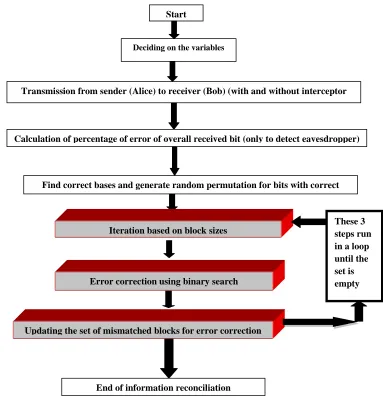
Transmission from sender (Alice) to receiver (Bob) (with and without interceptor
Calculation of percentage of error of overall received bit (only to detect eavesdropper)
Find correct bases and generate random permutation for bits with correct
Error correction using binary search
Updating the set of mismatched blocks for error correction Iteration based on block sizes
Fig. 2. Steps of implementing information reconciliation
End of information reconciliation
Fig. 3. Number of error correction vs. total number of errors in pass 1 to 4 for ε = 0.01, 0.05, 0.10, 0.15 without Eve
From Fig. 3, we can see the total number of error correction in pass 1, 2, 3 and 4 for several values of ε for the case without Eve. As the value of ε increases, the total number of error also increases. Almost all the errors are corrected at the end of pass 2.
Fig. 4. Number of error correction vs. total number of errors in pass 1 to 4 for ε = 0.01, 0.05, 0.10, 0.15 with Eve
From Fig. 4, we can see the total number of error correction in pass 1, 2, 3 and 4 for several values of ε for the case with Eve.
0 100 200 300 400 500 600 700 800
=0.01 =0.05 =0.10 =0.15 No. of corrections up to pass 1
No. of corrections up to pass 2 No. of corrections up to pass 3 No. of corrections up to pass 4 Total no. of bit errors
0 200 400 600 800 1000 1200 1400 1600 1800 2000
=0.01 =0.05 =0.10 =0.15 No. of corrections up to pass 1
No. of corrections up to pass 2 No. of corrections up to pass 3 No. of corrections up to pass 4 Total no. of bit errors
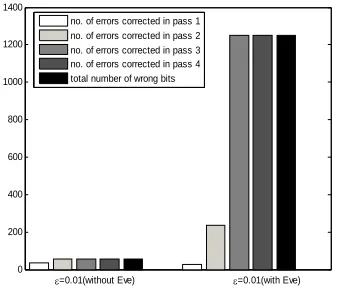
0 200 400 600 800 1000 1200 1400
=0.01(without Eve) =0.01(with Eve) no. of errors corrected in pass 1
Fig. 6 Number of error correction vs. total number of errors in pass 1 to 4 for ε = 0.05, without Eve and with Eve
From Fig. 6, we can see the total number of error correction in pass 1, 2, 3 and 4 for ε = 0.05 for both the case with and without Eve. Total number of errors increases significantly with the presence of Eve; Also number of error increases with the increase in error probability of the channel. The rate of error correction in pass1 is same for both the cases of with Eve and without Eve. But the error correction rate in other passes is very high in case of with Eve then the case of without Eve.
Fig. 7. Number of error correction vs. total number of errors in pass 1 to 4 for ε = 0.10, without Eve and with Eve
From Fig. 7, we can see the total number of error correction in pass 1, 2, 3 and 4 for ε = 0.10 for both the case with and without Eve. Total number of errors increases significantly with the presence of Eve; Also number of error increases with the increase in error probability of the channel. The rate of error correction in pass1 is same for both the cases of with Eve and without Eve. But the error correction rate in other passes is very high in case of with Eve then the case of without Eve.
0 500
=0.05(without Eve) =0.05(with Eve)
0 200 400 600 800 1000 1200 1400 1600 1800
=0.10(without Eve) =0.10(with Eve) no. of bits corrected in pass 1
Fig. 8. Number of error correction vs. total number of errors in pass 1 to 4 for ε = 0.15, without Eve and with Eve
From Fig. 8, we can see the total number of error correction in pass 1, 2, 3 and 4 for ε = 0.15 for both the case with and without Eve. Total number of errors increases significantly with the presence of Eve; Also number of error increases with the increase in error probability of the channel. The rate of error correction in pass1 is same for both the cases of with Eve and without Eve. But the error correction rate in other passes is very high in case of with Eve then the case of without Eve.
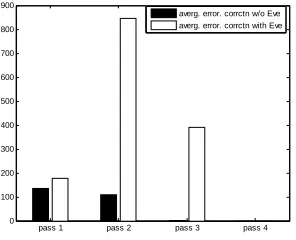
Fig. 9. The average number of error corrections with Eve vs. the average number of error corrections without Eve in pass 1 to 4, for ε=0.01
From Fig. 9, we can see that, in pass 1(for a fixed value of ε, here it is 0.01) the number of error correction is same for both the cases with Eve and without Eve.
0 200 400 600 800 1000 1200 1400 1600 1800 2000
=0.15(without Eve) =0.15(with Eve) no. of bits corrected in pass 1
no. of bits corrected in pass 2 no. of bits corrected in pass 3 no. of bits corrected in pass 4 total number of wrong bits
pass 1 pass 2 pass 3 pass 4
0 200 400 600 800 1000 1200
averg. error. corrctn w/o Eve averg. error. corrctn with Eve
pass 1 pass 2 pass 3 pass 4
0 100 200 300 400 500 600 700 800 900
Fig. 11. The average number of error corrections with Eve vs. the average number of error corrections without Eve in pass 1 to 4, for ε=0.10
From Fig. 11, we can see that, in pass 1(for a fixed value of ε, here it is 0.10) the number of error correction is quite same for both the cases with Eve and without Eve. In pass 2 and pass 3, the number of error correction is very much high for with Eve compare to without Eve. In pass4, no error is left to be corrected for both of the cases.
Fig. 12. The average number of error corrections with Eve vs. the average number of error corrections without Eve in pass 1 to 4, for ε=0.15
From Fig. 12, we can see that, in pass 1(for a fixed value of ε, here it is 0.15) the number of error correction is quite same for both the cases with Eve and without Eve. In pass 2 and pass 3, the number of error correction is very much high for with Eve compare to without Eve. In pass4, no error is left to be corrected for both of the cases.
The following two properties are derived from this research:-
1) With interceptor, almost all the errors are corrected at the end of round 3.
2) With interceptor, a small amount of error is corrected in round 1. Maximum number of error correction occurs in round 2.Here is the major difference between the cases with Eve and without Eve, where most errors (almost half) are corrected in round 1 for the latter case.
4. Conclusion
We investigated the performance of the cascade algorithm for information reconciliation. In the existing works the effect of interceptor is discussed theoretically. But here we also showed the effect through simulation. We compared the simulation results for both the cases with interceptor and without interceptor. Also we took
pass 1 pass 2 pass 3 pass 4
0 200
pass 1 pass 2 pass 3 pass 4
0 200 400 600 800 1000 1200 1400
decision from the analysis on the number of passes required for the error correction when the interceptor was present in the system.
References
[1] Bennett, C. H., Brassard, G.,Crkpeau,C. and Maurer, U. M., “Generalized Privacy Amplification,” Proceeding of IEEE Transactions on Information Theory, vol. 41, No.6,November1995.
[2] Sugimoto, T. and Yamazaki, K., “A study on secret key reconciliation protocol ‘cascade’,” Proceeding of IEICE Trans. Fundamentals, vol. E83-A, no. 10, pp. 1987– 1991, October, 2000.