PERFORMANCE ANALYSIS OF
HOPFIELD MODEL OF NEURAL
NETWORK WITH EVOLUTIONARY
APPROACH FOR PATTERN
RECALLING
T P Singh*
Department of Computer Science, Sharda University, Greater Noida Dr. M P Singh
Department of Computer Science, Institute of Computer & Information Science, Dr. B R Ambedkar University, Agra
Somesh Kumar
School of Computer Science, Apeejay Institute of Technology, Greater Noida ABSTRACT
In the present paper, an effort has been made to compare and analyze the performance for pattern recalling with conventional hebbian learning rule and with evolutionary algorithm in Hopfield Model of feedback Neural Networks. A set of ten objects has been considered as the pattern set. In the Hopfield type of neural networks of associative memory, the weighted code of input patterns provides an auto-associative function in the network. The storing of the objects has been performed using Hebbian rule and recalling of these stored patterns on presentation of prototype input patterns has been made using both - conventional hebbian rule and evolutionary algorithm. Exploration of the population generation techniques (mutation and elitism), crossover and setting up of proper fitness evaluation functions to generate the new population of the weight matrices from the optimal weight matrix of the stored patterns has been done. The simulated results show that the genetic algorithm is the best searching technique to recall the approximate input patterns.
Keywords: Evolutionary algorithms; Hopfield Neural Network; Hebbian learning rule; Genetic algorithm;
Pattern recalling. 1. INTRODUCTION
Most of the children of five-year age group can recognize digits, letters, shapes, objects etc. Small, large, hand-written, hand drawn, machine printed, or rotated - all are easily recognized by the young. The characters or shapes may be written/drawn on a cluttered background, on crumpled paper or may even be partially occluded. We take this ability for granted until we face the task of teaching a machine how to do the same [1]. Pattern recognition is the study of how machines can observe the environment, learn to distinguish patterns of interest from their background, and make sound and reasonable decisions about the categories of the patterns.
Several patterns recognition tasks are naturally and effortlessly performed by human beings just because of the inherent differences in information handling by us and machines in the form of patterns and data.
The Hopfield neural network is a simple feedback neural network which is able to store patterns in a manner rather similar to the brain - the full pattern can be recovered if the network is presented with only partial information. Furthermore there is a degree of stability in the system - if just a few of the connections between nodes are severed, the recalled pattern is not too badly corrupted and the network can respond with a "best guess". Pattern storage is generally accomplished by a feedback network consisting of processing units with non-linear bipolar output functions. The stable states of the network represent the stored patterns.
Neural networks are often used for pattern recognition and classification [8]-[10]. Hopfield (1982) proposed a fully connected neural network model of associative memory in which we can store information by distributing it among neurons, and recall it from the neuron states dynamically relaxed. Hopfield used the Hebbian learning rule [11] to prescribe the weight matrix. Hopfield type networks will most likely be trapped in non-optimal local minima close to the starting point, which is not desired. The presence of false minima will increase the probability of error in recall of the stored pattern. The problem of false minima can be reduced by adopting the evolutionary algorithm to accomplish the search for global minima.
Developed by Holland (1975), an evolutionary searching (genetic algorithm) is a biologically inspired search technique. In simple terms, the technique involves generating a random initial population of individuals, each of which represents a potential solution to a problem. Each member of that population’s fitness as a solution to the problem is evaluated against some known criteria. Members of the population are then selected for reproduction based upon that fitness, and a new generation of potential solutions is generated from the offspring of the fit individuals. The process of evaluation, selection, and recombination is iterated until the population converges to an acceptable solution. Genetic algorithms require only fitness information, not gradient information or other internal knowledge of a problem as in case of neural networks. Genetic algorithms have traditionally been used in optimization but, with a few enhancements, can perform classification, prediction and pattern association as well [12].
Much work has been done on the evolution of neural networks with GA [13]-[15]. There have been a lot of researches which apply evolutionary techniques to layered neural networks. However, their applications to fully connected neural networks remain few so far. The first attempt to conjugate evolutionary algorithms with Hopfield neural networks dealt with training of connection weights. Evolution has been introduced in neural networks at three levels: architectures, connection weights and learning rules [16]. The evolution of connection weights proceeds at the lowest level on the fastest time scale in an environment determined by architecture, a learning rule, and learning tasks. The evolution of connection weights introduces an adaptive and global approach to training, especially in the reinforcement learning and recurrent network learning paradigm. The evolution of learning rules can be regarded as a process of “learning to learn” in ANN’s where the adaptation of learning rules is achieved through evolution. The evolution of architectures enables ANN’s to adapt their topologies to different tasks without human intervention and thus provides an approach to automatic ANN design as both ANN connection weights and structures can be evolved.
The evolution of a network’s connection weights is an area of curiosity [17] and the center of attention of this work
In the present work, our objective is to analyze the performance of neural networks of Hopfield type for recalling of the already stored patterns with evolutionary algorithm. In this process, first the patterns of training set have been encoded in the neural network using conventional hebbian learning rule. It is expected that all the patterns of training set has been successfully stored as the associative memory feature of Hopfield type neural network. As a result of this learning process, we obtain the expected optimized weight matrix. Now, we employ the genetic algorithm to evolve the population of this approximate optimal weight matrix obtained by hebbian learning rule. The fitness of every evolved population of weight matrices is evaluated by using the two fitness evaluation functions. This process of evaluation of weight matrices continues till the last matrix of the generated population is not examined. This selected population of weight matrices reflects the optimal solution for recalling process in a way that on presentation of any noisy input pattern, it produces the correct corresponding stored pattern. The advantage of this approach is that it is minimizing the randomness from the genetic algorithms because, instead of starting from the random solution, it starts from approximate optimum solution. Therefore, the process of recalling by proposed hybrid evolutionary system will be efficient and relatively faster compared to simple genetic algorithm and conventional hebbian approach. The detailed comparative analysis of the results obtained during the simulation is presented and discussed with the help of graphs and tables.
2. SIMULATION DESIGN AND IMPLEMENTATION DETAILS
This section describes the experiments designed to evaluate the performance of Hopfield neural network with the genetic algorithm for the taken set of objects recalling.
2.1 Set of patterns used for training:
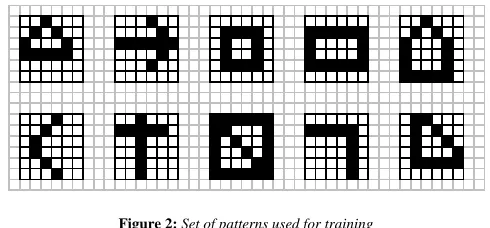
The patterns used for the simulations are shown in Figure 5.2. Each pattern consisted of a 6 X 6 pixel matrix representing an object of the set. White and black pixels are respectively assigned corresponding values of -1 and +1.
Figure 2: Set of patterns used for training
Using these bipolar values, the set of above objects is represented in the form a series. For example, object is written as:
[-1-1-11-1-1-1-1-1-11-1 111111-1-1-1-11-1-1-1-11-1-1-1-1-1-1-1-1]
2.2 Experiments
Four runs of the experiments were taken on same Hopfield network architecture (i.e. completely connected 36 neurons network). Each run is based on one of the two experiments - recalling the objects with Hebbian rule and recalling the same objects with genetic algorithm. The inputs for four different runs are 0-bit, 1-bit, 2-bits and 3-bits errors induced randomly in the patterns already stored in the network. In each
experiment, the
Hebbian learning rule is used to store patterns in the Hopfield neural network. The genetic operators used in each experiment are summarized in Table 1.Table 1: Genetic operator used in experiments
Training Algorithms Genetic Operator Used
Hebbian rule None
Genetic algorithm Population generation technique (mutation + elitism), Crossover and Fitness evaluation technique
The parameters used in different runs of the experiments are described in Table 2 and Table
3
.
Table 2: Parameters used for Hebbian learning rule
Parameter Value Initial state of neurons Randomly Generated Values Either –1 and 1
Threshold values of neurons 0.00
Table 3: Parameters used for Genetic Algorithm
Parameters Value Initial state of neurons Randomly Generated Values Either –1 and 1
Threshold values of neurons 0.00
Mutation Population Size N + 1
Mutation Probability 0.5
The task associated to the Hopfield neural networks in performing experiments is to store the taken set of objects as patterns with the appropriate recalling of the same patterns with induced noise.
2.3 Hopfield Neural Network
The proposed Hopfield model consists of N (36 = 6 X 6) neurons and N*N connection strengths. Each neuron can be in one of two states i.e. ±1, and L bipolar patterns have to be memorized in associative memory.
For storing L patterns, we could choose a Hebbian rule given by the summation of the Hebbian terms for each pattern. i.e.
);
(
1
1
x
x
i
j
w
Ll L j L i L
ij
and
w
ii
0
.
………..(5.1)
To store 10 objects in a 36-unit bipolar Hopfield neural network, at each corresponding one stable state and that must satisfy the following activation dynamics equation:
j
i j
ij
s
s
w
f
(
.
)
;
where i=1,2,3……….N
(5.2)
The initial weights has been considered as
w
ij
0
.
for all i’s and j’s . After storing all the patterns, the final weight matrix looks like as followsWL =
2.4 The Genetic Algorithm Implementation
In this simulation, a population of weight matrices is produced randomly from the parent weight matrix when GA starts. In each generation, this population is modified through uniform random mutations and discrete crossovers and their fitness values are evaluated. According to the fitness values, individuals of the next generation are selected, using a (µ+λ) -strategy in ES terminology.
The cycle of generating the new population with better individuals and restarting the search is repeated until an optimum solution is found. In this process the two fitness evaluation functions have been used. The first fitness function is evaluating the best matrices of the weights population on the basis of the settlement of the network in the stable state corresponding to the stored pattern on the presentation of the already stored pattern as the input pattern. The second fitness evaluation function is selection of the weight matrices on the basis of settlement of the network in the stable state corresponding to the correct or exact stored pattern on the presentation of prototype input pattern as the already stored pattern. It indicates that the stable states of the network will be used for the evaluation of the weight’s population. Thus in the recalling process, stable state of the network corresponding to the stored pattern should be retained for the selected weight vector on the presentation of prototype input pattern.
3. RESULTS AND DISCUSSION
The results presented in this section demonstrate that, within the simulation framework presented above, large significant difference exists between the performance of genetic algorithm and conventional Hebbian rule for recalling objects those have been stored in Hopfield neural network using Hebbian learning rule. These results
0
|
|
|
|
|
0
0
3 2 1
2 3
2 1
2
1 3
1 2 1
S
S
S
S
S
S
S
S
S
S
S
S
S
S
S
S
S
S
N N N
N N
recommend that, in all cases, recalling of any approximate pattern through genetic algorithm outperformed the recalling of the same patterns through conventional Hebbian rule.
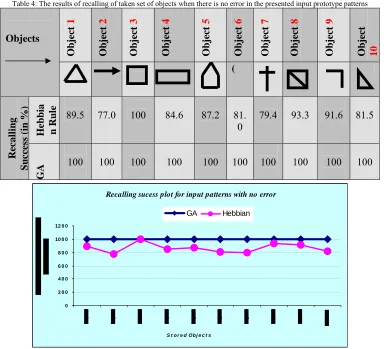
Table 4 shows the results for recalling the stored objects using both Hebbian rule and genetic algorithm, while there is no noise presented in the input pattern. In total 1000 times the recalling was made through both the algorithms separately for each object.
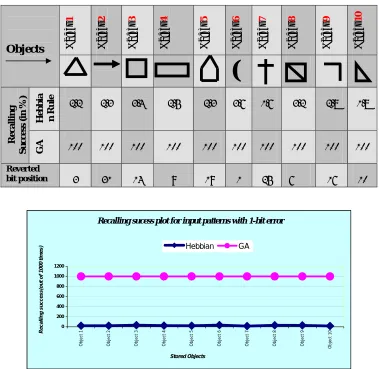
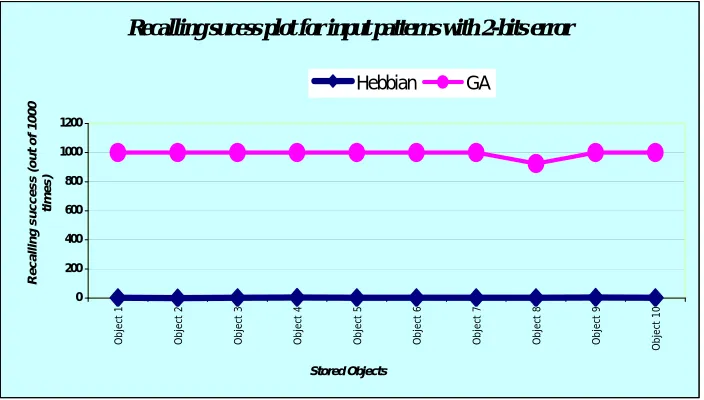
Table 5, 6 and 7 represent the results for recalling the corresponding stored patterns while these are presented with induced noise. In these cases, noise was created by reverting 1-bit, 2-bits and 3-bits in the presented prototype input patterns in the already stored patterns. These positions of the bit(s) to be reverted to create noise are taken randomly.
These results clearly indicate that Hebbian rule works well for a noiseless pattern, for most of the cases, but its performance degrades substantially when the noise is induced in the test pattern. It is a clear failure as noise increases. On the other hand, GA recalls the pattern successfully even when noise is present and Hebbian rule fails.
Figure 5, 6, 7 & 8 are presenting the comparison chart of performance of two algorithms (i.e. Hebbian rule
algorithm and GA algorithm) graphically based on results provided in Tables 4, 5, 6 & 7.
Table 4: The results of recalling of taken set of objects when there is no error in the presented input prototype patterns
Objects Object
1
Object
2
Object
3
Object
4
Object
5
Object
6
Object
7
Object
8
Object
9
Object 10
(
Recalling
Succes
s
(in %
)
Hebbia n Rule
89.5 77.0 100 84.6 87.2 81.
0
79.4 93.3 91.6 81.5
GA
100 100 100 100 100 100 100 100 100 100
Recalling sucess plot for input patterns with no error
0 2 0 0 4 0 0 6 0 0 8 0 0 10 0 0 12 0 0
S t o r e d Ob j e c t s
GA Hebbian
Table 5: The results of recalling of taken set of objects when there is 1-bit error in the presented input prototype patterns
Objects
Ob ject 1 Ob ject 2 Ob ject 3 Ob ject 4 Ob ject 5 Ob ject 6 Ob ject 7 Ob ject 8 Ob ject 9 Ob ject 10(
Reca ll in g S u cc ess (in %) Heb
b
ia
n R
ul
e
2.2 2.3 3.4 2.5 2.3 3.6 1.6 3.2 2.8 1.8
GA 100 100 100 100 100 100 100 100 100 100
Reverted
bit position 3 31 14 9 19 1 25 6 16 10
Recalling sucess plot for input patterns with 1-bit error
0 200 400 600 800 1000 1200 Ob je ct 1 Ob je ct 2 Ob je ct 3 Ob je ct 4 Ob je ct 5 Ob je ct 6 Ob je ct 7 Ob je ct 8 Ob je ct 9 Ob je ct 1 0 Stored Objects R ecal li n g su ccess( o u t o f 1000 ti m
es) Hebbian GA
Figure 6: The results of recalling of taken set of objects with 1-bit error in the input patterns
Table 6: The results of recalling of taken set of objects when there is 2-bits error in the presented input prototype patterns
Objects Ob je ct 1 Ob je ct 2 Ob je ct 3 Ob je ct 4 Ob je ct 5 Ob je ct 6 Ob je ct 7 Ob je ct 8 Ob je ct 9 Ob je ct 10
(
R ec a lling Su c cess (in %) H ebb ia n Rule 0.01 0.00 0.02 0.02 0.01 0.01 0.01 0.01 0.03 0.01
GA 100 100 100 100 100 100 92.6 100 100 100
Reverted
bit position 1,2 4,34 5.12 8,10 10,15 8,21 20,25 2,33 11,18 7,30
Recalling sucess plot for input patterns with 2-bits error
0 200 400 600 800 1000 1200 Ob je ct 1 Ob je ct 2 Ob je ct 3 Ob je ct 4 Ob je ct 5 Ob je ct 6 Ob je ct 7 Ob je ct 8 Ob je ct 9 Ob je ct 1 0 Stored Objects Rec al li n g s u c cess ( o u t o f 1000 ti m e s) Hebbian GAFigure 7: The results of recalling of taken set of objects with 2-bits error in the input patterns
Table 7: The results of recalling of taken set of objects when there is 3-bits error in the presented input prototype patterns
Objects
Ob je ct 1 Ob je ct 2 Ob je ct 3 Ob je ct 4 Ob je ct 5 Ob je ct 6 Ob je ct 7 Ob je ct 8 Ob je ct 9 Ob je ct 10(
R ec a lling Su cc ess (in % ) He b b ia n R ul e0.00 0.00 0.00 0.00 0.00 0.00 0.00 0.00 0.01 0.00
GA 74.2 94.6 95.3 75.7 75.6 91.2 82.2 91.4 44.1 89.7
Reverted
bit position 1,4,35 3,8,24 11,18,
22
5,8,34 11,18, 21, 20,28, 31 7,9, 13 28,30, 34
7,9,13 6,14, 32
Recalling sucess plot for input patterns with 3-bits error
0 200 400 600 800 1000 1200 Objec t 1 Objec t 2 Objec t 3 Objec t 4 Objec t 5 Objec t 6 Objec t 7 Objec t 8 Objec t 9 Ob je ct 1 0 Stored Objects Recal li n g su c cess ( o u t o f 10 00 ti m es) Hebbian GA
4. CONCLUSION
The simulation results (i.e. tables 4-7) are indicating that genetic algorithm has more success rate then the Hebbian rule for recalling the taken set of objects, which are containing 0, 1, 2, and 3 bit errors from stored patterns in Hopfield neural network. Sometimes it has also been observed that the performance of GA was less than what was expected to be. One of the reason for this deviation may be the position(s) of bits reverted to induce noise in the recalling pattern. It is also possible to obtain more than one weight matrices from the generated population of weight matrices as the optimal weight matrices for recalling the exact pattern on presentation of any prototype input pattern of already stored pattern.
The direct application of GA to the pattern association has been explored in this research. The aim is to introduce as alternative approach to solve the pattern association problem. The results from the experiments conducted on the algorithm are quite encouraging. Nevertheless more work needs to be perform especially on the tests for noisy input patterns. We can also use this concept for pattern recognition in the case of different objects, alphabets, shapes, numerals and overlapped alphabet etc.
References:
[1] Jain A K, Robert P W D, Mao J, “Statistical Pattern Recognition: A Review”, IEEE Transactions on Pattern Analysis and Machine Intelligence, vol. 22, number 1, pp. 4-33, (2000)
[2] Ross P E, “Flash of Genius”, Forbes, pp. 98-104, November (1998) [3] Hetch-Nielsen R, Neurocomputing, Adidison Wesley, (1990)
[4] Freeman J A, Skapura D M, Neural Networks: Algorithms, Applications and Programming Techniques, Reading, MA: Adidison Wesley, (1991)
[5] Antognetti P, Milutinovic V, “Neural Networks: Concepts, Applications, and Implementations (Eds.)”, vol I-IV, Prentice Hall, Englewood Cliffs, NJ, (1991)
[6] Anderson J A, Rosenfeld E, “Neurocomputing: Foundations of Research” MIT Press, Boston, MA, (1988)
[7] Hinton G E, Sejnowski T J, “Neural Network Architectures for AI”, Tutorial Number MP2, National Conference on Artificial Intelligence (AAAI-87), (July 1987)
[8] Mangal, M. & Singh, M. P. ‘Analysis of Classification for the Multidimensional Parity-Bit-Checking Problem with Hybrid Evolutionary Feed-forward Neural Network.’, Neurocomputing, Vol. 70, Issues 7-9 , pp.1511-1524, (2007).
[9] Amin, A. H. M., Mahmood, R. A. R. and Khan, A. I. ‘Analysis of Pattern Recognition Algorithms using Associative Memory Approach: A Comparative Study between the Hopfield Network and Distributed Hierarchal Graph Neuron (DHGN)’, IEEE 8th International Conference on Computer and Information Technology Workshoaps (CIT Workshoap 2008), pp. 153–158, (2008) [10] Blumenstien, M., Liu, X. Y. & Verma, B. ‘An investigation of the modified direction feature for cursive character recognition’, Pattern
Recognition, Vol. 40, Issue 2, pp. 376-388, (2007).
[11] Hebb, D. ‘The Organization of Behavior’, A Neuropsychological Theory, Wiley, New York, (1949)
[12] Mangal, M. & Singh, M. P. ‘Analysis of Multidimensional XOR Classification Problem with Evolutionary Feed-forward Neural Networks’, International Journal on Artificial Intelligence Tools, Vol. 16, No.1, pp.111-120 , (2007)
[13] Yao, X. ‘Evolving artificial neural networks’, Proceeding of the IEEE, vol.87,no. 9,pp.1423-1447, (1999)
[14] Pal, S. K., De, S. & Ghosh, A ‘Designing Hopfield type networks using genetic algorithms and its comparison with simulated annealing’, Intl Journal of Pattern Recognition and Artificial Intelligence, Vol. 11, No. 3 pp-447-461, (1997)
[15] Salcedo-Sanz,S. & Yao, X. ‘A Hybrid Hopfield Network-Genetic Algorithm Approach for the Terminal Assignment Problem’IEEE Transactions on Systems, Man, and Cybernetics—Part B: Cybernetics, Vol. 34, No. 6, pp. 2343-2353, (2004)
[16] Jiyou Xu, J. H., & Yao, X. ‘Solving Equations by Hybrid Evolutionary Computation Techniques’, IEEE Transactions on Evolutionary Computation, Vol. 4, Issue 3, pp. 295-304, (2000)
[17] Mangal, M. & Singh, M. P. ‘Handwritten English Vowels using Hybrid Evolutionary Feed-forward Neural Network’, Malaysian Journal of Computer Science, Vol. 19, No. 2, pp. 169-187, (2006)