Image Coding Scheme Based on Object
Extraction and Hybrid Transformation
Technique
Usama S. Mohammed*, Walaa M. Abd-elhafiez**
*
Department of Electrical Engineering, Assiut University, Assiut 71516, Egypt,
**
Mathematical department,faculty of science, Sohag University, Sohag 82524, Egypt.
Abstract
This paper describes an efficient object-based hybrid image coding (OB-HIC) scheme. The proposed scheme is based on using the discrete wavelet transform (DWT) in conjunction with the discrete cosine transform (DCT) to provide coding performance superior to the popular image coders. The proposed method uses combination of the object-based DCT coding and the high performance of the set partitioning in hierarchical tree (SPIHT) coding. The subband image data in the wavelet domain is modified based on the DCT and the object classification of the coefficient in the low-frequency image subband (LL). The modification process provides a new subband image data containing almost the same information of the original one but having smaller values of the wavelet coefficients. Simulation results of the proposed method demonstrate that, with small addition in the computational complexity of the coding process, the peak signal-to-noise ratio (PSNR) performance of the proposed algorithm is much higher than that of the SPIHT test coder and some of famous image coding techniques.
Keywords: Image compression; Region of interest (ROI); Image coding; Wavelet transform; Embedded coding; JPEG 2000; DCT; SPIHT; EZW.
I. INTRODUCTION
In a lossy compression scheme, the image compression algorithm should achieve a tradeoff between compression ratio and image quality. One of the solutions of this problem is to code the image based on the feature extraction [1]. In this method, the pixels are classified in the pre-processing step to code each block of pixels related to its significant. It does not need to send any information about the classification process to the decoder. Another solution to this goal is the object based image coding or the region of interest (ROI) image coding. The general theme is to preserve the quality for diagnostically important regions, whereas the rest of the image (background) is highly compressed. ROI coding usually supports progressive transmission by quality, which may further reduce the transmission time and storage cost. Object-based/ROIs can also be useful in applications such as web browsing, or image retrieval. The detection of ROIs has been studied by various researchers [2- 4].
The object-based Discrete Cosine Transform (DCT) coder produces annoying visual degradation, i.e. the block effect between blocks with the visibility of this effect depending upon local image characteristics. In recent years, much of the research activities in this area have been focused on the distribution of the wavelet coefficients of the image to achieve an embedded image coding. From the most famous and successful techniques is Shapiro's embedded zerotree of wavelet coefficients method (EZW) [5], which exploits the existing zero-correlation across subband images. In practice, to reach a better coding performance of the EZW algorithm, more scales are required and to obtain higher resolution reconstructed images, the complexity of the algorithm will be relatively high. To reduce the computational complexity of the EZW algorithm, Egger et. Al. [6] proposed a two-band based wavelet decomposition scheme. The most important development of the EZW algorithm is the Set Partitioning in Hierarchical Trees (SPIHT) coding technique [7]. SPIHT outperforms EZW in both compression efficiency and speed. Even without arithmetic coding it is more efficient than EZW whose compression efficiency is to some extent
*
Corresponding author Tel.: +20-88-2411779.
due to the use of arithmetic coding. SPIHT is less efficient in coding performance than the embedded block coding with optimized truncation (EBCOT) [8], the main wavelet-based image coding algorithm of the JPEG-2000 standard [9, 10]. SPIHT does not employ any explicit rate-distortion optimization, so it has lower computational complexity than the EBCOT algorithm. EBCOT exploit the dependency between the wavelet coefficients exist inside each subband. The set partitioning embedded block coder (SPECK) [11] is used as a low complexity image coding option of the JPEG-2000 (SPHP) [12, 13]. A higher complexity variant of SPECK, called embedded zero-block coding (EZBC) is introduces by Hsiang and Woods [14]. Another class of image coding techniques is the hybrid image coding [15, 16, 17]. In these techniques, instead of using one transformation a combination of two image transformations are used to get better coding performance. Yu and Mitra [15] introduced a computationally efficient hybrid image coding scheme. The proposed hybrid coding method is based on the nonlinear modification of the wavelet coefficients in the first level using the DCT of the approximation (LL) band image. The EZW coding is applied to the modified wavelet coefficients followed by adaptive arithmetic coding representation to generate the symbol stream. Singh et. Al. [17] presented a hybrid scheme using both discrete wavelet transform (DWT) and discrete cosine transform (DCT) for medical image compression. DCT is applied to the DWT details, which generally have zero mean and small variance, thereby achieving better compression than obtained from either technique alone. Haiping et. Al. [18] presented an algorithm for hyperspectral image compression. It carries DCT on spectral bands to exploit the spectral correlation and then DWT on every eigen image to exploit the spatial correlation. After that, 3D-SPIHT (three-dimensional Set Partitioning in Hierarchical Trees) is performed for encoding. Experiments were done on the OMIS-I (Operational Modular Imaging Spectrometer) image. Usama [16] proposed a highly scalable hybrid image coding scheme (HS-HIC). The proposed hybrid coding scheme combines simply modification of the data in the wavelet domain and the SPIHT coding. The modification of the subband image data is done based on the transformation of the high-frequency subband (details) in the wavelet domain. It is based on linear modification of 9-subband image data within three-layer in the wavelet domain. Except the image data in LL3, all other image data will be linearly modified based on the Discrete Fourier Transform (DFT) components. The modified data is then located in the corresponding position and the simple SPIHT coder followed by adaptive arithmetic coder is applied on the resulting hierarchical representation to generate the symbol stream. A comparison of the most famous image coding methods can be summarized as follows. The SPIHT method is consider the best image coding technique in terms of decoded image quality, progressive rate control and transmission and the simplicity of the coding process. The EZW method provides several dB’s of signal-to-noise ratio improvement for the most real world still images at low bit-rate over the discrete cosine transform (DCT) based JPEG still image coding standard. The SPECK method produces very competitive PSNR results. The JPEG2000 method achieves PSNR results slightly below those of the EZBC method, but appears to provide some perceptual advantage in the reconstructed images, especially in preserving detail information. In this work, the idea of the proposed method is based on the same idea introduced in [15]. The proposed scheme is based on using the discrete wavelet transform (DWT) in conjunction with the discrete cosine transform (DCT) to provide coding performance superior to the popular image coders. The proposed method uses combination of the object-based DCT coding and the high performance of the set partitioning in hierarchical tree (SPIHT) coding.
The remainder of this paper is organized as follows. In section 2, the basic of the SPIHT algorithm is described. The proposed algorithm is introduced in Section 3. Section 4 introduces the idea of the object-based DCT coding process. Simulation results are introduced in Section 5. Finally, concluding remarks are given in Section 6.
II. THE SET PARTITIONING IN HIERARCHICAL TREE (SPIHT) CODING ALGORITHM
In the SPIHT coding algorithm [7], after the wavelet transform using 9/7 tap wavelets from Antonini et al. [19] is applied to an image, the main algorithm works by partitioning the wavelet decomposed image into significant and insignificant partitions based upon the following function
otherwise
0,
2n
}
j)
b(i,
{
T
j)
(i,
max
1,
(T)
n
where Sn(T) is the significance of the set of coordinates T, and b(i,j) is the coefficient value at coordinate (i,j). There
are two passes in the algorithm, the sorting pass and the refinement pass. The sorting pass is performed on the list of insignificant sets (LIS), list of insignificant pixels (LIP) and the list of significant pixels (LSP). The LIP and LSP consist of nodes that contain single pixels while the LIS contains nodes that have descendants. The maximum number of bits required to represent the largest coefficients in the spatial orientation tree is obtained and designed as nmax and is given by
max
{
b(i,
j)
}
j)
(i,
log2
nmax
(2)During the sorting pass, those coordinates of the pixels which remain in the LIP are tested for significance by using equation (1). The result Sn(T) is sent to the output. Those that are significant will be transferred to the LSP as well as
have their sign bit output. Sets in the LIS will also have their significance tested and if found to be significant, will removed and partitioned into subsets. Subsets with a single coefficient and found to be significant will be added to the LSP, or else they will be added to the LIP. During the refinement pass, the n-th most significant bit of the coefficients in the LSP is output. The value of n is decreased by 1 and the sorting and refinement passes occur again. This continues until either the desired rate is reached or until n=0 and all nodes in the LSP have all their bits output. It is clear from equation (1) and (2) that the coding performance of the SPIHT coding algorithm is highly related to the distribution of the b(i,j) in the 3P+1 subband images, where P is the number of scales. So, the normalization of the filter coefficients is indeed an efficient bit allocation scheme to put more bits in coding of lower frequency subband images. Moreover, to reach the higher coding performance, more scales in the wavelet decomposition are required. The main disadvantage of the SPIHT coding algorithm is that the error in one bit of the coded bit stream will result in a noticeable error in output of the decoder.
III. PROPOSED OBJECT-BASED HYBRID IMAGE CODING (OB-HIC) ALGORITHM
In this work, combination of the object-based DCT coding and the high performance of the set partitioning in hierarchical tree (SPIHT) coding is used. The modification of the subband image data in the wavelet domain is done based on the DCT transformation and the classification of the wavelet coefficients in the LL subband. The modified data size is exactly the same size as the original one and containing almost the same original information but having smaller values. The proposed hybrid coding algorithm is described next.
First, one-level of the discrete wavelet transform is applied on the input image. This process will generate 4-subband data (xll, xlh, xhl, xhh) in this layer. Next, the baseband image
x
ll(i,
j)
is compressed using the object-based DCTcoding method (this process is reported in Section 4), and its reconstructed image is designed asx'(i,j)
ll . The
difference between
x
ll(
i
,
j
)
and x'(i,j)ll is the residual basedband image (, )
'' i j xll , i.e.
).
j
,
i
(
x
)
j
,
i
(
x
)
j
,
i
(
x
' ll ll ''ll
=
(3)Weber’s law indicates that for a wide range of image intensity, the ratio of the just-noticeable difference (j.n.d) to the image intensity is a constant. To make use of this phenomenon in the proposed coding algorithm, the subband image
x
ll''(
i
,
j
)
,x
lh(
i
,
j
)
,x
hl(
i
,
j
)
andx
hh(
i
,
j
)
will be normalized as indicated below:k
j
i
x
j
i
x
j
i
x
ll ll nll
)
,
(
)
,
(
)
,
(
' ''k
j)
(i,
x
j)
(i,
x
j)
(i,
x
' ll lh nlh
k
j
i
x
j
i
x
j
i
x
ll hl n hl
)
,
(
)
,
(
)
,
(
'k
j)
(i,
x
j)
(i,
x
j)
(i,
x
' ll hh n hh
(4)Where k is a constant used to minimize the number of the sorting passes in the SPIHT coder, and will be determined as follows:
2
/
))
(
*
2
)
(
(
Max
X
ll''Max
X
ll'K
(5)
y
i
j
p
q
j
i
y
j
i
y
n p n p np
(
,
)
1(
,
)
2
1(
,
)
,
1
,...,
(6)Where
y
0n(i,
j)
is the value of the normalized coefficientsx
lln(
i
,
j
)
,x
lhn(
i
,
j
)
,x
nhl(
i
,
j
)
andx
hhn(
i
,
j
)
, and q is an integer constant which may change with different subbands. After normalization and mapping, four sub-images are generated and designated asy
nll(
i
,
j
)
,y
lhn(
i
,
j
)
,y
hln(
i
,
j
)
and yhhn(i,j), which are then located in the corresponding positions of xll(i,j), xlh(i,j),x
hl(
i
,
j
)
andx
hh(
i
,
j
)
in the wavelet decomposition. Then, the data iny
lln(
i
,
j
)
is rearranged into four sub-images,(2i,2j)
y
j)
(i,
y
n ll 1 n ll=
1,2j)
(2i
y
j)
(i,
y
n ll 2 nll
1)
(2i,2j
y
j)
(i,
y
n ll 3 nll
(7)1)
1,2j
(2i
y
j)
(i,
y
n ll 4 nll
This rearrangement is further applied on
y
lln1(
i
,
j
)
and so on to obtain hierarchical representation ofylln(i,j),y (i,j)n
lh ,
) , (i j
yn
hl and y (i,j) n
hh to be coded by the SPIHT coder. SPIHT image coding without adaptive multilevel arithmetic
coding is finally applied on the resulting hierarchical representation to generate symbol streams.
IV. OBJECT-BASED DCT IMAGE CODING
In general, the idea behind the object based DCT image coding is base on modification of the quantized image based on pre-processing (object edge extraction). The modification will be done after the quantization step. The image is subdivided into a block of pixels and then these blocks is classified into edge and non-edge blocks. For the non-edge blocks, a certain number of these block will be located in the top left hand corner and multiplied the rest of our DCT coefficients with 0 (mask matrix). This would simplify the coding process and improve the compression ratio, but the quality of the compressed image will be reduced. This “mask” matrix determined what dimension of the upper left-hand corner of quantized DCT coefficients would be kept and the rest of the coefficients multiplied by 0. In this work, the LL band image is segmented into region of interest (ROI), which is considered important, and background, which is less important. By allowing the ROI to be coded with higher fidelity than background, a high compression ratio with good quality in the ROI can be achieved. Therefore, the greatest benefit of ROI coding is its capability of delivering high reconstruction quality over certain spatial regions at high compression ratios.
The object-based DCT image coding process is divided into two steps in the wavelet domain. First is the identification (classification) process and second is the compression process. To identify the ROI, the LL image edges are detected by rainfalling watershed technique [18], and then a morphological filter is used to fill in holes and small gaps. In the rainfalling watershed technique, the threshold value is calculated automatically using the maximum cross-entropy methods [21]. After the classification process, all the background-area is compressed using only the DC coefficient of one block from the background and the foreground-area is compressed using all the DCT coefficients.
In the rainfalling watershed technique, the threshold, using in the edge detection process, is obtained automatically using the entropy-based methods [21]. It is based mainly on maximizing the cross-entropy between the edge and non-edge levels. Automatically threshold estimation technique can be summarized as follows:
Assume that the foreground and background probability mass function (pmf) is expressed as Pf(g), 0≤ g ≤T, and Pb(g), T+1≤ g ≤G, respectively, where G is the maximum gray level, T is the threshold. The foreground and
background area probabilities are calculated as follows:
T g ff
T
P
p
g
P
0)
(
)
(
G T g bb
T
P
p
g
P
1
)
(
)
(
(8)then the Shannon entropy parametrically dependent upon the threshold T for the foreground and background is formulated as:
T g f ff
T
P
g
P
g
H
0)
(
log
)
(
)
(
,(
)
(
)
log
(
)
1
g
P
g
P
T
H
b G T g b b
the sum of these two entropy expressed by H(T)=Hf(T)+Hb(T).
The optimum threshold can be viewed as the threshold that makes the summation of the background and foreground entropy be maximum, which can be formulated by:
Topt=arg max [Hf(T)+Hb(T)] (10)
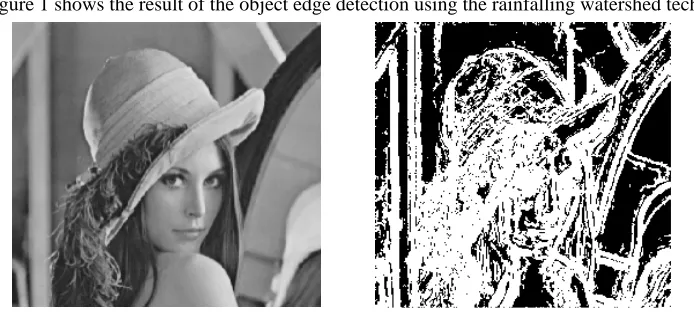
Figure 1 shows the result of the object edge detection using the rainfalling watershed technique.
Fig. 1 the Lena image and the result of applying the rainfalling watershed technique on the image
V. SIMULATION RESULTS
The performance of the proposed techniques is introduced in this section. Various kinds of gray images with size of 512×512 pixels and 8 bpp are selected as a test data. The performance is evaluated by the peak signal-to-noise ratio (PSNR) in dB and the perceptual quality of the reconstructed images. The proposed method is compared with JPEG, JPEG2000, EZBC, SPIHT, EZW, SPECK, Yu and Mitra [15], and the HS-HIC [16].
The 9-tap low-pass filter and the 7-tap high-pass filter are used to decompose the input image into four sub-images. The resulting baseband image was coded with the object-base DCT coder followed by adaptive arithmetic code at moderate bit rates. The constant k in the normalization was automatically calculated from equation (5) and the rearrangement in equation (7) was performed to obtain a 6-scale hierarchical data structure.
In the simulation results the exact number of bits used is selected as follows:
For Lena image we used 32446 bits in DCT coding, and 322 bits in SPHIT coding so that the total bit rate per pixel (bpp) is 0.125. To achieve total bit rate per pixel (bpp) is 0.25, we used 65214 bits in DCT coding, and 322 bits in SPHIT coding. The total bit rate per pixel of 0.5 bpp is achieved using 130429 bits in DCT coding, and 643 bits in SPHIT coding.
For Barbara image we used 32397 bits in DCT coding, and 371 bits in SPHIT coding so that the total bit rate per pixel (bpp) is 0.125. To achieve total bit rate per pixel (bpp) is 0.25, we used 57551 bits in DCT coding, and 7985 bits in SPHIT coding. The total bit rate per pixel of 0.5 bpp is achieved using 127517 bits in DCT coding, and 3555 bits in SPHIT coding.
For Goldhill image we used 25264 bits in DCT coding, and 7504 bits in SPHIT coding so that the total bit rate per pixel (bpp) is 0.125. To achieve total bit rate per pixel (bpp) is 0.25, we used 65214 bits in DCT coding, and 322 bits in SPHIT coding. The total bit rate per pixel of 0.5 bpp is achieved using 130429 bits in DCT coding, and 643 bits in SPHIT coding.
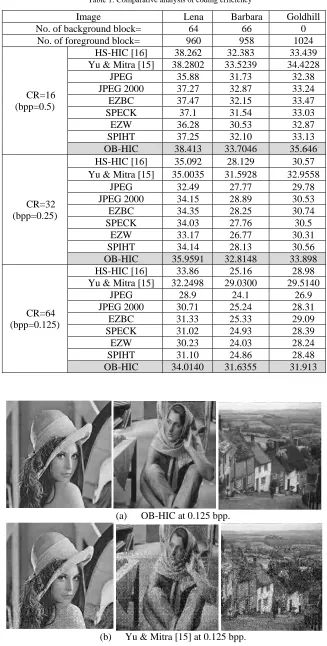
Table 1: Comparative analysis of coding efficiency
Image Lena Barbara Goldhill
No. of background block= 64 66 0
No. of foreground block= 960 958 1024
CR=16 (bpp=0.5)
HS-HIC [16] 38.262 32.383 33.439 Yu & Mitra [15] 38.2802 33.5239 34.4228
JPEG 35.88 31.73 32.38
JPEG 2000 37.27 32.87 33.24
EZBC 37.47 32.15 33.47
SPECK 37.1 31.54 33.03
EZW 36.28 30.53 32.87
SPIHT 37.25 32.10 33.13
OB-HIC 38.413 33.7046 35.646
CR=32 (bpp=0.25)
HS-HIC [16] 35.092 28.129 30.57 Yu & Mitra [15] 35.0035 31.5928 32.9558
JPEG 32.49 27.77 29.78
JPEG 2000 34.15 28.89 30.53
EZBC 34.35 28.25 30.74
SPECK 34.03 27.76 30.5
EZW 33.17 26.77 30.31
SPIHT 34.14 28.13 30.56
OB-HIC 35.9591 32.8148 33.898
CR=64 (bpp=0.125)
HS-HIC [16] 33.86 25.16 28.98
Yu & Mitra [15] 32.2498 29.0300 29.5140
JPEG 28.9 24.1 26.9
JPEG 2000 30.71 25.24 28.31
EZBC 31.33 25.33 29.09
SPECK 31.02 24.93 28.39
EZW 30.23 24.03 28.24
SPIHT 31.10 24.86 28.48
OB-HIC 34.0140 31.6355 31.913
(a) OB-HIC at 0.125 bpp.
(c) SPIHT at 0.125 bpp.
Fig. 2 The results of SPIHT, Yu and Mitra [15], and OB-HIC image coder at 0.125 bpp bit rate.
(a) OB-HIC at 0.5 bpp.
(b) Yu & Mitra [15] at 0.5 bpp.
Fig. 3 The results of Yu and Mitra [15] and OB-HIC image coder at 0.5 bpp bit rate.
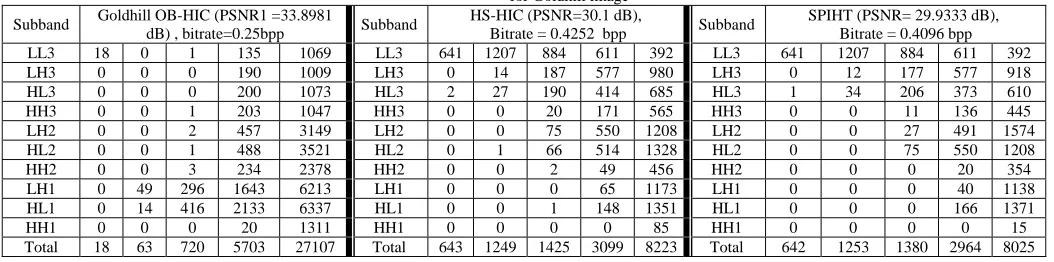
To demonstrate the effect of the hybrid approach in OB-HIC technique, the numbers of significant coefficients were calculated in all subbands in the wavelet domain during the coding process to compare the results of the proposed technique related to the results of the SPIHT coder and the HS-HIC coder in each subband. Only 3-layers are used in this test. Table 2 provides the number of significant coefficients in each subband for the OB-HIC, HS-HIC and SPIHT of Lena image for five passes of the coding process. The bit rate results in this table are calculated without arithmetic coding. The results in this table reveal the performance gain in each subband of the proposed coder (OB-HIC) related to the other coders. As expected, the number of significant coefficients in each pass of the OB-HIC coder is lower than the number of significant coefficients in each pass of the SPIHT coder and the HS-HIC coder. Simulation results show that, in most cases, the binary non-coded bit rate of OB-HIC coder is much better than that of SPIHT and HS-HIC coder.
Table 2: List of significant coefficients comparison between OB-HIC, HS-HIC and SPIHT coding performance at each pass of the coding process for Lena image
Subband Lena OB-HIC (PSNR1 =
35.7713dB) , bitrate=0.5 bpp Subband
HS-HIC (PSNR=33. 9041 dB),
Bitrate =0.4366 bpp Subband
Lena SPIHT (PSNR=31.4271 dB), bitrate=0.3764 bpp LL3
10 51148 36 29 LL3 853 1235 1049 398 243 LL3 853 1235 1049 398 243
LH3 0 0 0 378 LH3 190 141 363 583 LH3 180 138 266 457
HL3 0 0 2 288 HL3 816 305 561 612 HL3 832 301 502 580
HH3 0 0 0 331 HH3 0 615 229 467 HH3 0 561 201 365
LH2 0 610 404 1039 LH2 0 1376 699 1435 LH2 0 380 294 885
HL2 0 0 6 485 HL2 110 165 707 1477 HL2 0 1370 699 1435
HH2 0 0 1526 574 HH2 0 0 1278 505 HH2 0 0 871 520
LH1 0 0 550 370 LH1 0 0 340 640 LH1 0 0 260 567
HL1 0 0 3047 1639 HL1 0 0 2806 1469 HL1 0 0 2140 1371
HH1 0 0 0 350 HH1 0 0 0 871 HH1 0 0 0 240
Total
10 133148 973 3832 Total 859 1357 1872 3399 7518 Total 855 1343 1720 2687 6397
Table 3: List of significant coefficients comparison between OB-HIC, HS-HIC and SPIHT coding performance at each pass of the coding process for Barbara image
Subband barbara OB-HIC (PSNR1=32.7856 dB) ,
bitrate=0.25bpp Subband
HS-HIC (PSNR= 28.1294 dB),
Bitrate = 0.33 bpp
Subband SPIHT (PSNR=25.097dB),
Bitrate = 0.2455 bpp
LL3
10 82 82 53 LL3 856 1369 957 545 LL3 856 1369 957 545
LH3 0 101 24 LH3 250 141 432 LH3 250 136 362
HL3 0 0 196 HL3 560 271 517 HL3 580 257 534
HH3 0 0 170 HH3 0 230 212 HH3 0 0 1686
LH2 0 0 435 LH2 0 1480 1027 LH2 0 530 308
HL2 0 0 220 HL2 0 2079 941 HL2 0 1500 1038
HH2 0 0 0 HH25 0 470 448 HH2 0 0 3860
LH1 0 100 54 LH1 0 0 0 LH12 0 0 0 0
HL1 120 1160 4931 HL1 0 4180 2733 HL1 0 300 2154
HH1 0 0 0 HH13 0 0 3460 HH1 0 0 0 1
Total
10 95 1273 5171 Total 856 1459 2212 7203 Total 856 1452 1589 5495
Table 4: List of significant coefficients comparison between OB-HIC, HS-HIC and SPIHT coding performance at each pass of the coding process for Goldhill image
Subband Goldhill OB-HIC (PSNR1 =33.8981
dB) , bitrate=0.25bpp Subband
HS-HIC (PSNR=30.1 dB),
Bitrate = 0.4252 bpp Subband
SPIHT (PSNR= 29.9333 dB), Bitrate = 0.4096 bpp LL3
18 0 1351 1069 LL3 641 1207 884 611 392 LL3 641 8841207 611 392
LH3 0 0 1900 1009 LH3 140 187 577 980 LH3 120 177 577 918
HL3 0 0 2000 1073 HL3 272 190 414 685 HL3 341 206 373 610
HH3 0 0 2031 1047 HH3 0 200 171 565 HH3 0 110 136 445
LH2 0 0 4572 3149 LH2 0 750 550 1208 LH2 0 270 491 1574
HL2 0 0 4881 3521 HL2 0 661 514 1328 HL2 0 750 550 1208
HH2 0 0 2343 2378 HH2 0 0 492 456 HH2 0 0 200 354
LH1 490 296 1643 6213 LH1 0 0 650 1173 LH1 0 0 400 1138
HL1 140 416 2133 6337 HL1 0 0 1481 1351 HL1 0 0 1660 1371
HH1 0 0 200 1311 HH1 0 0 0 850 HH1 0 0 0 150
Total
18 63 720 5703 27107 Total 643 1249 1425 3099 8223 Total 642 1253 1380 2964 8025
VI. CONCLUDING REMARKS
References
[1] Usama Sayed, Image Coding Technique Based on Object-Feature Extraction,In the Proceedings of the National Radio Science Conference
(NRSC'2005), Cairo, Egypt, CD (Commission C16), (2005).
[2] K. An, M Lee, J. Shin, Saliency map model based on the edge images of natural scenes, International Joint Conference on Neural Networks (IJCNN), USA, (2002).
[3] B. Ko, S Kwak, H. Byun, SVM-based salient region(s) extraction method for image retrieval, 17th International Conference on Pattern
Recognition (ICPR 2004), Cambridge, UK, 977-980 (2004).
[4] G.P. Nguyen, M. Worring, An user based framework for salient detail extraction, IEEE International Conference on Multimedia and Expo (ICME), Taipei, Taiwan, (2004).
[5] J. Shapiro, Embedded image coding using zerotress of wavelet coefficients, IEEE Trans. Signal Processing, 41:3445-3462 (1993).
[6] O. Egger, A. Nicoulin, W. Li, Embedded zerotree based image coding with low decoding complexity using linear and morphological filter banks, in: Proceeding of IEEE International Conference on Acoustics, Speech and Signal Processing, New York, NY, USA, 2237-2240 (1995).
[7] A. Said and W. Pearlman, A new, fast and efficient image codec based on set partitioning in hierarchical trees, In IEEE Trans. Circuits and Systems for Video Technology, 3: 243-250 (1996).
[8] D. Taubman, High performance scalable image compression with EBCOT, IEEE Trans. Image Process, 7: 1158-1170 (2000). [9] ISO/IEC JTC1/SC29/WG1 N871 R, Embedded, Independent block-based coding of subband data, July 1998.
[10] ISO/IEC JTC1/SC29/WG1 N1020 R, EBCOT: Embedded block coding with optimized truncation, October 1998.
[11] A. Said and W. Pearlman, Low-complexity waveform coding via alphabet and sample-set partitioning, In Visual Communications and Image Processing '97, Proc. SPIE 3024, 25-37 (1997).
[12] C. Chrysafis, A. Said, A. Drukarev, A. Islam, W. A. Pearlman, SBHP-a low complexity wavelet coder, in IEEE International Conference on
Acoustics, Speech and Signal Processing (ICASSP 2000), Istanbul, Turkey, (2000).
[13] W. A. Pearlman, A. Islam, N. Nagaraj, A. Said, Efficient, low-complexity image coding with a set-partitioning embedded block coder, IEEE
Trans. Circuits Syst. Video Technol, 11:1219-1235 (2004).
[14] Shih-Ta Hsiang, J.W.Woods, Embedded image coding using zeroblocks of subband/wavelet coefficients and context modeling, MPEG-4
Workshop and Exhibition at ISCAS 2000, Geneva, Switzerland, (2000).
[15] T. Yu and S. K. Mitra, Wavelet based hybrid image coding scheme, IEEE international symposium on circuits and systems, 1:377-380
(1997).
[16] Usama Sayed, Highly Scalable Hybrid Image Coding Scheme, In the Digital Signal Processing Journal, Science Direct, 18(3): 364-374
(2008).
[17] S. Singh, V. Kumar, and H. K. Verma, DWT-DCT hybrid scheme for medical image compression, Journal of Medical Engineering &
Technology, 31(2): 109–122 (2007).
[18] Wei, Haiping; Zhao, Baojun; He, Peikun, Hyperspectral image compression using SPIHT based on DCT and DWT, Proceedings of the
SPIE, 6787: 67870H (2007).
[19] M. Antonini, M. Barlaud, P. Mathieu, and I. Daubechies, Image coding using wavelet transform, IEEE Trans. Image Processing, 1: 205-220 (1992).
[20] T. Yu and S. K. Mitra, a novel DPCM algorithm using a nonlinear operator, Proc. IEEE international conference on image processing'94,
Austin, Texas, USA,871-875 (1994).
![Fig. 2 The results of SPIHT, Yu and Mitra [15], and OB-HIC image coder at 0.125 bpp bit rate](https://thumb-us.123doks.com/thumbv2/123dok_us/9600331.1488508/7.612.152.461.225.451/fig-results-spiht-mitra-hic-image-coder-rate.webp)