S T U D Y P R O T O C O L
Open Access
The
“
Happy Heart
”
educational program for
changes in health habits in children and their
families: protocol for a randomized clinical trial
Vanessa Minossi
1and Lucia Campos Pellanda
1,2*Abstract
Background:The prevalence of childhood obesity increased worldwide in recent decades and is associated with risk factors for the development of chronic diseases in adulthood. Strategies for health promotion directed at an early age, with recommendation for healthy habits, can achieve good results. The objective of this study is to evaluate the effectiveness of an innovative, simple and cost effective educational program to improve eating habits, physical activity and the knowledge about healthy habits in children, as well as in their families, as compared to routine outpatient care.
Methods/Design:The study is designed as a randomized clinical trial. Sample size is estimated to include 37 children, aged between 7 and 11 years, and their guardians, randomized for an intervention or a control group. The intervention will consist of 11-weekly group meetings of nutritional education and distribution of explanatory material, with orientation about healthy food and family habits and physical activity. Recreational, simple and low cost resources, carefully designed for the presentation of contents to the children and parents, will be used in all meetings. The control group will receive standard outpatient care based in individual clinical practice guidelines. The primary outcomes will be changes in dietary habits, knowledge and physical activity of children and adults. The secondary outcomes will be changes of body mass index, waist circumference, systolic and diastolic blood pressure and laboratory tests, in children and adults.
Discussion:The Happy Heart Study offers a playful and low-cost approach for the prevention and control of obesity and cardiovascular disease in children. Although this program is being planned for implementation in Brazil, the method can be adapted to many other countries.
Registry of protocol:Protocol registered on the site ensaiosclinicos.gov.br: RBR-8ttw64.
Keywords:Children, Family, Risk factors, Obesity
Background
The global incidence of childhood obesity in recent decades has been considered as a worldwide epidemic, present in all socioeconomic classes, age and ethnical groups [1]. Although this incidence has plateaued in many developed countries, it is still increasing in many parts of the world [2-4]. Children with excess weight are
at a greater risk of obesity in adult life. In a cohort that included 1709 overweight 5–12 year-olds, almost half of the girls and a third of the boys became obese adults before the age of 40. Of those with more than 12 years old, 60% remained obese in adulthood [5]. A systematic review showed that overweight children had twice the risk of becoming overweight adults, compared with healthy weight children [6].
Poor lifestyle habits, such as consuming processed foods, with high sugar, fat and sodium content; reduced consumption of fruits and vegetables; sedentary activities such as long periods spent watching on TV or at the * Correspondence:[email protected]
1Post-Graduation Program in Health Sciences: Cardiology, Instituto de
Cardiologia/Fundação Universitária de Cardiologia, Lucia Campos Pellanda– Research Unit, Av. Princesa Isabel, 370, Santana, Porto Alegre 90620-000, RS, Brazil
2Universidade Federal de Ciências da Saúde de Porto Alegre, Porto Alegre,
RS, Brazil
computer; all contribute to the continuing increase in the prevalence of overweight among children [7-10].
Previous studies have shown that the habit of watching more than two hours of TV a day is associated with an unfavorable body composition [10] and may affect phys-ical and psychologphys-ical health. Decreased levels of physphys-ical fitness, low self-esteem, social behavior change and lower levels of academic achievements have been related to screen time [11].
Conversely, changes in lifestyle, including decreasing screen time, reducing consumption of fat-rich foods and reducing physical inactivity may lead to decreased body mass index (BMI) [11,12].
Childhood is considered as a critical period, during which the patterns of dietary habits and lifestyle are learnt and rooted [13,14]. The fact that, in this age group, the control over eating habits is still largely dependent on the parents makes the treatment more complex, since success depends on involving the family in the whole reeducation process [11,15-17]. Results of a meta-analysis revealed that interventions that included family members produced larger effects than interven-tions focusing only in children [18,19].
Therapeutic groups represents another important option, since they promote and enhance the process of health education. Problems are divided among the group com-ponents and solutions are sought collectively, helping to achieve the bigger objective which is the change in behavior, both for the family and the child [17-19].
There is evidence that social support helps to improve lifestyle habits. Many patients find the motivation and energy required to maintain healthy eating plans through the support of their peers. Group support is one of the most valuable ways of support, especially regarding motiv-ation [11].
Preventive interventions, including health education strategies to reduce obesity and other cardiovascular risk factors in children, are important tools for the reduction of the epidemics cardiovascular diseases in the future [20-22]. Educational programs focusing in food habits are being implemented in various countries [23-25], but studies on interventions to reduce cardiovascular risk factors in childhood in the routine pediatric ambulatory are still scarce [26,27].
A systematic review and meta-analysis conducted by our group showed that education and physical activity interventions in children have good results on blood pres-sure control and biochemical parameters [28], however, there is little effect an antropometric measures [28].
Individuals develop theories to explain experiences and discuss concepts from observations and analyzes, thus systematizing their knowledge. The information in itself is not enough to change habits and attitudes; only when the individual gives sense to the information that
it becames knowledge, which can lead to an attitude change. Knowledge is processed and acquired from several ways, depending on the context, the time, the emotional status and motivation of individuals. It is noteworthy that perception is influenced by socio-cultural habits and by the personality of the perceiver, which determine how the individual sees, hears, thinks, acts and feels [21].
Scholars in the field of education explain the construc-tion of knowledge in several ways. In accordance with the Swiss educator Jean Piaget, the development of intelligence in children is based on an approach that considers knowledge a result of subject-object inter-action [29]. The subject learns by his inter-actions, as he/she builds his knowledge from interactions with the environ-ment. Development is an ongoing and always expanding process [29]. Russian neuropsychologist Lev Vygotsky believed that education and knowledge building take place within a cultural-historical context. Thus, know-ledge building occurs through experiences and habits, attitudes and values of those who interact with the child in his family group and in their living group. Therefore, it is in the intra- and interpersonal relationships that the subject will internalize the knowledge of social roles and functions [30]. For the researchers Maturana [31,32] and Varela [33], life is a continuous process of knowledge. Educating constitutes a process during which the indi-viduals live with one another, constantly adjusting this coexistence in a way in which makes progressively more congruent with each other in the living space. Learning happens, therefore, all the time and in a reciprocal way [31-33]. For Freire, the maturation of new possibilities and new challenges occurs through the exploitation of the environment; the subject builds new answers, and the construction of knowledge occurs through inter-action with the world. The knowledge of the child in early childhood is based on the observation of the attitudes of adults. Bridging this concept to health edu-cation in childhood, playful activities are very effective in the teaching-learning process, arousing curiosity and facilitate the child’s understanding [34]. The pedagogical workshops can serve as catalysts for construction of collective/individual creative knowledge. Every workshop needs to promote search, action and reflection, combin-ing individual and collective work and ensurcombin-ing the unity of theory and practice [29,32].
showed increased knowledge and improved self-care of these individuals [35,36]. Thus, increasing knowledge may help to improve self-care related to life habits changes.
In this context, the present study aims to present a dif-ferentiated proposal that includes technological resources that are already part of the lives of young people. The target population is formed by schoolchildren, also called “digital natives”. The construction of learning in a healthy education should involve attractive tools, in accordance with the reality of the world in which they live, in order to reach a more effective practical modifi-cation of life habits [28,37,38].
This proposal aims to work with a mixture of low cost and innovative materials, associating recreational activities with everyday knowledge of the participants and scientific knowledge of professionals involved, through the forma-tion of a group (children and parents) in which partici-pants can share experiences [11-15]. It is a proposal involving collective construction of healthy habits, with the potential to reach a large number of people, thus reducing expenses with the consequences of future chronic diseases [22,23].
In addition, the use of a multidisciplinary educational intervention protocol for prevention of chronic diseases, guiding the child and family toward the construction of a critical, conscious and healthy thinking, can allow the individual to multiply the knowledge among family, school, work and community as a whole. After validation by the present study, this protocol may be used in differ-ent settings (school, family health strategy, community centers), allowing the prevention of chronic diseases through an educational program.
Thus, our hypothesis is that an educational program with playful activities for children and families, including text message reminders and social media composed of recreational activities is effective to increase the know-ledge, physical activity and improve cardiovascular risk in children with risk factors, when compared to usual outpatient management. The objectives of the study are evaluate the effectiveness of an innovative, simple and cost-effective educational program in improving eating habits, physical activity and the knowledge of healthy habits in children, as well as their families, compared to routine ambulatory medical care.
Methods/Design Study design
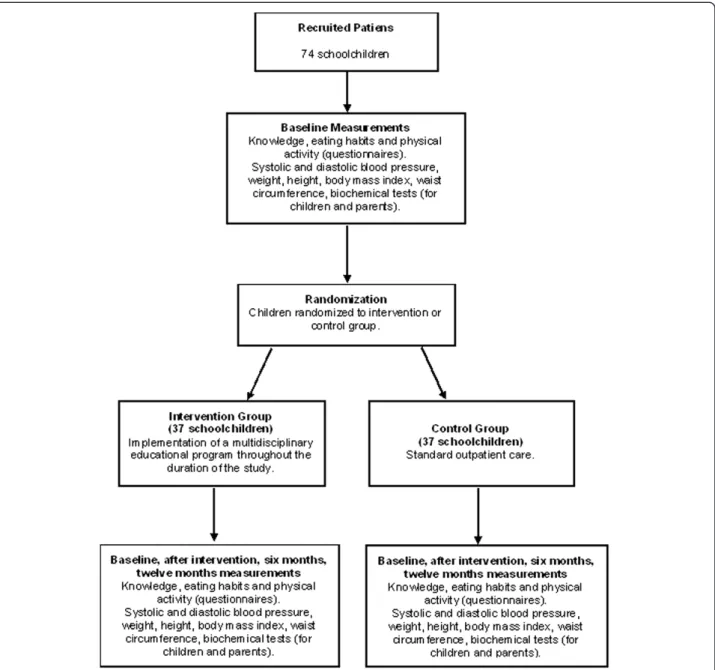
The study is planned as a randomized controlled, out-come evaluator-blinded parallel prospective clinical trial. This protocol is based in the CONSORT and SPIRIT statements for reporting of clinical trials and protocols [39,40]. A total of 74 children will be recruited. After the initial assessment, children will be randomized to either the intervention or the control groups with 1.1 allocation
(Figure 1). The study setting is the“Instituto de Cardiolo-gia do Rio Grande do Sul”, a cardiology hospital in south Brazil.
Participants and recruitment
Patients will be recruited through public announcements in radio and newspapers of wide circulation in the State of Rio Grande do Sul, and through referrals by health professionals from the public health system. All children and their guardians will be informed about the goals and methods of the study. Parents and children who meet the inclusion criteria and agree to participate in the study will sign an informed consent.
Inclusion/exclusion criteria
Inclusion criteria are: Children aged 7 11 years present-ing at least one of the followpresent-ing risk factors: overweight or obesity, hypertension, dyslipidemias or diabetes.
Exclusion criteria are: contraindications for the prac-tice of physical activity, use of drugs that would interfere with body weight and/or lipid profile and neurological or cognitive deficits that would prevent the completion of questionnaires.
Interventions
The goal of the intervention is to improve health habits of students and their families. Children and their families will receive intervention for eleven weeks. The materials will be developed around the following key messages:
a) Consequences of inadequate eating habits; b) Recommendation of adequate intake of nutrients; c) Health promotion strategies.
will take place at the cooking lab (days 3 and 8). During the 9 weeks of workshops, text messages will be sent twice a week, on Mondays and Saturdays (total of 18 messages). Message content will be related to practical tips for a healthy lifestyle. Some examples are presented in Table 1.
After the end of each workshop, the participants will receive information about the importance of healthy prac-tices for cardiovascular health and homework assignments (painting, collages, games, creating stories and drawings), in order to improve awareness and encourage the correct choice of foods to improve lifestyle. Text messages with motivational phrases will be sent to the parents during the week and, in the days prior to meetings, they will be
reminded of the local and time of activities, in order to stimulate attendance. In addition, a closed group will be created on the social network Facebook, for sharing experiences, exchanging recipes, questions, progress and suggestions, thus strengthening the link between patients and professionals.
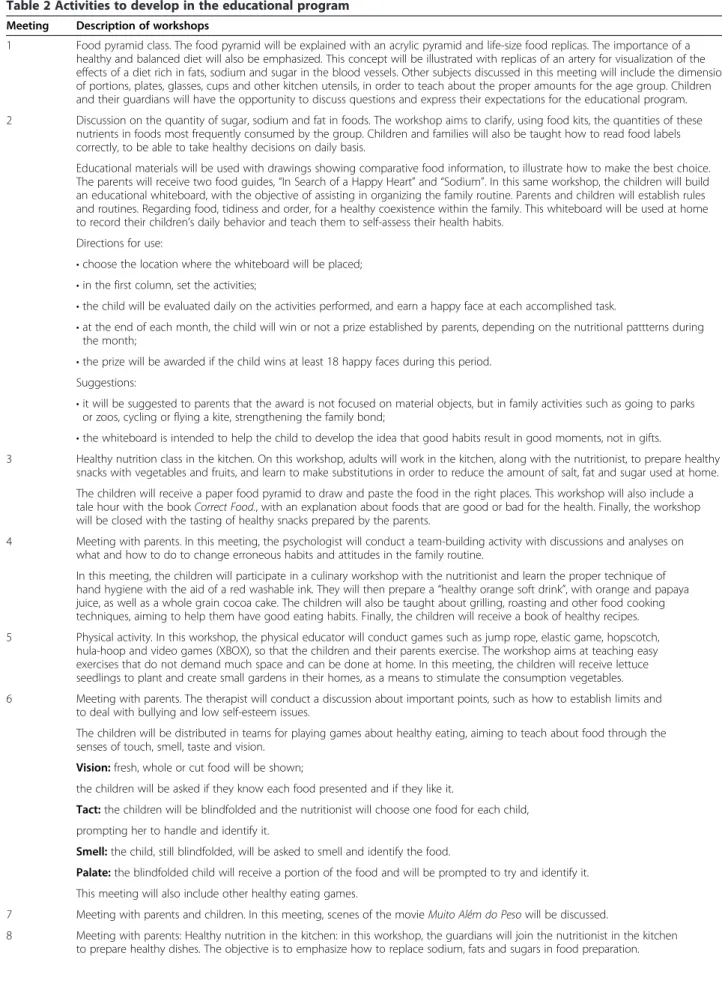
A total of 11 meetings will be held. The first and the last meetings will be used for nutritional and biochem-ical assessment and the nutrition education program will be developed during the remaining nine meetings with 90-minute weekly workshops, summing up a total of eleven weeks of participation. The activites will be dele-veloped as part of the educational program, as shown in Table 2.
Control group
The participants will be seen at the Outpatient Cardi-ology Clinic of the Institute of CardiCardi-ology. Children in the control group will be seen every two weeks, receiv-ing orientation about correct eatreceiv-ing habits and the need to increase physical activity. This type of care is per-formed routinely, but a specific day will be reserved for these patients in the outpatient clinic.
Each child will receive a booklet with written guide-lines. Targets will be set with the child, to promote a change of attitudes and motivation specifically focused on possibly inappropriate food choices detected.
At the end of the study, the intervention activities will be offered to all participants in the control group.
Outcomes
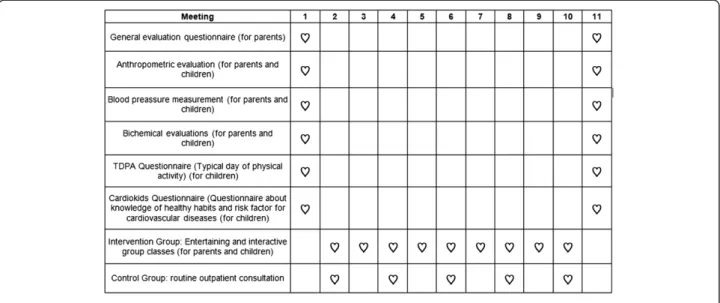
The primary outcomes will be the differences between the intervention and control groups with regard to changes in dietary habits, knowledge and physical activ-ity of the participants, from the beginning to the end of follow-up for children and adults. The secondary out-comes will be the differences between the intervention and changes in body mass index, waist circumference, systolic and diastolic blood pressure, total cholesterol, LDL-cholesterol, HDL-cholesterol, triglycerides, glucose, complete blood count and C-reactive protein, both in children and their parents. Figure 2 presents a timeline for assessing the outcomes.
Evaluation of outcomes
Time schedules for both groups is presented in Figure 2. All results will be evaluated at the beginning and at the end of follow-up, in all participants in the intervention and control groups.
A general evaluation questionnaire will be administered to the parents, to identify personal details of parents and children, breastfeeding time, age of introduction of com-plementary foods, early and family history. Evaluation tools used with the children will include the“TDPA” and the“Cardiokid”questionnaires.
The TDPA (Typical day of physical activity question-naire) is an illustrated and structured questionnaire, developed in the Portuguese language by a group of researchers from Brazil, with the purpose of obtaining information about a typical day of physical activity [41]. The questionnaire was developed for children aged 7 10 years and is evaluated by a sum of scores: children reaching a total lower than 36 classified as“less active”, from 37 to 58 as “intermediate”, and from 59 to 141 classified as“most active”[41].
The Cardiokid questionnaire was developed in the portuguese language with the aim of evaluating know-ledge about healthy habits and risk factors for cardiovas-cular disease [42]. It presents 12 illustrated and colourful questions, with three alternative answers represented by faces: “smiling” (good for the heart), “sad” (bad for the heart) and “neutral” (I don’t know). The sum of right answers determines the level of knowledge: “excellent knowledge” (11 to 12), “good knowledge” (eight to 10) and “insufficient knowledge” (below seven correct an-swers) [42].
The blood pressure will be measured with the appropri-ate size cuff. Three readings, each about two minutes apart, will be taken on the right arm, in a sitting position, with the arm supported at heart level, after a 10 minutes rest. The average of the last two measurements will be used for the analysis. For children, the systemic blood pressure will be considered abnormal if the systolic and/or diastolic measurement is greater than or equal to the 95th
Table 1 Examples of text messages for families
Number Message
1 Remember to eat vegetables today and everyday!
2 Eat slowly and enjoy your food!
3 Avoid soft drinks; substitute for a nice up of water :-)
4 Water is important for the organism to work well; remember to take a glass now!
5 How about turning off the TV now and go for a family walk?
6 Use different vegetables. An idea: grate a red cabbage and a carrot; add an apple and season with olive oil, balsamic vinegar and black pepper.
7 The way food is introduced to kids is very important, as this may determine if he/she will accept it or not. Even when the child refuses the food, you may try another way to introduce it. Do not give up!
8 To stimulate children to practice sports is a key factor in the fight against childhood obesity and other diseases.
9 The best strategy to make a sandwich tastier, nutritive and less caloric is to increase leafs and vegetables among its ingredients. Green leafs, as lettuce, spinach and vegetables such as tomatoes, carrots, beet, green pepper and hearts of palm fill your sandwich, giving a sturdy appearance to the snack and, at the same time, promoting greater satiety.
Table 2 Activities to develop in the educational program
Meeting Description of workshops
1 Food pyramid class. The food pyramid will be explained with an acrylic pyramid and life-size food replicas. The importance of a healthy and balanced diet will also be emphasized. This concept will be illustrated with replicas of an artery for visualization of the effects of a diet rich in fats, sodium and sugar in the blood vessels. Other subjects discussed in this meeting will include the dimension of portions, plates, glasses, cups and other kitchen utensils, in order to teach about the proper amounts for the age group. Children and their guardians will have the opportunity to discuss questions and express their expectations for the educational program.
2 Discussion on the quantity of sugar, sodium and fat in foods. The workshop aims to clarify, using food kits, the quantities of these nutrients in foods most frequently consumed by the group. Children and families will also be taught how to read food labels correctly, to be able to take healthy decisions on daily basis.
Educational materials will be used with drawings showing comparative food information, to illustrate how to make the best choice. The parents will receive two food guides,“In Search of a Happy Heart”and“Sodium”. In this same workshop, the children will build an educational whiteboard, with the objective of assisting in organizing the family routine. Parents and children will establish rules and routines. Regarding food, tidiness and order, for a healthy coexistence within the family. This whiteboard will be used at home to record their children’s daily behavior and teach them to self-assess their health habits.
Directions for use:
•choose the location where the whiteboard will be placed; •in the first column, set the activities;
•the child will be evaluated daily on the activities performed, and earn a happy face at each accomplished task.
•at the end of each month, the child will win or not a prize established by parents, depending on the nutritional pattterns during the month;
•the prize will be awarded if the child wins at least 18 happy faces during this period. Suggestions:
•it will be suggested to parents that the award is not focused on material objects, but in family activities such as going to parks or zoos, cycling or flying a kite, strengthening the family bond;
•the whiteboard is intended to help the child to develop the idea that good habits result in good moments, not in gifts.
3 Healthy nutrition class in the kitchen. On this workshop, adults will work in the kitchen, along with the nutritionist, to prepare healthy snacks with vegetables and fruits, and learn to make substitutions in order to reduce the amount of salt, fat and sugar used at home.
The children will receive a paper food pyramid to draw and paste the food in the right places. This workshop will also include a tale hour with the bookCorrect Food., with an explanation about foods that are good or bad for the health. Finally, the workshop will be closed with the tasting of healthy snacks prepared by the parents.
4 Meeting with parents. In this meeting, the psychologist will conduct a team-building activity with discussions and analyses on what and how to do to change erroneous habits and attitudes in the family routine.
In this meeting, the children will participate in a culinary workshop with the nutritionist and learn the proper technique of hand hygiene with the aid of a red washable ink. They will then prepare a“healthy orange soft drink”, with orange and papaya juice, as well as a whole grain cocoa cake. The children will also be taught about grilling, roasting and other food cooking techniques, aiming to help them have good eating habits. Finally, the children will receive a book of healthy recipes.
5 Physical activity. In this workshop, the physical educator will conduct games such as jump rope, elastic game, hopscotch, hula-hoop and video games (XBOX), so that the children and their parents exercise. The workshop aims at teaching easy exercises that do not demand much space and can be done at home. In this meeting, the children will receive lettuce seedlings to plant and create small gardens in their homes, as a means to stimulate the consumption vegetables.
6 Meeting with parents. The therapist will conduct a discussion about important points, such as how to establish limits and to deal with bullying and low self-esteem issues.
The children will be distributed in teams for playing games about healthy eating, aiming to teach about food through the senses of touch, smell, taste and vision.
Vision:fresh, whole or cut food will be shown;
the children will be asked if they know each food presented and if they like it.
Tact:the children will be blindfolded and the nutritionist will choose one food for each child,
prompting her to handle and identify it.
Smell:the child, still blindfolded, will be asked to smell and identify the food.
Palate:the blindfolded child will receive a portion of the food and will be prompted to try and identify it.
This meeting will also include other healthy eating games.
7 Meeting with parents and children. In this meeting, scenes of the movieMuito Além do Pesowill be discussed.
percentile for gender, age and height percentile [42-45]. For adults, values of systolic blood pressure≥140 mmHg and/or diastolic blood pressure≥90 mmHg [46] will be considered abnormal.
Body weight and height will be measured in duplicate by one of the researchers. Patients (children and parents) will be asked to remove shoes and heavy coats for this measurement. Nutritional status will be assessed by calculation of body mass index (BMI), with use of the Anthro Plus ® program, according to the guidelines of the World Health Organization [47,48]. BMI cut-off points for defining overweight and obesity in children will be percentile > 85 and percentile > 95, respectively, according to WHO-2006/2007 [49]. For adults, the BMI will be obtained through the relationship between total body weight in kilograms divided by height in meters squared, and will be classified according to the World Health Organization - eutrophy (BMI between 18.5 and 24.9 kg/m2), overweight (between 25 and 29.9 kg/m2), obesity I (between 30 and 34.9 kg/m2), obesity II (between 35 and 39.9 kg/m2) and obesity III (≥40 kg/m2
) [50,51].
For children and adults, waist circumference will be measured with a measuring tape at the midpoint be-tween the last palpable rib and the top of the iliac crest, where there is a greatest amount of visceral tissue. In children, waist circumference will be classified according
to the National Health and Nutrition Examination Survey, 2003–2006 (NHANES 2003–2006), with cut-off points in the 90th percentile, according to gender and age. For adults, waist circumference cut-off points for increased cardiovascular risk will be considered as≥94 cm for men and ≥80 cm for women, according to the World Health Organization [52].
Blood will be collected for analysis of total cholesterol, LDL-cholesterol, HDL-cholesterol and triglycerides, glu-cose, complete blood count and C-reactive protein after a 12 h fasting. The biochemist performing the assay will be blinded to the identity of the participants. Analyses will be conducted with an automatic enzyme technique, with Roche® kits (Brazil).
Lipid profile abnormalities will be defined as: total cholesterol≥200 mg/dL; LDL-cholesterol≥130 mg/dL; HDL-cholesterol < 40 mg/dL; triglycerides≥100 mg/dL (age 0–9 years) or≥130 mg/dL (age 10–19 years). Glucose levels will be considered abnormal as≥100 mg/dL [43-45]. All the above cut-off points, which are very similar to the cut-off points of the Brazilian guidelines [44], were proposed in the Expert Panel on Integrated Guidelines for Cardiovascular Health and Risk Reduction in Children and Adolescents: Summary Report, of the American Academy of Pediatrics (AAP) [45].
For adults, lipid profile abnormalities will be defined as: total cholesterol≥240 mg/dL; LDL-cholesterol≥ Table 2 Activities to develop in the educational program(Continued)
The children will play with the human board game, that encourages healthy habits and in which they themselves are the parts.
9 Meeting for questions and conversation. For parents and children who wish to participate, a video will be recorded on what they have learned during the meetings.
In this last meeting, anthropometric and biochemical assessments, as well as blood pressure measurements, will be repeated in children and their guardians. All participant children will receive a certificate and a fridge magnet about“the ten healthy habits”.
190 mg/dL; HDL-cholesterol < 40 mg/dL) and triglycer-ides≥200 mg/dL). Glucose will be considered abnormal if≥100 mg/dL [44,45].
Sample size
Sample size was estimated considering a possible reduc-tion of 20 g/dL and standard deviaton of 29,9 on total cholesterol in the intervention groups, similar to the observed in another Brazilian study [53]. The sample size was thus estimated as 37 patients in each group, considering a significance level of 0,05 and power of 0,80, with the aid of an online sample size calculator (Russ Lenth) USA [54]. Considering the outcome “BMI change”, to detect a standardized difference of 1,0 as observed by“Effects of a School-based Weight Mainten-ance Program for Mexican-American Children: Results at 2 years, with a bilateral alpha of 0,05 and power of 0,8, we estimated the need of a sample size of 17 partici-pants per group [55].
Randomization
The randomization will be performed with the aid of a se-quence generated on the website www.randomization.com [56], after input of the total number of patients re-quired, number of arms and number of blocks. The randomization in blocks was chosen because the total number of patients will probably not be available at the same date in the beginning of the study. If there is the need to apply the intervention in more than one small group in order to reach the total sample required, it is more appropriate the these patients will be evenly dis-tributed regarding date of inclusion. The list will include ten random blocks, each with ten patients, aiming at en-suring equal distribution between the arms of the study. Allocation will be concealed by placing the randomized designations in white envelopes, which will be sealed and opened only after inclusion of the patient in the study. All steps described above will be undertaken by a third party researcher, not directly involved in the study.
Data analysis
Data will be analyzed according to the intention-to-treat approach, with the Statistical Package for the Social Sciences (SPSS) version 20.0. Continuous variables will be expressed as means and standard deviations, and cat-egorical variables, in absolute and relative frequencies. Groups will be compared with the Student’s t test for continuous variables and Chi-square test for categorical variables. Analysis of variance (ANOVA) for repeated measures will be used for intra and inter-group compari-sons. Since this is a short duration trial and risks are considered minimal, we do not plan to perform interim analysis. The significance level adopted will be 5%.
Project timelines
The recruitment of the participants began on October 1, 2013. Analyses are expected to be completed, with dis-cussion of the first results, in March 2014.
Ethics and divulgation Ethics
In order to comply with the ethical issues in research, the project was submitted to the Research Ethics Committee of Institute of Cardiology – Fundação Universitaria de Cardiologia.
All participants will sign an informed consent form, in accordance to well-established practices. For that, they will be informed about the objectives of the study, and any questions will be answered by the researcher. All participants will be able to discontinue participation at any time, without the need for any explanation. The data will be under the guard of the researcher, with secrecy and confidentiality guaranteed.
After analysis, the data collected will be archived by the researcher for at least five years, and then will be destroyed by tearing and burning. At the end of the study, a final report will be sent to Instituto de Cardiolo-gia, where it will be accessible to the participants of the program. A manuscript will be prepared for publication in scientific journals.
Divulgation
The results of this study will be widely publicized by presentations in lectures and by publications, aiming to contribute to improving child health in developing countries.
Discussion
Although the vast majority of deaths attributed to car-diovascular diseases and obesity occur in adulthood, there is growing evidence that risks for these diseases begin in childhood and continue throughout life. In this context, early childhood education and care represents an special opportunity for prevention. Small changes in risk factors can have a considerable impact in improving the quality of life of the population.
between patient and the professional team is important in helping the process of change, the awareness and capacity of resilience, even in the adoption of a new life-style [59,60].
Various methods are used to improve habits of children; however, studies show that educational alternatives, with recreational intervention strategies, are more efficient [44,61,62]. Recreational resources should be encouraged as supporting actors in the process, since during play the child acquires experience and knowledge, concepts and values. Playful activities, including games and toys, are effective instruments that facilitate the learning process, improving the child’s performance [63]. An innovative, low-cost protocol that can be easily applied in educational interventions for the treatment and prevention of cardio-vascular diseases, using resources appropriate for the age group, can be used in multiple contexts [61,62].
The Happy Heart Study offers a playful and differenti-ated approach for the prevention and control of obesity and cardiovascular disease in children. Although this program is being planned for implementation in Brazil, the method can be adapted to many other countries. In developing countries, it is even more important to learn to prevent instead of dealing with the consequences of an established epidemics, and prevention depends on the implementation of health educational programs and healthy living habits.
Children are capable of quickly internalize what they learn, establishing a healthy lifestyle. They are also very able to spread this practice to the familiar context and to the society, as a whole increasing both short and long term results of preventive public health programs. The inclusion of the family in the intervention procedures was due to evidence that children’s treatment programs in which several members of the family participate are more successful than programs consisting only of food restriction. In addition, educational materials in the form of manuals will be provided for parents in some of the meetings.
The present protocol for prevention of chronic diseases is a simple and low cost tool, and can be incorporated into the school curriculum, in the community and in different contexts. It has the potential to produce beneficial health effects and thus considerably reduce public spending with health problems triggered in adulthood by overweight and physical inactivity in childhood, representing an important prevention strategy.
Competing interests
The authors declare that they have no competing interests.
Authors’contributions
VM and LCP wrote the project and designed the education materials. All the authors contributed to the improvement of the study protocol. All authors read and approved the final manuscript.
Acknowledgement
This work will be funded by Capes (Coordenação de Aperfeiçoamento de Pessoal de Nível Superior) and Fappic (Fundo de Apoio à Pesquisa do Instituto de Cardiologia do RS/FUC), of Rio Grande do Sul, Brazil, grant number: 410/11. The funding agencies will not be involved in any of the project’s activities, including management, analysis and interpretation of data, preparation of the report or decision to submit the report for publication.
Received: 6 February 2014 Accepted: 17 February 2015
References
1. National Center for Health Statistics. Health, United States, 2011: With Special Features on Socioeconomic Status and Health. Hyattsville, MD; 2012. U.S Department of Health and Human Services.
2. World Health Organization. Cardiovascular diseases. Geneva: WHO; 2010 [http://www.who.int/topics/cardiovascular_diseases/en/]
3. Wang Q, Yin J, Xu L, Cheng H, Zhao X, Xiang H, et al. Prevalence of metabolic syndrome in a cohort of Chinese schoolchildren: comparison of two definitions and assessment of adipokines as components by factor analysis. BMC Public Health. 2013;13:249.
4. Gama SR, Carvalho MS, Cardoso Lde O, Chaves CR, Engstrom EM. Cohort study for monitoring cardiovascular risk factors in children using a primary health care service: methods and initial results. Cad Saude Publica. 2011;27:510–20.
5. Janssen I, Katzmarzyk PT, Srinivasan SR, Chen W, Malina RM, Bouchard C, et al. Utility of childhood BMI in the prediction of adulthood disease: comparasion of national and international references. Obesity research. 2005;13(6):1106–15.
6. Singhal V, Schwenk WF, Kumar S. Evaluation and Management of Childhood and Adolescent Obesity. Mayo Clin Proc. 2007;82:1258–64. 7. McWilliams L, Saval K, Glazebrook C. Inattention and hyperactivity in
children at risk of obesity: a community cross-sectional study. BMJ Open. 2013;3:e002871.
8. Yau PL, Castro MG, Tagani A, Tsui WH, Convit A. Obesity and metabolic syndrome and functional and structural brain impairments in adolescence. Pediatrics. 2012;130:e856–64.
9. Enes CC, Slater B. Obesity in adolescence and its main determinants. Rev Bras Epidemiol. 2010;13(1):163–71.
10. Han JC, Lawlor DA, Kimm SY. Childhood obesity. Lancet. 2010;375(9727):1737–48.
11. Wiecha JL, Peterson KE, Ludwig DS, Kim J, Sobol A, Gortmaker SL. When children eat what they watch: impact of television viewing on dietary intake in youth. Arch Pediatr Adolesc Med. 2006;160:436–42.
12. Halford JC, Gillespie J, Brown V, Pontin EE, Dovey TM. Effect of television advertisements for foods on food consumption in children. Appetite. 2004;42:221–5.
13. Tremblay MS, LeBlanc AG, Kho ME, Saunders TJ, Larouche R, Colley RC, et al. Systematic review of sedentary behaviour and health indicators in school-aged children and youth. Int J Behav Nutr Phys Act. 2011;8:98. 14. Nielsen SJ, Popkin BM. Patterns and trends in food portion sizes, 1977–1998.
JAMA. 2003;289:450–3.
15. Singh AS, Mulder C, Twisk JW, van Mechelen W, Chinapaw MJ. Tracking of childhood overweight into adulthood: a systematic review of the literature. Obes Rev. 2008;9:474–88.
16. James J, Thomas P, Cavan D, Kerr D. Preventing childhood obesity by reducing consumption of carbonated drinks: cluster randomised controlled trial. BMJ. 2004;328:1237.
17. Beaglehole R, Bonita R, Horton R, Adams C, Alleyne G, Asaria P, et al. Priority actions for the non-communicable disease crisis. Lancet. 2011;377:1438–47. 18. Young KM, Northern JJ, Lister KM, Drummond JA, O’Brien WH. A meta-analysis
of family-behavioral weight-loss treatments for children. Clin Psychol Rev. 2007;27:240–9.
19. Silveira JAC, Taddei JAAC, Guerra PH, Nobre MR. Effectiveness of school-based nutrition education interventions to prevent and reduce excessive weight gain in children and adolescents: a systematic review. J Pediatr (Rio J). 2011;87:382–92.
21. Ho M, Garnett SP, Baur L, Burrows T, Stewart L, Neve M, et al. Effectiveness of lifestyle interventions in child obesity: Systematic review with meta-analysis. Pediatrics. 2012;130:1647–71.
22. Lavelle HV, Mackay DF, Pell JP. Systematic review and meta-analysis of school-based interventions to reduce body mass index. J Public Health (Oxf). 2012;34:360–9.
23. Brasil. Ministério da Saúde. Plano de ações estratégicas para o enfrentamento das doenças crônicas não transmissíveis (DCNT) no Brasil: 2011–2022. Brasília, DF: Ministério da Saúde; 2011.
24. National Institute for Health and Clinical Excellence (NICE). Guidance on the prevention of cardiovascular disease at the population level. [http://guidance.nice.org.uk/PH25]
25. Centers for Disease Control and Prevention. National health education standards. Atlanta: Centers for Disease Control and Prevention 2013 [http://www.cdc.gov/healthyyouth/sher/standards/index.htm] 26. Lloyd JJ, Logan S, Greaves CJ, Wyatt KM. Evidence, Theory and Context
-Using intervention mapping to develop a sch a school-based intervention to prevent obesity in children. Int J Behav Nutr Phys Act. 2011;8:73. 27. Reinehr T, Widhalm K, l’Allemand D, Wiegand S, Wabitsch M, Holl RW, et al.
Two-year follow-up in 21,784 overweight children and adolescents with lifestyle intervention. Obesity (Silver Spring). 2009;17:1196–9.
28. Sbruzzi G, Eibel B, Barbiero SM, Petkowicz RO, Ribeiro RA, Cesa CC, et al. Educational interventions in childhood obesity: A systematic review with meta-analysis of randomized clinical trials. Prev Med. 2013;56:254–64. 29. Geldoph K. Jean Piaget. New Jersey: Transaction Publishers; 2013. 30. Vygotsky LS. A formação social da mente. São Paulo: Martins Fontes; 1998. 31. Maturana H. From being to doing–the orgins of the biology. Heidelberg:
Carl–auer International; 2004.
32. Maturana H, Varela F. The tree of knowledge. Boston: Shambhala; 1998. 33. Maturana H. Autopoiesis and cognition. Boston: Kluwer Print on Demand; 1980. 34. Maturana H, Varela F. Autopoiesis and cognition. New York: Springer; 2012. 35. Cintra SMP, Silva CV, Ribeiro CA. [The teaching of play/therapeutic play in
nursing schools in São Paulo State]. Rev Bras Enferm. 2006;59:497–501 [Article in Portuguese].
36. Lisón JF, Real-Montes JM, Torró I, Arguisuelas MD, Alvarez-Pitti J, Martínez-Gramage J, et al. Exercise intervention in childhood obesity: A randomized controlled trial comparing hospital-versus home-based groups. Acad Pediatr. 2012;12:319–25.
37. Slusser W, Staten K, Stephens K, Liu L, Yeh C, Armstrong S, et al. Payment for obesity services: examples and recommendations for stage 3 comprehensive multidisciplinary intervention programs for children and adolescents. Pediatrics. 2011;128:78–85.
38. Hughes AR, Sherriff A, Lawlor DA, Ness AR, Reilly JJ. Incidence of obesity during childhood and adolescence in a large contemporary cohort. Prev Med. 2011;52:300–4.
39. Schulz KF, Altman DG, Moher D, for the CONSORT Group. CONSORT 2010 Statement: updated guidelines for reporting parallel group randomised trials. Trials. 2010;11:32.
40. Chan A-W, Tetzlaff JM, Gotzsche PC, Altman DG, Mann H, Berlin J, et al. Explanation and Elaboration: Guidance for protocols of clinical trials. BMJ. 2013;2013:346.
41. Barros MVG, Assis MAA, Pires MC, Grossemann S, Vasconcelos FAG, Luna MEP, et al. Validity of physical activity and food consumption questionnaire for children aged seven to ten years. Rev Bras Saúde Matern Infant. 2007;7:437–48.
42. Cecchetto F, Pellanda L. Construction and validation of the CARDIOKID questionnaire on the knowledge of healthy habits and risk factors for cardiovascular disease in schoolchildren. J Pediatr (Rio J). 2014;90(4):415–9. 43. Chobanian AV, Bakris GL, Black HR, Cushman WC, Green LA, Izzo Jr JL, et al.
The Seventh Report of the Joint National Committee on Prevention, Detection, Evaluation, and Treatment of High Blood Pressure: the JNC 7 report. JAMA. 2003;289:2560–72.
44. de Onis M, Onyango AW, Borghi E, Siyam A, Nishida C, Siekmann J. Development of a WHO growth reference for school-aged children and adolescents. Bull World Health Organ. 2007;85:660–7.
45. World Health Organization. Growth reference 5–19 years. Geneva: WHO; 2013 [http://www.who.int/growthref/en/]
46. Must A, Dallel GE, Dietz WH. Reference data for obesity: 85 and 95 percentiles of Body Mass Index(w/h2) and Triceps Skin fold Thickness. Am J Clin Nutr. 1991;53:839–46.
47. Brasil. Ministério da Saúde. Vigilância Alimentar e Nutricional–Sisvan: orientações básicas para a coleta, processamento, análise de dados e informações em serviços de saúde. Brasília, DF: Ministério da Saúde; 2008. 48. World Health Organization. Report of a WHO Consultation on Obesity. Obesity,
preventing and management the global epidemic. Geneva: WHO; 1997. 49. McDowell MA, Fryar CD, Ogden CL, Flegal KM. Anthropometric reference
data for children and adults: United states, 2003–2006. National Center for Health Statistics. 2008;10:1–48.
50. Expert Panel on Integrated Guidelines for Cardiovascular Health and Risk Reduction in Children and Adolescents, National Heart, Lung, and Blood Institute. Expert panel on integrated guidelines for cardiovascular health and risk reduction in children and adolescents: Summary report. Pediatrics. 2011;128 Suppl 5:S213–56.
51. Giuliano ICB, Caramelli B, Pellanda L, Duncan B, Mattos S, Fonseca FH, et al. [I guidelines of prevention of atherosclerosis in childhood and adolescence]. Arq Bras Cardiol. 2005;85 Suppl 6:4–36.
52. National High Blood Pressure Education Program Working Group on High Blood Pressure in Children and Adolescents. The fourth report on the diagnosis, evaluation, and treatment of high blood pressure in children and adolescents. Pediatrics. 2004;114(2 Suppl 4th Report):555–76.
53. Mello E, Luft V, Meyer F. [Individual outpatient care versus group education programs. Which leads to greater change in dietary and physical activity habits for obese children?]. J Pediatr (Rio J). 2004;80:468–74.
54. Huley S, Cummings S. Delineando a pesquisa clínica. Porto Alegre: Artmed; 2008.
55. Craig A, Johnston C, Tyler C, McFarlin B, Poston W, Haddock C, et al. Effects of a School-based Weight Maintenance Program for Mexican-American Children: Results at 2 years. Intervention and Prevention. 2010;3:542–7. 56. Dallal GE: Randomization Plans: randomizing the order in which subjects
receive multiple treatments [http://www.randomization.com]
57. Hampl S, Paves H, Laubscher K, Eneli I. Patient engagement and attrition in pediatric obesity clinics and programs: Results and recommendations. Pediatrics. 2011;128 Suppl 2:S59–64.
58. Shapiro JR, Bauer S, Hamer RM, Kordy H, Ward D, Bulik CM. Use of text messaging for monitoring sugar-sweetened beverages, physical activity, and screen time in children: A pilot study. J Nutr Educ Behav. 2008;40:385–91. 59. Cotonne E, Byrd-Bredbenner C. Knowledge and psychosocial effects of the
filme Super Size Me on Young Adults. J Am Diet Assoc. 2007;107:1197–203. 60. Kriemler S, Zahner L, Schindler C, Meyer U, Hartmann T, Hebestreit H, et al.
Effect of school based physical activity programme (KISS) on fitness and adiposity in primary schoolchildren: cluster randomised controlled trial. BMJ. 2010;340:c785.
61. He FJ, Wu Y, Ma J, Feng X, Wang H, Zhang J, et al. A school-based education programme to reduce salt intake in children and their families (School-EduSalt): protocol of a cluster randomised controlled Trial. BMJ Open. 2013;3:e003388.
62. Grundy SM, Cleeman JI, Merz CN, Brewer Jr HB, Clark LT, Hunninghake DB, et al. Implications of Recent Clinical Trials for the National Cholesterol Education Program Adult Treatment Panel III Guidelines. Circulation. 2004;110:227–39. 63. WRITING GROUP MEMBERS. Heart Disease and Stroke Statistics−2010 Update: A Report From the American Heart Association. Circulation. 2010;121:46–215.
Submit your next manuscript to BioMed Central and take full advantage of:
• Convenient online submission
• Thorough peer review
• No space constraints or color figure charges
• Immediate publication on acceptance
• Inclusion in PubMed, CAS, Scopus and Google Scholar
• Research which is freely available for redistribution