R E S E A R C H A R T I C L E
Open Access
Increased intestinal permeability and tight
junction disruption by altered expression and
localization of occludin in a murine graft versus
host disease model
Rainer Noth
1, Julia Lange-Grumfeld
1, Eckhard Stüber
1, Marie-Luise Kruse
1, Mark Ellrichmann
1, Robert Häsler
2,
Jochen Hampe
1, Burkhard Bewig
1, Philip Rosenstiel
2, Stefan Schreiber
1,2and Alexander Arlt
1*Abstract
Background:Hematopoietic stem cell transplantation is increasingly performed for hematologic diseases. As a major side effect, acute graft versus host disease (GvHD) with serious gastrointestinal symptoms including diarrhea, gastrointestinal bleeding and high mortality can be observed. Because surveillance and biopsies of human
gastrointestinal GvHD are difficult to perform, rare information of the alterations of the gastrointestinal barrier exists resulting in a need for systematic animal models.
Methods:To investigate the effects of GvHD on the intestinal barrier of the small intestine we utilized an established acute semi allogenic GvHD in C57BL/6 and B6D2F1 mice.
Results:By assessing the differential uptake of lactulose and mannitol in the jejunum, we observed an increased paracellular permeability as a likely mechanism for disturbed intestinal barrier function. Electron microscopy, immunohistochemistry and PCR analysis indicated profound changes of the tight-junction complex, characterized by downregulation of the tight junction protein occludin without any changes in ZO-1. Furthermore TNF-a expression was significantly upregulated.
Conclusions:This analysis in a murine model of GvHD of the small intestine demonstrates serious impairment of intestinal barrier function in the jejunum, with an increased permeability and morphological changes through downregulation and localization shift of the tight junction protein occludin.
Background
Hematopoietic stem cell transplantation is an estab-lished treatment modality for a wide range of hematolo-gic malignancies [1]. After bone marrow transplantation, T cells present in the graft, either as contaminants or intentionally introduced into the host, can attack the host tissues of the transplant recipient by recognition of host tissues as foreign antigens. The T cells produce an excess of cytokines like TNF-a and interferon-gamma (IFNg) which in turn lead to a pro-inflammatory envir-onment. This graft-versus-host-disease (GvHD) affects
up to 70% of patients who undergo stem cell transplan-tation and is clinically divided into acute and chronic forms which also involve different immune cell subsets and cytokine profiles [1-4].
The acute form of the disease is mostly observed within the first 100 days post-transplantion, and is a major challenge to transplants owing to associated mor-bidity and mortality [1,5]. Classically, acute GvHD is characterized by selective damage to liver, skin and the gastrointestinal (GI) tract. The manifestation in the GI tract (GI GvHD) can result in severe diarrhea, abdom-inal pain, nausea, and vomiting. The gastrointestabdom-inal manifestation of the disease is typically diagnosed via intestinal biopsy. However, risk of endoscopy is higher in these ill patients and frequently thrombocytopenia * Correspondence: [email protected]
1
Department of Internal Medicine, University Hospital Schleswig-Holstein, Campus Kiel, 24105 Kiel, Germany
Full list of author information is available at the end of the article
complicates mucosal biopsies [6]. Histological findings that support the diagnosis are nonspecific and have lim-ited sensitivity and specificity [2]. In addition, specific options for treatment of GvHD of the intestine [3,6] are currently lacking. The problem in the diagnosis and treatment of GI GvHD are due to the still limited understanding of the pathophysiology of the disease. However it is well established that disruption of the mucosal barrier leads to the GI-symptoms and the increase in morbidity and mortality [2,3].
Murine acute GVHD has long been investigated for two reasons: as an animal model for the immune patho-mechanisms of human GVHD after allogenic bone
mar-row transplantation. Furthermore, due to its
characteristic changes in the intestinal histology consist-ing of lymphocytic infiltrates, crypt hyperplasia, and vil-lous atrophy, it serves as a model for immunologically mediated atrophic-hyperregenerative diseases of the intestine (29, 30). By improving the understanding of the pathophysiology of GI GVHD more focused and effective diagnostic and therapeutic options could be implemented leading to reduced morbidity and mortality.
The aim of this study was to evaluate effects of a GI GvHD in a mouse model regarding the functions of the gastrointestinal barrier by analysing the intestinal per-meability and the composition of the tight junctions. Our analysis showed a seriously impaired intestinal bar-rier function with an increased permeability associated with an upregulation of TNF-aexpression and downre-gulation and localization shift of the tight junction pro-tein occludin.
Methods Animal model
C57BL/6, DBA/2 mice and the F1 intercross of these two mouse strains (B6D2F1) were raised and kept under standard conditions in the animal facility of the Univer-sity Hospital of Kiel, Germany. Animal care and experi-ments were approved by the local commitee for animal use (Az 28-5/96).
To induce semi-allogenic graft-versus host disease, a slightly modified procedure as described by [7] was per-formed. To prepare donor lymphocytes, spleen and mesenterial lymph nodes of C57BL/6 mice were removed and pressed through a cell filter (40 μm pore size). Red blood cells were subsequently lysed by a hypotonic lysing buffer (ACK-buffer, Boehringer Ingel-heim, Germany) The resulting lymphocytes (80 × 106
cells/animal) were transferred to 8-14-week-old irra-diated (7,5 Gy) B6D2F1 mice of the same sex by intra-peritoneal injection. Six days after the induction of semi-allogenic GvHD, recipient animals were killed. The small bowel (jejunum) was removed and frozen in liquid
nitrogen or fixed in 10% phosphate buffered (pH 7.4) formalin for further analysis. Irradiated B6D2F1 mice, which were transferred with the same amount of syn-genic (B6D2F1) cells served as controls.
Measurement of intestinal permeability
Intestinal permeability was determined using two non-metabolized sugars. Threehundred mililiters lactulose and 200 mg mannitol were dissolved in 20 ml distilled water. After a fasting period of 12 hours, GvHD-mice and control animals received 1 ml of the lactulose/man-nitol solution by orogastral tube. One hour after feeding, blood was taken from the sinus cavernosus under anaes-thesia with ether. Serum concentrations of lactulose and mannitol were determined using melibiose as internal standard as described below.
Measurement of lactulose and mannitol serum concentrations
Mannitol and the disaccharide lactulose, (4-0-ß-D-galac-topyranosyl-D-fructofuranose) for oral administration were obtained from Fluka (Seelze, Germany) and Cal-biochem (San Diego, Ca, USA) while melibiose for inter-nal standards was supplied from Sigma (Deisenhofen, Germany). The high-performance-liquid-chromatogra-phy (HPLC) equipment was from Merck (Darmstadt, Germany) and comprised an eluent degas module, a micro injection valve fitted with a 25μl loop and a gra-dient pump. The pulsed amperometric detector (PAD) with a gold electrode and a silver/silver chloride refer-ence electrode, a Carbopac® PA 100 anion exchange column and a guard column filled with the same mate-rial was from Dionex (Idstein, Germany). Data were pro-cessed using a Merck integrator D7500. Deionised water with high resistance (18 M Ώ/per XYZ) for dilution of samples and eluent was from Merck.
Eluent preparation
High-performance-liquid-chromatography water was degassed by sparkling with helium for 15 minutes. Fifty percent sodium hydroxide solution was added and gently stirred for 5 minutes to achieve the required con-centration of 90 mM NaOH.
Sample preparation (serum)
NaOH. Twenty five microliters of this supernatant were then applied onto the anion exchange column.
Analyses of carbohydrates with HPLC and pulsed amperometric detection (PAD)
The samples were eluted with the 90 mmol NaOH elu-ent at a flow rate of 1 ml/min at 25°C. Analytes were separated through the Carbopac® 100 anion exchange column and detected with a pulsed amperometric detec-tor (PAD) using a gold working electrode and a silver/ silver chloride reference electrode. A repeating sequence of three different potentials was used. Carbohydrates were detected by measuring the electrical current gener-ated by their oxidation at the surface of a gold electrode (E1: 0.05 V, T1: 0.4 sec.). The second potential oxidized the gold electrode to clean the surface (E2: 0.75 V, T2 0.2 sec.). The third potential reduced the gold oxide on the electrode surface back to gold, thus permitting a new detection during the next cycle (E3: -0.15 V, T3: 0.4 sec). Sensitivity on the PAD was set to 100 nC. Cal-culation of sugar concentration was performed by inte-grator analysis of the area of the melibiose reference peak and the area of the mannitol and lactulose peaks.
Electron microscopy
The jejunum specimens were fixed for at least four hours in Karnovsky solution (2.5% glutaraldehyde and 2% paraformaldehyde in 0.1 M sodium-cacodylate-buf-fer, pH 7.0). The fixed samples were washed three times for ten minutes with a 0.1 M sodium-cacodylate-buffer (pH 7.0) followed by a second fixation in 1% cacodylate-buffered osmiumtetroxide solution (Roth, Karlsruhe, Germany). Dehydration with ethanol was followed by imbedding with Araldit (Serva, Germany). For contrast-ing, uranylacetate treatment of the ultrathin sections was performed subsequently. A Zeiss electron micro-scope (EM 902, Zeiss, Jena, Germany) was used for imaging.
Immune fluorescence microscopy
Snap-frozen jejunum samples were cut into 1 μm sec-tions at -24°C. These secsec-tions were dried, fixed with acetone and rehydrated in phosphate-buffered saline (Dulbecco’s PBS (1×), PAA Laboratories GmbH, Aus-tria). To suppress unspecific background, fluorescence blocking reagent Vectastain EliteABC-Kit (Rabbit IgG, Vector Laboratories, Servion, Switzerland) was applied followed by incubation with the primary antibody rab-bit-anti-occludin and rabbit-anti-ZO-1 (Zymed Labora-tories, USA). After washing with PBS, incubation with the fluorescent secondary antibody Alexa Fluor® 488 anti-rabbit (Invitrogen™, Molecular Probes™, Oregon, USA) followed. After washing with PBS, Phalloidin (Sigma) was applied as a cytoskeleton dye. For staining
of nucleic acids, DAPI was used (Sigma, USA). Imaging was performed with the fluorescence microscope Axion imager Z.1 (Carl Zeiss MicroImaging GmbH, Jena, Ger-many) and analysed using theAxion Vision (Zeiss) software.
Expression analysis
RNA isolation and cDNA synthesis
Total RNA was extracted from frozen biopsies using silica gel-based spin columns (RNeasy Kit; QIAGEN, Hilden, Germany). Genomic DNA was digested by treat-ment with deoxyribonuclease I (QIAGEN). Reverse tran-scription of 2 mg RNA was performed using 0.5 μg oligo (dT)15-primers (You prime First strand cDNA synthesis kit; Amersham Biosciences, Freiburg, Ger-many) according to the manufacturer’s instructions.
Primers
Specific intron-spanning primers for TNF-a, occludin and ZO-1 were designed using the Primer3 software [8] Oligonucleotides were obtained from Sigma ARK (Darmstadt, Germany). The oligonucleotide sequences are depicted as followed: 5’-TGA AGG TCG GTG TGA ACG GAT -3 (G3PDH fwd, GenBank Accession #
NM_002046) and 5’-CAT GTA GGC CAT GAG GTC
CAC -3’(G3PDH rev’); 5’-AGA CTA CAC GAC AGG TGG GG -3’ (Occludin fwd, NM_008756) and 5’-CTG CAG ACC TGC ATC AAA AT -3’ (Occlucin rev); 5’
-GCA GAC TTC TGG AGG TTT CG -3’ (ZO-1 fwd,
NM_009386) and 5’-CTT GCC AAC TTT TCT CTG
GC -3’(ZO-1 rev); 5’-TCT ACT GAA CTT CGG GGT GA -3’(TNF-a fwd, NM_013693) and 5’-CAC TTG GTG GTT TGC TAC GA -3’(TNF-arev)
Polymerase chain reaction (PCR)
PCR was performed with Gene Amp®PCR system 9700 (Applied Biosystems, USA) using two microliters of cDNA dissolved in H2O, primer F/R (1.0 μl), GoTaq
DNA-Polymerase (0.1μl), dNTP mix (0.2μl), 5 × Green GoTaq Reaction Buffer (4.0 μl) and autoclaved H2O
(12.7μl). Samples were loaded into capillary tubes and incubated in the PCR-machine with initial denaturation at 94°C for 5 min, followed by 32-40 cycles (G3PDH 32, occludin/ZO-1 35, TNF-a 40), each cycle consisting of 94°C for 30 sec. for denaturation, primer specific anneal-ing temperature for 30 sec., and 72°C for 30 sec to one minute for elongation.
Data analysis
Results
Increased paracellular intestinal permeability
Six days after induction of the semi allogenic GvHD, intestinal permeability was assessed by differential uptake of lactulose and mannitol in GvHD animals (n = 20) and controls (n = 18). For demonstration of the effects of the irradiation alone differential uptake of lac-tulose and mannitol of B6D2F1 mice was measured (Figure 1). At this time point the GvHD animals showed a slightly lower weight and are swelling of the intestine in cross anatomy (data not shown).
The measurement of mannitol and lactulose by HPLC analysis showed higher levels of both sugars in compari-son to the internal standard melibiose indicating
impaired gastrointestinal permeability (Figure 1A). Man-nitol levels, an indicator for transcellular permeability, were 443.33 mg/ml in the GvHD animals and 192.44 mg/ml in control animals. The increase in lactulose levels to 277.35 mg/ml in GvHD animals in comparison to 81.18 mg/ml in control animals indicated a higher paracellular permeability in the GvHD group (Figure 1A). By comparing the lactulose to mannitol levels (lac-tulose/mannitol 0.64 in GvHD vs. 0.43 in control ani-mals, p < 0.05), we were able to show that the disturbance of the paracellular permeability is statisti-cally more pronounced (Figure 1B). Statistical testing by a Man-Whitney U test showed that all observed effects on the gastrointestinal permeability were statistical highly significant (Figure 1A and 1B, p < 0.05).
GvHD is characterized by alterations of the morphology of the tight junctions
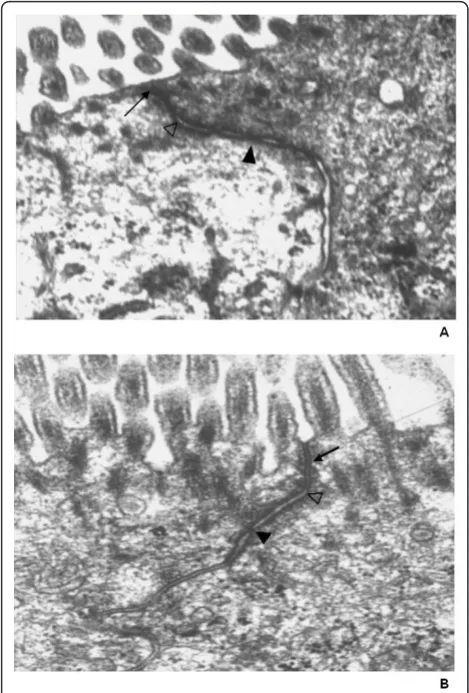
Since permeability testing indicated that GvHD of the small intestine is characterized by an impaired control of the paracellular permeability we next performed morphological analysis of the tight junctions by electron microscopy (Fig-ure 2). In comparison to the control animals (Fig(Fig-ure 2A), GvHD led to discontinuous tight-junction strand with widening of the paracellular spaces (Figure 2B).
GvHD is associated with upregulation of the proinflammatory cytokine TNF-a
Since TNF-a have been shown to be a critical compo-nent of the course of GvHD in general [9] and for the increased paracellular permeability in DSS induced coli-tis [10], we next analysed expression of this proinflam-matory cytokine in specimen of the jejunum by PCR. As shown in Figure 3, GvHD is associated with a strong increase of TNF-a expression at mRNA level in com-parison to the expression observed in the jejunum of the control animals.
Downregulation of occludin but not ZO-1 expression in GvHD
The molecular composition of the tight junction by transmembrane and cytoplasmatic proteins is highly complex. Due to their reported involvement in disrup-tion of intestinal barrier funcdisrup-tion in other disease mod-els, we focused our analysis on the transmembrane protein occludin [11] and the intracellular protein ZO-1 [12]. We showed by rtPCR, that expression levels of occludin were significantly reduced in the course of GvHD (Figure 4A). In contrast, no changes in ZO-1 expression were observed (Figure 4B).
Changes in intracellular localization of occludin in GvHD Besides alterations of expression levels of tight-junction proteins, changes of their intracellular localisation can
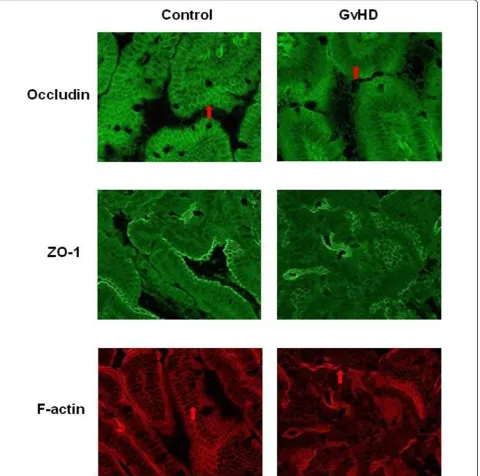
also affect barrier function, as shown recently [11]. Therefore, indirect immunofluorescence staining for occludin and ZO-1 was performed. Figure 5 shows fluorescence microscopy of control animals (left panel) versus GvHD animals (right panel). Occludin staining was found along the lateral cell walls with enhanced sig-nals at the apical site under control conditions (Figure 5 top left). Tangential sectioning of epithelial cells showed a polygonal pattern reminiscent of mesh wire. In con-trast, analysis of GvHD sections revealed a fuzzy appear-ance of immune reactivity throughout the cell, leaving only the nucleus free of staining indicative of re-localisa-tion from the plasma membrane (Figure 5, top right). Analysis of ZO-1 distribution showed concentrated staining at the apical aspect of the plasma membrane in control slices (Figure 5, middle left) This pattern appeared only slightly impaired in GvHD animals (Fig-ure 5, middle, right) Since a recent report indicated TNF-a induced effects on the interaction of occluding and ZO-1 with components of the actin cytoskeleton
Figure 2Electron microscopy of tight junctions of the small
intestine. Morphological analysis of tight junctions of the small
intestine of control animals A) and GvHD animals 2B) by electron microscopy. Small black arrow = Tight junction, white triangle = adherens junction, black triangle = desmosome. Representative results of independent examinations of 10 animals each group.
Figure 3TNF-aexpression in the jejunum. Expression of the proinflammatory cytokine TNF-ain the specimen of the jejunum of GvHD-mice (n = 20) and control animals (n = 18) was analysed by PCR. Mean and SD of TNF-aexpression normalized to the housekeeping gene GAPDH are shown. * indicates p-values < 0.05.
[13], the expression of F-actin was analyzed next. Actin is a major constituent of the terminal web at the apical plasma membrane. Underlying the brush border of the epithelium, actin staining apears as a tight line at the apical aspect of the cells, showing the typical mesh wire-like pattern in tangential sections of the epithelial cell layer in control animals (Figure 5, bottom left). In GvDH animals (Figure 5, bottom right) actin staining in
epithelial cells appeared disrupted and extended, no longer confined to the terminal web, but mostly diffuse, or randomly accumulated into denser patches of staining.
Discussion
Acute graft versus host disease (GvHD) is a severe com-plication after hematopoietic stem cell transplantation.
The impaired integrity of the gastrointestinal tract dur-ing GvHD (GI-GvHD) seems to play an important role in the amplification of the systemic disease.
In this study, we show for the first time that GI-GvHD leads to tight junction impairment with subsequently increased paracellular permeability. In the murine T-cell mediated acute GI-GvHD model used in this study, the transmembrane tight junction protein occludin is down-regulated and its mesh wire-like appearance within the apical tight-junction complex is lost due to cytoplasmic re-localization. Furthermore, we observed an increased expression of TNF-a which might in turn lead to the observed changes in occludin expression and/or localization.
Our findings are in line with other studies on T-cell mediated small bowel diseases which found increased paracellular permeability [14-19]. Tight-junction pro-teins are essential for the integrity of the intestinal bar-rier by building the most apical structure and regulating paracellular permeability and polarity of the cell. The tight-junction composition is a highly dynamic process and different tight-junction components can be divided into the transmembrane proteins (occludin, the claudin protein family, junctional adhesion molecules, coxsackie adenovirus receptor and tight-junction associated marvel proteins) and cytoplasmatic proteins (ZO-1 and cingu-lin). Furthermore, F-actin and myosin, as part of the cytoskeleton [20,21], are involved in the composition of the tight junctions. Interactions between tight-junction proteins, kinase activation and cytokine release influence the regulation of two transepithelial molecular pathways: a high-capacity, charge selective pore pathway for small uncharged molecules influenced primarily by claudin expression and a low-capacity leak pathway for larger ions regardless of charge regulated by the cytoskeleton involving ZO-1 and occludin. We observed a downregu-lation of occludin and a shift from the membrane to the cytoplasm without any significant changes in ZO-1 expression. Hypothetically, this could be an important cause of the observed increased permeability. Occludin is known to interact with other tight-junction proteins like ZO-1 and F-actin, mediating signal transduction, tissue growth and differentiation as well as cytoskeleton mediated leak pathway regulation [22]. Furthermore, the function and the localisation seem to differ depending on posttranslational phosphorylation by enzymes [20]. Fluorescence recovery after photobleaching analyses showed that occludin is very mobile at the tight-junction undergoing constant remodelling [23]. In line with our observations, recent data in colitis associated impaired barrier function indicated that alterations in the expres-sion level and localization of occludin are pivotal for increased paracellular permeability. Interestingly, the promoter of the occludin gene harbours a TNF-a
response element, negatively regulating the transcription of occludin [24]. Referring to the pivotal role of TNF-a in the regulation of gastrointestinal barrier function and permeability [10,13,16,25-28] and the fact that we observed a strong upregulation of TNF-a expression, it is tempting to speculate, that occludin is a central downstream target of TNF-a in GI-GvHD. It is well known, that IFN-g production by the donor T cells, endotoxins and LPS as a component of the normal gut flora who penetrate the impaired intestinal barrier can lead to an excessive TNF-a production by monocytes and macrophages [4,29-31]. This increased TNF-a expression is associated with the severity of intestinal GvHD [32] and an elegant recent work showed the pivotal role of TNF tight junction remodeling and bar-rier maintenance [13]. Thus, increased TNF-a may impair the barrier function through disturbance of the tight junction which in turn results in increased paracel-lular permeability, enforced translocation of antigens from the gut into the circulation and an uncontrolled systemic inflammatory response.
In contrast to colitis model systems in mice [33-35], we did not observe alterations in the cytoplasmatic tight junction protein ZO-1. The alterations in the tight junc-tion complex and its components seem to be dependent of the disease as indicated by data showing alterations in only the claudin family in other model systems [36,37].
By immune fluorescence microscopy, we were able to show that f-actin was released from the tight organisa-tion of the terminal web beneath the apical plasma membrane and showed a mostly diffuse, spreaded appearance with some more densely packed areas in irregular patterns in GvDH. This could be due to a con-traction of the cytoskeleton with tension on the tight-junction followed by an augmented paracellular channel as described by other studies [17] or part of the response of intestinal epithelia to TNF-a induced shed-ding [13] as reported recently.
Conclusions
In conclusion, the present study demonstrates that the induction of T-cell mediated acute murine GI-GvHD leads to an enhanced intestinal permeability character-ized by high expression of TNF-aleading to a downre-gulation and localization shift of the tight junction protein occludin, whereas ZO-1 protein expression and
localisation within the tight junction remains
influence the barrier defect and therefore these gastroin-testinal complications.
Acknowledgements
This study was supported by grants of the German Research Society and the Excellence Clusters Inflammation at Interfaces and Future Ocean to E.S., P.R., S.S, J.H. and A.A.
Author details 1
Department of Internal Medicine, University Hospital Schleswig-Holstein, Campus Kiel, 24105 Kiel, Germany.2Institute of Clinical Molecular Biology,
University Hospital Schleswig-Holstein, Campus Kiel, 24105 Kiel, Germany.
Authors’contributions
RN, JLG, ES, and MLK and ME carried out the experimental studies and drafted the manuscript. RN, RH, JH, BB, PR and SS participated in the design of the study and performed the statistical analysis. PR and AA conceived of the study, and participated in its design and coordination and helped to draft the manuscript. All authors read and approved the final manuscript.
Competing interests
The authors declare that they have no competing interests.
Received: 17 May 2011 Accepted: 6 October 2011 Published: 6 October 2011
References
1. Ferrara JL, Levine JE, Reddy P, Holler E:Graft-versus-host disease.Lancet 2009,373(9674):1550-1561.
2. Washington K, Jagasia M:Pathology of graft-versus-host disease in the gastrointestinal tract.Human pathology2009,40(7):909-917.
3. Takatsuka H, Iwasaki T, Okamoto T, Kakishita E:Intestinal graft-versus-host disease: mechanisms and management.Drugs2003,63(1):1-15. 4. Reddy P:Pathophysiology of acute graft-versus-host disease.
Hematological oncology2003,21(4):149-161.
5. Morris ES, Hill GR:Advances in the understanding of acute graft-versus-host disease.British journal of haematology2007,137(1):3-19.
6. Ross WA, Couriel D:Colonic graft-versus-host disease.Curr Opin Gastroenterol2005,21(1):64-69.
7. Guy-Grand D, Vassalli P:Gut injury in mouse graft-versus-host reaction. Study of its occurrence and mechanisms.J Clin Invest1986,
77(5):1584-1595.
8. Rozen S, Skaletsky H:Primer3 on the WWW for general users and for biologist programmers.Methods Mol Biol2000,132:365-386. 9. Brown GR, Lindberg G, Meddings J, Silva M, Beutler B, Thiele D:Tumor
necrosis factor inhibitor ameliorates murine intestinal graft-versus-host disease.Gastroenterology1999,116(3):593-601.
10. Liu XC, Mei Q, Xu JM, Hu J:Balsalazine decreases intestinal mucosal permeability of dextran sulfate sodium-induced colitis in mice.Acta pharmacologica Sinica2009,30(7):987-993.
11. Li N, Gu L, Qu L, Gong J, Li Q, Zhu W, Li J:Berberine attenuates pro-inflammatory cytokine-induced tight junction disruption in an in vitro model of intestinal epithelial cells.Eur J Pharm Sci2010,40(1):1-8. 12. Sasatomi K, Sakisaka S, Kawaguchi T, Hanada S, Taniguchi E, Koga H,
Harada M, Sata M:Cholestasis in a rat model of graft-versus-host disease is accompanied by alteration of the expression and distribution of tight-junction-associated proteins.Int J Mol Med2005,15(3):431-436. 13. Marchiando AM, Shen L, Graham WV, Edelblum KL, Duckworth CA, Guan Y,
Montrose MH, Turner JR, Watson AJ:The epithelial barrier is maintained by in vivo tight junction expansion during pathologic intestinal epithelial shedding.Gastroenterology.
14. Tang Y, Clayburgh DR, Mittal N, Goretsky T, Dirisina R, Zhang Z, Kron M, Ivancic D, Katzman RB, Grimm G,et al:Epithelial NF-kappaB enhances transmucosal fluid movement by altering tight junction protein composition after T cell activation.Am J Pathol176(1):158-167. 15. Chen J, Xiao L, Rao JN, Zou T, Liu L, Bellavance E, Gorospe M, Wang JY:
JunD represses transcription and translation of the tight junction protein zona occludens-1 modulating intestinal epithelial barrier function.Mol Biol Cell2008,19(9):3701-3712.
16. Clayburgh DR, Musch MW, Leitges M, Fu YX, Turner JR:Coordinated epithelial NHE3 inhibition and barrier dysfunction are required for TNF-mediated diarrhea in vivo.J Clin Invest2006,116(10):2682-2694. 17. Clayburgh DR, Barrett TA, Tang Y, Meddings JB, Van Eldik LJ, Watterson DM,
Clarke LL, Mrsny RJ, Turner JR:Epithelial myosin light chain kinase-dependent barrier dysfunction mediates T cell activation-induced diarrhea in vivo.J Clin Invest2005,115(10):2702-2715.
18. Clayburgh DR, Shen L, Turner JR:A porous defense: the leaky epithelial barrier in intestinal disease.Lab Invest2004,84(3):282-291.
19. Musch MW, Clarke LL, Mamah D, Gawenis LR, Zhang Z, Ellsworth W, Shalowitz D, Mittal N, Efthimiou P, Alnadjim Z,et al:T cell activation causes diarrhea by increasing intestinal permeability and inhibiting epithelial Na+/K+-ATPase.J Clin Invest2002,110(11):1739-1747. 20. Paris L, Tonutti L, Vannini C, Bazzoni G:Structural organization of the tight
junctions.Biochim Biophys Acta2008,1778(3):646-659. 21. Laukoetter MG, Bruewer M, Nusrat A:Regulation of the intestinal
epithelial barrier by the apical junctional complex.Curr Opin Gastroenterol 2006,22(2):85-89.
22. Schulzke JD, Fromm M:Tight junctions: molecular structure meets function.Ann N Y Acad Sci2009,1165:1-6.
23. Shen L, Weber CR, Turner JR:The tight junction protein complex undergoes rapid and continuous molecular remodeling at steady state.J Cell Biol2008,181(4):683-695.
24. Mankertz J, Tavalali S, Schmitz H, Mankertz A, Riecken EO, Fromm M, Schulzke JD:Expression from the human occludin promoter is affected by tumor necrosis factor alpha and interferon gamma.J Cell Sci2000,
113(Pt 11):2085-2090.
25. Suenaert P, Bulteel V, Lemmens L, Noman M, Geypens B, Van Assche G, Geboes K, Ceuppens JL, Rutgeerts P:Anti-tumor necrosis factor treatment restores the gut barrier in Crohn’s disease.Am J Gastroenterol2002,
97(8):2000-2004.
26. Marano CW, Lewis SA, Garulacan LA, Soler AP, Mullin JM:Tumor necrosis factor-alpha increases sodium and chloride conductance across the tight junction of CACO-2 BBE, a human intestinal epithelial cell line.J Membr Biol1998,161(3):263-274.
27. Hering NA, Schulzke JD:Therapeutic options to modulate barrier defects in inflammatory bowel disease.Digestive diseases (Basel, Switzerland)2009,
27(4):450-454.
28. Turner JR:Molecular basis of epithelial barrier regulation: from basic mechanisms to clinical application.Am J Pathol2006,169(6):1901-1909. 29. Barreau F, Madre C, Meinzer U, Berrebi D, Dussaillant M, Merlin F,
Eckmann L, Karin M, Sterkers G, Bonacorsi S,et al:Nod2 regulates the host response towards microflora by modulating T cell function and epithelial permeability in mouse Peyer’s patches.Gut59(2):207-217. 30. Cooke KR, Gerbitz A, Crawford JM, Teshima T, Hill GR, Tesolin A,
Rossignol DP, Ferrara JL:LPS antagonism reduces graft-versus-host disease and preserves graft-versus-leukemia activity after experimental bone marrow transplantation.The Journal of clinical investigation2001,
107(12):1581-1589.
31. Nestel FP, Price KS, Seemayer TA, Lapp WS:Macrophage priming and lipopolysaccharide-triggered release of tumor necrosis factor alpha during graft-versus-host disease.J Exp Med1992,175(2):405-413. 32. Hill GR, Teshima T, Gerbitz A, Pan L, Cooke KR, Brinson YS, Crawford JM,
Ferrara JL:Differential roles of IL-1 and TNF-alpha on graft-versus-host disease and graft versus leukemia.J Clin Invest1999,104(4):459-467. 33. Mazzon E, Cuzzocrea S:Role of TNF-alpha in ileum tight junction
alteration in mouse model of restraint stress.American journal of physiology2008,294(5):G1268-1280.
34. Fries W, Muja C, Crisafulli C, Cuzzocrea S, Mazzon E:Dynamics of enterocyte tight junctions: effect of experimental colitis and two different anti-TNF strategies.American journal of physiology2008,294(4): G938-947.
35. Poritz LS, Garver KI, Green C, Fitzpatrick L, Ruggiero F, Koltun WA:Loss of the tight junction protein ZO-1 in dextran sulfate sodium induced colitis.The Journal of surgical research2007,140(1):12-19.
36. Oshima T, Miwa H, Joh T:Aspirin induces gastric epithelial barrier dysfunction by activating p38 MAPK via claudin-7.American journal of physiology2008,295(3):C800-806.
Pre-publication history
The pre-publication history for this paper can be accessed here: http://www.biomedcentral.com/1471-230X/11/109/prepub
doi:10.1186/1471-230X-11-109
Cite this article as:Nothet al.:Increased intestinal permeability and
tight junction disruption by altered expression and localization of occludin in a murine graft versus host disease model.BMC Gastroenterology201111:109.
Submit your next manuscript to BioMed Central and take full advantage of:
• Convenient online submission
• Thorough peer review
• No space constraints or color figure charges
• Immediate publication on acceptance
• Inclusion in PubMed, CAS, Scopus and Google Scholar
• Research which is freely available for redistribution