RESEARCH
A common language to assess allergic
rhinitis control: results from a survey conducted
during EAACI 2013 Congress
Peter W. Hellings
1,2*, Antonella Muraro
3, Wytske Fokkens
2, Joaquim Mullol
4, Claus Bachert
5, G. Walter Canonica
6,
David Price
7, Nikos Papadopoulos
8, Glenis Scadding
9, Gerd Rasp
10, Pascal Demoly
11, Ruth Murray
12and Jean Bousquet
13,14,15,16Abstract
Background: The concept of control is gaining importance in the field of allergic rhinitis (AR), with a visual analogue
scale (VAS) score being a validated, easy and attractive tool to evaluate AR symptom control. The doctors’ perception
of a VAS score as a good tool for evaluating AR symptom control is unknown, as is the level of AR control perceived by
physicians who treat patients.
Methods: 307 voluntarily selected physicians attending the annual (2013) European Academy of Allergy and
Clini-cal Immunology (EAACI) meeting completed a digital survey. Delegates were asked to (1) estimate how many AR
patients/week they saw during the season, (2) estimate the proportion of patients they considered to have well-,
partly- and un-controlled AR, (3) communicate how they gauged this control and (4) assess how useful they would
find a VAS as a method of gauging control. 257 questionnaires were filled out completely and analysed.
Results: EAACI delegates reported seeing 46.8 [standard deviation (SD) 68.5] AR patients/week during the season.
They estimated that 38.7 % (SD 24.0), 34.2 % (SD 20.2) and 20.0 % (SD 16.34) of their AR patients had well-controlled
(no AR symptoms), partly-controlled (some AR symptoms), or un-controlled-(moderate/severe AR symptoms) disease
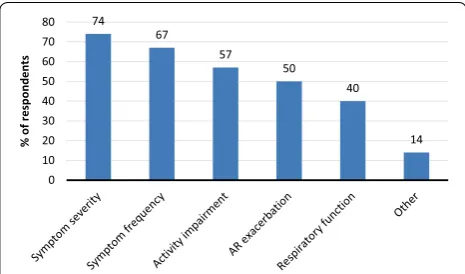
despite taking medication [remainder unknown (7.1 %)]. However, AR control was assessed in many ways, including
symptom severity (74 %), frequency of day- and night-time symptoms (67 %), activity impairment (57 %), respiratory
function monitoring (nasal and/or lung function; 40 %) and incidence of AR exacerbations (50 %). 91 % of delegates
felt a simple VAS would be a useful tool to gauge AR symptom control.
Conclusions: A substantial portion of patients with AR are perceived as having uncontrolled or partly controlled
disease even when treated. A simple VAS score is considered a useful tool to monitor AR control.
Keywords: Allergic rhinitis, Control, Digital, Survey, Visual analogue scale, VAS
© 2015 Hellings et al. This article is distributed under the terms of the Creative Commons Attribution 4.0 International License (http://creativecommons.org/licenses/by/4.0/), which permits unrestricted use, distribution, and reproduction in any medium, provided you give appropriate credit to the original author(s) and the source, provide a link to the Creative Commons license, and indicate if changes were made. The Creative Commons Public Domain Dedication waiver (http://creativecommons.org/ publicdomain/zero/1.0/) applies to the data made available in this article, unless otherwise stated.
Background
Control of disease is considered one of the key outcomes
in several medical domains. Although the concept of
control is well-defined in asthma, chronic obstructive
pulmonary disease and other conditions such as
glycae-mic control in diabetes, [
1
] it has only recently gained
significant attention in the field of allergic rhinitis (AR)
[
2
–
5
]. Indeed, the patients’ evaluation of disease control
by any type of treatment, leading to a significant reduction
of symptom severity, has become one of the novel goals
of treatment in different chronic diseases. In AR, there
is growing consensus that a visual analogue scale (VAS)
score represents a simple, good and valid tool to
moni-tor AR disease control [
2
,
6
]. In 2010, Bousquet and
col-leagues [
7
] proposed a simple VAS to evaluate AR control.
More sophisticated means of monitoring AR control have
been used without showing superiority of one over the
Open Access
*Correspondence: [email protected]
1 Department of Otorhinolaryngology, University Hospitals Leuven,
Leuven, Belgium
other [
8
]. Therefore, a VAS has been incorporated into the
treatment algorithms for AR [
2
] to guide treatment
deci-sions as part of an integrated care pathway [
9
]. It has yet
to be validated in children. Nowadays, a digital version of
the AR control VAS will be rolled out to patients,
pharma-cists and physicians to encourage better communication
(with patients) and referral when appropriate. Physicians
of all specialities involved in AR management can use the
same VAS, from general practitioners (GPs) and allergists,
to ear nose and throat (ENT) specialists, paediatricians,
pulmonologists and dermatologists.
A VAS for AR has been shown to assess disease
sever-ity according to the Allergic Rhinitis and its Impact on
Asthma (ARIA)-guidelines, with a VAS cut off score of
50 mm distinguishing between mild and moderate/severe
AR in adults [
10
]. The VAS score incorporates quality
of life (QoL) and reflective total nasal symptom score
(rTNSS) [
11
] and correlates with improvements in AR
symptoms and QoL. It can be used to assess AR severity
in both intermittent and persistent disease in untreated
or treated patients [
10
]. A change in VAS score of more
than 23 mm represents clinically relevant changes in
QoL and AR symptoms, possibly reflecting a response to
treatment [
6
].
The major gaps in the current appreciation of VAS as a
tool for the evaluation of symptom control are the
follow-ing: (1) the level of control reached in patients by actual
treatment options as perceived by the medical
doc-tors, (2) how disease control is evaluated, and (3)
physi-cian perception on the usefulness of a VAS score for the
evaluation of symptom control. Physicians often
under-estimate disease severity and impact on patients’ lives,
while at the same time over-estimate the effectiveness
of treatment [
12
,
13
]. Physician-patient communication
is greatly hampered by a lack of a common language to
describe AR control and a lack of a universally-accepted
definition of what AR control actually means. The aim
of this exploratory study was to assess how physicians
measure AR symptom control, how they perceive the
control status of their patients and how they regard the
usefulness of a VAS to gauge disease control.
Methods
A quantitative, digital survey, designed to collect views
of physicians who treat AR routinely in clinical
prac-tice, was carried out during the 32nd EAACI Congress
(Milan, Italy) from 22nd to 26th June 2013. The survey
content was informed by experts in the field of AR (JB,
CB and DP) and conducted at the Meda booth by
phy-sicians attending the exhibition (see Additional file
1
).
There was no incentive to take part in the survey.
Those who consented to take part had their EAACI
barcode scanned, were allocated a digital ID and were
provided with the survey questions on an iPad. Responses
to all questions were anonymised and stored on an
inde-pendent server.
Delegates were asked to:
1. Estimate how many AR patients they saw per week
during the season,
2. estimate the proportion of their patients they
consid-ered to have well-, partly- and un-controlled disease,
3. communicate how they gauged this control (>1
answer permitted)
4. assess how useful they would find a VAS as a method
of gauging control.
A representation of a VAS with marker slider was
shown to delegates when considering their response to
question 4. Survey questions and representation of the
VAS with marker slider are provided in Additional file
1
.
Descriptive statistics (mean and standard deviation)
were used to summarise survey responses.
Results
307 EAACI 2013 delegates from 60 different countries
and from different specialties (e.g. GPs, allergists, ENT
specialists and paediatricians) completed the survey.
Valid question responses were obtained for 257 of these.
Surveys from 50 delegates were not included as they were
incomplete.
On average, respondents reported seeing 46.8
[stand-ard deviation (SD) 68.5] AR patients/week during the
season. They estimated that AR was well-controlled,
partly-controlled and un-controlled in 38.7 % (SD 24.0),
34.2 % (SD 20.2) and 20.0 % (SD 16.34) of patients,
respectively, and unknown for the remainder (7.1 %).
Delegates reported assessing disease control in many
different ways, including symptom severity (74 %),
fre-quency of day- and night-time symptoms (67 %),
activ-ity impairment (57 %), respiratory function monitoring
(nasal and/or lung function; 40 %) and incidence of AR
exacerbations (50 %) (Fig.
1
). 91 % of delegates felt that a
VAS was a useful tool to assess disease control.
Discussion
corresponds well with previous reports: A European
sur-vey found that, according to physician assessment, good
control of nasal and ocular symptoms was achieved in
45.4 and 51.3 % of patients, respectively [
13
].
It was also apparent that AR control was assessed
in multiple ways with no consensus on an optimal
method. Of note was the large standard deviation seen
around control perception, which shows a wide-ranging
response to the question. Interestingly, the determinants
of control as perceived by the physicians varied from
fre-quency of day- and night-time symptoms to respiratory
function monitoring (nasal and/or lung function). One
of the most striking findings was the extra-nasal
symp-toms, like frequency of day- and night-time symptoms
and impaired activity being reported as key determinants
of AR control.
91 % of the EAACI delegates who completed this
sur-vey agreed upon the validity of a VAS as a useful tool for
assessing AR control. In our opinion, it is an intuitive tool
for use in clinical studies, and by physicians and patients
every day. The VAS is well suited to the task of assessing
AR control. It is simple and quick to complete,
incorpo-rating assessment of both AR symptoms and
quality-of-life [
11
]. It correlates well with recognized randomized
controlled trial endpoints [
16
], can discriminate
accord-ing to severity [
10
] and assess efficacy of treatments [
16
,
17
]. The VAS has also been used to assess effectiveness of
treatments in real-life [
18
] as well as inadequacies of
oth-ers (including multiple treatments) [
19
].
Limitations of this survey relate to the fact that the
most respondents were specialists (although with
expe-rience in treating AR), with relatively few GPs included.
Delegates were not provided with an alternative control
tool choice and also completed the survey at the Meda
booth, which may have introduced bias. However, no
financial or any other incentive was given to complete
the survey. Also delegate speciality was not consistently
recorded which may have yielded interesting insights into
how AR control is assessed across specialities. Finally,
information on what proportion of AR patients had
con-comitant asthma was not captured. This would have
pro-vided important information on how disease control was
assessed and whether the perception of control was
bet-ter or worse for those patients with co-morbid disease.
The VAS will form the basis of a new contre les
MAla-dies Chronique pour un VIeillissement Actif
(MACVIA)-ARIA AR app directed at patients called ‘
Allergy Diary
’
which is now available for free download in many
Euro-pean countries. Users can assess their disease control daily
by simply clicking on the VAS in response to the question
‘overall how much are your allergic symptoms
bother-ing you today?’, from ‘not at all bothersome’ to ‘extremely
bothersome’. VAS scores are logged and plotted over time
with control assessed as well-, partly- and un-controlled,
according to specific VAS score cut-offs. The VAS will
also be incorporated into a companion app for healthcare
providers as well as into the new AR guideline, and used
to guide treatment decisions. Moving to a digital VAS is
attractive since in real life, on paper, VAS scores are often
wrongly completed by the patient, even after explanation;
either by failing to cross the line, putting a cross above or
below it or writing a figure. An electronic version would
prevent such errors. However, it may not allow for
com-plexity of response such as persistence of a
problemati-cal co- morbidity despite good control of AR. The overall
aim of ‘
Allergy Diary
’, the Allergy Diary companion app
and the updated AR guideline (and the VAS contained
within them) is to facilitate a top down communication,
from guidelines to healthcare providers to patients,
allow-ing doctors to more easily comply with the guidelines, to
better tailor AR medications to patients’ needs and enable
patients to better communicate their needs.
In short, a common language of AR disease control
is needed. A simple VAS to measure and assess disease
control could meet this need and is welcomed by
physi-cians. It should enable us to move from the illusion to the
confirmation of communication.
Additional file
Additional file 1. Survey questions. The questions asked in a quantita-tive, digital survey carried out during the 32nd EAACI Congress (Milan, Italy) from 22nd to 26th June 2013.The survey was designed to collect views of physicians who treat AR routinely in clinical practice. It includes a representation of a VAS with maker slider that was shown to delegates when considering their response to question 9 of the survey.
74 67
57 50
40
14
0 10 20 30 40 50 60 70 80
% of respondents
Abbreviations
AR: allergic rhinitis; ARIA: allergic rhinitis and its impact on asthma; EAACI: European Academy of Allergy and Clinical Immunology; ENT: ear nose and throat; GP: general practitioner; MACVIA: Contre les MAladie Chronique pour un VIeillissement Actif; QoL: quality of life; rTNSS: reflective total nasal symp-tom score; SD: standard deviation; VAS: visual analogue scale.
Authors’ contributions
All authors have been involved in the analysis and interpretation of data. JB, CB and DP also designed and approved the content of the questionnaire for the physicians. All authors were involved in the drafting of the manuscript, critically revised each draft and gave their final approval for publication. All authors agree to be accountable for all aspects of this work and have partici-pated sufficiently to take public responsibility for the content. All authors read and approved the final manuscript.
Authors’ information
PH is a rhinologist and allergologist, working in the University Hospitals of Leuven, and Academic Medical Center, Amsterdam, and leading a research team on upper airways inflammation at the University of Leuven. He is the current Secretary-General of EAACI (2015–2017). AM is a Consultant Paediatric Allergist at the Department of Women and Child Health, Padua University Hospital, Italy and Professor of Paediatric Allergology at the Allergy and Clinical Immunology School, University of Padua. She was Secretary General of EAACI from 2013 to 2015 and is the current President of EAACI (2015–2017). WF is an otorhinolaryngologist and head of the department of Otorhinolaryngology of the Academic Medical Centre Amsterdam. JM is an ENT specialist and Director of the Rhinology Unit and Smell Clinic, ENT Department, Hospital Clínic de Barcelona; and Professor of Research and Head of the Laboratory Clinical and Experimental Respiratory Immunoallergy at IDIBAPS, Barcelona, Catalonia, Spain. CB is ENT specialist and allergologist at the Ghent University Hospital, and runs the Upper Airways Research Laboratory, Ghent University. He also is affiliated with the Karolinska Institute in Stockholm, Sweden. GWC is Professor of Respiratory Medicine and Director of Allergy & Respiratory Disease Clinic, Dept Internal Medicine, University of Genoa, IRCCS AOU San Martino, Genoa Italy. DP is Professor of Primary Care Respiratory Medicine at the University of Aberdeen, co-founder of the Respiratory Effectiveness Group (http://www. effectivenessevaluation.org) and Director of Observational and Pragmatic Research Institute, Singapore. NP is Professor of Allergy and Paediatric Allergy at the Universities of Manchester, UK and Athens, Greece. GS is Hon. Consult-ant Rhinologist and Allergist at the Royal National TNE Hospital, London and Hon. Senior Lecturer at University College, London. GR is Professor for Otorhinolaryngology and Chairman of the ORL-Department at the Paracelsus Medical University Salzburg, Austria. PD is a pulmonologist and allergist, Pro-fessor of Pulmonology and Head of Department at the University Hospital of Montpellier. He was the Vice-President for Education and Specialties of EAACI from 2011 to 2015 and President of the French Allergy Society from 2010 to 2012. In addition, PD is Associate Editor of the journal ALLERGY, is a member of the editorial board of several national and international medical allergy journals and is a member of the French National Academy of Medicine. RM is the director of a Medical and Scientific research consultancy. JB is a Professor Emeritus at the University of Montpellier in France. He is recognized as past chairman of the Global Initiative for Asthma (GINA) and as the founder and Chairman of ARIA (Allergic Rhinitis and its Impact on Asthma), in collaboration with the World Health Organization. Prof Bousquet is also past Chairman of the WHO Global Alliance Against Chronic Respiratory Diseases (GARD), Direc-tor of the WHO Collaborating Centre for Asthma and Rhinitis in Montpellier, and coordinator of several projects of the European Union in research, health and ICT. Professor Bousquet’s current interests lie with the European Innova-tion Partnership on Active and Health Aging, and updating how chronic diseases like allergic rhinitis are managed using an integrated care pathway.
Author details
1 Department of Otorhinolaryngology, University Hospitals Leuven, Leuven,
Belgium. 2 Department of Otorhinolaryngology, Academic Medical Center
(AMC), Amsterdam, The Netherlands. 3 Department of Women and Child
Health, Food Allergy Referral Centre, Padua University Hospital, Veneto Region, Padua, Italy. 4 Hospital Clinic, IDIBAPS, CIBERES, Barcelona, Catalonia, Spain. 5 Upper Airways Research Laboratory (URL), University Hospital Ghent, Ghent,
Belgium. 6 Allergy and Respiratory Diseases, Department of Internal Medicine,
IRCCS S Martino, IST, University of Genoa, Genoa, Italy. 7 Centre of Academic
Primary Care, University of Aberdeen, Aberdeen, UK. 8 Allergy Department,
2nd Pediatric Clinic, University of Athens, Athens, Greece. 9 RNTNE Hospital,
London, UK. 10 Department of Otorhinolaryngology, Paracelsus Medical
Uni-versity, Salzburg, Austria. 11 Division of Allergy, Department of Pulmonology,
Hôpital Arnaud de Villeneuve, University Hospital of Montpellier, Montpellier, France. 12 MedScript Ltd, Dundalk, Co. Louth, Ireland. 13 University Hospital,
Montpellier, France. 14 MACVIA-LR, Contre les Maladies Chronique pour un
Vieillissement Actif en Languedoc Roussilon, European Innovation Partnership on Active and Healthy Aging Reference Site, Montpellier, France. 15 INSERM,
VIMA: Ageing and Chronic Diseases. Epidemiological and Public Health Approaches, U1168 Paris, France. 16 UVSQ UMR-S1168, Universite Versailles
St-Quentin-en-Yvelines, Versailles, France.
Acknowledgements
We thank EAACI for allowing this survey to be conducted during the 32nd annual meeting in Milan, 2013.
Competing interests
Received: 31 July 2015 Accepted: 23 September 2015
References
1. Fullerton B, Jeitler K, Seitz M, Horvath K, Berghold A, Siebenhofer A. Intensive glucose control versus conventional glucose control for type 1 diabetes mellitus. Cochrane Database Syst Rev. 2014;2:CD009122. 2. Hellings PW, Fokkens WJ, Akdis C, Bachert C, Cingi C, Dietz de Loos D,
et al. Uncontrolled allergic rhinitis and chronic rhinosinusitis: where do we stand today? Allergy. 2013;68:1–7.
3. Mullol J, Bartra J, Del CA, Izquierdo I, Munoz-Cano R, Valero A. Specialist-based treatment reduces the severity of allergic rhinitis. Clin Exp Allergy. 2013;43:723–9.
4. Fonseca JA, Nogueira-Silva L, Morais-Almeida M, Sa-Sousa A, Azevedo LF, Ferreira J, et al. Control of Allergic Rhinitis and Asthma Test (CARAT) can be used to assess individual patients over time. Clin Transl Allergy. 2012;2:16.
5. Linhares DV, da Fonseca JA, Borrego LM, Matos A, Pereira AM, Sa-Sousa A, et al. Validation of control of allergic rhinitis and asthma test for children (CARATKids)—a prospective multicenter study. Pediatr Allergy Immunol. 2014;25:173–9.
6. Demoly P, Bousquet PJ, Mesbah K, Bousquet J, Devillier P. Visual analogue scale in patients treated for allergic rhinitis: an observational prospective study in primary care: asthma and rhinitis. Clin Exp Allergy. 2013;43:881–8. 7. Bousquet PJ, Bachert C, Canonica GW, Casale TB, Mullol J, Klossek JM, et al. Uncontrolled allergic rhinitis during treatment and its impact on quality of life: a cluster randomized trial. J Allergy Clin Immunol. 2010;126:666–8. 8. Demoly P, Calderon MA, Casale T, Scadding G, Annesi-Maesano I, Braun JJ,
et al. Assessment of disease control in allergic rhinitis. Clin Transl Allergy. 2013;3:7.
9. Bousquet J, Addis A, Adcock I, Agache I, Agusti A, Alonso A, et al. Inte-grated care pathways for airway diseases (AIRWAYS-ICPs). Eur Respir J. 2014;44:304–23.
10. Bousquet PJ, Combescure C, Neukirch F, Klossek JM, Mechin H, Daures JP, et al. Visual analog scales can assess the severity of rhinitis graded accord-ing to ARIA guidelines. Allergy. 2007;62:367–72.
11. Bousquet PJ, Combescure C, Klossek JM, Daures JP, Bousquet J. Change in visual analog scale score in a pragmatic randomized cluster trial of allergic rhinitis. J Allergy Clin Immunol. 2009;123:1349–54.
12. Meltzer EO. Allergic rhinitis: the impact of discordant perspectives of patient and physician on treatment decisions. Clin Ther. 2007;29:1428–40. 13. Canonica GW, Bousquet J, Mullol J, Scadding GK, Virchow JC. A survey of
the burden of allergic rhinitis in Europe. Allergy. 2007;62(Suppl 85):17–25. 14. Keith PK, Desrosiers M, Laister T, Schellenberg RR, Waserman S. The
burden of allergic rhinitis (AR) in Canada: perspectives of physicians and patients. Allergy Asthma Clin Immunol. 2012;8:7.
15. Fromer LM, Ortiz G, Ryan SF, Stoloff SW. Insights on allergic rhinitis from the patient perspective. J Fam Pract. 2012;61:S16–22.
16. Bousquet J, Bachert C, Canonica GW, Mullol J, Van CP, Bindslev-Jensen C, et al. Efficacy of desloratadine in intermittent allergic rhinitis: a GA(2)LEN study. Allergy. 2009;64:1516–23.
17. Bousquet J, Bachert C, Canonica GW, Mullol J, Van CP, Bindslev-Jensen C, et al. Efficacy of desloratadine in persistent allergic rhinitis—a GA(2)LEN study. Int Arch Allergy Immunol. 2010;153:395–402.
18. Klimek L, Bachert C, Mosges R, Munzel U, Price D, Virchow JC, et al. Effec-tiveness of MP29-02 for the treatment of allergic rhinitis in real-life: results from a noninterventional study. Allergy Asthma Proc. 2015;36:40–7. 19. Bousquet PJ, Demoly P, Devillier P, Mesbah K, Bousquet J. Impact of
aller-gic rhinitis symptoms on quality of life in primary care. Int Arch Allergy Immunol. 2013;160:393–400.
Submit your next manuscript to BioMed Central
and take full advantage of:
• Convenient online submission • Thorough peer review
• No space constraints or color figure charges • Immediate publication on acceptance
• Inclusion in PubMed, CAS, Scopus and Google Scholar • Research which is freely available for redistribution