
METHODOLOGY
Defining a staged-based process
for economic and financial evaluations
of mHealth programs
Amnesty E. LeFevre
1,2*, Samuel D. Shillcutt
1, Sean Broomhead
3, Alain B. Labrique
1,2and Tom Jones
3Abstract
Mobile and wireless technology for health (mHealth) has the potential to improve health outcomes by addressing critical health systems constraints that impede coverage, utilization, and effectiveness of health services. To date, few mHealth programs have been implemented at scale and there remains a paucity of evidence on their effectiveness and value for money. This paper aims to improve understanding among mHealth program managers and key stake-holders of how to select methods for economic evaluation (comparative analysis for determining value for money) and financial evaluation (determination of the cost of implementing an intervention, estimation of costs for sustaining or expanding an intervention, and assessment of its affordability). We outline a 6 stage-based process for selecting and integrating economic and financial evaluation methods into the monitoring and evaluation of mHealth solutions including (1) defining the program strategy and linkages with key outcomes, (2) assessment of effectiveness, (3) full economic evaluation or partial evaluation, (4) sub-group analyses, (5) estimating resource requirements for expansion, (6) affordability assessment and identification of models for financial sustainability. While application of these stages optimally occurs linearly, finite resources, limited technical expertise, and the timing of evaluation initiation may impede this. We recommend that analysts prioritize economic and financial evaluation methods based on program-matic linkages with health outcomes; alignment with an mHealth solution’s broader stage of maturity and stage of evaluation; overarching monitoring and evaluation activities; stakeholder evidence needs; time point of initiation; and available resources for evaluations.
Keywords: mHealth, Economic evaluation, Financial evaluation, Costs, Digital health
© The Author(s) 2017. This article is distributed under the terms of the Creative Commons Attribution 4.0 International License (http://creativecommons.org/licenses/by/4.0/), which permits unrestricted use, distribution, and reproduction in any medium, provided you give appropriate credit to the original author(s) and the source, provide a link to the Creative Commons license, and indicate if changes were made. The Creative Commons Public Domain Dedication waiver (http://creativecommons.org/ publicdomain/zero/1.0/) applies to the data made available in this article, unless otherwise stated.
Background
Mobile phones are the leading form of
communica-tion worldwide [1], and in many settings, access to them
exceeds the availability of clean water, bank accounts or
electricity [2]. Their widespread and increasing use,
par-ticularly in low- and middle-income countries (LMICs) where the disease burden is highest, has led to grow-ing calls to harness the potential of mobile and wireless technology (mHealth) to improve health and health care
delivery [3]. mHealth aims to improve health outcomes
by addressing critical health systems constraints that
impede coverage and utilization of health services [4].
mHealth solutions encompass a diverse range of appli-cations of wireless and mobile technologies which may broadly be categorized into approaches focusing on (1) health systems, including supply chain reporting,
perfor-mance monitoring, quality of care; (2) health care
provid-ers, including work flow management, record keeping,
clinical documentation and support; and (3) client/
patient empowerment through knowledge transfer, alerts
and reminders for care-seeking [4].
Throughout the last decade, over 600 mHealth pilot strategies and programs have been introduced globally
[5]. Despite the proliferation of mHealth programs,
evi-dence on their effectiveness is still limited [6–8], with a
particular dearth of economic evaluations, which aim to inform decisions on optimal resource use and allocation.
Open Access
*Correspondence: [email protected]
To date, a small number of peer-reviewed articles com-prise the body of evidence on the value for money of mHealth solutions, including cost-effectiveness analy-ses (CEA), cost-utility analyanaly-ses (CUA), and cost-benefit
analyses (CBA) [9]. While efforts to define the economics
of mHealth have highlighted potential types of costs and benefits likely to emerge from program implementation
[10], along with broad categories of economic evaluations
available [11], guidance does not exist on which analytic
approaches are most appropriate based on the maturity of the mHealth solution and/or its stage of evaluation.
Governments have found it challenging to select, scale up, and integrate mHealth solutions into existing national systems; partly due to a shortage of high qual-ity data allowing assessments of comparative
effective-ness and comparative value [12]. In this paper, we aim to
improve basic understanding among mHealth decision takers, program managers, and other key stakeholders of available economic analyses to catalyse their timely and appropriate application. Improvements in the qual-ity and frequency of the economic value of digital health strategies are, we posit, critical to their serious consid-eration among alternative health system investments by donors and partner governments. Over the past 5 years, our research team has provided technical assistance to dozens of large-scale mHealth programs directly and through multi- and bilateral donor agencies. Very often, although formative and summative evaluations have been planned and integrated as part of routine monitoring and evaluation, economic and financial evaluations are given scant attention. This is difficult to explain, given the seminal role this information has played in health system
decision-making over the past three decades [13].
In an effort to bolster use, we outline a stage-based pro-cess for economic and financial evaluations of mHealth solutions, which aligns types of economic analyses with the stage of maturity and concomitant type of evaluation appropriate to the mHealth solution under consideration. In these stages, we distinguish economic evaluations— a form of comparative analysis for determining value for money—from financial evaluations which can be used to determine how much will be spent on an inter-vention, estimate the amount needed for sustaining or expanding an intervention, and compare to the amount of resources available to assess affordability. While apply-ing these stages optimally occurs linearly and is repeated as the stage of maturity increases, we recognize that finite resources, limited technical expertise, and the timing of evaluation initiation may occur in different patterns dur-ing the implementation and policy process. We outline five steps for facilitating prioritization of which economic analyses to undertake.
Conceptualizing a stage‑based process for economic and financial evaluations of mHealth solutions
Inputs used to support health systems are called
resources [14]. Costs are monetary measures of resources
used to produce goods or services. Economic costs repre-sent the value of resources used to produce a health inter-vention based on the concept of opportunity cost, which is the value of the next best alternative use of a resource given up when making a choice. Economic costs include both resources for which expenditures were made and those which were donated or volunteered free of charge
[15], while excluding transfer payments not associated
with the provision of a good or served (e.g. value added tax). Economic costs are relevant to providers as well as patients and families and in the latter instance may include productivity losses and other indirect costs. By comparison, there are two types of financial costs. One is the cash flows, the other is accrued operational and capi-tal expenditures to purchase resources for an
interven-tion [15]. Cash flows include money transfers from bank
accounts. Accruals are expenses when they are incurred, regardless of when cash is exchanged, and expenses for which there are no cash transactions, such as deprecia-tion, including the effect on balance sheets, and transfer payments.
Economic evaluations draw from economic costs and benefits, discounted to produce a net present value that reflects differences in the value of money over time, to determine the probable value for money of alternative resource uses. Financial evaluations use accounting costs of the resources required to implement, sustain and/or scale up an intervention. Where economic evaluations are a comparative analysis for determining what to invest in, financial evaluations help to demonstrate affordabil-ity, and estimate resource requirements for scale-up and sustainability.
Collectively, economic and financial evaluations may be conceptualized as part of a larger appraisal process. Appraisals encompass a broad framework of activities, which generate evidence necessary for decision-taking
and reviews on the worth of an intervention [16]. In this
context, economic and financial evaluations become critical ‘stages’ repeated with each progression in an mHealth solution’s stage of maturity from pre-prototype, prototype, pilot, demonstration, scale-up, to integration
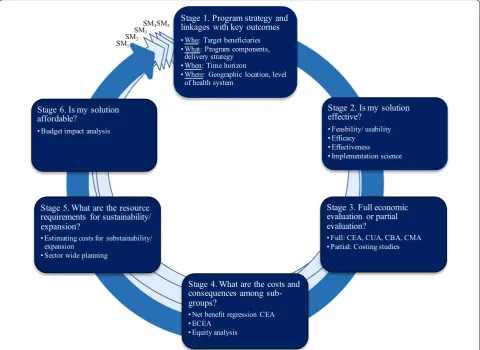
and sustainability (Fig. 1) [17]. These stages can be
com-pleted independently in succession, or as part of a larger business case, which includes concurrent efforts to out-line a strategic case (context, need, anticipated outcomes and impact), commercial case (viability of supply side), and management case [arrangements for program
19]. In the text to follow, we review each Stage in turn and then outline a 5-step process for facilitating deci-sion making on which analyses are most appropriate for a given mHealth program strategy based on its stage of maturity and evaluation, timing of initiation and available resources.
Stage 1. Define your program strategy and linkages with key outcomes
Defining the mHealth program strategy is a vital starting point for economic and financial evaluations, and one which will require re-assessment continuously as pro-grams mature and grow over time. Efforts to define the program strategy should outline the ingredients which underline the program, including who (key stakeholders, target population and characteristics), what (program components, delivery strategy, activities required to develop, start-up and maintain implementation), when (time period), and where (geographic location, level of health system) implementation is occuring. Once the
program strategy has been defined, the pathway between this strategy and a target outcome must be defined. While we consider broader issues around the monitoring and evaluation of mHealth programs in greater depth
elsewhere [17], in brief, this can be done through the
application of a theory of change [20], results framework
[21], logic-model [22], or other conceptual model1 [23].
As part of this process, analysts should consider three critical factors: (1) does the mHealth solution have a direct effect on health status or does it aim to enhance the delivery of an intervention with known effectiveness? (2) are sub-group differences in the uptake of the mHealth solution anticipated? (3) is the mHealth solu-tion anticipated to influence the broader financial
1 Conceptual models help to identify and illustrate the relationships among factors (systemic, organizational, individual or other) that may influence the operation of an intervention and the successful achievement of the inter-vention’s goals [23].
SM1
SM2
SM3
SM4 Stage 1. Program strategy andlinkages with key outcomes
• Who: Target beneficiaries • What: Program components,
delivery strategy • When: Time horizon
• Where: Geographic location, level of health system
Stage 2. Is my solution effective?
• Feasbility/ usability • Efficacy
• Effectiveness • Implementation science
Stage 3. Full economic evaluation or partial evaluation?
• Full: CEA, CUA, CBA, CMA • Partial: Costing studies
Stage 4. What are the costs and consequences among sub-groups?
• Net benefit regression CEA • ECEA
• Equity analysis Stage 5. What are the resource
requirements for sustainability/ expansion?
• Estimating costs for substainability/ expansion
• Sector wide planning Stage 6. Is my solution affordable?
• Budget impact analysis
SM5
Fig. 1 Conceptualizing a stage-based process for economic and financial evaluations of mHealth solutions. SM1-5 corresponds to Stages of maturity
wellness of the household? The answers to these ques-tions will influence the type of evaluation study designs, outcome/impact level data available, and ultimately the types of economic analyses which are feasible to conduct.
For mHealth solutions aiming to have a direct impact on health, a more rigorous process of impact evaluation may be indicated starting with efficacy and effectiveness studies. By comparison, for mHealth solutions aiming to improve delivery of an intervention with a well-established evidence base, emphasis may instead be on the indirect relationship between the mHealth solution and health outcomes. In such instances, the evidence base for health effects, may render the measurement of health outcomes to be unethical or unnecessary. The emphasis may instead be placed on the effectiveness of the delivery strategy as a catalyst for improving service delivery or utilization, there-fore restricting the type of outcome measure available for use in economic analyses to changes in coverage, or pro-cess indicators. For these mHealth programmes, oppor-tunities should be explored for translating coverage data for key reproductive, maternal, newborn, and child health (RMNCH) interventions into modelling tools such as the
Lives Saved Tool (LiST) [24] to generate estimates of lives
saved for individual and packages of interventions. For mHealth solutions which are anticipated to have a differ-ential affect across sub-groups, opportunities for collect-ing data on financial protection, equity, and out of pocket spending should be explored from the outset. For mHealth solutions which are anticipated to have an impact on the financial wellness of the broader household, efforts need to be undertaken from the outset to additionally measure these and ensure their inclusion.
Stage 2. Is my solution effective?
Methods for determining the effectiveness of mHealth solutions are well-established and several guidelines exist
to facilitate their design and implementation [17]. Efforts
to determine the effectiveness of an mHealth solution play a vital role in defining the scope, utility, and feasi-bility of conducting economic and financial evaluations. As part of efforts to determine the effectiveness of an mHealth solution, it is important to understand what role the mHealth solution has in catalysing changes in pro-cess, performance or health effects. Where an mHealth solution has a direct effect on health outcomes, data on health outcomes may be measured. Where the mHealth solution aims to improve delivery of an intervention with known effectiveness, quantifying the direct effect of the mHealth solution on health outcomes may not be required and outcome measures for coverage, changes in service delivery, practices or efficiency may be used in their existing form or to model changes in health out-comes including lives saved.
If an mHealth solution is not effective in a given context according to pre-defined objectives, efforts to determine its value for money, and/or affordability may be contrain-dicated. In some instances, even improvements in worker satisfaction, a commonly cited indicator of early-stage digital health success, may be used as an outcome met-ric, provided the investor in the solution is interested in improving satisfaction. If an mHealth solution is effec-tive, the intended audience, study design, available data, policy time frame, proficiency of the analysts, disease epidemiology, and emerging results may drive the selec-tion of economic, then financial evaluaselec-tions methodolo-gies. Effectiveness studies which adopt randomized or quasi-experimental study designs, and have data on the costs and consequences of two or more alternatives, may enable economic evaluations to be conducted based on primary data. However, when only data on a single pro-gram are available and a comparator or alternative can-not be modelled, partial evaluations or costings studies may be all that are feasible.
Stage 3. Full economic evaluation or partial evaluation?
Full economic evaluations compare two or more alter-native courses of action in terms of both their costs and
consequences [25]. This category of study includes CEAs,
which use natural, identical units to measure changes in outcomes; CUAs which measure outcomes in terms of utility measures such as Quality Adjusted Life Years (QALYs) or Disability Adjusted Life Years (DALYs); CBAs, where both inputs and outcomes are evaluated in mon-etary terms; and cost-minimization analysis (CMA) which
assumes equivalent outcomes before the study onset [26].
Despite differences in the valuation of consequences or measures of effect, full economic evaluations value resources in similar ways. Differences in the valuation of consequences reflect the different aims and viewpoints of different decision problems. Where consequences have been designed to demonstrate equivalence, a CMA may be used to determine the lowest-cost mHealth solution.
However, appropriate applications of CMA are rare [27,
28], and far more common are CEAs, CUAs, and CBAs.
units of outcome and can only be compared against alter-natives with the same outcome (e.g. number of children exclusively breastfed or number of lives saved).
Where programs do not have the data, resources, time or expertise to conduct a full economic evaluation, par-tial evaluations (sometimes referred to as ‘costing stud-ies’) may be undertaken to measure the costs of a single program (cost description); to measure costs of a pro-gram and alternatives (cost analysis); or to describe the costs and consequences of a single program (cost
out-come description analyses) [13]. While partial
evalu-ations do not make explicit comparisons in the costs
and consequences of alternatives [29], they can provide
useful insights for stakeholders by identifying potential amounts of costs, understanding key drivers of costs, and/or preparing to estimate the resources required to sustain or expand a solution, or to develop more
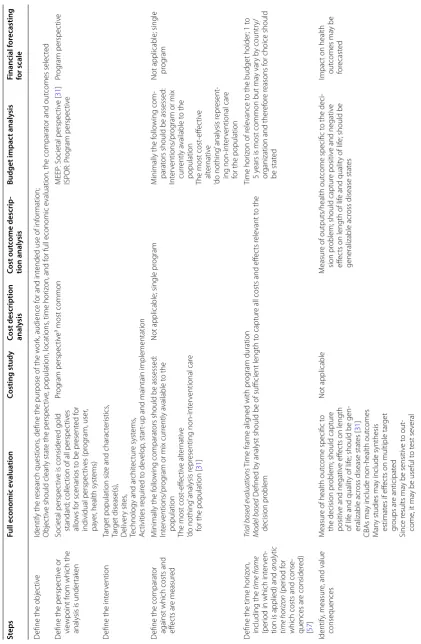
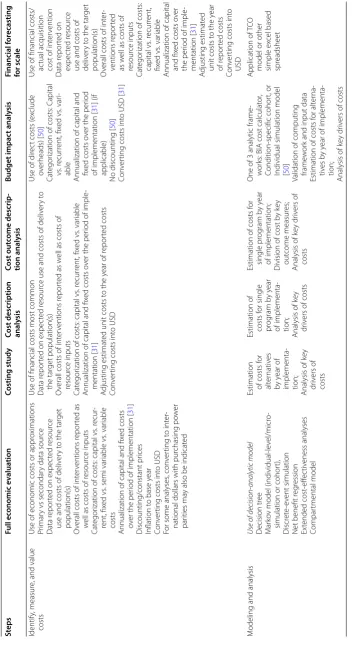
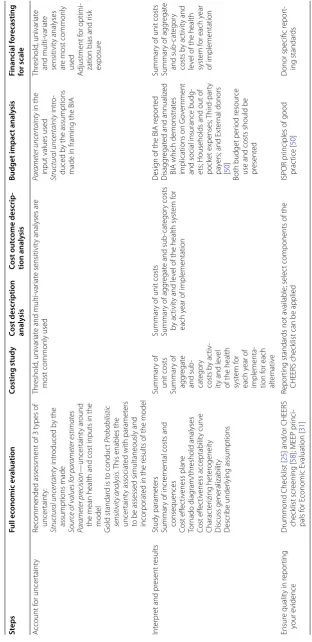
com-prehensive economic evaluations [30]. Table 1
summa-rizes the most common forms of financial and economic
evaluations. Figure 2 presents a flow chart for facilitating
decision-making on which type of economic evaluation is indicated based on the data available.
Stage 4. How do costs and consequences vary across key population sub‑groups?
Variability in population responses to an mHealth solu-tion may correspond to heterogeneity in program uptake and the health outcomes observed. Partitioning patient, provider or citizen populations into sub-populations, communities or groups and assessing the expected costs and consequences on these groups can facilitate deci-sion-taking on the optimal allocation of resources. Given finite resources, the differential allocation of resources to different target populations may yield greater
improve-ments in overall health gains [31].
For mHealth programs expected to yield differences in costs and consequences across sub-groups, CEAs using a net benefit regression framework (NBRF) may be appro-priate. Applications of NBRF marry econometrics with CEA or CUAs to improve the handling of uncertainty, control for confounding, and “allow analysts to explore the importance of covariates on the marginal cost effec-tiveness of an intervention” (i.e., interaction effects between the intervention and important subgroups)”
[32]. In common applications of CEAs or CUAs,
incre-mental cost effectiveness ratios (ICERs) are generated which compare the expected values of cost and conse-quences across alternatives. An intervention is deemed good value for money if its ICER is below a pre-deter-mined maximum willingness to pay for health gain. In practice, since two different treatments or interventions cannot be applied to the same population simultane-ously, the true incremental costs and true incremental
consequences of an intervention remain unknown [32].
Drawing upon sample data obtained from clinical trials or programs, it is possible to estimate the sample mean and sample consequences of a true but unobservable ICER parameter. However, using ratio statistics may pose statistical problems which may affect the
interpreta-tion of sampling uncertainty in the ICER [33, 34]. Since
ICERs are not amenable to regression-based methods, the marginal effect of an intervention on key population sub-groups (e.g. gender, ethnicity) cannot be determined
while controlling for other co-variates [32].
In NBRF, the traditional equation which divides changes in sample mean costs (ΔC) by changes in mean effects (ΔE) to generate an (ΔC/ΔE) ICER is re-arranged
by multiplying each arm of the equation by ΔE [34, 35].
The result is ΔC = ΔE * ICER and for any ceiling ratio λ,
ΔC = ΔE * λ. In NBRF, the dependent variable is
calcu-lated as a net monetary benefit statistic with the equation
ΔE * λ − ΔC = NMB. When computed at an individual
level, the resulting equation of NBi = ΔEi * λ − ΔCi
mirrors that of simple linear regression equation
Y = α + βxi + εi where Y is the dependent variable, α is
the y-intercept, β the regression coefficient on an
explan-atory variable, and εi is the standard error [35]. The basic
NBRF model can then be expanded to include impor-tant covariates and interaction terms, to control for con-founding and evaluate incremental cost effectiveness for
those subgroups [32]. NBRF is strategy which improves
not only the handling of uncertainty in economic evalu-ation, but allows analysts to identify and account for important determinants that affect the cost-effectiveness
results [32, 34]. NBRF also has the added advantage of
allowing analysts to model different probabilities that an mHealth solution would be preferred over alternatives
given different budget constraints [35].
To estimate the differential affect across sub-groups, ana-lysts can consider dimensions of equity and financial pro-tection. In many countries, out of pocket expenditures for health care, particularly when added to income loss from
illness, are leading causes of impoverishment [36, 37].
While some economic evaluations may assume the per-spective of the user and aim to measure out of pocket pay-ments for care, they are not principally concerned with measuring catastrophic spending, nor do they consider non-health or wider economic and social benefits of
invest-ing in a particular innovation [38]. Extended cost
effective-ness analysis (ECEA) has emerged as a tool for synthesizing the health and financial risk protection benefits and
distri-butional consequences of policy [36, 38]. Building on
Table 1 T yp es of ec onomic e valua tion f or mH ealth
a One t
ype of CBA c
onduc
ted f
or r
egula
tions inst
ead of in
ter
ven
tions is called
“r egula tor y impac t analy sis
” which can influenc
e ho w net w or ks ar e r egula ted . A pplica
tions of this ma
y be appr
opr ia te f or eHealth, par ticular ly t o inf or
m decision mak
ing on ho
w best t
o dev
elop r
egula
tions on the in
ter
oper
abilit
y of health inf
or
ma
tion infr
astruc
tur
es and da
ta pr ot ec tion [ 56 ] Definition Costs Consequenc es Primar y audienc e Economic e valuations C ost eff ec tiv eness analysis Compar
ison of t
w
o alt
er
nativ
es wher
e consequences of the pr
o-gramme ar
e measur
ed in natural units
M
onetar
y units
Natural units (lif
e y ears gained , liv es sa ved
, cases det
ec
ted)
D
ecision-tak
ers within a specialit
y
C
ost utilit
y analyses
For
m of CEA wher
e consequence is measur
e in t
er
ms of health
y years M onetar y units Summar y measur
e of population
health: Q
AL
Ys or D
AL Ys Health sec tor go ver nment
NGO Decision tak
ers acr oss sec tors C ost benefit analysis a Compar
ison of t
w
o alt
er
nativ
es wher
e consequences of the pr
o-gramme ar
e measur
ed in monetar
y t er ms . M onetar y units M onetar y units D ecision tak ers acr oss sec tors Ex
tended cost eff
ec
tiv
eness
analysis
For
m of CEA which assesses both the financial r
isk pr
ot
ec
tion
(catastr
ophic health costs a
ver
ted
, cases of po
ver ty a ver ted , mone y-metr
ic value of insurance) and the equitable distr
ibution
of costs and health gains acr
oss population sub
-g
roups and t
o polic y mak ers M onetar y units
Health gains gar
ner ed acr oss population sub -g roups; ma y
also use a summar
y measur
e
of population health (
Q AL Ys or D AL Ys) Health sec tor go ver nment
NGO Decision tak
ers acr
oss sec
tors
C
ost consequence analysis
For
m of CBA which examines costs and consequences but does not aggregat
e consequences int
o a single measur
e M onetar y units Natural units D ecision tak ers acr oss sec tors C
ost minimization analysis
Compar
es r
elativ
e costs of int
er
ventions with eff
ec
ts that ar
e
assumed t
o be equivalent
M
onetar
y units
A
ssumed t
o be equivalent
D
ecision-tak
ers within a specialit
y Par tial e valuations C osting analysis Compar
ison of the costs of t
w
o or mor
e pr og rams M onetar y units Not applicable D ecision-tak
ers within a specialit
y C ost descr iption analysis D escr
ibes the costs of a single pr
og ram M onetar y units Not applicable D ecision-tak
ers within a specialit
y C ost out come descr iption analysis D escr
ibes the costs and consequences of a single pr
og
ram
M
onetar
y units
Natural units (lif
e y ears gained , liv es sa ved
, cases det
ec
ted)
D
ecision-tak
ers within a specialit
y Financial e valuations F inancial f or ecast model Estimat
es the financial and accounting pr
ofile of the capital and
operational cash flo
w and income and expenditur
e of a pr
ojec
t
option o
ver its whole lif
e-cy
cle f
or compar
ison with budgets and
financial plans t
o seek aff
or dabilit y M onetar y units Not applicable Reimbursement author ities Budget impac t analysis Estimat
es the financial consequences of an int
er
vention and its
diffusion within a specific
health-car
e setting or syst
em cont ex t giv en r esour ce constraints M onetar y units
Number of beneficiar
ies or aff ec ted individuals Reimbursement author ities OneHealth National strat eg
ic health planning t
ool which pr
ovides analysts
with a single frame
w
or
k which includes scenar
io analysis
, costing
,
health impac
t analysis
, budgeting and financing of strat
eg
ies
for all major diseases and health syst
em components
. Outputs
facilitat
e (1) the identification of r
esour
ce needs t
o implement a
strat
eg
ic health plan; (2) the det
er
mination of costs f
or the strat
e-gic plan b
y y
ear and input; and (3) estimat
es of health impac
t [ 49 ] M onetar y units
Natural units (liv
es sa
ved)
distribution of costs and health gains across population sub-groups. While there remains a paucity of applications of ECEAs in the literature, and none to date for mHealth, benefits for mHealth solutions could be evaluated across dimensions of direct out of pocket payments for medical
and non-medical costs; financial risk protection2; health
benefits (lives saved; hospitalizations averted); and
distribu-tional consequences across sub-groups [36]. ECEA
applica-tions to date have explored financial protection and the health gains garnered across population sub-groups
2 Financial risk protection aims to ensure access to quality healthcare as needed without incurring financial hardship [36].
defined by socioeconomic status (wealth quintiles). ECEA could also explore differences across other dimensions of equity including gender, ethnicity, geography, and educa-tion given the disparities in health or in social determinants of health between social groups who have different levels of
underlying social advantage/disadvantage [39, 40]. ECEA is
most suited for evaluating health benefits, financial risk protection, total costs to stakeholders, and equity in one analytic framework.
Stage 5. What are the resource requirements for expanding delivery?
Analytical frameworks [41], tools [42], and methods
expansion of mHealth solutions are emerging [43–45]. Health systems frameworks for scaling up mHealth solu-tions recommend that financial planning occurs as a part of a larger planning for scale process which additionally includes groundwork, a review of policies, partnerships (including government stewardship), technology and
architecture systems, operations, and M&E [41, 43, 44].
While there are many approaches to financial planning for scale, two starting points are to: (1) develop a finan-cial forecast for sustaining and/or expanding program activities; and (2) model the sector wide implications of scaling up.
Financial evaluations that estimate the costs to deliver an mHealth program at scale may start by estimating the total addressable market, revenue streams, total cost of ownership, and ultimately explore break-even scenarios before identifying a preferred strategy for scale. Efforts to determine the total addressable market will start with detailed planning on how and where program rollout will occur and at what pace, and include estimates of the total number of beneficiaries. This may be followed by efforts to identify revenue streams, including the willingness to pay on the part of key customer segments (where appro-priate). Once the beneficiary population and revenue streams have been identified, context specific adapta-tions required in response to local epidemiology, popula-tion and health systems needs as well as connectivity and infrastructure should be identified. Understanding that multiple strategies for scaling up a particular program exist, it may be advisable to develop several expansion scenarios. Once program specifications and scenarios are finalized, drawing from primary data, capital and opera-tional costs to modify/develop, start-up, and maintain program implementation should be estimated for each scenario as part of efforts to determine the total cost of
ownership [46, 47]. While the analytic time horizon and
perspective taken will depend on the intended audience and implementers, costs for most mHealth program should seldom exceed a 5-year analytic time horizon in light of the rapid pace with which technology changes, and the depreciation inherent to technology investments. Once total cost of ownership has been determined, a breakeven analysis can be conducted to facilitate deci-sion-making on the preferred strategy for scale. Examples
of breakeven analyses are emerging in the literature [48]
as one tool for facilitating understanding of the optimal strategy and its growth trajectory in conjunction with costs and sources of probable revenue. Beyond facilitat-ing decision-makfacilitat-ing on the optimal scale up scenario, such analyses may help implementers to negotiate with key stakeholders, including mobile network operators to reduce costs and/or identify the optimal cost recovery strategy required to ensure long-term sustainability.
Once the preferred strategy for expansion/sustainabil-ity is identified, the broader sector-wide implications of integrating an mHealth program into the exciting health system should be considered. Depending on the mHealth solution, programmatic context and scale, the OneHealth tool may be an appropriate alternative tool. Designed to inform national strategic health planning in LMICs, One-Health provides analysts with “a single framework for scenario analysis, costing, health impact analysis, budget-ing and financbudget-ing of strategies for all major diseases and
health system components” [49]. Outputs facilitate (1)
identifying resource needs for strategic health plans; (2) estimating costs for strategic plans by year and input; (3)
estimating health impacts [49]. Based on these outputs,
analysts can then compare costs with available finance
[49]. Based on these outputs, analysts can then compare
costs with available finance [49].
Stage 6. Is my mHealth program strategy affordable?
Affordability measures the extent to which net accounting costs and cash flow match the provisions in annual budgets and financial plans over a specified time period. Affordability should be assessed at multiple time points in the stage-based process through three major financial statements: (1) budget statement (draws from resource accounting and budgeting to illustrate resources over the lifetime of a proposal); (2) cashflow statement (depicts the additional cash flow needed if the lead option goes forward); and (3) funding statement (shows resources slated for provision from key stakeholders)
[16]. Affordability is met if the following six criteria are met:
(1) the balance sheet correctly accounts for assets and liabili-ties, and (2) it is healthy; (3) the organization or service unit is solvent; (4) it is not overtrading; (5) the cash flow of the organization is sound; and (6) allowances for risk have been
made [16]. For unaffordable mHealth programs, either the
scope of activities underpinning the mHealth project costs need reducing; the scale of implementation changed; and/ or the overall budget needs increasing. Given that changes in the design of an mHealth program could have implications on both costs and consequences, options for affordability should be iterated with the value for money estimates gener-ated by economic evaluations to find an optimal relationship between them that guides final investment decisions. Set-ting an affordability plan in place may also require an assess-ment of alternative financing models and their sustainability. This could entail identifying new collaborative partnerships to facilitate cost-sharing; negotiating with key vendors to reduce costs (e.g. mobile network operators to reduce air-time costs); and/or exploring alternative service delivery models (e.g. ‘freemium models where users pay for some
features) [43]. Where these change an mHealth program’s
To assess affordability, the Bill and Melinda Gates Foundation, NICE International, and other stakehold-ers recommend conducting a Budget Impact Analysis
(BIAs) [31]. While BIAs can be performed in isolation,
they are most commonly presented with CEAs and used to estimate the financial consequences of adopting
a new intervention [50]. This falls in contrast to CEAs
which aim to measure the relative value of an interven-tion against an alternative; ultimately generating a
meas-ure of the additional cost per outcome measure [51].
BIAs typically assume a 1–5 year analytic time horizon, adopt the perspective of the budget holder, and present the financial streams for each budget period of interest
as undiscounted costs [50]. Most BIAs will exclude
over-head costs and measure only the direct costs of inputs
required to implement the intervention [51]. Additional
BIA reporting standards can be found in country-specific
and global guidelines [50]. Table 2 outlines differences in
the content of steps for conducting BIAs alongside full economic evaluations and partial evaluations.
Which type of analyses are right for me?
Stages 1–6 outline an optimal stage-based process for integrating economic and financial evaluations into
mHealth programs. Figure 1 demonstrates the iterative
nature of how these steps are intended to repeat at mul-tiple points to generate evidence necessary to inform and catalyze the progression of an mHealth solution across stages of maturity from pre-prototype, prototype, pilot, to demonstration and ultimately scaling up, and similarly across stages of evaluation from efficacy, effectiveness to
implementation science. Table 2 illustrates the
relation-ship between many stage-based activities by highlighting differences and similarities in the content of each step required to execute them. Changes in the program design and underlying components inherent with implementa-tion in different contexts and at increasing scale are likely to correspond to changes in both the costs and conse-quences, requiring repeated measures of effectiveness and value for money to ensure appropriate returns as maturity increases. Optimally, application of these stages would occur in a sequential linear process at each stage of maturity, drawing from data obtained in prior stages. In practice, finite resources, including technical exper-tise, coupled with limitations in timing of initiation may render completion of all stages infeasible. Accordingly, a five-step process helps prioritize to match stakeholders’ needs.
Step 1. Define where the technology is in the stage of maturity and in the stage of evaluation
A critical starting point in defining which economic and financial evaluation activities are right for you, lies in first
defining where an mHealth solutions lies within its stages
of maturity [17]. The stage of maturity is the continuum
from pre-prototype and prototype, where mHealth solu-tions are in their earliest stages of evolution and testing, up to fully fledged integration into the health system at
scale (Fig. 3). Closely aligned with the stage of
develop-ment, is to identify the corresponding stage of evaluation. The stage of evaluation ranges from efficacy (implemen-tation under controlled circumstances), effectiveness (implementation under real-world conditions), to imple-mentation science (Assesses the uptake, integration and sustainability of evidence-based mHealth interventions)
[17]. Figure 3 outlines the economic and financial
evalu-ation activities indicated for each stage of maturity and stage of evaluation. While it is envisioned that Stages 1–6 be repeated at each stage of maturity as the mHealth solution moves along the continuum, the types of eco-nomic evaluations (model vs. trial based; CBA vs. CEA vs. CUA) undertaken will also be driven by larger study design considerations, available data, policy timelines, and technical expertise.
Table 2 D iff er enc
es in the c
on ten t of st eps f or c onduc ting ec
onomic and financial e
valua tions of mH ealth solutions St eps Full ec onomic e valua tion Costing study
Cost description analy
sis Cost out come descrip ‑ tion analy sis Budget impac t analy sis Financial f or ecasting for scale D
efine the objec
tiv
e
Identify the r
esear
ch questions
, define the pur
pose of the w
or
k, audience f
or and int
ended use of inf
or
mation;
Objec
tiv
e should clear
ly stat
e the perspec
tiv
e, population, locations
, time hor
iz
on, and f
or full economic e
valuation, the comparat
or and out
comes selec
ted
D
efine the perspec
tiv
e or
vie
wpoint fr
om which the
analysis is under
tak
en
Societal perspec
tiv
e is consider
ed gold
standar
d; collec
tion of all perspec
tiv es allo ws f or scenar ios t
o be pr
esent ed f or individual perspec tiv es (pr og ram, user , pa yer
, health syst
ems) Pr og ram perspec tiv e
a most common
MEEP : S ocietal perspec tiv e [ 31 ] ISPOR: P rog ram perspec tiv e Pr og ram perspec tiv e D
efine the int
er
vention
Tar
get population siz
e and charac
ter istics , Tar get disease(s), D eliv er y sit es ,
Technology and ar
chit ec tur e syst ems , A ctivities r equir ed t o de velop , star
t-up and maintain implementation
D
efine the comparat
or
against which costs and effec
ts ar
e measur
ed
M
inimally the f
ollo
wing comparat
ors should be assessed:
Int
er
ventions/pr
og
ram or mix cur
rently a
vailable t
o the
population
The most cost
-eff ec tiv e alt er nativ e ‘do nothing
’ analysis r
epr
esenting non-int
er
ventional car
e
for the population [
31
]
Not applicable; single pr
og
ram
M
inimally the f
ollo
wing com
-parat
ors should be assessed:
Int
er
ventions/pr
og
ram or mix
cur
rently a
vailable t
o the
population
The most cost
-eff ec tiv e alt er nativ e ‘do nothing
’ analysis r
epr esent -ing non-int er ventional car e
for the population
Not applicable; single pr
og
ram
D
efine the time hor
iz on, including the time fr ame (per
iod in which int
er
ven
-tion is applied) and
analytic time horiz on (per iod f or
which costs and conse
-quences ar e consider ed) [ 57 ]
Trial based e
valuations
T
ime frame alig
ned with pr
og
ram duration
Model based
D
efined b
y analyst should be of sufficient length t
o captur
e all costs and eff
ec ts r ele vant t o the decision pr oblem Time hor iz
on of r
ele
vance t
o the budget holder
; 1 t
o
5
years is most common but ma
y var
y b
y countr
y/
or
ganization and ther
ef
or
e r
easons f
or choice should
be stat
ed
Identify
, measur
e, and value
consequences
M
easur
e of health out
come specific t
o
the decision pr
oblem; should captur
e
positiv
e and negativ
e eff
ec
ts on length
of lif
e and qualit
y of lif
e; should be gen
-eralizable acr
oss disease stat
es [
31
]
CBA
s ma
y include non-health out
comes
M
an
y studies ma
y include synthesis
estimat
es if eff
ec
ts on multiple tar
get gr oups ar e anticipat ed Since r esults ma
y be sensitiv
e t
o out
-come
, it ma
y be useful t
o t est se veral Not applicable M easur
e of outputs/health out
come specific t
o the deci
-sion pr
oblem; should captur
e positiv
e and negativ
e
eff
ec
ts on length of lif
e and qualit
y of lif
e; should be
generalizable acr
oss disease stat
es
Impac
t on health
Table 2 c on tinued St eps Full ec onomic e valua tion Costing study
Cost description analy
sis Cost out come descrip ‑ tion analy sis Budget impac t analy sis Financial f or ecasting for scale Identify , measur
e, and value
costs
Use of economic costs or appr
oximations
Pr
imar
y vs secondar
y data sour
ce
Data r
epor
ted on expec
ted r
esour
ce
use and costs of deliv
er
y t
o the tar
get
population(s)
O
verall costs of int
er
ventions r
epor
ted as
w
ell as costs of r
esour
ce inputs
Cat
egor
ization of costs: capital vs
. r
ecur
-rent, fix
ed vs
. semi var
iable vs
. var
iable
costs
Annualization of capital and fix
ed costs
ov
er the per
iod of implementation [
31
]
Discounting/constant pr
ices
Inflation t
o base y
ear
Con
ver
ting costs int
o USD
For some analyses
, con ver ting t o int er
-national dollars with pur
chasing po
w
er
par
ities ma
y also be indicat
ed
Use of financial costs most common Data r
epor
ted on expec
ted r
esour
ce use and costs of deliv
er y t o the tar get population(s) O
verall costs of int
er
ventions r
epor
ted as w
ell as costs of
resour
ce inputs
Cat
egor
ization of costs: capital vs
. r ecur rent, fix ed vs . var iable
Annualization of capital and fix
ed costs o
ver the per
iod of imple
-mentation [ 31 ] A djusting estimat
ed unit costs t
o the y
ear of r
epor
ted costs
Con
ver
ting costs int
o USD
Use of dir
ec
t costs (
ex clude ov er heads) [ 50 ] Cat egor
ization of costs: C
apital vs . r ecur rent, fix ed vs . var i-able
Annualization of capital and fix
ed costs o
ver the per
iod
of implementation [
31
] (if
applicable)
No discounting [
50
]
Con
ver
ting costs int
o USD [
31
]
Use of financial costs/ ac
tual acquisition
cost of int
er vention Data r epor ted on expec ted r esour ce
use and costs of deliv
er
y t
o the tar
get
population(s)
O
verall costs of int
er -ventions r epor ted as w
ell as costs of
resour
ce inputs
Cat
egor
ization of costs:
capital vs . r ecur rent, fix ed vs . var iable
Annualization of capital and fix
ed costs o
ver
the per
iod of imple
-mentation [ 31 ] A djusting estimat ed
unit costs t
o the y
ear of r epor ted costs Con ver
ting costs int
o
USD
M
odeling and analysis
Use of decision
-analytic model D ecision tr ee M ar ko
v model (individual-le
vel/micr
o-simulation or cohor
t), Discr et e-ev ent simulation
Net benefit r
eg ression Ex tended cost -eff ec tiv eness analyses Compar tmental model
Estimation of costs f
or alt er nativ es by y ear of implementa -tion;
Analysis of k
ey
dr
iv
ers of
costs
Estimation of costs f
or single pr og ram b y y ear of implementa -tion;
Analysis of k
ey
dr
iv
ers of costs
Estimation of costs f
or single pr og ram b y y ear of implementation;
Division of cost b
y k
ey
out
come measur
es;
Analysis of k
ey dr
iv
ers of
costs
One of 3 analytic frame
-w
or
ks: BIA cost calculat
or
,
Condition-specific cohor
t, or
Individual simulation model [50
]
Validation of computing frame
w
or
k and input data
Estimation of costs f
or alt er na -tiv es b y y
ear of implementa
-tion;
Analysis of k
ey dr
iv
ers of costs
Application
of T
CO
model or other simple ex
cel based
spr
Table 2 c on tinued St eps Full ec onomic e valua tion Costing study
Cost description analy
sis Cost out come descrip ‑ tion analy sis Budget impac t analy sis Financial f or ecasting for scale A ccount f or uncer taint y
Recommended assessment of 3 t
ypes of uncer taint y: Structur al unc er taint y intr oduced b y the assumptions made Sour
ce of v
alues for par
ameter estimates Par ameter pr ecision —uncer taint y ar ound
the mean health and cost inputs in the model
G
old standar
d is t
o conduc t Pr obabilistic sensitivit y analysis . T
his enables the
uncer
taint
y associat
ed with paramet
ers
to be assessed simultaneously and incor
porat
ed in the r
esults of the model
Thr
eshold
, univar
iat
e and
multi-var
iat
e sensitivit
y analyses ar
e
most commonly used
Par ameter unc er taint y in the
input values used
Structur al unc er taint y intr o-duced b
y the assumptions
made in framing the BIA
Thr eshold , univar iat e and multi-var iat e sensitivit y analyses ar
e most commonly
used
A
djustment f
or optimi
-zation bias and r
isk exposur e Int er pr
et and pr
esent r
esults
Study paramet
ers
Summar
y of incr
emental costs and
consequences Cost eff ec tiv eness plane Tor nado diag ram/thr eshold analyses Cost eff ec tiv eness acceptabilit y cur ve Charac ter izing het er ogeneit y Discuss generalizabilit y D escr ibe under lying assumptions Summar y of unit costs Summar y of agg regat e and sub -cat egor y costs b y ac tiv
-ity and le
vel
of the health syst
em f or each y ear of implementa -tion f or each alt er nativ e Summar
y of unit costs
Summar
y of agg
regat
e and sub
-cat
egor
y costs
by ac
tivit
y and le
vel of the health syst
em f
or
each y
ear of implementation
D
esig
n of the BIA r
epor
ted
Disagg
regat
ed and annualiz
ed
BIA which demonstrat
es
implications on G
ov
er
nment
and social insurance budg
-ets; Households and out of pock
et expenses; T hir d-par ty pa
yers; and Ex
ter
nal donors
[
50
]
Both budget per
iod r
esour
ce
use and costs should be present
ed
Summar
y of unit costs
Summar
y of agg
regat e and sub -cat egor y costs b y ac tivit y and le
vel of the health
syst
em f
or each y
ear
of implementation
Ensur
e qualit
y in r
epor ting your e vidence Drummond Check list [ 25
] and/or CHEERS
check
list scr
eening [
58
]; MEEP pr
inci -pals f or E conomic E valuation [ 31 ] Repor ting standar
ds not a
vailable; selec
t components of the
CHEERS check
list can be applied
ISPOR pr
inciples of good
prac
tice [
50
]
D
onor specific r
epor
t-ing standar
ds
Synon
ymous with budget holder perspec
tiv
you to identify key drivers of costs and potential areas for cost savings, while setting the stage for affordability analyses. For programs within a scale-up or integration/ sustainability stage of maturity, identifying a compara-tor may be challenging unless the nature of the rollout of the mHealth solution can be influenced to accommo-date a quasi-experimental or stepped wedge study design. Where this is possible, the value for money of the scaled mHealth solution can be assessed drawing from primary data. Where a comparator is not feasible, a model-based economic evaluation or single-arm costing study may be executed and the primary emphasis shifted towards assessing the affordability to different budget holders in different contexts and/or creating a sustainable business model. The latter may be accompanied by broader sys-tem-wide assessments through application of modelling tools such as OneHealth.
Step 2. What M&E activities are planned as part of the overarching mHealth program?
Most economic and financial evaluations are nested within larger program M&E activities. They overlap in data requirements, with economic analyses depending on effectiveness data obtained through overarching M&E, and require extensive support to execute, both from pro-gram managers and financial staff overseeing the propro-gram. The overarching study design for the evaluation, coupled
with scope and content of M&E activities, helps to define the scope of economic analyses and identify opportunities for integrating costing analyses into the on-going M&E. Beyond drawing effectiveness data from the larger study, opportunities to incorporate questions on out of pocket payments to users, socioeconomic status and financial protection into planned or existing surveys may allow for more comprehensive perspectives to be considered and alternative sub-analyses to be undertaken. Further oppor-tunities to ensure that program staff appropriately docu-ment key activities associated with program developdocu-ment, start-up and implementation will ensure that all compo-nents and resources used to execute the program are iden-tified, measured and valued. The extent to which synergies can be identified between M&E and costing activities will help to minimize demands on finite project resources and optimize the scope and use of economic analyses to inform program implementation, expansion and sustainability.
Step 3. Which evidence needs are appropriate for your mHealth solution?
A critical consideration in defining the scope of eco-nomic analyses lies in first considering how the data are intended to be used, by whom, and when. Full economic evaluations answer vital questions on the costs, benefits and comparative use of resources, while financial evalu-ations can estimate resource and financing requirements Stage of
maturity Stage of evaluation
Economic evaluations Illustrative example
Pre-pilot cost effectiveness
analysis for business case Explores the costs and consequences of the mHealth solution
Explores the costs and consequences of the mHealth solution
+ delivery strategy Forecasting probable VFM over 5+year analytic time horizon
Sub-group analyses: Stratified analysis
Cost effectiveness analysis using net benefit regression framework
Extended cost effectiveness analysis Partial
evaluations Financial Evaluations
Pre-prototype/
Prototype Pilot Demonstration Scale-up SustainabilityIntegration/ Feasibility/
Usability Efficacy Effectiveness Implementation Science
Economic evaluation based on primary data Model based economic evaluation
Costing study
Affordability assessment
Financial forecast for sustainability/ expansion Sector-wide planning
for expansion, and provide foundations for assessing affordability. If planned appropriately from the outset, adopting the full range of analyses highlighted in Stages 1–6 should be considered. In practice, this may be infea-sible or cost-prohibitive, in which case, for mHealth
solutions with a comparator, answering basic questions
on value for money, heterogeneity in costs and conse-quences, and affordability should be prioritized. For
mHealth solutions without a comparator, a model-based
full economic evaluation may be possible, drawing on primary data on the program’s implementation costs. If this is not feasible, a partial evaluation or costing study may be undertaken. This can be followed by a basic esti-mate of expansion costs and affordability. However, in the absence of data on value for money that compares the mHealth solution to an alternative, it remains difficult to justify expansion. Given the likely changes to the pro-gram components associated with an mHealth solution’s maturation and/or its introduction to new contexts, one could argue that analyses from an early timepoint in an mHealth program’s implementation may not be general-izable to a more mature program. It is therefore impor-tant to appreciate the caveats underpinning economic evidence and where possible, advocate that analyses be repeated as maturity increases.
Step 4. What is the time point of initiation for economic analyses?
The time point for starting economic analyses within a larger program funding and implementation cycle is a critical consideration in refining study objectives and activities. What is the timeline under which analy-ses must be completed? Has program implementation already begun? Many economic analyses are initiated after implementation, and many of M&E activities have been defined. These analyses may require the retrospec-tive measurement of costs and effects and may be limited by the study design inherited and the availability of data and associated opportunities for primary data collection. While modelling is inherent in most economic analyses, primary collection of reliable and appropriate data, while challenging, is essential for capturing the full spectrum of costs and consequences. Economic analyses planned from a project’s inception allow for the prospective tracking of costs and consequences as implementation unfolds. Economic analyses that aim to estimate events into the future can occur either at a project’s end to catalyse expansion or at its inception, requiring analysts to hypothesize and model changes in how the program might look under a range of options in varied contexts.
Step 5. Available resources
It is critical to assess the technical and financial resources available to conduct economic analyses. While most financial evaluations can be conducted by program staff with an accounting background, economic evaluations will require technical support from a health economist or someone with prior expertise conducting and publish-ing value for money analyses. The challenge with the lat-ter lies not only in collecting, assembling, and analysing data on costs and consequences but in executing compre-hensive uncertainty analyses which have become the gold standard for economic evaluations. Beyond requirements for technical support, it is important to ensure that suf-ficient resources have been set aside to support eco-nomic analyses and in particular primary data collection requirements. The latter may entail face to face struc-tured interviews with respondents to capture data on costs and consequences not obtained through overarch-ing monitoroverarch-ing and evaluation activities. In the absence of appropriate technical and financial planning, resource limitations can heavily impede the quality and rigor of economic analyses.
Conclusions
This paper describes a stage-based process for inte-grating economic and financial evaluations into busi-ness case and M&E activities of mHealth solutions in LMICs. Where economic evaluations generate evidence on which programs represent the best value for money, financial evaluations can provide evidence on the financ-ing required to initiate, sustain and/or expand programs
as well as assess their affordability [52]. By highlighting
synergies in the contents of economic and financials eval-uation activities, we demonstrate how they can be imple-mented concurrently at multiple time points within the lifecycle of an mHealth solution to catalyze progression across stages of maturity. With proper planning and ade-quate resources, economic and financial evaluations can generate evidence essential to improve the allocation of finite resources, program planning, implementation, effi-ciency, effectiveness and sustainability.
Abbreviations
Authors’ contributions
AEL and TJ conceived the idea for this manuscript. The first draft was written by AEL with inputs from all authors. All authors read and approved the final manuscript.
Author details
1 Department of International Health, Johns Hopkins Bloomberg School of Public Health, 615 N. Wolfe Street, Baltimore, MD 21205, USA. 2 Johns Hop-kins University Global mHealth Initiative, 615 N. Wolfe Street E8139, Baltimore, MD 21205, USA. 3 African Centre for eHealth Excellence (Acfee), Kimberley, South Africa.
Acknowledgements
The authors are grateful for the guidance and support provided by Dr. Garrett Mehl of WHO as well as Dr. Peter Benjamin and Helen Alexander of Health. Enabled South Africa.
Competing interests
The authors declare that they have no competing interests.
Funding
Funding for this manuscript was provided by the Johns Hopkins University Global mHealth Initiative, Health.Enabled (http://www.healthenabled.org) and the World Health Organization as part of technical assistance to the United Nations Innovation Working Group (IWG) Catalytic mHealth Grants program. Costs to support the publication of this manuscript were provided by the Johns Hopkins University Global mHealth Initiative.
Publisher’s Note
Springer Nature remains neutral with regard to jurisdictional claims in pub-lished maps and institutional affiliations.
Received: 18 October 2016 Accepted: 5 April 2017
References
1. ICT, The world in 2014: ICT facts and figures. International Telecom-munication Union, ICT Data and Statistics Division, TelecomTelecom-munication Development Bureau. Geneva; 2014.
2. Bank W. Information and communications for development: maximiz-ing mobile. Washmaximiz-ington DC: International Bank for Reconstruction and Development/The World Bank; 2012.
3. WHO. eHealth tools and services: needs of the member states. Report of the WHO global observatory for eHealth. Geneva: World Health Organiza-tion; 2006.
4. Mehl G, et al. Harnessing mHealth in low-resource settings to overcome health system constraints and achieve universal access to healthcare in healthcare and technology. In: Marsch L, Lord S, Dallery J, editors. Using science-based innovations to transform practice. New York: Oxford University Press; 2015.
5. Cargo M. South Africa mHealth Landscape. GSMA; 2013.
6. Kallander K, et al. Mobile health (mHealth) approaches and lessons for increased performance and retention of community health workers in low- and middle-income countries: a review. J Med Internet Res. 2013;15(1):e17.
7. Free C, et al. The effectiveness of mobile-health technologies to improve health care service delivery processes: a systematic review and meta-analysis. PLoS Med. 2013;10(1):e1001363.
8. Free C, et al. The effectiveness of mobile-health technology-based health behaviour change or disease management interventions for health care consumers: a systematic review. PLoS Med. 2013;10(1):e1001362. 9. LeFevre A, et al. Systematic review of economic evaluations of eHealth
and mHealth programs in low and middle income countries from 2005 to 2015. Submitted for publication.
10. Schweitzer J, Synowiec C. The economics of eHealth and mHealth. J Health Commun. 2012;17:73–81.
11. Bergmo T. How to measure costs and benefits of ehealth interven-tions: an overview of methods and frameworks. J Med Internet Res. 2015;17(11):e254.
12. WHO. mHealth: use of mobile wireless technologies for public health. 2016. http://apps.who.int/gb/ebwha/pdf_files/EB139/B139_8-en.pdf. 13. Drummond MF, et al., editors. Methods for the economic
evaluation of health care programmes. 3rd ed. Oxford: Oxford University Press; 2005. https://www.amazon.com/
Methods-Economic-Evaluation-Health-Programmes/dp/0198529457.
14. WHO. Health systems strengthening glossary. 2014. http://www.who.int/ healthsystems/hss_glossary/en/.
15. SNL. Saving newborn lives initiative: project costing guidelines. Washing-ton DC: Save the Children; 2004.
16. Treasury H. The green book: appraisal and evaluation in central govern-ment. London: TSO; 2003.
17. WHO. M&E for digital health: a pragmatic workbook to assist with monitoring and evaluation of digital health interventions. Geneva: World Health Organization; 2016.
18. DFID. How to note: writing a business case. London: Department for International Development; 2011.
19. Public sector business cases using the five case model: green book sup-plementary guidance on delivering public value from spending propos-als. In: Lowe J, editor. London: HM Treasury; 2013.
20. Vogel I. Review of the use of ‘Theory of Change’ in international develop-ment. London: UK Department of International Development; 2012. 21. USAID. Performance monitoring and evaluation TIPS: building a results
framework. Washington, DC: USAID; 2010.
22. Bank W. Monitoring and evaluation: some tools, methods, and approaches. The International Bank for Reconstruction and Develop-ment/The World Bank: 1818 H Street NW, Washington DC 20433, USA; 2004.
23. Earp JA, Ennett ST. Conceptual models for health education research and practice. Health Educ Res. 1991;6(2):163–71.
24. JHSPH. LiST: Lives Saved Tool. 2016. http://www.livessavedtool.org/. 25. Drummond M, et al. Methods for the economic evaluation of health care
programmes. 3rd ed. Oxford: Oxford University Press; 2005.
26. Higgins J, Green S. Cochrane handbook for systematic reviews of inter-ventions. Chichester: Wiley; 2008.
27. Briggs AH, O’Brien BJ. The death of cost-minimization analysis? Health Econ. 2001;10(2):179–84.
28. Dakin H, Wordsworth S. Cost-minimisation analysis versus cost-effective-ness analysis, revisited. Health Econ. 2013;22(1):22–34.
29. Shemilt I, et al. Incorporating economics evidence. In: Higgins JPT, Green S, editors. Cochrane handbook for systematic reviews of interventions version 5.1.0; 2011.
30. Walker D. Cost and cost-effectiveness guidelines: which ones to use? Health Policy Plan. 2001;16(1):113–21.
31. International N. Bill and Melinda Gates Foundation methods for eco-nomic evaluation project (MEEP): final report. Bill and Melinda Gates Foundation, NICE International, the Health Intervention and Technol-ogy Assessment Program (Thailand), and the University of York. Seattle: Centre for Health Economics; 2014.
32. Hoch JS, Briggs AH, Willian AR. Something old, something new, something borrowed, something blue: a framework for the marriage of health econometrics and cost effectiveness analysis. Health Econ. 2002;11:415–30.
33. O’Brien BJ, et al. In search of power and significance: issues in the design and analysis of stochastic cost-effectiveness studies in health care. Med Care. 1994;32:150–63.
34. Stinnett AA, Mullahy J. Net health benefits: a new framework for the analysis of uncertainty in cost-effectiveness analysis. Med Decis Mak. 1998;2(Suppl):S68–80.
35. Hounton S, Newlands D. Applying the net-benefit framework for analyzing and presenting cost-effectiveness analysis of a maternal and newborn health intervention. PLoS ONE. 2012;7(7):e40995.
36. Verguet S, Laxminarayan R, Jamieson D. Universial public finance of tuberculosis treatment in India: an extended cost effectiveness analysis. Health Econ. 2015;24:318–32.

![Fig. 2 Choosing between alternative types of economic evaluations (adapted from [53–55])](https://thumb-us.123doks.com/thumbv2/123dok_us/587154.1554157/7.595.58.538.85.526/fig-choosing-alternative-types-economic-evaluations-adapted.webp)
![Fig. 3 Linking the stages of maturity and evaluation with economic and financial evaluations (modified from [17])](https://thumb-us.123doks.com/thumbv2/123dok_us/587154.1554157/13.595.56.543.90.352/linking-stages-maturity-evaluation-economic-financial-evaluations-modified.webp)