R E S E A R C H A R T I C L E
Open Access
Intimate partner violence among women with
HIV infection in rural Uganda: critical implications
for policy and practice
Michael O Osinde
1, Dan K Kaye
2*and Othman Kakaire
2Abstract
Background:Intimate partner violence (IPV) is a major public health problem in Africa and worldwide. HIV infected women face increased IPV risk. We assessed the prevalence and factors associated with IPV among HIV infected women attending HIV care in Kabale hospital, Uganda.
Methods:This cross-sectional study was conducted among 317 HIV infected women attending Kabale regional hospital HIV treatment centre, from March to December 2010. Participants were interviewed using an interviewer-administered questionnaire. Data was collected on socio-demographic variables, social habits, and IPV (using the abuse assessment screen and the Severity of Violence against Women Scale to identify physical, sexual and psychological violence). Characteristics of the participants who reported IPV were compared with those who did not. Multivariate logistic-regression analysis was conducted to analyze factors that were independently associated with IPV.
Results:The mean age of 317 respondents was 29.7 years. Twenty two (6.9%) were adolescents and 233 (73.5%) were married or cohabiting. The mean age of the spouse was 33.0 years.
One hundred and eleven (35.0%) were currently on antiretroviral therapy. Lifetime prevalence of IPV (physical or sexual) was 36.6%. In the preceding 12 months, IPV (any type) was reported by 93 respondents (29.3%). This was physical for 55 (17.6%), and sexual /psychological for 38 (12.1%). On multivariate multinomial logistic regression analysis, there was a significant but inverse association between education level and physical partner violence (adjusted relative risk (ARR) 0.50, confidence limits (95% CI) 0.31-0.82, p-value = 0.007). There was a significant but inverse association between education level of respondent and sexual/psychological violence (ARR 0.47 95%CI (0.25-0.87), p-value = 0.017) Likewise, there was a significant inverse association between the education level of the spouse and psychological/sexual violence (ARR 0.57, 95% CI 0.25-0.90, p-value = 0.018). Use of antiretroviral therapy was associated with increased prevalence of any type of violence (physical, sexual or psychological) with ARR 3.04 (95%CI 1.15-8.45, p-value = 0.032).
Conclusion:Almost one in three women living with HIV had suffered intimate partner violence in the preceding 12 months. Nearly one in five HIV patients reported physical violence, and about one in every seven HIV patients reported sexual/psychological violence. Likewise, women who were taking antiretroviral drugs for HIV treatment were more likely to report any type of intimate partner violence (physical, sexual or psychological). The implication of these findings is that women living with HIV especially those on antiretroviral drugs should be routinely screened for intimate partner violence.
* Correspondence: [email protected] 2
Department of Obstetrics and Gynecology, School of Medicine, Makerere University College of Health Sciences, P.O. Box 7072, Kampala, Uganda Full list of author information is available at the end of the article
Background
Intimate partner violence (IPV) is a major public health problem in Africa and worldwide [1-7]. For women, its consequences include low birth weight [6], unwanted pregnancy and induced abortion [7] and death from homicide [8]. Other effects include physical injury or disability, depression [9], post-traumatic stress syndrome [9] and preterm birth [10]. In addition, other sequelae include poor acceptance of services to prevent human immunodeficiency virus (HIV) vertical transmission [11]. IPV has been associated with several risk factors, which include (for the male) having multiple sexual partners [4] and perpetrator alcohol use [2,3,12,13]. For the woman, risk factors for IPV include HIV positive status [3,6,11], low education or low socioeconomic sta-tus [2,6], pregnancy [7] and being in a cohabitating rela-tionship [7].
Numerous studies in heterosexual relationships [14-19] found an association between IPV and high rates of risk behaviors (such as multiple sex partners, non-use or inconsistent use of condoms and sexual coercion) and sexually transmitted infections (STIs) such as HIV. There are several explanations for this relationship. Firstly, gender differences in socialization of men and women (in socially defined and socially structed ways) influence who, where and in what con-text men and women form sexual partnerships, as well as the overt and covert power relationships involved [14]. Secondly, in some patriarchal societies, men’s socialization idolizes traits of strengths and toughness, phenomenal sexual success and clustering of violent, anti-social and risky sexual practices [14], as well as women’s submissiveness. In such societies, women’s sexuality might pose a threat to the socially accepted norms and behavior, as it challenges men’s control over women, and provokes jealousy in the women’s spouses [14,15]. Women who follow such socially prescribed norms are at high risk of acquiring HIV infection subse-quent to their partners’high-risk behavior puts them at risk of acquiring HIV infection.
Substance abuse is often associated with risky sexual behavior [14-16]. IPV increases women’s risk of acquisi-tion of HIV as a result of coercive sex (in case of sexual violence), non-use of condoms and increased risk of exposure to HIV [17-19]. Abusive partners have other risk behaviors such as drinking alcohol, drug abuse, STIs, multiple sexual partners and concurrent sexual partnerships. Abused women face increased HIV risk based both on the greater likelihood of HIV infection among abusive husbands and elevated HIV transmission within abusive relationships [17-19]. IPV affects the psy-chological and mental health of women survivors, in part through increasing other risk behaviors such as drug and substance abuse [16]. Indeed, alcohol use
before sex and related disinihibition were found to increase therisk of HIV infection in young women aged 15-24 years in Uganda [17].
In addition, IPV may be a consequence of HIV care. Where as voluntary counseling and testing (VCT) and routine counseling (RCT) are cornerstones of HIV pre-vention interpre-ventions and are entry points into care for those who test HIV positive, the behaviors promoted after testing positive increase risk of IPV. Such behaviors include negotiating condom use with sexual partners, abstaining from sex and disclosure of HIV status to sex-ual partners [20]. To overcome this problem, couple counseling has been advanced as a measure to promote HIV prevention and reduce IPV risks. IPV functions as both a risk marker and a risk factor for HIV among women [21]. Indeed, among women attending antenatal clinic in South Africa and Nigeria, a strong association was found between gender-based violence and HIV infection [22-25], suggesting the need for routine HIV and IPV screening for Prevention of Mother to Child HIV transmission (PMTCT) programs. Given that IPV increases women’s risk of acquiring HIV and that disclo-sure of HIV status or negotiating safer sex could be cat-alysts for based violence [20], integrating gender-based violence screening and management could be a critical component of HIV prevention and care pro-grams. The objective of this cross-sectional study was to assess the prevalence and factors associated with IPV among HIV infected women attending HIV care in Kabale Hospital, Uganda.
Methods
Study design, participants and data collection procedure
participants, and all eligible participants were provided with appropriate counseling, support and antiretroviral therapy.
Data analysis
Data was analyzed by computing frequencies and per-centages for categorical variables as well as means and standard deviations for numerical variables, stratified for presence or absence of IPV. On bivariate analysis, fac-tors associated with IPV were analyzed, using chi-square test for categorical variables and Student’st-test for numerical variables, at the 95% significance level. Multi-variate multinomial logistic-regression analysis was con-ducted to analyze factors that were independently associated with IPV, computing relative risks for IPV. During the stepwise multinomial logistic regression modeling, IPV in the preceding 12 months was coded at three levels: any type of violence, physical violence only and sexual/psychological violence. Absence of IPV was the reference category.
Results
Regarding socio-demographic characteristics, the mean age of the 317 women was 29.7 years (standard devia-tion 9.9 years). Twenty two (6.9%) were adolescents while 233 (73.5%) were married or cohabiting. The mean age of the spouse was 33.0 years (standard devia-tion 8.6 years). The respondents were of high parity with 164 women (51.7%) being of parity 5 or higher. Regarding education level, 184 women (58.5%) had just primary level or no formal education. Lifetime preva-lence of IPV (physical or sexual) was reported by 116 (36.6%) respondents. In the preceding 12 months, IPV (any type) was reported by 93 respondents (29.3%). This was physical for 55 (17.6%), and sexual/psychological for 38 (12.1%). Table 1 shows the socio-demographic char-acteristics of the respondents stratified by presence of IPV in the preceding 12 months. The respondents who reported history of IPV were comparable to those who did not (p > 0.05) with respect to all socio-demographic variables except level of education (of the respondents) (p-value = 0.002) and level of education of their spouses (p-value = 0.037).
Table 2 shows the respondents’treatment with antire-troviral therapy (ART) in relation to the prevalence of intimate partner violence in the preceding12 months. One hundred and eleven women (35.0%) were currently on ART. The mean duration of ART was 3.3 months (± 3.2 months). Thirty four women (30.6%) had changed their treatment regimen to second line regimen, with side effects of the drugs being the main reasons for treatment regimen change. (The commonest ART first line regimen was Triomune, a fixed dose combination of Stavudine, Lamivudine and Nevirapine, which frequently
caused side effects and was eventually phased out from the available treatment regimes). Women who were cur-rently on ART were nearly twice as likely to be report IPV in the preceding 12 months (Odds ratio 1.9, 95% CI 0.93-3.93), p-value = 0.078).
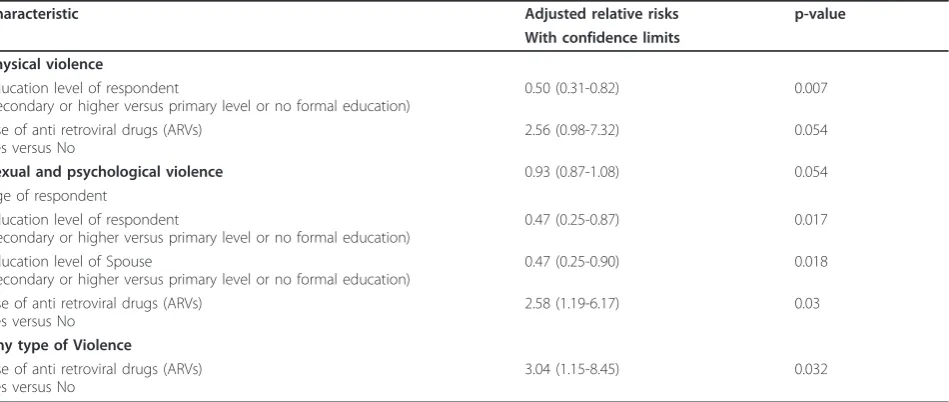
Table 3 shows the results of multivariate multinomial logistic regression analysis showing factors associated with IPV in the preceding 12 months. Factors associated with lower prevalence of physical violence were educa-tion level of respondent (adjusted relative risk (ARR) 0.50, confidence limits (95%CI) 0.31-0.82), education level of spouse (ARR 0.5, 95%CI 0.31-0.82, p = 007) and use of antiretroviral therapy (ARR 2.56, 95%CI 0.98-7.32, p-value = 0.054). There was an inverse association between age of respondent (ARR 0.93, 95%CI 0.87-1.08, p-value = 0.054), education level of respondent (ARR 0.47, 95%CI 0.25-0.87, p-value = 0.017) and education level the spouse of respondent (ARR 0.47, 95%CI 0.25-0.90, p-value = 0.018) and presence of sexual/psycholo-gical violence. Only use of ART was significantly asso-ciated with prevalence of any type of violence (physical, sexual or psychological) with ARR 3.04 (95%CI 1.15-8.45, p-value = 0.032), after adjusting for age, parity, education level and employment status of the respondent.
Discussion
Violence against women has been identified as a major risk factor for HIV infection among women [28-31]. Observational studies have shown that a woman’s expo-sure to IPV is associated with an increased risk for HIV infection in southern and eastern Africa [3,4,13-15,21,22,32]. There are several mechanisms through which IPV is related to increased risk for HIV infection among women. These include direct effects through higher levels of violent sexual intercourse among abused women. This is in addition to the likelihood that men who enact IPV will have more high-risk sexual beha-viors [33,34] and may be more likely to be HIV infected [23]. Furthermore, there are indirect effects through reduced likelihood that women who have suffered past abuse are likely to have more sexual partners and more transactional sex, as well as being less likely to test/disclose sero-status or less receptive to HIV awareness programs [35,36]. These reflect an underlying power imbalance. Indeed, two cohort studies in South Africa have found reduced HIV risk behaviors [37] and reduced HIV inci-dence [38] following interventions to empower women.
of the contextual factors for increased IPV in other con-texts [14-16]. In addition, gender inequality and poly-gamy have been associated with increased risk of IPV. Likewise, there is no evidence that the more educated the woman is, the less likely they will be in polygamous marital relationships. There is no evidence that marital conflict, drug abuse or excessive alcoholic consumption occur with lower frequency in sexual relationships of more educated women. However, women in such rela-tionships may have more bargaining power and poten-tial to leave such abusive relationships. In the latter case, such leaving or threats of leaving may trigger inti-mate partner violence.
In this study, we acknowledge several limitations: this was a cross-sectional study in women attending a health facility with a regional HIV care centre, where we evalu-ated only 317 respondents, all of whom were HIV posi-tive. Our findings are not representative of all HIV patients or all survivors of IPV. Since the respondents were women already accessing HIV care, it is possible that they experienced lower levels of violence that the HIV infected women in the general population. Sec-ondly, we can not establish a temporal relationship between HIV and IPV. Thirdly, since we have no refer-ence group that was HIV negative, we can not evaluate a causal relationship between IPV and HIV. Our
Table 1 Socio-demographic characteristics of the respondents stratified for presence or absence of intimate partner violence in the preceding 12 months
Characteristic All participants Number (percentage)
History of IPV Number (percentage)
No history of IPV Number (percentage)
Age group of respondent
24 years or less 125 (39.4) 22 (40.0) 103 (39.3)
Above 24 years 192 (60.6) 33 (60.0) 159 (60.7)
Religion of respondent
Catholic 120 (38.0) 14 (25.5) 106 (40.5)
Protestant 168 (53.2) 28 (50.9) 130 (49.6)
Moslem 16 (5.1) 2 (3.6) 14 (5.3)
Others 12 (3.8) 1 (1.8) 11 (4.2)
*Education level of respondent
No formal education 27 (8.5) 7 (12.7) 20 (7.6)
Primary level 157 (50.0) 35 (63.6) 123 (46.9)
Secondary level 81 (25.6) 11 (20.0) 70 (26.7)
University or higher than secondary
50 (15.8) 2 (3.6) 48 (18.3)
Drinking
Yes 34 (10.8) 6 (10.9) 28 (10.7)
No 283 (89.2) 49 (89.1) 233 (89.3)
Parity
1 52 (16.4) 8 (14.5) 44 (16.8)
4-Feb 101 (31.9) 21 (38.2) 80 (30.5)
5 and above 164 (51.7) 26 (47.3) 138 (50.7)
Marital status of respondent
Single 23 (7.3) 2 (3.6) 21 (8.0)
Currently married 227 (71.6) 48 (87.4) 179 (68.3)
Ever married 67 (21.1) 5 (9.0) 62 (25.7)
Type of marriage if currently married
Monogamous 200 (88.2) 48 (87.3) 179 (74.3)
Polygamous 117 (11.8) 5 (12.7) 62 (25.7)
*Education level of spouse
No formal education 9 (3.6) 3 (5.5) 6 (2.3)
Primary level 96 (41.0) 23 (41.8) 73 (27.8)
Secondary level 92 (39.3) 19 (48.2) 73 (27.8)
University or higher than secondary
37 (15.8) 3 (5.5) 34 (42.1)
findings, however, suggest that IPV is associated with HIV infection, as almost every third woman living with HIV had suffered IPV, and about one in seven HIV patients reported both sexual and psychological violence in the preceding 12 months.
Our findings are in agreement with studies from Tan-zania [4], Rwanda [39] and South Africa [40,41] which found an association between HIV and IPV. The high prevalence of IPV (both physical and sexual violence) in women with HIV infection has critical implications for policy and practice in programs and interventions for HIV or IPV. Such programs/interventions should incor-porate strategies to address the problem on several fronts. Firstly, the strategies should change the underly-ing social construction of masculinity and gender power imbalances that underlie risk for IPV and HIV. The experience of violence reinforces gendered power inequalities that impact on women’s HIV risk, such that
women who have less power in their sexual relationship (measured on the Sexual Relationship Power Scale) are at higher risk of having HIV [13] and women with less power have a lower likelihood of condom use [14,41]. In addition, health education should be provided to women receiving care for HIV or IPV regarding the nature of the associated risk, as well as reduction of risk factors (that increase risk of both HIV and IPV).
Secondly, policy guidelines should incorporate routine screening for IPV and HIV in healthcare settings. Thirdly, clinicians should incorporate inquiries about IPV to women accessing care for STIs or HIV. Similarly, STIs should be recognized as potential epidemiological markers for IPV. Lastly, our findings have implications for future research: A larger study comprised of both HIV positive and HIV negative participants would con-firm whether a true association exists between HIV infection and IPV. Furthermore, though their findings
Table 2 Drug therapy and Intimate partner violence in the preceding 12 months
Characteristic All respondents History of IPV No History of IPV Number (Percentage) Number (Percentage) Number (Percentage)
Are you currently on Antiretroviral therapy
Yes 111 (35.0) 13 (23.6) 98 (37.4)
No 206 (65.0) 42 (76.4) 164 (62.6)
Have you ever changed Antiretroviral treatment regimen
Yes 34 (30.6) 7 (63.6) 27 (27.6
No 77 (69.4) 4 (37.3) 71 (72.3)
Reasons for changing ARV treatment regimen
Side effects of drugs 20 (58.8) 2 (33.3) 18 (64.3)
Drug resistance (treatment failure) 7 (20.6) 2 (33.3) 5 (17.9)
Pregnancy-related 3 (8.8) 1 (16.7) 2 (7.2)
Reasons Others (drug costs, Tuberculosis co-infection) 4 (11.8) 1 (16.7) 3 (10.7)
Table 3 Multinomial multivariate logistic regression of factors associated with Intimate partner violence in the preceding 12 months
Characteristic Adjusted relative risks p-value
With confidence limits Physical violence
Education level of respondent
(secondary or higher versus primary level or no formal education)
0.50 (0.31-0.82) 0.007
Use of anti retroviral drugs (ARVs) Yes versus No
2.56 (0.98-7.32) 0.054
Sexual and psychological violence 0.93 (0.87-1.08) 0.054 Age of respondent
Education level of respondent
(secondary or higher versus primary level or no formal education)
0.47 (0.25-0.87) 0.017
Education level of Spouse
(secondary or higher versus primary level or no formal education)
0.47 (0.25-0.90) 0.018
Use of anti retroviral drugs (ARVs) Yes versus No
2.58 (1.19-6.17) 0.03
Any type of Violence
Use of anti retroviral drugs (ARVs) Yes versus No
tend to be context-specific and their generalisability is limited, qualitative studies should be conducted in this population and setting to develop more nuanced under-standing of the complex interaction between gender norms, IPV and HIV. In addition, association between use of antiretroviral therapy and IPV requires further investigation in longitudinal community based studies, given its grave possible repercussions at the personal and public health levels, resulting from viral resistance that could develop in case of poor adherence to medication.
Conclusion
Nearly one in five women living with HIV had suffered IPV in the preceding 12 months, and one in every six HIV patients with sexual violence reported psychological violence. The higher the education level attained by the respondent (or their spouse), the less likely they were to report sexual or psychological violence. Likewise, women who were taking antiretroviral drugs for HIV treatment were more likely to report any type of IPV. The implication of these findings is that women living with HIV especially those on antiretroviral drugs should be routinely screened for intimate partner violence
Acknowledgements
The authors are grateful to colleagues of the Kabale hospital, the research assistants who did the data collection and all the research participants.
Author details
1
Kabale Regional Hospital, Department of Obstetrics and Gynecology, P.O.B ox 7, Kabale, Uganda.2Department of Obstetrics and Gynecology, School of Medicine, Makerere University College of Health Sciences, P.O. Box 7072, Kampala, Uganda.
Authors’contributions
DKK and OK conceptualized the study. DKK, OK and MOO designed the study instrument. MOO piloted the study instruments and collected the data. DKK and OK conducted the data analysis. DKK wrote the first draft of the manuscript. All co-authors contributed to revision of the subsequent drafts and approved the final version of the manuscript.
Competing interests
The authors declare that they have no competing interests.
Received: 10 March 2011 Accepted: 17 November 2011 Published: 17 November 2011
References
1. Ellsberg M, Jansen HA, Heise L, Watts CH, Garcia-Moreno C, WHO Multi-country Study on Women’s Health and Domestic Violence against Women Study Team:Intimate partner violence and women’s physical and mental health in the WHO multi-country study on women’s health and domestic violence: an observational study. 1.Lancet2008, 371(9619):1165-1172.
2. Garcia-Moreno C, Jansen HA, Ellsberg M, Heise L, Watts CH, WHO Multi-country Study on Women’s Health and Domestic Violence against Women Study Team:Prevalence of intimate partner violence: findings from the WHO multi-country study on women’s health and domestic violence.
Lancet2006,368(9543):1260-1269.
3. Koenig MA, Lutalo T, Zhao F, Nalugoda F, Wabwire-Mangen F, Kiwanuka N,
et al:Domestic violence in rural Uganda: evidence from a community-based study.Bulletin of the World Health Organisation2003,81:53-60. 4. Maman S, Mbwambo JK, Hogan NM, Kilonzo GP, Campbell JC, Weiss E,
et al:HIV positive women report more lifetime partner violence: findings from a voluntary counseling and testing clinic in Dar Es Salaam, Tanzania.American Journal of Public Health2002,92:1331-1337.
5. Andersson N, Ho-Foster A, Mitchell S, Scheepers E, Goldstein S:Risk factors for domestic physical violence: a national cross-sectional household survey in eight southern African countries.BMC Women’s Health2007, 16:11.
6. Kaye DK, Mirembe FM, Bantebya G, Johansson A, Ekstrom AM:Domestic violence during pregnancy and risk of low birthweight and maternal complications: a prospective cohort study at Mulago Hospital, Uganda.
Tropical Medicine and International Health2006,11(10):1576-1584. 7. Kaye DK, Mirembe FM, Bantebya G, Johansson A, Ekstrom AM:Domestic
violence as risk factor for unwanted pregnancy and induced abortion in Mulago Hospital, Kampala, Uganda.Tropical Medicine and International Health2006,11(1):90-101.
8. Campbell JC, Glass N, Sharps PW, Laughon K, Bloom T:Intimate partner homicide: review and implications of research and policy.Trauma Violence and Abuse2007,8:246-269.
9. Rosen D, Seng JS, Tolman RM, Mallinger G:Intimate partner violence, depression, and posttraumatic stress disorder as additional predictor of low birth weight infants among low-income mothers.Journal of Interpersonal Violence2007,22:1305-1314.
10. Neggers Y, Goldenberg R, Cliver S, Hauth J:Effects of domestic violence on preterm birth and low birth weight.Acta Obstetricia et Gynecologia Scandinavica2004,83(5):455-460.
11. Karamagi CA, Tumwine JK, Tylleskar T, Heggenhougen K:Intimate partner violence against women in eastern Uganda: implications for HIV prevention.BMC Public Health2006,6:284.
12. Uganda Bureau of Statistics (UBOS):Uganda Demographic and Health Survey
Entebbe, Uganda; Uganda Bureau of Statistics and ORC Macro; 2006. 13. Dunkle KL, Jewkes RK, Brown HC, Yoshihama M, Gray GE, McIntyre JA,et al:
Prevalence and patterns of gender-based violence and revictimization among women attending antenatal clinics in Soweto, South Africa.
American Journal of Epidemiology2004,160:230-239.
14. Jewkes R, Morrell R:Gender and sexuality: emerging perspectives from the heterosexual epidemic in South Africa and implications for HIV risk and prevention.Journal of the International AIDS Society2010,13:6. 15. Dunkle K, Jewkes R, Nduna M, Levin J, Jama N, Khuzwayo N,et al:
Perpetration of partner violence and HIV risk behaviour among young men in the rural Eastern Cape.AIDS2006,20:2107-2114.
16. el-Bassel N, Fontdevila J, Gilbert L, Voisin D, Richman BL, Pitchell P:HIV risks of men in methadone maintenance treatment programs who abuse their intimate partners: a forgotten issue.Journal of Substance Abuse2001, 13(1-2):29-43.
17. Zablotska IB, Gray RH, Koenig MA, Serwadda D, Nalugoda F, Kigozi G,et al: Alcohol use, intimate partner violence, sexual coercion and HIV among women aged 15-24 in Rakai, Uganda.AIDS and Behavior2009, 13(2):225-33.
18. Martin SL, Kilgallen B, Tsui AO, Maitra K, Singh KK, Kupper LL:Sexual behaviors and reproductive health outcomes: associations with wife abuse in India.JAMA1999,282(20):1967-1972.
19. Silverman JG, Decker MR, Kapur NA, Gupta J, Raj A:Violence against wives, sexual risk and sexually transmitted infection among Bangladeshi men.
Sexually Transmitted Infections2007,83(3):211-215.
20. Gaillard P, Melis R, Mwanyumba F, Claeys P, Muigai E, Mandaliya K,et al: Vulnerability of women in an African setting: lessons for mother-to-child HIV transmission prevention programmes.AIDS2002,16(6):937-9. 21. Decker MR, Seage GR, Hemenway D, Raj A, Saggurti N, Balaiah D,et al:
Intimate partner violence functions as both a risk marker and risk factor for women’s HIV infection: findings from Indian husband-wife dyads.
Journal of the Acquired Immune Deficiency Syndrome2009,51(5):593-600. 22. Dunkle KL, Jewkes RK, Brown HC, Gray GE, McIntyre JA, Harlow SD:
Gender-based violence, relationship power, and risk of HIV infection in women attending antenatal clinics in South Africa.Lancet2004,
363(9419):1415-1421.
programmes.Tropical Medicine and International Health2007, 12(12):1484-1489.
24. Ezeanochie MC, Olagbuji BN, Ande AB, Kubeyinje WE, Okonofua FE: Prevalence and correlates of intimate partner violence against HIV sero-positive pregnant women in a Nigerian population.Acta Obstetricia et Gynecologia Scandinavica2011,90(5):535-539.
25. Christofides N, Jewkes R:Acceptability of universal screening for intimate partner violence in voluntary HIV testing and counseling services in South Africa and service implications.AIDS Care2010,22(3):279-285. 26. McFarlane J, Parker B, Soeken K, Bullock LF:Brief report. Assessing for
abuse during pregnancy.JAMA1992,267:3176-3178.
27. World Health Organization:WHO Multi-Country Study on Women’s Health and Domestic Violence: Core Questionnaire and WHO Instrument-Version 9
Geneva: World Health Organization; 2000.
28. Andersson N, Cockcroft A, Shea B:Gender-based violence and HIV: relevance for HIV prevention n hyperendemic countries of southern Africa.AIDS2008,22(Suppl 4):S73-86.
29. Garcia-Moreno C, Watts C:Violence against women: its importance for HIV/AIDS.AIDS14(Suppl 3):S253-265.
30. Silverman JG, Decker MR, Saggurti N, Balaiah D, Raj A:Intimate partner violence and HIV infection among married Indian women.JAMA2008, 300:703-710.
31. Jewkes RK, Levin JB, Penn-Kekana LA:Gender inequalities, intimate partner violence and HIV preventive practices: findings of a South African cross-sectional study.Social Science and Medicine2003,56:125-134. 32. Fonck K, Els L, Kidula N, Ndinya-Achola J, Temmerman M:Increased risk of HIV in women experiencing physical partner violence in Nairobi, Kenya.
AIDS and Behavior2005,9:335-339.
33. Jewkes R, Dunkle K, Koss MP, Levin JB, Nduna M, Sikweyiya Y:Rape perpetration by young, rural South African men: Prevalence, patterns and risk factors.Social Science and Medicine2006,63:2949-2961. 34. Silverman JG, Decker MR, Kapur NA, Gupta J, Raj A:Violence against wives,
sexual risk and sexually transmitted infection among Bangladeshi men.
Sexually Transmitted Infections2007,83:211-215.
35. Townsend L, Jewkes R, Mathews C, Johnston LG, Flisher AJ, Zembe Y,et al: HIV risk behaviors and their relationship to intimate partner violence (IPV) among men who have female sexual partners in Cape Town, South Africa.AIDS Behav2011,15:132-141.
36. Dunkle KL, Jewkes RK, Nduna M, Levin J, Jama N, Khuzwayo N,et al: Perpetration of partner violence and HIV risk behaviour among young men in the rural Eastern Cape, South Africa.AIDS2006,20:2107-2114. 37. Pronyk PM, Kim JC, Abramsky T, Phetla G, Hargreaves JR, Morison LA,et al:
A combined microfinance and training intervention can reduce HIV risk behaviour in young female participants.AIDS2008,22:1659-1665. 38. Jewkes RK, Dunkle K, Nduna M, Shai N:Intimate partner violence,
relationship power inequity, and incidence of HIV infection in young women in South Africa: a cohort study.Lancet2010,376(9734):41-48. 39. van der Straten A, King R, Grimstead O, Vittinghoff E, Serufilira A, Allen S:
Sexual coercion, physical violence and HIV infection among women in steady relationships in Kigali, Rwanda.AIDS and Behavior1998,2:61-73. 40. Harling G, Msisha W, Subramanian SV:No association between HIV and intimate partner violence among women in 10 developing countries.
PLoS One2010,5(12):e14257.
41. Jewkes R, Dunkle K, Nduna M, Levin J, Jama N, Khuzwayo N,et al:Factors associated with HIV sero-status in young rural South African women: Connections between intimate partner violence and HIV.International Journal of Epidemiology2006,35:1461-1468.
Pre-publication history
The pre-publication history for this paper can be accessed here: http://www.biomedcentral.com/1472-6874/11/50/prepub
doi:10.1186/1472-6874-11-50
Cite this article as:Osindeet al.:Intimate partner violence among
women with HIV infection in rural Uganda: critical implications for policy and practice.BMC Women’s Health201111:50.
Submit your next manuscript to BioMed Central and take full advantage of:
• Convenient online submission
• Thorough peer review
• No space constraints or color figure charges
• Immediate publication on acceptance
• Inclusion in PubMed, CAS, Scopus and Google Scholar
• Research which is freely available for redistribution