S T U D Y P R O T O C O L
Open Access
The effect of an interactive weekly
mobile phone messaging on retention
in prevention of mother to child
transmission (PMTCT) of HIV program:
study protocol for a randomized
controlled trial (WELTEL PMTCT)
Patricia Opondo Awiti
1*, Alessandra Grotta
2, Mia van der Kop
3,4,5, John Dusabe
1, Anna Thorson
1,
Jonathan Mwangi
1, Rino Belloco
2, Richard Lester
6, Laura Ternent
7, Edwin Were
8and Anna Mia Ekström
1Abstract
Background:Improving retention in prevention of mother to child transmission (PMTCT) of HIV programs is
critical to optimize maternal and infant health outcomes, especially now that lifelong treatment is immediate regardless of CD4 cell count). The WelTel strategy of using weekly short message service (SMS) to engage patients in care in Kenya, where mobile coverage even in poor areas is widespread has been shown to improve adherence to antiretroviral therapy (ART) and viral load suppression among those on ART. The aim of this study is to determine the effect of the WelTel SMS intervention compared to standard care on retention in PMTCT program in Kenya.
Methods:WelTel PMTCT is a four to seven-centers, two-arm open randomized controlled trial (RCT) that will be conducted in urban and rural Kenya. Over 36 months, we plan to recruit 600 pregnant women at their first antenatal care visit and follow the mother-infant pair until they are discharged from the PMTCT program (when infant is aged 24 months). Participants will be randomly allocated to the intervention or control arm (standard care) at a 1:1 ratio. Intervention arm participants will receive an interactive weekly SMS‘How are you?’to which they are supposed to respond within 24 h. Depending on the response (ok, problem or no answer), a PMTCT nurse will follow-up and triage any problems that are identified.
The primary outcome will be retention in care defined as the proportion of mother-infant pairs coming for infant HIV testing at 24 months from delivery. Secondary outcomes include a) adherence to WelTel; (b) adherence to antiretroviral medicine; (c) acceptance of WelTel and (d) cost-effectiveness of the WelTel intervention.
Discussion:This trial will provide evidence on the effectiveness of mHealth for PMTCT retention. Trial results and the cost-effectiveness evaluation will be used to inform policy and potential scale-up of mHealth among mothers living with HIV.
Trial registration:ISRCTN98818734; registered on 9th December 2014
Keywords:Mobile health (m-health), Retention, HIV/PMTCT, Antiretroviral therapy (ART), Kenya
* Correspondence:[email protected]
1Department of Public Health Sciences, Karolinska Institutet, 171 77
Stockholm, Sweden
Full list of author information is available at the end of the article
Background
HIV and maternal and newborn health in Kenya
Identification and rollout of the most cost-effective in-terventions to eliminate HIV infections and AIDS death among women and children is a key priority for Kenya. According to the AIDS Response Progress Report 2014, the number of people living with HIV (PLHIV) in Kenya has increased by 15 % over the last 4 years, reaching 1.6 million cases in 2013, with an estimated incidence of100 000 new HIV infections in 2014 [1]. Women represent about 57 % of all PLHIV in Kenya and close to 1 % (101,000) of all Kenyan children are living with HIV, cor-responding to 10 % of all PLHIV [1]. As many as 11 000 Kenyan children were estimated to be newly infected in 2013, mainly through mother to child transmission (MTCT). Thus, Kenya’s commitment to eliminate MTCT of HIV by 2015 will not be achieved, but im-provements have been made. Over the last decade, the number of HIV-infected pregnant women in need for PMTCT in Kenya has also declined, albeit too slowly, from 98,000 in 2004 to 79,000 in 2013 [1]. Since 2013, Kenya has adopted PMTCT Option B+, the World Health Organization guideline recommending all preg-nant women living with HIV receive immediate HIV treatment for life regardless of immune defense (CD4 count), a strategy called PMTCT Option B+ [2].
Antiretrovirals (ARVs) during pregnancy, delivery and breastfeeding, and for the infant 6 weeks post-delivery can reduce the risk of transmission from 35 % to <2 % in low-income countries [3]. Key strategies to finally eliminate MTCT include increased knowledge of PMTCT, increased involvement from the male partner, universal attendance of antenatal care (ANC) by preg-nant women, universal testing of pregpreg-nant women for HIV and provision of ARVs from early pregnancy throughout the breastfeeding period, and facility delivery [4]. Kenya’s progress on these goals is uneven. While the proportion of pregnant women tested for HIV has in-creased from 68 to 92 % in the last 5 years [1], only 5 % of male partners accompanied their pregnant partner to ANC [1]. PMTCT coverage (the number of pregnant women living with HIV started on ARVs before delivery) declined in Kenya from 86 % in 2010 to 73 % in 2013, i.e. 58,000 out of 79,000 pregnant women living with HIV were offered PMTCT services [1]. This was partly due to the multiple challenges of implementing Option B+, which is much more resource demanding.
Only 50 % in need of PMTCT were given ARVs within 6 weeks of their HIV diagnosis [1], a service delay that may cause avoidable MTCT. Only 45 % of all HIV-exposed infants were tested for HIV, i.e. the majority of children were lost to follow up leading to preventable child deaths [1]. Because of these short-comings, the proportion of HIV-exposed children who
became HIV-infected has halted at 14 % in the last 3 years. If Kenya is to achieve the global target of eliminating MTCT of HIV, initially aimed for 2015, this trend needs to be reversed through new and more effective interventions.
Mobile phone use for information and health service strengthening in Kenya
The rapid expansion in mobile phone technology in Africa has created new opportunities for information sharing and service delivery where other infrastruc-ture, such as cable connectivity and constant electri-city supply is inadequate. In 2013, 82 % of Kenyan households owned a mobile phone [5], reaching 100 % of 20–29 year-olds i.e. the age-period when most women give birth [6]. In fact, Kenya has the world’s highest proportion of cell phone owners (80 %) who use mobile banking, and 60 % of Kenyans living on less than $2,50 i.e. under the poverty line, have mobile phones [6].
Mobile technology for health (mHealth) is increas-ingly being used to overcome shortcomings in infor-mation systems, laboratory equipment and human resource capacity in low-income countries. Within maternal and child health care (MCH), mobile tech-nology has been used to link ANC with pregnant women and new mothers [7], to remind community health workers in rural areas [8] and to submit sur-veillance reports on disease outbreaks and delivery of services [9]. Other uses of mHealth include registra-tion of records [10] and monitoring of drug procure-ments [11, 12].
Several trials have highlighted the potential of mHealth to improve HIV services e.g. in adherence to ART, reten-tion in ART care, and even for receipt of laboratory HIV test results [13–15]. A recent Cochrane review, which included the WelTel RCT in Kenya found compelling evidence that weekly text messages to non-pregnant HIV infected patients are effective [16] in improving ART adherence.
feelings of guilt and fear of transmitting HIV to the baby, fear of abandonment and violence from the male partner also affects women’s capacity to adhere to PMTCT [18].
The WelTel trial remains the only SMS adherence intervention study with the lowest risk of bias ranking. The WelTel service has other advantages in that it is low cost since it uses SMS to check-in on patients, can work with minimal literacy since problems can be followed up with voice calls and extends into the popu-lation that do not own their own phones since shared access is sufficient, and by being open-ended check-ins allows almost any problem to be triaged. We will assess the effectiveness, including evaluation of costs of weekly interactive SMS reminders to improve the retention of pregnant women and mother-infant pairs in PMTCT care in Kenya. Ultimately this will result in better PMTCT coverage and reduced infant HIV infections.
Research hypothesis
The weekly interactive mobile phone SMS (WelTel) is an effective as well as cost-effective method to improve the retention of women living with HIV and their new-borns’in PMTCT care (women living with HIV and their HIV exposed infants who successfully complete the pro-gram when infant is aged 24 months).
Study objectives
Primary objective
To determine effectiveness of the WelTel SMS inter-vention on retention of women living with HIV and their newborns’ in PMTCT care in urban and rural Kenya.
Secondary objectives
1. To assess adherence to the WelTel SMS intervention among pregnant women and newly delivered mothers living with HIV.
2. To determine adherence to single components of PMTCT among pregnant women and newly delivered mothers living with HIV (ARVs,
facility-based delivery, early infant HIV testing and exclusive breastfeeding).
3. To explore facilitators for and barriers to using WelTel SMS in order to inform any improvements on the model for PMTCT among pregnant women and newly delivered mothers living with HIV as well as PMTCT staff.
4. To evaluate costs from a payer’s perspective, of the WelTel SMS for retaining women living with HIV and HIV-exposed infants in clinical follow-up until 24 months post-delivery (discharge from PMTCT).
Methods/design
Trial design
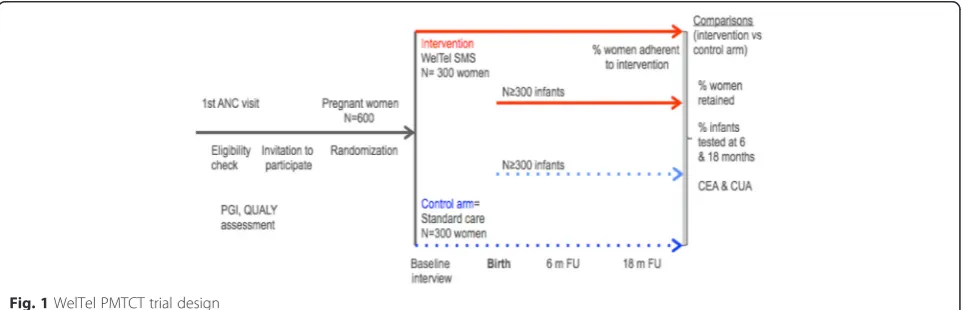
The WelTel PMCT study is a 4–7 center two-arm open randomized controlled trial in which the intervention is allocated in a 1:1 ratio (Fig. 1 trial design).
Study setting
The study is in western Kenya and involves 4–7 facilities that are among over 192 facilities providing PMTCT ser-vices located in the catchment of Academic Model Provid-ing Access to Health Care (AMPATH) – a large HIV Comprehensive Care Program run under the auspices of Moi University School of Medicine, located in Eldoret. These facilities implement Option B+ regimen of PMTCT. The approximate coverage of mobile phones in western Kenya is around 78 % [19]. The research setting has been carefully selected to represent urban and rural mixes that have high antenatal HIV percentage prevalence (10–15 %), about twice that of the national prevalence of 6 %.
Study population
The study population will consist of: (i) pregnant women living with HIV aged 18 and over presenting at ANC for a first visit in the current pregnancy at
the selected clinics; and (ii) newborns delivered to these women living with HIV. Women who will be pregnant and will be diagnosed with HIV infection will be referred to a male or female research assistant to complete a checklist for eligibility. Determination of HIV infection will be based on two repeated Deter-mine or Colloidal Gold tests for women newly diag-nosed during the current pregnancy, or, based on referral from the comprehensive care clinic for those with known HIV infection and on antiretroviral ther-apy (ART) or pre-ART). Individuals must fulfill all the inclusion criteria, provide consent to participate and complete an interviewer-administered question-naire before they are randomized to either the control and intervention groups.
Inclusion criteria
1. Women aged 18 years or above 2. Evidence of pregnancy
3. Evidence of HIV infection
4. Resident of the PMTCT clinic catchment area and plans to remain residents from recruitment until 24 months after delivery
5. Willing to be followed-up from recruitment until 24 months after delivery
6. Owning a mobile phone or having access to a mobile phone
7. Able to text message in Kiswahili or have someone in close contact that they trust to read and respond to a text message
8. Willing to receive text messages from the PMTCT clinic staff
9. Able and willing to provide informed consent
Intervention
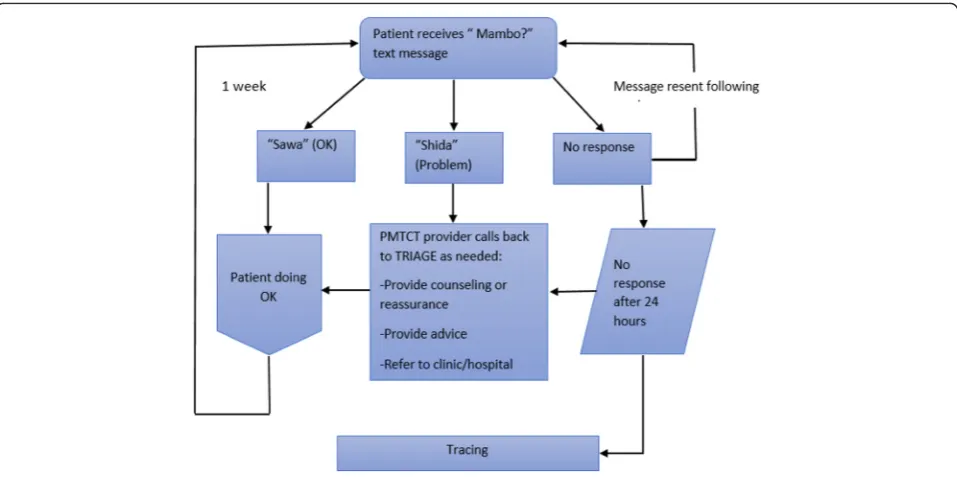
Participants in the intervention group will register their phone numbers in the WelTel system (online or via SMS) and then receive a weekly short text message question in Kiswahili“Mambo?”(Kiswahili for“How are you?”) asking about their general wellbeing (Fig. 2). The message will be sent on a fixed day of the week and will allow the patient to respond within 24 h either that they are well for example “ok”or “sawa” or that they have a problem (for example “problem” or “shida”). A female study coordinator will be in charge of centrally monitor-ing the WelTel SMS platform, which automatically sends the messages and registers responses from the par-ticipants and categorizes them. All parpar-ticipants who re-spond“problem”or who do not respond will be directly linked to a regular PMTCT nurse at the woman’s clinic to assist with identified problems. Problems that cannot be immediately resolved by the nurse follow routine pro-cedures at the clinic and are normally referred to the PMTCT clinical officer at the respective facility who will then decide if the patient needs to visit the facility or should receive a follow up phone call. The study coord-inator will follow up with the respective PMTCT nurses to record action taken, which is entered directly into the WelTel platform logs as notes. Patients who will not re-spond to the SMS within 24 h will be traced (first by telephone then at households) within the defaulter
tracing outreach program in routine PMTCT care. At enrollment, the participants will be informed that the weekly SMS support service does not replace routine clinic services, and that all appointments made by PMTCT staff should be honored and all emergencies should be handled by usual means. A WelTel SMS plat-form technician will handle all technical problems that may arise.
Outcomes
Primary outcome
Retention in PMTCT care is defined as the proportion of women living with HIV and their HIV-exposed infants that remain in care until infants are aged 24 months measured from when the pair is enrolled in the program from the woman’s first visit at ANC until 24 months after birth.
Secondary outcomes
1. Adherence to the WelTel SMS intervention measured as the proportion of women living with HIV who do not respond to the SMS within 7 days. 2. Adherence to (i) ARVs measured as the proportion
of women living with HIV who do not respond to the SMS within 7 days when suspected to be out of ARVs (i.e. failure to pick up ARVs that can cover her absence); (ii) facility-based delivery measured as the proportion of women who deliver in hospital; (iii) early infant HIV testing defined as the proportion of HIV-exposed infants who are tested for HIV within 8 weeks of birth measured as HIV–exposed infants with known HIV status at age 10weeks and (iii) exclusive breastfeeding defines as feeding the HIV-exposed infant only milk from the mother’s breast.
3. Participant perceived facilitators and barriers of the WelTel SMS intervention (assessed as perceived reasons and challenges of use as well as suggestions to possible solutions).
4. Cost compared with (i) effectiveness (levels of retention) from a payers’perspective and (ii) quality of life (differences in pregnant women’s QALYs between the two trial arms.
Sample size
The primary outcome of the study is defined as the pro-portion of mother-newborn retained in PMTCT care at 24 months; assuming i) a power of 80 %, ii) a two-sided test (alpha = 0.05), iii) and based on prior knowledge, a proportion retained in the control group of about 30 %, a sample size of 300 participants in each arm for a total of 600 subjects, with 5 % dropout rate (i.e. women who decide to withdraw from the study) in both the control
and intervention arms was estimated to detect a 11 % difference (the smallest detectable difference) in the primary outcome between the intervention and con-trol arms that is the difference that it would be
im-portant to detect is 11 %, computed as the
proportion retained in the intervention arm minus the proportion retained in the control arm i.e. the proportion retained in the intervention group minus the proportion retained in the control group. Calcula-tions were performed using Stata 14.1.
Recruitment
A PMTCT nurse at the selected clinics will inform all consecutive pregnant women identified as living with HIV at their first ANC visit about the study. The PMTCT nurse will then refer these clients to the re-search assistant who will assess their eligibility and provide detailed information about the study. Individ-uals who are eligible will be invited to participate in the study and the research assistant will seek their consent.
Participants in the intervention arm who own or have access to mobile phones will be registered directly onto the WelTel platform with their phone number.
Randomization and allocation
Eligible and consenting patients will be randomized to the intervention and control arms using a 1:1 allocation ratio. To ensure balance between the arms throughout the trial, we adopted a permuted-block randomization scheme. The block size will be concealed until the trial is over. Randomization will be performed separately at each clinic. We will use opaque sealed envelopes to as-sign participants to the intervention and control arms. The randomization list was be generated at the Karo-linska Institutet (Stockholm, Sweden) by an independent statistician.
Baseline
An interviewer- facilitated baseline questionnaire will be administered after recruitment and allocation. Questions record information on participants’ social and demo-graphic characteristics; time of HIV diagnosis, time on ARV, disclosure of HIV status, HIV care and social sup-port, mobile phone use as well as costs for accessing care.
Follow up
intervention, and health related status/quality of life using the EuroQol 5-dimensional (EQ-5D) utility scores and twelve item short form survey (SF-12) standardized tools.
To investigate quality of life, we will first develop a pa-tient generated index (PGI) to identify areas in the women’s lives that are affected by their HIV infection during pregnancy and nursing period; periods when the risk of transmitting HIV is high. A PGI is an individual-ized patient reported instrument that allows the re-spondent to state, weight and rate areas of importance to the patients’ lives that are affected by their illness. The PGI will also enable the investigators to assess the validity of the EQ5D and SF12 in this population and context.
Data collection and management
All outgoing and incoming text messages will be auto-matically recorded on the WelTel platform. The plat-form also captures all of the “problems” noted by participants, instances of non-response, and actions taken in relation to participants’ ‘problem’responses and non-responses. Platform data will be backed up every 7 days.
All questionnaires will be paper-based and the data manager will then enter data into a database at the cen-tral office on an ongoing basis. A data manager will check the forms for completeness and quality will be verified by re-checking a random sample of 10 % of the data. Any problems that arise will be resolved promptly. Participant files will be stored in a locked office at the trial sites.
Data on attendance, HIV care clinical indicators like viral load and CD4 cell count as well as treatment regi-men will be collected medical records. We will also col-lect information on demographic characteristics (age, education level, marital status and parity) of all screened patients/potential trial participants.
Qualitative research using in –depth interviews will also be performed to discover ‘how’and ‘why’the inter-vention works to improve retention in PMTCT program. Purposive sampling will be used to identify participants for qualitative interviews. Face-to-face interactions will be used to build trust during the interview process and to enhance free interaction between the researcher and the participants [20]. All conversations will be recorded with permission from the respondents and the inter-views will be performed at a place and in a language pre-ferred by the respondent.
All qualitative research tools will be developed in English, then translated to Kiswahili, and then back translated to English. The interview guide will be avail-able in both languages.
Analysis
Statistical methods
Baseline participants’characteristics will be reported sep-arately by treatment arm. Baseline characteristics in-clude: age, parity (nulliparous versus previous birth), marital status (single, married or cohabiting, divorced/ widowed), ARV exposure (experienced vs. naive), dur-ation of known HIV diagnosis (newly vs. previously diag-nosed), age (18–29, 30–39, 40–49, ≥50 years of age), phone ownership (owned vs. shared), level of education (none, primary, secondary, post-secondary), distance from clinic (≤1 h vs. >1 h), number of children born after HIV diagnosis, on ARV at enrolment (yes, no), time on ARV at enrolment (≤6 months, 7–12 months, ≥13 months) and HIV status disclosure (yes, no). We will report the mean (standard deviation [SD]) or me-dian (first quartile, third quartile) for continuous vari-ables, and count and percentages for categorical variables. All analyses are by intention-to-treat i.e. according to the study group to which women were originally allocated regardless of subsequent intervention received and per protocol. Other more statistical methods will be used to take into account switching.
statistical analyses will be again performed with Stata version 14.1 (Stata Corporation, College Station, TX, USA).
Qualitative process evaluation
Qualitative data will be analyzed using content analysis, guided by Graneheim and Lundman [21]. First, the tran-scribed material is read a number of times to get a gen-eral sense of the material by a group of researchers. Using the open code software for qualitative research, meaning units, which are key phrases in the text, are identified, condensed and outlined. Codes will then be ascribed to each meaning unit. The codes will be com-pared and grouped into sub-categories. This comparison will be performed consistently to identify emerging cat-egories that will be further compared, re-organized and merged into sub-themes and one overarching theme. The coding and analysis process will be deductive in na-ture and involve key members of the research team.
Economic evaluation
We will perform an economic evaluation to assess Wel-Tel SMS from a healthcare payer perspective. The pri-mary outcome of the cost effective analysis (CEA) will be the incremental cost per additional mother-infant pairs that remain in PMTCT until infant is aged 24 months. A secondary outcome is averted infant HIV-infections at cessation of breastfeeding. For the cost-utility analysis the outcome will be quality adjusted life years (QALYs), based on responses to the SF-12 and EQ5D. For both analyses (CEA and CUA) we will report the incremental cost-effectiveness ratios (ICERs) that will be computed as the ratio of the incremental costs to provide WelTel SMS over usual care and incremental effects e.g. cost per additional mother-infant pairs that remain in PMTCT until infant is aged 24 months, cost averted infant HIV-infections at cessation of breastfeed-ing and cost per QALY.
A secondary analysis will also consider the incremental cost per averted deaths by bringing infants lost to follow up back and enabling treatment. Thus, we will deter-mine ICER for cost per averted deaths. Deterministic sensitivity analysis will be to address uncertainty.
Discussion
This trial provides an opportunity to test whether the WelTel SMS intervention is effective in improving re-tention in PMTCT care. Further, we will be able to de-termine whether the interactive WelTel text-messaging intervention, by engaging patients with the PMTCT clinic on a weekly basis, is a cost-effective way to im-prove retention in this critical stage of care, potentially helping to eliminate pediatric HIV infections.
Abbreviations
AIDS, acquired immune deficiency syndrome; ANC, antenatal care; ART, antiretroviral therapy; ARVs, antiretroviral drugs; CEA, cost effectiveness analysis; CUA, cost utility analysis; HIV, human immunodeficiency virus; ICERs, incremental cost effectiveness ratios; IDIs, in-depth interviews; IREC, Institutional review and ethics committee; MCH, maternal and child health; MTCT, mother to child transmission; PIP, partners in prevention–Moi University; PLHIV, people living with HIV; PMTCT, prevention of mother to child transmission; QALYs, quality-adjusted life years; RCT, randomised clinical trial; RR, relative risk; SMS, short message service; UNAIDS, Joint United Nations programme on AIDS; WelTel SMS, Weekly mobile phone short message service
Acknowledgements
We thank the patients who participated in pre-testing the data collection tools, the staff at Partners in Prevention (PIP) Moi University for organizing field logistics for the trial. Special thanks go to WelTel Kenya for providing reduced costs, software and technical support.
Funding
The Swedish Research Council (Vetenskaprådet) supported the trial protocol reported in this publication. The funder had no role in the design of the study and will not have any role during its execution, analyses, interpretation of data, or decision to submit results. The content of this publication is solely the responsibility of the authors and does not necessarily represent the official views of the Swedish Research Council.
Availability of data and material
There is no data shared in this protocol. However, any data collected will be available for others interested in the area of research.
Authors’contributions
PA is a co-investigator and leads the trial implementation. She is part of the team that conceived the study; contributed to study design and also leads coordinates fieldwork for the trial implementation. AT is part of the team that conceived the study and also contributed in study design. AME is the lead investigator, conceived the study and also contributed to the study design. JD contributed to the study design and field implementation. M van der K contributed to study design and drafting of the manuscript. EW is a co-investigator and contributed to study design. RL contributed to the study design of the trial. LT contributed to the economic evaluation and study design. AG contributed to the statistical aspects and study design of the trial. RB contributed to statistical aspects of the trial. JM contributed to study design of the trial. All authors contributed to the development study protocol and approved the final manuscript.
Authors’information
Anna Thorson, Anna Mia Ekström, Edwin Were, Richard Lester and Jonathan Mwangi are clinicians working with the management of HIV infections as well as public health issues of HIV. Patricia Awiti is a sociologist and public health researcher working with issues of HIV and women and child health including reproductive health. Mia van der Kop is an epidemiologist working with HIV issues among others. John Dusabe is an environmental scientists and public health researcher. Richard Lester, Mia van der Kop and John Dusabe are experienced in designing and implementing mHealth interventions. Laura Ternent is an economist with experiences of performing costing of evaluations within health sector. Alessandra Grotta and Rino Bellocco are statisticians and experienced in performing clinical trials. Most authors have experiences of working in low-income countries in Africa.
Competing interests
Richard T Lester is the founder and paid consultant for the WelTel International mHealth Society, a non-profit non-governmental mHealth organization with the goal of scaling up evidence-based mHealth solutions and is funded in part by Grand Challenges Canada. For the remaining authors no conflicts of interest were declared.
Consent for publication
Ethics approval and consent to participate
The original study protocol, consent forms and data collection tools were approved by the Moi University Institutional Research and Ethics Committee (IREC 1292) in Kenya. Any modifications to the original trial protocol, including the data collection tools, will be submitted as amendments to the institutional review boards, and requisite approvals obtained. Ethical approval will be renewed annually.
Ethical considerations and consent to participate
Strict criteria for obtaining informed consent have been established for health behavior research. Informed consent will be sought in writing and all content pertaining to voluntary participation and description of the trial will be presented in English and Kiswahili. Research team members are sensitive to the fact that of potential participants may be newly diagnosed with HIV at the time of enrolment. They will give all eligible participants that are newly diagnosed until their next clinic appointment to decide whether to enroll in the study. The risk of breach of confidentiality resulting from the text messaging intervention will be minimized since the content of the text message will not include language related to HIV. In addition, the research phone number will not be displayed on the participant’s cell phone when a text is received unless the participant actively installs a“true caller”software that reveals the number from which an SMS or call originates.
Each participant will be assigned a unique study ID (the outpatient number with additional serialization that denote participation codes), which will be used in all subsequent data collection and analyses. This ID number will not be released to individuals outside of the core research team.
Harms
In this trial all expected adverse events include those directly involved with the intervention such as unintended HIV infection disclosure and to a lesser extent disagreement relating to privacy in a relationship. Potential harms will be discussed during the consent process and also outlined are channels for dealing with such events. A study coordinator will be in charge of documenting all adverse events as per the requirements of the ethics review board.
Dissemination
All findings will be published in peer-reviewed journals. Additional dissemination will occur in conferences, workshops and specified feedback sessions planned at mid and end of the trial targeting involved staff, participants and local and national stakeholders including providers and policymakers.
Author details
1
Department of Public Health Sciences, Karolinska Institutet, 171 77 Stockholm, Sweden.2Department of Medical Epidemiology and Statistics, Karolinska Institutet, 171 77 Stockholm, Sweden.3Division of Infectious diseases, University of British Columbia, Vancouver, Canada.4Division of Global Health, University of British Columbia, Vancouver, Canada. 5Department of Public Health Sciences, 171 77 Stockholm, Sweden. 6
Department of Medicine, University of British Columbia, Vancouver, Canada. 7Newcastle University, Tyne and Wear NE1 7RU, UK.8Department of
Reproductive Health, Moi University, P.O.BOX 3900–30100, Eldoret, Kenya.
Received: 13 January 2016 Accepted: 8 June 2016
References
1. Kenya National AIDS Control Council. Kenya AIDS response progress report - progress towards zero. Nairobi, Kenya: Kenyan Ministry of Health; 2014.
2. World Health Organisation. Use of antiretroviral drugs for treating pregnant women and preventing HIV infection in infants. Geneva: WHO/HIV; 2012. 2012.6.
3. Joint United Nations Programme on HIV/AIDS UNICEF World Health Organization. Towards Universal Access: Scaling Up Priority HIV/AIDS Interventions in the Health Sector: Progress Report. Geneva, Switzerland: World Health Organization; 2007.
4. World Health Organization. Consolidated guidelines on the use of antiretroviral drugs for treating and preventing HIV infection. Geneva: World Health Organization; 2013.
5. Pew Research Center. Emerging nations embrace internet, mobile technology. Accessible at: http://www.pewglobal.org/files/2014/02/Pew- Research-Center-Global-Attitudes-Project-Technology-Report-FINAL-February-13-20147.pdf [last Accessed 29 Sept 2015], 2014. 6. Mas, I. and D. Radcliffe. Mobile payments go viral: M-PESA in Kenya.
Washington DC: World Bank; 2010.
7. Tamrat T, Kachnowski S. Special delivery: an analysis of mHealth in maternal and newborn health programs and their outcomes around the world. Matern Child Health J. 2012;16(5):1092–101.
8. Shieshia M, Noel M, Andersson S, Felling B, Alva S, Agarwal S, et al. Strengthening community health supply chain performance through an integrated approach: Using mHealth technology and multilevel teams in Malawi. J Glob Health. 2014;4(2):020406.
9. Nsubuga P, White ME, Thacker SB, Anderson MA, Blount SB, Broome CV, et al. Public health surveillance: a tool for targeting and monitoring interventions. Dis Control Priorities Dev Ctries. 2006;2:997–1018. 10. Doctor HV, Olatunji A. Bridging the communication gap: Successes and
challenges of mobile phone technology in a health and demographic surveillance system in northern Nigeria. Online journal of public health informatics. 2012; 4(3) doi: 10.5210/ojphi.v4i3.4288.
11. Barrington J, Wereko-Brobby O, Ward P, Mwafongo W, Kungulwe S. SMS for Life: a pilot project to improve anti-malarial drug supply management in rural Tanzania using standard technology. Malar J. 2010;9(298):1–9.
12. Githinji S, Kigen S, Memusi D, Nyandigisi A, Mbithi AM, Wamari A, et al. Reducing stock-outs of life saving malaria commodities using mobile phone text-messaging: SMS for life study in Kenya. PLoS One. 2013;8(1):e54066. 13. Lester RT, Ritvo P, Mills EJ, Kariri A, Karanja S, Chung MH, et al. Effects of a
mobile phone short message service on antiretroviral treatment adherence in Kenya (WelTel Kenya1): a randomised trial. Lancet. 2010; 376(9755):1838–45.
14. Pop-Eleches C, Thirumurthy H, Habyarimana JP, Zivin JG, Goldstein MP, De Walque D, et al. Mobile phone technologies improve adherence to antiretroviral treatment in a resource-limited setting: a randomized controlled trial of text message reminders. AIDS. 2011;25(6):825. London, England.
15. Mbuagbaw L, van der Kop ML, Lester RT, Thirumurthy H, Pop-Eleches C, Ye C, et al. Mobile phone text messages for improving adherence to antiretroviral therapy (ART): an individual patient data meta-analysis of randomised trials. BMJ Open. 2013;3(12):e003950.
16. Horvath, T, Azman H, Kennedy GE, Rutherford GW. Mobile phone text messaging for promoting adherence to antiretroviral therapy in patients with HIV infection. The Cochrane Library; 2012
17. Turan JM, Miller S, Bukusi E, Sande J, Cohen C. HIV/AIDS and maternity care in Kenya: how fears of stigma and discrimination affect uptake and provision of labor and delivery services. AIDS Care. 2008;20(8):938–45. 18. Ngarina M, Tarimo EA, Naburi H, Kilewo C, Mwanyika-Sando M, Chalamilla G,
et al. Women’s Preferences Regarding Infant or Maternal Antiretroviral Prophylaxis for Prevention of Mother-To-Child Transmission of HIV during Breastfeeding and Their Views on Option B+ in Dar es Salaam, Tanzania. PLoS One. 2014;9(1):e85310.
19. Kenya Ministry of Information Science and Technology. Nairobi, Kenya: Kenya ICT report; 2015.
20. Richie J, Lewis J. Qualitative research practice. A guide for social science students and researchers. London: SAGE Publications; 2003.