Iran J Public Health, Vol. 48, No.11, Nov 2019, pp.2050-2057
Original Article
Evaluation of Oral Health Status Based on the Decayed, Missing
and Filled Teeth (DMFT) Index
Ghobad MORADI 1, *Amjad MOHAMADI BOLBANABAD 1, Ardavan MOINAFSHAR 2, Hemn
ADABI 2, Mona SHARAFI 2, Bushra ZAREIE 1
1. Social Determinants of Health Research Center, Research Institute for Health Development, Kurdistan University of Medical Sciences, Sanan-daj, Iran
2. Student Research Committee, Kurdistan University of Medical Sciences, Sanandaj, Iran
*Corresponding Author: Email: [email protected]
(Received 11 Oct 2018; accepted 12 Dec 2018)
Introduction
Oral health is part of the general health that af-fects many of the daily activities of people, such as eating, talking, social relationships, and ap-pearances (1, 2). The impact of oral and dental diseases on the quality of life is stronger than what seems to be (3, 4). Because of the
signifi-cant effect of oral health on people's daily lives, WHO has identified oral health as one of the most important public health priorities in the world (5). Despite the great emphasis of WHO on oral health, it is still one of the public health problems, even in developed countries, and the Abstract
Background: The Decayed, Missing and Filled Teeth (DMFT) is a valuable index used for determining and monitoring the oral health status in a community. This study aimed to determine the oral health status and its associated factors based on the DMFT index among people aged 15 to 45 yr old in Kurdistan Province, west of Iran.
Methods: This study was conducted on 2000 people aged 15-40 yr old in Kurdistan, western Iran in 2015. Using a questionnaire, data were collected by four trained dental students. The dependent variable was the DMFT index. The collected data were analyzed using T-test, ANOVA, Pearson statistics, Kendall statistics, and multiple regression.
Results: The mean (SD) values of Decayed teeth (DT), Missing teeth (MT), and Filled teeth (FT) indices in the participants were 2.85±1.7, 1.15±1.84, and 3.33±1.7, respectively. The mean (SD) value of total DMFT index was 7.33±3.0. The results of multiple regression showed that the frequency of using dental floss (coefficient= -0.296, P=0.001), socio-economic status (coefficient=-0.199, P=0.001), parental education (coefficient= -0.183, P=0.001), frequency of brushing (coefficient=-0.182, P=0.001), and frequency of the use of mouthwash (coef-ficient=-0/143, P=0.001) had the highest level of with association with the DMFT index.
Conclusion: The oral health status of the adult population is alarming and undesirable. The oral and dental health status can be improved via changing behavioral habits (such as brushing, using mouthwashes, and dental floss), promoting socioeconomic status, increasing individual’s and parent's level of education, and enhancing people’s access to health insurance.
problem is even more remarkable in developing countries (6). Even less-privileged people in Western European countries (with advanced den-tal care systems) have a poor denden-tal health status (7). Overall, 60% to 90% of students and 100% of adults in the world have dental caries. In addi-tion, about 30% of people aged 65 to 74 yr old in the world does not have any natural teeth (8). For over 70 years, the Decayed, Missing and Filled Teeth (DMFT) index has been globally used as the most important index for assessing the status of oral and dental health. Moreover, this index is the most important index used in epidemiological studies of the health status of the community (9). This index determines the num-ber of decayed teeth, the numnum-ber of treated teeth, and the number of teeth missed due to decay (10). This index is used to evaluate and monitor oral health interventions in the community by developing policies and programs related to this area (11, 12).
Oral and dental health status of children and el-derly, as the two high-risk groups, is continuously studied in most countries (13-17). Although den-tal caries have been a major problem for adult populations in developing and industrial coun-tries over the past decade, dental caries and oral health status in adults have been less studied (18). In different studies in the world various methods have been used to investigate the prevalence of dental caries and the factors affecting it. The most important risk factors for dental caries were gender (19, 20), age (20, 21), level of education (19-22), oral and dental hygiene including brush-ing (20, 23, 24), oral and dental health literacy (23), and the economic status (19, 25).
The prevalence of dental caries is high in Iran (26). About 50% of 12-year-old children have dental caries (27). The results of a national oral health survey conducted in 2001 and 2002 showed that the mean DMFT score was 3.4 for young people aged 18 yr old and 11.0 for adults aged 35 to 45 yr old. In addition, 53% of the population aged 35 to 44 yr old had periodontal pockets (28). The population aged 15 to 45 yr old is economically the most productive population group in the community and improper oral
health can affect their daily activities. Neverthe-less, there is less data on the prevalence of dental caries and oral health status in this population group, as compared with children and elderly. Therefore, this study aimed to investigate the oral health status and its effective factors based on the DMFT index among the people aged 15 to 45 yr old in Kurdistan Province.
Methods
This study was a cross-sectional descriptive-analytic study conducted on people aged 15-40 yr old living in Sanandaj, Kurdistan, western Iran in 2015. The estimated sample size was 2200 peo-ple, and finally, the required data were collected from 2000 people. We used cluster sampling method and each cluster included 10 people who were in the desired age range. The heads of the clusters were selected based on the geographical encoding of Sanandaj, obtained from the Sanan-daj post office. The required data were collected using a questionnaire and clinical examinations carried out through visiting the selected house-holds.
countries. Using the principal component analysis (PCA) method, the studied people were divided into five quintiles including poorest, poor, mod-erate rich, and richest (29).
The DMFT score of the samples were deter-mined based on the results of clinical examina-tion and calculaexamina-tion of the number of decayed (D), filled (F), and missed (M) teeth due to caries. The data were collected by questioners through observation and direct examination of the sam-ples’ teeth using mirror number 4 and a medisporex catheter. During the examination, the subjects under examination and the researcher sat close to the window to perform the examination under the maximum natural light. After examin-ing each patient, the results were recorded in the questionnaire.
In this study, the statistical analysis was per-formed using SPSS (ver.20, Chicago, IL, USA) software at a significance level of P<0.05. De-scriptive statistics (Mean, Standard Deviation (SD), and frequency distribution tables) were used to describe the collected data. Using T-test and ANOVA, the DMFT index was assessed at different levels of the independent variables. The relationship between independent variables and the DMFT index was evaluated using Pearson statistics and Kendall statistics. The variables were entered into the multiple regression model for a P<0.05 in the univariate analysis. Finally, the variables that were significant in the regres-sion test using a stepwise backward method, re-mained in the model.
The study was approved by the Ethics Commit-tee of Kurdistan University of Medical Sciences (IR.MUK.REC.1393/1). All participants provid-ed written informprovid-ed consent before participating in the study.
Results
Overall, 2000 adults aged 15-40 yr old were in-volved in this study, of whom 1039 people (51.8%) were male, 1012 people (50.6%) were married, and 1515 people (76%) had academic education. In addition, 80% of the respondents
were under the coverage of health insurance, 88.2% had a household size fewer than four peo-ple, and 895 people (45%) were at the lowest so-cioeconomic group.
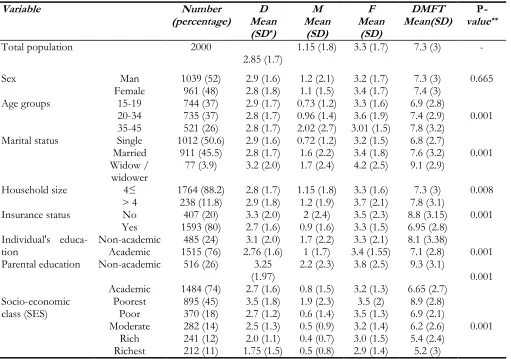
The mean (SD) values of DT, MT, and FT indi-ces in the participants were 2.85±1.7, 1.15±1.8, and 3.3±1.7, respectively. The mean (SD) value of total DMFT index was 7.3±3.0 in all the par-ticipants, 6.9±2.8 in people aged 15-19 yr old, and 7.8±3.2 in people aged 35 to 45 yr old. The DMF index was associated with the house-hold size (P=0.008) and insurance status (P=0.008). This index is more unfavorable in adults with a household size of more than four (DMFT=7.8) and adults without insurance cov-erage (DMFT=8.2) (Table 1).
The results of ANOVA showed that the DMFT index was associated with age group (P=0.001), mar-ital status (P=0.00), Individual's education (P=0.001), parental education (P=0.001), and socio-economic class (P=0.001). This index was more unfavorable in people aged 35 to 45 yr old (DMFT=7.83), widows and widowers (DMFT=9.05), people with a non-academic education level (DMFT=8.1), people with a non-academic parental education (DMFT=9.3), and people in the poorest social class (DMFT=8.9) (Table 1).
As shown in Table 2, 1148 (57%) of the partici-pants reported that they were brushing their teeth once a day. In addition, 54% and 85.7% of the subjects, respectively, reported that they were not using dental floss and mouthwash daily.
Table 1: Mean number of decayed, missing, and filled (D, M, and F) teeth and DMFT index by the demographic variables of respondents
Variable Number
(percentage) Mean D
(SD*)
M Mean
(SD)
F Mean
(SD)
DMFT
Mean(SD) valueP-**
Total population 2000
2.85 (1.7) 1.15 (1.8) 3.3 (1.7) 7.3 (3)
-Sex Man 1039 (52) 2.9 (1.6) 1.2 (2.1) 3.2 (1.7) 7.3 (3) 0.665
Female 961 (48) 2.8 (1.8) 1.1 (1.5) 3.4 (1.7) 7.4 (3)
Age groups 15-19 744 (37) 2.9 (1.7) 0.73 (1.2) 3.3 (1.6) 6.9 (2.8)
0.001
20-34 735 (37) 2.8 (1.7) 0.96 (1.4) 3.6 (1.9) 7.4 (2.9)
35-45 521 (26) 2.8 (1.7) 2.02 (2.7) 3.01 (1.5) 7.8 (3.2)
Marital status Single 1012 (50.6) 2.9 (1.6) 0.72 (1.2) 3.2 (1.5) 6.8 (2.7)
0.001
Married 911 (45.5) 2.8 (1.7) 1.6 (2.2) 3.4 (1.8) 7.6 (3.2)
Widow /
widower 77 (3.9) 3.2 (2.0) 1.7 (2.4) 4.2 (2.5) 9.1 (2.9)
Household size 4≤ 1764 (88.2) 2.8 (1.7) 1.15 (1.8) 3.3 (1.6) 7.3 (3) 0.008
> 4 238 (11.8) 2.9 (1.8) 1.2 (1.9) 3.7 (2.1) 7.8 (3.1)
Insurance status No 407 (20) 3.3 (2.0) 2 (2.4) 3.5 (2.3) 8.8 (3.15) 0.001
Yes 1593 (80) 2.7 (1.6) 0.9 (1.6) 3.3 (1.5) 6.95 (2.8)
Individual's
educa-tion Non-academic Academic 1515 (76) 485 (24) 2.76 (1.6) 3.1 (2.0) 1.7 (2.2) 1 (1.7) 3.4 (1.55) 3.3 (2.1) 8.1 (3.38) 7.1 (2.8) 0.001
Parental education Non-academic 516 (26) 3.25
(1.97) 2.2 (2.3) 3.8 (2.5) 9.3 (3.1) 0.001
Academic 1484 (74) 2.7 (1.6) 0.8 (1.5) 3.2 (1.3) 6.65 (2.7)
Socio-economic
class (SES) Poorest 895 (45) 3.5 (1.8) 1.9 (2.3) 3.5 (2) 8.9 (2.8)
0.001
Poor 370 (18) 2.7 (1.2) 0.6 (1.4) 3.5 (1.3) 6.9 (2.1)
Moderate 282 (14) 2.5 (1.3) 0.5 (0.9) 3.2 (1.4) 6.2 (2.6)
Rich 241 (12) 2.0 (1.1) 0.4 (0.7) 3.0 (1.5) 5.4 (2.4)
Richest 212 (11) 1.75 (1.5) 0.5 (0.8) 2.9 (1.4) 5.2 (3)
*SD: Standard Deviation // **P-value is related to difference subgroups for DMFT
Table 2: Mean number of decayed, missing, and filled (D, M, F) teeth and DMF index by factors practiced to ob-serve oral and dental health
Variable Number
(percentage) Mean D
(SD*)
M Mean
(SD)
F Mean
(SD)
DMFT Mean
(SD)
P-value**
Frequency of tooth
brush-ing per day 0 1 1148 (57) 79 (4) 4.0 (2.9) 3.2 (1.7) 5.2 (4.00) 1.9 (2.1) 11.1 (3.4) 1.2 (1.6) 3.5 (1.8) 7.8 (2.9) 0.001
≥ 2 773 (39) 2.3 (1.3) 0.7 (1.3) 3.2 (1.4) 6.2 (2.5)
Frequency of dental
floss-ing per day 0 1 1098 (55) 831 (41) 3.5 (1.7) 2.2 (1.3) 1.6 (2.2) 3.4 (1.7) 8.85 (2.8) 0.6 (0.9) 3.3 (1.7) 6 (2.5) 0.001
≥ 2 71 (4) 1.3 (1.5) 0.5 (0.9) 2.2 (1.3) 4.0 (2.7)
Frequency of using
mouthwash per day 0 1 1713 (85.7) 224 (11.2) 3.0 (1.7) 1.8 (1.4) 1.3 (1.9) 3.4 (1.7) 0.5 (0.9) 2.9 (1.3) 7.7 (2.9) 5.3 (2.6) 0.001
≥ 2 63 (3.2) 1.4 (0.9) 0.2 (0.4) 2.3 (1.3) 3.8 (1.8)
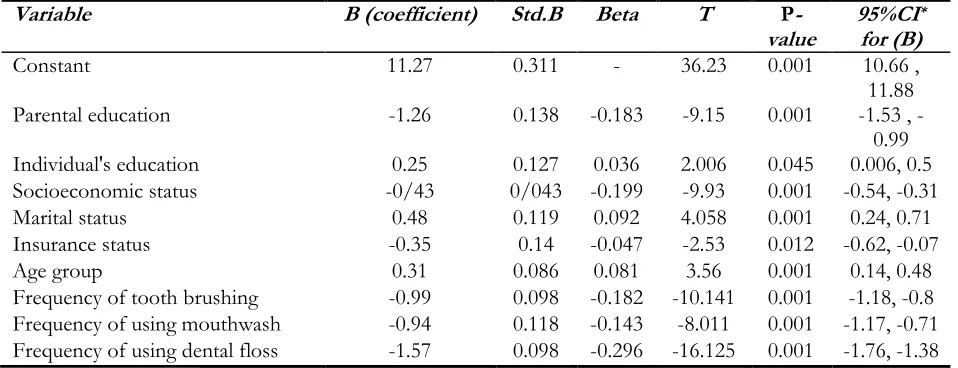
The frequency of using dental floss (coefficient= -1.57, 95% confidence interval (CI) -1.76, -1.38), Parental education (coefficient= 1.26, 95% CI -1.53, -0.99), Frequency of tooth brushing (coeffi-cient= -0.99, 95% CI -1.18, -0.8), Frequency of using mouthwash (coefficient = 0.94, 95% CI
-1.17, -0.71) had the highest level of association with the DMFT index. The other effective varia-bles were socioeconomic status, marital status,
age group, insurance status, and Individual's
edu-cation.
Table 3: Backward regression model for predicting DMFT index
Variable B (coefficient) Std.B Beta T P
-value 95%CI
*
for (B)
Constant 11.27 0.311 - 36.23 0.001 10.66 ,
11.88
Parental education -1.26 0.138 -0.183 -9.15 0.001 -1.53 , -
0.99
Individual's education 0.25 0.127 0.036 2.006 0.045 0.006, 0.5
Socioeconomic status -0/43 0/043 -0.199 -9.93 0.001 -0.54, -0.31
Marital status 0.48 0.119 0.092 4.058 0.001 0.24, 0.71
Insurance status -0.35 0.14 -0.047 -2.53 0.012 -0.62, -0.07
Age group 0.31 0.086 0.081 3.56 0.001 0.14, 0.48
Frequency of tooth brushing -0.99 0.098 -0.182 -10.141 0.001 -1.18, -0.8
Frequency of using mouthwash -0.94 0.118 -0.143 -8.011 0.001 -1.17, -0.71
Frequency of using dental floss -1.57 0.098 -0.296 -16.125 0.001 -1.76, -1.38
* Confidence interval (CI)
Discussion
The DMFT index was 7.3 in all the participants, 6.9 in people aged 15-19 yr old, and 7.8 in people aged 35 to 45 yr old, which is unfavorable ac-cording to WHO (30). Probably, the reasons are the inadequate attention of families to oral health, low financial accessibility due to uncovering such services in insurance programs, and insufficient government attention to community-based oral
health promotion programs. The DMFT index in
people aged 35 to 45 yr old was 14.8 in Iran, 12.28 in Japan, 12.10 in Malaysia, 5.2 in South Korea, and 10.8 in Turkey (17). The DMFT in-dex in people aged 35 to 45 yr old was 4.10 in Iran, 3.24 in Japan, 2.9 in Malaysia, 3.57 in South Korea, and 2.3 in Turkey (7). The data about these countries were obtained from surveys per-formed during 2002 to 2010, so it is difficult to compare them with each other.
In a study conducted on Iranians aged 35 to 45 yr in all parts of Iran, the DMFT index was
report-ed to be 11.00 ± 6.4 (28). The results on people aged over 30 yr are different from our findings; this difference might to be attributed to the in-crease in people’s access (physical, financial, and cultural access) to oral health care which has led to an improvement in the economic status of the people and increased their mean education level over the last decades. Moreover, the difference might be also attributed to interventions by The Ministry of Health and Medical Education (MOHME) of Iran such as the use of sodium fluoride mouthwash for elementary students (6 to 12 yr old) with a mean coverage of 90%, and the provision of varnish floor therapy for elementary students (6 to 14 yr old) with a mean coverage of 83% on a regular basis, twice a year (31).
Individuals with an academic education degree had a better mean DMFT score. Individuals or parental education has always been one of the variables influencing individual health. Academic education is associated with improving economic status n and health literacy; as a result, it is neces-sary to improve financial and cultural access to oral care services. In Mexico, poor dental health status was associated with lower level of tion (32). The relationship between lower educa-tion level and adverse health status has also been reported (19-22).
People without health insurance coverage had poorer oral and dental health status. The odds ratio of higher DMFT index in non-insured indi-viduals was 20% to 40% more than that in peo-ple with a health insurance coverage (33). Iran health insurance does not cover oral care services (34). However, insurance coverage helps to save the household's costs in other health care fields, as a result, it somewhat preserves people’s finan-cial funds to ask for oral care services.
In the present study, people with poorest SES had more unfavorable DMFT index. In many studies, the relationship between poor economic status and poor oral health is reported (35, 33, 19). Probably a large part of the lack of financial access to health care services is due to health in-surance scheme’s poor coverage or lack of cover-age for oral health care services.
The findings of this study showed that as age in-creases, the DMFT index becomes more unfavor-able. With aging, the number of decayed, missed, and filled teeth normally increases; thus, the WHO sets a higher DMFT index for people of polder ages (30). With increasing the age, the DMFT in-dex was higher (36). In addition, some other stud-ies have reported the relationship between older age and poorer oral health status (20, 21).
The results of our study indicated that brushing, using dental floss, and using oral mouthwash im-proved the DMFT index. Many studies have re-ported the positive effects of good oral health habits (including those mentioned above) on oral and dental health (20, 24, 37, 38). Inappropriate oral health habits increases the incidence of oral infections and may lead to more unfavorable oral
health status (39). Furthermore, behavioral habits such as brushing, using mouthwashes and floss, having a balanced diet, and regular referral to dentists are associated with reduced risk of tooth decay (40).
As one of the limitations of this study, it was conducted only in a city which was due to finan-cial and logistical constraints. In addition, be-cause of the same constraints, we were not able to cover all age groups, which is another limita-tion of this study.
Conclusion
Despite the interventions carried out in recent years, oral and dental health in the adult popula-tion is alarming and inappropriate. Oral and dental health status can be improved via changing behav-ioral habits (such as brushing, using mouthwashes, and dental floss), promoting socioeconomic status, increasing individual’s and parental education, and enhancing people’s access to health insurance. When implementing dental caries prevention pro-grams, it is necessary to pay special attention to people with lower socioeconomic status as they have more unfavorable behavioral habits and low-er education level.
Ethical considerations
Ethical issues (Including plagiarism, informed consent, misconduct, data fabrication and/or fal-sification, double publication and/or submission, redundancy, etc.) have been completely observed by the authors.
Acknowledgements
This research project was approved and funded by Social Determinants of Health Research Cen-ter, Kurdistan University of Medical Sciences.
Conflict of interest
References
1. Parker EJ, Jamieson LM (2010). Associations
be-tween indigenous Australian oral health litera-cy and self-reported oral health outcomes. BMC Oral Health, 10:3.
2. Acharya S, Sangam DK (2008). Oral health‐
related quality of life and its relationship with health locus of control among Indian dental university students. Eur J Dent Educ, 12(4):208-12.
3. Nanayakkara V, Renzaho A, Oldenburg B,
Eka-nayake L (2013). Ethnic and socio-economic disparities in oral health outcomes and quality of life among Sri Lankan preschoolers: a cross-sectional study. Int J Equity Health, 12:89.
4. Cantekin K, Yildirim MD, Cantekin I (2014).
As-sessing change in quality of life and dental anxiety in young children following dental re-habilitation under general anesthesia. Pediatr Dent, 36(1):12E-17E.
5. Jin LJ, Lamster IB, Greenspan JS et al (2016). Global burden of oral diseases: Emerging concepts, management and interplay with sys-temic health. Oral Dis, 22(7):609–619.
6. Petersen PE (2003). The World Oral Health
Re-port 2003: continuous improvement of oral health in the 21st century–the approach of the WHO Global Oral Health Programme. Community Dent Oral Epidemiol, 31 Suppl 1:3-23.
7. Krustrup U, Petersen PE (2007). Dental caries prevalence among adults in Denmark--the impact of socio-demographic factors and use of oral health services. Community Dent Health, 24(4):225-32.
8. World Health Organization. Oral health.
[Ac-cessed 14 Jan 2016, at
https://www.who.int/news-room/fact-sheets/detail/oral-health].
9. Broadbent JM, Thomson WM (2005). For
de-bate: Problems with the dmf index pertinent to dental caries data analysis. Community Dent Oral Epidemiol, 33(6):400-9.
10. Roland E, Gueguen G, Longis MJ, Boiselle J (1994). Validation of the reproducibility of the dmf index used in bucco-dental epidemiology and evaluation of its 2 clinical forms. World Health Stat Q, 47(2): 44-61.
11. Marthaler TM (2004). Changes in dental caries 1953-2003. Caries Res, 38(3): 173-81.
12. Nadanovsky P, Sheiham A (1995). Relative
con-tribution of dental services to the changes in caries levels of 12-year-old children in 18 in-dustrialized countries in the 1970s and early 1980s. Community Dent Oral Epidemiol, 23(6):331-9.
13. Kim SR, Han SJ (2015). The relationship be-tween perceived oral health status and en-trance exam stress levels in high school stu-dents. J Dent Hyg Sci, 15(4):509-17.
14. Bozdemir E, Yilmaz HH, Orhan H (2016).
General Health and oral health status in elder-ly dental patients in Isparta, Turkey. East Med-iterr Health J, 22(8):579-585.
15. Bridges SM, Parthasarathy DS, Wong HM et al
(2014). The relationship between caregiver functional oral health literacy and child oral health status. Patient Educ Couns, 94(3):411-6. 16. Mittal M, Chaudhary P, Chopra R, Khattar V
(2014). Oral health status of 5 years and 12 years old school going children in rural Gur-gaon, India: an epidemiological study. J Indian Soc Pedod Prev Dent, 32(1):3-8.
17. Bernabé E, Sheiham A (2014). Extent of
differ-ences in dental caries in permanent teeth be-tween childhood and adulthood in 26 coun-tries. Int Dent J, 64(5):241-5.
18. Namal N, Can G, Vehid S et al (2008). Dental
health status and risk factors for dental caries in adults in Istanbul, Turkey. East Mediterr Health J, 14 (1): 110-8.
19. Moradi G, Moinafshar A, Adabi H et al (2017).
Socioeconomic Inequalities in the Oral Health of People Aged 15-40 Years in Kurdi-stan, Iran in 2015: A Cross-sectional Study. J Prev Med Public Health, 50(5):303-310.
20. Damyanov ND, Witter DJ, Bronkhorst EM,
Creugers NH (2012). Dental status and asso-ciated factors in a dentate adult population in Bulgaria: a cross-sectional survey. Int J Dent, 2012: 578401.
21. Mendes DC, de Oliveira Poswar F, de Oliveira
MV et al (2012). Analysis of socio‐
demographic and systemic health factors and the normative conditions of oral health care in a population of the Brazilian elderly. Gerodontology, 29(2): e206-14.
caries experience among Jewish adults in Je-rusalem. Caries Res, 46(1):47-54.
23. Lu HX, Wong MC, Lo EC, McGrath C (2013).
Risk indicators of oral health status among young adults aged 18 years analyzed by nega-tive binomial regression. BMC Oral Health, 13:40.
24. Álvarez L, Liberman J, Abreu S et al (2015). Dental caries in Uruguayan adults and elders: findings from the first Uruguayan National Oral Health Survey. Cad Saude Publica, 31(8):1663-72.
25. Tonello Benazzi AS, Pereira da Silva R, de Cas-tro Meneghim M et al (2012). Dental caries and fluorosis prevalence and their relationship with socioeconomic and behavioural variables among 12-year-old schoolchildren. Oral Health Prev Dent,10(1): 65-73.
26. Pakpour AH, Hidarnia A, Hajizadeh E et al (2011). The status of dental caries and related factors in a sample of Iranian adolescents. Med Oral Patol Oral Cir Bucal, 16(6):e822-7. 27. Pakshir HR (2004). Oral health in Iran. Int Dent J,
54(6 Suppl 1):367-72.
28. Hessari H, Vehkalahti MM, Eghbal MJ,
Murto-maa HT (2007). Oral health among 35-to 44-year-old Iranians. Med Princ Pract, 16(4):280-5.
29. O’donnell O, Van Doorslaer E, Wagstaff A,
Lindelow M (2008). Analyzing health equity using household survey data. Washington, DC: World Bank: 150.
30. World Health Organization (2013). Oral health surveys: basic methods. World Health Organ-ization; 74.
31. Ministry of Health and Medical Education.
[Ac-cessed 14 Jan 2016, at
http://oralhealth.behdasht.gov.ir/file/OralH ealth%20Pannel-57th.EXIDA.pdf]
32. Hernandez-Palacios RD, Ramirez-Amador V,
Jarillo-Soto EC et al (2015). Relationship
be-tween gender, income and education and self-perceived oral health among elderly Mexicans: An exploratory study. Cien Saude Colet, 20(4):997-1004.
33. Ditmyer M, Dounis G, Mobley C, Schwarz E
(2011). Inequalities of caries experience in Nevada youth expressed by DMFT index vs. Significant Caries Index (Sic) over time. BMC Oral Health, 11:12.
34. Rad EH, Kavosi Z, Arefnezhad M (2016).
Eco-nomic inequalities in dental care utilizations in Iran: Evidence from an urban region. Med J Islam Repub Iran, 30:383.
35. Ghorbani Z, Ahmady AE, Ghasemi E, Zwi AB
(2015). Socioeconomic inequalities in oral health among adults in Tehran, Iran. Commu-nity Dent Health, 32(1):26-31.
36. Eslamipour F, Borzabadi-Farahani A, Asgari I (2010). The relationship between aging and oral health inequalities assessed by the DMFT index. Eur J Paediatr Dent, 11(4):193-9.
37. Melo P, Marques S, Silva OM (2017). Portuguese
self‐reported oral‐hygiene habits and oral sta-tus. Int Dent J, 67(3):139-47.
38. Kwon MH, Choi HS (2016). Association of
Gender, Education, Income and Self-Perceived Oral Health Status among the Ko-reans; the 6th Korea National Health and Nutrition Examination Survey (KNHANES).
Indian J Sci Technol, 9(41):
DOI: 10.17485/ijst/2016/v9i41/103895.
39. Beiser M, Hou F, Hyman I, Tousignant M
(2002). Poverty, family process, and the men-tal health of immigrant children in Canada. Am J Public Health, 92(2):220-7.
40. Chattopadhyay A, Kumar JV, Green EL (2003).