Effect of Grain Size on the Radon Exhalation Rate and
Emanation Coefficient of Soil, Phosphate and Building
Material Samples
S. Harb*, N. K. Ahmed, Sahar Elnobi
ERML, Physics Department, Faculty of Science, Qena, South Valley University, Egypt
Abstract
Our present work was focused on the effect of grain size on the emanation coefficient, mass and area exhalation rate in different grain size of the soil, phosphate and building material samples. These samples were fractionated into seven-grain sizes each (2000-1800, 1800-1000, 1000-560, 560-425, 425-200, 200-80 and < 80 μm) and employingAlphaGUARD to determine the radon exhalation rate in these samples. The data analyses were performed to determine emanation coefficient, mass and area exhalation rate. Results revealed an inverse relationship between radon exhalation and grain size in soil and building materials (sand, granite and marble) samples while the trend is not clear in the phosphate and limestone samples. The emanation coefficient of Rn-222 was constant in different grain sizes of all samples.
Keywords
AlphaGUARD, Exhalation, Grain Size, Emanation, Radon and Building Materials1. Introduction
Radon is an odourless, colourless, inert gas with isotopes of relatively short half-lives, there are no chemical or mass spectrometric techniques with sufficient sensitivity to measure it. Consequently, it must be determined using techniques that depend on the radioactive properties either of radon itself or its decay products. The radon gas is created as the first disintegration product of 226Ra. There is three
radon (Rn) isotopes naturally present in the environment:
222Rn, a member of the uranium decay series, 220Rn, a
member of the thorium decay series, and 219Rn, a member
of the actinium decay series. 220Rn and 219Rn are often
referred to as thoron and actinon, respectively (Ishimori et al., 2013) [1].
Radon is highly radioactive and decays by the emission of alpha particles. Every nucleus of 222Rn eventually decays
through the sequence Po-218, Pb-214, Bi-214, Po-214 and Pb-210. With each transformation along this path the nucleus emits characteristic radiations: alpha, beta particles, gamma rays, or combinations of these. A particular radon nucleus may decay at any time, but it is most likely to decay between now and eight days. 222Rn is the most important in
radiological protection because of its relatively long half-life of 3.82 days. The migration of radon gas occurs the form of diffusion and advection.
* Corresponding author:
[email protected] (S. Harb) Published online at http://journal.sapub.org/jnpp
Copyright © 2016 Scientific & Academic Publishing. All Rights Reserved
Radon gas arrives the indoors from different sources, such as soil or rock under or surrounding the buildings, building materials, water supplies, natural gas and outdoor air. (Akerblom and Wilson, 1981; Colle′ et al., 1981; Durrani and Ilic, 1997) [2-4]. The major source of Radon in the atmosphere at least 80% is from emanations from soil that derived from rocks. (Deepanjan, 2000; Badr et al., 1996; Abumurad et al., 2001; Khan et al., 1987; Jonsson, 1987) [5-9]. These rocks contain some uranium, where the decay of
238U through 226Ra gives radon to which people are exposed.
Certain types of rock, including granites, dark shale, light-colored volcanic rocks, sedimentary rocks containing phosphate and metamorphic rocks derived from these rocks have higher average uranium contents (Virk et al., 1993) [10]. A soil radon activity unnatural environmental condition is affected by soil moisture content, Air pressure variations and temperature and structure of soil. Freed sandy soil lets the maximum diffusion of radon gas, whereas frozen, compressed or clay soil inhibits its flow. Eventually, it exhales into the atmosphere.
Phosphate rocks contain relatively high concentrations of naturally occurring radioactive materials from the uranium and thorium decay series (238U and 232Th) (UNSCEAR,
gamma exposure at dose rates up to 0.8 µGy/h (Steinhäusler, 1984)) [14]. Phosphate industry is producing dust with high intensity and with different grain size and it can be a negative impact on the respiratory tract in industrial workers. When they exposed for a long time can cause an inflammation. Buildings are very important in human life because people spend most of their time (about 80%) indoors (home or office). Where sand, granite, marble and limestone sample as building materials are very common in Egypt. Therefor constructions Workers are exposed to the high intensity of dust (small particle sizes). So these samples have been selected to be under investigation study.
The exhalation is radon atoms that have been transported to the ground surface and then exhaled to the atmosphere (Ishimori et al., 2013) [1]. Radon exhalation depends mainly on 226Ra content and mineral grain size, its transport in the
earth governed by geophysical and geochemical parameters while exhalation is controlled by hydrometeorological conditions (Etiope and Martinelli, 2002) [15]. Grain size is one of the important factors that control radon concentration and exhalation rate in soil. The effect of the grain size factor has been studied (e.g. Markkanen and Arvela, 1992; Shweikani et al., 1995; Menetrez and Mosley, 1996; Sundal et al., 2004; Barillon et al., 2005) [16-20]. They determine how much radium is near enough the grain surface to allow radon to escape into pore spaces. The measurement of indoor radon exhalation rates are of utmost importance because inhalation of radon and its progeny contributes more than 50% of the total radiation dose from the natural sources. By separating the radon exhalation rate by either the area of the exhaling surfaces or by the mass of the sample, the area (radon flux Bq/ m2h) and mass radon exhalation rates
(Bq/kgh) can be calculated.
The alpha decay of 226Ra has enough energy to propel the
progeny 222Rn atom out of the mineral lattice (with a range
of 34 nm in quartz, given in Sakoda et al. (2011) [21]) and into the pore space between the mineral grains (Tanner, 1980) [22]. This process of 222Rn escaping into the pore
space is called emanation, the fraction of radon atoms generated that escape the solid phase in which they are formed and become free to migrate through the bulk medium is called the emanation coefficient (Ishimori et al., 2013 [1]). Pore and grain size and the distribution of 226Ra and 238U in
the grain affect the emanation coefficient (Sakoda et al., 2011) [21].
The present study illustrates the measurements of emanation coefficient and radon exhalation from phosphate, soil, and building materials (sand, granite, marble and limestone) samples using active techniques and study of the effect of grain size on the mass and area exhalation rate in different grain size of the samples.
2. Materials and Methods
2.1. Sampling and Samples Preparation
Six kinds of materials were under investigation. These
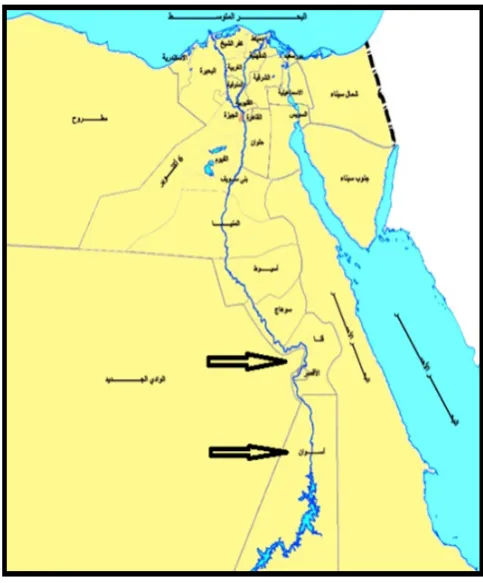
materials collected from different locations in Aswan and Qena governorate, Egypt as shown in Fig. 1 Phosphate sample obtained from the El-Sabaea phosphate factory (25° 11’ N, 32° 39’ E) with different grain size. Soil, sand and limestone samples were collected from Hagaza village in Qus city. Granite and marble samples were collected from Aswan governorate.
After collection, samples were dried at room temperature in open air to ensure that any residual moisture was removed and put in an oven for 48 h at 105°C and crushed to small pieces using Ball-Milling (FRITSCH-Germany) and sieved by different sizes of sieves, 2000, 1800, 1000, 560, 425, 200
and 80 μm by using an electrical sieve (FRITSCH-Germany) to separate the sample into seven categories. The background of empty set-up was measured for a few minutes before every sample measuring. About 200 g of sample was put into the degassing vessel. The Alpha pump was switched on with the flow rate 1/min and 10 min flow, so 222Rn activity
concentration will be recorded every 10 minutes.
Figure 1. Sampling location
2.2. Measuring Systems 2.2.1. AlphaGUARD
2.2.1.1. Radon Exhalation Rate
Ionization chamber AlphaGUARD PQ2000PRO along with the additional special equipment AquaKIT [23] was used for determining 222Rn exhalation activity concentration
the final activity of exhaled radon inside that vessel is given by:
At = A0(1 − e−λt ) (1)
Where λ is the decay constant of the radon nuclide and A0
is the final value of the activity concentration at t ≈ 7T1/2.
The area radon exhalation rate of the sample Ea is calculated using the following formula (Mustonen, 1984; Barton, 1986, harb et al 2015) [24- 26].
Ea = A0λ (V/F) (2)
Where V is the volume of the exhalation vessel (2400 × 10−6 m3) and F is the total surface area of the sample
(0.0113 m2), which equals the cross-sectional area of the
exhalation vessel. By analogy of Eq. 3, the mass radon exhalation rate of that sample Em is also calculated using the
following formula:
Em = A0λV/m (3)
Where m is the mass of the sample. 2.2.1.2. Emanation Coefficient of Radon-222
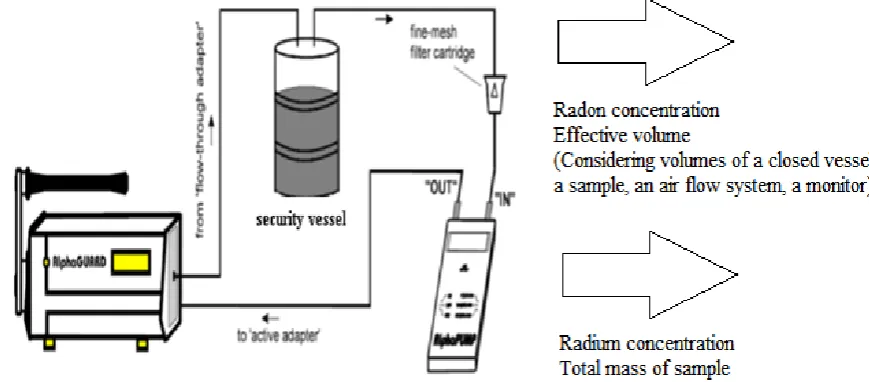
The total activity of radon released into the air from the sample material is evaluated by a measurement of radon concentration and the effective volume of the measurement system Fig. 2. The emanation coefficient is calculated by (Ishimori et al., 2013) [1]:
E = VC/MR
Where E is the emanation coefficient, V is the effective volume of the sampling device (m3), C is the radon
concentration (Bq/m3), M is the total mass of the sample
(kg) and R is the radium activity concentration (Bq/kg). The effective volume is determined by considering the volume of the closed vessel, of all material inside the closed vessel, of the loop system for radon measurement and the radon monitor. The total activity of radium in the sample material
can be determined by alpha spectrometry (IAEA, 2010) [27].
3. Results and Discussions
3.1. Radon Exhalation
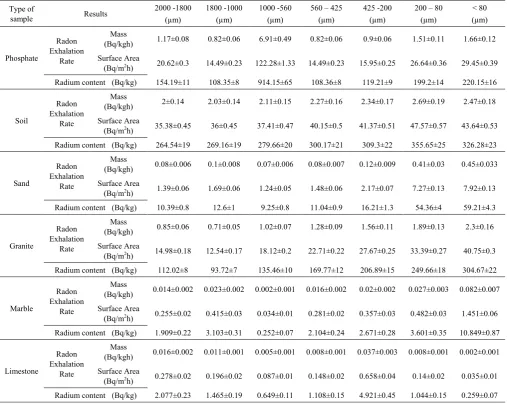
The calculated values of radium content and radon
exhalation rate in different grain sizes from 80 to 2000 μm of
the phosphate, soil and building materials (sand, granite, marble and limestone) samples with the help Alpha GUARD has been presented in Table 1. It can be seen from the results that the radon exhalation rate of phosphate is high, where the radium is high in phosphate rock (Negm, 2009) [28]. The radon concentration of different grain size of the phosphate sample varies appreciably from one-grain size to another due to the variation of radium content as shown in Fig. 3.
Radium content of different grain sizes of phosphate sample ranged from 108.35±8 to 914.15±65 Bq/kg with a mean value of 260.52±19 Bq/kg. The mass exhalation rate falls within the range of 0.82±0.06 to 6.91±0.49 Bq/kgh with a mean value of 1.97±0.14 49 Bq/kgh. The area exhalation rate falls within the range of 14.49±0.23 to 122.28±1.33 Bq/m2h with a mean value of 34.85±0.44 Bq/m2h. From
Table 1, the highest radium content, mass and area exhalation rate of phosphate sample were found to be 914.15±65 Bq/kg, 6.91±0.49 49 Bq/kgh and 122.28±1.33 Bq/m2h, respectively in grain size >560 μm and <1000 μm of
the phosphate sample. While, the lowest radium content, mass and area exhalation rate were found to be 108.36±8 Bq/kg, 0.82±0.06 49 Bq/kgh and 14.49±0.23 Bq/m2h, respectively in the grain size >425 μm and <560 μm of the
sample. The results indicate that the radon exhalation rates strongly depend on the grain size of phosphate sample (Rashmi, 2009; Breitner, 2010) [29, 30].
Table 1. Radon exhalation rate and radium content in phosphate, soil, and building materials (sand, granite, marble, and limestone) samples and in their different grain sizes (µm) using Alpha GUARD
Type of
sample Results
2000 -1800 (µm)
1800 -1000 (µm)
1000 -560 (µm)
560 – 425 (µm)
425 -200 (µm)
200 – 80 (µm)
< 80 (µm)
Phosphate
Radon Exhalation
Rate
Mass
(Bq/kgh) 1.17±0.08 0.82±0.06 6.91±0.49 0.82±0.06 0.9±0.06 1.51±0.11 1.66±0.12
Surface Area
(Bq/m2h) 20.62±0.3 14.49±0.23 122.28±1.33 14.49±0.23 15.95±0.25 26.64±0.36 29.45±0.39
Radium content (Bq/kg) 154.19±11 108.35±8 914.15±65 108.36±8 119.21±9 199.2±14 220.15±16
Soil
Radon Exhalation
Rate
Mass
(Bq/kgh) 2±0.14 2.03±0.14 2.11±0.15 2.27±0.16 2.34±0.17 2.69±0.19 2.47±0.18
Surface Area
(Bq/m2h) 35.38±0.45 36±0.45 37.41±0.47 40.15±0.5 41.37±0.51 47.57±0.57 43.64±0.53
Radium content (Bq/kg) 264.54±19 269.16±19 279.66±20 300.17±21 309.3±22 355.65±25 326.28±23
Sand
Radon Exhalation
Rate
Mass
(Bq/kgh) 0.08±0.006 0.1±0.008 0.07±0.006 0.08±0.007 0.12±0.009 0.41±0.03 0.45±0.033
Surface Area
(Bq/m2h) 1.39±0.06 1.69±0.06 1.24±0.05 1.48±0.06 2.17±0.07 7.27±0.13 7.92±0.13
Radium content (Bq/kg) 10.39±0.8 12.6±1 9.25±0.8 11.04±0.9 16.21±1.3 54.36±4 59.21±4.3
Granite
Radon Exhalation
Rate
Mass
(Bq/kgh) 0.85±0.06 0.71±0.05 1.02±0.07 1.28±0.09 1.56±0.11 1.89±0.13 2.3±0.16
Surface Area
(Bq/m2h) 14.98±0.18 12.54±0.17 18.12±0.2 22.71±0.22 27.67±0.25 33.39±0.27 40.75±0.3
Radium content (Bq/kg) 112.02±8 93.72±7 135.46±10 169.77±12 206.89±15 249.66±18 304.67±22
Marble
Radon Exhalation
Rate
Mass
(Bq/kgh) 0.014±0.002 0.023±0.002 0.002±0.001 0.016±0.002 0.02±0.002 0.027±0.003 0.082±0.007 Surface Area
(Bq/m2h) 0.255±0.02 0.415±0.03 0.034±0.01 0.281±0.02 0.357±0.03 0.482±0.03 1.451±0.06
Radium content (Bq/kg) 1.909±0.22 3.103±0.31 0.252±0.07 2.104±0.24 2.671±0.28 3.601±0.35 10.849±0.87
Limestone
Radon Exhalation
Rate
Mass
(Bq/kgh) 0.016±0.002 0.011±0.001 0.005±0.001 0.008±0.001 0.037±0.003 0.008±0.001 0.002±0.001 Surface Area
(Bq/m2h) 0.278±0.02 0.196±0.02 0.087±0.01 0.148±0.02 0.658±0.04 0.14±0.02 0.035±0.01
Radium content (Bq/kg) 2.077±0.23 1.465±0.19 0.649±0.11 1.108±0.15 4.921±0.45 1.044±0.15 0.259±0.07
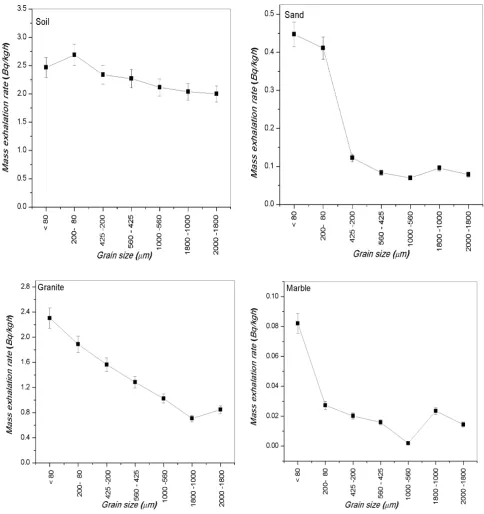
Figure 4. Relationship between mass exhalation rare and grain size in different grain sizes of soil, sand, granite and marble samples For soil sample Radium content falls within the range of
264.54±19 to 355.65±25 Bq/kg with a mean value of 300.68±21 Bq/kg, mass exhalation rate ranged from 2±0.14 to 2.69±0.19 Bq/kgh with a mean value of 2.27±0.16 Bq/kgh. Area exhalation rate falls within the range of 35.38±0.45 to 47.57±0.57 Bq/m2h with a mean value of 40.22±0.5 Bq/m2h.
In soil sample, the highest radium content and exhalation rate of radon in fine grains of 425-200, 200-80 and <80 μm.
While, the particle sizes of 2000-1800, 1800-1000, 1000-560 and 560-425 μm show lower radium content and exhalation
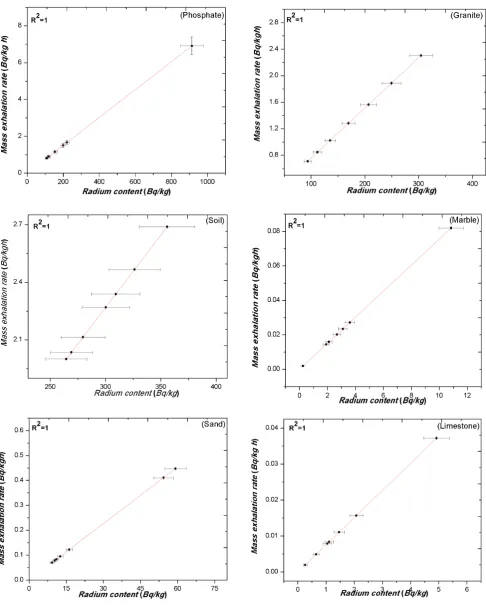
Figure 5. The relation between the Radium content (Bq/kg) & mass exhalation rate (Bq/kgh), of Rn-222 in different grain sizes of phosphate, soil and sand samples
Also from Table 1 the grain size <80 μm of the sand,
granite and marble samples have the highest radium content and radon exhalation rate. These radium content, mass and area exhalation rate were found to be 59.21±4.3 (Bq/kg), 0.45±0.033 (Bq/kgh) and 7.92±0.15 (Bq/m2h), respectively
for sand sample, 304.67±21.7 (Bq/kg), 2.3±0.164 (Bq/kgh) and 40.75±0.5 (Bq/m2h), respectively for granite sample, and
10.85±0.9 (Bq/kg), 0.08±0.007 (Bq/kgh) and 1.45±0.06 (Bq/m2h) respectively for marble sample. While, the lowest
radium content and exhalation rate of radon-222 were found to be 9.25±0.8 (Bq/kg),0.07±0.006 (Bq/kgh) and 1.24±0.05 (Bq/m2h), respectively for sand samples in the grain
size >560 µm and <1000 μm, 93.72±6.7 ((Bq/kg),
0.71±0.051 (Bq/kgh) and 12.54±0.21 (Bq/m2h), respectively for granite samples in grain size >1000 μm and <1800 μm
and 0.25±0.1 (Bq/kg), 0.002±0.001 (Bq/kgh), 0.03±0.01 (Bq/m2h), respectively for marble samples in the grain
size >650 µm and <1000 μm. For limestone samples the
lowest radium content and exhalation rate for radon-222 were found to be 0.259±0.1 (Bq/kg), 0.002±0.001 (Bq/kgh) and 0.03±0.01 (Bq/m2h), respectively in the grain size
<80µm. The highest radium content and exhalation rate of radon-222 were found to be 4.92±0.4 (Bq/kg), 0.04±0.003 (Bq/kgh) and 0.66±0.04 (Bq/m2h), respectively in the grain
size <425µm and size >200 µm.
The overall trend there is an increase in activity with decreasing in particle size for radium content and exhalation rate of radon-222 in soil, sand, granite and marble samples. This trend could be explained by the fact that the smaller the particle size the bigger the surface area hence more ion exchange capacity and greater adsorption (Rickert et al., 1977 [31]; Wilber and Hunter, 1979 [29] and Sam et al., 1998 [30]; Tuccimei, 2006 [27]; Breitner, 2010 [26]).
It can be seen that there are a good correlation between radium content (Bq/kg), and mass exhalation rate in (Bq/kgh) of Rn-222 with a correlation coefficient of 1 as shown in Fig. 5, 6 and from it we can see the linearity between them, so the exhalation of Rn-222 increase with increasing the content of Ra-226 (238U-series).
3.2. Emanation Coefficient
The emanation coefficient was constant regardless of the particle diameter in all samples because of radium were mainly distributed on the grain surface. The particle size and shape determine in part how much uranium and radium is close enough to the surface of the grain to allow the radon to escape into the interstitial pores (Ishimori et al., 2013) [1].
4. Conclusions
The results indicate that the measured values of radon exhalation rates strongly depend on the grain size of the samples. The radium content and exhalation rate of all samples increase with decreasing the grain size except
phosphate and limestone samples, where this trend is not clear. This trend may be due to the reduction in pore space between grains due to which more wide space becomes available for radon to exhale from the surface. The results indicate that phosphate generally has higher exhalation rate than other building materials and soil. While granite sample shows a possible dependency of exhalation rate on grain size and other samples show a very small variation of exhalation rate. Higher radiation levels of granite sample are associated with igneous rocks. The obtained values of radon exhalation rate for all samples, except phosphate sample, are well below the world average value of 57.60 Bq/m2h. Strong positive
correlation has been observed between radium content, area exhalation rate and mass exhalation rate. The emanation coefficient was constant regardless of the particle diameter in all samples.
REFERENCES
[1] Ishimori, Y., Lange, K., Martin, P., Mayya, Y.S., Phaneuf, M., 2013. Measurement and Calculation of Radon Releases from NORM Residues. Technical reports series No. 474. International Atomic Energy Agency, Vienna.
[2] Akerblom, G.V., Wilson, C., 1981. Radon gas - A radiation hazard from radioactive bedrock and building materials. Bull. of the Interna. Asso. of Engin. Geol. 23, 51-61.
[3] Colle´, R., Rubin, R.J., Hutchinson, J.M., 1981. Radon Transport Through and Exhalation from Building Materials: A Review and Assessment. U.S. National Bureau of Standards. Report NBS TN 1139.
[4] Durrani, S.A., Ilic, R., 1997. Radon Measurements by Etched Track Detectors: Applications in Radiation Protection, Earth Sciences and the Environment. World Scientific, Singapore.
[5] Deepanjan, M., 2000. Radon in the environment and associated health problems.. NRL Building, Indian Agriculturalm Research Institute. New Delhi 110 012, 44-55.
[6] Sundal, A.V., Henriksen, H., Lauitzen, S.E., Soldal, O., Strand, T., Valen, V., 2004. Geological and geochemical factors affecting radon concentrations in dwellings located on permeable glacial sediments e a case study from Kinasarvik, Norway, Environ. Geol., 45, 843-858.
[7] Badr, I., Oliver, M.A., Durrani, S.A., 1996. Statistical evidence of the geological control over radon soil gas concentration and its implications for mapping radon potential, Radi. Prot. Dosim., 36, 4, 28-321.
[8] Abumurad, K.M., Al-Tamimi, M.H., 2001. Emanation power of radon and its concentration in soil and rocks, Radia. Measur., 34, 423–42.
[10] Jonsson, G., 1987. Soil radon survey in solid state nuclear track detection: Principles, methods and application, eds. Durrani S. A. and Bull R. K., Pergamon press, Oxford, 3-20. [11] Virk, H.S., Singh, B., 1993. Radon Anomalies in soil-gas
and groundwater as earthquake precursor phenomena. Tectonophysics, 27, 215-224. UNSCEAR; “Sources and Effects of Ionizing Radiation”, United Nations, New York. [12] UNSCEAR; 1993 “Sources and Effects of Ionizing
Radiation”, United Nations, New York.
[13] IAEA (International Atomic Energy Agency); 2004, “Extent of environmental contamination by naturally occurring radioactive materials (NORM) and technological options for mitigation”, Technical Report No. 419. Vienna.
[14] Othman, I., M.S. Al-Masri; 2007, “Impact of phosphate industry on the environment: A case study” Applied Radiation and Isotopes 65, 131–141.
[15] Steinhäusler, F.; 1993 “Natural Radiation Exposure: An overview of the problem and research perspectives”, 23rd Ital. Rad. Prot. Ass. Congress, Capri, Italy.
[16] Etiope, G., Martinelli, G. 2002. Migration of carrier and trace gases in the geosphere: an overview, Phys. Earth Planet. In., 129, 185– 204.
[17] Markkanen, M., Arvela, H., 1992. Radon emanation from soils. Radi. Prot. Dosi., 45, 269-272.
[18] Shweikani, R., Giaddui, T.G., Durrani, S.A., 1995. The effect of soil parameters on the radon concentration values in the environment. Radia. Measur., 25, 581-584.
[19] Menetrez, M.Y., Mosley, R.B., 1996. Evaluation of radon emanation from soil with varying moisture content in a soil chamber. Environ. Internat., 22, 447-453.
[20] Sundal A.V., Henriksen H., Lauitzen S.E., Soldal O., Strand T. and Valen V. 2004. Geological and geochemical factors affecting radon concentrations in dwellings located on permeable glacial sediments e a case study from Kinasarvik, Norway. Environmental Geology 45, 843-858.
[21] Barillon, R., Özgümüs, A., Chambaudet, A., 2005. Direct recoil radon emanation from crystalline phases. Influence of moisture content. Geoch. et Cosmoch. Acta 69, 2735-2744. [22] Sakoda, A., Ishimori, Y., Yamaoka, K. 2011. A
comprehensive review of radon emanation measurements for mineral, rock, soil, mill tailing and fly ash. Appl. Radiat. Isoto., 69, 1422-1435.
[23] Tanner, A.B., 1980. Radon migration in the ground: a supplementary review. In: The Natural Radiation
Environment, 3. 5-56.
[24] AquaKIT Manual., 1999. Genitron Instruments GmbH, Germany 09/97.
[25] Mustonen, R., 1984. Natural radioactivity in and radon exhalation from Finnish building materials. Health Phys. 46, 1195–1203.
[26] Barton, T.P., Ziemer, P.L., 1986. The effects of plastic size and moisture content on the emanation of Rn from coal ash. Health Phys. 50, 518–528.
[27] Harb, S., N. K. Ahmed, Sahar Elnobi, 2015, Radon exhalation rate and Radionuclides in soil, phosphate, and building materials, J. Appl. Phys., 7, 2, 41-50.
[28] International Atomic Energy Agency, 2010. Analytical Methodology for the Determination of Radium Isotopes in Environmental Samples, IAEA Analytical Quality in Nuclear Applications Series No. 19, IAEA, Vienna.
[29] Negm, H., 2009. Studies of the natural radioactivity levels and radiological levels and radiological effects of some local fertilizers, Master Thesis, Assiut University.
[30] Rashmi, Kant, K., and Sharma, G.S., 2009. Activity Measurements and Dependence of Radon Exhalation Rate on Physical Sample Parameters in Soil Samples, Activity Measurements and Dependence, 21, 271-274.
[31] Breitner D., Arvela H., Hellmuth K.-H., Renvall T., 2010. Effect of moisture content on emanation at different grain size fractions - A pilot study on granitic esker sand sample, J. of Environ. Radio., 101, 1002-1006.
[32] Tuccimei, P. Moroni, M. Norcia, D., 2006. Simultaneous determination of 222Rn and 220Rn exhalation rates from
building materials used in Central Italy with accumulation chambers and a continuous solid state alpha detector: Influence of particle size, humidity and precursors concentration, Appl. Radia. and Isoto., 64, 254–263.
[33] Rickert, D.A., Kennedy, V.C., McKenzie, S.W., Hines, W.G., 1977. A synoptic survey of trace metals in bottom sediments of the Willamette River, Oregon: U.S. Geological Survey Circular 715, 27.
[34] Wilber, W.G., Hunter, J.V., 1979. The impact of urbanization on the distribution of heavy metals in bottom sediments of the Saddle River. Water Resou. Bull., 15,790-800.