Geschke Center
Doctoral Dissertations Theses, Dissertations, Capstones and Projects
2016
A Moving Imagination in Spaces of Distress:
Teacher and Student Agency in a Science
Classroom
Annie Sunshine Adamian
University of San Francisco, [email protected]
Follow this and additional works at:https://repository.usfca.edu/diss Part of theScience and Mathematics Education Commons
This Dissertation is brought to you for free and open access by the Theses, Dissertations, Capstones and Projects at USF Scholarship: a digital repository @ Gleeson Library | Geschke Center. It has been accepted for inclusion in Doctoral Dissertations by an authorized administrator of USF Scholarship: a digital repository @ Gleeson Library | Geschke Center. For more information, please [email protected].
Recommended Citation
Adamian, Annie Sunshine, "A Moving Imagination in Spaces of Distress: Teacher and Student Agency in a Science Classroom" (2016).
Doctoral Dissertations. 311.
The University of San Francisco
A MOVING IMAGINATION IN SPACES OF DISTRESS: TEACHER AND STUDENT AGENCY IN A SCIENCE CLASSROOM
In Partial Fulfillment
of the Requirements for the Degree Doctor of Education
A Dissertation Presented to
The Faculty of the School of Education
Department of International and Multicultural Education
by
Annie S. Adamian San Francisco
ii
THE UNIVERSITY OF SAN FRANCISCO Dissertation Abstract
A Moving Imagination in Spaces of Distress: Teacher and Student Agency in a Science Classroom
This qualitative study explored the ways in which our classroom community
(students and teacher) engaged with humanizing pedagogy in a seventh grade science
classroom, toward the full development (e.g. personal, social, emotional, academic) of our
classroom community, and the dismantling of inequitable practices and unjust policies that
we recognized in our science classroom, school and/or community while utilizing the process
of teacher and student participatory action research (tsPAR) (Adamian, 2015) and Critical
Race Praxis for Educational Research (CRP-Ed) (Jayakumar & Adamian, 2015).
This study examined the complexities of mutually engaging across differing
positionalities while intentionally working in spaces of distress (e.g. push and pull between
oppression and liberation). The findings demonstrated the ways in which building a beloved
community while situated within an oppressive U.S. schooling system, supported students
and teacher toward cultivating pedagogy rooted in love and agency, with a collective
commitment toward social justice. As a result, this study contributed toward expanding the
possibilities for teaching and learning toward social justice in constricting institutional
contexts that honor students and teachers relationships while simultaneously defining for
iii
This dissertation, written under the direction of the candidate’s dissertation committee and
approved by the members of the committee, has been presented to and accepted by the
Faculty of the School of Education in partial fulfillment of the requirements for the degree of
Doctor of Education. The content and research methodologies presented in this work
represent the work of the candidate alone.
Annie S. Adamian 5–5–2016
___________________________________ ____________
Candidate
Dissertation Committee
Dr. Emma H. Fuentes 5–5–2016
____________________________________ ______________
Chairperson
Dr. Shabnam Koirala–Azad 5–5–2016
____________________________________ ______________
Dr. Patrick Camangian 5–5–2016
____________________________________ ______________
Dr. Uma M. Jayakumar 5–5–2016
iv
ACKNOWLEDGEMENTS
Family – Mama jan, Baba jan, and Koyrik jan Students – past, present, and future
Mentors – Drs. Emma H. Fuentes, Uma M. Jayakumar, Kevin K. Kumashiro, and Ann K.
Schulte Three Musketeers – Victoria Duran and Farima Pour Khorshid USF family –
Melissa Canlas, Alejandro Covarrubias, Victoria Duran, Olivia Muñoz, Garrett Naiman,
Manuel Perez, Roselva Tunstall, and Anyanwu Uwa, Professors – Drs. Benjamin Baab,
Mark Bautista, Onllwyn Dixon, Susan R. Katz, and Jacquelyn Reza Dissertation
Committee Members – Drs. Emma H. Fuentes (Chair/Guardian Angel), Shabnam Koirala
Azad (Humble Brilliance), Patrick Camangian (Raw Truth Teller), and Uma M. Jayakumar
(Mentor/Soul Sister).
I appreciate you and I love you. You all know how much I admire you and the deep gratitude
I hold for your love, trust, and support. I am honored to imagine with you and move
v
TABLE OF CONTENTS
Dissertation Abstract…...………...………..ii
Signature Page………...………iii
Acknowledgments………..…………...………...………iv
CHAPTER I. THE RESEARCH PROBLEM Introduction………....…………...………...………...1
Background and Need………...…………...……...……..2
Purpose of the Study……….………...………...…...…..………..9
Research Questions..….………...…..………...……….………...……...………...12
Theoretical Framework……….………..……....…...12
Educational Significance……….………...……..………..…………..….16
Limitations…....………..………...…...19
Definition of Terms….…...…..………..……….………...………20
CHAPTER II: REVIEW OF THE LITERATURE………...………...….22
Introduction………...……...……….………..…………...………22
Neoliberal Frames and The Purpose of Schooling………...……..…..…………..24
Anti-oppressive Education: Teacher and Student Agency..……….…...…………31
Critical Pedagogy……….………..…..……...………….33
Youth Participatory Action Research………...…….………..……..………41
Building a Beloved Community: Radical Healing Spaces……….……….48
Conclusion………..58
CHAPTER III: RESEARCH DESIGN………...……….………...………...……….64
Restatement of the Purpose……...………64
Research Questions………...………..………...64
Design of the Investigation and Methodology………...……..………..……….65
Critical Race Praxis for Educational Research………...……… 65
Teacher and Student Participatory Research……..………..69
Research Site ………78
Participants….………...……….……..….……...………79
Ethical Considerations….………...……….……….…..80
Data Collection Instruments………...………..81
Data Analysis Procedures……….……….…...…….84
CHAPTER IV: FINDINGS………...………...………87
Teacher-Researcher’s Profile……...………...………...……87
Working in, with, and Through the Contradictions………..……….89
Structure of the Findings……….……….………..89
Findings: Phase One (mid August to mid November)…………..………93
Findings: Phase Two (mid November to mid January)………….……….112
vi
CHAPTER V: DISCUSSIONS, RECOMMENDATIONS, AND CONCLUSION...161
Summary of the Findings……….…..………..169
Tenet One – Relational Advocacy Toward Mutual Engagement …….…….……...…170
Tenet Two – Redefining Dominant and Hegemonic Systems………....…….………….181
Tenet Three – Research as a Dialectical Space……….…….…….…..186
Implications……….194
For Students and Teachers in k–12 Public School Classrooms…………..……….……194
For Educational Researchers………...……….………..199
Conclusion………….………..……….202
REFERENCES……….……….………206
APPENDIX………216
Chapter I: THE RESEARCH PROBLEM
Introduction
Three years ago, as I was walking by one of my seventh grade students, she stopped
working and asked, “Ms. Adamian, remember when we were talking about elephant tusks
and poaching the other day?” I responded, “Yes.” The student continued, “I think it’s wrong
that people kill elephants for their tusks. It makes me really sad.” I replied, “When you get
older, you should do something about it.” My student nodded and continued working. As I
began walking away, something didn’t feel right about our exchange. I reflected on our
conversation and recognized that I had contradicted my own stance on teaching and learning
toward social justice. This experience rattled me, causing me to think deeply about the
questions teachers often ask their students. Such as, “What do you want to be when you grow
up?” or take the stance of “teach them now, so that they can use the knowledge later.” When
we act in these ways, we position young people in static, disempowering, oppressive spaces
where their knowledge, emotions, and passions are to be stored and used at a later date.
Our conversation caused me to critically reflect on the ways in which my
commonsensical assumptions were generating barriers for the students I was working with in
a classroom that strived to be justice-centered. At the time of this interaction, we had been
working as a classroom community developing liberating discourse, problematizing the
curriculum, working through crises, and forging relationships rooted in building community,
trust, and respect. We were working on reclaiming our legacies, developing self-worth, and
building a classroom culture where students were engaged with and part of the curriculum
At the same time, I was perpetuating oppressive practices by not recognizing and
humanizing students’ experiences and actions now. I was waiting for them to become,
instead of honoring their humanity and agency at that very moment. I highlight this particular
moment to share the lesson I learned that day: By acknowledging that anti-oppressive
education is a process that teachers and students must actively engage in – serves to
dismantle the notion of equity as something students and teachers may benefit from at a later
date. If teachers are serious about creating and sustaining equitable classrooms and schools
alongside their students, we must challenge the notion of focusing on what young people are
going to become, by focusing instead on recognizing, loving, and respecting who they are
right now.
To this end, the relationship between students and teachers working toward liberation
exists in a space of hybridity (Bhabha, 1994) and is a story that largely goes untold. Gaining
insight into the relationship between students and teachers carves out a space to share the
humanizing practices of teaching and learning toward social justice. In this way, an
epistemology that relies on the recognition that teaching and learning are acts of love is a
crucial component of creating and sustaining equitable classrooms and schools that honor
students, teachers and the communities in which they live and work. Indeed, “knowledge
emerges only through invention and re-invention, through the restless, impatient continuing,
hopeful inquiry human beings pursue in the world, with the world, and with each other”
(Freire, 1970, p. 72). It is within this context that legacies are shared, realized, and new
stories have the potential to transpire.
Background and Need for the Study
discourse and norms since its inception. A legacy of Eurocentric policies and practices rooted
in free-market tactics have posited that the sole purpose of U.S. public schools is to produce
human capital in order to meet the needs of the market economy (Apple, 2006; Engel, 2000).
Exclusive emphasis on producing human capital by means of the public school system was
systematically embraced during the George W. Bush administration, and reauthorized by
President Obama’s administration (e.g. No Child Left Behind and Race to The Top).
Propelled by the launch of Sputnik in 1957, U.S. educational standards have deemed
Eurocentric curriculum and practices to be the knowledge of most worth, purposed for U.S.
economic gain in the global marketplace. Schooling in this way normalizes free-market
tactics and justifies the hierarchical practices that promote decentralization, vying for rigid,
mass-marketed, scripted schooling with no regard for the communities that public schools are
supposed to serve and reflect (Apple, 2006). Consequently, the move towards standards/
standardization has resulted in greater tracking of students (Oakes, 2005) and unending
regulation of students and teachers (Fuller, 2003). In this way, the oppressive patterns of
neoliberalism – with its ongoing production of common sense – are justified in sustaining a
hegemonic culture that is reproduced through public schooling, attempting to strip students
and teachers of their identities, dignity, desires, hopes, and dreams.
State and federally mandated education policies honor dominant cultural practices
which deliver inequitable funding, dehumanizing curriculum, and testing strategies that place
the blame on teachers and students for the pitfalls of our system, and continue to shift the
discourse about poverty, institutional racism, and a negligent capitalist system. For example,
in 1965, the implementation of the Elementary and Secondary Education Act (ESEA)
What the ESEA neglected to address were the systemic inequities that perpetuated poverty,
inequitable funding for schools, racial and class segregation, and the crucial need to
revolutionize the Eurocentric curriculum and practices within U.S. public schools, alongside
the inequities found at the state and local level.
The ESEA neglected to acknowledge where the heart of the problem resided. The
inequities found within public schools would not be mitigated with accountability and
rigorous curriculum driven by free-market tactics. The heart of the problem was and is still
beating within U.S. classrooms and more predominantly impacting underserved communities
of color. Students’ and teachers’ hopes and dreams have become scripted with rigid
curriculum that purports knowledge as a means to an end (Apple, 2007). The practice of
democratic values, equitable funding for all public schools, and the art of teaching and
learning have been strategically silenced from mainstream educational discourse and
practices.
In 1983, Ronald Reagan warned us that we were “a nation at risk.” Ronald Reagan’s
National Commission on Excellence in Education solely placed the blame for U.S. economic
failures on public school system (Gabbard, 2007). These attempts to “reform” education were
based on the increased demand for human capital, therefore focusing on and justifying core
subjects that upheld Eurocentric knowledge and the assimilation of racialized communities.
More specifically, “these school literacies were characterized by a view of knowledge as
stable, standard, decontextualized, bounded, and situated in clear hierarchies that privileged
the ‘official knowledge’ of dominant groups” (Apple, 2007, p. 439). Simultaneously, the
discourse placed the blame on teachers and students for the gross inequities produced by the
neoliberal policies and the looting of resources from communities of color.
Indeed, neoliberal policies and practices suffocate the democratic ideals that schools
and communities deserve to experience. Neoliberal frames confirm, promote, and perpetuate
the unjust status quo in regards to the inequities they produce and deliver dehumanizing
tactics in prepackaged lyrics framed as common sense. For example, neoliberal policies
promote the production of knowledge as a means to an end and legitimize the dominant
culture’s discourse which posits that the sole purpose of schooling is to provide the necessary
skills for students to participate in the market economy (Engel, 2000).
Oppressive, dehumanizing education that works to strip students of their identities
and normalizes hegemony in the name of capitalism is an act of violence against youth
(Freire, 1970). “For apart from inquiry, apart from the praxis, individuals cannot be truly
human” (Freire, 1993, p.72). Therefore, exploring the ways in which students and teachers
link their schooling experiences with racial, gender, economic, and youth injustice inspires
the development of new frames that work towards the development of equitable public
schools that underserved communities deserve.
Fear, standardization, and competition are examples of three neoliberal frames that
contribute towards normalizing oppressive schooling practices and the privatization of public
spaces (Kumashiro, 2012). Below, I discuss each of these frames and the ways in which they
perpetuate commonsense thinking and practices. Naming these frames and problematizing
how they influence educational practices and policies evokes the development of new frames
rooted in social justice.
The first frame relies on fear-driven tactics and policies. For example, A Nation at
produce human capital in order to meet the needs of the market economy. Policies such as
the Elementary and Secondary Education Act (ESEA, 1965) and No Child Left Behind
(NCLB, 2001) reflect a legacy of educational reforms that legalized the looting of resources
from communities of color disguised in the false notions of freedom, equality, and choice.
Systematically, current neoliberal practices are perpetuated and legalized through the
American Recovery and Reinvestment Act (ARRA, 2009), which promote interstate
competition for federal funding through the Race to the Top initiative (RTTT). The ARRA
mandates states to comply with the Common Core and is a policy steeped in upholding
Eurocentric curriculum and practices driven by free-market solutions. Such tactics continue
to define the purpose of schooling as a means to an end. In doing so, corporate lobbied
frames have shaped the commonsensical ways of thinking about high-stakes testing, the
dismantling of teacher unions, and the privatization of public schools through the
establishment of charter schools. How well schools align their practices with these
dehumanizing policies results in sanctions and/or incentives that mirror capitalist notions of
winners and losers (Kumashiro, 2012).
Common sense thinking about the purpose of public schools lends itself to a second
neoliberal frame that justifies standardized testing (Kumashiro, 2012). Empirical research
rooted in statistical analysis (e.g. eugenics movement) holds a highly charged legacy of
promoting and perpetuating racist policies and practices that normalized institutional racism
by placing the blame on the very groups of people that the policies were strategically
designed to oppress (Zuberi & Bonilla-Silva, 2008). Current policies and practices that
justify inequitable funding for schools and the privatization of public schools are driven by
in the results of high-stakes testing resembles the legacy of racist policies and practices,
justified through statistical research that holds no validity, similar to the false reliance on
statistical research that justified the eugenics movement (e.g. Crania Americana, Bell Curve).
High-stakes testing places the blame on teachers and students, particularly students of
color, and shifts the discourse away from the inequities that are reproduced through current
inequitable policies and practices. The results from standardized test scores systematically
justify public school closures and the privatization of public schools which predominantly
impact communities of color and the forced displacement of students of color. Ultimately,
neoliberal frames are normalized within a hegemonic construct that justifies the current
context of educational reform rooted in a legacy of oppression. In essence, standardization
and statistical research frames education “within the discourse of neoliberalism…construing
the public good as a private good and the needs of the corporate and private sector as the only
source of investment” (Giroux, 2004, para. 6).
A third framing that perpetuates inequitable schooling conditions is competition
(Kumashiro, 2012). Neoliberal discourse justifies competition by hiding behind claims that
initiatives like RTTT will solve all of the problems in education leading to a successful
market economy. Embedded within this frame are the common sense ways of thinking about
choice, meritocracy and the purpose of schooling. Choice renders charter schools as an
option for parents to enroll their students in a “better” school. In doing so, choice
individualizes the problem by placing the blame on teachers and students as opposed to the
systemic inequities normalized through common sense thinking (Kumashiro, 2012).
Inseparable from choice, is the belief in individual mobility while participating in an
renders the privatization of public spaces such as schools as the only viable option for
families wanting their youth to receive the education that they deserve. Neoliberal ideology
rooted in common sense thinking affirms meritocracy and posits that by working hard and
competing for resources, folks will be compelled to do their best in order to reap the benefits
of the free-market. Advertising that schooling is the vehicle towards economic gain,
discourse about social justice is silenced and dismissed. The practice of neoliberal ideology
then translates into the privatization of public schools staking claim in the public sector
through the false promises of efficiency and management strategies that resemble that of the
free-market (Lipman, 2011). Generating new frames that shift how we think about the
purpose of public schools carves out spaces wherein teaching and learning toward social
justice is embraced, and the possibility for humanizing curriculum and practices can be
honored.
The consistent reproduction of a hegemonic culture that promotes
individual-consumers and colorblind actors with “habits, memories, prejudices, mental schemata,
predispositions… etc. – that enable people to make sense of their world” unlinked to
institutional racism and central to liberation, is reflected within public schools today (Della
Porta & Diani, 2002, p. 67). Hegemonic practices and discourse confirm, promote, and
justify the unjust status quo in regards to economic, racial and gender inequities in the name
of “freedom” and “choice.” Such a stance bolsters an uncritical recognition of inequities and
challenges the struggle toward sustaining public schools for the public good. Ultimately,
free–market tactics diminish the purpose of schooling as a means to an end and serve to
problematize students and teachers.
life the spirit of democracy, it is crucial to investigate the ways in which students and
teachers cultivate their own critical consciousness and participate as change agents in public
schools. Indeed, exploring the ways in which students and teachers negotiate anti-oppressive
education while teaching and learning within an oppressive and constricting neoliberal
schooling system is necessary (Kumashiro, 2000, 2009). Sharing how students and teachers
contribute towards dismantling neoliberal policies and practices that work to reproduce
unjust curriculum and practices sustained through sanctions and incentives based solely on
standardized test scores, contributes to the work in progress toward social justice in public
schools (Fuller, 2003; Sleeter, 2005).
Purpose of the Study
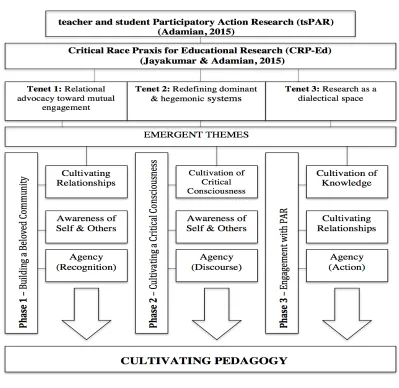
The purpose of this qualitative study is to explore the ways in which our classroom
community (students and teacher) engages with humanizing pedagogy in a seventh grade
science classroom, toward the full development (e.g. personal, social, emotional, academic)
of our classroom community, and the dismantling of inequitable practices and unjust policies
that we recognize in our science classroom, school and/or community while utilizing the
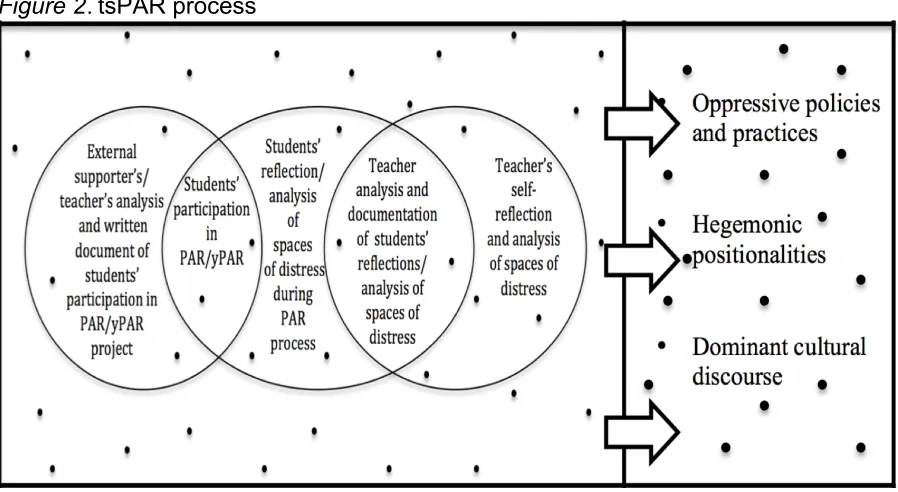
methodological process of teacher and student participatory action research (tsPAR)1
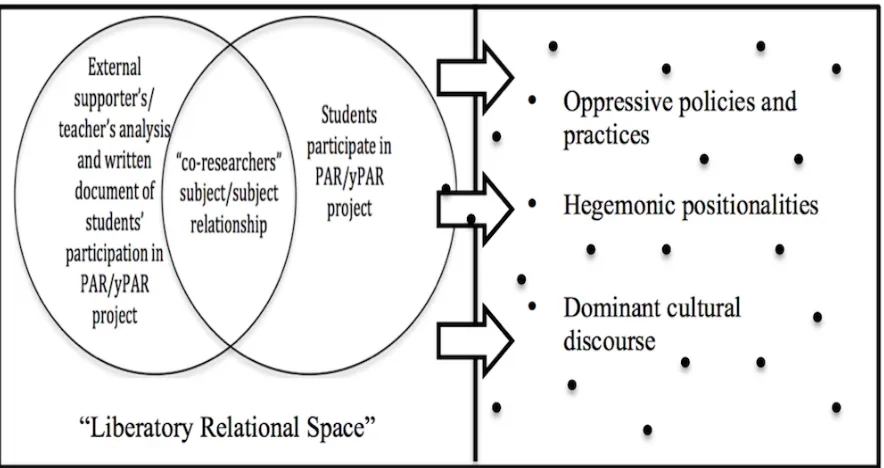
1tsPAR draws from participatory action research (PAR)/youth participatory action research (yPAR) studies
which intentionally honor and center the experiences and knowledge of local communities working toward justice. As reflected in the review of the literature, communities engaged with PAR/yPAR have changed unjust policies and/or practices, transformed their own lives, and the lives of those they love (Fals-Borda & Rahman, 1991; Cammarota & Fine, 2008; Stovall & Delgado, 2009). However, how external supporter(s)
(Adamian, 2015) and Critical Race Praxis for Educational Research (CRP-Ed)2
, both of
which will be further discussed in Chapters 2 and 3 of this study (Jayakumar & Adamian,
2015). Furthermore, through the continued development of one’s own critical consciousness,
the critical analysis of standards-based curriculum, and the honoring of students’ and
teachers’ identities, the practice of humanizing pedagogy carves out a space for our
classroom community to contribute toward the dismantling of dehumanizing and inequitable
practices and policies driven by neoliberal ideology.
The practice of humanizing pedagogy will support our classroom community while
we simultaneously engage with the process of tsPAR and CRP-Ed in order to contribute
toward redefining the purpose of schooling and defining for ourselves who we are. Engaging
with the methodological process of tsPAR through the lens of CRP-Ed, not only supports us
in navigating our immediate circumstances, but also provides us future means of creatively
embarking on situations we have not yet confronted or know about. Thus, embracing
community activism as a part of our identity is a crucial component of contributing towards
reframing the purpose of schooling and who we are. In this sense, this study seeks to honor
our collective knowledge both from a historical context, as historical beings, and as current
change agents acting on our world in the present – toward a renaming of ourselves that
cherishes our collective relationships, individual selves, and our dignity.
2
The crux of this study situates the current neoliberal agenda and the inequities
manufactured by an amnesia-ridden educational reform movement and how our classroom
community experiences and negotiates these dynamics in our seventh grade science
classroom. For example, standardization and state mandated Eurocentric curriculum are two
oppressive practices that we will negotiate on a daily basis while simultaneously working
towards building a beloved community that honors our identities, hopes, and dreams (hooks,
1995; Ginwright, 2010).
Exploring the particular challenges and triumphs that we experience through the
practice of anti-oppressive education (Kumashiro, 2004/2008) while simultaneously
negotiating with state mandated standards, has the potential to inspire new ways of thinking
about teaching and learning in public schools. This study shares the ways in which engaging
with tsPAR and CRP-Ed in a seventh grade science classroom inspires student and teacher
agency, supports anti-oppressive education (Kumashiro, 2015), and simultaneously generates
spaces of hope, healing and transformation (hooks, 1995, 2003; Ginwright, 2010).
When students and teachers seek to redefine the purpose of schoolingit requires
exploring the ways in which anti-oppressive education brings to life teaching and learning
toward social justice in public school classrooms. Indeed, teaching and learning in
anti-oppressive ways requires us to enter the classroom everyday with intention, purpose, and
courage. With intention, this study will attempt to disrupt the curriculum that is designed to
reproduce the unjust status quo. With purpose, this study will seek to agitate and
problematize the very structure that normalizes oppression, marginalizes the other, and
attempts to dehumanize teachers and students. With courage, this study will work toward
Research Questions
This study attended to the overarching research question: In what ways can our
classroom community engage with humanizing pedagogy and research towards the full
development (e.g. personal, social, emotional, academic) of students and teacher and the
building of a beloved community?
1) To what extent can our classroom community’s engagement with tsPAR and CRP-
Ed contribute toward naming the spaces of distress and defining for ourselves the
purpose of schooling and who we are?
2) To what extent can our classroom community honor the principles of tsPAR and
the tenets of CRP-Ed while simultaneously negotiating with and pushing back on
state and federally mandated science standards?
Theoretical Framework
When teachers and students participate in redefining the purpose of schooling,
schooling transforms from the false notion that the sole purpose of schooling is where
free-market solutions are sought toward the recognition of a public space where teachers and
students work towards healing their own hearts and ultimately, the heart of democracy
(Palmer, 2011). Therefore, contributing toward reframing the purpose of schooling requires
redefining what it means to be a teacher or student working within a hegemonic system
rooted in a legacy of heteronormative White male privilege (Alexander, 2010; Fanon, 1952;
Karabel, 1984).
Problematizing our situatedness compels us to recognize that teaching and learning
toward social justice in public schools means to consistently work within a space of
capital, dehumanization, and fear) (Kumashiro, 2012). Simultaneously, we do this work
while knowing that the dominant cultural discourse is embedded within the Common Core
and state standards, normalized, measured, and regulated with high stakes testing
(Ladson-Billings, 2006; Sleeter, 2005).
We acknowledge that both students and teachers will be monitored, regulated, and
punished based on how well we have taught and learned the dominant narrative. We do so,
knowing these results will support a neoliberal frame that will be used against us and will be
used to define us (Kumashiro, 2012). We recognize that when we enter our classroom, we
enter a space that holds a legacy of inequities shaped by the bombardment of racist policies
and practices (and current neoliberal reform tactics) justified through common sense
thinking.
In a similar way, we know that placing the blame on teachers and students is merely a
tactic used to shift the discourse away from oppression and the bigger picture (Kumashiro,
2012). By redefining ourselves, we reframe what it means to teach and learn in public
schools and dismantle how we are defined by the dominant cultural narrative. Inspired
through humanizing curriculum and practices, we transcend the victimization of their blame
and define for ourselves the purpose of schooling and who we are.
Therefore, this study draws from three humanizing frameworks including critical
pedagogy (Darder, Baltodano, & Torres, 2003; Duncan-Andrade & Morrell, 2008; Freire,
1970; Giroux, 1989), anti-oppressive education (Kumashiro, 2004/2015), and the notion of
beloved communities (hooks, 1995; King, 1957; Royce, 1913/2001). These frameworks
support teaching and learning toward social justice in public schools, while simultaneously
support teaching and learning toward the full development (e.g. personal, social, emotional,
academic) of our classroom community, and the dismantling of inequitable practices and
unjust policies that we recognize in our science classroom, school and/or community. Below,
I discuss the ways in which these frameworks support this research study and honor the
process of contributing toward redefining the purpose of schooling and who we are.
Critical Pedagogy
The practice of critical pedagogy by teachers and students reflects a humanizing
epistemology that acknowledges teaching and learning as acts of love, “For apart from
inquiry, apart from the praxis, individuals cannot be truly human” (Freire, 1970, p. 72).
Consequently, the practice of critical pedagogy works to transform oppressive schooling
conditions into liberating sites where social justice is at the core of classroom practices
(Giroux, 2004). In essence, critical pedagogy demands a break from the past and the
development of new anti-oppressive practices reinvented through action and reflection and
generated from the constant grappling with knowledge and power (Giroux 1997, 2004;
Freire, 1998, Kumashiro, 2009). Indeed, the practice of critical pedagogy has the potential to
transform dehumanizing static spaces, from which the oppressed need a break, into fluid
transformative spaces that honor their identities (Tatum, 1997).
Critical pedagogy inspires students and teachers to, “challenge, resist, and change the
root cause of their suffering [and] is at the core of any democratic process” (Ginwright &
James, 2002, p. 31). In this sense, “Knowledge emerges only through invention and
re-invention, through the restless, impatient continuing, hopeful inquiry human beings pursue in
student agency is an exemplar of the untapped bond that can agitate and bring forth
movement towards change.
Anti-oppressive Education
Anti-oppressive education honors teacher and student agency and is a crucial
component of creating and sustaining equitable classrooms, schools, and communities.
Teaching and learning in anti-oppressive ways agitates dehumanizing curriculum and
practices (Freire, 1970; Giroux, 1989; Kumashiro, 2009). More specifically, anti-oppressive
education “constantly turns its lens of analysis inward as it explores ways that its own
perspectives and practices make certain changes possible but others, impossible” (p. xxxviii).
In other words, anti-oppressive education is about teachers and students acknowledging the
partiality of their own knowledge, the knowledge produced collectively (although understood
in different ways), and embracing uncertainty (Ellsworth, 1997). Therefore, anti-oppressive
education is about working through/in crisis and discomfort and recognizing moments of
negotiation, contradiction, struggle, and resistance while teaching and learning toward social
justice. In this sense, the practice of anti-oppressive education consistently reminds our
classroom community that teaching and learning is an ongoing process, not a means to an
end.
Beloved Communities
Lastly, how teachers and students work towards cultivating liberating sites while
working toward the practice of freedom necessitates a mutual engagement rooted in the
principles of a beloved community (hooks, 1995; King, 1957). Working toward the building
of a beloved community inspires solidarity and trust in the classroom where students and
freedom in all parts of the educational system” (Candoli, 1976, p. 246).Within the building
of a beloved community, “is this generous spirit of affirmation that gives us the courage to
challenge one another, to work through misunderstandings, especially those that have to do
with race and racism” (hooks, 1995, p. 272). In order for teachers and students to work
toward a beloved community, solidarity, trust, and a shared purpose towards social justice
rooted in critical consciousness, self-determination, hope, and agency are necessary.
Educational Significance
This study shares new insights and generates new inquiries in response to teaching
and learning in anti-oppressive ways in public schools by sharing how our classroom
community took action within our own classroom, school, and/or community. This study
adds to past and current research studies in regards to contributing toward creating and
sustaining equitable classrooms and schools by sharing our relationship (between students,
and students and myself) in our life science classroom. For example, this study examined the
ways in which we took action in response to the inequities and unjust practices we
recognized in our classroom, school and/or community.
In order to contribute toward creating and sustaining equitable classrooms and
schools, it is essential that teacher educators, pre-service teachers, and current teachers
recognize the crucial need for critical pedagogy in the classroom as a contributing factor
toward the transformation of oppressive U.S. educational policies and practices. Educational
research shows that students involved in classrooms and youth development programs rooted
in the practice of critical pedagogy, and/or participatory action research (PAR)/youth
participatory action research (yPAR) are creating equitable classrooms and schools, changing
2008, 2011; Ginwright & Cammarota, 2007; Ginwright & James, 2002; Mirra & Morrell,
2011; Stovall, Calderon, Carrera, & King, 2009; Stovall, 2013). This study honors and
developed from the collective knowledge brought forth from empirical research studies that
investigated the ways in which young people across the nation worked (and continue to)
toward creating equitable schools and communities (Cammarota, 2008, 2011; Ginwright,
2007; Ginwright & James, 2002; Mirra & Morrell, 2011; Stovall, Calderon, Carrera, & King,
2009).
Drawing from the empirical studies mentioned above, this study explored the ways in
which our classroom community cultivated our own critical consciousness, engaged with
participatory action research, and created anti-oppressive spaces. For example, examining the
ways in which teachers and students work together in these capacities is needed because
regardless of the positionality of one’s stance on the purpose of schooling, educational
discourse is popularly immersed within the binary of either the student or the teacher. In this
sense, whether the literature is generated from a position towards social justice or from a
neoliberal stance, both bodies of educational research have the habit of severing the
relationship between students and teachers. What this means is that the discourse is either
about how teachers teach and act or about how students learn and act. Yet, the story of the
relationship between the two in regards to inspiring agency and the practice toward freedom
is rarely shared. It is within this space of discomfort and tension that this study turned a
critical lens (Kumashiro, 2009). More specifically, the ways in which these spaces humming
with emotion, discomfort, and tension which existed in our classroom and school as they
related to oppression and anti-oppressive teaching and learning. Indeed, by developing new
students and teachers that educational discourse can transcend the deficit perspective that
problematizes students and teachers. Framing students and teachers in these ways generates a
binary of “us and “them,” and becomes an easier target for cooptation, dehumanization, and
sites of blame for neoconservative reformists.
Paradoxically, it is within this space of distress that students and teachers generate
healing spaces in public schools, as opposed to the commonsensical ways of thinking about
abandoning public schools and losing hope in our public spaces. Ultimately, teaching and
learning in anti-oppressive ways has the potential to transform schooling into public spaces
that people look to for freedom, hope, agency, and care - as opposed to a place to blame,
justify the inequities, and promote a hegemonic culture.
This study builds on previous research that highlights the ways in which young
people participate in counter-action, and also provides insight into the ways in which our
classroom community participates together in creating and sustaining liberating spaces in a
public school classroom in order for humanizing educational practices to transpire.
Additionally, this study builds on past empirical studies conducted in classrooms and
communities seeking to create and sustain equitable learning environments. By sharing the
process of students and teachers simultaneously, this study adds to previous studies by
sharing the relationship of students and teachers working together in spaces of distress
(Cammarota, 2008, 2011; Caro-Bruce, Flessner, Klehr, & Zeichner, 2007; Ginwright, 2007;
Ginwright & James, 2002; Mirra & Morrell, 2011; Stovall, Calderon, Carrera, & King,
2009).
Additionally, this study problematizes the ways in which external supporters involved
explored the possibilities toward expressing the mutual engagement between the external
supporter, in this case, me (life science teacher) and the local community (students enrolled
in life science class), in addition to the mutual engagement between the students. In other
words, this study attended to teachers and students, named the tensions during the
relational/methodological process, and troubled the ways in which external supporters
engaged with and documented PAR/yPAR studies by employing teacher and student
participatory action research (tsPAR) in order to name the spaces of distress.
Lastly, one area of scholarship that does not often include students’ development of
their own critical consciousness, spaces to heal, and participate in critical pedagogy and/or
PAR/yPAR, is in the k-12 science classroom. This study filled that gap by specifically
looking at the ways in which critical pedagogy, anti-oppressive education, and working
toward a beloved community while engaging with PAR/tsPAR were possible in this age of
standardization and the constraints brought about by high-stakes testing and top-down
management.
Limitations of the Study
The limitations of this investigation arose due to the nature of this study. This study
took place in a 7th grade life science classroom located in a public junior high school in
Northern California. This eight-month study began in August 2015 and ended in April 2016.
The participants for this study included myself and the young people enrolled in the 7th life
science classes that I taught and learned alongside.
Due to my positionality as both a teacher and researcher, I was mindful of the
tensions that emerged between the students I worked with and myself, in both capacities.
worked to grapple with our moments of tension in order to name our situatedness. As
“co-researchers” we shared the ways in which our differing positionalities were negotiated
through field notes/journal entries and/or audio/voice recordings of classroom discussions
and/or interviews. Additionally, we honored the contradictions that emerged as we engaged
with the process of PAR/tsPAR in the classroom, by intentionally naming and/or working to
dismantle the power dynamics that emerge due to our differing positionalities and the context
and constraints that we were working in and through.
Definitions of Key Terms
Agentic
The capacity to transform oneself and oppressive spaces or systems (Bandura, 2001).
Anti-oppressive education
“Constantly turns its lens of analysis inward as it explores ways that its own
perspectives and practices make certain changes possible but others, impossible; and
it constantly turns its lens outward to explore the insights made possible by
perspectives on teaching and learning that have yet to be adequately addressed in the
field of education” (Kumashiro, 2009, p. xxxviii).
Common Sense
Oppressive systems and practices normalized through habits of mind and actions
(Gramsci, 1971; Kumashiro, 2009).
Ideological Hegemony
“Systems of practices, meanings, and values which provide legitimacy to the
dominant society’s institutional interests and arrangements” (Giroux, 1997, p. 6).
“Neoliberalism is an ensemble of economic and social policies, forms of governance,
and discourses and ideologies that promote individual self-interest, unrestricted flows
of capital, deep reductions in the cost of labor, and sharp retrenchment in the public
Chapter II: REVIEW OF THE LITERATURE
Introduction
When teachers working toward social justice dream of redefining the purpose of
schooling, it requires exploring the ways in which anti-oppressive education inspires critical
consciousness and critical agency toward the development of beloved communities. How we
choose to teach and learn necessitates redefining what it means to be a teacher and/or student
working within a hegemonic schooling system rooted in a legacy of heteronormative White
male privilege. Problematizing our situatedness compels us to recognize that teaching and
learning toward social justice in public schools means to consistently work within a space of
contradiction, driven by common sense tactics and practices – steeped within an oppressive
hegemonic culture (Kumashiro, 2009). Common sense refers to the ways in which
oppressive systems and practices are normalized through habits of mind and actions (Giroux,
1997). For example, today, common sense tells us that the purpose of schooling is to produce
human capital, therefore normalizing market-reform tactics (Kumashiro, 2012).
Consequently, when teachers and students engage with justice-centered practices in
public schools, they agitate common sense thinking and oppressive practices through action
and reflection (Giroux, 1989; Freire, 1970; Kumashiro, 2009). In doing so, students and
teachers participate in the creation of “cultural works that enable communities to envision
what’s possible with collective action, personal self transformation, and will” (Kelley, 2002,
p. 7).
In a similar way, teaching and learning in anti-oppressive ways expands the
possibilities for teachers and students to navigate, “between lived experiences of oppression
possible” (Negron-Gonzales, 2009, p. 2). Therefore, anti-oppressive education is a
humanizing epistemology that acknowledges teaching and learning as acts of love.
In this review, I investigate the social construction of neoliberal frames that define the
purpose of schooling through common sense tactics (Lipman, 2011; Meiners, 2007; Gramsci,
1971; Kumashiro, 2008, 2012). In addition, I explore the ways in which teacher and student
critical agency is a crucial component of creating and sustaining equitable classrooms,
schools, and communities, with a particular focus on the practice of critical pedagogy and
yPAR in public schools. Finally, this review concludes with an exploration of the ways in
which anti-oppressive education comes to life in public school science classrooms.
The crux of this review situates the current neoliberal reform agenda and the
inequities that are manufactured by an amnesia ridden, racist and classist – U.S. educational
reform movement. I start by discussing how neoliberal frames shape commonsense thinking
and justify oppressive policies, practices, and discourses. I then look to the ways in which
anti-oppressive education supports humanizing classroom spaces (Kumashiro, 2004/2008),
leading to a discussion about the ways in which critical pedagogy is practiced in the
classroom (Darder, Baltodano, & Torres, 2003; Duncan-Andrade & Morrell, 2008; Freire,
1970; Giroux 1989; Kincheloe, 2008/2010; Leonardo, 2009). More specifically, I look to
qualitative studies that provide exemplars of how communities engage with youth
participatory action research (yPAR) and transform oppressive spaces into humanizing sites
rooted in resistance, agency, and community change (see Akom, Cammarota & Ginwright,
2008; Cammarota & Fine 2008; Cammarota, 2011; Cammarota & Romero, 2009, 2010;
Fals-Borda & Rahman, 1991; Ginwright & James, 2002; Mirra & Morrell, 2011; Stovall,
use of yPAR in the classroom and the ways in which it inspires student and teacher critical
agency student and teacher critical agency, fosters anti-oppressive education, and generates
spaces of tension, hope, contradiction, healing and transformation (Duncan-Andrade, 2009;
hooks, 1995, 2003; Ginwright, 2010). I conclude with a discussion about the ways in which
social justice and human rights education are practiced in public school science classrooms,
providing meaningful insight towards expanding the possibilities for liberatory education in a
content area such as science.
The contributions by young people, grassroots organizations/local communities,
theorists, and educational practitioners and researchers honored in this review often times
overlap, intersect, or merge towards the development of something new and cultivate the
hope for justice and the practice towards freedom that we feel in our hearts and imagine in
our minds. In the pages ahead, I demonstrate how these frameworks have been utilized to
push back on the neoliberal agenda and have transformed dehumanizing spaces, into
liberating sites where social justice is at the core of classroom and community practices.
Neoliberal Frames and the Purpose of Schooling
Neoliberal ideology emerged in the U.S. in the 1980’s under the Reagan
administration (Harvey, 2005), an administration that supported racist policies and practices
including “the war on drugs” in the U.S. and racial segregation (apartheid) in South Africa
(Feagin, 2010). Neoliberalism is an ideology that, “proposes that human well-being can best
be advanced by liberating individual entrepreneurial freedoms and skills within an
institutional framework characterized by strong private rights, free markets, and free trade”
(Harvey, 2005, p. 2). The emergence of neoliberalism as an ideology was both supported and
warned us that we were “a nation at risk” (National Commission on Excellence in Education,
1983). His speech solely placed the blame on the U.S. public school system and more
specifically points to the role of teachers and students in the nation’s economic failures
(Gabbard, 2007). Thus, Reagan’s linking of public schools and economic failure helped to
generate a neoliberal frame that produced the commonsense belief that the purpose of
schooling was to produce human capital.
This was just one of many instances when socio-political discourse, both in the U.S.
and globally were promoting neoliberalism. In turn, neoliberalism developed as an ideology
that would go unquestioned through commonsense thinking. Commonsensical ways of
thinking about neoliberalism required the shaping of, “common understandings, myths, and
stories that make possible generalized practices and the widely shared legitimacy of a
particular social order” (Lipman, 2011, p. 6).
By placing the blame on U.S. public schools for the failure of a U.S. economic
system, two neoliberal frames were constructed. These frames shaped the way society would
think about the purpose of schooling, while simultaneously shifting discourse away from a
fraudulent capitalist system and institutional racism, and the systemic inequities they
produced. Seizing the public imagination towards a belief that a weakened U.S. economy
was due to the failure of U.S. public schools, neoliberal ideology purported that efficient
public schools would make for an efficient market economy (Gabbard, 2007). Therefore, I
describe the first frame as, efficiency through market – based reform, which defined the
purpose of schooling in ways that aligned with free-market tactics, strengthening the belief
that the privatization of public schools would improve schooling conditions, therefore
nationwide, that the purpose of schooling was to produce human capital in order to meet the
needs of the market economy.
I describe the second frame that emerged as the deficit ways of thinking about
students and teachers. Within this discourse or ideology teachers were positioned as the
problem, or the cause of U.S. economic failure and defined as inefficient, incapable,
unknowing, and not working hard enough – particularly those that work with students of
color and students from low socioeconomic backgrounds. At the same time, students and
more specifically students of color, were defined in similarly dehumanizing ways, recognized
merely as numbers that were to eventually rise above their deficits, assimilate, and emerge as
human capital, in order to meet the needs of a U.S. market economy.
When the dominant cultural discourse places the blame on individuals and/or groups,
it distracts people from seeing the bigger picture (e.g. systemic inequities, institutional
racism, and a fraudulent capitalist system). For example, since its inception, U.S. public
schools have been steeped in a legacy of racist policies and practices. Historically, the
maintenance of racist policies such as the exclusion and segregation of students of color were
justified through the false biological explanations of genetic inferiority. Affirmed with
scientific research studies (e.g. Crania Americana, Bell Curve), people of color were viewed
as being intellectually inferior to whites. In doing so, common sense thinking at the time
overtly supported the exclusion, segregation, and lack of investment in students of color.
Today, commonsensical ways of thinking about genetic inferiority have shifted toward
cultural ones, as a way to covertly justify current racist practices and policies. Racial
(e.g., racial profiling, urban planning, inequitable schooling, segregation, school closures,
and college admissions) that are supported by the logic of colorblind frames.
Colorblind racism emerged from the Civil Rights era as the new dominant racial
ideology that enables the contemporary reproduction of racial inequity through subtle means
that appear nonracial (Bonilla-Silva, 2010). Hence, as Bonilla-Silva (2010) proclaims,
“despite its suave, apparently nonracial character, the new racial ideology is still about
justifying the various social arrangements and practices that maintain white privilege”
(Bonilla-Silva, 2010, p. 211). This assertion and more specifically, the evolving nature of
racism and its present day manifestation, is supported by the theoretical contributions of
numerous scholars (see Alexander, 2011; Bobo & Kluegel, 1997; Burke, 2012; Kovel, 1985;
Lopez, 2014; Thomas, 2000; Wellman, 1993). Indeed, colorblind ideology relies on the
commonsensical ways of thinking about race and racism in the U.S. today that feel nonracial
and are facilitated by accessing one’s own internalized colorblind frames, or “set paths for
interpreting information” (Bonilla-Silva, 2010, p. 26, emphasis added).
Consequently, colorblind frames support a hegemonic culture by normalizing,
shaping, and influencing everyday thoughts, actions, practices, and policies that create and
reinforce negative outcomes for people of color (Jayakumar & Adamian, 2016). These
frames include cultural racism, naturalization, minimization of racism, and abstract
liberalism. Bonilla-Silva (2010) contended that these four frames contribute toward the
development and perpetuation of colorblind racism wherein, “whites rationalize minorities’
contemporary status as the product of market dynamics, naturally occurring phenomena, and
Of these four frames, the cultural racism frame of colorblind ideology replaces
genetic inferiority rationales for racial disparities with cultural ones. According to
Bonilla-Silva (2010), the cultural racism frame “relies on culturally based arguments…to explain the
standing of minorities in society” (Bonilla-Silva, 2010, p. 28). The rejection of racist beliefs
with regard to the genetic inferiority of people of color creates a framework for what
constitutes racism and absolves people from colluding in systems of oppression. By falsely
attributing cultural deficits to people and communities of color as an explanation for current
gross inequities, racism can be rationalized as a thing of the past, and “the achievement gap,”
which Ladson-Billings (2006) more justly named “the education debt,” as a consequence of
cultural practices.
Therefore, through common sense tactics, both efficiency through market – based
reform and deficit ways of thinking about students and teachers gained public support,
justifying aggressive neoliberal practices which Harvey (2003) described as, “accumulation
by dispossession.” Accumulation by dispossession relies on private corporations taking
control over public services. In essence, privatization relies on “the restructuring of public
services into a market-like industry that results in the shifting of funds, oversight, and
accountability from the government to individuals and corporations” (Kumashiro, 2012, p.
38). Hence, by defining public schools as a system intended to produce human capital, the
privatization of public schools became commonsensical.
Deeply ingrained within neoliberal ideology is the sustainment and production of
racialized performances that seep into the public imagination and, “are central to constructing
consent for the privatizing of public goods, including schools”(Lipman, 2011, p. 12). For
being ‘bad’ and ‘Black’” (Haymes, 1995, p. 20). Where this all merges equates in, “this
racialized logic [that] justifies privatization of public housing, schools, and health clinics and
gentrification through dispossession of urban black communities” (Lipman, 2011, p. 12).
Consequently, the deficit thinking of people of color, the dispossession of public spaces, and
assimilation tactics that mirror colonial practices and policies justify the “whitening” of
public schools. Indeed, “The oppressor consciousness tends to transform everything
surrounding it into an object of domination. The earth, property, production, the creation of
people, people themselves, time–everything is reduced to the status of objects at its disposal”
(Freire, 1993, p. 58). Neoliberalism then, relies on habits of mind rooted in deficit thinking,
thus supporting policies at the federal, state and local-level that grossly underfund,
underserve, and then ultimately seize public spaces for profit. Consequently, misguided
policies place the blame on teachers and students for the pitfalls of a capitalist system;
justifying the systematic takeover of the public schools that are predominantly attended by
students of color (Buras, 2013).
Today, the political, social, and economic constructs justified and driven by
neoliberal tactics attempt to strip away human dignity and self-determination through the
unjust policies and inequities that they perpetuate and produce. The common sense rhetoric
of neoliberal ideology in our educational system marginalizes the spirit of democracy in
public schools. In other words, neoliberal discourse, with its reproduction of the dominant
culture’s ideals – not only promotes knowledge as a means to an end for the sake of human
capital, but also justifies the status quo and the inequities it reproduces. In response to
neoliberal ideology, Giroux (2004) stated that:
private sector as the only source of investment, neoliberal ideology produces,
legitimates, and exacerbates the existence of persistent poverty, inadequate health
care, racial apartheid in the inner cities, and the growing inequalities between the rich
and the poor. (para. 6)
Consequently, dehumanizing policies and practices including, but not limited to, California’s
Propositions 187 (which severely restricted the rights of undocumented immigrants) and 227
(which prohibited bilingual instruction), No Child Left Behind (NCLB), tracking, inequitable
funding for schools, “the war on drugs” (Leonardo, 2009), and school closures reflect the
violent attack on communities of color, and the looting of resources to which young people
and communities of color have a right to. These policies and practices confirm, promote, and
perpetuate the unjust status quo in regard to the inequities they produce in prepackaged lyrics
framed as common sense (Gramsci, 1971; Kumashiro, 2008).
When oppressive educational policies and neoliberal ideology merge, a relentless
assault on public schools occurs – corporatizing one of the very few public spaces we have
left in the U.S. It is also important to recognize that neoliberalism is only successful by
means of redistribution of wealth, not due to the generation of wealth (Harvey, 2005). In this
sense, neoliberalism relies on, “the suppression of alternative (indigenous) forms of
production and consumption; [and] colonial, neocolonial, and imperial process of
appropriation of assets (including natural resources)” (Harvey, 2005, p. 159). Therefore, by
contributing toward redefining the purpose of schooling, we rename the word, and the world.
In this sense, “To exist, humanly, is to name the world, to change it. Once named, the world
in its turn reappears to the namers as a problem and requires of them a new naming” (Freire,
between public and private, oppression and freedom, dispossession and cultivation that
schooling is defined.
Ultimately, free-market tactics diminish the purpose of schooling as a means to an
end and problematize students and teachers. When teachers and students participate in social
justice work, schooling transforms from the false notion that the sole purpose of schooling is
where free-market solutions are sought, towards the recognition of a public space where
teachers and students work toward healing their own hearts and ultimately, the heart of
democracy through the practice of anti-oppressive education (Kumashiro, 2004/2015;
Palmer, 2011).
Anti-oppressive Education: Teacher and Student Critical Agency
Kumashiro (2004/2015) describes anti-oppressive education as an approach to
teaching and learning toward social justice that, “constantly turns its lens of analysis inward
as it explores ways that its own perspectives and practices make certain changes possible but
others, impossible” (p. xxxviii). In other words, anti-oppressive education acknowledges that
teaching and learning in anti-oppressive ways is never fully anti-oppressive, and insists that
while one form of oppression is being dismantled, other forms of oppression are
simultaneously being perpetuated. More specifically, anti-oppressive education is about
teachers and students acknowledging the partiality of their own knowledge, the knowledge
produced collectively (although understood in different ways), and embracing uncertainty
(Ellsworth, 1997). Therefore, anti-oppressive education is about working through crisis and
discomfort and recognizing moments of negotiation, contradiction, struggle, and resistance
when teaching and learning toward social justice.
lens outward to explore the insights made possible by perspectives on teaching and learning
that have yet to be adequately addressed in the field of education” (Kumashiro, 2015, p.
xxxviii). Consequently, teaching and learning in anti-oppressive ways requires
acknowledging, “the gaps between self and other, inside and outside, that dialogue
supposedly bridges, smooths, alleviates, and ultimately crosses, are scenes troubled by
cognitive uncertainty, forbidden thoughts, unreliable and unstable perceptions” (Ellsworth,
1997, p. 42). This gap, identified by Ellsworth, is where the practice of anti-oppressive
education agitates the partiality of our work, recognizes uncertainty, and works to develop
what Antonio Gramsci (1971) called “good sense” while teaching and learning toward social
justice. Therefore, anti-oppressive teaching and learning are not static positions that one can
reach, but are reflections of the partial stories produced within the everyday contradictory
context teachers and students are working in at any particular moment (Kumashiro, 2015).
This unresolved space that develops when teaching and learning in anti-oppressive
ways is what O’Shea (1993) defined as a, “gap between what we are supposed to be and what
we have actually not become” (p. 504). This area of tension, “provides the space of
individuation and agency – the resource which supports, not just brute resistance, but also
conscious, intentional refusal” (O’Shea, 1993, p. 504). Indeed, teacher and student critical
agency is a generative process that transpires in the classroom when students and teachers
engage with anti-oppressive education. Working within this space of distress honors the
necessary and untapped relational bond that inspires and brings forth the movement toward
change (Adamian, 2015). In other words, anti-oppressive education reflects the love, hope,
action, and change that teachers and students develop with and for each other while
In the pages ahead, a review of the literature in support of the practice of
anti-oppressive education is summarized. Specifically, I looked to both critical pedagogy and
yPAR as examples of anti-oppressive education in praxis. I start by highlighting the ways in
which critical pedagogy honors the development of “good sense,” by discussing the legacy
and theoretical underpinnings of critical pedagogy, followed by several studies that share the
practice of critical pedagogy in the classroom. I then look to empirical studies to illustrate the
ways in which communities have engaged with youth participatory action research (yPAR)
both in the U.S. and globally. Finally, I conclude with the ways in which a mutual
engagement with critical pedagogy and yPAR generates radical healing spaces for students
and teachers while teaching and learning in anti-oppressive ways (Ginwright, 2010).
Critical Pedagogy
To a certain extent, the emergence of critical pedagogy was inspired by the early
works of Frankfurt School theorists and philosophers who theorized the ways in which a
capitalist system (although not connecting its functionality to race/racism) objectified culture
and was a system worthy of analysis, critique, and transformation. Their theoretical work
aimed at naming oppression and subordination in order to break free from the oppressive
cultural inheritance shaped by a legacy of socio-political forces (see Adorno, 1969, 1973;
Horkeimer, 1972; Marcuse, 1964, 1970). In other words, naming oppression meant to engage
in a form of analysis that recognized the, “tensions in history, all of which become valuable
in that they highlight the centrality of human agency and struggle while simultaneously
revealing the gap between society as it presently exists and society as it might be” (Giroux,
2003, p. 51).
shaped and reproduced oppression. To this end, the ideas of theorists and writers including,
but not limited to, Boal (1982), Gramsci (1971), and Foucault (1972/1977), contributed
toward the development of critical pedagogy by naming ideological systems of oppression,
hegemony, and power and connected these forces with institutional structures. For example,
Gramsci’s (1971) discourse on ideological hegemony shared insight into the ways in which
schooling played a crucial role in reproducing oppression. He posited that, “If every state
tends to create and maintain a certain type of civilization and of citizen ... and to eliminate
certain customs and attitudes and to disseminate others, then the law will be its instrument for
this purpose (together with the school system, and other institutions and activities)" (Gramsci
1971, p. 246).
Drawing from the Frankfurt School theorists’ development of critical pedagogy and
Gramsci’s theoretical contributions toward naming hegemony, critical pedagogy in education
emerged from the work of Paulo Freire (1970; 1998). His insight into the banking method,
oppression, critical consciousness, and praxis supported the later works of educational
theorists, practitioners, and researchers. For example, critical pedagogues both theorized and
practiced critical pedagogy (and acknowledged race/racism and other forms of oppression)
that honored and continues to honor the possibilities toward freedom (racial and social
justice) (see Darder, Baltodano, & Torres, 2003; Camangian, 2008; Duncan-Andrade &
Morrell, 2008; Giroux 2004; Grande, 2004; hooks, 2003; Kincheloe, 2010; Leonardo, 2009).
The theoretical underpinnings of critical pedagogy are rooted in action and reflection
– praxis (Freire, 1970). More specifically, “As both an object of critique and a method of
cultural production, it refuses to hide behind claims of objectivity, and works effortlessly to