Geschke Center
Doctoral Dissertations Theses, Dissertations, Capstones and Projects
Spring 2018
Preserving Catholic Identity in Catholic Secondary
Schools and the Impact on Catholic Identity by
Non-Catholic and International Students
Stephen Frederick Baccari
University of San Francisco, [email protected]
Follow this and additional works at:https://repository.usfca.edu/diss
Part of theEducational Leadership Commons, and theInternational and Comparative Education Commons
This Dissertation is brought to you for free and open access by the Theses, Dissertations, Capstones and Projects at USF Scholarship: a digital repository @ Gleeson Library | Geschke Center. It has been accepted for inclusion in Doctoral Dissertations by an authorized administrator of USF Scholarship: a digital repository @ Gleeson Library | Geschke Center. For more information, please [email protected].
Recommended Citation
Baccari, Stephen Frederick, "Preserving Catholic Identity in Catholic Secondary Schools and the Impact on Catholic Identity by Non-Catholic and International Students" (2018).Doctoral Dissertations. 413.
The University of San Francisco
PRESERVING CATHOLIC IDENTITY IN CATHOLIC SECONDARY SCHOOLS AND THE IMPACT ON CATHOLIC IDENTITY BY NON-CATHOLIC AND
INTERNATIONAL STUDENTS
A Dissertation Presented to
The Faculty of the School of Education Department of Leadership Studies Catholic Educational Leadership Program
In Partial Fulfillment
of the Requirements for the Degree Doctor of Education
by
ii ABSTRACT
Preserving Catholic identity in Catholic Secondary Schools and the Impact on Catholic Identity by Non-Catholic and International Students
Catholic education in the United States dates back to 1606 when missionaries of the
religious order of Franciscans opened a school in what is now St. Augustine, Florida (USCCB
Staff, 2017). The purpose of Catholic education has always been to educate students on the
mission of the Catholic Church which is evangelization. “The Church’s mission is to evangelize.
Evangelization is the Church’s deepest identity. Therefore, the Catholic school, parish schools of
religion, and adult religious education programs which carry out the mission of the Church also
exists to evangelize” (Archdiocese of St. Louis Staff, 2018, para. 1). For most of the 20th
century, this catechetical responsibility was predominantly entrusted to religious women (nuns),
religious men (brothers), and clergy (priests). With religious men and women as administrators
and faculty:
Tuition was nearly free, in part because of support from church members and dioceses,
but also because of an army of cheap labor: There were sufficient nuns and priests to run
the schools, with nearly everyone from the principal on down living under a vow of
poverty. (Egan, 2000, para. 28)
Since the end of the Second Vatican Council in 1965, religious educators and
administrators left religious life and their positions in Catholic education. Today, statistics
indicate there are approximately 152,833 full-time educators in Catholic elementary and
secondary schools in the United States with religious women comprising 1.6% of the total
number and religious men and clergy comprising 0.5% (NCEA Staff, 2017). The loss of
iii
benefitted from Catholic education as students found themselves as parents of baptized children
sending their sons and daughters to public schools. As enrollments declined in Catholic primary
and secondary schools, many (Arch)bishops across the country decided to either merge schools
or close them. Two student markets have helped Catholic primary and secondary schools
maintain enrollment numbers and financial revenues: non-Catholic and international students.
Statistics from the National Catholic Education Association (2017) found Catholic secondary
schools in the United States have seen the enrollment of non-Catholic students increase from
2.7% in 1970 to 18.4% today. In addition to enrolling non-Catholic students, many secondary
schools are proactively recruiting international students whose families can afford to pay up to
five times the standard tuition and fees (Huang, 2016). As worthwhile as it is for some Catholic
secondary schools to enroll non-Catholic and international students, no study has been conducted
on the impact these two student groups have on their school’s level of Catholic identity. This
lack of information can be problematic, and it is precisely for this reason this study was initiated.
The research was conducted implementing a quantitative methodology of surveying
students, faculty, and administrators. The study utilized the Catholic Identity Defining
Characteristics Survey and the Catholic Identity Program Effectiveness Survey (Ozar & Weitzel-O’Neill, 2012). Both surveys are contained in the National Standards and Benchmarks for
Effective Catholic Schools (2012) which served as the theoretical framework for this study.
This study also implemented the conceptual framework of relationships, “a coherent and
relevant framework for thinking about Catholic identity and charism in contemporary schools
using relationships as the organizing principle” (Cook & Simonds, 2011, p. 319).
Eight Catholic secondary schools that were randomly selected from across the U.S.
iv
Approximately half of the respondents were international students (n = 65, 51.6%). A total of 56
individuals responded to the administrator/faculty survey (n = 56). The results suggest that
non-Catholic and international students do not impact the non-Catholic identity in secondary schools. The
results also highlighted two notable responses that point to administrators and faculty has
negatively impacting Catholic identity: (1) students were most concerned that although
administrators and faculty members wanted to be present for their students, for unknown
reasons, were not available; and (2) administrators and faculty were concerned that there was the
v
SIGNATURE PAGE
This dissertation, written under the direction of the candidate’s dissertation committee and
approved by the members of the committee, has been presented to and accepted by the Faculty of
the School of Education in partial fulfillment of the requirements for the degree of Doctor of
Education. The content and research methodologies presented in this work represent the work of
the candidate alone.
Stephen F. Baccari February 1, 2018
Stephen F. Baccari February 1, 2018
Candidate
Dissertation Committee
Patricia A. Mitchell, Ph.D. February 1, 2018
Chairperson
Michael Duffy, Ed.D. February 1, 2018
vi
ACKNOWLEDGEMENTS
I have competed well; I have finished the race; I have kept the faith. (2 Timothy 4:7)
This passage from the New Testament is attributed to St. Paul in his second letter to St.
Timothy. Although no one knows for sure whether Paul or one of his disciples authored the
letter, most biblical scholars agree that it was written during the time of Paul’s imprisonment in
Rome, and more than likely shortly before his death. This second letter to Timothy is pastoral;
Paul is instructing Timothy, one of his early converts and disciples, to ensure that Timothy’s
community of followers remains faithful to the teachings of Jesus even to the point of being
persecuted for one’s belief.
I selected this scripture passage because I know that I gave my best effort in this doctoral
program and writing this dissertation despite all of the trials and tribulations I endured outside of
this program. My faith in God was tested numerous times during the last four years but I never
wavered. I can honestly say that my faith in God is what propelled me finished this academic
marathon.
There are a few individuals who journeyed with me in this program who knew the secular
obstacles I battled. First and foremost, I want to acknowledge Dr. Doreen Jones. Dr. Jones
holds a special place in my heart. She was there with me from the beginning through my first
three years in the program. She gave me confidence when I doubted myself. She would often
remind me of the prayer of Jabez; an Old Testament character who shouted to God, "Oh that You
would bless me indeed and enlarge my territory, and that Your hand might be with me, and that
You would keep me from harm that it may not pain me!" And God granted him what he
vii
When Dr. Jones suddenly retired, I was a bit devastated because I leaned so heavily on
her for guidance and support. She told me not to worry, that I would be in the proper hands of
Dr. Patricia Mitchell and she was correct. Dr. Mitchell lived up to her promise that I would
graduate.
Special thanks are given to Dr. Michael Duffy and Dr. Jane Bleasdale for not only being
part of my dissertation committee but for their continuous support and encouragement.
I am thankful as well for my classmates and colleagues, notably Thanh Ly, who, like Dr.
Jones, knew what to say to encourage me. I am also grateful to Ken Yoshioka who went out of
his way numerous time to assist me with my technology challenges.
I am deeply grateful to my supportive family. They never doubted that I would not
complete this journey, so, for their love and encouragement I say thank you.
From the time I entered this program, this doctoral program tested me physically,
psychologically, and spiritually. Although there were numerous times when it would have been
easy not to complete the program, my faith in God and my conviction to the importance of
Catholic education drove me to complete this program, especially when researching and writing
my dissertation.
I have taken all of the required academic courses for this doctoral program and I have
successfully defended my dissertation. I am ready to move forward in a higher capacity in
Catholic education. As Dr. Jones would remind me, “It is time go onward and upward and
preach the good news to all!”
Peace.
viii
TABLE OF CONTENTS
ABSTRACT ... ii
SIGNATURE PAGE ...v
ACKNOWLEDGEMENTS ... vi
LIST OF FIGURES ...x
LIST OF TABLES ... xi
CHAPTER I THE RESEARCH PROBLEM ...1
Statement of the Problem ... 1
Background and Need for Study ... 8
Purpose of the Study ... 15
Theoretical Framework ... 16
Conceptual Framework ... 19
Application of the Conceptual Framework of Relationships in Catholic Schools ... 23
Research Questions ... 24
Significance of the Study ... 24
Definition of Terms ... 25
Summary ... 27
CHAPTER II REVIEW OF THE LITERATURE ...29
Restatement of the Problem ... 29
Overview ... 31
Evolutionary Decline in Catholic Schools in the United States ... 32
Impact of the Second Vatican Council on Catholic Education in the United States .... 32
Higher Tuition Costs Lead to Decreasing Populations in Catholic Schools ... 38
Reasons Parents and Guardians Send Their Children to Catholic Schools ... 41
Introduction of Non-Catholic and International Students ... 45
Mission of the Catholic Church and Catholic Education ... 55
Introduction ... 55
Evangelization ... 57
Community ... 59
School Climate ... 64
Catholic Identity in Catholic Schools ... 69
Introduction ... 69
What Makes a School Catholic? ... 73
Identity and Mission ... 80
To Teach as Jesus Did ... 84
ix
CHAPTER III METHODOLOGY ...95
Restatement of the Purpose ... 95
Research Design ... 96
Research Setting ... 98
Population ... 99
Instrumentation (or Interviews) ... 100
Validity and Reliability ... 105
Data Collection Procedure ... 107
Data Analysis ... 108
CHAPTER IV RESULTS ...109
Introduction ... 109
Student Demographics ... 110
Adult Demographics ... 111
Research Question 1 ... 113
Research Question 2 ... 116
Research Question 3 ... 120
Research Question 4 ... 121
Summary ... 123
CHAPTER V SUMMARY AND RECOMMENDATIONS ...125
Summary of the Study ... 125
Implications ... 129
Closing Remarks ... 135
REFERENCES ...138
Appendix A 16 Second Vatican Council Documents ... 155
Appendix B Comparison Between J-1 and F-1 Visa Status ... 158
Appendix D Catholic Identity Survey for Non-Catholic and International Students ... 178
Appendix E Letter of Permission From Dr. Loraine Ozar ... 194
Appendix F IRBPHs Request & Approval ... 196
Appendix G Letter to Secondary School Administrators ... 202
Appendix H Administrator Consent Form ... 205
Appendix I Letter to Non-Catholic and International Students ... 207
Appendix J Administrator and Faculty Informed Consent ... 209
x
LIST OF FIGURES
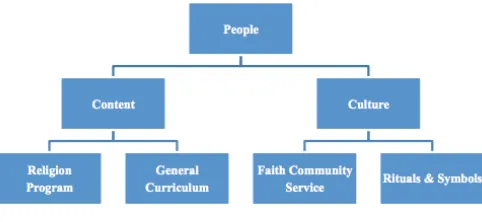
Figure 1. Framework for the renewal of Catholic schools. ... 20
Figure 2. Tri-party relationship ... 20
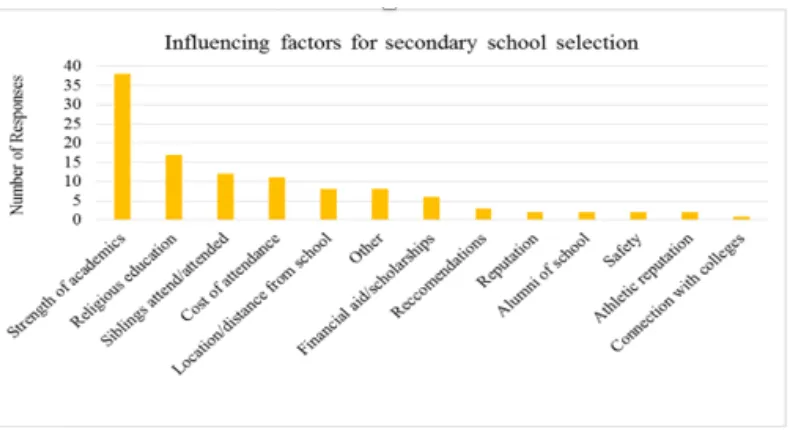
Figure 3. Influencing factors for secondary school selection. ... 42
Figure 4. Reasons for sending children and teenagers to Catholic schools. ... 43
xi
LIST OF TABLES
Table 1. Catholic Primary and Secondary School Statistics ... 9
Table 2. Comparison of Private School and Public School ... 15
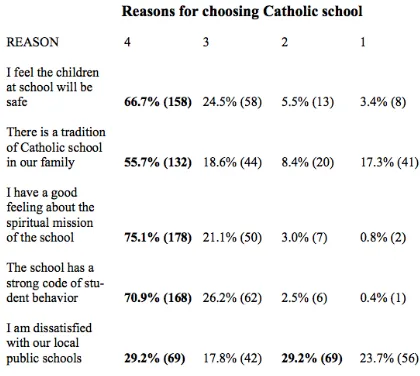
Table 3. Reasons for Choosing Catholic School ... 44
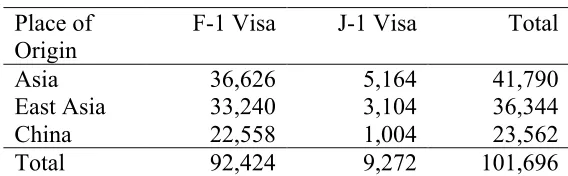
Table 4. Place of Origin and Type ... 52
Table 5. Miller’s (2006) Five Characteristics of Catholic Identity ... 92
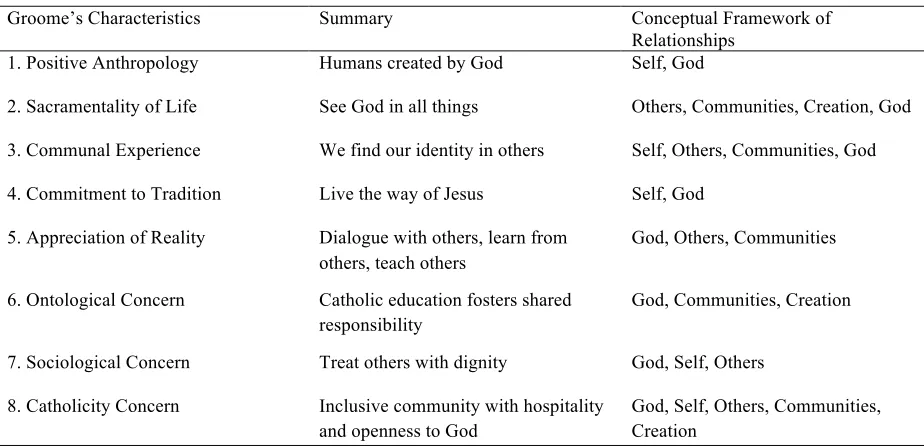
Table 6. Groome’s (1996) Eight Characteristics of Catholic Identity ... 80
Table 7. O’Connell’s (2012) Five Characteristics of Catholic Identity ... 84
Table 8. Five Themes of Catholic Education ... 88
Table 9. Names of 50 Catholic Secondary Schools Asked to Participate & Their Response ... 98
Table 10.Student Demographic Characteristics ... 110
Table 11.Administrator/Faculty Demographic Characteristics ... 112
Table 12.Reliability Coefficients for Defining Characteristics (Students) ... 114
Table 13.Descriptive Statistics for Defining Characteristics (Students) ... 115
Table 14.Defining Characteristics by International Student Status (Students) ... 115
Table 15.Reliability Coefficients for Defining Characteristics (Administrators/Faculty) ... 117
Table 16.Descriptive Statistics for Defining Characteristics (Administrators/Faculty) . 117 Table 17.Defining Characteristics by Years in Education (Administrators/Faculty) ... 118
Table 18.Defining Characteristics by Knowledge of National Standards and Benchmarks (Administrators/Faculty) ... 119
xii
Table 20.Descriptive Statistics for Effectiveness (Students) ... 120
Table 21.Effectiveness by International Student Status (Students) ... 121
Table 22.Reliability Coefficients for Effectiveness (Administrators/Faculty) ... 122
Table 23.Descriptive Statistics for Effectiveness (Administrators/Faculty) ... 122
Table 24.Effectiveness by Years in Education (Administrators/Faculty) ... 123
CHAPTER I
THE RESEARCH PROBLEM
Statement of the Problem
On September 13, 2010, America Magazine published The Catholic Schools We Need, an
article written by Timothy Cardinal Dolan, Archbishop of New York. In his article, Dolan
posted a straightforward but thought-provoking question: “Are we not facing [a] crisis of closure
for the Catholic school in America?” (para. 3). Dolan cited:
Statistics from the National Catholic Educational Association tell a sobering tale about
Catholic schools in the United States. From a student enrollment in the mid-1960s
of more than 5.2 million in nearly 13,000 elementary and secondary Catholic schools
across America, there are now only half as many, with just 7,000 schools and 2.1 million
students enrolled. (para. 4)
A closer look at the statistics shows that in 1965 there were 4,431,000 students enrolled
in 10,667 Catholic elementary schools and 689,264 students in 1,527 secondary schools. By
2016, the enrollment decreased to 1,340,000 students in 4,119 primary schools and 578,477 high
school students in 1,212 secondary schools (Center for the Applied Research in the Apostolate,
2016). Despite the fact that decreases in enrollments in Catholic schools, the population of
baptized Catholics in the United States grew from 45 million in 1965 to almost 81.6 million in
2015 (McGill, 2015). To put this into perspective:
When Catholic schools educated 12 percent of all schoolchildren in the United States,
Catholics still make up about one-quarter of the American population, but their schools
enroll less than 5 percent of all students. (Meyer, 2007, para. 7)
Catholic school closures continue to have many parents concerned about their children’s
future in Catholic schools. For example, in the first 45 days of 2018, the Archdiocese of Chicago
announced five elementary schools would close at the end of the 2018 academic year (Runge,
2018). The response of parents whose students were affected said: “they were upset and had
some very pointed questions for the Archdiocese” (Runge, 2018, para. 2). This same concern
and disappointment was witnessed in parents whose children’s Catholic schools would also close
at the end of the academic year: St. Pancras Catholic School in Brooklyn (Pozarycki, 2018), St.
Anthony in Kalihi, Hawaii (Mendoza, 2018), and the entire Memphis Jubilee Catholic School
System which affects over 1500 students from kindergarten through 12th grade (Sadowski,
2018).
While parents fret over their children’s Catholic education, members of the United States
Conference of Catholic Bishops convened on January 17 and 18 of 2018 with educators and
members of Catholic education organizations to address concerns affecting Catholic primary and
secondary schools.
The bishops and the educators focused on four trends during the meeting: (1) The
changing relationship across Catholic school leadership including those between bishop
and pastors, pastors and principals, and principals and teachers; (2) The evolving
landscape of Catholic school governance as more advisory boards of lay leaders take
shape; (3) Expanding access to Catholic schools through educational choice; (4) Charter
tuition costs and changes in the practice of the faith, all of which influence whether
parents decide to enroll their children in Catholic schools. (Sadowski, 2018a, para. 8)
Although the Catholic school closures noted above affect primary schools, Catholic
secondary schools can be affected by these school closures because primary schools naturally
feed into the secondary schools. As Bishops, Catholic educators, and Catholic educational
associations labor to determine a cure to prevent further closures, one marketing strategy many
Catholic secondary schools are employing is selling the benefits of Catholic education to
families of non-Catholic and international students. The USA Today reported in April 2013 that:
Catholic school administrators are working to combat these trends through aggressive
marketing efforts and educational improvements, such as offering the Apple TV,
individual iPads and smart boards. They're also reinforcing the idea that a Catholic school
education is superior to that available at another private or public facility, says Kevin
Baxter, elementary schools' superintendent for the Archdiocese of Los Angeles. (Bath,
2013, para.7)
This study examined the problem of preserving Catholic identity in Catholic secondary
schools that enroll non-Catholic and international students. Researching for this study revealed
there was limited academic research available on non-Catholic students, but there was no
research conducted on international students. It is precisely because there is no research on the
experiences of international students in Catholic secondary schools that this study directs its
attention. Specifically, the focus of research is directed on Catholic identity: what Catholic
identity is; how one measures the level of Catholic identity in a secondary school; how one
instills Catholic identity in a secondary school and the impact on Catholic identity by
The researcher has defined Catholic identity as encompassing two complimenting
components: those that are visible and invisible. The visible elements are items such as
crucifixes, statues, icons, a chapel, Catholic literary works, and if a school is fortunate enough to
have the presence of a religious women (nun) or man (priest or brother) walking the halls of the
campus.
As powerful as these visible items associate with Catholicism, perhaps the most
significant contributing factor on Catholic identity comes from what cannot be seen and resides
in the spiritual nature of the school: watching adults on campus interact with colleagues,
superiors, students, and staff as loving, caring, compassionate people, who take great pride living
by the Golden Rule. There are many examples of how Catholic identity is experienced in a
Catholic school: it is witnessed when a faculty member of the science department expresses as
much joy in teaching students how to pray as explaining how religion and science can coexist; it
is an English teacher who proudly introduces his or her students to notable Christian and
Catholic authors such as T.S. Eliott, the poet, and the author, G.K. Chesterton. A strong Catholic
identity can be experienced witnessing how students treat themselves, their classmates, and the
adults on campus. Catholic identity can be experienced emotionally by witnessing reverence
during a school-wide celebration of a student-led prayer service, or attending and participating in
retreats coordinated by a school’s Campus Ministry department but led by upperclassmen, or felt
merely by finding joy working alongside a classmate in a service project for people less
fortunate.
The National Standards and Benchmarks provide a definition of Catholic identity that
encapsulates the above description of visible and non-visible attributes for effective Catholic
having “The particular expression of the Catholic heritage, the practices of the Catholic
community, the living of the Gospel message, and the information and relationships that sustain
the school’s activities” (Ozar & Weitzel-O’Neill, 2012.).
An essential element of Catholic identity is Catholic culture. The NSBECS explains that
all experiences, both academic and extracurricular, are to be rooted in Jesus Christ. Over time,
as a school cultivates its Catholic identity, it establishes traditions which are passed down from
generation to generation (Ozar & Weitzel-O’Neill, 2012). The NSBECS goes on to define an
effective Catholic school as one that encompasses nine distinct characteristics which:
Flow directly from the Holy See’s teaching of Catholic schools as compiled by
Archbishop J. Michael Miller, CSB (The Holy See’s Teaching on Catholic
Schools, 2006), and from statements by Pope Benedict XVI and the American
bishops. The characteristics define the deep Catholic identity of Catholic schools
and serve as the platform on which the standards and benchmarks rest. The
defining characteristics authenticate the standards and benchmarks, justifying
their existence and providing their meaning. (Ozar & Weitzel-O’Neill, 2012, p.
VI)
The nine characteristics are:
(1) Centered in the Person of Jesus Christ, (2) Contributing to the Evangelizing
Mission of the Church, (3) Distinguished by Excellence, (4) Committed to Educate the
Whole Child, (5) Steeped in a Catholic Worldview, (6) Sustained by Gospel Witness, (7)
Shaped by Communion and Community, (8) Accessible to All Students, and (9)
Established by the Expressed Authority of the Bishop. (Ozar & Weitzel-O’Neill, 2012,
The first characteristic compels Catholic school administrators to focus their attention on
the teachings and values of Jesus Christ as noted in the Gospels. All administrative decisions
concerning the school’s day to day operations and interactions with others should be based on
Jesus’ teachings. In other words, no decision should ever be made without considering what
Jesus would do in a similar situation.
The second characteristic reminds administrators that a Catholic school is the best
environment to teach the mission of the Catholic Church which is evangelization. As Pope Saint
John Paul II wrote, “Catholic education is above all a question of communicating Christ, of
helping to form Christ in the lives of others” (John Paul II, 1979). “If Catholic schools are not
imbuing a Catholic worldview and communicating Christ to their students, they fail to look
much different than their private and public-school counterparts” (Warner, 2014). This unique
Catholic identity makes Catholic elementary and secondary schools “schools for the human
person” (Miller, 2006, para. 14) and allows them to fill a critical role in the future life of the
Church.
Academic excellence is the third characteristic of Catholic identity in effective Catholic
schools. Consistent with the other defining characteristics, Catholic schools should implement
on-going processes and structures and gather evidence to ensure excellence in all aspect of all its
programs, school life, and activities (Gravissimum Educationis 8 and 9; Code of Canon Law,
Canon 806 #2).
The fourth distinguishing feature of effective Catholic education is one that educates the
whole child: body, mind, and soul. Catholic education is rooted in the conviction that human
beings have a transcendent destiny and that education for the whole person must form the
each child. Catholic schools should develop and implement academic, co-curricular,
faith-formation, and service/ministry programs to educate the whole child in all these dimensions (The
Catholic School, 29).
The fifth characteristic understands that Catholic schools are part of a global community.
Students should be educated to not only be productive citizens when they graduate but to assume
their role as a citizen in the greater community. Catholic education aims at the integral
formation of the human person, which includes “preparation for professional life, formation of
ethical and social awareness, developing awareness of the transcendental and religious
education” (The Catholic School, 31).
The sixth defining characteristic states that Catholic schools are nourished by Gospel
values. It is the values, principles, and teachings of Christ that spiritually feed the person in the
school to become a better and more caring person. Critical to this sixth characteristic is ensuring
that all Catholic educators understand their role as modeling a life committed to the mission of
the Catholic Church and its teachings (Benedict XVI, June, 2005; Miller, 53).
The seventh characteristic describes Catholic schools as inclusive communities whereby
every person, regardless of their faith beliefs, is seen to be created in the image of God, and as
such, is deserving of Catholic education. An effective Catholic school education places
emphasis on the school being a community—an educational community of persons and a
genuine community of faith (Lay Catholics in Schools, 41, 22).
The eighth defining characteristic is a Catholic school’s accessibility to all students.
Because of their evangelizing mission, Catholic schools should be available to all people who
desire a Catholic school education for their children regardless of their backgrounds and faith
possible. (Gravissimum Educationis, 6; Code of Canon Law, Canons 793 #2; Renewing Our
Commitment to Catholic Elementary and Secondary Schools in the Third Millennium,
Introduction).
Lastly, the ninth characteristic of Catholic schools is the support of the local bishop. It is
vitally important that administrators have a trusting relationship with their Bishop and with
diocesan officials. Catholic schools should have a formal and defined relationship with their
Bishop, guided by a spirituality of ecclesial communion, marked by mutual trust, close
cooperation, continuing dialogue, and respect for the Bishop’s legitimate authority (Code of
Canon Law, Canon 803 #1 and #3; Miller, 33).
Understanding what Catholic identity is and how it is lived out in a Catholic primary and
secondary school in an effective way was the task placed before a group of educators from
Loyola University Chicago, School of Education, the Center for Catholic School Effectiveness;
and the Barbara and Patrick Roche Center for Catholic Education, Lynch School of Education,
Boston College, with support from the National Catholic Education Association (NCEA). The
result of their research and study was the creation of the National Standards and Benchmarks for
Effective Catholic Elementary and Secondary Schools (NSBECS).
Background and Need for Study
. As the enrollment of non-Catholic and international students increases in Catholic
secondary schools, there is a strong need to understand the effect these student groups have on
the Catholic identity of their schools. It is essential for administrators to understand the
perceptions of their non-Catholic and international students’ experiences in their Catholic
secondary schools, and specifically, their opinions of what Catholic identity means to them. Any
risk of being criticized for being Catholic in name only. With growing competition from private
secular schools, charter schools, public schools, and students being homeschooled, this study
provides administrators with historical and contemporary documents, and most importantly, with
data that support the need for maintaining and heightening the level of Catholic identity in
Catholic secondary schools.
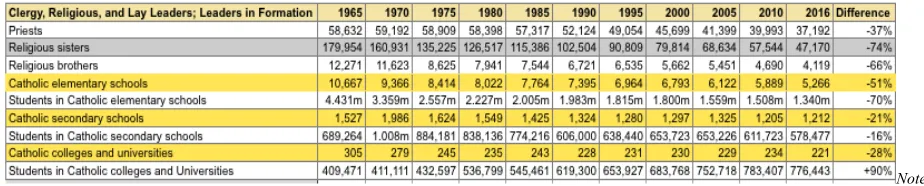
As previously noted, statistics indicate that the number of students in U.S. Catholic
elementary and secondary schools has been decreasing since 1965. The data listed in Table 1,
compiled by the Center for Applied Research in the Apostolate (2017), confirmed three essential
facts: (1) In 1965, 4,431,000 students enrolled in 10,667 Catholic elementary schools; (2) in the
51-year period from 1965 to 2016 the number of Catholic elementary schools decreased by 50%
resulting in a loss of 70% of Catholic elementary students; and (3) secondary schools also
experienced a decline in numbers. Data indicates from 1965 to 2016, 315 Catholic secondary
schools closed resulting in a loss of 110,000 students.
Table 1
Catholic Primary and Secondary School Statistics
Note. Data taken from the Center for Applied Research in the Apostolate, 2017.
As previously noted, the trend of Catholic schools either closing or merging continued
into early 2018. When examining the research for this study, many of the documents pointed to
the high costs of tuition as one of the primary concerns for parents when considering to send
religious men and women as educators and administrators in Catholic schools as the main reason
for tuition increases. For example, in the 2011 article “The State of Catholic Schools in the US”
it states:
Costs have risen largely because of the collapse of vocations to the religious life
in the United States; the number of women religious (in previous decades the
primary educators in Catholic schools) declined from 179,954 in 1965 to 57,544
in 2010. Today, only 2.6 percent of teachers in Catholic schools are nuns, 0.1
percent are brothers, and 0.3 percent are clergy, according to the [National
Catholic Educational Association] NCEA; 84 percent are laywomen, and 13
percent are laymen.
Catholic schools have thus experienced a transition “from a basically free
workforce in the persons of religious priests, brothers, and women (supported by
religious communities) to one comprised predominantly of the laity, who rightly
must receive a just wage and benefits,” says George Henry, superintendent of
Catholic education for the Archdiocese of St. Louis. (Ziegler, 2011, Section
"Other challenges," para. 2–3)
As correct as the statistics above are, Catholic schools have had several years to address
and resolve their financial concerns. Many Catholic secondary schools have responded by
placing more considerable attention to their fundraising practices and applying for grants.
One viable solution for Catholic secondary school administrators has been to market and
sell their Catholic high schools to non-Catholic families and to families of students who live
overseas. Non-Catholic students certainly help increase Catholic secondary school enrollments,
families of international students can “pay more than five times as much as local students.”
(Spencer, 2014, para. 4) Catholic secondary schools are allocating a lot of resources to attract
international students, especially those students from affluent families in China.
American parochial schools from Westchester County to Washington State are
becoming magnets for the offspring of Chinese real estate tycoons, energy executives and
government officials. The schools are aggressively recruiting them, flying admissions
officers to China, hiring agencies to produce glossy brochures in Chinese, and putting up
web pages with eye-catching photos of blond, tousled-haired students gamboling around
with their beaming Chinese classmates. (Spencer, 2014, para. 3)
Although there are many advantages to having non-Catholic and international students,
there is a concern that Catholic secondary school administrators are placing less emphasis on
maintaining a high level of “Catholic identity” in their schools.
Attracting families by reaching for secular standards and embracing the goals, methods,
curricula and even textbooks of public education can be damaging to Catholic schools.
Ultimately, it fills schools with students who don’t value what we value. The same can be
said for attracting donors by the same methods.” (Reilly, 2016, para. 10)
Some Catholic school administrators have said that by not identifying so closely with
Catholicism, a Catholic high school will be able to attract intelligent, athletic, artistic,
non-Catholic and international students who will promote the school with their accomplishments in
the classroom, on the athletic field, and in the auditorium. Dan Guernsey, director of K–12
programming for the Cardinal Newman Society, stated that “Often, Catholic schools will
down-sell their Catholic identity so as not to have customers go away” (Bateman, 2017, Section
identity, downplaying Catholic identity is not an option for Fr. Karl Kiser, S.J., president of the
University of Detroit-Jesuit High School, who sees the benefit of enrolling non-Catholic
students: “The most common result is non-Catholic students gaining a greater appreciation of the
Catholic faith and a greater sense of the Catholic identity” (Meloy, 2015, para. 11). Fr. Dennis
Noelke, a member of the Basilian order and principal at Novi Detroit Catholic Central High
School, concurred with the sentiment of Fr. Kiser, stating:
Non-Catholic students are an integral part of the school’s community and the
expression of other faiths in the halls of Catholic Central serves to strengthen the
faith of Catholic students.
Our Catholic students have a lot to learn from our non-Catholic students,
especially from those who are active in their faith while at Catholic Central.
Seeing a Muslim or Jewish student express and support their beliefs with their
words and actions can be an inspiration for our Catholic students. Alternatively, it
allows our Catholic students to show our non-Catholic students what it means to
be a Catholic man. (Meloy, 2015, para. 12–13)
The main point here is if a Catholic secondary school sincerely wishes to be Catholic,
then its Catholic identity and the charisms of the school must be defined and visible to all
individuals on the school campus. To illustrate the importance of maintaining a strong Catholic
identity, Cook and Simonds (2011) wrote:
What is the charism of Catholic school education today? What is its distinctive
purpose and unique gift to the Church and society? Catholic school leaders and
relevant and a worthy investment in today’s competitive educational arena where
choices are increasing but financial resources are not. (p. 319)
Although numerous studies have been conducted on non-Catholic students and their
experiences in Catholic secondary schools, this study is the first to research the experiences of
international students in Catholic secondary schools and their impact on their secondary schools’
Catholic identity. Evaluating these two groups of students’ perceptions is crucial to Catholic
education leaders because Catholic Church documents state that non-Catholic and international
students have every right to attend a Catholic secondary school.
Pope Paul VI, who proclaimed Gravissimum Educationis placed great responsibility on
Church officials to carry out the mission of Catholic education when he said, “The influence of
the Church in the field of education is shown in a special manner by the Catholic school”
(Vatican Council II, 1965, Section "8. Catholic Schools," para. 1). Most importantly,
Gravissimum Educationis states:
The Church considers very dear to her heart those Catholic schools…which are
attended also by students who are not Catholics…This Sacred Council of the Church
earnestly entreats pastors and all the faithful to spare no sacrifice in helping Catholic
schools fulfil this function…especially in caring for the needs of those…who are
strangers to the gift of faith. (para. 9)
This reassurance to non-Catholic students was followed by the Congregation for Catholic
Education’s 1977 document The Catholic school which states:
The Catholic school offers itself to all, non-Christians included, with all its distinctive
qualities, the social and cultural values, which characterize different civilizations. (para.
85)
Perhaps the most emphatically written commitment appeared in the 1982
document Lay Catholics in Schools: Witnesses to Faith written by the Congregation for Catholic
Education which states:
Every person has a right to an integral education, an education which responds to all of
the needs of the human person (para. 3)…[and that] At times there are students in
Catholic schools who do not profess the Catholic faith [sic], or perhaps are without any
religious faith at all. Faith does not admit of violence; it is a free response of the human
person to God as He reveals Himself. Therefore, while Catholic educators will teach
doctrine in conformity with their own religious convictions and in accord with the
identity of the school, they must at the same time have the greatest respect for those
students who are not Catholics. They should be open at all times to authentic dialogue,
convinced that in these circumstances the best testimony that they can give of their own
faith is a warm and sincere appreciation for anyone who is honestly seeking God
according to his or her own conscience. (para. 42)
This commitment from the Catholic Church has gained the reward from non-Catholic
students whose enrollment has grown from less than 3% in 1970 (Meyer, 2007) to 17% in 2015
(McDonald & Schultz, 2016).
In today’s educational environment, there are many types of secondary schools for
parents and their children to consider before enrolling their son or daughter into a private,
and other private religious schools that all compete to entice eighth-grade students to attend their
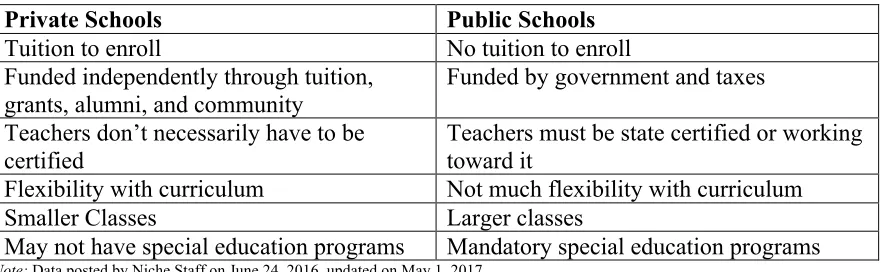
high schools. Below in Table 2 is a chart comparing public and private K-12 schools:
Table 2
Comparison of Private School and Public School
Private Schools Public Schools
Tuition to enroll No tuition to enroll
Funded independently through tuition, grants, alumni, and community
Funded by government and taxes
Teachers don’t necessarily have to be certified
Teachers must be state certified or working toward it
Flexibility with curriculum Not much flexibility with curriculum
Smaller Classes Larger classes
May not have special education programs Mandatory special education programs
Note: Data posted by Niche Staff on June 24, 2016, updated on May 1, 2017
The declining number of enrollments and the ever-increasing number of merged or closed
Catholic primary and secondary schools should be a concern for all Catholics, not just for
(Arch)bishops and Catholic school officials. The research noted in the review of literature in
Chapter Two confirmed that many baptized Catholic families are not enrolling their sons and
daughters in Catholic schools. There is one factor, however, which defines a Catholic school and
differentiates it from all other types of educational institutions and that is its level of Catholic
identity.
Purpose of the Study
The purpose of this study was to explore how a Catholic secondary school preserves its
Catholic identity and the impact on its Catholic identity by admitting non-Catholic and
international students. Although limited research has been conducted on the overall experience
of non-Catholic students in Catholic secondary schools, no research has been conducted on
international students’ perceptions of Catholic identity in their Catholic secondary schools. As a
result of being the first study to investigate the international students’ perceptions of Catholic
(1) To what extent do non-Catholic and international students perceive a Catholic
identity at their secondary school?
(2) To what extent do school administrators and faculty perceive a Catholic identity at
their secondary school?
(3) To what extent do non-Catholic and international students perceive their secondary
schools as effective?
(4) To what extent do school administrators and faculty perceive their secondary schools
as effective?
Additionally, this study served three additional purposes: (1) it provided a definition and
foundational information on Catholic identity which all Catholic secondary school administrators
must ensure is present in their schools; (2) it reiterated the importance of the National Standards
and Benchmarks for Effective Catholic Elementary and Secondary Schools (NSBECS) which
measures a secondary school’s level of Catholic identity and its program effectiveness; and (3)
for the first time data was conducted and the results were provided on the perceptions of
international students on Catholic identity in their secondary schools.
Theoretical Framework
In 2010, the first phase of Common Core State Standards (Common Core) was unveiled
to public school officials and administrators. The Common Core Standards were to provide “a
clear and consistent framework of what American students were expected to learn to prepare
them for college and the workforce” (Gogniat Eidemiller, 2013, para. 1).
The Common Core Standards was “developed by the National Governors Association
Best Practices and Council of Chief State Officers, and adopted by 46 states. While Catholic
As the Common Core curriculum was eventually rolled out into certain Catholic schools,
Catholic school administrators and educators voiced their concern that their Catholic schools
were becoming more secular, more of a public school because Catholic school administrators
appeared to emphasize on the Common Core Curriculum and not on its Catholic identity.
Eventually, a concern grew from a group of select members of the National Catholic Education
Association (NCEA) who formed a task force to study Catholic identity in primary and
secondary schools and how these schools could blend Common Core Standards into a Catholic
curriculum. The task force was led by Dr. Lorraine Ozar with members of the NCEA, Loyola
University Chicago, School of Education, the Center for Catholic School Effectiveness, with
members from the Barbara and Patrick Roche Center for Catholic Education, Lynch School of
Education, Boston College. The result of the task force’s research efforts led to the creation of
The National Standards and Benchmarks for Effective Catholic Elementary and Secondary
Schools (NSBECS). The NSBECS were used as the theoretical framework for this study. The
NSBECS were created to:
Describe how the most mission-driven, program effective, well managed, and
responsibly governed Catholic schools operate. They are offered as school
effectiveness standards rather than curriculum content standards, although they
support curriculum development consistent with national standards and the
Common Core State Standards. (Ozar & Weitzel-O’Neill, 2012, p. VI)
The NSBECS is comprised of three components: (1) nine defining characteristics; (2) 13
standards, and (3) 70 benchmarks:
There are nine defining characteristics centered on Jesus Christ, sustained by the
Another 13 standards describe policy, governance and leadership, and schools can
use the 70 benchmarks to self-assess their current level of implementation in the four
domains: Mission and Catholic Identity, Governance and Leadership, Academic
Excellence and Operational Vitality. (Gogniat Eidemiller, 2013, para. 8)
The nine characteristics define Catholic identity of Catholic schools and serve as the
platform on which the standards and benchmarks rest.
The Defining Characteristics authenticate the standards and benchmarks,
justifying their existence and providing their meaning…The Standards address
four domains: Mission and Catholic Identity, Governance and Leadership,
Academic Excellence, and Operational Vitality…The Benchmarks provide
observable, measurable descriptors for each standard. (Ozar & Weitzel-O’Neill,
2012, p. VI)
By using the NSBECS, Catholic school administrators have the opportunity to develop a
Catholic school that is “mission-driven, program effective, well managed, and responsibly
governed” (USCCB, 1972, p. VI). As previously noted, the NSBECS include two surveys, one
measuring “Defining Characteristics,” the other measuring “Program Effectiveness,” each
customized for four types of demographics: faculty, parents, students in grades 6 through 8, and
students in grades 9 through 12 (Appendix C). For this study, the two surveys were combined
into one survey and distributed to the following two groups: a select group of non-Catholic and
international students in grades 9 through 12, and a select group of administrators and faculty.
(Appendix D). The standards (Appendix E), and benchmarks, which is a list of rubrics
(Appendix F) were used to measuring the level of “Defining Characteristics” and “Program
Conceptual Framework
As noted above, the theoretical framework implemented for this study was the NSBECS
which provided an appropriate tool for defining and measuring Catholic identity. The conceptual
framework of relationships was added to complement the theoretical framework by providing
this study with one additional tool to help administrators maintain Catholic identity.
Designed by Timothy Cook and Thomas Simonds (2011), the idea for their conceptual
framework of relationships was based on the fact that although Catholic Church documents
provide common themes and characteristics of Catholic education, most Church documents lack
“an organizing principle or thread that captures the essence of Catholic school education in a
manageable and memorable way” (p. 321).
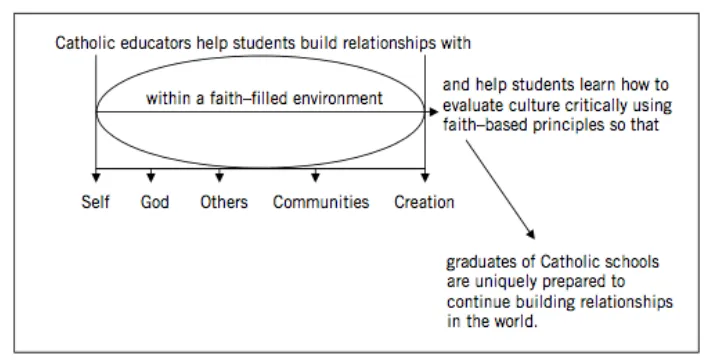
The conceptual framework of relationships builds a philosophy of relations. There are
three phases to Cook and Simonds’ (2011) framework noted in Figure 1. Although these stages
can be discussed separately, they must all work in unison to be effective. The first phase calls for
school administrators and faculty to teach students how to build relationships with “self, God,
others, local and world communities, and creation, within a faith-filled environment” (Cook &
Simonds, 2011, p. 324). Phase two “helps students learn how to evaluate culture critically using
faith-based principles” (p. 324). This second phase is important because critical thinking discerns
“what is good and what is evil; what is true and what is false; what is beautiful and what is not.”
(p. 329). Phase three is lived out after graduation, a time when “graduates of Catholic schools are
Note. Adapted from Cook & Simonds, 2011.
Figure 1. Framework for the renewal of Catholic schools.
The conceptual framework of relationships illustrated in Figure 1 shows how Catholic
secondary schools distinguish themselves from other schools by educating students how to
evaluate culture critically by using faith-based principles so that they will be prepared to build
relationships in the world. The use of religious tenets is the distinguishing factor.
Figure 2 illustrates how the conceptual framework of relationships comprises an
interrelationship model between student, teacher, and administrator.
Figure 2. Tri-party relationship
Just as the conceptual framework includes relationships as the single organizing
principle, the tri-party relationship in Figure 2 provides the added thread of support necessary to
bind the members with each other.
Administrator Teacher
Faith-Filled Environment
This conceptual framework of relationships will also help the process of educating,
forming, and ultimately transforming students from teenagers into young adults who are
conscientious, caring citizens. Teachers will become more valuable because they will learn how
to incorporate faith into teaching their secular subjects such as science, math, and languages.
Students will become graduates who will “change the world by building relationships instead of
fences” (Cook & Simonds, 2011, p. 330). Effectively using the conceptual framework of
relationships will also encourage Catholic secondary school administrators to rethink the context
of the curriculum as well as provide professional development programs that will teach and
support faculty and staff how to incorporate components of Catholic identity into their classroom
instruction, service opportunities, and retreats. This framework of relationships will guide
administrators who hire faculty and staff members. Perhaps most importantly, the conceptual
framework of relationships will ultimately improve the overall graduate student learning
outcomes. Graduates of secondary schools who use the concepts and skills learned from the
conceptual framework of relationships will have an advantage over other students in the future
because these students will look for opportunities to create dialogue and find common ground
with people of different cultures, religions, political parties, or families of lower socioeconomic
status. This type of attitude and behavior identifies well as Catholic identity.
To illustrate how the theoretical framework of the NSBECS compliment the conceptual
framework of relationships and vice versa, one needs only to look at the historic yet
contemporary document To Teach as Jesus Did, written in 1972 by the USCCB. In this book, the
bishops emphasize the importance of relationships regarding community:
Education is one of the most important ways by which the Church fulfills its
Community is central to educational ministry both as a necessary condition and an
ardently desire goal. The educational efforts of the Church must therefore be
directed to forming persons–in–community; for the education of the individual
Christian is important not only to his solitary destiny but also to the destinies of
the many communities in which he lives.
The educational mission of the Church is an integrated ministry embracing
three interlocking dimensions: the message revealed by God (didache) which the
Church proclaims; fellowship in the life of the Holy Spirit (koinonia); service to
the Christian community and the entire human community (diakonia). (USCCB,
1972, para. 13–14)
A community can only be established when genuine, trusting relationships exist, and as
Cook and Simonds added, “A school is authentically Catholic when it fosters relationships that
are both human and divine” (2011, p. 323). These authors went on to report, “Catholic educators
who embrace the concept of relationship building as the organizing principle for their schools
will embark on a process of educational change” (2011, p. 323), and it will be this theory of
relationship that distinguishes a Catholic secondary school from public, charter, and private
secular schools.
In addition to the NSBECS, in Figure 3, Simonds and Cook provide questions to help
Catholic educators assess their schools’ level of relationships:
Regularly assess whether or not they are providing a unique educational experience
that will enable students to evaluate the world critically and seek to build relationships.
Figure 3 is provided as a means to help educators engage in this assessment process.
Application of the Conceptual Framework of Relationships in Catholic Schools
Implementing the Framework
• Do you recruit staff, administrators, and teachers by telling them about the religious purpose of
your school and asking how they can participate in faith formation with students?
• What opportunities does your school provide to employees to help them learn how to enter into the faith-formation process with students?
Healthy Relationships with Self and God • Describe opportunities students have to gain self-knowledge.
• Describe how students learn about world religions.
• Ask students to describe how a teacher at school helped them learn about one of their gifts. • Ask students to describe a time at school in the last week when they received positive support from a teacher.
• Ask students to describe how a teacher helped them experience Jesus.
• Ask students to describe their gifts and how they feel called to serve others by using these gifts.
Healthy Relationships with Others
• Are healthy relationships being built in your school? Explore how much fighting and bullying is taking place at your school.
• Ask students to list areas of strength and areas of growth in relationship building at school. • Ask students to describe how they feel about people with religious beliefs different from their own.
Healthy Relationships with Local and World Communities • Describe service opportunities available to students at your school.
• Describe how students learn about world cultures at your school.
• Ask students to describe the Catholic beliefs that would motivate a Catholic person to help those in need.
Healthy Relationships with Creation
• Describe the lesson plan activities across disciplines that teach students to be good stewards of God’s creation.
• Ask students to describe how they learned to care more about the environment through an activity, class, or project at school.
• Ask students to describe the teachings of the Catholic faith that support care for the environment.
The Synthesis of Culture and Faith
• Consider holding a faculty discussion to explore how the teachings of the Catholic Church are integrated across all disciplines and programs.
• Describe opportunities students have to synthesize their learning by drawing from multiple disciplines and experiences.
• Describe the instructional activities your school uses to help students critically evaluate culture using faith-based principles.
Research Questions
The following are four research questions which guided this study:
(5) To what extent do non-Catholic and international students perceive a Catholic
identity at their secondary school?
(6) To what extent do school administrators and faculty perceive a Catholic identity at
their secondary school?
(7) To what extent do non-Catholic and international students perceive their secondary
schools as effective?
(8) To what extent do school administrators and faculty perceive their secondary schools
as effective?
Significance of the Study
This study was significant for several reasons, but most importantly it opened the door
for further research on international students in Catholic secondary schools. Other important
factors include a preliminary list of documents written about the growing trend of international
students coming to the United States for their secondary education. This study provided an
initial set of data on the impact of Catholic identity by non-Catholic and international students.
Two other significant contributions this study presented pertains to the importance of utilizing
the theoretical framework of the National Standards and Benchmarks for Effective Catholic
Schools (NSBECS) and the conceptual framework of relationships. The NSBECS is an
instrument created by educators to help Catholic school administrators create, monitor, and
maintain a strong Catholic identity and Catholic culture. The conceptual framework of
relationships is a program designed to help students develop a healthy relationship with self,
Definition of Terms
The following terms have been operationalized for this study:
Archbishop: The title given automatically to bishops who govern archdioceses.
Archdiocese: The chief diocese of an ecclesiastical province.
Bull: A pope’s official, formal decree establishing a religious order, clarifying a doctrine, ratifying other documents, founding a university, convoking a general council, declaring a
jubilee, or making a similar statement.
Catholic identity: “The particular expression of the Catholic heritage, the practices of the
Catholic community, the living of the Gospel message, and the information and relationships that
sustain the school’s activities,” (Ozar & Weitzel-O’Neill, 2012).
Church: The Catechism of the Catholic Church (CCC) defines “Church” as:
The name given the ‘convocation’ or ‘assembly’ of the People God has called
together from “the ends of the earth.” (751) In Christian usage, the word
“Church” has three inseparable meanings: People that God gathers in the whole
world; the particular or local church (diocese); and the liturgical (above all
Eucharistic) assembly. The Church draws her life from the Word and the Body of
Christ, and so herself becomes Christ’s Body (752). In the Creed, the sole Church
of Christ is professed to be one, holy, catholic, and apostolic (750).
Code of Cannon Law: The codified body of general laws governing the Church.
Charisms: The faith-based core values, those values that make the institutions “distinctive and cohesive” (Cook, 2004).
Dicasteries: Departments of the Roman Curia.
Effective Catholic School: a school that encompasses the following nine distinct characteristics of Catholic schools:
(1) Centered in the Person of Jesus Christ, (2) Contributing to the Evangelizing Mission
of the Church, (3) Distinguished by Excellence, (4) Committed to Educate the Whole
Child, (5) Steeped in a Catholic Worldview, (6) Sustained by Gospel Witness, (7) Shaped
by Communion and Community, (8) Accessible to All Students, and (9) Established by
the Expressed Authority of the Bishop (Ozar & Weitzel-O’Neill, 2012, pp. 1–3).
Evangelize: To preach but not necessarily convert someone.
F1 and J1 Visas: “A student is eligible for an F1 Visa if they are funded by personnel sources, outside sources OR a combination of the two. The difference between an F1 and a J1 student visa
in terms of funding is that a J1 visa requires a large or ‘substantive’ portion of the funding to
come from an outside source, such as a university or the government” (KBB Law firm, 2017,
Section “Funding,” para. 1).
Holy See: “The Holy See is the universal government of the Catholic Church and operates from Vatican City State, a sovereign, independent territory. The Pope is the ruler of both Vatican City
State and the Holy See”(Bureau of Public Affairs, 2016, Section “U.S.-Holy See Relations,”
para. 1).
Original Sin: Original sin may be taken to mean: (1) the sin that Adam committed; and (2) a consequence of this first sin, the hereditary stain with which we are born on account of our origin
or descent from Adam. From the earliest times, the latter sense of the word was more common,
as may be seen by St. Augustine's statement: “[T]he deliberate sin of the first man is the cause of
original sin” (Harent, 1911, Section “Nature of original sin,” para. 3).
Sacred Congregation for Catholic Education (SCCE): Pontifical department of the Catholic Church that ensures the authenticity of the Catholic Church’s educational institutions and
publications.
United States Catholic Conference of Bishops (USCCB) (Formerly known as the United Conference of Catholic Bishops (UCCB)): Civil corporation and executive agency of the National Conference of Catholic Bishops. An association composed of all active and retired
bishops of the United States.
Vatican Councils: Councils called by the pope of all bishops of the Church. These councils are usually called to discuss specific matters of interest to the Church.
Vatican II: A major meeting of the bishops of the world convened by Pope John XXIII to bring about a renewal of the Church for the second half of the 20th century. It ran from 1962 to 1965
and produced important documents in liturgy, ecumenism, communications, and other areas.
Summary
This chapter introduced the reader to this study which examined the topic of Catholic
identity and the perceptions of Catholic identity in Catholic secondary schools by four groups:
administrators, faculty, non-Catholic and international students. With many secondary schools
facing the prospects of closing or merging, some school administrators have resorted to
recruiting and enrolling non-Catholic domestic students and international students. Both groups
of students helped many Catholic secondary schools remain open. Although these student
groups provide much needed financial assistance, the question this study poses is whether or not
these two student groups impact the level of “Catholic identity” in their schools.
This chapter introduced several positive issues. First, it established the commitment of
documents that described the Church’s commitment, including their position of welcoming
students of all faiths and no faith into their schools.
The National Standards and Benchmarks for Effective Catholic Primary and Secondary
Schools (NSBECS) was proposed as the theoretical framework for this study while a conceptual
framework of relationships was presented to assist in teaching students how to develop stronger
relationships with themselves, with their God, with members of their immediate community, and
the community at large, and with creation. Four research questions were established to direct this
CHAPTER II
REVIEW OF THE LITERATURE
Restatement of the Problem
Enrollment in Catholic elementary and secondary schools in the United States has
continuously declined since the conclusion of Second Vatican Council in 1965, and as a result,
bishops continue to merge or close schools (McDonald & Schultz, 2016). In its most recent
report for the academic year 2016–2017, the National Catholic Education Association (NCEA)
reported: “20 new Catholic schools opened and 96 schools closed or consolidated” (United
States Conference of Catholic Bishops [USCCB] Staff, 2017, Section “Other Religious
Education,” bullet 6). According to Tom Burnford, president of the NCEA, “[T]he closures is a
reflection of demographics and geography. Many Catholic schools have closed in poor inner-city
neighborhoods” (Fudge, 2016, para. 2). Catholic school closures have been an on-going concern
as noted in a 2015 article published in The Atlantic:
Confronted with falling birth rates and demographic shifts, rising tuition, the
growth of charter schools, and other challenges, parochial schools are seeing their
enrollments plummet…Catholic schools nationwide have fewer than half as many
students as they did 50 years ago, and the decline has resumed in the last 10 years
after leveling off briefly in the late 1990s, according to the U.S. Department of
Education. (Marcus, 2015, para. 3–4)
Further research confirmed that declining Catholic school enrollments are not
isolated to one area of the country. For example, in Massachusetts:
Enrollment in Boston Archdiocese schools has dropped 21 percent in a decade,
closed 58 schools. By 2016, enrollment was down to about 38,000…The primary
cause in the decline are the tuition hikes impossible to avoid because of the
changing status of teachers in Catholic schools. (Connaughton, 2017, para. 3, 7)
A similar situation occurred in the ten-year period from 2000 to 2010 in the
Archdiocese of Chicago, which “has seen 31% of its students leave; the Archdiocese of
New York and the Diocese of Brooklyn have lost 26% and 33% of their students,
respectively” (Smarick, 2011, Section “Road to Perdition,” para. 13). Catholic News
Service posted an article on January 30, 2017, stating:
A small city located 90 miles east of Houston, Port Arthur was once a thriving city thanks
to the local oil refinery, but economic changes have left the area with an unemployment
rate more than twice the national average. As jobs left the city, so did families, and with
them went Catholic school students. There used to be 13 Catholic schools in the area, and
now there is only one remaining: St. Catherine of Siena. (Catholic News Service Staff,
2017, para. 1)
Even the affluent San Francisco Bay Area is not exempt from witnessing school closures
as “Five East Bay Catholic elementary schools will close at the end of the academic year as part
of what the Diocese of Oakland called a ‘strengthening’ of religious education” (Lochner, 2017,
para. 1).
Many Catholic parents who were once a part of the thriving urban Catholic school system
have grown discontent witnessing their elementary and secondary schools diminish the level of
the school’s Catholic identity:
As more and more Catholic schools closed, those that remained were changing in
young lay (occasionally non-Catholic) teachers. They educated growing numbers
of non-Catholic students. Grumbling grew that such schools, lacking a strong,
common faith identity, were Catholic in name only. As a result, many Catholic
parents felt there was little to be gained by paying Catholic-school tuition instead
of just sending their children to the local public school. (Smarick, 2011, Section
“Road to Perdition,” para. 9)
The rationale of many families desiring a Catholic education for their children was
simple: Why pay for Catholic education when the school does not project a suitable level
of Catholic identity? Further complicating matters, two Catholic secondary school
markets that continue to grow in enrollment numbers and tuition dollars are non-Catholic
students and international students (Hurley, 2015). This trend of marketing Catholic
secondary schools to non-Catholic and international students benefits Catholic secondary
schools financially, but does admitting non-Catholic and international students pose a
problem by negatively impacting their secondary schools’ level of Catholic identity?
Overview
The literature review for this study is divided into four sections. The first part focused on
the mission of Catholic education and the importance of creating Catholic identity in Catholic
secondary schools. The literature cited in this first section included Catholic Church documents
written during and immediately following the conclusion of Vatican II in 1965. The second part
of the literature review centered on the demographic changes in Catholic secondary schools in
the U.S. since the middle 20th century. Documents included studies and articles written by
theologians and lay experts in Catholic education. The third part concentrated on recruiting and