Available online on 15.01.2020 at http://jddtonline.info
Journal of Drug Delivery and Therapeutics
Open Access to Pharmaceutical and Medical Research© 2011-18, publisher and licensee JDDT, This is an Open Access article which permits unrestricted non-commercial use, provided the original work is properly cited
Open Access Research Article
Analytical Method Development and Validation for the Estimation of
Sugammadex
Hemangi Parekh, Parin Chokshi and Rajashree Mashru*
Faculty of Pharmacy, G. H. Patel Building, Donor`s Plaza, The M.S. University of Baroda,Vadodara, 390002, INDIA
ABSTRACT
A simple, precise, accurate, specific RP-HPLC method developed for sugammadex in bulk and simulated mixture. Chromatographic separation is achieved by C18 column (250 x 4.6 mm, 5µ) in isocratic mode. The optimized mobile phase consists of acetonitrile and double d istilled water in ratio of 20:80%v/v at a flow rate of 0.5mL/min and sugammadex was monitored at 210nm. Retention time of the drug was found to be 3.39min. The linearity obtained in range of 50 – 250 µg/mL. %RSD mean for precision and %Recovery mean of the sugammadex were found to be 0.63 and 99.04% - 99.84% respectively. Stability indicating nature of RP-HPLC method was established by applying the degradation condition. The results indicate that developed RP-HPLC method would be suitable for estimation of drug in presence of degradant product. The above developed method was validated according to ICH guideline.
Keywords: Sugammadex, Assay, Simulated Mixture, Forced Degradation, Validation.
Article Info:Received 29 Nov 2019; Review Completed 22 Dec 2019; Accepted 30 Dec 2019; Available online 15 Jan 2020
Cite this article as:
Parekh H, Chokshi P, Mashru R, Analytical Method Development and Validation for the Estimation of Sugammadex, Journal
of Drug Delivery and Therapeutics. 2020; 10(1):52-59 http://dx.doi.org/10.22270/jddt.v10i1.3842
*Address for Correspondence:
Rajashree Mashru, Faculty of Pharmacy, G. H. Patel Building, Donor`s Plaza, The M.S. University of Baroda, Vadodara, 390002, INDIA
INTRODUCTION
Sugammadex is a selective relaxant binding agent, which is a modified gamma cyclodextrin. The full chemical name of
drug is 6-per-deoxy-6-per-(2-carboxyethyl)
thio-γ-cyclodextrin, sodium salt. Due to its complex structure (as shown in fig 1.1), extreme polarity and good water solubility indicated for reversal of neuromuscular blockade induced by vecuronium bromide and rocuronium bromide during surgery in adults. Vecuronium bromide and rocuronium bromide are neuromuscular blocking medications that cause temporary paralysis and are especially useful for ventilation, general anesthesia, or tracheal intubation that patients may require for surgery. Sugammadex provides a new treatment option to reverse the effects of those medications and possibly help patients recover sooner post-surgery. Sugammadex (Bridion) was approved by the United States FDA on December 15, 2015.[1,2]
This study aimed to validate the developed HPLC method for estimation of sugammadex sodium drug as per the ICH Guideline. Literature review suggest some UHPLC/TMS[3], HPLC/TMS[4], UV[5] spectroscopic method. After doing study in recent research work, it was found that the present research work has some advantages like its isocratic mobile
phase, less run time, simple and economical. While literature review shows gradient mobile phase.
MATERIAL AND METHOD
Sugammadex drug was obtained as a gift sample from Zydus Cadila, Ahemdabad, Gujarat. HPLC grade Acetonitrile was purchase from Astron Chemicals, Ahmedabad. Double Distilled Water was prepared in lab.
Instrumentation:
Shimadzu HPLC System Equipped with UV Detector, UV-VIS Spectrophotometer, pH meter and electronic balance also used in this study.
Chromatographic Condition:
Analytical Technologies Limited C18 column (4.6mm x 250mm, 5µm) used as stationary phase. Acetonitrile and Double distilled water in the ratio of 20:80 (v/v) was used as mobile phase. Flow rate of 0.5 mL/min at Detection wavelength of 210 nm under reverse phase condition by UV detector. Injection volume of 20µL with run time of 10 minutes. Water was used as diluent.
Preparation of Standard stock solution:
Weighed accurately about 10 mg of Sugammadex into 10 mL volumetric flask and make up the volume with water. Further, Dilute 1mL of resulting solution in 10mL of volumetric flask with water.
Preparation of test Stock Solution (Simulated Mixture): Simulated formulation was prepared by accurately weighed 10mg sugammadex and dilute it with water as condition in injection.[7]
Method Validation
The developed analytical method was further subjected to validation in accordance to the current ICH guidelines. The evaluated parameters like system suitability, specificity, linearity, accuracy, precision, accuracy, limit of detection, limit of quantification, ruggedness and robustness.[3-5,8]
Specificity: Specificity is one of the significant feature of
HPLC. It generate signals free from interference. Its capability to measure precisely an analyte in the presence of interferences that may be expected to be present in the sample. Typically these might be degradants, matrix, impurity. Identification tests should be able to differentiate compound of closely related structure which are expected to be present. Purity test ensures that the analytical procedure performed allows an accurate statement of content of the impurity of an analyte. Significance of assay is to arrive at an accurate result, this permit true report on the content or potency of analyte in a sample.[9]
System Suitability: It is to prove that system is working
ideally before the analysis on HPLC analyzer or any other system. SST required to done before every sample analysis. The System Suitability Testing (SST) limits should conform to the guideline provided by Center for Drug Evaluation and Research (CDER), International Conference on Harmonization (ICH). There is some parameter which can be checked using the SST. Such as retention time, repeatability, plate number, tailing factor, column efficiency, resolution, plate number, signal-to-noise ratio, pressure, etc. The SST shows that the requirements are met easily when the system is functioning perfectly and fail if there is a problem.[9,10]
Linearity and Range: Linearity is capable to procure test
results, which are directly proportional to the concentration of analyte in the sample. It can be analyzed by performing single measurements at several analyte concentration. The data is then processed using a linear least square regression.
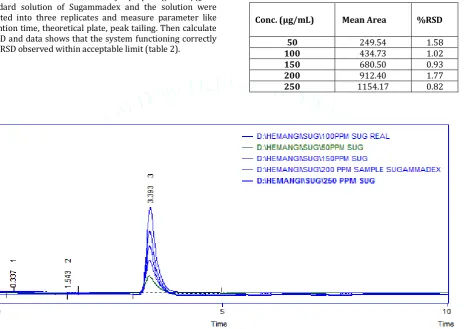
The resulting plot intercept, slop and correlation coefficient provide the desired information on linearity.[9] Linearity is performed by adding accurate quantity of stock solution of sugammadex and volume adjusted to 10mL to set final concentration of 50, 100, 150, 200, and 250 µg/mL (Table 3 and Fig. 3).
Precision: Precision of an analytical method represents the
closeness of individual measurements to each other under similar analytical condition and it is divided in three categories. The ICH guideline suggest that repeatability should be assessed using a minimum of 9 determination covering the specified range for the procedure (3concentration/ 3replicates each) or a minimum of 6 determinations at 100% of the test concentration.[9]
Intraday Precision: It can be defined as within-day precision and performed by 3 replicates at 3 different concentrations (50, 150, 250 µg/mL) of sugammadex within a day as shown in table 5.
Inter-day Precision: It can also be referred to as between-day precision. It is determined by 3 replicates at 3 different concentrations (50, 150, 250 µg/mL) of sugammadex on different days as shown in table 6.
Repeatability: Precision under same analyst, same operating condition over short period of time. It was performed by 6 replicates of 100 µg/mL concentration.
Accuracy: Accuracy is a measure of closeness of
experimental value to the actual value of the substance. It is one of the most important parameters of an analytical method. It can also be defined as percent recovery of known amounts of drug added to a sample.[9,11] There are three way to determine accuracy:
Recovery of analyte spiked into blank matrix
Comparison to a reference standard
Standard addition of the analyte
LOD: Limit of detection is determined by the analysis of
samples with known concentration of drug and by establishing that minimum level at which the analyte can detected, but not necessarily quantitated as precise value. LOD is generally expressed in the concentration of analyte in the sample(ppm). A number of approaches are recommended by the ICH for determining the detection limit of sample, depending on nature of analyte, suitability of the method and instrument used for analysis. The acceptable approaches are signal to noise ratio, Standard deviation of the slope of the linearity plot, Visual evaluation, standard deviation of response.[9] The formula for calculating LOD =
LOQ: Limit of quantification is expressed as least
concentration of analyte in a sample which is estimated with appropriate accuracy and precision under the affirmed experimental conditions. The formula for calculating LOQ is [9]
LOQ = 10
= Standard deviation of response
S = Mean of slopes of the of calibration curves.
Robustness: It can be described as the ability of an
differences in the obtained result. The variable method parameters in HPLC technique may involves pH, flow rate, column temperature, mobile phase composition, solvents grades, detection wavelength and sample temperature. Study was carried out by varying the one parameter and keeping other one standard parameter constant. The test was originally introduced to avoid problem in inter-laboratory studies and to identify the potential responsible factors. [12,14] The test are carried out by injecting standard solution of sugammadex by varying parameter as mention in table 8. It shows stability of method.
Matrix Robustness: Robustness of the sample matrix is advantageous to consider and it is favorable to distinguish it from the selectivity. Different matrices can lead to different matrix effects.[12,14]
Ruggedness: It can be explained as the degree of
reproducibility of sample results obtain under a variety of
normal test condition like different instrument, different analyst, different laboratories, different days, different elapsed assay times, etc. ruggedness shows stability of method.[12,14]
RESULT AND DISCUSSION
SpecificityThe specificity of the method (analytical) for the assay of sugammadex is demonstrated by injecting solution into the HPLC system.
Diluent as a Blank (Figure 2)
Standard Solution of 100µg/mL Sugammadex (Figure 3)
Test Solution (simulated mixture of sugammadex- Figure 4)
Figure 2 Chromatogram of blank water
Fig.3 Chromatogram of Simulated Mixture Sugammadex
Table1: Specificity of sugammadex
Sr. no. Sample Name Analyte Name Specificity
1 Blank No peak -
2 Standard Sugammadex Specific
3 Test Sugammadex Specific
The method is considered to be specific as no peak was observed at the retention time of sugammadex in blank. (Fig.2).
System Suitability
Parameter were monitored by preparing 100µg/mL standard solution of Sugammadex and the solution were injected into three replicates and measure parameter like retention time, theoretical plate, peak tailing. Then calculate %RSD and data shows that the system functioning correctly as %RSD observed within acceptable limit (table 2).
Table 2: System suitability data of sugammadex
Parameters Mean (n=3) %RSD
RT (min) 3.39 0.61
Theoretical plates 14567 0.70
Tailing Factor 1.87 1.47
Linearity
The linearity of sugammadex was determined by analyzing at 5 independent level. The range of 50 – 250 µg/mL (figure.5). The calibration curve of AUC of sugammadex vs concentration was plotted (figure.6) and correlation coefficient and regression line equation was calculated (table 4). The method considered to be linear as the correlation coefficient was found within acceptance criteria.
Table 3: Linearity data of sugammadex
Conc. (µg/mL) Mean Area %RSD
50 249.54 1.58
100 434.73 1.02
150 680.50 0.93
200 912.40 1.77
250 1154.17 0.82
Fig.5: Linearity overlay Chromatogram of sugammadex
Fig.6: Calibration curve of sugammadex
Table 4. Regression data analysis RP-HPLC method.
Parameters Sugammadex
Wavelength 210nm
Range 50 -250 µg/mL
Regression Equation y = 4.5739x + 0.1931
Slop (m) 4.5739
Intercept (c) 0.1931
Correlation coefficient 0.9979 y = 4.5739x + 0.1931
R² = 0.9979
0 500 1000 1500
0 100 200 300
Linearity of Sugamadex
A
re
a
Precision
It was determined at three different levels at 50, 150 and 250 µg/mL and were analyzed at three different level. %RSD of repeatability was found to be 0.47. %RSD of intraday and interday precision is shown in table 5 and 6.
Table 5: Intraday precision data of sugammadex
Conc. (µg/mL) Mean Area (n=3) %RSD
50 249.85 0.64
150 680.89 0.24
250 1153.23 1.01
Table 6: Interday precision data of sugammadex
Conc. (µg/mL) Mean Area (n=3) %RSD
50 255.64 1.78
150 687.55 0.87
250 1136.30 0.35
Accuracy
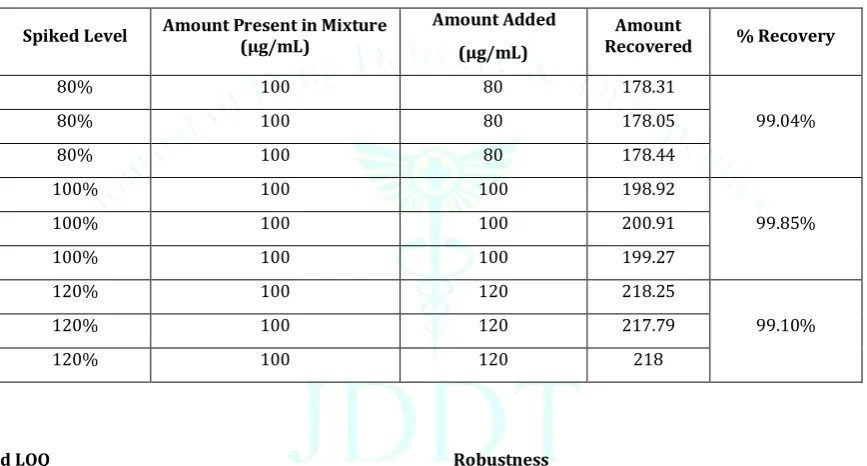
Recovery study obtained by using standard addition method of pure standards at three different levels in 80%, 100%, 120% to the sample in triplicate.[8] The spiked test solution was analysed according to the proposed procedure. Then calculate the average percent recovery was obtained as 99.04%, 99.85%, 99.10% respectively (as shown in table 7).
Table 7: Accuracy table of sugammadex
Spiked Level Amount Present in Mixture (µg/mL) Amount Added
(µg/mL)
Amount
Recovered % Recovery
80% 100 80 178.31
99.04%
80% 100 80 178.05
80% 100 80 178.44
100% 100 100 198.92
99.85%
100% 100 100 200.91
100% 100 100 199.27
120% 100 120 218.25
99.10%
120% 100 120 217.79
120% 100 120 218
LOD and LOQ
Limit of detection is the lowest quantity of analyte in a sample which can be detected but not necessarily quantitated as an exact value. LOQ is the lowest amount of analyte in the sample which can be quantitatively determined with suitable precision and accuracy. LOD and LOQ were calculated based on the linearity data was found to be 0.19 and 0.57 respectively.
Robustness
There replicate solution of sugammadex at 100µg/mL were analyzed as per changes in level of factor as mention in below table i.e. changes in mobile phase and flow rate 0.5mL/min. Which were analyzed as per the alter chromatographic condition.
Table 8: Robustness data of sugammadex
Factor Level Change Mean area (n=3) % RSD
Mobile phase Water:ACN::82:18 Water:ACN::80:20 460.00 452.81 0.85 1.22
Water:ACN::78:22 443.27 1.25
Flow rate (mL/min)
0.45 451.59 0.35
0.5 452.14 0.61
Ruggedness
The tests were carried out by injecting standard solution of sugammadex by different analyst and different instrument (table 8).[14] And calculate the % RSD.
Table 9: Ruggedness data of sugammadex
Factor Level change Mean area % RSD
Different Analyst Analyst-1 460.00 0.85
Analyst-2 452.81 1.22
Different Instrument Instrument-1 451.59 0.35
Instrument-2 452.14 0.61
Assay of Simulated Mixture
Assay was performed by adding 10mg sugammadex and make it up to 10mL with water. Take 1mL of resulting solution and volume adjust to 10mL with diluent water to set final concentration of 100µg/mL.
Table 10: Assay data of sugammadex.
Sr. No % Drug Recovered
(n = 6)
Mean %Drug
Recovered %RSD of Drug Recovered
1 99.61
99.42 0.68
2 98.89
3 98.54
4 99.42
5 100.51
6 99.54
Degradation Study
The goal of the present study is to provide information about condition for stress testing and to establish the stability of drug substances and product. There is different condition to observed degradation of drug.
Acid Degradation: Degradation in acidic condition was performed by adding 20% of 0.005M HCl at room temperature kept for 20 minutes in dark condition. The solution was neutralized with 0.005M NaOH. Volume adjusted to 10mL with diluent to set final concentration of 100µg/mL. Chromatogram (Figure 7) revealed 9.54% drug degraded in acid hydrolysis.
Figure 7: Acid degradation of sugammadex
Alkali Degradation: Degradation in basic condition was performed by adding 20% of 0.005M NaOH at room temperature kept for 20 minutes in dark condition. The solution was neutralized by 0.005M HCl. And volume make
Figure 8: Base degradation of sugammadex
Oxidative degradation: Performed by adding 3% hydrogen
peroxide at room temperature in dark. Volume adjusted to 10mL with water to set final concentration(100µg/mL). It gives 18.88% drug degradation (Figure. 9 and Table 9).
Figure 9: Oxidative degradation of sugammadex Drug was not stable in photolytic degradation due to sugammadex is light sensitive drug. [12]
Table 9: Degradation summary of sugammadex
Degradation Type Stress Condition % Assay %Drug Degradation
Controlled Sample As such 100% -
Acid Hydrolysis 0.005M HCl 90.46% 9.54%
Alkali Hydrolysis 0.005M NaOH 75.22% 24.78%
Oxidative Degradation 3% H2O2 81.12 18.88%
CONCLUSION:
Sugammadex is selective relaxant binding. A simple, precise, specific, accurate, sensitive RP-HPLC method have been developed and validated. Accuracy was observed. In Concentration range of 50 – 250µg/mL with correlation coefficient. The mean assay of sugammadex simulated mixture was found to be 92.42%. The result of the study follows the protocol of ICH guideline. The procedure described is suitable for the routine estimation of sugammadex.
REFERENCES:
1. https://www.drugbank.ca/salts/DBSALT000556
2. Welliver M. New drug sugammadex: a selective relaxant binding agent. AANA journal. 2006 Oct 1; 74(5).
3. Zeng W, Xu Y, Constanzer ML, Goykhman D, Woolf EJ. Determination of Sugammadex in Human Plasma using Protein Precipitation and Ultra High Performance Liquid Chromatography/Tandem Mass Spectrometry. SF J Pharm Anal Chem. 2018; 1 (1):1007.
4. De Zwart MA, ten Bruggencate-Broeders J, Van Hal HJ, Megens RH, Frasa HW. Determination of sugammadex in human plasma, urine, and dialysate using a high-performance liquid chromatography/tandem mass spectrometry assay. Journal of Chromatography B. 2011 Jun 1; 879(19):1573-86.
5. Ashok CV, Sailaja BB, Praveen KA. Method development and validation of UV-visible spectroscopic method for the estimation of assay of sugammadex sodium, apremilast, riociguat and vorapaxarsulfate drugs in API form. Asian J Pharm Clin Res. 2017; 10:241-50.
6. https://www.google.com/search?q=sugammadex+hplc+meth od&sxsrf=ACYBGNQGbdx7FX9HPfBm3vDzC997diNHmQ:1576 727489679&source=lnms&tbm=isch&sa=X&ved=2ahUKEwi7f P58DmAhXXSH0KHfoPBiQQ_AUoAXoECA0QAw&cshid=15767 27548748265&biw=1366&bih=657#imgrc=GncO2C-eVPxuzM:
7. European Medicines Agency, Evaluation of Medicines for Human Use, 2008, Doc.Ref.: EMEA/CHMP/317523/2008, Assessment report for Bridion, Procedure No. EMEA/H/C/000885
estimation of glucosamine, methyl Sulfonyl methane and Diacerein in tablet Dosage form.
9. Ravisankar P, Navya CN, Pravallika D, Sri DN. A review on step-by-step analytical method validation. IOSR J Pharm. 2015; 5(10):7-19.
10. https://www.pharmaguideline.com/2017/09/system-suitability-in-hplc-analysis.html?m=1
11. Urban MC, Mainardes RM, Gremião MP. Development and validation of HPLC method for analysis of dexamethasone acetate in microemulsions. Brazilian journal of pharmaceutical sciences. 2009 Mar; 45(1):87-92.
12. Vander Heyden Y, Nijhuis A, Smeyers-Verbeke J, Vandeginste BG, Massart DL. Guidance for robustness/ruggedness tests in method validation. Journal of pharmaceutical and biomedical analysis. 2001 Mar 1;24(5-6):723-53.
13. Karalapillai D, Kaufman M, Weinberg L. Sugammadex. Critical Care and Resuscitation. 2013 Mar;15(1):57
14. Rao TN. Validation of Analytical Methods. Calibration and Validation of Analytical Methods: A Sampling of Current Approaches. 2018 Apr 25:131.
15. https://sisu.ut.ee/lcms_method_validation/10-ruggedness-robustness
16. https://www.researchgate.net/post/How_to_calculate_limit_o f_detection_limit_of_quantification_and_signal_to_noise_ratio# view=537b192cd4c118531f8b4637
17. https://www.drugs.com/monograph/sugammadex-sodium.html
18. https://www.accessdata.fda.gov/drugsatfda_docs/nda/2015/ 022225Orig1s000ClinPharmR.pdf