Sequencing Educational Resources with Seqins
Ricardo Queir´os1, Jos´e Paulo Leal2, and Jos´e Campos3
1
CRACS & INESC-Porto LA & DI-ESEIG/IPP, Porto, Portugal [email protected]
2
CRACS & INESC-Porto LA, Faculty of Sciences, University of Porto, Portugal [email protected]
3
Lusada University, Portugal [email protected]
Abstract. Existing adaptive educational hypermedia systems have been using
learn-ing resources sequenclearn-ing approaches in order to enrich the learnlearn-ing experience. In this context, educational resources, either expository or evaluative, play a central role. However, there is a lack of tools that support sequencing essentially due to the fact that existing specifications are complex. This paper presents Seqins as a sequencing tool of digital educational resources. Seqins includes a simple and flex-ible sequencing model that will foster heterogeneous students to learn at different rhythms. The tool communicates through the IMS Learning Tools Interoperability specification with a plethora of e-learning systems such as learning management systems, repositories, authoring and automatic evaluation systems. In order to val-idate Seqins we integrate it in an e-learning Ensemble framework instance for the computer programming learning domain.
Keywords:e-learning, educational resources, sequencing, interoperability.
1.
Introduction
In the last few years, higher education institutions have been challenged by the emergence of new information and communication technologies (ICT). In this context, e-learning has been adopted as the preferred channel for the dissemination of knowledge.
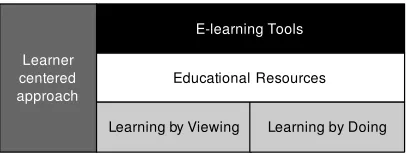
In the mid-1980s, educational researchers found that learning was faster and bet-ter when some practice/evaluative resources were replaced by worked-out examples that demonstrated the lesson skills. Sweller and Cooper [19] found that errors were reduced in half when 12 math practice resources were replaced by 6 worked-out examples, each followed by practice.
Many experiments showed a combination of examples and practice exercises engages novice students rather than just practice. For instance, in a lesson on how to use program-ming variables, an example showing the steps to declare and initialise a variable would be followed by a practice in which the learner must repeat these steps in a slightly different situation. When viewing an example, the learner’s working memory is free to build a new mental model of the skill. Then the learner can try out the new mental model in a practice problem [6].
Learner centered approach
Learning by Viewing Learning by Doing
Sweller and Cooper (1985) Educational Resources
E-learning Tools
Fig. 1.Sweller and Cooper constructivist learning model.
paradigms: ”learning by viewing” and ”learning by doing”. In this model educational resources, either expository or evaluative, play a pivotal role.
These resources are crucial for the teaching-learning process. It is important that an e-learning system provides a collection of resources covering a course syllabus and with different levels of difficulty. It has been shown that this can improve the performance of students and their satisfaction levels [21]. Students with lower computer skills can begin by viewing examples and solving easier problems in order to progressively learn and to stay motivated to read and solve harder topics later [14]. At the same time this gives them experience which is one of the factors that has a greater influence on student success in learning [22]. In recent years, a large number of educational resources have been devel-oped and published and mostly of them stored in proprietary systems for their own use. Although some standard organisations such as IMS and Advanced Distributed Learning (ADL) have created several specifications such as IEEE Learning Object Metadata (IEEE LOM), IMS Content Packaging (IMS CP), Sharable Content Object Reference Model (SCORM) and IMS Common Cartridge (IMS CC), for the description and aggregation of educational resources, each one has its own format, making it difficult to share among instructors and students. This poses several issues on the resources interoperability among e-learning systems.
At the same time, both types of resources are interdependent and their sequencing would create a richer educational experience to the end user. However, there is a lack of tools that support sequencing essentially due to the fact that existing specifications are complex.
In this paper we present Seqins as a sequencing tool for educational resources. This is an extended version of a paper [12] first presented at the Symposium on Languages, Applications and Technologies – SLATE 2013. Seqins is based on a simple sequencing model where students after seeing a set of examples on a particular topic, consolidate their knowledge solving a set of exercises on the same topic. The student must solve an (a set of) exercise(s) before proceeding to next topic. This approach has several advantages. The most important is the ability to foster heterogeneous classes, enabling students with different learning rhythms to progress autonomously.
integra-tion on a network for the computer programming learning. Finally, we conclude with a summary of the main contributions of this work and a perspective of future research.
2.
E-learning specifications
In the e-learning realm, the learner satisfaction when using interactive learning environ-ments is influenced by the type of learning experience that the environment provides. Many solution present the one size fits all approach [18], delivering the same learning paths and resources, independently of their prior knowledge, learning goals, progress, and personal preferences.
Existing adaptive educational hypermedia systems have been using learning resources sequencing approaches in order to address the issues previously focused. These systems typically implement a rule-based sequencing approach based on a two steps procedure: they generate a sequence of concepts that matches the learning goal and then select learn-ing resources for each concept of that sequence.
Karampiperis [9] presented an alternative approach since it first generates all possible learning paths that match a specific learning goal. After that, it adaptively selects the desired one, based on the use of a decision model that infers the suitability of learning resources for a specific targeted learner.
Brusilovsky [3] introduced the user model facet as an important piece to any adaptive system since the prior knowledge of information related with the user that uses the system can help the system in its guidance.
Fischer [7] explored the use of metadata standards such as IEEE LOM and Dublin Core with regard to course and exercises sequencing. The following subsections focus on other important types of e-learning specifications such as sequencing and integration specifications that should be taken in consideration when developing learning resources sequencing approaches.
2.1. E-learning sequencing specifications
The SCORM specification is a collection of standards and specifications for web-based e-learning. It allows the communication between client side content and a host system called the run-time environment, which is commonly supported by a learning manage-ment system. SCORM also defines how content may be packaged into a transferable ZIP file called ”Package Interchange Format”. Despite its enormous popularity some re-searchers have questioned the instructional value of the SCORM model. The focus of the critics was whether atomic de-contextualized learning objects (LO) can support an effec-tive pedagogic goal and whether it could convey an unified learning experience. In order to address these concerns SCORM included the IMS Simple Sequencing specification (IMS SS).
Unfortunately, IMS Simple Sequencing does not make the instructional designers task of bringing instructional order and meaning through sequencing easy. The standard is highly technical and procedural, and lacks support for associating instructional meaning with the sequencing code (e.g. domain related segments). In fact, the IMS SS specification has been the target of much criticism such as:
– Modularity - included in the Learning Objects as a content package (IMS CP);
– Scope - widening the scope exaggerated (”spray and pray”);
– Utility - More focused on quantity than quality (”shovelware”);
– Complexity - difficult to implement.
The following IMS CP manifest excerpt (Figure 2) shows some of the IMS SS tags to define the conditions under which a specific item is delivered during an e-learning instruction.
<manifest ...>
<metadata>...</metadata> <organizations default="TOC1">
<organization identifier="TOC1"> <title>Photoshop Tutorial</title>
<item identifier="ITEM45" identifierref="QUESTION6"> ...
<imsss:sequencing>
<imsss:controlMode choice="false" forwardOnly="true"/> <imsss:rollupRules>
<imsss:rollupRule childActivitySet="all"> <imsss:rollupConditions>
<imsss:rollupCondition condition="attempted"/> </imsss:rollupConditions>
<imsss:rollupAction action="completed"/> </imsss:rollupRule>
</imsss:rollupRules>
</imsss:sequencing> </item>
...
</organization>
</organizations> <resources>
<resource>...</resource> ...
</resources>
</manifest>
Fig. 2.Excerpt of IMS CP manifest
can be constructed (e.g. Reload, LAMS) and rendered (e.g. CopperCore, .LRN). However (once again) this standard provides templates for learning in a multi-person/entity setting and is not really applicable to the web-based, single learner setting which is the focus of SCORM 2004.
As of fall 2012, both of IMS sequencing languages, i.e. Simple Sequencing and IMS Learning Design seem to be ignored by industry. IMS rather seems to focus on better interoperability between online content and service providers.
2.2. E-learning integration specifications
An Learning Management System (LMS) plays an important role in any e-learning envi-ronment. Still, the LMS cannot afford to be isolated from other systems in an educational institution. Thus, the potential for interoperability is an important, although frequently overlooked, aspect of an LMS system. The following sub-subsections present the most common strategies for integrating an LMS with other systems usually found in educa-tional institutions. Their names are the Data, the API and the Tool integration strategies. Although the focus is the LMS other types of systems can achieve these types of integra-tion.
Data Integration Data integration is the simplest and most popular form of integration in content management. This type of integration uses the import/export features of both systems and relies on the support of common formats. For instance, an e-Portfolio system may import data (blog and forum contributions by students, course materials and assign-ments uploaded by teachers) from LMS to avoid the burden of entering this data manually. These systems support two types of common formats: generic (e.g. HTML files) and e-Portfolio specific (e.g. Leap2A files). The former are useful since they are widely avail-able, but they lack domain specific semantic data provided by the latter. For instance, if someone adds a post in a Moodle forum it should be included in the Mahara e-Portfolio as a blog post and not as a non-editable HTML artifact. This requires the use of a common e-Portfolio standard so that Mahara (or any other e-Portfolio system) can understand the meaning of the content and decides its final format.
API Integration The major LMS vendors include also APIs to allow developers to ex-tend their predefined features through the creation of plug-ins. Blackboard uses the Build-ing Blocks technology to cover the integration issues with other systems allowBuild-ing third parties to develop modules using the Building Blocks API. The new Moodle versions (from v.2.0 released in November 2010) includes several API to enable the development of plug-ins by third parties such as the Repository API for browsing and retrieving files from external repositories; and the Portfolio API for exporting Moodle content to exter-nal repositories. These two API are based on the File API - a set of core interfaces to allow Moodle to manage access control, store and retrieve files. The new File API aims to enhance file handling by avoiding redundant storage.
components for LMSs integration in service oriented architecture (SOA) based e-learning systems. Apostolopoulos [2] proposes a middleware component to address the lack of integration of e-learning services. In this approach the e-learning components are imple-mented as agents maintained in a local management information base, and can communi-cate with the agent manager through the Simple Network Management Protocol (SNMP) protocol. Costagliola [5] develop an architecture based on a middleware component and use Web Services to integrate different software components and improve interoperability among different systems. The middleware component enables the student learning pro-cess traceability since it has been developed to be compliant with SCORM. Al-Smadi [1] presents a service-oriented architecture for a generic and flexible assessment system with cross-domain use cases. All these approaches have in common the need of a modification of LMS for each specific vendor, with the implementation of a new module or building block. To the best of the authors’ knowledge there are no references in the literature to the use of a common standards supported by the major LMS vendors as a means to integrate the LMS in a service oriented network of learning environments.
A common interoperability standard that is increasingly supported by major LMS ven-dors is the IMS Learning Tools Interoperability (IMS LTI) specification. The IMS LTI provides a uniform standards-based extension point, allowing remote tools and content to be integrated into LMSs. The main goal of LTI is to standardize the process of building links between learning tools and the LMS. There are several benefits from using this ap-proach: educational institutions, LMS vendors and tool providers by adhering to a clearly defined interface between the LMS and the tool, will decrease costs, increase options for students and instructors when selecting learning applications and also potentiate the use of software as a service (SaaS). The LTI has 3 key concepts [8]: the Tool Provider, the Tool Consumer and the Tool Profile.
The tool provider (TP) is a learning application that runs in a container separate from the LMS. It publishes one or more tools through tool profiles. A tool profile is an XML document describing how a tool integrates with a tool consumer. It contains tool metadata, vendor information, resource and event handlers and menu links. The tool consumer (TC) publishes a Tool Consumer Profile (XML descriptor of the Tool Consumer’s supported LTI functionality that is read by the Tool Provider during deployment), provides a Tool Proxy Runtime and exposes the LTI services.
A subset of the full LTI v1.0 specification called IMS Basic LTI (Figure 3) exposes a single (but limited) connection between the LMS and the tool provider. In particular, there is no provision for accessing run-time services in the LMS and only one security policy (OAuth protocol4) is supported. For instance, to export content from Moodle to
Mahara using the Basic LTI the teacher (or LMS administrator) must first configure the tool (Mahara) as a Basic LTI tool in the course structure. When a student selects this tool, Moodle launches a Mahara session for the student. The web interface for this session can either be embedded in Moodles web interface as an iframe or launched in a new browser window.
In March 2012 IMS launched the LTI v1.1 (final version) merging both specifications (Basic LTI and LTI). This version includes updates and clarifications as well as support for an outcomes service and bidirectional communication support. This version also includes
4
Co ntext Reso urce
Basic LTI To o l Proxy Runtime
To o l Pro vider To o l Co nsumer
Basic LTI Launch
Fig. 3. IMS Basic LTI.
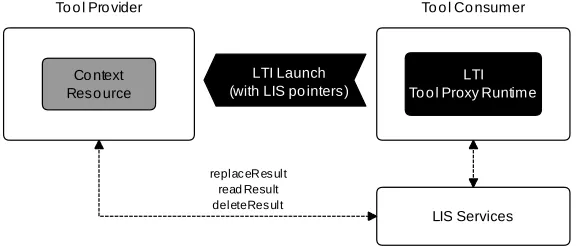
the support for an outcomes service based on a subset of the IMS Learning Information Services (LIS) - the LTI Basic Outcomes Service.
Co ntext Reso urce
To o l Pro vider To o l Co nsumer
LIS Services
LTI Launch (with LIS po inters)
replaceResult read Result deleteResult
LTI To o l Proxy Runtime
Fig. 4. IMS Full LTI.
The LIS specification is the definition of how systems manage the exchange of in-formation that describes people, groups, memberships, courses and outcomes within the context of learning. Figure 4 shows how the bidirectionality of the LTI specification is performed. The TC provides launch data with LIS pointers to the TP. It is not required for the TC to provide these services. The LIS services could even be provided by a third system such as a Student Information System. Then, the TP calls the LTI Basic Outcomes Service if available. This service receives ”Plain Old XML” (POX) messages signed using OAuth.
The service supports setting, retrieving and deleting LIS results associated with a particular user/resource combination. The following functions are supported:
– The replaceResultRequest function sets a numeric grade (0.0 - 1.0) for a particular result;
– The readResultRequest function returns the current grade for a particular result;
– The deleteResultRequest function deletes the grade for a particular result.
released in November 2012. The LTI 2.0 supports two types of connection defined be-tween the Tool Consumer and the Tool Provider: message-based and service-based. A message-based connection involves the user with data being transferred as a signed HTTP POST request via their browser. For example, this is used when the Tool Consumer wishes to launch the external tool for a user. A service-based connection involves direct connec-tions between the Tool Consumer and Tool Provider servers using an HTTP request and response web service pattern to a service URL. For example, a Tool Consumer may pro-vide an Outcomes service which allows a Tool to update the values of grades in the Tool Consumer. Data being exchanged between the servers is formatted using JSON-LD.
This REST based framework will provide a more sophisticated and extensible plat-form to enable deeper integrations and greater support for services and events.
Comparison of the integration strategies Comparing these three approaches one could say that data integration is the best option when the development effort must be kept to a minimum or no one with technical skills (specially programming skills) is available, since the other two strategies require them. This strategy has also the advantage of not coupling the two systems and enabling a bi-directional communication.
API integration is best suited when batch integration is required since the other two strategies involve the use of the GUI of both systems. For instance, if the work of the students of a given set of courses must be copied on a regular basis from the LMS to their portfolios then the API strategies are recommended. The major drawbacks of this approach are the amount of development required and the tight coupling between the LMS and the other e-learning system, since special plug-ins must be implemented and API are vendor specific.
Tool integration is arguably the best choice in general since it provides a good bal-ance between implementation effort and coupling and security. This is especially true if only unidirectional communication is required and Basic LTI is used. This tool integra-tion flavour is simple to implement and is already supported by most LMS vendors. If bidirectional communication is required then full LTI is needed but in this case the im-plementation is harder and few LMS vendors support this flavor of the specification. In both cases, tool integration has the added value of providing some basic security features based on the OAuth protocol aiming to secure the message interactions between the Tool Consumer and the Tool Provider.
3.
Seqins
This section presents Seqins as a sequencing tool for educational resources categorized as:
– Expositives (e.g.: videos, PDF, HTML + images);
– Evaluatives (e.g.: assignments, tests, exercises).
Seqins follows a simple sequencing model. After seeing examples on a particular topic, students consolidate their knowledge by solving a set of exercises related to topic. The success in solving exercises leads the student to the next topic.
supports the IMS LTI 1.1. specification who has been increasingly supported by e-learning systems, especially by LMSs.
The following subsections present Seqins architecture and main components, and de-scribe its sequence, data and communication models.
3.1. Architecture
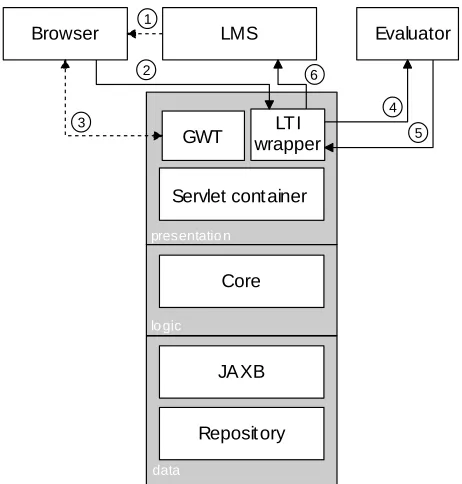
Seqins is a web application for sequencing educational resources that mediates between an LMS and an Evaluator. The role of the LMS is to manage instruction and it will initiate a session in Seqins to sequence a course for a particular student. During the interaction with the student Seqins presents content (HTML, PDF, videos) embed in its web interface. The evaluation of exercises requires the use of a specialised e-learning system designated here as Evaluator. The communication of Seqins with these other systems relies on the LTI protocol described in the previous section.
Browser
LTI wrapper GWT
LMS Evaluator
Servlet container
Core
JAXB
Repository
presentatio n
data lo gic
1
2
3 4
5 6
Fig. 5.Seqins architecture.
A typical use of Seqins starts with a HTTP message replied by the LMS to the stu-dent’s browser (1) that starts an LTI request processed by the LTI wrapper (2). This re-quest start a Seqins course for the student and creates a GWT interface (more on GWT later on) on the browser where the students interacts with the system. During this inter-action, starting an exercise triggers an LTI request to the evaluator (4) handled by LTI Wrapper. Eventually the Evaluator answers with an LTI communication carrying a grade (5) and this information is processed by the core and persistently stored. The steps (4) and (5) are repeated for each attempted exercise. Finally, the results obtained by the student in the course are reported to the LMS using LTI.
One of the key components in this architecture is the LTI Wrapper that implements both sides of the LTI communication. This component receives LTI requests from both the LMS and the Evaluator, and also invokes their services. This Java package was developed for Seqins but can be used by any Java application requiring LTI communication. Both the LTI Wrapper and the GWT user interface are supported by a java servlet container.
The GUI component was developed using an Ajax framework called Google Web Toolkit (GWT). GWT is an open source Java software development framework that allows a rapid development of AJAX applications in Java. When the application is deployed, the GWT cross-compiler translates Java classes of the GUI to JavaScript files and guarantees cross-browser portability. The controls required by the GUI are provided by SmartGWT, a GWT API’s for SmartClient, a Rich Internet Application (RIA) system. The GWT code is organised in two main packages: the back-end (server) and the front-end (client). The back-end includes all the service implementations triggered by the user interface. These implementations are centralised in the Core component that relies on the LTI wrapper which implements the LTI 1.1 specification.
The data layer deals with the data persistence through JAXB (Java Architecture for XML Binding). JAXB allows Java developers to map Java classes to XML representations providing two main features: the ability to marshal Java objects into XML and the inverse, i.e. to unmarshal XML back into Java objects. In the following subsections we detail these XML representations.
3.2. Data model
Seqins organizes its data based on two entities: student and course. Since Seqins follows a learner-centered approach it is important to store the learner data. This data is gather by the Tool Producer (Seqins) upon a launch request from the Tool Consumer (typically an LMS). The LTI variables sent in the request are organized in the following data levels: Course, Resource, User, Context and OAuth. In this case two levels are used: the data level is used to store/update information (e.g. identification, name, email) about the user; and the resource level to assign to the respective learner the last resource viewed/solved. Most of this information is stored in the filesystem in XML documents, one for each user, as illustrated Figure 6. The other information is not relevant and, therefore, is not stored.
The root element student has an id attribute that identifies the student. The element con-tains three sub-elements:
<?xml version="1.0" encoding="UTF-8" standalone="yes"?> <student id="2">
<href>http://ensemble.dcc.fc.up.pt/ch/lo/unit01/2</href> <lastRequest>2012-12-10T17:18:27.464Z</lastRequest>
<lastUpdate>2012-11-27T17:22:15.335Z</lastUpdate> </student>
Fig. 6.XML document with student data
– lastrequest- is a timestamp of the last request to see if there has been any change in student status;
– lastupdate- corresponds to the last time that a change occurred. In order to not gen-erate too many requests we check for any update after the last request.
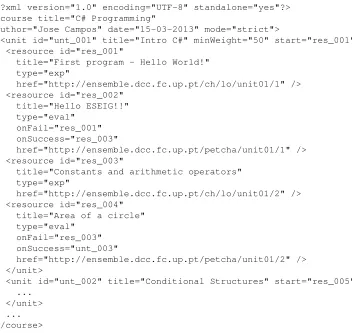
The course entity formalizes how a course is structured. The formalization of the course controls the generation of the tree that appears in Seqins’s GUI to enable navigation through the course resources. The formalization of a course is made by the definition of a XML Schema. Figure 7 shows a valid XML instance of a course.
Acourseelement is the root element of the XML instance. The course element has several attributes: the name of the course, its author and the creation date. A last attribute named mode defines the execution flow (explained later).
Thecourseelement contains one or moreunitelements. A unit aggregates a set of related resources. It contains four attributes: an identification, the title of the unit, a mini-mum weight that is used by Seqins to determine the progress of a learner within a course and astartattribute that identifies the first resource to be delivered to the student the first time he enters in the unit.
Each unit contains a set ofresourceelements. Each resource has four attributes:id -identification of the resource;title- name of the resource;type- type of the resource (exp - expositive and eval - evaluative); andhref - URL pointing to the resource on the Web.
This XML representation contains one very important attribute calledmode in the
courseelement. The mode attribute defines how Seqins controls the progress of a learner within a course. The possible values for the mode attribute are:
1. Relax - the student has access to any resource of any unit. By default, the resources are accessed sequentially, but the student may access any resource regardless of the success/fail in solving the evaluation resources;
2. Moderate - the student is free to access any resource within the unit. By default, the resources are accessed sequentially. In order to unlock the next unit the student need to solve a percentage of the total of the evaluation resources. This percentage is defined in the minWeight attribute of the unit element;
3. Strict - the student is guided by theonFailandonSuccessattributes of the evaluation resources. All other resources are accessed sequentially. The student cannot access any resource that is ahead of its current position but the student can visit any resources back.
<?xml version="1.0" encoding="UTF-8" standalone="yes"?> <course title="C# Programming"
author="Jose Campos" date="15-03-2013" mode="strict">
<unit id="unt_001" title="Intro C#" minWeight="50" start="res_001">
<resource id="res_001"
title="First program - Hello World!" type="exp"
href="http://ensemble.dcc.fc.up.pt/ch/lo/unit01/1" /> <resource id="res_002"
title="Hello ESEIG!!" type="eval"
onFail="res_001" onSuccess="res_003"
href="http://ensemble.dcc.fc.up.pt/petcha/unit01/1" /> <resource id="res_003"
title="Constants and arithmetic operators"
type="exp"
href="http://ensemble.dcc.fc.up.pt/ch/lo/unit01/2" />
<resource id="res_004" title="Area of a circle"
type="eval" onFail="res_003"
onSuccess="unt_003"
href="http://ensemble.dcc.fc.up.pt/petcha/unit01/2" /> </unit>
<unit id="unt_002" title="Conditional Structures" start="res_005"> ...
</unit> ...
</course>
Fig. 7.XML instance of a course
and it has its own risks. Competitive learning is a learning paradigm that relies on the competitiveness of students to increase their programming skills [4] [17], although the concept of ”winners and losers” may hinder the motivation of some students [20].
3.3. Communication model
The integration of Seqins with other e-learning systems relies on the LTI specification. The LTI specification recommends REST as the web service flavour for exchanging data among e-learning tools. The LTI functions are summarised in Table 1.
Table 1.LTI functions.
Function REST LTI
Basic Full
Launch POST TA URL < LTI PARAMETERS yes yes
ReplaceResult POST LIS OUTCOMES URL < LIS SOURCE ID + GRADE no yes
ReadResult POST LIS OUTCOMES URL < LIS SOURCE ID > GRADE no yes
DeleteResult POST LIS OUTCOMES URL < LIS SOURCE ID no yes
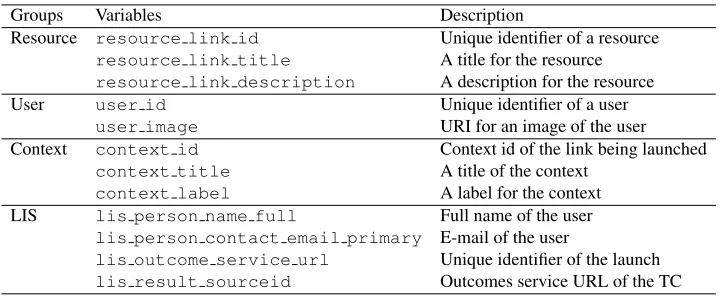
request includes a set of launch parameters (LTI PARAMETERS) as hidden form fields. Table 2 organizes the most important parameters in four groups.
Table 2.LTI launch parameters.
Groups Variables Description
Resource resource link id Unique identifier of a resource
resource link title A title for the resource
resource link description A description for the resource
User user id Unique identifier of a user
user image URI for an image of the user
Context context id Context id of the link being launched
context title A title of the context
context label A label for the context
LIS lis person name full Full name of the user
lis person contact email primary E-mail of the user
lis outcome service url Unique identifier of the launch
lis result sourceid Outcomes service URL of the TC
This list can be extended by adding custom parameters. The syntax iscustom keyname
= value. Three new parameters were added to the launch request:custom collection id
- defines a link for a collection of exercises in an IMS DRI repository;custom sequencing
- defines if the exercises should be solved sequentially;custom time limit- defines a date/time limit for the solving of all exercises. The next code excerpt shows a subset of the launch parameters that the LMS (Tool Consumer) sends to Seqins (Tool Provider).
resource_link_title = Sum two vectors lis_person_name_full= Pimenta Ana roles = Student
context_title = Algorithms and Programming
lis_result_sourceid={"data":{"instanceid":"1","userid":"2", "launchid":1914382991},"hash":"..."}
lis_outcome_service_url=
http://ch.dcc.fc.up.pt:8080/moodle/mod/lti/service.php custom_collection_id=
http://ch.dcc.fc.up.pt:8080/ch/lo/myCollection/vectors custom_sequencing = true
In this example, Seqins presents the exercises of thevectorscollection and students should solve them sequentially till November 7, 2011.
Table 1 also refers to three functions included in the IMS LIS Outcomes Service. These functions use thelis result sourceidparameter included in the launch re-quest that is unique for every combination ofresource link id/user id param-eters and identifies a unique row and column within the TC gradebook. After comput-ing a grade, the TA calls the LTI Basic Outcomes Service uscomput-ing the URL stated in the
lis outcome service urllaunch parameter. The service supports setting, retriev-ing and deletretriev-ing of LIS results associated with a particular user/resource combination
(lis result sourceidparameter). ThereplaceResultRequestfunction sets
a numeric grade (0.0 - 1.0) for a particular result. ThereadResultRequestfunction returns the current grade for a particular result. ThedeleteResultRequestfunction deletes the grade for a particular result.
4.
Integration on Ensemble framework
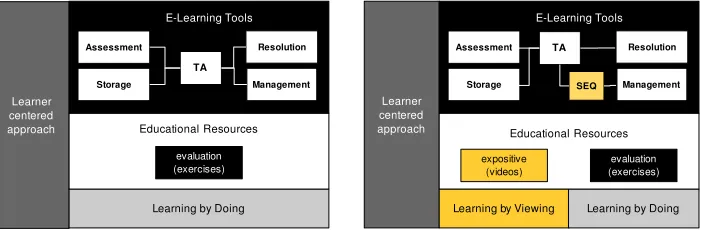
For validation purposes, Seqins was integrated with an instance for computer program-ming of an e-learning framework called Ensemble [15].
Learner centered approach
Learning by Doing evaluation (exercises) Educational Resources Assessment
Storage
Resolution
E-Learning Tools
Learner centered approach
Learning by Viewing Learning by Doing expositive
(videos)
evaluation (exercises) Educational Resources
Ensemble instance (ESEIG, 2011/12) Ensemble instance (ESEIG, 2013) Management
TA
Assessment
Storage
Resolution
E-Learning Tools
Management SEQ
TA
Fig. 8.Evolution of Ensemble framework instance to the Sweller and Cooper model.
Ensemble is a conceptual tool to organize networks of e-learning systems and services based on international content and communication standards. Ensemble is focused exclu-sively on the teaching-learning process. In this context, the focus is on coordination of educational services that are typical in the daily lives of teachers and students in schools, such as the creation, resolution, delivery and evaluation of assignments.
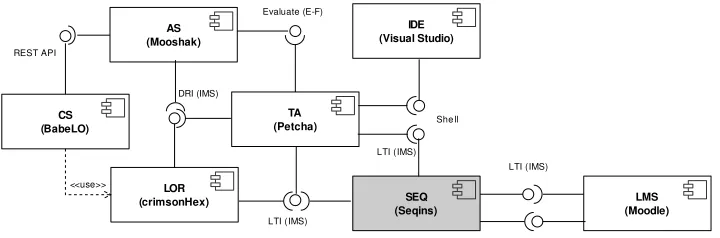
This integration is made at two levels:communicationanddata. At communication level Seqins implements the LTI 1.1 specification for the communication with other e-learning systems. The components diagram of Seqins is depicted in Figure 9.
AS (Mooshak)
IDE (Visual Studio)
LOR
(crimsonHex) LMS
(Moodle) TA
(Petcha) Evaluate (E-F)
She ll DRI (IMS)
LTI (IMS) CS
(BabeLO) REST API
<<use>>
SEQ (Seqins) LTI (IMS)
LTI (IMS)
Fig. 9.Seqins components diagram.
The integration of Seqins with the LMS and the Teaching Assistant (TA) relies on the LTI specification. After the launch of Seqins through the LMS the LTI parameters are sent by HTTP POST to Seqins. Then, if the learner select an evaluative resource, the same parameters are sent by HTTP POST to the TA. The TA has two main tasks in this setup: to assist teachers in the authoring exercises and to help students in solving them. When a student submits an exercise for evaluation, the grade is sent back to Seqins. This grade will influence the progress of the student. At same time Seqins clones the HTTP response of the TA and sends it back to LMS in order to feed the LMS’s grade book.
At the data level, Seqins uses two types of resources: expositives and evaluatives. These resources can be seen in Figure 10 in the left panel.
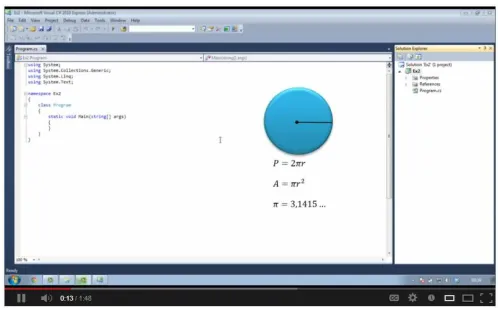
The former are typically videos (Figure 11) with working examples of exercises solv-ing. The videos were created with Camtasia, a software that records screen activity and voice.
The videos were deployed on Youtube. The design requirements for the videos were:
– Coverage - covering all the curricula;
– Diversity - several difficulty levels;
– Fragmented - ”video clip time” (¡= 5 minutes);
– Complete - composed by pictures, sound, subtitles, layers.
Fig. 10.Seqins screenshot.
Fig. 11.Video screenshot.
After solving the exercises, the student submits their solution to an Assessment Sys-tem (AS). The purpose of an assessment sysSys-tem is to mark and grade exercises in com-puter programming courses and in programming contests. These systems include auto-matic evaluators and many of these systems organize their own contests such as Mooshak, UVA-OJ (University of Valladolid Online Judge), SPOJ (Sphere Online Judge), DOM-Judge and others. By exposing its functions as services, an evaluator of this kind is able to participate in business processes integrating different system types.
The evaluation model is enumerated below:
2. The evaluator loads the exercise from a repository using the reference and uses the as-sets available in the resource package (static tests, generated tests, unit tests, solution files, etc.) according to their role.
3. The evaluator produces an evaluation report with a classification and possibly also with a correction and feedback. The feedback that may depend on the learner’s refer-ence and may be stored for future incremental feedback to the same learner;
4. The evaluator returns the evaluation report immediately or makes it available within a short delay.
The AS selected was Mooshak [10]. Mooshak is an open source system for managing programming contests on the Web including automatic judging of submitted programs. The current version (1.6a2) supports the Evaluate service (E-F) [13].
5.
Conclusions and future work
Seqins is a sequencing tool for educational resources. It has a simple sequencing model that depends on the score obtained by the learner on solving exercises. Seqins can commu-nicate with any tool that supports the IMS LTI specification. In order to evaluate this fea-ture, Seqins was integrated with an Ensemble instance for computer programming learn-ing. In this context, learners can launch Seqins through the LMS and browse resources of two types: expositive and evaluative. The former are typically short videos with hands-on demonstrations on solving programming exercises. The latter are programming exercises that learners should solve on their favourite IDE guided by the pivot component of En-semble, the Teaching Assistant.
The main contributions of the research presented in this paper are the design and imple-mentation of a sequencing tool based on a simple sequencing model. The LTI integra-tion is also detailed and can prove to be useful for others researchers developing Java e-Learning tools. One of the key components of the Seqins archiecture is the IMS LTI wrapper. This Java package5was developed for Seqins but can be used by any Java
appli-cation requiring LTI communiappli-cation.
The next challenge is to improve Seqins and integrate it in an e-learning environment to foster the teaching-learning process in the computer programming domain. Based on this challenge we intend as future work to:
– Create more expositive resources (e.g. C programming course and other courses);
– Improve sequencing model (e.g. optative - ”solve N of X” and conditional - ”If Then Else”);
– Improve graphical user interface (e.g. sophisticated graphical controls through Smart-GWT);
– Include a competitive facet (e.g. statistics on number of people that solved a particular exercise).
References
1. Al-Smadi, M.; Gutl, C.: Soa-based architecture for a generic and flexible e-assessment system. In: EDUCON (2010)
5
2. Apostolopoulos, T.K., Kefala, A.S.: An e-learning service management architecture. In: ICALT. pp. 140–144 (2003)
3. Brusilovsky, P., Mill´an, E.: The adaptive web. chap. User Models for Adaptive Hypermedia and Adaptive Educational Systems, pp. 3–53. Springer-Verlag, Berlin, Heidelberg (2007),http: //dl.acm.org/citation.cfm?id=1768197.1768199
4. Burguillo, J.C.: Using game theory and competition-based learning to stimulate student motiva-tion and performance. Comput. Educ. 55(2), 566–575 (Sep 2010),http://dx.doi.org/ 10.1016/j.compedu.2010.02.018
5. Casella, G., Costagliola, G., Ferrucci, F., Polese, G., Scanniello, G.: A scorm thin client archi-tecture for e-learning systems based on web services. IJDET 5(1), 19–36 (2007)
6. Colvin, R., Richard, C.: Learning by viewing versus learning by doing : Evidence-based guide-lines for principled learning environments. Performance Improvement 47(9), 5–13 (2008),
http://doi.wiley.com/10.1002/pfi.20028
7. Fischer, S.: Course and exercise sequencing using metadata in adaptive hypermedia learning systems. J. Educ. Resour. Comput. 1(1es) (Mar 2001),http://doi.acm.org/10.1145/ 376697.376700
8. Gilbert, T.: Leveraging sakai and ims lti to standardize integrations. In: 10th Sakai Conference (2010)
9. Karampiperis, P., Sampson, D.: Adaptive learning resources sequencing in educational hyper-media systems. Educational Technology Society 8, 128–147 (2005)
10. Leal, J.P., Silva, F.: Mooshak: a web-based multi-site programming contest system. Software: Practice and Experience 33(6), 567–581 (2003),http://dx.doi.org/10.1002/spe. 522
11. Leal, J.P., Queir´os, R.: Crimsonhex: a service oriented repository of specialised learning ob-jects. In: ICEIS 09 - 11th International Conference on Enterprise Information Systems, Milan, Italy. Lecture Notes in Business Information Processing, vol. 24, pp. 102–113. Springer-Verlag, LNBIP, Springer-Verlag, LNBIP (May 2009)
12. Leal, J.P., Rocha, R., Sim˜oes, A. (eds.): 2nd Symposium on Languages, Applications and Tech-nologies, SLATE 2013, June 20-21, 2013 - Porto, Portugal, OASICS, vol. 29. Schloss Dagstuhl - Leibniz-Zentrum fuer Informatik (2013)
13. Leal, J., Queirs, R., Ferreira, D.: Specifying a programming exercises evaluation service on the e-framework. In: Luo, X., Spaniol, M., Wang, L., Li, Q., Nejdl, W., Zhang, W. (eds.) Advances in Web-Based Learning ICWL 2010, Lecture Notes in Computer Science, vol. 6483, pp. 141–150. Springer Berlin Heidelberg (2010),http://dx.doi.org/10.1007/ 978-3-642-17407-0_15
14. lok Lee, F., Heyworth, R.: Problem complexity: A measure of problem difficulty in algebra by using computer (2000)
15. Queir´os, R., Leal, J.P.: Petcha - a programming exercises teaching assistant. In: ACM SIGCSE 17th Anual Conference on Innovation and Technology in Computer Science Education. ACM, Haifa, Israel (July 2012 2012),http://www.dcc.fc.up.pt/˜zp/papers/ITiCSE_ 2012.pdf
16. Queirs, R., Leal, J.P.: Pexil: Programming exercises interoperability language. Conferˆencia -XML: Aplicac¸˜oes e Tecnologias Associadas (XATA) (2011)
17. Siddiqui, A., Khan, M., Akhtar, S.: Supply chain simulator: A scenario-based educational tool to enhance student learning. Comput. Educ. 51(1), 252–261 (Aug 2008),http://dx.doi. org/10.1016/j.compedu.2007.05.008
18. Stewart, C., Cristea, R., Brailsford, T., Ashman, H.: Authoring once, delivering many: Creat-ing reusable adaptive courseware, wbe’05. In: 4th IASTED International Conference on Web-Based Education - WBE 2005. Grindelwald. pp. 21–23 (2005)
20. Vansteenkiste, M., Deci, E.L.: Competitively contingent rewards and intrinsic motivation: Can losers remain motivated? Motivation and Emotion 27, 273–299 (2003),http://dx.doi.
org/10.1023/A:1026259005264, 10.1023/A:1026259005264
21. Wang, F.L., Wong, T.L.: Designing programming exercises with computer assisted instruction. In: Proceedings of the 1st international conference on Hybrid Learning and Education. pp. 283–293. ICHL ’08, Springer-Verlag, Berlin, Heidelberg (2008),http://dx.doi.org/ 10.1007/978-3-540-85170-7_25
22. Wiedenbeck, S., Labelle, D., Kain, V.N.R.: Factors affecting course outcomes in introductory programming. In: In 16th Annual Workshop of the Psychology of Programming Interest Group. pp. 97–109 (2004)
Ricardo Queir´osis an assistant professor at the Department of Informatics of the School of Management and Industrial Studies (Polytechnic Institute of Porto). He is also a re-searcher in the field of e-learning standardization and interoperability, XML Languages and e-learning systems architectural integration at the Center for Research in Advanced Computing Systems (CRACS) research group of INESC TEC Porto and at the Knowl-edge Management, Interactive and Learning Technologies (KMILT) research group. He has participated in several research projects in his main research areas, including technol-ogy transfer projects with industrial partners.
Jos´e Paulo Lealis an assistant professor at the department of Computer Science of the Faculty of Sciences of the University of Porto (FCUP) and associate researcher of the Center for Research in Advanced Computing Systems (CRACS). His main research inter-ests are eLearning system implementation, structured document processing and software engineering. He has a special interest on automatic exercise evaluation, in particular on the evaluation of programming exercises, and on web adaptability. He has participated in several research projects in his main research areas, including technology transfer projects with industrial partners.
Jos´e Camposis an employee of the Department of Informatics at ESEIG. His main func-tions are: management and administration of web/domain servers, LMS, backups, net-work services and maintenance of all computers equipment. His main research interests are related with computer programming and e-learning.