a l c h e m y ( 2 0 1 2-2 0 1 4 ) [i n s t all a ti o n]. I n: C o n s t r u c ti n g M e m o r y: a n
I n t e r n a ti o n al C o nf e r e n c e a n d D e b a t e o n t h e P r e s e r v a tio n of
R e c o r d s , Kn o wl e d g e a n d M e m o r y (RK& M) of R a di o a c tiv e Wa s t e
a c r o s s G e n e r a ti o n s , 1 5-1 7 S e p t e m b e r 2 0 1 4 , C e n t r e M o n d i al d e
l a P aix, Ver d u n , F r a n c e .
Do w n l o a d e d fr o m : h t t p ://i n si g h t . c u m b r i a . a c . u k /i d/ e p ri n t/ 2 3 3 0 /
U s a g e o f a n y i t e m s f r o m t h e U n i v e r s i t y o f C u m b r i a’ s i n s t i t u t i o n a l r e p o s i t o r y ‘I n s i g h t ’ m u s t c o n f o r m t o t h e f o l l o w i n g f a i r u s a g e g u i d e l i n e s .
Any it e m a n d it s a s s o ci a t e d m e t a d a t a h el d i n t h e U niv e r si ty of C u m b r i a ’s in s ti t u ti o n al r e p o si t o r y I n si g h t ( u nl e s s s t a t e d o t h e r wi s e o n t h e m e t a d a t a r e c o r d ) m a y b e c o pi e d , di s pl ay e d o r p e rf o r m e d , a n d s t o r e d i n li n e wi t h t h e JIS C f ai r d e a li n g g ui d eli n e s ( av ail a bl e
h e r e) fo r e d u c a t i o n al a n d n o t-fo r-p r ofi t a c tiviti e s
p r o v i d e d t h a t
• t h e a u t h o r s , ti tl e a n d full bi blio g r a p h i c d e t ail s of t h e it e m a r e ci t e d cl e a rly w h e n a n y p a r t
of t h e w o r k is r ef e r r e d t o v e r b a lly o r i n t h e w ri t t e n fo r m
• a h y p e rli n k/ U RL t o t h e o ri gi n al I n si g h t r e c o r d of t h a t it e m is i n cl u d e d i n a n y ci t a ti o n s of t h e w o r k
• t h e c o n t e n t is n o t c h a n g e d i n a n y w a y
• all fil e s r e q ui r e d fo r u s a g e of t h e it e m a r e k e p t t o g e t h e r wi t h t h e m a i n it e m fil e.
Yo u m a y n o t
• s ell a n y p a r t of a n it e m
• r e f e r t o a n y p a r t of a n it e m wi t h o u t ci t a ti o n
• a m e n d a n y it e m o r c o n t e x t u ali s e it i n a w a y t h a t will i m p u g n t h e c r e a t o r ’s r e p u t a t i o n
• r e m ov e o r a l t e r t h e c o py ri g h t s t a t e m e n t o n a n it e m .
T h e full p oli cy c a n b e fo u n d h e r e.
Alt e r n a t iv ely c o n t a c t t h e U niv e r si t y of C u m b ri a R e p o si t o ry E di t o r b y e m a ili n g
Cumbrian Alchemy (2012-2014)
Robert Williams and Bryan McGovern Wilson
Cumbrian Alchemy project United Kingdom
The Cumbrian Alchemy project explores issues emerging from an enquiry into convergent relationships among the nuclear and other energy industries, archaeological monuments and oral traditions of the North Lancashire and Cumbrian region in the north-west of England. Topically, it focuses on ideas of “places of power”, issues and discourse associated with hazardous industrial sites, long-term nuclear repositories, matters of “deep-time” with respect to the recording and remembering of these repositories, language preservation and stewardship of the land. The project was supported by Arts Council England and the University of Cumbria.
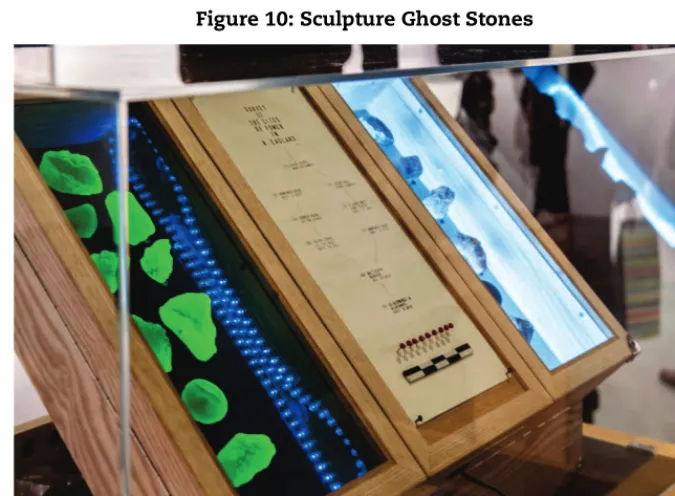
As part of the fieldwork, sites were visited at the nuclear facilities at Heysham 1&2 reactors, historical site of Sellafield and the associated training facility for vitrification of nuclear waste. Historical and heritage sites were explored at Heysham in North Lancashire, as well as a variety of prehistoric archaeological sites in the region including the monuments of Long Meg and her Daughters, the cursus at King Arthur’s Round Table near Penrith, and the stone circle at Castlerigg. The fieldwork stage led to the making of new work, notably three large-scale Diasec photographs, the series of drawings included in the exhibition at The Rheged Centre (February-April 2014) and Centre Mondial de la Paix at Verdun (September 2014), and a collaborative sculpture in which a collection of stones sourced from folkloric sites in Cumbria, were sent to New York to be cast in uranium glass. These were then returned to Cumbria with their radioactive doubles as part of the sculpture Ghost Stones (Figure 10). The film Gryss-hryggr
focuses on narrated elements of the Volsünga Saga found on the Heysham Hogback Stone
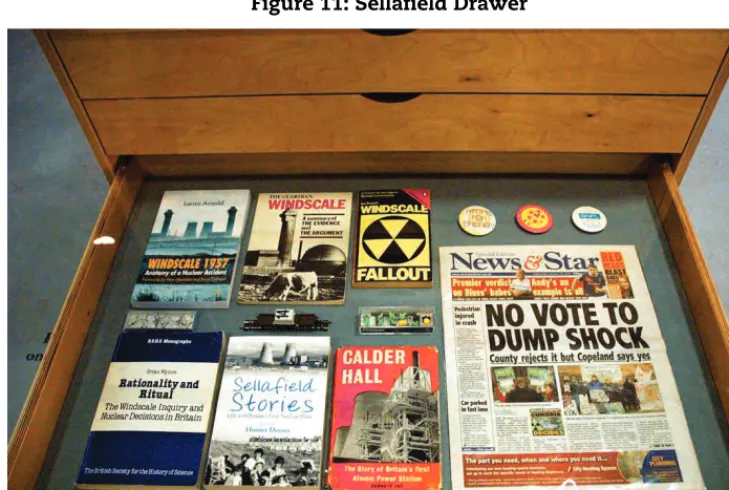
monument. Material associated with Britain’s Energy Coast, the archaeology and folklore of the region was collected to form documentation of place and context, with bibliographic references and associative material presented within two plan-chests that act as archival repositories.
Figure 10: Sculpture Ghost Stones
© Robert Williams, Bryan McGovern and Sam Knight.
Wilson made the trans-Atlantic journey in early 2011. By this time Wilson and Williams had completed research that informed the dialogic and interdisciplinary project. Not least of which was in the identification of three principle areas of interest that emerged from the investigation of the region in consideration of RK&M themes as a contribution to the discourse. The first aspect being the “energy coast” of Cumbria and North Lancashire, which encompasses the historically significant nuclear power, renewable energy production and mineral extraction industries. That these were then considered in relation to what the artists had begun to conceptualise as other “places of power” in Cumbria, was significant in their exploration of the extant archaeological monuments in the region, referencing millennia of human occupation since the last glaciation. The monuments informing this second strand ranged from the Mesolithic and Neolithic periods, later western Megalithic cultures, Brythonic Celt, to the Roman occupation signalled by the presence of Hadrian’s Wall, and the region’s mediaeval Norse heritage. The third aspect of their interest was to consider how ideas of these places of power, of “deep-time”, “mythic-time” form a sense of continuity with the land that might find expression within the narratives, stories, place names and folklore of the region in an exploration of ideas that form part of current proposals and strategies for RK&M. The extent of the field area encompassed territory within the nexus of old Lancashire, Westmorland and Cumberland. In the centre and across to the coast on the west and the Pennine Hills to the east lies the ancient kingdom of Cumbria, a place of dramatic scenery, lakes and mountains, huge geological formations and great valleys carved by glaciers nearly a mile thick during the last Ice Age.
The region is important culturally in informing the rise of Romanticism, particularly
with reference to Edmund Burke’s idea of The Sublime (1756), which focused not only on
creating the dichotomy between beauty and the sublime, but also with reference to emotional and physiological responses to landscape as part of a dynamic for interpretation. However, less well-known and yet as equally important is Harriet Martineau. A reformer and early pioneer of women’s rights, racial equality and political science, she is considered to be the first woman sociologist. Of significance for our project,
she was the author of The Complete Guide to the English Lakes (1855), in which she
sublime elements. This represents a development of Thomas West’s earlier guide book on Lakeland (1780) which led to the setting up of viewing stations linked to historical, aesthetic and antiquarian qualities which were invoked according to the theory of the significance of “place” and “context”, in order to fully appreciate the sublime experience.1 Martineau was interested in this holistic approach to the concept of place, her guidebook invoked folkloric elements, oral histories, along with antiquarian, geographical and topographical information to draw in all the aspects of a particular location in order to read landscape and to make meaning.
Central to the Cumbrian Alchemy project are the energy industries, perhaps most
directly referenced in the form of the nuclear installations on the coast. To the west is Sellafield, now no longer a producer but a reprocessing site. Sellafield began life as Calder Hall, the world’s first atomic power station and the first British facility built to provide enriched plutonium for use in Britain’s nuclear arsenal during the Cold War. Significantly, the site of production for the British nuclear submarine fleet is at Barrow-in-Furness in the south-west of the county. After Calder Hall, the nuclear facility known as Windscale was developed. It was here on 10 October 1957 that the world saw its first civil nuclear disaster. The air-cooled reactor in unit 1 malfunctioned and burnt for three days, creating a disaster of severity level 5 on the International Nuclear Event 7 point scale. While most of the nucleotide releases had short half-life decay cycles, there was still significant contamination of the site, the surrounding region and in the Irish Sea. Memory of this event and its consequences remain topical in the region. Consequently, the issue of long-term geologic storage of nuclear waste under Cumbria is a significant social, political and cultural matter within the region. The plan for a geologic repository was narrowly defeated at a local level during the lifetime of the project. The no vote surprised both local and national governments alike. It is the urban communities that oppose these underground storage facilities. The inhabitants of the West Coast and the communities surrounding Sellafield are emphatically pro-storage, representing long-term economic stability, employment and security in a very deprived part of the country.
It seemed important within the framework of our enquiry, to put aside particular ethical, moral or political positions. To treat the existence of these industries and the concomitant issues that they give rise to as phenomenon to be addressed and investigated. The artists became interested in the current discourse about the preservation of knowledge and the deep-time marking of nuclear repositories, in view of the wealth of archaeological material in close proximity to the Cumbrian sites.
Less than a mile north of the Heysham nuclear facility lies the Barrows, a site of human occupation for more than 10 000 years (see Salisbury and Sheppard, 1994; and ARS, 2009). Here are found a series of stone coffins cut into the bedrock of the premonitory that once held the bodies of Christianised Vikings at a site of one of the earliest churches established in Britain in the 8th or 9th century. Nearby in the mediaeval church of St. Peter built around 1340 on earlier Saxon foundations, is preserved the famous Viking Hogback Stone. Hogback sculptures are found in a narrow corridor on the west side of the country – a single stone found on Merseyside marks the southernmost extent, while there is a group at Govan which forms the most northerly range. The vast concentration of all known hogbacks lies within Cumbria. However, this Lancashire example is the best preserved of them all. The stone carries within its carvings two stories from the Norse Völsunga Saga, an epic tale concerning the heroes Sigmund and his son, Sigurd. They are stories of epic battles, voracious wolves, magical transformations,
and the famous story of dragon slaying when Sigurd defeats the monster Fafnír. The narration in the film, Gryss-Hryggr was provided by the late Mr John Disney, senior guide at St. Peter’s church. This was his personal account of the ancient tale, delivered in his own idiom as part of an oral tradition that goes back more than a thousand years. As a Yorkshire man, Mr Disney’s dialect owed its cadence and rhythms to the Norse speech that it developed from. Short of hearing this story in Old Icelandic, this is as authentic as it gets and is a way to link the deep past to the contemporary world.
Figure 11: Sellafield Drawer
© Robert Williams, Bryan McGovern and Sam Knight
One strategy considered in the project emerged from an encounter with the work of Thomas Seboek, a Hungarian born folklorist and semiotician. He is noted particularly for the development of the theory of Zoosemiotics, in relation to theories of mind in terms of animal communication, intelligence and language use (also see Williams R., 2013). It was his interest in languages that led to his appointment by the US Nuclear Regulatory Commission to consider ways to mark nuclear sites for future generations, in many ways a precursor to the discourse and the concerns of the Constructing Memory conference.
This work led to his noted 1984 paper Communication Measures to Bridge 10 Millennia
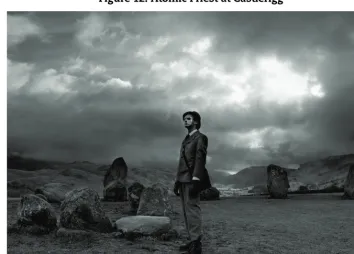
(Sebeok, 1984). He proposed what he called a “folkloric relay system” to use narrative and oral traditions, as well as a sequence of signs to create an “Atomic Priesthood”. Wilson took this as a lead in his development of the Alchemical Host that chimes directly with his
persona as the Atomic Priest within Cumbrian Alchemy. Here the Atomic Priest’s
Figure 12: Atomic Priest at Castlerigg
© Robert Williams, Bryan McGovern and Sam Knight
The third thematic aspect of the exploration in considering how power – natural,
human, or supernatural – might be identified with place, speculated on how the
communication of this might warn, beguile or control, in view of maintaining knowledge of dangerous or significant sites while transcending time on the scale of a human lifespan. Folkloric stories and oral traditions informed the research and guided this aspect of the enquiry. On the upper Eden valley lies Wild Boar Fell, where Sir Richard Musgrave killed the last wild boar of England. A tusk of this beast, formerly buried with Sir Richard’s body, is now preserved as a relic in the Parish Church of Kirby Stephen. At the western extent is a precipitous premonitory, Humphrey Head. This is the very spot where the last wolf of Cumbria was killed. The significance of these animals is also preserved within Norse place names in Cumbria – the Boar or Grisle, gives its name to
many locations in the county that have the gris prefix, like Grizedale or Grisland.
Similarly, the wolf is very much represented in place names, the word Ulpha, of which
here are many in the county, means “hill of the wolves”, and gives its name to places like Ulverston and Ullswater and Ullscarf. These two animals became important within the project as evidence of the preservation of meaning in relation to place and land over lengthy periods of time. These powerful and potent animals were imagined as elemental stewards of the land, they might have been so in the past, and remain so in terms of their continued existence in an eternal mythic space.
Robert Williams, a British artist, holds a personal chair as Professor of Fine Art at the University of Cumbria. His interdisciplinary practice draws from subjects as diverse as archaeology, taxonomy, alchemy and anthropology. Recent practice includes collaborative projects with his 16-year-old son, Jack Aylward-Williams, the American artist Mark Dion, German cultural sociologist Dr Hilmar Schäfer and the British conceptual writers, practitioners and publishers Information as Material.
Bryan McGovern Wilson is a multidisciplinary artist whose work addresses themes of time, the body, and ritual. Wilson looks to craft traditions as methodology, archaic symbolism and field research as strategy to inform his works. Wilson is the recipient of the 2014 Irwin Borowsky Prize in Glass Arts. He currently lives and works in New York City.
Wilson and Williams have worked together over several years on projects such as
Opus Magnum: Theatrum Chemicum Britannicum for the Mildred’s Lane Project in
Pennsylvania, and An Ordinall of Alchimy with Mark Dion for Cabinet Magazine in Brooklyn, New York. Cumbrian Alchemy is their first UK-based project together.
References
ARS (2009), North West Rapid Coastal Zone Assessment (NWRCZA), Archaeological Research
Services Ltd Report 2009/53, ARS Ltd, Gateshead.
Burke, E. (1998), A Philosophical Enquiry into the Sublime and Beautiful, Penguin Classics, London (original work published 1756).
Martineau, H. (1855), A Complete Guide to the English Lakes, Garnett, Windermere/Whittaker, London.
Sebeok, T.A. (1984), Communication Measures to Bridge Ten Millennia, BMI/ONWI-532,
prepared by Research Center for Language and Semiotic Studies, Indiana University, for Office of Nuclear Waste Isolation, Battelle Memorial Institute, Columbus.
West, T. (1780), A Guide to the Lakes in Cumberland, Westmorland and Lancashire, Pennington, Kendal (original work published 1777).
Williams R. (2013), “Wilder Talents (Even): Uncanny Talking Animals”, in I, Sparkie:
Andrew Dodds. Nick Thurston (ed.), Information as Material, York.
Salisbury, C.R. and D. Sheppard (1994), “The Mesolithic Occupation of Heysham Head,
Lancashire”, Transactions of Lancashire and Cheshire Antiquarian Society, No. 87,