© 2015 IJSRSET | Volume 1 | Issue 6 | Print ISSN : 2395-1990 | Online ISSN : 2394-4099 Themed Section: Engineering and Technology
Modified OLSR (MOLSR) Protocol for improving optimal route selection with
Dynamic MPR selection in Mobile Adhoc Network
Ankit Kumar Jaiswal, Siddharth Tiwari
Shree Ram Institute of Science & Technology, Jabalpur, Madhya Pradesh, India
ABSTRACT
In this Paper, we focus on proactive protocol called OLSR (Optimize Link State Routing Protocol), where the routes are always maintained by interchanging control overhead, namely HELLO and TC (Topology Control) messages. However, the resource is very wasteful and this causes the performance degradation. We propose the method to reduce the control overhead while maintaining the throughput of OLSR and also reducing the power consumption by using the well-known mathematic tool, which is widely used in interactive decision systems. Our proposed method is modified OLSR. We also investigate the effect of OLSR on power consumption of nodes based on two type of Medium Access Control (MAC) protocol; IEEE 802.11 MAC and Sensor Medium Access Control (SMAC) protocol used in mobile sensor network. OLSR is modified in such a way that every node in the system when HELLO and TC interval are expired. Each node will choose its strategy to “Update” or “Not update” the HELLO and TC messages. The performance in terms of control overhead and throughput of the proposed algorithm is evaluated by using parameters namely Routing Overhead (RO), Average Throughput. However, the performance in terms of power consumption is evaluated by metrics called Average Power Consumption of nodes in two states (transmission and reception). According to the simulation results, it is apparent that the proposed OLSR Modified algorithm (MOLSR) provides large RO reduction while the Average Throughput is reduced a little bit. The power consumption of the network in all states is also reduced. That is, the proposed algorithm modification in HELLO and TC message can reduce the certain amount of Control Overhead as well as the Power Consumption while the Average Throughput is reduced a little bit.
Keywords: HELLO and TC messages, MANET, OLSR, MAC Protocol, RO, MOLSR
I.
INTRODUCTION
Due to the revolution of the Internet, the inter-operability between computers plays a major role in today’s business functions. Sharing and exchanging information, data, and electronic services is a must in modern computing. This issue is critical not only at company or office level. Moreover, the use of Information Technology in Indus- try indicates that improvements and developments in networking should be designed to not only improve the processes in plants and factories but also be a means of helping Industry save money and make money. Owing to the number of multifarious nodes interconnected to networks is rapidly increasing these days, more knowledge and administrative services are required to provide the same
level of service. As a result, an ”auto configuration mechanism” is crucial in order to satisfy these demands.
how network topology will develop in the future. Moreover, mobility of the Users cannot be based on the prediction whether a node is about to move or not. However, a familiar User can, with certainty, predict the nodes’ need for mobility for itself and its segment. An OLSR is one of the most promising routing protocols best suited to accomplish these requirements [4]. However, OLSR itself does not handle IP address redistribution even though it needs correctly assigned addresses to work properly; it also requires unique addresses on each node. None of these mechanisms are implemented by an OLSR: DAD (Duplicate Address Detection) mechanism, or an address redistribution handling mechanism. In order to have IP ad- dresses properly allocated and assigned to all devices several proto- cols may be used, such as DHCPv6 [5], or Extensible MANET Auto- configuration Protocol (EMAP) ([6]), Passive Auto-configuration for Mobile Ad-hoc Networks (PACMAN) . For this purpose the best solution may be the exploitation of IPv6 Stateless Address Auto configuration protocol [4] or No Administration Protocol (NAP) [2] that reuses a number of OSPFv3 characteristics, and contains DAD mechanism, discusses solutions for redistributing addresses for multi-homer and single-homed networks, and proposes mecha-nisms for very complex or dynamically evolving networks.
The addresses of network may be allocated in such a way that they give some structure to spontaneous networks and provide a structure for the proposed OLSR extension. At this stage, in such a Semi-structured network the nodes that do not migrate or vary in topology have, at the very least, IP addresses from the same network scope and are unique within the network. Additionally, the MPR mechanism within the OLSR plays a very important role as a gate-way node. This MPR mechanism is used to access different nodes through the other nodes not necessary to build complete joint graph that are called MPR selectors and its status is announced to every MPR.
IEEE 801.11 Standard
The IEEE 802.11 wireless network technology is one of the current main self-organizing network transmission communication technolo- gies and the main wireless Internet-access technology. It employs well-known Infrastructure mode and an Ad-hoc mode that provides a
method for wireless devices to directly communicate with each other. The operation in Ad-hoc mode allows all wireless devices within a range of each other to discover and communicate in a peer to peer fashion without involving central access points known from Infrastructure mode. This mode is easy to set up without any addi- tional need of a centralized entity. This allows participants to com- municate with each other when there is a bi-directional connectivity present. However, this mode does functions well in close proximity of all participants.
II.
METHODS AND MATERIAL
A. Related Work
Mobile Ad hoc Networks (MANETs) are multi hop wireless networks, in which nodes move and communicate with each other without any centralized control or base stations [9]. Each node in MANETs acts as a source transmitting the data packets, as a destination receiving the packets transmitted by other source and also plays an additional role as a router, in routing the data packets which are destined to some other node. The applications of these networks are in battle field, disaster recovery and emergency rescue operations.
In MANETs nodes are in mobile nature. Hence the topology of the network frequently changes. By this reason frequent link failures occur [21]. Therefore providing an efficient and effective routing in MANETs with limited resources like radios communication range, bandwidth and power is a challenging task. In recent years, it has received tremendous amount of attention from researchers, which led to the design and implementation of several routing protocols.
Mobile Ad hoc Networks
There are two variations of wireless mobile communications. The first one is known as infrastructure wireless networks, where the mobile node communicates with a base station that is located within its transmission range (one hop away from the base station). The second one is infrastructure less wireless network which is known as Mobile Ad hoc Networks (MANETs) [12].
central administration. These nodes are self-arranged and can be organized “on the fly” anyplace, any time to support a particular reason or situation. Two nodes know how to communicate if they are within the reach of other’s transmission range; if not intermediate nodes serve as routers [2,4].
Routing in MANETs
Routing is defined as the process of finding path from a source to every destination in the network. There are three main requirements for designing ad hoc network routing protocols i.e. Low overhead, Adaptiveness and Resilience to loss. In case of low overhead, the routing protocol requires less number of control messages to transmit each data packet. Further the size of each control message is also very small. Hence it conserves bandwidth and battery. For adaptiveness, the routing protocol needs to be able to adapt to a highly dynamic environment in which topology and propagation conditions may vary significantly. For resilience to loss, the routing protocol needs to operate correctly and efficiently in the presence of packet loss. The packet loss in the ad hoc network environment is high, especially for multicast and broadcast packets.
Classification of ad hoc routing protocols
Ad hoc routing protocols are classified into various types based on different criteria [8]. Classification is shown in Fig 2.1. Classification is not commonly restricted and few more protocols fall under other classes. The routing protocols designed for ad hoc wireless networks are generally classified into four types based on Routing information update mechanism, Use of temporal information for routing, Routing topology and Utilization of specific resources.
An interesting concept described in paper [14] presents an ex- tension of the standardized OLSR routing protocol in order to make it more energy efficient. By means of energy information that is in- serted to every HELLO and TC messages by every node, it presents a new routing policy and a new MPR selection policy. Instead of the shortest-path routing policy used in standardized OLSR it uses a one hop-by-hop energy efficient routing policy, where each node for- wards the received packets towards the next hop on the minimum cost path. Also, It proposes an energy efficient selection
B. Proposed Work
MODIFIED OLSR (MOLSR)
Congestion of the network disappears and load is transmitted uniformly throughout the network. Proposed technique evaluates optimum paths based on number of hops and available energy. Load will be mainly assigned to the main path, but if the energy of the intermediate nodes is reaching to threshold (given by the ,user), then another path to be considered. This will give the benefit of shortest hop route as well as optimum node energy consideration for longer life span of the network.
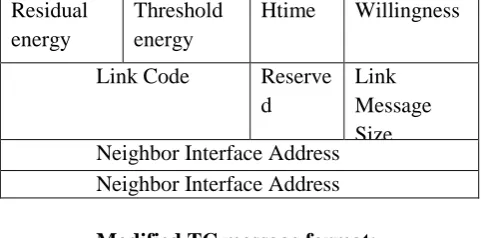
Modified Hello message format:
Residual energy
Threshold energy
Htime Willingness
Link Code Reserve
d
Link Message Size Neighbor Interface Address Neighbor Interface Address
Modified TC message format:
ANSN Residual Energy Threshold energy
Advertised Neighbor Main Address
Advertised Neighbor Main Address
The residual energy of any particular node will get compared to the threshold energy of the node. If the threshold energy of the node is greater than the residual energy of the node then data will not travel through the node, as further reduction of energy in the node may lead to the dead node. This will improve the performance of the OLSR. The performance can be evaluated by using various parameters end to end delay, routing overhead and the remaining energy.NS3 tool that is used to visualize the ns simulations and real world packet trace data. The first step to configure network and formulate topology and nodes. The trace file should contain topology information like nodes, links, queues, node connectivity etc as well as packet trace information. In this work we shall describe the trace format and simple ns commands/APIs that can be used to produce topology configurations and control.
Parameter used:Routing Overhead: Nodes often change their location within network. So, some routes are generated in the routing table which leads to unnecessary routing overhead.
End-to-end Delay: The average time taken by a data packet to arrive in the destination. It also includes the delay caused by route discovery process and the queue in data packet transmission. Only the data packets that successfully delivered to destinations that counted. ∑ (arrive time – send time) / ∑ Number of connections
Optimized Link State Routing (OLSR) is such a proactive routing protocol. Condition of bandwidth and energy will increase for higher mobility. OLSR is an optimization of pure link state routing protocol which inherits the stability of a link state algorithm and takes over the advantage of proactive routing nature to provide route instantly when needed. In this paper, we have evaluated an optimum paths based on number of hops and available energy. Load will be mainly assigned to the main path, but if the energy of the intermediate nodes is reaching to threshold (given by the user and generally depends on data type), then another path to be considered. This will give the advantage of shortest hop route as well as optimum node energy consideration for longer life span of the network. Some methods or techniques can be added to reduce the normalized overheads. In future, message authentication can be applied to the proposed protocol using SHA, routing table can be modified to introduce the integrity.
Before presenting my OLSR extension and improvement proposal, which has already been outlined earlier, let me first define what a Semi-structured network is and what it may look like. maintenance:
2. Routing table: MPR nodes are responsible on update the partial topology of the network which is maintains by periodically sending the topology message “TC” with the purpose of providing each node in the network with sufficient link-state information to allow route calculation with routing table.
3. Neighbour set: contains all information about the neighbours tuples to keep track of the a node„s neighbour status, including activates time willingness and valid time type of link state (symmetric, asymmetric) etc. this information include one and two hop tuple, is updates by Hello message modified in our Work.
4. MPR set: this include set of node selected as MPR, while MPR‟s selector is select it‟s MPR depend on neighbour set and tuple set record set of MPR selector tuples and describe neighbour which is select just one hop neighbour that have symmetric links. where the MPR nodes are responsible to generate Modified TC message for updating Routing table.
5. Link tuple: to keep track of link state between the node and its neighbours, there are two type of state synchronized link (SYN)(e.g. unidirection) and synchronized link (ASYN) (e.g.bidirections) and the interface addresses(e.g.end point of the link) of local node and neighbour node is updates by Hello message.
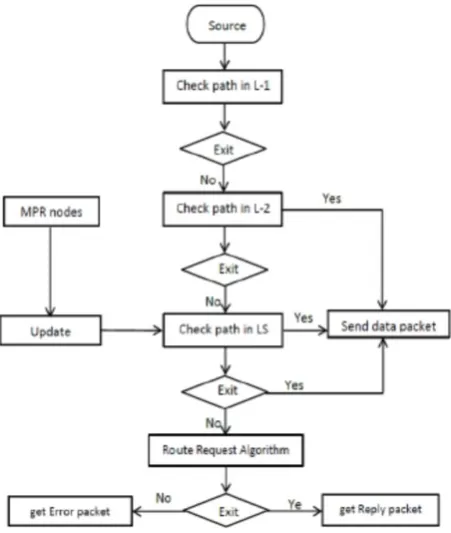
Figure 1 : flowchart of Modified OLSR Algorithm
III.
RESULTS AND DISCUSSION
Simulation and Results
NS 3 Introduction: ns (from network simulator) is a name for series of discrete event network simulators, specifically ns-1, ns-2 and ns-3. All of them are discrete-event network simulator, primarily used in researchand teaching. Ns-3 is free software, publicly available under the GNU GPLv2 license for research, development, and use. The goal of the ns-3 project is to create an open simulation environment for networking research that will be preferred inside the research community:
It should be aligned with the simulation needs of modern networking research.
It should encourage community contribution, peer review, and validation of the software.
Since the process of creation of a network simulator that contains a sufficient number of high-quality validated, tested and actively maintained models requires a lot of work, ns-3 project spreads this workload over a large community of users and developers. Our proposed method will be tested under NS-3.20 on Ubuntu 14.04 system Steps:
Processor and sensing capabilities
SA 1100
Power for a node
Single 3.4v dc Data Transmission
renge
1 mb/s up to 10 meter
Data Packet size 2500 byte Data flow rate 20 kb/s
Mobility model Random Way Point Mobility Model
Routing protocol OLSR
Name of parameter Value of the parameter Number of nodes 5,10,15,20,40
Simulation area 1000X1000 Simulation Time 100 ms Packet Size 512 Packet rate 40kb
(A) This indicates the modification of OLSR protocol In HELLO and TC Message.
void
Olsr :: CreateDevices () {
NqosWifiMacHelper wifiMac = NqoWifiMacHelper : : Default (); wifiMac.SetType("ns3::AdhocWifiMac");
YansWifiChannelHelper wifiChannel = YansWifiChannelHelper :: Default ();
WifiChennel.SewtPropogationDelay = YanWifiChennalHelper :: Default ();
// transmission power :40 mw
wifyPhy.Set ("TxPowerStart",DoubleValue(16.0206); wifyPhy.Set ("TxPowerEnd", DubleValue(16.206)); wifiPhy.Set("TxPowerLevels",UintegerValue(1)); wifiPhy.Set("TxGain",DoubleValue(0));
wifiPhy.Set("RxGain",DoubleValue(0));
// transmission range: 250 m
wifiPhy.Set("EnergyDetectionThresold" , DoubleValue(-71.9842))://modified hello message
//include energy thresold
wifiPhy.Set("CcMode1Thresold", DoubleValue(-74.9842));//modified TC message
Ptr<YansWifiChennel> chan = wifiChennel.Create(); Ptr<FriisPropogationLossModel> lossmodal = CreateObject<FriisPropogationModel> ();
//frequency: 2.4GHz
//lossmodel->m_lambda(2.40e9, 300000000.0);
chan->SetPropogationLossModel(lossmodel);
wifiPhy.SetChannel (chan);
wifiHelper wifi = WifiHelper :: Default ();
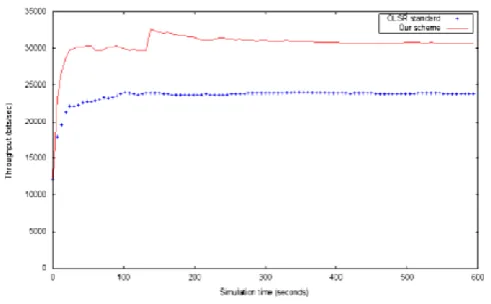
(B)This graph shows the comparison of OLSR and Modified OLSR in term of Throughput.
Figure 2 : The throughput in the network: OLSR standard vs. our scheme
(C) This graph represent Load balancing between average load and simulation time depending upon the routing table obtain after simulation.
Figure 3 : Load in the network: OLSR standard vs. our scheme
IV.
CONCLUSION
In this paper OLSR may still have some way to go, but by means of aggregating IP addresses the maximal possible improvement was achieved. The next steps forward may be achieved by the addition of already presented ideas in the field of OLSR optimalization. For example, probabilistic methods could be used in message emission intervals: Intervals have constant communication in regards to their values, specifications, and settings. However, a network segment propagated by a TCA message does not need strict regular announcing. Validity time can be set to ever increasing numbers depending upon the time- length of the segment announced by a certain MPR. Even reaching two minutes validity time may not cause routing errors nor unreachabilities of nodes due to an immoderate emission interval.This is because every node that would change its location and leave an aggregated network would be instantly announced by the next TC message via an appropriate MPR. The other improvement may target changes of IP addresses of the nodes during OLSR running in such a way that an aggregated set of nodes increases its numbers. Furthermore, this proposed extension may be combined with other improvements suggested by other scientific papers, including those of state-of-the-art.
V.
REFERENCES
[1] T. L. Andreas Tonnesen. Optimized link state
routin protocol deamon (olsrd), 2010.
[2] G. Chelius, E. Fleury, and L. Toutain. No administration proto- col (nap) for ipv6 router auto-configuration. In Advanced Infor- mation Networking and Applications, 2005. AINA 2005. 19th International Conference on, volume 2, pages 801 – 806 vol.2, march 2005.
[3] S. Cheshire and B. Aboba. Dynamic configuration
of ipv4 link- local addresses, draft-ietf.zeroconf-ipv4-linklocal-03.txt, 2001. Internet Engineering Task Force, Zeroconf Working Group, June 2001.
[4] D. Dhillon, T. S. Randhawa, M. Wang, and L.
Lamont. Imple- menting a fully distributed certificate authority in an olsr manet. 2004.
[5] R. Droms, E. Cisco, J. Bound, H. Packard, B.
Volz, et al. Dynamic host configuration protocol for ipv6 (dhcpv6).
[6] U. o. M. F. Ros, P. Ruiz. Extensible manet
auto-configuration protocol (emap), 2006.
http://masimum.dif.um.es/fjrm/ downloads/draft-ros-autoconf-emap-02.html.
[7] S. T. for Bellcore and T. N. for IBM. Ipv6
stateless address auto- configuration, 1998.
[8] F. Galano. Proposition of a mechanism to divide a
manet net- work into subnetworks of given size. 2005.
[9] R. Gilaberte and L. Herrero. Automatic
configuration of ad- hoc networks: Establishing unique ip link-local addresses. In Emerging Security Information, Systems, and Technologies, 2007. SecureWare 2007. The International Conference on, pages 157 –162, oct. 2007.
[10] S. C. J. Macker. Ietf mobile ad hoc networks
(manet) work- ing group charter.
”http://www.ietf.org/html.charters/manet- charter.html”.
[11] S. Javed, F. ul Islam, and A. Pirzada. Performance
analysis of olsr protocol in a mobile ad hoc wireless network. In Computer, Control and
Communication, 2009. IC4 2009. 2nd
International Conference on, pages 1 –5, 2009.
[12] B. Jenkins. Algorithm alley,2005.
http://burtleburtle.net/bob/hash/doobs.html.
[13] R. Joshi and P. Rege. Distributed energy efficient
routing in ad hoc networks. In Wireless Communication and Sensor Net- works, 2008. WCSN 2008. Fourth International Conference on, pages 16 –21, dec. 2008.
[14] H. Kumar. Mobile wireless adhoc networks
manet, 2004. im- age url
http://harishkumarhn.50webs.com/research. html#Mobile%20wireless%20Adhoc%20Network s% 20MANET.
[15] J. Lebegue, C. Bidan, and T. Plesse. An olsr