California State University, San Bernardino California State University, San Bernardino
CSUSB ScholarWorks
CSUSB ScholarWorks
Theses Digitization Project John M. Pfau Library
1996
Convex functions
Convex functions
Susanna Maria Zagar
Follow this and additional works at: https://scholarworks.lib.csusb.edu/etd-project Part of the Mathematics Commons
Recommended Citation Recommended Citation
Zagar, Susanna Maria, "Convex functions" (1996). Theses Digitization Project. 986. https://scholarworks.lib.csusb.edu/etd-project/986
CONVEX FUNCTIONS
A Project
Presented to the
Faculty of
California State University,
San Bernardino
In Partial Fulfillment
of the Requirements for the Degre Master of Arts
in
Mathematics
by
Susanna Maria Zagar
CONVEX FUNCTIONS
A Project
Presented to the
Faculty of
California State University,
San Bernardino
by
Susanna Maria Zagar
March 1996
Approved by:
Dr. Hajrudin Fejzic, Chair, Mathematics
Dr. Dan Rinne
Dr. Chetan Parkash
ABSTRACT
This paper will analyze convex functions.
In particular, it will
investigate criteria for convexity.
The investigation will list the
criteria from the weakest to the strongest based on theorems,
definitions, propositions, and various examples.
The theory of convex functions is based on the theory of
real-valued functions of a real variable. The purpose of this thesis is to
analyze convex functions.
We begin with the analytic and geometric representation of
convex functions. Then we establish Some properties of convex
functions. Namely, we show that a convex function on an open
interval has to be continuous and it has to be differentiable with the
possible exception of a countable set. We provide and prove two
different versions of Jensen's inequality for convex functions, and we
use this inequality to establish the familiar inequality between
arithmetic and geometric means.
In the second chapter, we give sufficient criteria for convexity,
from the familiar criteria involving Second derivatives to criteria
involving Schwartz and Peano derivatives.
The bibliography lists several books which deal with convex
functions and related material.
TABLE OF CONTENTS
ABSTRACT...^... ...iii
UST OF FIGURES... ...v
CHAPTER!
Definitions and Examples... 1
Continuity....,...;
...4
Differentiability...
...9
CHAPTER II
First Set of criteria for convexity. .14 ...1 9
BIBLIOGRAPHY ...24
CHAPTER I
1 Definitions and Examples
DeHnition 1.1 A function f is said to be convex on [a,b] when
/(or+(1-a)x') < af(x)+(1-a)f{x')
for all jc, x' {a<x<x'<b) and 0<a<1.
Example 1.1 The function f(x)= x^ is convex on (0,1).
To show that f is convex, we have to verify that the following inequality holds.
f(cxx+(l-a)x')< af(x)+(l-a)f(x')
Let 0<j*:<x'<l and 0^a<l. Then
/(or+(1-a)x')
af(x)+(1-a)f(x')
=(ocx +(l-cc)x'f
= ocx^ +(1
= a^x^ +2ax(l-a}x'+(l-a)^(x')^
= cxx^ +(x'f-a(x'X
= a^x^ +2cccc'-la^xx'+(l-2a+a^)(A:')^
Hence, we have to check that
a^x^ +laxx'-la^xx'+{x'f -2a(x'f + a^(x'f -ocx^ -(x'f + cc(x'f < 0
cxx^(a-l)+2cxxxXl-a)+a(x'f(a-l) < 0
{a-l)^ooc^-2oocx'+ a{x'f^ < 0
a{a-l){x^- 2xx'+(x'f) ^ 0
a{a-lXx-x'X < 0
-a(l-aXx-x'f < 0,
and the last inequality holds since 0<a<l.
Therefore, f{ax+{l-a)x') < af(x)+{l-a)f{x').
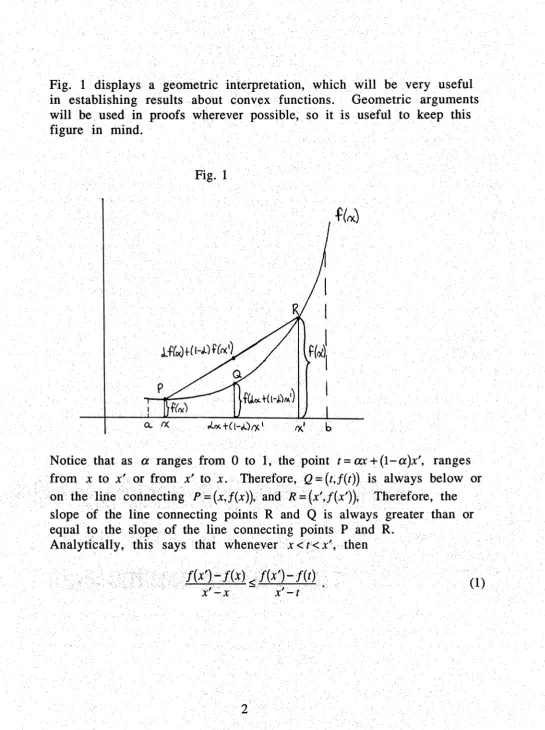
Fig. i displays a geometric interpTetation, which will be very useful
in establishing results about convex functions. Geometric arguments will be used in proofs wherever possible, so it is useful to keep this figure in mind, .
Hg. 1
JJY/x) {
T]
a
fhcc
CL /X
nC b
Notice that as a ranges from 0 to 1, the point t= ax +{l-a)x', ranges
from X to x' or from x' to x. Therefore, Q={t,f(t)) is always below or
on the line connecting P=(x,f(x)), and /?=(x',/(a:')). Therefore, the
slope of the line connecting points R and Q is always greater than or equal to the slope of the line connecting points P and R.
Analytically, this says that whenever x<t<x', then
(1)
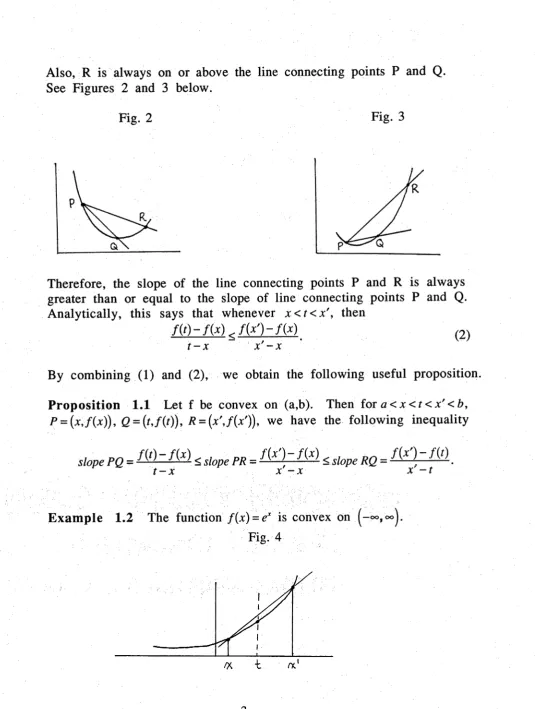
Also, R is always on or above the line connecting points P and Q.
See Figures 2 and 3 below.
Fig. 2 Fig. 3
a
Therefore, the slope of the line connecting points P and R is always
greater than or equal to the slope of line connecting points P and Q.
Analytically, this says that whenever x<t<a:', then
fit)-fix)^f{x')-fix)^
(2)
t-x x'-X
By combining (1) and (2), we obtain the following useful proposition.
Proposition 1.1 Let f be convex on (a,b). Then for
P={x,fix)), Q={t,fit)), R =(x',fix')), we have the following inequality
slope PQ = <slope PR = <slope RQ =
t-x X -X X -t
Example 1.2 The function/(x)=e'' is convex on
- -Fig.A ■
By looking at the graph of f{x)^e'', it is obvious that for any
-oo<x<t<x'
the point (t,/(0) is below the line connecting the
points (a:,/(a:)),(a:',/(a:')). We will give a proof of this fact later.
Continuity
In this section, we investigate continuity of convex functions. The
main theorem is the following result.
Theorem 1.1 If a function, f, is convex on (a,b), then f is continuous
on (a,b).
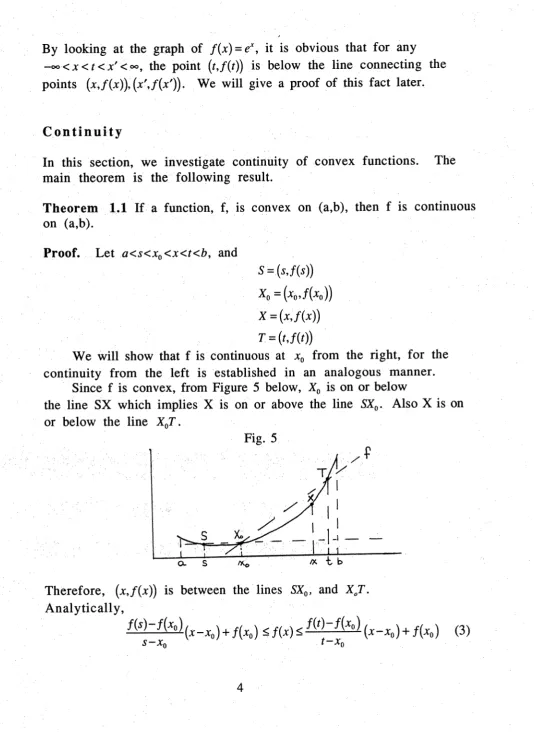
Proof. Let a<5<JCo<x<t<fe, and
X,=(x„.f(x,))
X=(x,f(x))
We will show that f is continuous at Xq from the right, for the
continuity from the left is established in an analogous manner. Since f is convex, from Figure 5 below, Xq is on or below
the line SX which implies X is on or above the line Also X is on
or below the line XJr.
Fig. 5
T
X. _ -1
u
O. S /X t. b
Therefore, (jc,/(x)) is between the lines SX^, and XJT.
Analytically,
I'.. „ \
\ ^ ^f(0~f(^o)
'■(x-x„)-^f(x,)
+
(3)
t
As x~^Xq^, the left-hand side of (3); and the right-hand side of (3)
converge to f{X(,). Therefore, by the Squeeze Theorem,
lim fix)=f{xo)'
A convex function on a closed interval [a,b]f doesn't necessarily have to be continuous at the endpoints a and b.
For example, the function
Fig. 6
X -1<X<1
f(x)= 2 jc =-l 1
2 x = l
-I
is convex on [-1,1], but obviously it fails to be continuous at the
endpoints.
We will use Theorem 1.1, to establish the well-known Jensen's
Inequality.
Theorem 1.2 (Jensen's Inequality) Let be a convex function on
an interval (a,b) and f a Riemann integrable function on (a,b) with a<f{x)<b.
f ^ b \ ^ b
Then y/
^Jf(x)dx <-^j\i/{f{x))dx.
The more general inequality involving Lebesgue integration holds and it is proved in [7]. Lebesgue's integration is beyond the scope of this thiesis. We will use the ideas from [7] to prove the theorem. In order to prove the theorem, we will briefly review the definition of the supremum.
Definition 1.2 Let A be an ordered set and X a subset of A. An
element be A is called the least upper bound (or supremum) of X if b
is an upper bound for X and there is no upper bound b' for X that is
From the definition of a supremum, it is clear that if b = sup X,
then for all aeX, a^b. Also, if c is such that for all asX^a<c, then
b<c.
The proof of Jensen's inequality now follows.
Proof. Let a<s<t<u<b.
I Ait)
a. b
The equation of the line passing through points (5,v^(s))and{«,
is
y=*h£M
y(,)
U -S
Since ij/ is convex. t More specifically, -y(^)-(t-s)+
u-s
and from here
t-s u-s
By Proposition 1.1, applied to yf with u = x',s =x, we have
\tfiu)-\i/is)^ yfju)- y/jt)^
(5)
u — s u-^t ■
1
Let t= - Since a<f{x)<b, we have a <t<b.
b-a
Le,
Then from (4) and (5), J3 is finite and for all b>u>t.
. ■ ■ ■ ' u-t
Hence, for all we have
\l/iu)>y/{t)+P(u-t) (7)
Also from (6), for all a<s<t,
¥it) Wi^)<p
t—s
y/is)>}ff{f)+P{s-t). (8)
Combining (7) and (8), we have that for all a<s<b,\j/{s)> y/{t)+p{s-1).
In particular, the inequality is true if we replace s by/(ir). Then for
all xs{a,b), we have ~ v(0 Since by Theorem 3.1,
is continuous, v^(/(3c)) is Riemann integrable, so integrating the
inequality aboye, we obtain
b h b b b
J\j/{f{x))dx-J y/{t)dx-pjf{x)dx+jSJtdx > Jodr
a ... a ■/. a a a
J
b\i/{f{x))dx - {b -a)\f/{t) -{b-a)P - t + Q)- a)p • r > 0
a
b f , b \
J y/{f{x))dx> {b-'a)\i/{t) =(b-a)y/ —-—jf{x)dx \, which is the
a V a J
desired inequality.
Example 1.3 Let a < .Vi.Aj, '•',x„ < b.
Let f(x) = \xi for a+
—— <jc<a+——
l<i<n.
[ n n
and \j/(x) = e\
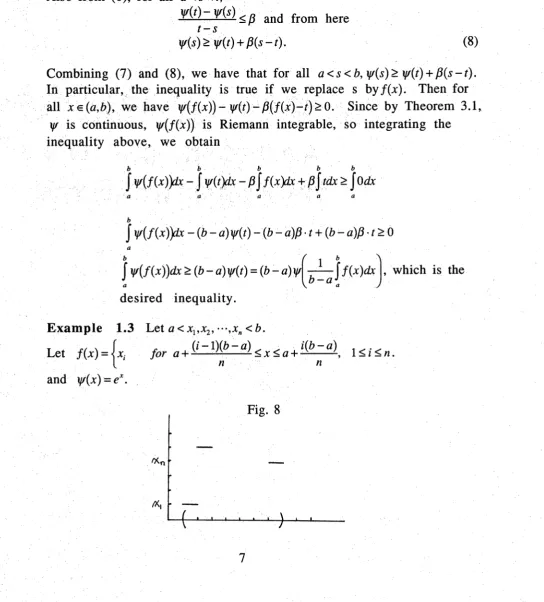
Fig. 8
/X,
The function y/ is convex and f is Riemann integrable. By Jensen's
Inequality,
^\f(x)dx I 6
e "' <— (9)
b-a'
o b
Since ^f{x)dx =
n Jtf
and
n ti
the left-hand side of
-(*1+•••+*»)
(9) is equal to c"'' " =(^''
, while the right-hand side of
(9) is
). Thus (e"
)" <-(e"'+...+c'"). Now let y,= ,
Then y,. e(0,+oo) and by substitution, we get (y,y2...y„) 1(ji +J2+—+3'/i) n
which is a familiar inequality between the arithmetic and geometric
means.
A weaker form of Jensen's inequality. Theorem 1.3, is described below. Here we give a different proof of Theorem 1.3 by using
Theorem 1.1.
Theorem 1.3 (Jensen's Inequality) Let be a convex function on
' ■ ' ''X /»
(0,1), 0<X, <1, 0< Pi,and fbri=1,2,...,n, define P„=^Pi. Then
i=l
V « J n /=1
Proof. Let y/ be a convex function on (0,1), 0<x,<1 and 0<p. for
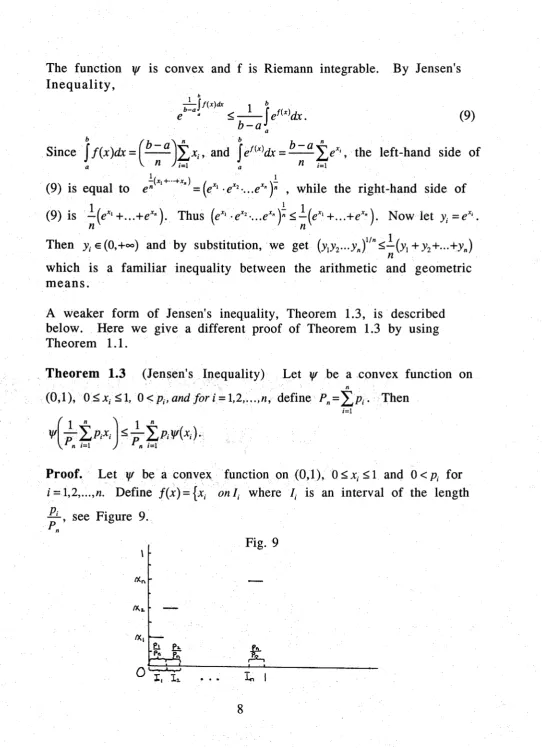
i= l,2,...,n. Define /(x)={x, on I- where /, is an interval of the length
see Figure 9.
Fig. 9
/Xn
£i In.
Glearly, fix) is between 0 and 1 and it is Riemann integrable.
Therefore by Theorem 1.2, y/
Jf(x)dx <J Y{f{x))dx. Finally since
\o ■ ■■■; ' ■ 7: r;.:'- 7;. ■
■ = Ta:, — and
[xim=y.w{x^' —, yve obtain
1=1
V''^" '=1 J '=1
Dif f er en11abilit y
Now we examine differentiability properties of convex fuhctions. Oiir goal is to show that convex functions are differentiable with the possible exception of a countable number of points. We will need
some background on one-sided derivatives and monotonic functions.
Defimtioii 1.3 The fight-hand derivative (x) and the left-hand
derivative / (x) are defined to be as follows:
and
liniyt.
f{y)-fix)f- (^) =
y-x
Theorem 1.4 Let / be convex on {a,b). Then a) /+ and f'_ exist on {a,b),
b) /+ and /' are monotone increasing, and
c) for w in lii;n/+W^/-(H')</;(H')<lini/+W
xtw xiw
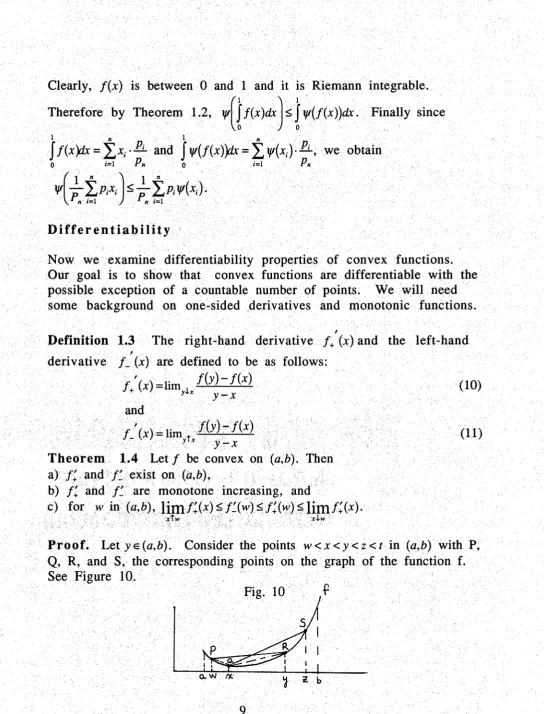
Proof. Let ys{a,b). Consider the points w<x<y<z<t in {a,b) with P, Q, R, and S, the corresponding points on the graph of the function f.
See Figure 10.
Fig. 10
,f
I
I I I—U
a w t%
Since f is convex, by Proposition 1.1, slopePQ<slopePR< slopeQR< slopeQS<slopeRS.
Since >v<jc<y, implies slope PR <slope QR, it follows that Slope QR
increases as jcTy. Similarly, slope RS decreases as ziy. Therefore,
the left-hand side of the inequality
slope QR=^^—
=slope RS increases as xTy, and the
x-y z-y
f(x)— f(y^
right-hand side decreases as ziy. Therefore, /'(y)=liin
—
xty ^ yand /+(y)= exist. Since ye(a,Z)) was arbitrary, part (a)
ziy Z-y
of the theorem is proved. Moreover, the monotonicity of the slopes
PR and QR implies that whenever x<y<z,
MzM<f(y)<f(y)<fi±:M,
(12)
jf-y ^ z-y „
To prove (b), let w<y be two points in (a,i>). If w < x< y, then from
(12) we have f!.{w)<fi{w)<^\
, and
< y:^(y)</^(y). On
x-w x-y
the other hand, from Proposition 2.1, we have
</U) f(y)^
x-w x-y
and hence fl(w)<f^(w)<fl(y)</^(y), (13)
establishing the monotonic nature of /I and /+.
Finally to prove (c), let we(a,b). For y>w from (13) we have
f:{w)<f:{y). (14)
Since /+ is monotone increasing, letting yiw in
(14), we get
/+(w)^lim/+(y)
On the other hand, for x<w, from (13) we have f'^.{x)<f_{w). (15)
Letting xtw in (15), we get lim/+(^)-/-(^)
xtw
In order to prove that the set E where the derivative of a convex
function fails to exist is countable, we need Theorem 1.2 below regarding continuity of monotonic functions.
Definition 1.4 If g is an increasing function on (a,b), then g_(x) is defined to be linig(A:+/i). Similarly, g+(A:) is defined to be +
Since g is an increasing function, g_(A:) and g+(x) exist, and g_(x)<g(x)<g^(x).
Lemma 1.1 Let an increasing function, g, be defined on (a,b). Let Xi,X2,-",x„ be arbitrary points lying in (a,b). Then
i=l , '
Proof. We may assume that a<x^<X2<-'-<x„<b. Let Xq =a, =&. Choose points yo,yi,--,y„ such that (A:=0,l,...,n) Since g is
an increasing function, ^+(xt)<g(yi) and g_(x;fc)>g(>'i_i). Combining
these inequalities, we obtain
(%)-^_(%)^
) (^= 1'2,•••,«)
(«)-.?(«) and
8{b)-g-{b)^g{b)-g(y,)
Adding the left and right side of the inequalities yields
S )~«?-
))+8^(a)-8ia)+8{b)-g.(b)< X
))+ )"8(a)+8(b)-g(y„,
it=l k=l
By simplifying the right-hand side of this inequality, we obtain (16).
Corollary 1.1 An increasing function, g, defined on (a,b) can have only a finite number of points of discontinuity at which g^.(jc)-^g_(x) is
greater than a given positive number a.
Proof. If the points x^,X2,.-;X„ e (a,b) are points of discontinuity with
^+(x,)-g_(x,) greater than cr, then from (15),
hence n Therefore,
*=i ^
there can be only finitely many Xi,X2,...,x„€((fl,i)) for which g+(x,)-g_(x,)
is greater than <T.
Theorem 1.5 The set of points of discontinuity of an increasing function, g, defined on (a,b) is at most countable.
Proof. Let H be the set of all points of discontinuity of the function
g. Let //jt be the set of those points of discontinuity of this function,
at which g(x)-g_(x)org^(x)-g(x) is greater than —. Clearly, if xeH,
then there is an integer k such that g(A:)-g_(x)>^ or g+(x)-g(x)>-.
OO
Thus, jce//^, and hence, H=
]f xeH^, then
k=l
gAx)-gM=gAx)-g{x)+g{x)-g_{x)>j, therefore by Corollary 1.1, each
is finite. Hence H is at most countable.
Now we are ready to prove our main result of this section.
Theorem 1.6
If/ is convex on (a,b), then the set where /' fails to
exist is countable.
Proof. By Theorem 1.4,
is an increasing function, and for
>v€ (a,ft), lim/:W^/-(^)^/+(^)^lim/:W- Therefore, if w is a point
jcfw xiw
of continuity of /+, then /I(w)=/+(>v) i.e. f is differentiable at w. By
Theorem 1.5, the set of points where /+ is not continuous is at most
countable. Hence, the set of points where f is not differentiable is at
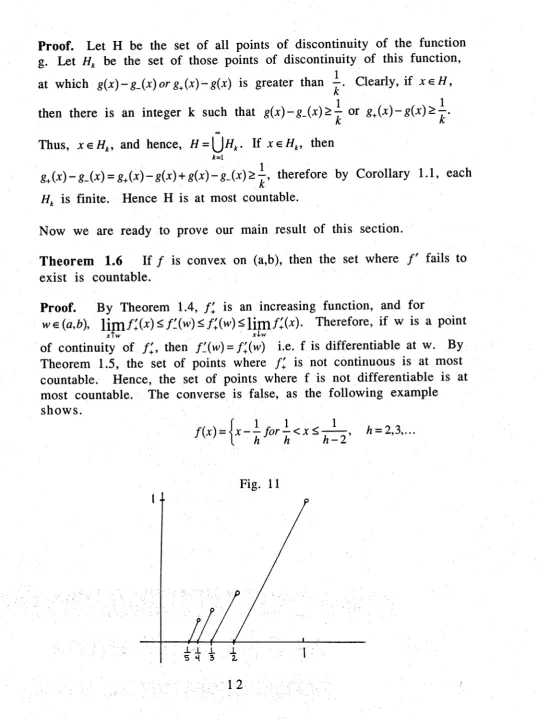
most countable. The converse is false, as the following example
shows.
h =2.X...
Fig. 11
-L iL J- i. 5 4 5 2,
Then f'{x) exists on (0,1) except at the sequence < Also it is h h=\
clear that f\x)=\ where it exists, but f{x) is not convex.
CHAPTER II
In this chapter, we give criteria for convexity. We divide these criteria
into two groups, and we present them from the weakest to the strongest.
We begin by the first set of criteria for convexity which is based on the
differentiability of a function.
2 First Set of Criteria for Convexity
The following is a useful criterion to check for convexity.
Proposition 2.1
Suppose /"(jc)>0. Then f(x) is convex.
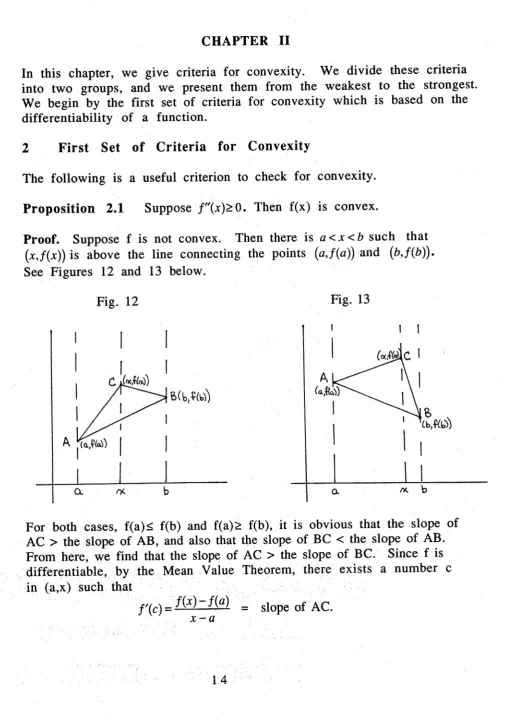
Proof. Suppose f is not convex. Then there is a<x<b such that
(jc,/(jc)) is above the line connecting the points {a,f{a)) and {b,f{b)).
See Figures 12 and 13 below.Fig. 12 Fig. 13
A
. A
A (ayto)
/X
<X
For both cases, f(a)< f(b) and f(a)> f(b), it is obvious that the slope of
AC > the slope of AB, and also that the slope of BC < the slope of AB.
From here, we find that the slope of AC > the slope of BG. Since f is
differentiable, by the Mean Value Theorem, there exists a number c
in (a,x) such that
= slope of AC.
x-a
And also, there exists a number d in (x,b) such that
f(d) = = slope of BC.
It follows that f'(c)>f'(d).
Since c < d, /' decreases.
But /"(jc)>0 implies /' is non-decreasing, a contradiction.
Hence, f must be convex.
We use this proposition to provide several examples of convex
functions.
Example 2.1 fixy^e"
r{x)= e''
Since e"" >0, the function, f(x)= e'', is convex by Proposition 2.1.
Fig. 14
Graph of f"(x)
Example 2.2 f(y)= -1
1 + ery
f'(y)=
(l+e-'r
e-'
and r(y)=
(1+e-')'
From the graph of f"{y) below, we see that /"(>')>0 for 0<3'<~.
Therefore, by the proposition, f is convex on (0,«>).
Fig. 15
Graph of r{y)
0.08
0.06:
0.04
0.02
Previously it had been shown that, for a differentiable function,
convexity implies an increasing derivative which leads into
Proposition 2.2 which shows the converse to be true, i.e. an
increasing derivative implies that f(x) is convex.
Proposition 2.2 Suppose f(x) is non-decreasing. Then f(x) is
convex.
Proof. Let f(x) be increasing. Suppose that f is not convex. Then
there is Xi<x<jc2such that [x,f{x))is above the line connecting
(xi,/(xi)),(jc2,/(a:2)). As in the proof of Proposition 2.1, we would
obtain two points c<d such that /'(c)>/'(d), which is a contradiction
since /'(jc) is increasing. Therefore, f is convex.
The next example shows that Proposition 2.2 is stronger than
Proposition 2.1.
for jr >0
Example 2.3 f{x)=
0 for X <0
^ fix forx>0
Then
/(x)=L
i
n
[0
forx<0
/'(x) is non-decreasing, therefore fix) is convex, but obviously /"(O)
doesn't exist.
A function can still be convex without /'(x) existing at a point.
Example 2.4 Let /(x)=[x].
Fig. 16
Clearly the function is convex, but it is also clear that /'(O) doesn't
exist. Moreover, there is a convex function for which /' doesn't exist
at countable many points.
From Theorem 1.4(b), we see that for convex functions where /'(x)
exists, it has to be increasing.
Example 2.5 Consider
(2n + 1
for —-— < a: < —
n{n +1) n(n +1) n + 1 n
fix)=
0 for jc <0
M
r ^
which are segments with endpoints and I — 1 for n n
n +1'(rt+1)
n=l, 2, 3, ...
Fig. 17
f(r^V trvVO*")
L
JL I
3 X
Therefore,
2n +l 1 1
for < a: < —
n(n +1) n +1 n
rix)=
doesn't exist for x =
n
Now it will be shown that f(x) is increasing.
In order to show that f(x) is increasing, it will be shown below that
2m +1 2n +l » 1^1 > -7 :t for —
/n(m +l) n(/i+l) m n
2m +\ 2/1+ 1 For
m{m +\)
/j(/i+l)'
2/m +I 2/1 +1 _ « 1 1 . .. „
>0 for —>— implies n-m>0
m{m +1) n(n +1)
m n
{rf'+n^(2m +1)-(2/i+l)('w^
^ q
mn{m + l){n +l)
Simplifying^ we obtain
(n-
m)(2mn +n + m +1) ^ q
mn(m +l)(/i+1)
We know that (n-m)>0 since — > —, and 2mn + n + m +l>0.
m n
Also, mn{m +l)(/i +1)> 0.
Therefore,
2m + 1 2/1+ 1 - 1 1
> -7 TT for — >-.
m(/n +l) n{n +l) m n
Hence, f(x) is increasing but doesn't exist at countably many points.
Convexity of f(x) is obvious from the graph.
Second Set of Criteria for Convexity
The second set of criteria is based on some generalized derivatives,
in particular on Peano and Schwartz derivatives.
We begin with definitions of Peano and Schwartz derivatives.
Definition 2.1 Second Peano Derivative
If exists, then the limit is denoted f^ix) and A-»o 2\ h
it is called the Second Peano Derivative.
If f'(x) exists, then by Taylor's formula /jCx) exists, and /2(x)=f"(x). If /2(x) exists, f" doesn't necessarily exist as the following example
shows.
■ ■ . \ 2 . ■■
„ ■ ^ v . X sm— jCi^O
Exaniple 2.6 /(;c)=
|
jc
■■ ■'■V ■ ■ ■ jc =
Here /2(x) = 0, but f"{x) doesn't exist.
By definition, if /2(x) exists, then f'{x) must exist.
Definition 2.2 The Schwartz Derivative is defined as
h^o n
If /2(jc) exists, then /^ (x) exists, as it can be easily verified.
If (x) exists, then /2(x) doesn't have to exist.
Theorem 2.1 If /2 >0 on {a,b), then f is convex.
Proof. First we prove the special case when /2 >0. Suppose that f is
not convex. Then there are d<Xp <Xj <Xj<b such that (xi,/(xi)) is above
the graph of the function between the points Xp and X2. Letg(x)=
/(X2) +
/(xp) be the line connecting points (xp,/(xp))
. X2-X0 . X2-Xp ..
and (x2,/(x2)), and consider the function h(x) = f{x)-g(x). Then it is easy
to check that /i(xp) = /i(x2) = 0, /i(xi)>0; and since g"{x) = 0 d2(x) = /2(x)>0.
Since h is continuous on [xp.Xj], there is Xp < x < X2 such that h attains its
maximum at x, and hence h'{x) = 0. From
fem.lini
^ t^o t-'-nv),|in,M.v-'-')-m^
rto all
sufficiently small t, we have > 0, and from here it follows
h{x+t)>h{x) which is a contradiction to the choice of x. Therefore f is
convex.
To prove the general case /2(x)>0 implies f{x) is convex, we will
assume that f is not convex. Therefore, there are Xo<Xi<X2
such that (xi,/(jCi)) is above the chord connecting (xo,/(xo)) and
(jC2,/(jC2)). As in the special case, consider h{x)=f(x)-g(x). Then
7i(jCo)=/i(x2)=0, /i(xi)>0 and /t2(x)=/2(x)>0.
Let H{x)= h{x)-
. Then H{xo)=H{x2)=0, and
2 -^0j(*^2 ~"^1/
//(xi)= h{xi)-
>0 and therefore H is not convex. On the other
2 2
hand, H2{x)= h2{x)+ y ^>o and by the special case, H is
{X,-X,){X2-X,)
convex. A contradiction. Therefore, f is convex.
Theorem 2.2 If f is continuous and the Schwartz derivative fXx)^0
on {a,b), then f is convex.
Proof. First we prove the special case when /,'t^x)>0. Suppose that f is not convex. Let Xo<Xi<X2, g and h be as in the proof of the special
case of Theorem 2.1. Then we have that h" exists and h">0. Since h
is continuous, there is Xo<x<X2 such that h attains its maximum at x.
From
=
2h(^)+h{x
sufficiently small t,
h{x+t)+h{x^t)> 2h{x). But this can happen only if h{x +t)> h{x) or
h(x-t)> h{x). In either case, h doesn't attain a maximum at x, which
is a contradiction.
The general case can be proved in exactly the same way as the general case of Theorem 2.1.
In the proofs of Theorems 2.1 and 2.2, we used basically the same idea which we briefly describe below:
We assume that a function / is not convex. By adding a suitable function g, we obtain the function /i with the same original
hypothesis as the function /, but for which there are three points
jfjCCjCCj such that h{xi)= h[x^)=0, and /j(jc2)>0. Since h is continuous
there is Xi<x<x^ such that the function h attains its maximum at x.
Finally the assumption on the function contradicts the choice of x. We use the same idea to prove the next two theorems but first we
introduce Schwartz derivates:
Let / be a function, the following expression
f,{x)=lim inf
^
0 called the lower Schwartz
derivate of / at a point x while //(x)=lim sup,_,o
2/(x)+/(x t)
is called the upper Schwartz derivate of / at a point x. Note that although neither Peano nor Schwartz derivative has to exist, the Schwartz derivates always exist.
Theorem 2.3 If/ is continuous and the lower Schwartz derivate is positive, then f is convex.
Proof. Suppose that f is not convex. Let x^ <Xi<X2, g and h be as in
the proof of the special case of Theorem 2.1. Then we have that
^>0. Since h is continuous, there is Xo<x<X2 such that h attains its
maximum at x. As in proofs of Theorems 2.1 and 2.2 above, it is enough to consider only the special case h'^>0. From
h(x +t)-2h(x)+ h(x-t) ^ '
^(x)=liminf
f
——^>0, for sufficiently small t,
h{x+t)-2h{x)+h{x-t)>0. But that can happen only if /j(x+r)>/i(x) or
h{x-i)> hi^x). In either case, h doesn't attain a maximum at x, which
is a contradiction.
Theorem 2.4 If f is continuous and the upper Schwartz derivate is positive, then f is convex.
Proof. Suppose that f is not convex. Let Xo<Xi<X2, g and h be as in
the proof of the special case of Theorem 2.1. Then we have that hi> 0 Since h is continuous, there is x,, < x < X2 such that h attains its
hi^+i)-2h(x]+ h(x-t)
maximum at x. From
=lim sup,^^
^
^>0, there is
a sequence {?„} converging to 0 such that h{x-\- )-2h{x)+h{x-f„)>0.
But that can happen only if hix+t„)> h{x) or
> h(x). In either
case, h doesn't attain a maximum at x, which is a contradiction.
BIBLIOGRAPHY
[1] K. "Q&mon, Euclidean Geometry and Convexity, McGraw-Hill,
New York, 1966.
[2] H. G. Eggleston, in Euclidean Space: Application of Convexity, Cambridge University, New York, 1957.
[3] S. G. Kiantz, Real Analysis and Foundations, CRC Press, New York,
1991.
[4] I. P. Natanson, Theory of Functions of a Real Variable, Vol. II, Frederick Ungar Publishing, New York, 1960, 36-47.
[5] A. W. Roberts and D. E. Varberg, Convex Functions, Academic
Press, New York, 1973.
[6] R. T. Rockafellar, Convex Analysis, Princeton University, Princeton, New Jersey, 1970.
[7] W. Rudin, Real and Complex Analysis, McGraw-Hill, New York,
1974.
{8} A. Zygmund, Trigonometric Series, Cambridge University Press, Cambridge and New York, 1990.