Available online on 30.08.2019 at http://jddtonline.info
Journal of Drug Delivery and Therapeutics
Open Access to Pharmaceutical and Medical Research© 2011-18, publisher and licensee JDDT, This is an Open Access article which permits unrestricted non-commercial use, provided the original work is properly cited
Open Access
Research Article
Formulation Development and Evaluation of Gastro Retentive Floating
Tablet of Atorvastatin using Statistical Design (JMP Software)
Patil Nilesh*, Salunkhe Kishor
Amrutvahini College of Pharmacy, Sangamner, Ahmednagar-422608, Maharashtra, India
ABSTRACT
More complications and cost of promoting of imaginative drugs are more prominent consideration to the improvement of controll ed release (CR) drug delivery systems. Sustained release or controlled release drug delivery system helps to reduced toxicity of drug and more patient compliant drug delivery system. The aim of this study is to have efficient means of manufacturirng of Gastro retentive floating tablet of Atorvastatin Calcium. Atorvastatin is used in the treatment of hyperlipidaemia. Oral bioavailability of atorvastatin calcium is less than 12% due to instability and in complete absorption. It also undergoes high first pass metabolism. It is absorbed more in the upper part of the GIT. Gastro retentive drug delivery system of Atorvastatin enhanced the bioavailability by retaining the drug in upper part of GIT and by preventing the first pass metabolism of the drug. The objective of present work was to create and assessed oral extended release gastro retentive tablet dosage form of Atorvastatin by using direct compression method using Methocel K4MDC2, Methocel K100MDC2 and Glyceryl behenate using Statistical design (JMP software). Sodium bicarbonate and Citric Acid is used as gas generating agent which helps to float the tablet.
Keywords: Atorvastatin Calcium, Floating Tablet, Direct compression, In-vitro drug release, JMP
Article Info:Received 12 July 2019; Review Completed 16 August 2019; Accepted 19 August 2019; Available online 30 Aug 2019
Cite this article as:
Patil N, Salunkhe K, Formulation Development and Evaluation of Gastro Retentive Floating Tablet of Atorvastatin using Statistical Design (JMP Software), Journal of Drug Delivery and Therapeutics. 2019; 9(4-A):19-25
http://dx.doi.org/10.22270/jddt.v9i4-A.3284
*Address for Correspondence:
Mr. Nilesh Patil, Amrutvahini College of Pharmacy, Sangamner, Ahmednagar-422608, Maharashtra, India
INTRODUCTION:
The oral route of drug administration is the most important strategy of regulating the drug for systemic impact. To attain and keep up the concentration of managed drug within therapeutically viable range, it is frequently necessary to take drug dosage a few times and this result in fluctuating levels in plasma. Controlled drug delivery systems have been presented to overwhelm the downsides of fluctuating levels
associated with traditional dosage form1.
Gastro retentive drug delivery system (GRDDS) is novel site-specific drug delivery for advancing maintenance of drug within the stomach, duodenum or small intestine can drag out drug released to controlled manner. The oral administration approaches to realize prolong discharge of drug is the utilize of gastro-retentive frameworks. The thought is to prolong the home time of the drug release
within the stomach known as gastric home time (GRT)2
GRDDS expand essentially the term of time over which the drugs may be released. They not as it were draw out dosing interims, but moreover increment quiet compliance past the level of existing controlled release dosage form. Control release suggests the consistency and reproducibility to control the drug release, drug concentration in target tissue and optimization of the restorative impact of a drug by
controlling its release within the body with lower and less
visit measurements3,4
Controlling the home time of drug delivery system in a specific locale of GI tract can be achieved by a few approaches, muco adhesive system, super permeable
hydrogels and expandable system and drifting drug release5
Choice of excipients is a critical strategic decision for planning a dosage form with consistence and controlled release in the stomach. Water dissolvable cellulose derivatives represent a normal lesson of polymers best suited for such purposes. It has been proposed that higher molecular weight polymers and slower rates of polymer hydration are ordinarily related with better drifting behavior. In this manner, tall molecular weight and less hydrophilic polymers are expected to improve floating
properties of delivery systems6
Effervescent drifting drug delivery systems are the network sort systems formulated with the assistance of swellable polymers such as hydroxyl propyl methyl-cellulose with various effervescent components like sodium bicarbonate and citric acid. Such dosage forms once interacted with gastric fluid then carbon dioxide liberated, and it helps the swollen matrix to float in stomach and release the drug at
The point of the work is to create a Gastroretentive floating drug delivery tablet of atorvastatin calcium by effervescence strategy. The objective behind the study was to analyze the impact of concentration of Methocel polymers and glyceryl behenate, concentration of sodium bicarbonate and citric acid on the release of atorvastatin calcium utilizing Statistical design.
MATERIALS AND METHODS:
Materials:
Atorvastatin Calcium was obtained as a gift sample from Rubicon Research, Mumbai. Hydroxy propyl methyl cellulose (HPMC K4M DC2 & K100M DC2) and Starch 1500 was obtained from Colorcon Asia Bio limited. (India). Citric acid, Magnesium stearate, Sodium bicarbonate, were obtained from Perrigo Laboratories as gift sample. Glyceryl behenate (Compritol 888 ATO) obtained from Gattefosse, Mumbai. All other ingredients used for analytical method were analytical grade material.
Method:
Different formulation composition is determined using Custom design using JMP software (version 13).and batches prepared accordingly.
Extended release floating tablets of Atorvastatin were prepared by direct compression method. Weighed accurately quantity of all the excipients and drug Atorvastatin Calcium. Sifted all raw materials through mesh 20# ASTM. Atorvastatin and Glyceryl behenate mixed in V-shell blender for 15 minutes. Added other excipients such as HPMC K4MDC2, HPMCK100M DC2, Starch 1500, Citric Acid and Sodium bicarbonate and mixed for 30 minutes in V-blender and lubricated the blend with sifted magnesium stearate for 5 minutes in V-blender. Then lubricated blend was feed in hopper and tablets were prepared by direct compression using multi station rotatory punching machine. The tablets were prepared using the punch of 10 mm diameter using the rotary tablet processing machine. Each formulation was composed of drug and excipients in various proportions as shown in Table1 and Table 2:
Table 1: Formulation details for F1to F6
Ingredients F1 F2 F3 F4 F5 F6
Atorvastatin Calcium 86.76 86.76 86.76 86.76 86.76 86.76
Glyceryl Behenate 43.00 43.00 43.00 43.00 43.00 43.00
Methocel K4MDC2 80.00 100.00 80.00 120.00 120.00 80.00
Methocel K100M DC2 140.00 120.00 100.00 100.00 140.00 100.00
Starch 1500 25.00 25.00 25.00 25.00 25.00 25.00
Sodium bicarbonate 20.00 30.00 30.00 30.00 30.00 30.00
Citric Acid anhydrous 15.00 10.00 10.00 10.00 10.00 10.00
Microcrystalline Cellulose PH 102 85.24 80.24 120.24 80.24 40.24 120.24
Magnesium Stearate 5.00 5.00 5.00 5.00 5.00 5.00
Total 500.00 500.00 500.00 500.00 500.00 500.00
Table 2: Formulation details for F7 to F12
Ingredients F7 F8 F9 F10 F11 F12
Atorvastatin Calcium 86.76 86.76 86.76 86.76 86.76 86.76
Glyceryl Behenate 43.00 43.00 43.00 43.00 43.00 43.00
Methocel K4MDC2 100.00 120.00 80.00 80.00 120.00 80.00
Methocel K100M DC2 120.00 100.00 100.00 140.00 140.00 140.00
Starch 1500 25.00 25.00 25.00 25.00 25.00 25.00
Sodium bicarbonate 30.00 30.00 30.00 30.00 30.00 30.00
Citric Acid anhydrous 10.00 10.00 10.00 10.00 10.00 10.00
Microcrystalline Cellulose PH 102 80.24 80.24 120.24 80.24 40.24 80.24
Magnesium Stearate 5.00 5.00 5.00 5.00 5.00 5.00
Total 500.00 500.00 500.00 500.00 500.00 500.00
Characterization of Atorvastatin Floating Tablet: Pre-compression studies9:
Evaluation final mix/blend were carried out to check the flow properties of blend includes angle of repose, bulk density and tapped density, compressibility index and Hausner's ratio.
Angle of Repose:
This is the angle between the horizontal plane and surface of a pile of blend. It was determined by using the funnel method. The weighed final mix/blend was taken in the funnel. The altitude of the funnel adjusted to the maximum cone height (h) and final mix/blend was poured through the funnel freely on to the surface. Then the radius of the heap (r) was measured and angle of repose was calculated. The diameter of the granule cone will be measured and then the angle of repose.
Tan Ѳ= h/r
Bulk density (BD):
50 g of final mix/ blend was introduced to a measuring cylinder of 250 ml. The volume occupied by the powder was measured which gave bulk volume. The bulk density of blend was determined using the following formula.
Bulk Density = Total weight of blend / Total volume of blend
Tapped density (TD):
The measuring cylinder was tapped until no further change in volume was noted which gave the tapped volume. The tapped density of blend blends was determined using the following formula.
Compressibility/Carr’s Index:
Compressibility / Carr’s index was calculated by below formula
Carr’s Index (%) = (Tapped density – Bulk density ) / (Tapped density) x 100
Hausner’s ratio
It is the measurement of frictional resistance of the final mix/blend. The ideal range should be 1.2-1.5, it was determined by the ratio of tapped density and bulk density.
HR = Tapped Density/ Bulk Density
Post Compression Parameters:
All batches were evaluated for different tableting parameters as follows;
Weight Variation:
Twenty tablets from each batch were selected randomly and their average weight was calculated. Then individual weight of each tablet was determined using analytical weighing balance and was compared with average weight.
Hardness:
Tablet hardness was measured by using Dr. Schleuniger hardness tester. From each batch 10 tablets were measured for the hardness and average of 10 values was noted along with standard deviations.
Thickness:
Ten tablets from the representative sample from each batch were randomly taken and individual tablet thickness was measured by using digital Vernier caliper.
Friability test:
For all batche friability were evaluated, Fifteen (15) tablets were accurately weighed and placed in the friability test apparatus. Apparatus was rotated for 100 rpm at the rate at 25 rpm per minute and tablets. The tablets were then taken reweighed. The friability was calculated as the percentage weight loss.
% friability = (Initial weight – Final weight after rotation) / (Initial weight) x 100
Drug Content:
10 tablets were weighed and powdered in mortar and pestle. A quantity equivalent to 100 mg of Atorvastatin calcium was taken in a 100 ml volumetric flask and dissolved in small
volume of Acetonitrile and made up the volume with 0.1N HCL and filtered using 0.45µ filter. An aliquot of 10 ml was pipetted out into 100 ml volumetric flask and made up the volume with diluent (0.1N HCl). Absorbance was read at 244 nm using 0.1N HCL as a blank.
Floating Lag time:
Floating lag time were evaluated to check the time taken by the dosage form to float on the top of the dissolution medium. The time required for the dosage form to rise to the
surface and float is called as floating lag time10
Total Floating time:
The time for which the dosage form floats on the dissolution medium is termed as floating time. All the formulations constantly floated on dissolution medium for varied period of time.
In-vitro drug release study:
In vitro dissolution study of atorvastatin calcium tablets was carried out in USP Dissolution apparatus type II in 900 ml 0.1 N HCl (pH 1.2), temperature maintained at 37± 0.5ºC with a speed of 75 rpm. Samples of 10 ml were withdrawn from the dissolution apparatus at pre-determined intervals i.e. 30 min, 1hr, 2hr, 3hr, 4hr, 6hr, 8hr and 10 hr and analyzed using HPLC instrument at wavelength 244 nm.
Statistical Evaluation of Data:
Statistical evaluation of the data was determined with the help of JMP Software (Version: 13) The models were generated for all the response variables using multiple linear regression analysis. 3D response plots were constructed using JMP software.
RESULTS AND DISCUSSION:
Physical characterization of final blend:
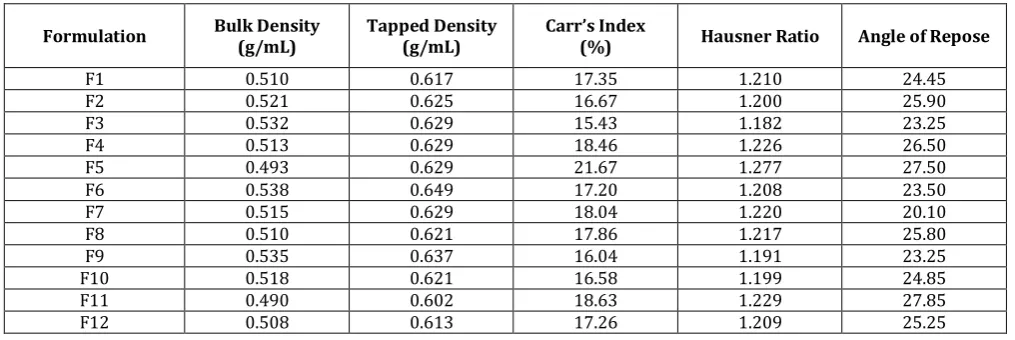
The powder blend was check through different evaluation to asses flow properties of final mix/blend. Bulk density of powder blend was found between 0.490 to 0.538 g/mL, and tapped density ranged between 0.602 to 0.649 g/mL, Carr's index was found to be in the range of 15.43 to 21.67. Hausner's ratio values for all the formulations were found to be about 1.182 to 1.277. And angle of repose was found to be in the range of 23.25 to 27.85. The values all physical evaluation of blend, indicating good flow of the final mix/blend. Table 3 shows all batches results
Table 3: Physical Characterization of final blend:
Formulation Bulk Density (g/mL) Tapped Density (g/mL) Carr’s Index (%) Hausner Ratio Angle of Repose
F1 0.510 0.617 17.35 1.210 24.45
F2 0.521 0.625 16.67 1.200 25.90
F3 0.532 0.629 15.43 1.182 23.25
F4 0.513 0.629 18.46 1.226 26.50
F5 0.493 0.629 21.67 1.277 27.50
F6 0.538 0.649 17.20 1.208 23.50
F7 0.515 0.629 18.04 1.220 20.10
F8 0.510 0.621 17.86 1.217 25.80
F9 0.535 0.637 16.04 1.191 23.25
F10 0.518 0.621 16.58 1.199 24.85
F11 0.490 0.602 18.63 1.229 27.85
Evaluation of compressed tablets:
Compressed tablets were evaluated for different physical characterization such as weight variation, hardness,
friability, thickness. Table 4 comprises all batches post compression parameters results.
Table 4: Compressed Tablet evaluation:
Formulation Weight variation (mg) Hardness (SCU) Thickness (mm) Friability (%) Drug Content (%)
F1 500 ± 9 21.5 5.27 0.21 99.6
F2 500 ± 8 22.7 5.32 0.23 99.0
F3 500 ± 8 20.4 5.40 0.24 98.5
F4 500 ± 12 22.1 5.28 0.18 100.1
F5 500 ± 10 21.9 5.33 0.22 98.6
F6 500 ± 11 22.8 5.40 0.17 99.4
F7 500 ± 8 20.4 5.52 0.19 100.3
F8 500 ± 13 23.5 5.31 0.21 99.9
F9 500 ± 12 19.8 5.28 0.27 98.8
F10 500 ± 10 20.9 5.25 0.22 98.6
F11 500 ± 9 22.7 5.37 0.18 100.1
F12 500 ± 11 20.9 5.26 0.26 98.7
Table 5: Floating behavior of Tablet
Formulation Floating lag time in seconds (n=3) Total Floating time (hr:min)
F1 83 7:15
F2 81 7:35
F3 61 6:50
F4 90 8:05
F5 127 9:30
F6 66 6:40
F7 71 7:45
F8 94 8:25
F9 63 6:40
F10 77 7:10
F11 123 9:45
F12 79 7:20
In-vitro dissolution study
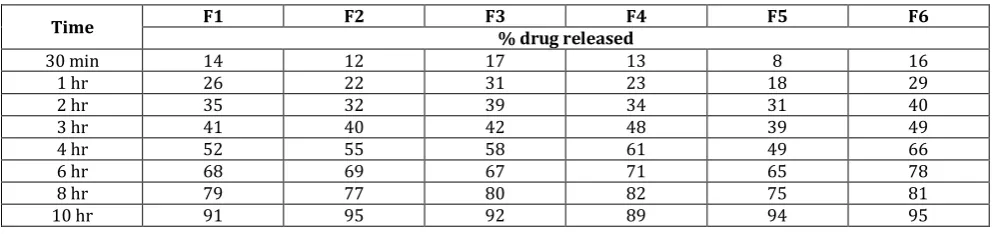
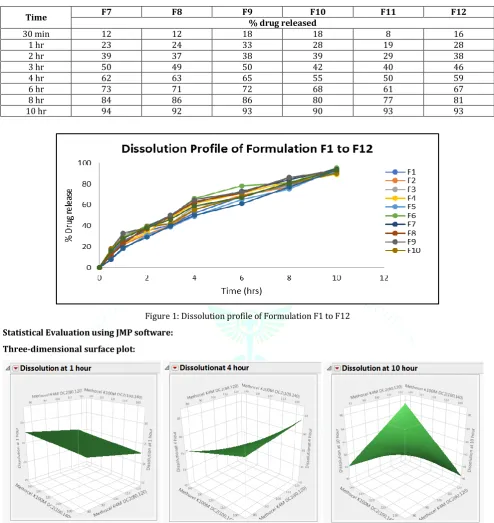
The tablets were evaluated for in vitro dissolution studies in 0.1N HCl for 1 hours. Drug release of all formulation shown in Table 6 and Table 7
Dissolution condition: 0.1N HCl, 900 mL, Type II, 75 RPM, temperature at 37± 0.5ºC
Table 6. Percentage drug release of Atorvastatin floating tablet
Time F1 F2 F3 F4 F5 F6
% drug released
30 min 14 12 17 13 8 16
1 hr 26 22 31 23 18 29
2 hr 35 32 39 34 31 40
3 hr 41 40 42 48 39 49
4 hr 52 55 58 61 49 66
6 hr 68 69 67 71 65 78
8 hr 79 77 80 82 75 81
Table 7. Percentage drug release of Atorvastatin floating tablet
Time F7 F8 F9 % drug released F10 F11 F12
30 min 12 12 18 18 8 16
1 hr 23 24 33 28 19 28
2 hr 39 37 38 39 29 38
3 hr 50 49 50 42 40 46
4 hr 62 63 65 55 50 59
6 hr 73 71 72 68 61 67
8 hr 84 86 86 80 77 81
10 hr 94 92 93 90 93 93
Figure 1: Dissolution profile of Formulation F1 to F12
Statistical Evaluation using JMP software: Three-dimensional surface plot:
Figure 2: Three-dimensional surface of % cumulative drug release at 1 hr, 4hr and10 hr as a function of formulation variables.
Response plot as a function of Formulation variables
Figure 4: Contour profile of Formulation F5 and F11 having Methocel K4M DC2 is 120mg and Methocel K100M DC2 is 140 mg Response plot (Actual vs Predicted), Contour plot shows
formulation F5 and F11 (Methocel K4M DC2 120mg and Methocel K100M DC2 140 mg) looks to be optimized formulation.
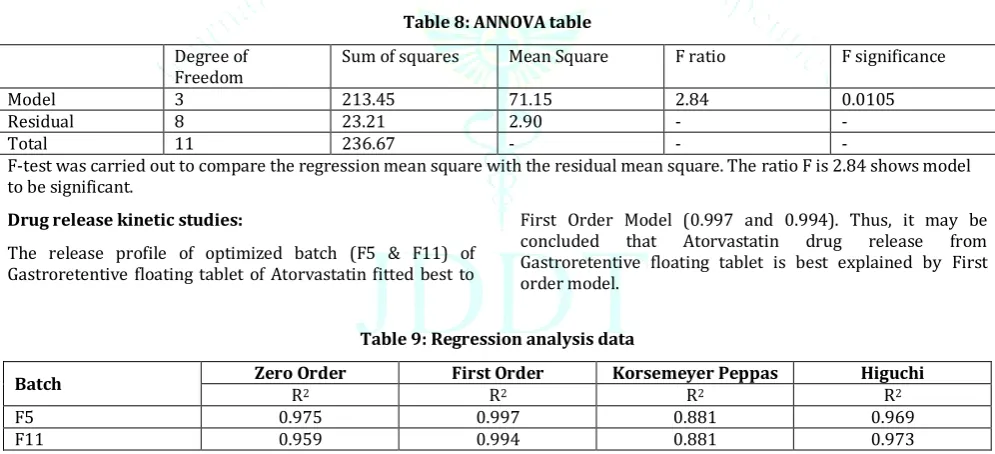
ANOVA was applied using on the % cumulative drug release to study the fitting and significations of model in Table 8
Table 8: ANNOVA table
Degree of
Freedom Sum of squares Mean Square F ratio F significance
Model 3 213.45 71.15 2.84 0.0105
Residual 8 23.21 2.90 - -
Total 11 236.67 - - -
F-test was carried out to compare the regression mean square with the residual mean square. The ratio F is 2.84 shows model to be significant.
Drug release kinetic studies:
The release profile of optimized batch (F5 & F11) of Gastroretentive floating tablet of Atorvastatin fitted best to
First Order Model (0.997 and 0.994). Thus, it may be
concluded that Atorvastatin drug release from
Gastroretentive floating tablet is best explained by First order model.
Table 9: Regression analysis data
Batch Zero Order R2 First Order R2 Korsemeyer Peppas R2 Higuchi R2
F5 0.975 0.997 0.881 0.969
F11 0.959 0.994 0.881 0.973
CONCLUSION:
Atorvastatin calcium Gastroretentive floating tablets were successfully prepared by direct compression method using statistical design (JMP software). The combination of Methocel K4M DC2 (24%, 120mg/tablet) and Methocel K100M DC2 (28%, 140mg) with sodium bicarbonate (6%) and Citric acid anhydrous (2%) was found to achieve optimum in vitro release (drug release at 1 hour below 20% which ensures no dose dumping, release at 4 hours shows half of drug released and at 10 hour ensures complete release of drug). In vitro release data were fitted to various kinetic models and drug release predominantly follows First Order model.
REFERENCES:
1. Singh BN et al. Floating drug delivery system: An approach to oral controlled drug delivery via gastric retention. J Control Release, 2000, 63(11), 235-259
2. Bansal AK, Chawla G, Gupta P, Koradia V. Gastroretention: A means to address regional variability in intestinal absorption. Pharmaceutical Technology. 2003;2(1):50-68
3. Rocca DJG, Omidian H, Shah K. Progresses in gastro retentive drug delivery systems. Business briefing Pharmatech 2003; 152-6.
4. Garg S, Sharma S. Gastro retentive drug delivery systems. Business Briefing Pharmatech 2003; 160-66
6. Patel GM. Floating drug delivery system: An innovative approach to prolong gastric
Retention.
7. Sharma N, Agarwal D, Gupta MK, Khinchi M. A comprehensive review on floating drug delivery system. International Journal of Research and Pharmaceutical Biomedical Sciences. 2011; 2(2): 428-41.
8. Kumar M, Pandey P, Dureja H. Box-Behnken designed gastroretentive floating tablets of famotidine. Drug Development and Delivery. 2015; 15(3): 62-7.
9. Elmowafy EM, Awad GA, Mansour S, El-Shamy AE. Release mechanisms behind
polysaccharides-based famotidine controlled release matrix tablets. AAPS
PharmSciTech. 2008; 9(4): 1230-9.