SMP-SIM: an SMP-based Discrete-event
Execution-driven Performance Simulator
Yufei Lin, Xinhai Xu, Yuhua Tang, Xin Zhang, and Xiaowei Guo
State Key Laboratory of High Performance Computing National University of Defense Technology, Changsha, China
{linyufei,xuxinhai,yhtang}@nudt.edu.cn,[email protected], xiaow [email protected]
Abstract. Designing and implementing a large-scale parallel system can be time-consuming and costly. It is therefore desirable to enable system developers to predict the performance of a parallel system at its design phase so that they can evaluate design alternatives to better meet per-formance requirements. Before the target machine is completely built, the developers can always build an symmetric multi-processor (SMP) for eval-uation purposes. In this paper, we introduce an SMP-based discrete-event execution-driven performance simulation method for message passing in-terface (MPI) programs and describe the design and implementation of a simulator called SMP-SIM. As the processes share the same memory space in an SMP, SMP-SIM manages the events globally at the granular-ity of central processing units (CPUs). Furthermore, by re-implementing core MPI point-to-point communication primitives, SMP-SIM handles the communication virtually and sequential computation actually. Our exper-imental results show that SMP-SIM is highly accurate and scalable, re-sulting in errors of less than 7.60% for both SMP and SMP-Cluster target machines.
Keywords:simulator, SMP, MPI, performance prediction.
1.
Introduction
Discrete event simulation is capable of simulating large-scale parallel sys-tems. The simulation procedure jumps from one state to another upon the oc-currence of an event [5]. A simulator updates the simulation time and state information by processing the events. Events are generated either by the pre-extracted trace (trace-driven) or by the execution of the program (execution-driven). For trace-driven techniques, such as Dimemas [12], PERC [19] and SIM-MPI [18], the event trace is obtained with instrumentation tools by running the program before the simulator runs. For execution-driven techniques, such as WWT [17], WWT II [14], MPI-SIM [15] and BigSim [26], the events are gen-erated when the program is running.
In discrete event simulation, the large-scale parallel machine to be con-ducted is called thetarget machine, the machine on which the simulator exe-cutes is called thehost machine, and the program whose performance is to be predicted is called thetarget program. Through analysis, we find that before the target machine is completely constructed, the system developers can al-ways build a symmetric multi-processor (SMP), whose central processing units (CPUs) are the same as those in the target machine. If the target machine is an SMP, such as NEC SX-9 [20], CRAY CX1000-S [4] or IBM SP-SMP [8], the developers can use some of the target machine’s CPUs to build a smaller SMP. If the target machine is an SMP-Cluster, a cluster whose nodes are SMPs, such as Roadrunner [2], Tianhe-1A [24] or K Computer [1], the developers can have at least one of the SMP nodes at the design phase. Therefore, we have opted to use the smaller SMP (or the SMP node) as the host machine to predict the performance of the target program on the target machine.
SMPs are well suited to discrete event simulation since the processes share the memory and are controlled by the same operating system. However, there has not been a simulation method utilizing these characteristics. Thus, in this paper, for message passing interface (MPI) [22], the de facto standard for paral-lel computing, we propose and design SMP-SIM, an SMP-based discrete-event execution-driven performance simulator. Our main contributions are as follows:
– We introduce a discrete-event execution-driven simulation method based on SMPs.
– We describe the design of SMP-SIM, a discrete-event execution-driven per-formance simulator, which consists of three modules, primitive decomposer, communication model, and event management.
– By re-implementing MPI core point-to-point communication primitives, we have implemented SMP-SIM based on MPICH2 [13].
– We show that SMP-SIM is highly accurate and scalable, with errors of less than 7.60% for both SMP and SMP-Cluster target machines.
2.
Related Work
Discrete event simulation has been researched extensively in academia and industries. A number of simulators have been developed, including WWT [17] and WWT II [14] of University of Wisconsin, Dimemas [12] of CEPBA (European Center for Parallelism in Barcelona), MPI-SIM [15] of University of California, PERC [19] of San Diego Supercomputer Center, and BigSim [26] of University of Illinois at Urbana-Champaign. Among these simulators, MPI-SIM and BigSim are the most similar with SMP-SIM. All the three predict the performance while executing the target MPI applications.
In MPI-SIM, each process of the target program is simulated by a thread. MPI-SIM uses a portable library MPI-LITE to translate the target program into a multithreaded program, and measures the execution time of sequential com-putation codes when the multithreaded program is executing. However, threads differ from processs in terms of such program behaviours such as cache re-placement policy and execution pattern. As a result, the sequential computation time cannot be measured accurately. Moreover, because MPI-SIM is not based on the SMP host machine, messages must carry the simulation timestamps that are used to calculate communication overheads.
BigSim is a simulator developed for BlueGene/C. The simulator contains two parts, a parallel-function emulator and a parallel-network simulator BigNet-Sim [27]. BigBigNet-Sim defines a set of application interfaces, such as addMessage and sendPacket, which are used to implement the MPI interfaces. All the ap-plication interfaces are executed by the simulator, and the other codes are di-rectly executed on the host machine. In BigSim, the sequential computation time is calculated by heuristic approaches, which cannot lead to high accuracy. Several parallel programming languages are implemented on BigSim, including MPI, CHARM++ [10] and Adaptive MPI [7].
Zhai et al. [25] proposed a new method, called Phantom, to estimate the sequential computation time, which is used in a trace-driven simulator SIM-MPI [18]. Phantom needs to execute the target program twice. During the first execution, the communication traces of parallel applications are generated by intercepting all communication operations for each process and the computa-tion between communicacomputa-tion operacomputa-tions is marked as sequential computacomputa-tion unit. During the second execution, the real sequential computation time is mea-sured on a target processing node for each process one by one. However, exe-cuting the target program twice is time-consuming. And it cannot deal with the uncertain programs because an inaccurate trace is usually generated.
The above simulation approaches are not based on SMP. To the best of our knowledge, there has not been an SMP-based performance simulator for MPI programs.
3.
Basic Ideas of SMP-SIM
events are processed for performance prediction. In this section, we introduce the basic idea behind SMP-SIM by addressing these questions. Without loss of generality, we assume that the core count of the target machine is equal to the process count of the target program. It should be noticed that as mentioned in Section 1, the CPUs in the host and target machines are the same.
3.1. Event Definition
For an MPI program, at any point during execution, a process is in either the
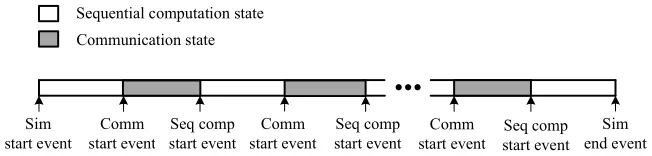
sequential computation state or the communication state. So there are four types of events during the simulation of an MPI program: simulation start events,simulation end events,communication start events and sequen-tial computation start events. A simulation start event means that the simula-tion starts, i.e. a process enters the sequential computasimula-tion state. A simulasimula-tion end event means that the simulation ends, i.e. a process ends. A communi-cation start event means that the process enters the communicommuni-cation state. A sequential computation start event means that the process enters the sequen-tial computation state.
It is not difficult to find out that the simulation start event and the simulation end event for an MPI process are the first event and the last event, respectively, of the process. Communication start events and sequential computation start events are generated alternately, as shown in Fig. 1.
Sequential computation state
Communication state
...
Sim start event
Sim end event Comm
start event
Seq comp start event
Comm start event
Comm start event Seq comp
start event
Seq comp start event
Fig. 1.The relationship between events and states.
3.2. Event Generation
program), trace-driven simulation may be inaccurate with the incorrect trace acquired.
For an execution-driven method, events are generated during program ex-ecution. Thus, program behaviours such as branch prediction and dynamic in-struction generation can all be simulated. Moreover, an execution-driven method can make use of available system resources to directly execute portions of the application code and simulate the features that are of specific interest or unavailable [16]. We prefer an execution-driven method over a trace-driven method, because the former is closer to the program execution reality and has higher efficiency. Therefore, in SMP-SIM, the events are generated when the target program is running on the host machine:
– The first executable statement in an MPI process is MPI Init and the last one is MPI Finalize. So the execution time of a process under considera-tion is the time period between MPI Init and MPI Finalize. Therefore, when the MPI process encounters MPI Init and MPI Finalize, the simulation start event and simulation end event are generated respectively.
– When encountering an MPI communication primitive, such as MPI Ibsend or MPI Irecv, a process enters the communication state and a communica-tion start event is generated.
– When an MPI communication primitive finishes (i.e. a process returns from an MPI communication primitive), the process enters the sequential com-putation state and a sequential comcom-putation start event is generated.
3.3. Processing the Events
The aim of processing the events is to estimate the execution time of the target program running on the target machine. For this purpose, SMP-SIM maintains the simulation time for each process of the target program, denoted asts. When
an event is generated when the target program is executing on the host ma-chine, the simulation time of this process will be updated to the generation time of the event. The generation time of an event is the time when the event is gen-erated if the target program executes on the target machine. Therefore, when a simulation end event is being processed, the simulation time of its correspond-ing process (i.e. the generation time of the simulation end event) represents the execution time of the process when it runs on the target machine.
As a parallel simulator that can be run on a small-scale SMP, SMP-SIM utilizes the characteristics of SMP to deal with the events efficiently and accu-rately:
– Use a virtual-actual combined method to process the selected event. If it is a communication start event, it will be processed virtually, i.e. the communi-cation overhead is estimated by the communicommuni-cation model; if it is a sequen-tial computation start event, it will be processed actually, i.e. the sequensequen-tial computation time is measured by direct execution.
It should be mentioned that for the MPI programs with non-deterministic communications (e.g. a receive request contains MPI ANY SOURCE as the source), the simulator needs a synchronization mechanism to make sure that the right messages (i.e. the messages that are received when the program executes on the target machine) are accepted during the simulation on the host machine. The synchronization mechanism used in SMP-SIM is optimistic mechanism [9] [21], which allows to process the earliest available event with no regard to safety. When an older message arrives, a rollback mechanism is needed to undo an earlier out of order execution and re-execute the events to guarantee the correct sequence of event processing. However, synchronization mechanism is not the focus of this work. The interested readers please refer to [9] for a detailed description.
4.
Framework of SMP-SIM
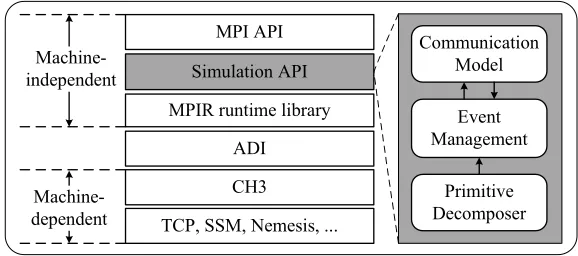
Due to its good configuration, high performance and portability, MPICH [6] has become one of the most popular MPI libraries. SMP-SIM is designed based on MPICH. We have modified the MPICH library and integrated all the functionali-ties of SMP-SIM into the modified MPICH library.
MPIR runtime library
ADI
Primitive Decomposer Communication
Model
Event Management
Machine-independent
MPI API
Simulation API
Machine-dependent
CH3
TCP, SSM, Nemesis, ...
Fig. 2.The framework of SMP-SIM.
pro-vides the user with programming interfaces and handles the MPI structures ir-relevant to environments. The MPIR runtime library translates the complex MPI primitives in MPI API into point-to-point communication operations. The main functionalities of SMP-SIM are implemented by adding aSimulation API Layer between the MPI API and MPIR runtime library layers. As shown in Fig. 2, the simulation API layer comprises three modules:primitive decomposer, com-munication modelandevent management.
In the primitive decomposer module, all the MPI communication primitives are reconstructed by using core point-to-point communication primitives. This is the base of the other modules. When a process encounters a communication primitive as the target program runs on the host machine, the primitive decom-poser module will decompose it into several core point-to-point communication primitives and then these core point-to-point communication primitives will be invoked one by one. The invocation and the return of a core point-to-point com-munication primitive will generate the corresponding events. When an event is generated, the event management module globally schedules the events, pro-cesses the selected event and updates the simulation time of the event’s cor-responding process. When processing a communication start event, the event management module will interact with the communication model module to cal-culate the time overheads of the corresponding core point-to-point primitive. Next, we will introduce these three modules in detail.
4.1. Primitive Decomposer
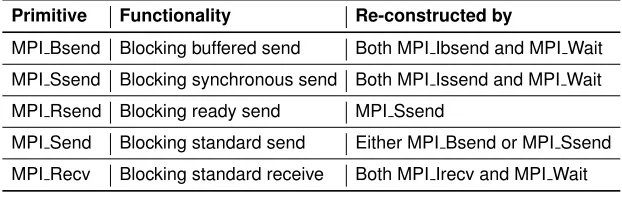
MPI provides users with a lot of communication primitives, including collec-tive communication primicollec-tives and point-to-point communication primicollec-tives. In MPICH, all collective communication operations are implemented in terms of point-to-point communication operations. So, we choose four core point-to-point communication primitives from the MPI library: MPI Ibsend (non-blocking buffered send), MPI Issend (non-blocking synchronous send), MPI Irecv (non-blocking receive) and MPI Wait [15]. Using these four core point-to-point communication primitives, we can reconstruct the other point-to-point and collective communi-cation primitives.
Table 1.Point-to-point communication primitives reconstruction in SMP-SIM
Primitive Functionality Re-constructed by
MPI Bsend Blocking buffered send Both MPI Ibsend and MPI Wait MPI Ssend Blocking synchronous send Both MPI Issend and MPI Wait MPI Rsend Blocking ready send MPI Ssend
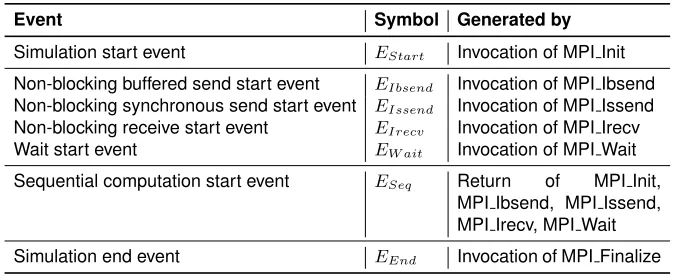
Table 1 lists the ways to reconstruct the other five point-to-point commu-nication primitives in MPI. The collective commucommu-nication primitives can be re-constructed by four core point-to-point communication primitives and the five primitives listed in the first column of Table 1. When a process of the target pro-gram encounters a communication primitive on the host machine, the primitive decomposer module will decompose it into several core point-to-point commu-nication primitives and then these core point-to-point commucommu-nication primitive will be invoked one by one. Consequently, the corresponding events will be generated. Therefore, the communication start events mentioned in Section 3.1 can be further divided into four types,non-blocking buffered send start events,
non-blocking synchronous send start events,non-blocking receive start events
andwait start events, which are generated due to the invocation of MPI Ibsend, MPI Issend, MPI Irecv and MPI Wait, respectively. All the events that will ap-pear in SMP-SIM are listed in Table 2, where the four items in the third row are all communication start events.
Table 2.All the events in SMP-SIM
Event Symbol Generated by
Simulation start event EStart Invocation of MPI Init Non-blocking buffered send start event EIbsend Invocation of MPI Ibsend Non-blocking synchronous send start event EIssend Invocation of MPI Issend Non-blocking receive start event EIrecv Invocation of MPI Irecv Wait start event EW ait Invocation of MPI Wait Sequential computation start event ESeq Return of MPI Init,
MPI Ibsend, MPI Issend, MPI Irecv, MPI Wait Simulation end event EEnd Invocation of MPI Finalize
4.2. Communication Model
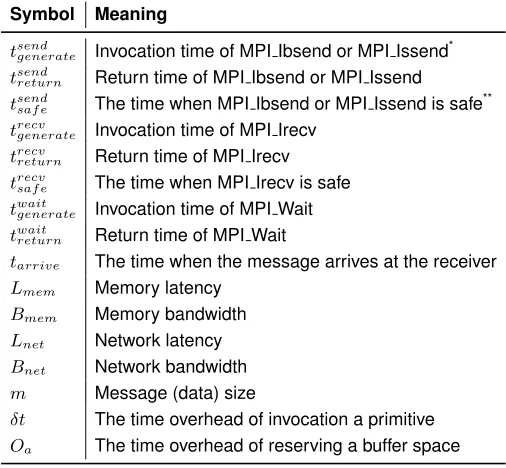
This module is responsible for calculating the time overheads of the point-to-point communication primitives. First, we list all the symbols to be used in Table 3. Then we discuss how to calculate the time overheads of core point-to-point communication primitives. The way to calculate the time overhead of an core point-to-point communication primitive is related to the two communicating pro-cesses’ physical distributions in the target machine.
Table 3.Symbols to be used in Section 4.2
Symbol Meaning
tsend
generate Invocation time of MPI Ibsend or MPI Issend * tsendreturn Return time of MPI Ibsend or MPI Issend tsendsaf e The time when MPI Ibsend or MPI Issend is safe
** trecvgenerate Invocation time of MPI Irecv
trecv
return Return time of MPI Irecv trecvsaf e The time when MPI Irecv is safe twaitgenerate Invocation time of MPI Wait twait
return Return time of MPI Wait
tarrive The time when the message arrives at the receiver Lmem Memory latency
Bmem Memory bandwidth Lnet Network latency Bnet Network bandwidth m Message (data) size
δt The time overhead of invocation a primitive Oa The time overhead of reserving a buffer space
*
The invocation time of an primitive is the generation time of the event generated by the primitive.
**
The time when a communication primitive is safe is the time when its corresponding data are safe.
As shown in Fig. 3(a), if two communicating processes are physically dis-tributed, MPI Ibsend returns as soon as the buffer at the sender side is avail-able. The data can be sent to the network while they are being copied to the buffer (generally speaking,Bmem> Bnet), according to the configurations of the
current machines. The data are safe when they have been completely copied to the buffer. We can calculatetsendreturn,tsendsaf eandtarriveas in Equations 1 – 3:
tsendreturn =t send
generate+δt+Oa (1)
tsendsaf e=tsendgenerate+δt+Oa+m/Bmem (2)
tarrive =tsendgenerate+δt+Oa+Lnet+m/Bnet (3)
As shown in Fig. 3(b), if two communicating processes are physically cen-tralized, the buffer will not be reserved and MPI Ibsend returns as soon as it is invoked. Then, we have:
tsendreturn=tsendgenerate+δt (4)
tsendsaf e=tsendgenerate+δt+m/Bmem (5)
DATA
Lmem m/Bmem
tarrive
m/Bmem
t
δ
DATA
Lnet m/Bnet
tarrive
m/Bmem
t
δ Oa
(b) (a)
send generate
t
t
returnsend send safet send
generate
t
t
returnsend tsafesendFig. 3.Non-blocking buffered send. (a) Physically distributed. (b) Physically centralized.
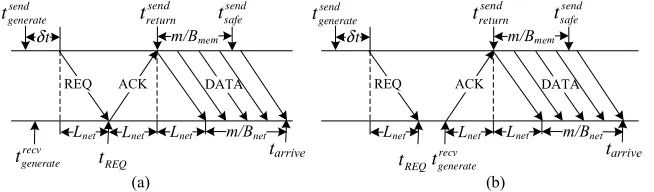
MPI Issend. MPI Issend starts a non-blocking synchronous send. A hand-shake, which is used to make sure the matching receive has started, happens between the sender and the receiver via REQ and ACK messages before the data message is sent to the receiver. MPI Issend will return when ACK from the receiver is received. The return time of MPI Issend is affected by the relation-ship betweentrecv
generateand the REQ’s arrival time (denoted astREQ).
DATA
Lnet m/Bnet tarrive m/Bmem t δ (b) (a) REQ ACK
Lnet Lnet
DATA
Lnet m/Bnet tarrive
m/Bmem t
δ
REQ ACK
Lnet Lnet
send generate
t treturnsend send safe
t send generate
t treturnsend send safe t recv generate t recv generate t REQ
t tREQ
Fig. 4.Non-blocking buffered send (the sender and receiver are physically distributed) (a)trecv
generate6tREQ. (b)trecvgenerate> tREQ.
Fig. 4(a)(b) shows the case where two communicating processes are phys-ically distributed in target machine. The data can be sent to network while they are being copied to the buffer, and the data are safe after they have been copied to the buffer.tsendreturn,tsendsaf eandtarrive can be calculated as in Equations 8 – 10:
tREQ=tsendgenerate+δt+Lnet (7)
tsendreturn=
{
tsendgenerate+δt+Lnet, trecvgenerate 6tREQ trecvgenerate+Lnet, trecvgenerate > tREQ
(8)
tsendsaf e= {
tsend
generate+δt+ 2Lnet+m/Bmem, trecvgenerate6tREQ trecv
generate+Lnet+m/Bmem, trecvgenerate> tREQ
(9)
tarrive= {
tsend
generate+δt+ 3Lnet+m/Bnet, trecvgenerate 6tREQ trecv
Due to the space limitation, we will not analyze the case where the com-municating processes are physically centralized. We can calculatetsend
return,tsendsaf e
andtarriveof this case by replacing theLnetandBnetin Equations 8 – 10 with LmemandBmem, respectively.
MPI Irecv. MPI Irecv returns as soon as it is invoked. The return of MPI Irecv means that the message can be received, rather than having been received. Then, we have:
trecvreturn =trecvgenerate+δt (11)
MPI Wait. MPI Wait is used to guarantee the safety of the data. It will block the process until the data sent or received by its related non-blocking commu-nication are safe. The return time of MPI Waittwait
returnis the maximum value of
the time when the data are safe (i.e.tsend
saf e ortrecvsaf e) and the invocation time of
MPI Waittwait
generate. So, we have:
twaitreturn=
{
max{tsendsaf e, twaitgenerate},if the waiting object is a non-blocking send
max{trecvsaf e, twaitgenerate},if the waiting object is a non-blocking receive
(12)
tsend
saf e in Equation 12 can be calculated as shown in Equations 2, 5 and 9.
Then, we analyze the way to calculatetrecv saf e.
DATA tarrive (b) (a) wait generate
t
DATAtarrive wait generate
t
recv safe t recv safe t (c) DATA tarrive m/Bmem recv safe t recv generate t recv generate t recv generate tFig. 5.Non-blocking receive. (a)trecvgenerate < tarrive,t wait
generate 6tarrive. (b)t recv generate < tarrive,twait
generate> tarrive. (c)trecvgenerate>tarrive.
trecv
saf e is affected by the relationships amongt recv
generate, twaitgenerate andtarrive,
as shown in Fig. 5. It is worth mentioning that the case shown in Fig. 5(c) only exists when the send primitive is MPI Ibsend. From Fig. 5, we can derive that
trecvsaf e=
{
max{tarrive, twaitgenerate}, trecvgenerate< tarrive trecvgenerate+m/Bmem, trecvgenerate>tarrive
(13)
wheretarrive can be calculated as shown in Equations 3, 6 and 10.
4.3. Event Management Module
has more CPUs than the host machine and the core count of the target machine is equal to the process count of the target program. So the processes allocated to a host machine’s CPU outnumber the cores in it. The event management module maintains awaiting event queue for each CPU, i.e. the processes al-located to the same CPU share a waiting event queue. At the beginning of running a target program on the host machine, this module inserts an EStart
event for each process into its corresponding waiting event queue and sets the generation time of this event as -1. During the execution of the target program, the module manages the events at the granularity of CPUs using the workflow:
Step 1. The event management module selects theun-processed executable event e that has the smallest generation time from the CPU’s waiting event queue. It should be noticed thatEStart,EEnd,ESeq,EIbsend andEIrecv events
are always executable; EIssend is executable only when its corresponding
re-ceive primitive has been invoked; andEW aitis executable only when the data
of its related send or receive primitive are safe. For convenience, for a given evente, we usee.tgenerateto represent the generation time ofe,e.doingto
de-termine whethereis being processed ande.executableto determine whethere
is executable at present.
Step 2. The event management module switches the process that is related to e onto an idle core and then processes e. As shown in Algorithm 1, the detailed dealing methods are different among different types of events. The
completing event queueis used to store theEIbsend,EIssendandEIrecvevents,
which have already been processed, and the information of these events is necessary when processing the correspondingEW aitevents. For convenience,
for a given communication evente, we usee.treturn,e.tarriveande.tsaf eto refer
to the return time, arrival time and the data’s safe time of e’s corresponding communication primitive respectively.
Step 3. After accomplishing the processing of the selected evente, the event management module deletesefrom the waiting event queue and may insert a new eventenewinto the waiting event queue as follows:
– e.typeisEStart,EIbsend,EIssend,EIrecv orEW ait: after executing the
com-munication operations corresponding to evente, the process will deal with sequential computation codes, soenew.type=ESeq andenew.executalbe= T rue.
– e.typeisESeq: denote the MPI primitive behind the sequential computation
codes asS.
• Sis MPI Ibsend:enew.type=EIbsendandenew.executalbe=T rue.
• S is MPI Issend:enew.type=EIssend; if theEIrecv event that matches enewis in the waiting/completing event queue,enew.executalbe=T rue,
otherwiseenew.executalbe=F alse.
Algorithm 1The Algorithm of EventHandler Input: Evente
Output: Void 1. e.doing←T rue 2. ife.type=EStartthen
3. execute the body codes of MPI Init; 4. ts←0;
5. else ife.type=EEndthen 6. printts;
7. execute the body codes of MPI Finalize; 8. else ife.type=ESeqthen
9. get the current system timet1;
10. execute the sequential computation codes; 11. get the current system timet2;
12. ts←ts+ (t 2−t1); 13. else ife.type=EIbsendthen
14. execute the body codes of MPI Ibsend;
15. calculatee.treturn,e.tsaf eande.tarrivebased on Equations 1 – 3 and 4 – 6; 16. ifthere is theEIrecvevente′matched withein waiting event queuethen 17. e′.tarrive←e.tarrive
18. else ifthere is theEIrecvevente′matched withein completing event queuethen 19. e′.tarrive←e.tarrive
20. ifthere is theEW aitevente′′matched withe′in waiting event queuethen 21. e′′.executable←T rue;
22. end if
23. end if 24. ts←e.treturn;
25. inserteinto its completing event queue; 26. else ife.type=EIssendthen
27. execute the body codes of MPI Issend;
28. getEIrecvevente′which matches withefrom the completing event queue; 29. calculatee.treturn,e.tsaf eande′.tarrivebased on Equations 8 – 10; 30. ifthere is theEW aitevente′′matched withe′in waiting event queuethen 31. e′′.executable←T rue;
32. end if 33. ts←e.treturn;
34. inserteinto its completing event queue; 35. else ife.type=EIrecvthen
36. execute the body codes of MPI Irecv; 37. e.tarrive← −1;
38. ifthere is theEIbsendevente′matched withein completing event queuethen 39. e.tarrive←e′.tarrive;
40. else ifthere is theEIssendevente′matched withein waiting event queuethen 41. e′.executable←T rue;
42. end if 43. ts←ts+δt;
44. inserteinto its completing event queue; 45. else ife.type=EW aitthen
46. execute the body codes of MPI Wait;
• Sis MPI Wait:enew.type=EW ait; ife′.tarrive >0(e′is theEIrecvevent
that matchesenew),enew.executalbe=T rue, otherwise enew.executalbe=F alse.
• Sis MPI Finalize:enew.type=EEndandenew.executalbe=T rue. – e.typeisEEnd: the process finishes after executing MPI Finalize, so event
management module will not insert any new event into the waiting event queue, i.e. no eventenewwill be created.
Whatever the type ofenew is,enew.doing =F alsealways holds after inserting enewinto the waiting event queue.
After the work of step 2 and step 3, if there is any un-processed event in the waiting event queue, the event management module will start the work of step 1 again and deal with the new selected event as described in step 2 and step 3. It is not difficult to find out that for each process, there is only one related event in the waiting event queue at any time during the simulation. Because only the processes whose events are selected to be processed can run, the unselected processes must be suspended. Processes allocated to the same CPU may be switched when a new event is selected to be processed, and the detailed implementation will be introduced in Section 5.
5.
MPICH2-based Implementation of SMP-SIM
This section describes the MPICH2-based implementation of SMP-SIM. By rec-ognizing the fact that the processes share the memory in SMPs, SMP-SIM cre-ates event queues in the shared segment for all the processes at the granularity of CPUs. SMP-SIM re-implements the core MPI primitives and integrates the functionalities of event management into them.
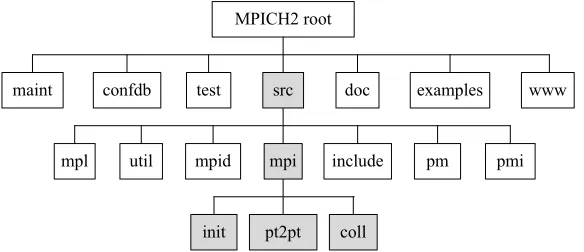
Fig. 6 shows the directory of the source codes of MPICH2. The major mod-ification of the implementation of SMP-SIM is in the sub-directory /src/mpi. The implementations of MPI Init and MPI Finalize are in /src/mpi/init; the implemen-tations of all point-to-point MPI primitives are in /src/mpi/pt2pt; and the imple-mentations of all collective MPI primitives are in /src/mpi/coll.
5.1. Data Structure
Event is the core of SMP-SIM, and we implement the data structure of an event as shown in Fig. 7.
– Attributestype,processID,doing,executableandt generateare used for all types of events.type,processIDandt generatestand for the type, process ID and generation time of the event respectively;doingandexecutablejudge whether the event is being and can be processed respectively.
– Attributes t return, t arrive, t saf e, pairID and tag are used for three types of events:EIbsend,EIssendandEIrecv. These attributes stand for the
MPICH2 root
confdb src
maint test doc examples www
util mpi
mpl mpid include pm pmi
pt2pt init coll
Fig. 6.The directory of the source codes of MPICH2
struct Event{ int type; int processID; bool doing; bool executable; double t_generate; double t_return; double t_arrive; double t_safe; int pairID; int tag;
MPI_Request *request; }
Fig. 7.The data structure of event
EIssendorEIrecvevent, we can find the matchedEIrecv,EIbsendorEIssend
event withpairIDandtag.
– Attributerequest is used for four types of events:EIbsend, EIssend, EIrecv
andEW ait. This attribute stands for the object of the corresponding
non-blocking communication. Given anEW ait event, we can find the matched EIbsend,EIssendorEIrecvevent withrequest.
Based on the definition of the data structure of an event, we create two event queues,W ait Event QueueandComplete Event Queue, at the granularity of CPUs, and store them in the shared segment so that all the processes can access them conveniently. It should be noticed that in order to guarantee cor-rectness, all the operations on the event queues must be protected by the lock mechanism, i.e. only one process is permitted to access a given event queue at one time. In order to briefly describe our implementation, all the operations on the event queues described in the rest of this section are encapsulated by
5.2. Re-implementations of Core Primitives
This subsection introduce the re-implementations of six core MPI primitives MPI Init, MPI Finalize, MPI Ibsend, MPI Issend, MPI Irecv and MPI Wait. These re-implementations realize the functionalities of event management described in Section 4.3.
MPI_Init(){
Codes of original body;
// codes added for SMP-SIM new a event e;
e.type=ESeq; e.processID=myRank; e.doing=False;
e.t_executable=True; e.t_generate=0; ts=0; Insert e into its Wait_Event_Queue; MPI_Barrier();
lock();
if(Count<CORE_NUM){ Count++;
set the priority of this process HIGH; if(Count == CORE_NUM)
suspend all the processes allocated to this CPU without HIGH priority; }
unlock();
e.doing=True; t1=gettime();
return; }
Fig. 8.The re-implementation of MPI Init
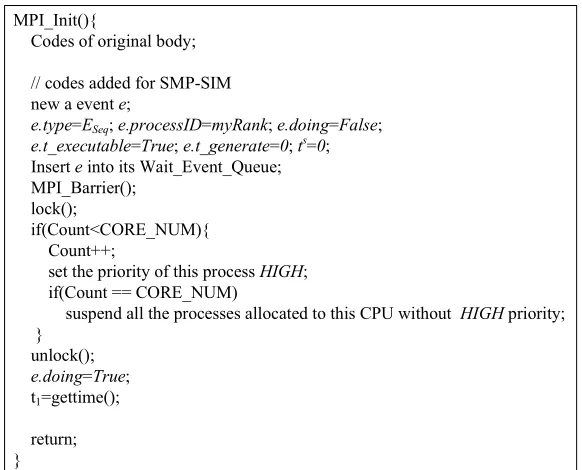
MPI Init As shown in Fig. 8, besides the codes of the original MPI Init body, the re-implementation of MPI Init does the work as follows: firstly, each process in-serts anESqeevent into its correspondingW ait Event Queue; secondly, make
sure that only one process is running on a given processing core and the other processes are suspended; thirdly, the process that has not been suspended starts to deal with theESqeevent.
In the re-implementation of MPI Init,Countis a global variable shared by all the processes allocated to the same CPU, and it is used for logging the count of the processes whoseESqeevents have been started to be processed.lock()
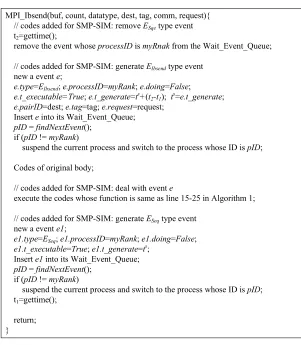
MPI_Ibsend(buf, count, datatype, dest, tag, comm, request){ // codes added for SMP-SIM: remove ESqe type event
t2=gettime();
remove the event whose processID is myRnak from the Wait_Event_Queue; // codes added for SMP-SIM: generate EIbsend type event
new a event e;
e.type=EIbsend; e.processID=myRank; e.doing=False; e.t_executable=True;e.t_generate=ts+(t2-t1); t
s
=e.t_generate;
e.pairID=dest; e.tag=tag; e.request=request; Insert e into its Wait_Event_Queue;
pID= findNextEvent(); if (pID!= myRank)
suspend the current process and switch to the process whose ID is pID; Codes of original body;
// codes added for SMP-SIM: deal with event e
execute the codes whose function is same as line 15-25 in Algorithm 1; // codes added for SMP-SIM: generate ESeq type event
new a event e1;
e1.type=ESeq; e1.processID=myRank; e1.doing=False; e1.t_executable=True; e1.t_generate=ts
; Insert e1into its Wait_Event_Queue;
pID= findNextEvent(); if (pID!= myRank)
suspend the current process and switch to the process whose ID is pID; t1=gettime();
return; }
Fig. 9.The re-implementation of MPI Ibsend
MPI Ibsend, MPI Issend, MPI Irecv and MPI Wait The re-implementations of MPI Ibsend, MPI Issend, MPI Irecv and MPI Wait are similar, and the major work is divided into four steps as follows:
– Firstly, remove theESeqevent that has just been processed from the W ait Event Queue.
– Secondly, insert a new communication event according to this MPI com-munication primitive into theW ait Event Queue; select the next event to process from theW ait Event Queue; switch to the process corresponding to the selected event.
– Thirdly, after this process is switched on again, execute the codes of the original body and process the event related to this primitive.
– Fourthly, insert a newESeq event into the W ait Event Queue; select the
The re-implementation of MPI Ibsend is shown in Fig. 9, where the function
f indN extEvent()is used for selecting the un-processed executable event e
with the minimum generation time, and the return value off indN extEvent()is
e.processID. The major difference between MPI Issend(/MPI Irecv/MPI Wait) and MPI Ibsend is the work of processing the event related to the primitive, and the detailed processing methods can be found in Algorithm 1.
MPI_Finalize(){
// codes added for SMP-SIM t2=gettime();
remove the event whose processID is myRnak from the Wait_Event_Queue; ts = ts+(t2-t1);
print ts;
Codes of original body; return;
}
Fig. 10.The re-implementation of MPI Finalize
MPI Finalize As shown in Fig. 10, in the re-implementation of MPI Finalize, before executing the codes of the original MPI Finalize body, we first remove theESeq event that has just been processed from theW ait Event Queue, and
then update and print the current simulation time of this process.
6.
Experiments
We demonstrate the validation and accuracy of SMP-SIM in this section. Sec-tion 6.1 introduces the benchmarks and experimental platform used. SecSec-tion 6.2 describes the methodology used for evaluating our work. Section 6.3 presents and analyzes the experimental results.
6.1. Benchmarks and Platform
We select three parallel kernels EP, CG, FT from NPB3.3-MPI benchmarks and Sweep3D-2.2d to evaluate SMP-SIM. The problem sizes of EP, CG and FT are all Class C, and the problem size of Sweep3D is100×100×100. All the benchmarks are executed in Red Hat Enterprise Linux Server Release 5.5, and MPICH2-1.3.1 is used.
6.2. Evaluation Methodology
In order to validate the accuracy of SMP-SIM for different target machines, our experiments include two parts:
– SMP target machine: for a single SMP node in our platform, firstly, we use the two CPU as the target machine and only one CPU as the host machine, and test the accuracy of SMP-SIM; secondly, we use only one core as the host machine, and test the scalability of SMP-SIM with varying the scale of the target machine.
– SMP-Cluster target machine: for the whole platform, we use all the eight nodes as the target machine and only one node as the host machine, and test the accuracy of SMP-SIM.
6.3. Results and Analysis
SMP Target Machine As shown in Fig. 11, when using two CPUs as the target machine and only one CPU as the host machine, for all the four benchmarks, the errors of SIM are between 2.56% and 6.14%. The accuracy of SMP-SIM for EP benchmark is the highest, because EP has the fewest communica-tions. The sequential computation time is measured by direct execution, so the simulation of sequential computation is more accurate than that of communica-tion. Consequently, the more communications a benchmark contains, the lower accuracy of SMP-SIM is.
EP CG FT Sweep3D
0 5 10 15 20 25 30 35 40
Benchmarks
T
im
e
(
s
)
Real Predicted
Fig. 11.The accuracy of SMP-SIM for SMP target machine
2 4 6 8 0
1 2 3 4 5 6 7 8 9
Number of Target Cores
E
rr
o
r(
%
)
CG EP Sweep3D FT
Fig. 12.The scalability of SMP-SIM
8 processing cores. As shown in Fig. 12, the results show that SMP-SIM has good scalability.
EP CG FT Sweep3D
0 3 6 9 12 15 18 21 24
Benchmarks
T
im
e
(
s
)
Real Predicted
Fig. 13.The accuracy of SMP-SIM for SMP-Cluster target machine
7.
Conclusion
For the system developers, it has been long desired that the performance of a parallel system can be predicted at the design phase. Before the target machine is completely constructed, the developers can always build an SMP machine used as a host machine. In this paper, we introduce SMP-SIM, an SMP-based discrete-event execution-driven performance simulator that exploits the charac-teristics of SMP to achieve accurate and scalable performance prediction.
In SMP-SIM, we have integrated three modules, primitive decomposer, com-munication model and event management, by adding a simulation API layer on top of the MPICH library. By executing the target program on the host machine with the modified MPICH library, SMP-SIM manages the events globally, han-dles the communication start events virtually and sequential computation start events actually. In our experimental evaluation, SMP-SIM shows high accuracy and good scalability with prediction errors of less than 7.60%.
Acknowledgments.This work is supported by the National Natural Science Foundation of China (NSFC) No.60921062.
References
1. Ajima, Y., Takagi, Y., Inoue, T., Hiramoto, S., Shimizu, T.: The tofu interconnect. In: High Performance Interconnects (HOTI), 2011 IEEE 19th Annual Symposium on. pp. 87–94 (aug 2011)
2. Barker, K.J., Davis, K., Hoisie, A., Kerbyson, D.J., Lang, M., Pakin, S., Sancho, J.C.: Entering the petaflop era: the architecture and performance of roadrunner. In: Pro-ceedings of the 2008 ACM/IEEE conference on Supercomputing. pp. 1:1–1:11. SC ’08, IEEE Press, Piscataway, NJ, USA (2008)
3. Barker, K., Pakin, S., Kerbyson, D.: A performance model of the krak hydrodynamics application. In: Parallel Processing, 2006. ICPP 2006. International Conference on. pp. 245 –254 (aug 2006)
4. Website, http://www.cray.com/Products/CX1000/Chassis/CX1000S.aspx
5. Fujimoto, R.M.: Parallel discrete event simulation. Commun. ACM 33, 30–53 (Octo-ber 1990)
6. Gropp, W., Lusk, E., Doss, N., Skjellum, A.: A high-performance, portable implemen-tation of the mpi message passing interface standard. Parallel Comput. 22, 789–828 (September 1996)
7. Huang, C., Lawlor, O., Kal, L.: Adaptive mpi. In: Languages and Compilers for Parallel Computing. Lecture Notes in Computer Science, vol. 2958, pp. 306–322. Springer Berlin / Heidelberg (2004)
8. Website, http://static.msi.umn.edu/tutorial/scicomp/sp/intro-Power3SP/index.html 9. Jefferson, D., Beckman, B., Wieland, F., L., B., Diloreto, M.: Time warp operating
system. SIGOPS Oper. Syst. Rev. 21, 77–93 (November 1987)
10. Kale, L.V., Krishnan, S.: Charm++: a portable concurrent object oriented system based on c++. SIGPLAN Not. 28(10), 91–108 (Oct 1993)
12. Labarta, J., Girona, S., Pillet, V., Cortes, T., Gregoris, L.: Dip: A parallel program development environment. Lecture Notes in Computer Science 1124, 665 – 665 (1996)
13. Website, http://www.mcs.anl.gov/research/projects/mpich2/
14. Mukherjee, S.S., Reinhardt, S.K., Falsafi, B., Litzkow, M., Hill, M.D., Wood, D.A., Huss-Lederman, S., Larus, J.R.: Wisconsin wind tunnel ii: A fast, portable parallel architecture simulator. IEEE Concurrency 8, 12–20 (October 2000)
15. Prakash, S., Bagrodia, R.L.: Mpi-sim: using parallel simulation to evaluate mpi pro-grams. In: Proceedings of the 30th conference on Winter simulation. pp. 467–474. WSC ’98, IEEE Computer Society Press, Los Alamitos, CA, USA (1998)
16. Prakash, S., Deelman, E., Bagrodia, R.: Asynchronous parallel simulation of parallel programs. IEEE Trans. Softw. Eng. 26, 385–400 (May 2000)
17. Reinhardt, S.K., Hill, M.D., Larus, J.R., Lebeck, A.R., Lewis, J.C., Wood, D.A.: The wisconsin wind tunnel: virtual prototyping of parallel computers. In: Proceedings of the 1993 ACM SIGMETRICS conference on Measurement and modeling of com-puter systems. pp. 48–60. SIGMETRICS ’93, ACM, New York, NY, USA (1993) 18. Website, http://sourceforge.net/projects/sim-mpi/
19. Snavely, A., Carrington, L., Wolter, N., Labarta, J., Badia, R., Purkayastha, A.: A framework for performance modeling and prediction. In: Proceedings of the 2002 ACM/IEEE conference on Supercomputing. pp. 1–17. Supercomputing ’02, IEEE Computer Society Press, Los Alamitos, CA, USA (2002)
20. Soga, T., Musa, A., Shimomura, Y., Egawa, R., Itakura, K., Takizawa, H., Okabe, K., Kobayashi, H.: Performance evaluation of nec sx-9 using real science and engineer-ing applications. In: Proceedengineer-ings of the Conference on High Performance Comput-ing NetworkComput-ing, Storage and Analysis. pp. 28:1–28:12. SC ’09, ACM, New York, NY, USA (2009)
21. Steinman, J.S.: Breathing time warp. SIGSIM Simul. Dig. 23, 109–118 (July 1993) 22. Website, http://www-unix.mcs.anl.gov/mpi
23. Xie, M., Lu, Y., Liu, L., Cao, H., Yang, X.: Implementation and evaluation of network interface and message passing services for tianhe-1a supercomputer. In: Proceed-ings of the 2011 IEEE 19th Annual Symposium on High Performance Interconnects. pp. 78–86. HOTI ’11, IEEE Computer Society, Washington, DC, USA (2011) 24. Yang, X.J., Liao, X.K., Lu, K., Hu, Q.F., Song, J.Q., Su, J.S.: The tianhe-1a
super-computer: Its hardware and software. Journal of Computer Science and Technology 26(3), 344–351 (2011)
25. Zhai, J., Chen, W., Zheng, W.: Phantom: Predicting performance of parallel applica-tions on large-scale parallel machines using a single node. In: Proceedings of the ACM SIGPLAN Symposium on Principles and Practice of Parallel Programming, PPOPP. pp. 305 – 314. Bangalore, India (2010)
26. Zheng, G., Kakulapati, G., Kale, L.: Bigsim: a parallel simulator for performance pre-diction of extremely large parallel machines. In: Parallel and Distributed Processing Symposium, 2004. Proceedings. 18th International. p. 78 (april 2004)
Yufei Linwas born in 1985. She received her B.S. degree in automation from the University of Science and Technology of China (USTC) in 2006 and M.S. degree in computer science from the National University of Defense Technol-ogy (NUDT) in 2008. She is now a Ph.D. candidate in Computer Science from State Key Laboratory of High Performance Computing at NUDT. Her research interest lies in high performance computing and performance evaluation. Her email address is [email protected].
Xinhai Xuwas born in 1984. He received his B.S., M.S. and Ph.D. degrees in computer science from NUDT in 2006, 2008 and 2012. He is now an assistant professor from School of Computer Science at NUDT. His research interest lies in high performance computing and fault tolerance. His email address is [email protected].
Yuhua Tangwas born in 1962. She received her B.S. and M.S. degrees in com-puter science from NUDT in 1983 and 1985. She is now a professor from School of Computer Science at NUDT. Her research interest lies in high performance computing and its router design. Her email address is [email protected].
Xin Zhangwas born in 1986. He received his B.S. degree in computer science from NUDT in 2009. He is now an M.S. candidate in Computer Science from School of Computer Science at NUDT. His research interest lies in performance evaluation. His email address is [email protected].
Xiaowei Guowas born in 1986. He received his B.S. and M.S. degrees in com-puter science from NUDT in 2009 and 2011. He is now a Ph.D. candidate in Computer Science from State Key Laboratory of High Performance Comput-ing at NUDT. His research interest lies in high performance computComput-ing and its applications. His email address is xiaow [email protected].