A Generic Parser for Strings and Trees
Riad S Jabri
Computer Science Department
King Abdullah II School for Information Technology University of Jordan, Amman 11942 –Jordan
Abstract. In this paper, we propose a two fold generic parser. First, it simulates the behavior of multiple parsing automata. Second, it parses strings drawn from either a context free grammar, a regular tree grammar, or from both. The proposed parser is based on an approach that defines an extended version of an automaton, called position-parsing automaton (PPA) using concepts from LR and regular tree automata, combined with a newly introduced concept, called state instantiation and transition cloning. It is constructed as a direct mapping from a grammar, represented in an expanded list format. However, PPA is a non-deterministic automaton with a generic bottom–up parsing behavior. Hence, it is efficiently transformed into a reduced one (RBA). The proposed parser is then constructed to simulate the run of the RBA automaton on input strings derived from a respective grammar. Without loss of generality, the proposed parser is used within the framework of pattern matching and code generation. Comparisons with similar and well-known approaches, such as LR and RI, have shown that our parsing algorithm is conceptually simpler and requires less space and states.
Keywords: bottom-up automata, parsing, regular tree grammars.
1.
Introduction
language to a pushdown automaton recognizing the same language in postfix notation. In addition to the transformation overhead, this approach assumes that the transformed grammar is in normal form, deterministic and without hidden-left and right recursion [9]. Hence, there is a need for a parsing approach that admits ambiguous grammar and maintains the efficiency of LALR parsers and the expressive power of tree parsers. To satisfy such a need, we propose an approach for a hybrid parsing of both general context-free and regular tree grammars. According to the proposed approach, and as a framework for parsing, a generic grammar (GG) is defined as one that can be either instantiated by a context-free grammar or by a regular tree grammar. GG is then represented in an expanded list format (PLF). As such, PLF constitutes a prefix representation of derivation trees for the grammar GG, where the ranked terminals are considered as nonterminals and the recursive terminal symbols are terminalized. Hence, the repeated expansion in the derivation trees is incorporated as invocation and
recursion-termination. The recursion-invocation constitutes an
-transition from therecursive occurrence to its respective head, while recursion-termination
implies an
-transition from the recursive-head to its respective occurrence.Hence, the recursive occurrence initiates a derivation/reduction path as the one initiated by its respective head and considered as an instance of the
original one. To distinguish between instances initiated by different recursive
occurrences, an instance-identifier (ID) is assigned to each initiated path. Therefore, PLF with incorporated recursion implies initiation and termination of derivations/ reductions paths, as well as respective instances of these paths. A nondeterministic parsing automaton, called position parsing automaton (PPA), is then constructed in terms of a set of state instances and respective parsing actions as a direct mapping from the PLF of the production respective to the start symbol S of GG. PPA is defined based on a newly introduced concept of state and transition instances. According to such
concept, Each PPA state (q, (inst)) is defined with an implicit index (inst) =
.PPA has been enriched by conceptual explanation, theory and graphical representation. However, PPA is a nondeterministic automaton. To obtain a more deterministic parsing behavior, PPA is efficiently transformed into a reduced one, called RBA, according to a proposed subset construction approach. The RBA automaton is represented by a parsing table that specifies the parsing actions respective to a given state and each input symbol. A parser is then constructed to simulate the run the RBA automaton on strings derived from a generic grammar. Furthermore, the proposed parser is based on formalizing the parsing process and its solution in a way that guarantees its soundness, generalization and its efficient implementation. This was demonstrated by the proposed theory and by the respective implementation algorithms.
Our parsing approach is motivated by reduction incorporated parsing introduced in [2, 3] and further developed in [10, 14]. According to these approaches, a finite automaton for terminalized grammar (RIA) is constructed to handle the regular parts of the language. Such automaton is then extended by recursive call automaton (RCA) to handle recursion. However, the suggested automaton in [2,3] does not handle hidden left recursion. In addition, the construction approach is based on by hand generated terminalization. Once terminalization has been detected, RCA is constructed. In [14] RIA has been extended to handle hidden-left recursion, while in [10] an automatic computation for terminalization has been suggested. In contrast, our approach handles hidden and direct left/right recursion. Terminalization is handled as recursion-invocation and recursion-termination during the concurrent construction of PLF and PPA. In addition, and rather than, the static creation of RCA, an instance is dynamically created during parsing. This achieved by the newly introduced concept of state instantiations and embedded semantic actions. Furthermore, our approach is embedded by appropriate concepts to parse regular trees. Further comparisons with these approaches and similar ones are given in Section 6.
The remainder of this paper is organized as follows. Section 2 presents preliminaries. Section 3 presents the proposed parsing approach, followed by the definitions of the newly introduced concepts. This includes the proposed nondeterministic parsing automaton (PPA) and the theory on which it is based. Section 4 presents the PPA construction algorithm. Section 5 presents the subset construction and subsequently the proposed parser, followed by a discussion and a conclusion that are given in section 6 and section 7 respectively.
2.
Preliminaries
For our further discussions, we assume the following definitions based on the ones given in [1, 8, 11, 12, 13, 15].
Σ is an alphabet of terminal symbols.
N is a finite set of nonterminal symbols, where S
N is the start symbol. P is a finite set of productions p having the form p: A
V, where A
Nand V
(Σ
N)*.Definition 2. A ranked alphabet Σ is a finite set of symbols (operators, constructors) such that each member of Σ has a nonnegative integer, called a
rank (arity). The rank is defined by the function arity: Σ
N, where N denotes the set of natural numbers.
The terminals having a rank
1 are called operators and the ones having arank =0 are called constants.
The members of Σ are grouped into the subsets Σ0,…, Σnsuch that Σn
=
{a
Σ | arity (a) = i, i
(0,1,…,n)}.Definition 3. A tree language over Σ, denoted by T (Σ), consists of all possible terms that are inductively defined as:
If a
Σ0 then a
T(Σ ) If t1,..., tn
T(Σ ) and a
Σnthen a (t1,…, tn )
T(Σ ). These terms represent trees with internal nodes and leaves labeled by
operators and constants respectively. The number of children of a node
labeled by an operator a is arity (a).
Definition 4. (Regular tree grammar). The 4-tuple G = (Σ, N, P, S) defines a
regular tree grammar, where:
Σ is a ranked alphabet
N is a finite set of nonterminals with an assumed rank =0, where S
N isthe start symbol.
P is a finite set of productions p having the form p: A
V, where A
Nand V
T (Σ
N) is a prefix encoding of a tree over (Σ
N).We denote A and V by LHS(p) and RHS(p), to represent the left hand side
and the right hand side of the production p respectively. Given p: A
V andt1
T (Σ
N), we say t1 derives t2
T(Σ
N) in one-step, denoted byt1
t2, if LHS (p)
t1 and RHS (p)
t2. Applying zero or more suchderivation steps on t1 is denoted by t1
*t2, where each step derives a treet
T (Σ
N).
Definition 5. (Regular tree language). The language generated by the
grammar G is defined by the set L (G) = {t |t
T(Σ) and S
* t}.Definition 6. (Regular tree parsing). Parsing a tree t
L (G) is the processof constructing a possible S– derivation tree for t, which is inductively defined as a tree with a root labeled by the start grammar symbol S and with children labeled by the RHS(S), where:
The children labeled by terminals
Σ0 are leaves. The children labeled by The children labeled by ranked terminals
Σn are interior nodes andconstitute roots for sub trees, each one of which is inductively defined as S-derivation tree. However, the children of such sub trees are labeled by the grammar symbols composing the arity of their respective roots.
Definition 7. Generic Grammar (GG) A generic grammar is a 4-tuple GG= (Σ,
N, P, S) that is either instantiated by a context-free grammar, as given by Definition 1, or by a regular tree grammar, as given by Definition 4. However, the ranked terminals are nonterminalized as given by Definition 8. Subsequently, in our further discussion, we use the following generic terms.
Derivation tree (DT): Denotes either an S-derivation tree or a classical one
for the context free grammars.
String: Denotes either a prefix encoding of the input trees or sentences
generated by a context free grammar.
Definition 8. Given a (t1,…,tn)
T(Σ), the ranked terminal (a
Σn) isnonterminalized as a → t1… tn, where each ranked terminal in (t1,…, tn ) is inductively nonterminalized.
Example 1. Given GG = (Σ, N, P, S), it can be instantiated with a regular tree
grammar as follows:
Σ = {Σ0, Σ1, Σ2}, where Σ0= {c}, Σ1= {m} and Σ2 = {+}
N = {R}, R = S and P= { R→ +(m(c),R) | + (m(R),R) | c }
Such grammar generates strings (trees) of the forms: c, + (m(c), c),…,
+(m(c),+ (m(c),c)).
GG can be instantiated with a context-free grammar as follows:
Σ= Σ0 = {a, b, c}; N = {S, A , B} and S is the start symbol
P = {S → A b , A → a B , B → c | c B}
Such grammar generates strings (sentences) of the forms: acb, accb,
accccb,...
3.
The proposed parsing approach
Given a generic grammar GG, we propose a parsing approach based on simulating the run of a reduced bottom--up automaton (RBA) on strings generated by GG. RBA is obtained as result of a subset construction applied on a proposed nondeterministic automaton (PPA). Such automaton is an extended version of a one introduced in [8]. It is constructed in terms of a set of states and parsing actions as a direct mapping from the production respective to the start symbol S of GG, which is represented in the expanded
list format (PLF). According to PLF, a production p: A →
in GG is definedas PLF (A) = A (
), where each nonterminal
A in
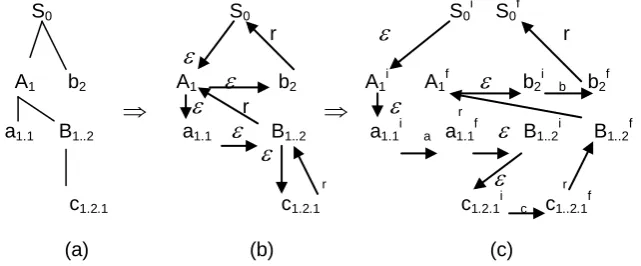
is inductivelyrecursive occurrence of the symbol A in RHS (p) is not replaced by a corresponding PLF. Only, it is designated as recursive instance of its respective head. In addition, each grammar symbol in PLF is assigned a doted integer as an index to reflect its occurrence order (position), as well as its nesting depth. As such, PLF constitutes a prefix representation of derivation trees for the grammar GG, where the repeated expansion in the derivation trees is represented as an incorporated recursion. Further, the positions assigned to the grammar symbols of PLF represent their paths in a respective derivation tree. Hence, the types of the grammar symbols and their occurrence order in PLF imply derivation/reduction relationships. The PPA states and parsing actions are then defined based on such relationships, using concepts from tree parsing and shift-reduce automata that are combined with newly introduced ones to handle the incorporation of recursion in PLF. Such concepts include state-instantiation, transition-cloning and transitions having embedded semantic-actions. In this section, we present the PLF form and PPA automaton. In the following sections, we present the subset construction of PPA into the reduced RBA automaton and the proposed parser. In addition and where appropriate, we present theory to demonstrate the generality and the soundness of the proposed approach. However, we immediately present an example to illustrate the proposed approach and to facilitate our further discussion.
Example 2. Consider the grammar of Example 1. A PLF form respective to
the start grammar symbol S is defined as PLF (S) = S0 (A1 (a1.1, B1.2(c1.2.1)),
b2). It is a prefix representation ofthe derivation tree for GG, as shown in Fig.
1(a). The grammar symbols are attached an index to represent their
respective positions, for examples: The index (0) attached to S, defines S as a head and the indexes assigned to A and b indicate that they constitute the
first and the second subordinates of S respectively.
S0 S0 S0 i
S0 f
r
r
A1 b2 A1
b2 A1 iA1 f
b2 ib b2 f
r
r a1.1 B1..2 a1.1
B1..2 a1.1i
a a1.1 f
B1..2 iB1..2 f
r
r c1.2.1 c1.2.1 c1.2.1i
c c1..2.1 f
(a) (b) (c)
The derivations/reductions implied by PLF (S) are shown in Fig.1 (b) in terms of the nested paths S0
A1 (
( a1.1
B1..2 (
c1.2.1) r
B1..2 )r A1 )
b2 r S0, where the outermost path
indicates the derivation S0
A1 b2 and the reduction to S0. The innermostpaths indicate the derivations A1
a1.1 B1.2 and B1..2
c1.2.1 as well as thereductions to B1..2 and A1. Further, the derivations are performed according to
the rightmost derivation first, and the reductions according to the leftmost phrase first. Hence, a bottom-up parsing automaton (PPA), as shown in Fig.
1(c), can be constructed by a direct mapping from PLF(S) as the tuple (T, qin,
qfin, Q, SPA, RPA), where:
T = (
) is the input alphabet, where represent strings generatedby the GG grammar.
Q is the set of PPA states, where qin and qfin are the initial and the final
ones.
SPA and RPA are the sets of shift and reduce parsing actions respectively.
The PPA construction proceeds as follows:
Each grammar symbol V
(
N) is represented by a pair ofabstract ones, defined as (Vi, Vf), to indicate a prediction and an
acceptance of V in an assumed parsing. Consequently, respective PPA states are defined by the pair (qi = Vi, qf = Vf), where: qi is an initial
state instantiated by Vi and acts as a predictor (scanner) for V. The
state qf is a final one, instantiated by Vf and acts as its respective
acceptor. Hence, the PPA states are constructed by the set Q = { (qp
i = Vpi, qp
f
= Vpf ) | Vp
PLF (p(S))}. For example, Fig. 2(c) shows atransition graph constructed in terms of a set of nodes instantiated by respective grammar symbols from PLF(p(S)). These nodes constitute the set Q. For simplicity, the symbols (qi , qf) and (Vi, Vf) are interchangeably used to denote respective PPA states.
The derivations/reductions implied by PLF (S) are mapped into
respective PPA parsing actions as follows:
o The
-transitions are mapped into the set {(
( q1,
) =qj)}
SPA, for example the
-transitions S0i
A1i ; b2
f
r
S0 f
and a1.1
f
B1..2i
are mapped into
(S0i ,
) = A1i ;
(b2f
) = S0 f and
( a1.1f,
) = B1..2i. Such parsingactions represent the following:
-transitions from the statesinstantiated by head grammar symbols to the states of their
immediate subordinates;
-transitions from the states of lastsubordinates to the states of their respective heads; and
-transitions from states of grammar symbols to the states of their respective successors (siblings).
o The derivations of terminal symbols are mapped into the set
{(
(q1, V) = qj)}
SPA of respective move-transitionsstates. For example, the derivation of the symbols a and c are
mapped into the move-transitions
( q1, a ) = a1.1f and
(c1.2.1 i
, a ) = c1..2.1 f
.
o The reduce-transitions r
indicate reductions to LHSs of the productions for respective nonterminal symbols. Hence,
these transitions are mapped by the set {
(q, V) = reduce(p)| V
N, q= Vf and V is LHS (p)} of reduce parsing actionsfor final states of their respective nonterminals. For example,
the reduce-transition b2
f r S0
f
is mapped as the reduce
parsing action
(S0 f , S) = reduce(S → A b).Once PPA has been constructed, a subset construction (
-closure) is thenapplied on the resulting automaton to obtain a reduced one (RBA), as shown in Fig.2, where:
The RBA states are constructed as the set Q = { q0= (S0
i , A1
i , a1.1
i
), q1 = (C1.21
i , B1.2
i , a1.1
f
), q2 = (b2 i
, A1 f
, B1.2 f
, c1.2.1 f
), q3 = (S0 f
, b2 f
)} of
-closures The RBA parsing actions are constructed as shift parsing actions defined
by the set SPA= {ζ (q0, a) = q1, ζ (q1, c) = q2, ζ (q2, b) = q3} and reduce
parsing actions defined by the set RPA = {δ (q2, B) = reduce (B → c), δ (q2,
A) = reduce (A →aB), δ (q3, S) = reduce (S →Ab)}.
Finally, the run of RBA on the input acb proceeds according to the
transitions q0 a q1c q2 b q3, where the reductions B → c,
A →aB and S →Ab are performed at the states q2, q2 and q3 respectively.
a c b
Fig. 2. RBA automaton for the grammar of Example 1
Example 2 demonstrates the proposed parsing approach using a simple context-free grammar. However, such approach handles regular tree grammars and subtle cases such as embedded recursion and grammar productions with different alternatives, as presented in the following sections.
3.1. The production list format (PLF)
Let the 4-tuple (Σ, N, P, S) be a GG grammar, where: (p: A →α)
P andα= (V1…Vj…Vn)
( Σ
N)*. We inductively define the production list formatrespective to p as PLF (A) = A (PLF (V1)),…, PLF(Vj),…, PLF(Vn)), where:
Each nonterminal Vj is replaced by the PLF (Vj) defined for its respective
production.
q0 :
S0i
A1 i
a1.1i
q1 :
C1.21i
B1.2 i
a1.1f
q2 :
b2i
A1 f
B1.2 f
c1.2.1 f
q3 :
S0f
Each ranked terminal Vj is rewritten by its respective PLF (Vj ), defined as PLF (Vj ) = (PLF (Vj1),…,PLF (Vji),…,PLF (Vjn)), where: Vj (Vj1, Vji,...,Vjn)
T(Σ
N). PLF(Vj) = Vj, if Vj
Σ0. Each grammar symbol in PLF (A) is assigned an index reflecting the
position at which it occurs within PLF (A). The index is computed using a function (IND) that is inductively defined as:
- IND (Vj) = { ε}, if Vj
Σ0.- IND (PLF(Vj)) = {0, 1. IND (PLF (V1j)),…,n. IND (PLF (Vnj))}, if Vj
N and
a production (Vj → V1j… Vnj )
P- IND (PLF(Vj)) = { ε, 1. IND (PLF (V1j)),…,n. IND (PLF (Vnj))}, if Vj
Σnand Vj( V1j… Vnj )
T(Σ
N).To cover the alternative productions and the productions having embedded recursion, the definition for PLF is extended as follows:
Let (p: A →α ) be a production having recursion, where α= V1…Ai…Vn.
The PLF respective to p is defined as PLF (A) = Ar∗0 (PLF (V1),..., Ar∗i ,…,PLF ( Vn)), where the grammar symbol A is expanded by its definition (production) while its respective recursive-occurrence Ai is rewritten,
without further expansion (terminalized). In addition, the head Ar∗0 and the
recursive-occurrence Ar∗i are designated by appending the mark (r*) as a
prefix to their respective index.
Let (p: A →{ αn}) be a production with alternatives. We represent p as A→
A(1) | A(2) |…|A(j)|…| A(n), where A(j) →αj is the alternative (j). The PLF
form respective to p is then defined as PLF (A) = A0 ((PLF (A (1)) |….| PLF
(A (n))), where the grammar symbols of different alternatives are designated by the number of the alternative to which they belong. However, they are indexed according to their positions in the designated alternative. PLF in its extended form constitutes a prefix representation of alternative derivation trees with incorporated recursion. Hence, it implies alternative sequences of derivations and reductions, where the embedded recursion is incorporated as recursion-invocation and recursion-termination. The
recursion-invocation constitutes an
-transition from the recursive occurrenceto its respective head, while recursion-termination implies an
-transitionfrom the recursive-head to its respective occurrence. Hence, the recursive occurrence initiates a derivation/reduction path as the one initiated by its
respective head and considered as an instance of the original one. To
distinguish between instances initiated by different recursive occurrences, an instance-identifier (ID) is assigned to each initiated path.
Example 3. Let GG be a regular tree grammar as given in Example1. A PLF form respective to the start symbol R is defined as
PLF (R) = Rr*0 (PLF (R (1)) PLF (R (2)) PLF (R(3)),where:
PLF (R(3) = Rr*0 (3)(c1(3)).
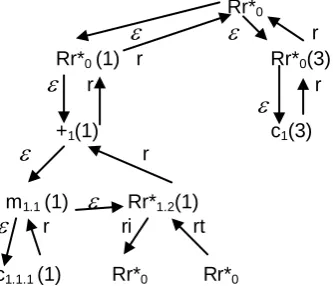
PLF(R) is a prefix representation of three alternative derivation trees with
incorporated recursion, as shown in Fig. 3, where Rr*1.2(1), Rr*1.1.1(2) and
Rr*1..2(2) designate such recursion. Consequently, PLF(R) implies three
alternative sequences of derivations and reductions as shown in Fig. 4.
Rr*0
Rr*0 (1) Rr*0(2) Rr*0(3)
+1(1) +1(2) c1(3)
m1.1 (1) Rr*1.2(1) m1.1(2) Rr*1..2(2)
c1.1.1 (1) Rr*1.1.1(2)
Fig. 3.Derivations trees respective to the grammar of Example 3
Rr*0
rRr*0 (1) r Rr*0(3)
r r
+1(1) c1(3)
r
m1.1 (1)
Rr*1.2(1)
r ri rtc1.1.1 (1) Rr*0 Rr*0
Fig. 4. The derivations/ reductions implied by PLF respective to the grammar (3).
The recursion-invocation is denoted by ri and constitutes the
-transitionfrom Rr*1.2(1)
ri
Rr*0, while the recursion-termination is denoted by rt
and constitutes the
-transition Rr*0
rt
Rr*1.2(1). Hence, the recursive
occurrence (Rr*1.2(1)) initiates a derivation/reduction path as the one initiated
by its respective head (Rr*0). An instance-identifier (ID) is assigned to the
initiated path from Rr*1.2(1) as ID= Rr*1.2(1), while the original one has ID=
.3.2. The position parsing automata (PPA)
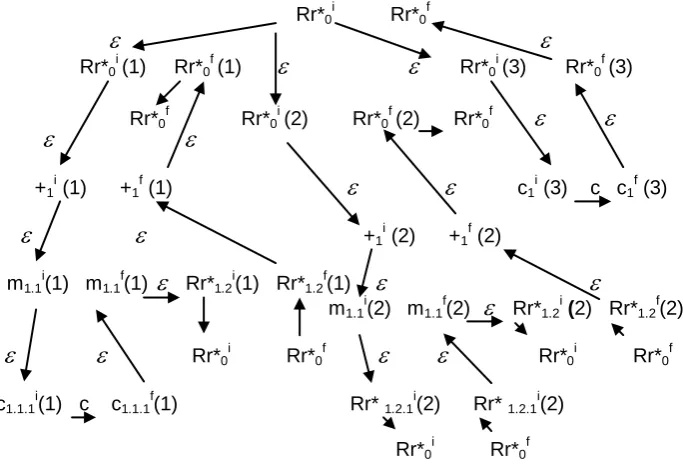
PPA is a nondeterministic automaton constructed in terms of a set of states and parsing actions respective to a GG grammar, represented in its expanded list format PLF(S). For example, Fig. 5 shows PPA respective to the grammar of Example 3. As such, PPA is defined as given below based on the following concepts and assumptions for its respective states and parsing actions:
Rr*0i Rr*0f
Rr*0i
(1) Rr*0 f
(1)
Rr*0 i(3) Rr*0 f
(3)
Rr*0f Rr*0i (2) Rr*0f (2) Rr*0f
+1i (1) +1f (1)
c1i (3) c c1f (3)
+1i (2) +1f (2)m1.1 i
(1) m1.1 f
(1)
Rr*1.2 i(1) Rr*1.2 f
(1)
m1.1i
(2) m1.1 f
(2)
Rr*1.2 i(2) Rr*1.2 f
(2)
Rr*0i Rr*0f
Rr*0i Rr*0fc1.1.1i(1) c c1.1.1f(1) Rr* 1.2.1i(2) Rr* 1.2.1i(2)
Rr*0 i
Rr*0 f
Fig. 5. PPA respective to the grammar of Example 3.
GG is either instantiated by a context-free grammar or as a regular tree
grammar. The set of productions P is generic and is either instantiated with grammar productions or ranked trees (terms). Hence, PPA includes parsing actions respective to the derivations and reductions of ranked trees. The derivations include shifting (reading) the subordinates of their respective ranked terminal. The reductions indicate the completion of such read. Therefore, reading the subordinates of a given ranked terminal are considered as a respective reduction, denoted by coherent-read, for example the string m(c) represents the ranked terminal m. Its respective
derivations / reductions as shown in Fig.4 are: m1.1 (1) r c1.1.1 (1))
r
m1.1 (1).They include an
-transition and a reduce-transition whichare mapped into the PPA states m1.1
i
(1), m1.1 f
(1), c1.1.1 i
(1) and c1.1.1
f (1)
as shown in Fig. 5 with the following parsing actions:
(m1.1i(1),
) =c1.1.1 i
(1)
SPA,
(c1.1.1 i(1), c) = c1.1.1 f
(1)
SPA,
(c1.1.1f
m1.1 f
(1)
SPA and δ(m1.1f(1), m) = reduce (m →m( c)), where the
subordinate c of m is read, and a reduction to the nonterminalized m is performed. Such reduction is considered as a coherent read of m(c).
PLF (S) implies instances of alternative derivations/ reductions,
distinguished by respective instance identifiers (ID), as explained in Example 3. Therefore, such PLF is mapped into instances of alternative of PPA states and parsing actions. Such mapping proceeds as given in
Example 2, where PPA is formulated as the tuple (T, qin, qfin,Q, SPA,
RPA). However, it is extended to include instances of alternative states and parsing actions as follows:
The set Q = { (qp i
= Vpi, qp f
= Vpf ) | Vp
PLF (S)} of PPA states, as given in Example 1, is extended by the concept of a state-instance to have the form Q = {(qpi (alt)(inst) = Vpi(alt)(inst)), (qpf(alt)(inst) =Vpf(alt)(inst))}, where the index (alt) represents the alternative to which
each pair of states (qp
i , qp
f
) belongs and (inst) is an implicit index to represent different instances of the pair. Initially, the PPA states are
created with the implicit index (inst) =
. At run-time, state-instances arecreated upon initiation of an instance of a derivation/reduction path. Such creation is indicated by appending the instance-identifier (ID) of the initiated derivation/reduction path atop of the implicit index (inst) of its respective states. For example, let the derivations/ reductions implied by PLF (S) be as given in Fig.4. A possible path initiated by the transition
Rr*1.2(1)
ri
Rr*0 is: Rr*0
ri
Rr*0(3)
c1 (3) Originally,such path has respective PPA states Rr*0i(3)(
) and c1i (3)(
) asshown in Fig.5. However, upon the transition Rr*1.2(1)
ri
Rr*0 ,
respective state instances are created as Rr*0
i
(3)((
)( Rr*1.2(1)) and c1 i(3)((
)Rr*1.2(1)). Since recursion-invocation and recursion-terminationestablish instances of derivation/reduction paths with nested life-time, the (inst) used as an index for PPA states is organized as a stack structure, onto which an ID is pushed upon recursion-invocation and thereafter popped upon recursion-termination.
To handle the initiation and termination of instances of PPA states, the
specifications of the parsing actions SPA and RPA are extended by semantic actions which are performed at run time as integral parts of the performed transitions and reductions. Thus, SPA and RBA are specified
as SPA = {
(q1(alt)(inst), V) = q2(alt)(inst)) :: { semantic-action} and RPA= { δ (q1(alt)(inst), V) = reduce(p(V)) :: { semantic-action} respectively. The specified semantic-actions constitute program segments defined in accordance with recursion-invocation and recursion-termination as follows:
The recursion-invocation is initiated by a transition of the form:
(qi(alt)(inst), V) = (qrj(alt)(inst)), where qi is a state whichimmediately precedes the one respective to a
recursive-occurrence(qrj(alt)(inst)). The
–transition
(qrj(alt)(inst),
) =respective recursive-head ( qr0(alt)(inst)), where recursion-initiation is
a semantic-action defined as: Top(inst(qr0)) = ID (qrj) to push the
instance-identifier atop of the implied index (inst) of qr0 . Further on,
instances of PPA states are subsequently created according to the
transitions respective to qr0. Such creation is achieved by augmenting
each transition
( qi(alt)(inst), V ) = qj(alt)(inst))
SPA by an implicitsemantic-action defined as Top(inst(qj)) = Top(inst(qi )) to propagate
the instance-identifier from qi to qj. Hence any transition
(qr0(alt)(inst), V ) = qj(alt)(inst))
SPA will propagate ID (qrj) and a respective instance of a derivation/reduction path will be established. For example, and considering Fig. 4, the PPA transition whichinitiates an instance of the path Rr*1.2(1)
ri Rr*0 is:
(Rr*1.2(1)(
),
) = Rr*0 (
) :: { recursion-initiation}
SPA, wherethe
–transition to Rr*0i
and { recursion-initiation} are performed. As a
result, the instance-identifier Rr*1.2(1) of the initiated path is pushed
atop of (ins) respective to Rr*0 (
). Subsequent transitions inaccordance with current input are then performed. These transitions create instances of PPA states respective to the initiated derivations/reductions. Assuming an input (c), the subsequent PPA
transitions, are: Rr*0i(
)(Rr*1.2(1))
(Rr*0i(3)(
)(Rr*1.2(1))
(c1.1.1i(3)(
)(Rr*1.2(1))
c c1.1.1f
(3)(
)(Rr*1.2(1)) ,as shown in Fig.5. The recursion-termination is established by a transition from a state
which immediately precedes the one respective to final state of a
recursive-head, where then an
–transition is performed to the finalstate respective recursive-occurrence. Hence, the reduce parsing action respective to the final state q of a recursive-head is extended by semantic-action, denoted by recursion-termination to execute a
program segment ({IF (Top (ID (q))
) { t = Pop(ID(q)); perform
–transition to t }) that terminates the initiated path and returns the
control (
–transition) to the final state respective to arecursive-occurrence. For example, and assuming an input (c) the above-illustrated path is terminated by the following sequence of PPA
parsing actions:
(c1.1.1f
(1) (
)(Rr*1.2(1)),
) = Rr*0 f(3)(
)(Rr*1.2(1)),
(Rr*0 f(3)(
) (Rr*1.2(1),
) = Rr*0 f(
)(Rr*1.2(1)). Once a transition toRr*0
f (3) has taken place, the reduce parsing action δ(R
r*0 f
(3),R(3)) =
reduce(R
c)::{recursion-termination} and the augmentedsemantic-action are performed. As a result, Rr*1.2(1) is popped from (inst)
respective to Rr*0f (3), and
–transition to Rr*1.2(1) is performed. Inaddition, (inst) respective to Rr*1.2(1) is established as
. To handle direct and indirect left recursion, the recursive-heads, the
recursive-occurrences and their mutual
–transitions are designatedas cyclic. The cyclic
–transitions and {recursion-initiation} are notthan the cyclic ones. In addition to its transitions, a cyclic recursion-termination (CRT) is added to the parsing actions of the final states
respective to the recursive- heads. CRT constitutes a default
–transitions to the final states respective to the recursive-occurrences, as Illustrated later by Example 9.
Based on the above assumptions, the definition of PPA is formalized as follows:
Definition 9. (Position Parsing Automaton). Let (Σ, N, P, S) be a GG grammar and PLF(S) be the PLF form respective to the start grammar symbol
S. The 5-tuple PPA (p) = (T, Q, qin, qfin, SA, SPA, RPA, CR) constitutes an
extended definition for the position parsing automaton (PPA), where:
1. T = (
) and
represent strings generated by the GG grammar. 2. qin and qfin are the initial and final states.3. Q =
nalt1 (qp
i
(alt)(
) = Vpi(alt)(
), qp f(alt)(
) =Vpf(alt)(
)) is the set the PPA states respective to the individual grammar symbols Vp in n alternatives of PLF(p(S)). Having a stack-structured index (inst), each PPA state constitutes a run-time nested state-instance created by PPA parsing actions in accordance with a dynamically incorporated recursion. Initially the PPA states are created with (inst) = (
).4. SA = {recursion-initiation, instance-propagation, recursion-termination} is a set of semantic-actions that are responsible for initiation, creation and termination of instances of PPA states and transitions with respect to embedded recursion. These actions are embedded within the PPA parsing actions, and executed when such actions are applied during parsing.
5. SPA:
(q1(Alt)(inst), V) = q2 (Alt)(inst),) :: {semantic-action} is a move parsingaction that specifies the subsequent PPA state q2
Q for a given state q1
Q anda given grammar symbol V
T. In addition, and whenever the transition is applied during parsing, the transition performs instance-propagation as implied semantic action and {semantic-action}
SA as explicit one, if the transition is augmented with the later.6. RPA:
(q(Alt)(inst), V) = reduce( r) :: { semantic-action} is a reduce parsing action that performs a reduction rule (r), for every V
N , q
Q such that q is the respective state to Vpf and V is the LHS (r). RPA performs the indicated {semantic- action}, If the reduction is associated with such action.7. CR:
( q(Alt)(inst),V) = coherent read V (V1…Vn) is a parsing action, defined for every V
n and q
Q such that q is the respective state to Vf. It represents the completion of the parsing process for the ranked terminal symbol V and its subordinate symbols (V1…Vn).Based on the presented definition for the PPA, its construction is reduced
to a direct mapping from the PLF (S) using the function: M (PLF(S)) →
{PPA.Q, PPA. PPA.SPA, PPA.RPA, PPA.CR}, where M (PLF(S)) performs two major steps. In each step, it scans PLF(S) from left to right and considers the grammar symbols of each alternative of PLF(S) according to their occurrence order. However, the first step constructs the set of PPA states
(PPA.Q) as union of the ones respective to the start symbol Sr*0 and to the
constructed as the set { (qin = Sr*0 I ),( qfin = Sr*0 f ),
n
alt1
i
((qii (alt)(
)= Vii(j)(ID)), (qi f
(alt)(
)=Vif(alt)(
))). The second step establishes the PPAparsing actions for the start symbol Sr*0 and for each grammar symbol Vi (j) in
every alternative PLF (S(j)), according to their order and using Definition 9 as a mapping scheme.
3.3. Soundness and generality of the PPA construction
Let the 4-tuple (Σ, N, P, S) be a GG grammar, where A
P and (
T(Σ
N )or
( Σ
N)). The constructed automaton PPA = (T, Q, qin, qfin,SPA, RPA, CR) using the mapping function M (PLF (A), as given in section
3.2, constitutes a two fold generic parsing automaton. First, its parsing behavior simulates tree parsing automata and shift–reduce automata, but with reduced stack activities. Second, it parses hybrid strings drawn from a given type of grammar, augmented by definitions from another type of a grammar, for examples:
A context-free grammar augmented by constructs from regular tree
grammar.
A regular tree grammar extended by context- free grammar constructs.
The validity of the PPA properties and the soundness of its construction approach are demonstrated by the following lemmas.
Lemma 1. PPA constitutes a bottom up parsing automaton that simulates
shift – reduce automata.
Proof. Let GG be instantiated by a context-free G. Let a rightmost
derivation be (S
Aw
Y
w
cw
). In shift-reduce parser, thereductions are performed according to the right most derivations, but in a reverse order. Thus, the reduction to Y is performed followed by one to A. In our approach, the above rightmost derivation is simulated by the
following sequence of transitions: Si
…
First(
)i
…
Last(
)f
Ai
First(
)I
…
Last(
)f
Yi
ci
….
cf
Yf
Af
First(w )i
…
Last(w )f, where Yf occurs before Af ,that is,the reduction to Y is performed first. Thus, the reductions performed by our automata are according to the rightmost derivations, but in reverse order. Further more, a handle in a shift-reduce parser is defined as the right side of a production that is formed on the top of the parsing stack [1]. Once, such a handle is formed a reduction is performed. For this purpose, the parser performs the following stack activities: push subsequent terminal (input) symbols, pop parsing stack symbols formed as a handle and push its respective nonterminal. In contrast, the PPA shift activity is defined
formed as a result of a sequence of transitions between the initial and the final states of a respective nonterminal. Subsequently, PPA reduction to a
respective nonterminal is performed upon the
-transition from the finalstate of the last handle's symbol to the final state of the respective
nonterminal, for example, the sequence (Yi
ci
c cf
Yf)forms the handle (c) respective to (Y). Upon the
-transition from cfto
Y
fpi, the reduction to Y is performed. Hence, PPA simulates ashift-reduce automaton. Furthermore, it parses the regular parts of the language as a finite automaton. However, it behaves as a pushdown automaton by using state instantiation with an instance identifier organized as a stack to handle recursion.
Lemma 2 PPA constitutes a bottom up parsing automaton that simulates the
run of regular tree automata.
Proof. Let GG be instantiated by a regular tree grammar, where Σ0= (b,x,y)
Σ2= c, (S,A)
N and P= { S
c(Ab), A
xy}. let S
cAb
cxyb be a GGderivation. Let a bottom-up regular tree automaton be defined by the 4-tuple
RA = (Σ, Q,
, Qf ), where: Σ is the input (ranked) alphabet, Q is a set ofautomaton states,
= { Q x Σj x Qj
| j
0} is a set of transitions and Qf is a setof final states. RA constructs S-derivation tree for cxyb as composed of sub trees constructed according to the following order: A(x,y), c(A,b) and S(c).
Such construction is obtained a result of the following transitions: (qx, x), (qy,
y), (qA, A, qx, qy), (qb, b), (qc, c, qA, qb) and (qS, S, qc ). On other hand, the run of PPA on cxyb simulates the same construction order, but according to the
following sequence of states transitions: Si0
ci
1
Ai
1.1
x i1.1.1
xf1.i.1
yi
1.1.2
y f1.1.2
A f1.1
b i1.2
b f1,2
c f1
Sf
0, where: the
reductions: A
xy, c
Ab (coherent read) and S
c(Ab) are performed atAf1.1, c f
1 and S
f
0 respectively. Thus, the reduction order represents a rightmost
derivation in reverse order and it is equivalent to the bottom–up construction of the S-derivation tree. Furthermore, RA and PPA have the same interpretation of their transitions with respect to the input cxyb.For example, the RA transitions (qx, x) and (qA, A, qx, qy) are considered as the mappings
x
qx and (A, qx, qy)
qA. In contrast, the respective PPA transitions: xi 1.1.1
xxf1.i.1 and A i
1.1
x
…
xAf1.1, with implied reduction A
xy,are considered as the mappings: x
xf1.i.1 and (A, xf 1.i.1, y
f
1.1.2)
A f1.1 respectively.
4.
The PPA construction algorithm
during second one the PPA parsing actions are constructed. Since PLF(S) is prefix representations of derivation trees respective to GG, its full expansion is equivalent to the construction of such trees. In this section, we propose an alternative but more efficient approach and derive a respective construction algorithm. The proposed approach is a one-pass and based on applying M (PLF(S)) over PLF(S) while it is being expanded in incremental way. For this purpose, we consider a non-expanded form of PLF(S) and a respective but partially constructed PPA as follows:
Let S
, where
= (V1…Vj…Vn )
( Σ
N). A non inductive form ofPLF(S) is defined as :
NPLF(S) = S0 (V1p1…Vj pj…Vn pn), where NPLF(S) implies a derivation sub
tree, denoted PDT (S), with a root labeled by S0 and children labeled by
V1p1, …,Vjpj,…, and Vn pn.
A partially constructed PPA (PPPA) respective to NPLF(S) is defined as
the one that is obtained as a result of applying a modified version of M(NPLF(S)) over PDT(S). Such version is defined as a mapping function
M (S0, Children( PDT(S)) which assumes that the states respective to the
root of PDT (S0) has been created and performs the following:
Create PPA states respective to the children of PDT(V1p1…Vj pj…Vn pn)
Establish the parsing actions that cover the transitions between the root
and children; the transitions between the children; and the transitions of the states instantiated by recursive occurrences of the grammar symbols. The construction of PPA is then proceeds according to Algorithm 1 as given below. Assuming an input consisting of the NPLF forms respective to a given GG grammar, Algorithm 1 constructs the PPA(S), using the following data structures and functions:
The first step of the mapping function is implemented by two functions:
CreateNode and CreatePDT to handle the construction of the individual PDTs. The function CreateNode constructs the individual nodes of PDT instantiated with respective grammar symbols. The nodes are indexed by the positions of grammar symbols as they occur within the NPLF forms. The function CreatePDT constructs the PDT respective to a given NPLF form. CreatePDT returns a record of two fields. The first field represents the root of the subtree PDT and the second one represents the children of the PDT as an array of nodes created by the function CreateNode.
The second step of the mapping function is implemented by two functions:
transitions between the children; and the transitions of the states, instantiated by recursive occurrences of the grammar symbols.
Algorithm 1
Input: A GG grammar , with start symbol S and its respective NPLF forms
Output : A bottom up automaton PPA = ( Q, qin, qfin, SPA, PAR, CR)
Method: An incremental construction of PLF forms, coupled with their
gradual transformation into the PPA(S), according to the program given in Fig. 8.
Nod0 = Create-node(S, , 0, S); GSPA = CreateGSPA (Node0);
PPA.qin= GSPA.States[1].initial; PPA.qfin = GSPA.States[1].final;
For (each alterntive of NPLF(S))
{PDT = CreateNewPDT(Node0);
ConstructPPPA( PDT.root, PDT.children)};}
Set–of–Current-PDT = Set–of–Current-PDT
PDT;While (Set–of –Current-PDT
){Current-PDT-Constructor = Select-next–PDT (Set–of–Current-PDT);
Set–of–current-PDT = Set–of–Current-PDT \ Current-PDT-Constructor; New-PDT-Roots = (Current-PDT-Constructor).ChildrenLevel
For i to MaxSize (New-PDT-Roots)
{New-Root= New-PDT-Roots[i];
For m = 1 to MaxAltenative (New-Root )
{ Alternative-Node = New-Root [m];
if AlternativeNode is terminal {}
Elseif{ PDT= CreatePDT(AlternativeNode);
Set–of–Current-PPT = Set–of–Current-PDT
PDT ;ConstructPPPA( PDT.root, PDT.children); } } }
Fig. 6. A program for the construction of the PPA automaton
S0 i S0 f
S0 i(1) S0 f
(1) S0 i
S0 i
(2) S0 f
(2)
PPPA(S0(2)) Ar*1
i
(1) A r*1 f
(1)
C2 i(1) C2 f
(1)
a3 i(1) a a3 f
(1)
c2.1 i(1) c c.2.1 f
(1)
A r*1.1 i
(1) A r*1.1 f
(1)
D1.2 i(1) D1..2 f
(1)
rec-init rec-term
a1.1 i
(1) a a1.1 f
(1) c1.2.1 i
(1) c c1.2.1 f
(1)
Example 4. Let G = (Σ, N, P, S) be a context free grammar, where: Σ = {a, b};
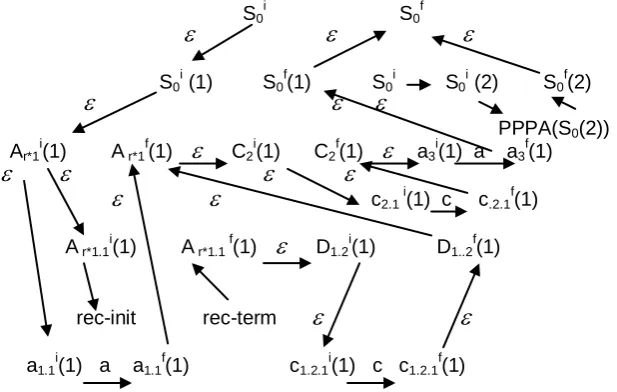
N= {A, B, C, D}; P= {p1: S→ACa; p2:S→BDb; p3:A→AD; p4:A→a; p5:B→Bc; p6: B→b; p7: C→c p8:D→c. This grammar has direct left recursion and reduce-reduce conflicts. The NPLF forms respective to G are as follows: NPLF(S0) = S0 ( Ar*1 (1), C2(1), a3(1) | Br*1 (1), D2(1), b3(1)); NPLF(Ar*1 (1) = Ar*0 (Ar*1 (1), D2(1) | a1(1)); NPLF(C2 (1) = C0 (c1(1); NPLF(Br*1 (1)= Br*0 (Br*1 (1), C2(1) | b1(1)); NPLF(D2 (1) = D0 (c1(1)). Fig.7 shows the transition graph of
PPA(S(1)) respective to alternative (1) of NPLF(S0). Its incremental
construction according to algorithm 1 proceeds as follows:
At steps 1.1 and 1.2, the root PDT is constructed as composed of the
single node Node0 = S0 with
- transitions to the roots ( Node1(1) = S0(1),Node0(2) = S0(2 ) of two alternative PDTs. The respective PPPA
automaton is constructed in terms of the following:
The PPA states: PPA.Q = {( PPA.q in = S0
i
), (PPA.qfin = S0 f
), (q 0 i
(1) = S0
i
(1)), (q 0 f
(1) = S0 f
(1)), ( q 0 i
(2) = S0 i
(2)), ( q 0 f
(2) = S0 f
(2))}
The PPA parsing action: PPA.SPA = {(
( q in,
) = q 0i
(1)),(
( q in,
) = q 0i
(2)), (
( q in,
) = q 0 i(3)), (
(q 0 f(1),
) =.qfin ), (
(q 0 f(2),
) =.qfin )} The PPA parsing action:
(q0f
(1),S)= reduce (r1(S));
( q 0f
(2), S) = reduce (r2(R).
At step 2, The PDT respective to the root Node0 (1)is formed as: Node1(1)
= Ar*1 (1), Node2 (1) = C2 (1) and Node3 (1) = a (1) respectively. The respective PPPA automaton is constructed as consisting of the following:
The PPA states: PPA.Q = PPA.Q
{ (q 1i(1) = Ar*1i(1))) ,(q 2i(2) = C2i(1)(2)) ,( q 3 i
(1) = a3 i
(1)), (q 1 f
(1) =Ar*1 f
(1) (1)), ( q2 f
(1) = C2 f
(1)), (q 3 f
(1)= a3
f (1)}.
The parsing actions: PPA.PAS = PPA.PAS
{(
(q 0i
(1),
)= (q 1 i(1)) , (
(q 1f
(1),
)= (q 2 i(1)), (
(q 2 f(1),
)= (q 3 i(1)), (
(q 3 i(1),a)= q 3
f
(1)), (
(q 3 f(1),
)= q 0 f(1)).
During the second iteration, the children of the (Node1(1) and Node2(1), are
considered as roots for which subsequent PDTs and PPPA are constructed .This process is iterated until no further PDT can be constructed. As a result, the construction of PPA(S(1)) automaton
respective to to alternative (1) of NPLF(S0), is completed, as given in
Fig.7.
PPA(S(1)) contains the cyclic transition Ar*1i(1) → A r*1.1i(1) → Ar*1i(1).
Hence, the transition Ar*1i(1)
A r*1.1i(1) and rec-init are freezed, andrec-term ( A r*1
f
(1)
A r*1.1 f(1)) is considered as a cyclic one.
5.
The Subset Construction Algorithm
In this section, we propose a subset construction (
-closure) for PPA (G). ItSuch extension is needed to cover a wider class of grammars including regular tree and context free grammars. The subset construction algorithm, denoted by Algorithm 2 is given below. Having the PPA states PPA.Q and their respective parsing actions (PPA.PAS, PPA.PAR, RBA.CR) as an input, Algorithm 2 constructs a reduced bottom-up automata RBA (G), represented by its respective states RBA.Q and a parsing table PAT. The table PAT is
organized as matrix of the form: ParsingAction array [ qo…qn, V1…Vn] , where
qo…qn
RPA.Q and V1…Vn
( the input alphabet of GG ). Theindividual entries of ParsingAction specify the transitions, the reductions and the semantic actions to be made by RBA(G) during its run on an input alphabet, generated from the grammar G. Algorithm 2 computes the RBA(G)
states and their respective parsing actions using an
-closure function [1].This function has a parameter of type state and returns set of states,
constituting the
-closure of the transmitted parameter. The function closesthe initial states and the final states respective to the different grammar symbol types. However, it does not close the initial states instantiated by grammar symbols of type ranked terminals and the grammar symbols of type
recursive instances. The steps of proposed algorithm handle their
-closures,taking into consideration their peculiarities. It is worth mentioning that the
-closure for the initial states is equivalent to the kernel item in LR parsing, while the one for final states is equivalent to the complete item.
Algorithm 2
Input: A nondeterministic PPA automaton represented by its respective
states (PPA. qin, PPA. qfin , PPA.Q) and parsing actions ( PPA.PAS,
PPA.PAR and PPA.CR).
Output: A reduced bottom-up automata RBA(G) represented by its respective
states (RPA.qin, RPA.qfin, RPA.Q) , parsing actions (RPA.PAS, RBA.PAR ,
RBA.CR) and by a parsing table PAT.
Method: Apply the subset construction on the states of the PPA(G),
according to the following steps: Step0:
Initially, apply the
-closure function on PPA. qin to obtain its respectiveRPA.qin
Add PPA.qin to the set of RBA (G) states (RBA.Q), marked as
unprocessed one. Step1:
Select an unprocessed state from the set (RBA.Q).
Group the alternative states from which the selected state is composed into
two classes. The first one includes the initial states instantiated by recursive instances. The second class includes the initial states respective to terminals and ranked terminals.
Step 2: Perform actions respective to each class as follows 2.1: Actions for the class of type recursive instance
Create new RBA states for each state(s) in the group, instantiated by their
Add the new states (s) to the set RBA.Q, marked as processed ones.
Add to the table PAT parsing actions of type "move" from the selected state
to the new one (s), augmented with semantic action (recursion-initiation).
Set the parsing actions for the new state (s), as the ones for the state
instantiated by the occurrence of its respective head. Compute
-closurefor the PPA state, instantiated by final symbol respective to the new state (s). Create new RBA state, instantiated by such closure. Add the new states to the set RBA.Q, marked as unprocessed.
The actions respective to recursive instances designated as cyclic are the
same as the above. However, their respective
–transitions and{recursion-initiation} are designated as cyclic.
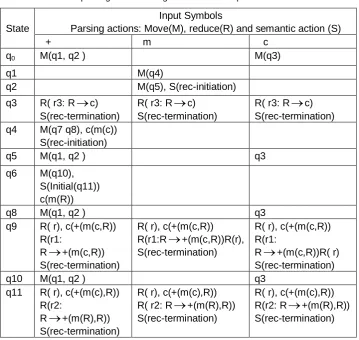
Table 1. The RBA parsing table for the grammar of Example 5
State
Input Symbols
Parsing actions: Move(M), reduce(R) and semantic action (S)
+ m c
q0 M(q1, q2 ) M(q3)
q1 M(q4)
q2 M(q5), S(rec-initiation)
q3 R( r3: R
c)S(rec-termination)
R( r3: R
c)S(rec-termination)
R( r3: R
c)S(rec-termination)
q4 M(q7 q8), c(m(c))
S(rec-initiation)
q5 M(q1, q2 ) q3
q6 M(q10),
S(Initial(q11)) c(m(R))
q8 M(q1, q2 ) q3
q9 R( r), c(+(m(c,R))
R(r1:
R
+(m(c,R))S(rec-termination)
R( r), c(+(m(c,R))
R(r1:R
+(m(c,R))R(r),S(rec-termination)
R( r), c(+(m(c,R)) R(r1:
R
+(m(c,R))R( r)S(rec-termination)
q10 M(q1, q2 ) q3
q11 R( r), c(+(m(c),R))
R(r2:
R
+(m(R),R))S(rec-termination)
R( r), c(+(m(c),R))
R( r2: R
+(m(R),R))S(rec-termination)
R( r), c(+(m(c),R))
R(r2: R
+(m(R),R))S(rec-termination)
2.2: Actions for the class of type terminals and ranked terminals
For each state in the class, select its respective parsing actions of type
Compute the
-closures for each destination state as defined by each selected transition. Create new RBA states, instantiated by the
-closures. Add the new states to the set RBA.Q, marked as unprocessed ones.
Add to the table PAT parsing actions "move" respective to the grammar
symbol ,instantiating the state ; the selected state ;and the new ones.
For each alternative of the new states of type "final" , add to the table PAT
the respective parsing actions "Reduce or coherent read" as specified by the PPA parsing actions , including the augmented semantic-action, if any.
Example 5 Applying the subset construction on the PPA automaton of Example 3, will produce the RBA automaton, represented by Table 1 as its respective parsing table.
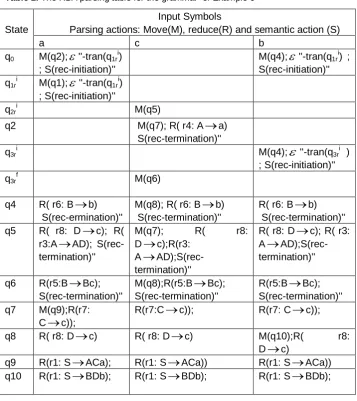
Example 6 Applying the subset construction on the PPA automaton of Example 4, will produce the RBA automaton, represented by its respective parsing table, given as Table 2.
5.1. The PA- Parser
In this section, we propose a parser, denoted PA-Parser, that simulates in pseudo-parallel the run of RBA (G) automaton on input strings, generated by the grammar G. In addition to the input string, the PA-Parser consults a parsing-table PAT respective to RBA(G), as constructed by the subset construction algorithm. The PA-Parser produces alternative parsing paths which represent a bottom-up construction of derivation trees respective to the input string. During paring, these paths are constructed in terms of performed state transitions and reductions as follows:
The RBA initial state(qin) is considered as the intial derivation. Hence, a
respective derivation/reduction path is created as parsing-pathind = qin,
where ind =1 indicates the nesting depth of the path.
For each alternative (J) of a subsequent transition or a recursion
termination (q), a continuation for the current parsing-pathind is created as
parsing-pathind.j= parsing-pathind
q.Based on the above- mentioned assumptions, PA-Parser is implemented by Algorithm3.
Algorithm 3 The PA- Parser
Input: An input string and the RBA(G) automaton respective to a
grammar G and represented by its respective parsing-table PAT.
Output: Successful and erroneous parsing paths represented as a set of
Table 2. The RBA parsing table for the grammar of Example 6
State
Input Symbols
Parsing actions: Move(M), reduce(R) and semantic action (S)
a c b
q0 M(q2);
''-tran(q1ri); S(rec-initiation)''
M(q4);
''-tran(q1ri) ; S(rec-initiation)'' q1ri
M(q1);
''-tran(q1ri ) ; S(rec-initiation)'' q2r
i
M(q5)
q2 M(q7); R( r4: A
a)S(rec-termination)'' q3r
i
M(q4);
''-tran(q3ri ) ; S(rec-initiation)'' q3r
f
M(q6)
q4 R( r6: B
b)S(rec-ermination)''
M(q8); R( r6: B
b)S(rec-termination)''
R( r6: B
b)S(rec-termination)''
q5 R( r8: D
c); R(r3:A
AD);S(rec-termination)''
M(q7); R( r8:
D
c);R(r3:A
AD);S(rec-termination)''
R( r8: D
c); R( r3:A
AD);S(rec-termination)''
q6 R(r5:B
Bc);S(rec-termination)''
M(q8);R(r5:B
Bc);S(rec-termination)''
R(r5:B
Bc);S(rec-termination)''
q7 M(q9);R(r7:
C
c));R(r7:C
c)); R(r7: C
c));q8 R( r8: D
c) R( r8: D
c) M(q10);R( r8:D
c)q9 R(r1: S
ACa); R(r1: S
ACa)) R(r1: S
ACa))q10 R(r1: S
BDb); R(r1: S
BDb); R(r1: S
BDb);Method:
Initially, the parsing algorithm considers the initial state of RBA (G) as the current parser state (ind, qin (
)) as well as the initial parsing path. Eachstate is considered as having its respective instance-identifier initialized to
,In addition, and as a transition-state, it is associated with an attribute, denoted by ind, to indicate the parsing path to which it belongs. The algorithm then, iteratively, consults the parsing table PAT entry respective to the pair (current state, current input symbol) and performs the following:
Determine the subsequent parser states , perform the implicit semantic
If the consulted parsing table entry specifies a parsing action reduction, the respective reduction is added to the current parsing path .
If this entry specifies semantic action of type recursion-termination, the
computed return state is considered as a continuation that is added to the set of the parser's next states and to respective parsing path.
Finally, upon reaching the end of the input string, the set { parsing-pathind}
is produced as an output, consisting of parsing paths in which RBA(G) has reached some of its final states and erroneous ones, otherwise.
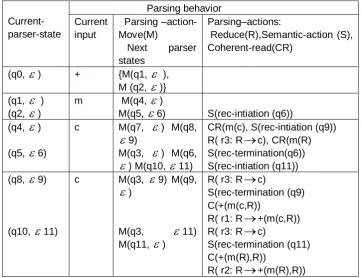
Example 7. Considering RBA automaton as given in Example 5, the run PA-Parser on the input + (m(c), c) proceeds as shown in Table 3, where two parsing paths are formulated and produced as an output:
parsing-path1,1.xxx = {(q0,
), (q1,
), (q4,
),(q7,
), (q8,
9), CR(m(c),(q3,
9),(q9,
),R( r3: R
c), CR(m(R), R( r3: R
c),CR(+(m(c),R)),R( r1: R
+(m(c,R))} andparsing-path1,2.xxx ={( q0,
), (q2,
),(q5,
6), (q3,
) (q6,
),(q10,
11), R( r3: R
c), CR(m(R), (q3,
11) (q11,
), R( r3: R
c),CR(+(m(R),R), R( r2: R
+(m(R),R) }. These paths are equivalent to abottom-up construction of their respective derivation trees ( Fig. 4)
Table 3. The parse of the input +(m (c),c) by PA-Parser for grammar (5)
Current-parser-state
Parsing behavior Current
input
Parsing –action- Move(M)
Next parser
states
Parsing–actions:
Reduce(R),Semantic-action (S), Coherent-read(CR)
(q0,
) + {M(q1,
),M (q2,
)}(q1,
) (q2,
)m M(q4,
)M(q5,
6) S(rec-intiation (q6))(q4,
)(q5,
6)c M(q7,
) M(q8,
9)M(q3,
) M(q6,
) M(q10,
11)CR(m(c), S(rec-intiation (q9))
R( r3: R
c), CR(m(R)S(rec-termination(q6)) S(rec-intiation (q11))
(q8,
9)(q10,
11)c M(q3,
9) M(q9,
)M(q3,
11)M(q11,
)R( r3: R
c)S(rec-termination (q9) C(+(m(c,R))
R( r1: R
+(m(c,R))R( r3: R
c)S(rec-termination (q11) C(+(m(R),R))
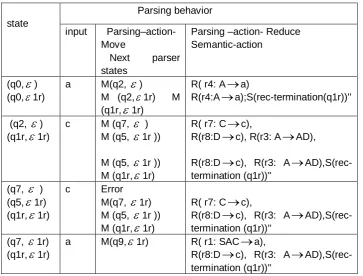
Example 8. Considering RBA automaton as given in Example 6, the run PA-Parser on the input acca proceeds as shown in Table 4, where three parsing paths are formulated and produced as an output:
parsing-path1,1.xxx = {( q0,
), (q2,
), R(r4:A
a), (q7,
), R( r7: C
c)Error}
parsing-path1,2.xxx = {(q0,
1r), (q2,
1r), R(r4:A
a),(q1r,
1r) ,(q5,
1r ),R(r8:D
c),R(r3:A
AD),(q7,
1r), R( r7: C
c),(q9,
1r), R( r1: S
ACa)}parsing-path1,2,2.xxx={(q0,
1r),(q2,
1r),R(r4:A
a),(q1r,
1r),(q5,
1r),R(r8:D
c), R(r3: A
AD), (q1r,
1r),(q5,
1r ), R(r8:D
c),R(r3:A
AD), (q1r,
1r), error}Among these parsing paths, parsing-path1,2.xxx constitutes a successful
one.
Table 4. The parse of input acca by PA-Parser for the grammar of Example 8
state
Parsing behavior
input Parsing–action- Move
Next parser
states
Parsing –action- Reduce Semantic-action
(q0,
)(q0,
1r)a M(q2,
)M (q2,
1r) M(q1r,
1r)R( r4: A
a)R(r4:A
a);S(rec-termination(q1r))''(q2,
) (q1r,
1r)c M (q7,
)M (q5,
1r ))M (q5,
1r ))M (q1r,
1r)R( r7: C
c),R(r8:D
c), R(r3: A
AD),R(r8:D
c), R(r3: A
AD),S(rec-termination (q1r))'' (q7,
)(q5,
1r)(q1r,
1r)c Error
M(q7,
1r)M (q5,
1r ))M (q1r,
1r)R( r7: C
c),R(r8:D
c), R(r3: A
AD),S(rec-termination (q1r))''
(q7,
1r)(q1r,
1r)a M(q9,
1r) R( r1: SAC
a),R(r8:D
c), R(r3: A
AD),S(rec-termination (q1r))''
Example 9. Let G = (Σ, N, P, S) be a grammar with left and embedded
recursion. Where (a,+)
Σ, (E,F)
N and P= { E
E+F, E
F, F
a,F
(E)). Applying the subset construction Algorithm 2 on the PPAbehavior on the input a+((a+a)) formulates the following parsing path as an output.
parsing-path1,1.xxx = {(q0,
), (q1,
1 ), (q6,
1 ), R( r3: F
a), R( r2:F
E, (q2,
) (q7,
), (q8,
), (q9,
3.1 ) (q3,
3.1 1.2 ) (q6,
3.1 1.2)R( r3: F
a), R( r2: F
E) (q2,
3.1 1.2), (q7,
3.1 1.2 ) (q10,
3.1 1.2 ),R( r3: F
a), R( r1: E
E+F), (q5,
3.1 ), (q12,
3.1), R( r4: F
(E)),(q1o,
), (q13,
), R( r4: F
(E)), R( r1: E
E+F)}.6.
Discussion
The experiments and the analysis of the derived algorithms for the proposed generic parser have shown the following:
1. The algorithms are characterized by the following calculated