Project Report
Closed Loop Farm Concept Design
Dr Henk Roodt
2014
i
Contents
1 Executive summary 1
2 Motivation for the study and outcome 2
3 Background concepts 2
4 The macro perspective 3
5 Theoretical and practical considerations 6
6 A transdisciplinary approach 9
7 First recursive design and modeling 12
8 The proposal for the next phase 14
9 Final Remarks 16
Figures
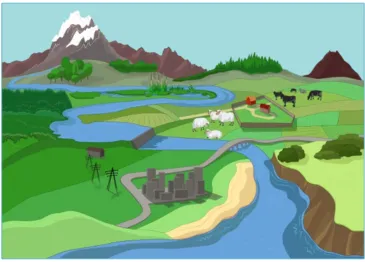
Figure 1. Natural and manmade ecosystems 5
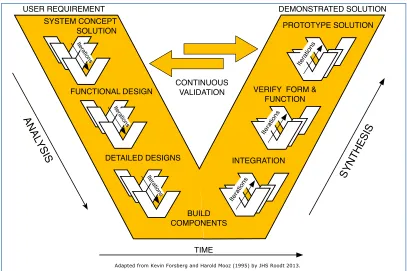
Figure 2. The iterative nature of the “Vee” process framework. 6
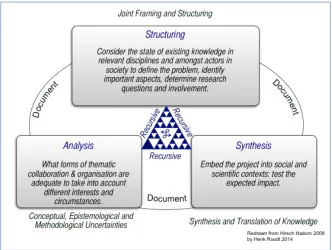
Figure 3. The recursive construvtive nature of transdisciplinary research. 10
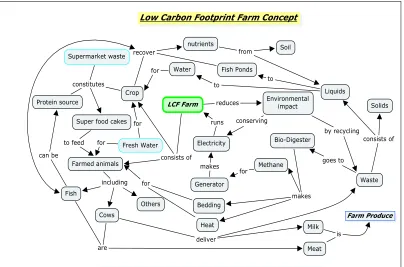
Figure 4. Capture of early discussions with stakeholders. 12
1 Executive summary
Farming procedures have intensified to the point where they significantly impact on the environment, the social fabric of the communities involved and the political and financial stability of regions. Traditional design procedures do not take the recursive and
adaptive nature of these systems fully into account. The study starts from the premise that the feedback loop and recursive causal nature inherent to agri-eco-socio-technical systems make them inherently wicked1. The design of a low carbon footprint farm takes this into account and uses a transdisciplinary approach to consider the solutions from a broad stakeholder group, using model based design approaches for the co-creation of solutions. The reason for this is that models can capture and clarify common
understanding; they can be used to effectively document and explain the recursive nature of the process being followed (as each model must stand alone as an artifact during each structure-analyze-synthesize effort). As the models increase in complexity and domain reach, it is possible to start with what-if analysis to support investment and technical decision making.
An initial solution design is presented that shows how the problem was structured and what factors were considered for a model based approach.
1
2 Motivation for the study and outcome
During 2014 a research voucher was requested by TS Farming Solutions to support the development of an early concept for a low carbon foot print farm, based on “closed loop systems” principles. This short report reflects on the process followed, the interaction with the client and the outcome of the initial project. It is concluded that a
transdisciplinary approach underpinned by extensive system simulation modelling may be used to address the further development of this complex and innovative farming concept.
3 Background concepts
Farming in developed countries have reached a point where the intensity of effort required to compete in a global market has a large impact on society and the
environment. Unless small farmers in small communities are protected by legislation, or unless they decide to only service a small local market, they are pushed out of business by intensified international operations. This has a severe effect on the social fabric in those communities, with jobs lost and social decay almost an inevitable outcome. This adds to the governmental burden on resources like policing, healthcare and welfare support.
The pressure to reduce the carbon footprint of all operations in the light of climate change compounds the problem. The debate at the level of the farm is however not on whether the climate change is manmade or not, but rather on the effects climate change produces and the changes required to cope with it.
On regional levels legislative pressure drives for reduction in nitrogen loads on water resources and curbing of greenhouse gas emissions. And finally society is becoming aware of farming practices and animal welfare.
In general the efforts to address these issues are driven by focused and segmented research based in specific research disciplines. It follows the approach that Descartes and Aristotle proposed and the current system of inquiry is grounded in a logical
manageable pieces of a bigger problem. This “disciplinary decadence” increases specialization and leaves very little room for cross-disciplinary innovation [1].
Developing a low carbon footprint dairy farming complex could easily proceed along these disciplinary lines, with initial focus on methods to reduce methane production and nitrogen load on the land. In the light of the discussion so far, this would be driven by a singular narrative (on the face of it) of compliance with new regulatory frameworks. The solution space could quickly proceed into bovine genetics and food source
management, or soil health and water purification approaches. This would not consider the impact on the small farmers with less than optimal land parcels (limited access to water, poor soil stocked with current herd genetics), or the community that may need to consider expensive off-the-grid approaches.
In this document it shown how a transdisciplinary approach expands the solution space by facilitating sharing and solution development by a wider stakeholder group. This is done through the co-development of systems models. The effort moves away from a strict focus on the baselined requirements and know-how of the initial owner of the problem (the farmer). It moves beyond the zero-sum game of reducing environmental impact via legislated management procedures while the farmers try to increase
production to remain viable businesses.
4 The macro perspective
The Māori culture and the broader cultural base of New Zealand are linked strongly to the land and the oceans surrounding Aotearoa. This is a result of it first being settled by Micronesian ancestors [2] and later similarly being discovered by European sailors. Dependence on the ecosystem services (ES) of this land and ocean was entrenched in culture. For example, industriousness (ahuwhenua) relates to activities of agriculture and to the provision of food and sustenance for the family. This is coupled to the fact that Māori traditionally regard themselves as custodians or guardians (kaitiakitanga) of the eco-resources. Vitality and excellence (ihi) are attributes of people, animals and plants and include the physical body, the spritual self and psychological attributes. It is the power of all living things to grow to maturity and excellence [3].
Few would argue that the earth is not experiencing what seems to be out of the ordinary climatic change. The debate about the drivers of this change will continue.
Understanding the effect this change has on sustainable food production is a matter of urgency, given that nearly half of the population of the planet depends directly on agriculture for its livelihood. Four types of functional ecosystem services sustain humans [4]:
1. Supporting (cycling of water and nutrients),
2. Provisioning (production of food and fuel wood),
3. Regulating (control of erosion and water purification) and
4. Cultural (social and spiritual values and aesthetics).
ES functions are found at multiple scales, including climate regulation globally and nutrient cycling locally. ES can be naturally occurring and can be engineered by man - for example farmland and cityscapes (Figure 1). Ecosystems (engineered or natural) are interrelated and provide and consume services.
trend is recognized as a major threat to food security, as it impacts directly on the supporting, provisioning and regulating clusters of ES.
Figure 1. Natural and manmade ecosystems
Understanding how the ES contribute to life is deceptively simple; it is more problematic to apportion (artificial) units of value to the different services. Economists have devised a methodology to assign (monetary) dollar values to the services. The idea is that this will make it simpler for people with diverse backgrounds to understand and compare the relative importance of services. This can cover goods and services traded in a formal way, like paying for fish and timber. Earning loss can be calculated when a resource fails to supply to expectation due to a natural or manmade disaster, for example, loss of milk production during a drought.
Given this broad context of regulatory considerations, farming obstacles and societal perceptions, how would one go about the design of a low carbon footprint dairy farm solution?
5 Theoretical and practical considerations
Buede [6] says that system engineers must be “big picture people”. He continues to state that depth of understanding is achieved by iteration through the design process (analysis and synthesis) to get to a sufficiently detailed solution specification. Who requires, or acquires this depth of understanding, is an obvious question to be resolved, and this will be addressed later in this paper. This approach is captured in the now well-known systems engineering “Vee” [7], shown in Figure 2.
Figure 2. The iterative nature of the “Vee” process framework.
The process starts with requirements capture and interpretation of stated needs. When the boundaries of the problem space that differentiate it from the larger environment in which it is contained are clearly articulated, the process works well. The requirements can be agreed to and are captured in a logical framework. Ideally the requirements remain stable over time and functional and architectural decomposition is possible.
USER REQUIREMENT CONTINUOUS VALIDATION DEMONSTRATED SOLUTION SYSTEM CONCEPT SOLUTION FUNCTIONAL DESIGN TIME DETAILED DESIGNS BUILD COMPONENTS INTEGRATION VERIFY FORM &
FUNCTION PROTOTYPE SOLUTION Itera tio ns AN AL YSI S SYN TH ESI S Itera tio ns Itera tio ns Itera tions Itera tions Ite ratio ns
When the sub-system functions and architectures are subsequently assembled, the behaviour of the synthesised system is expected to be very close to, or exactly as was required. System engineering program managers spend heavily on resources to ensure well-defined problem spaces and subsequent solutions. The principle is to isolate those elements that can be controlled within reason from those that cannot. [8].
What is not apparent in the “Vee” framework is whether a top-down or bottom-up or combination conceptual design approach is to be followed. The requirements are handled as an intrinsic part of the method in a top-down approach and may lead to development of new sub-systems and technologies to realise the solution. In a bottom-up design the exclusive use of existing systems and concepts may yield a solution, but not necessarily one that fulfils all the requirements, often leading to extensive add-on development and cost-overrun. For this reason, most design processes are
combinations of these approaches [9].
Solution designs are judged relative to how well they meet the requirements of the group of stakeholders that expressed the need or problem. Often the requirements are stated very broadly, initially by an individual or small group (a community of farmers, for example) and which often escalates into a large group of potential stakeholders when the farmers, government and other agencies become aware of the issue at hand. The solution may be stated in response to a changing environment where the causalities are all but clear. Examining a solution design on paper does not indicate when or if
unintended side effects may result from interaction of sub-systems. It is quite possible that several different designs are offered as an answer to the requirement, all seemingly satisfying it. Often complex systems exhibit exactly the characteristics described above [8].
services. Predictability that we associate with linear causality, disappears, making it difficult to fall back on past experience to develop understanding.
Public policy problems cannot be solved using traditional, structured approaches [11]. These problems are called “wicked” in contrast to the “tame” problems, problems that can be solved using traditional methods. Wicked problems do not have optimal or singular solutions [12]. They can only be resolved (a wise option is found) or dissolved (by declaring them incomprehensible or irrelevant).
Models and descriptions of complex systems do not aid in understanding how systems emerge from their components, or what factors play a role in maintaining them.
Simplification removes micro-exploratory processes that drive emergence [13]. Subsequently the model of the system, that is less complex than the system itself, cannot be used to accurately predict the behaviour of the system into the future [14].
However, humans often reduce complex problems by successive simplification to communicate the essence of the problem. Parts of the problem space resemble
patterns seen before, collapsing the big issue into ‘known’ units. Schultz [15] calls this the ‘veneer of simplicity’. But when these simplifications are seen as reflective of the real issue and addressed at the level of singular simplifications, a simple answer, that will seemingly do the job, is derived. This may not be a fitting solution, and it may give rise to even more unwanted consequences.
It has also been noted that with complex problem spaces it is better to consider
possibility and diversity rather than probability and uniformity [16] and aim to make wise decisions based on several factors. Such factors, include societal perspectives,
emerging technologies and natural systems that may be impacted by the system or impact it in turn. To this end a new approach is required that transcends disciplinary research [17] and design, an approach that encourages wide collaboration across disciplines to bring stakeholders with multiple, perhaps conflicting objectives and
6 A transdisciplinary approach
Transdisciplinarity can be defined by the following requirements [18]:
1. To grasp the complexity of the problem and focus on components and the interactions between them,
2. To account for diverse scientific and societal views of the problem,
3. To link abstract and case specific knowledge,
4. To synthesize knowledge focused on the problem to be solved, and
5. To be perceived to be for the common good.
Transdisciplinarity is inquiry driven, not discipline driven. It recognises the value of discipline specific knowledge in the development of knowledge “pertinent to the inquiry for the purposes of action in the world” [19]. It includes knowledge creation by the researcher that is reflective and self-critical (acknowledging the subjective role of the inquirer). As the requirements evolve and the structuring continues, a synthesis of possible (re)solutions is developed. Documentation of the recursive process is crucial to the co-development of a result that is accepted as being for the good of all. The process is explained in the recursive process diagram (Figure 3), redrawn by the author from [18].
This method can scale to mega-system projects that include cultural and societal complexity. Prof Julie Thompson Klein [17], Fellow in the Office For Teaching and Learning at Wayne State University, USA, put it this way: “One of the transgressive purposes of the new discourse of transdisciplinarity is to renounce the logic of
instrumental reason by creating a more democratic discourse involving participation.”
problem to where it becomes accessible. It also helps the stakeholders to make informed decisions.
Figure 3. The recursive construvtive nature of transdisciplinary research.
To conclude this discussion of the underlying procedural methodology, it is important to consider how this approach differs from the standard system engineering approaches we are accustomed to [21]. One could argue that the core of systems engineering is similar or identical to that of the transdisciplinary process. One could consider more recent versions of the extended “Vee” framework, which includes several nested “Vee”s, which allows for much of the iterative nature of the proposed approach. However, the transdisciplinary approach is recursive, and iterative. The requirements are diverse and they evolve as the understanding of the problem domain improves – the baseline
effectively shifts. The boundaries of the problem space move. The structuring and analysis proceed along a different process and the process of structure-analyse-synthesise occurs concurrently, building at each step on one another.
framework can continuously be analysed in a collaborative manner to account for multi-stakeholder interests.
Diverse candidate strategies can be synthesized and embedded into the social and scientific contexts. The expected impact of these strategies can be simulated by the systems tools developed in the analysis phase while aiding continuous structuring of the domain. For instance, agent-based models can be used to determine whether
influences from Iwi (traditional cultural entities in New Zealand) leadership will tip community behaviour towards total rejection or acceptance. Bayesian networks would be helpful in assessing the likelihood of these various systems-wide outcomes. When the strategies are actually implemented, data collected after implementation can be used to update the Bayesian networks, which would result in changes in the likelihoods of various outcomes. If there are significant changes in the likelihoods, then the solution strategy can be adapted accordingly.
The discussion so far focussed on the three processes in the transdisciplinary
approach, structuring, analysis and synthesis. The recursion that occurs, rather than iteration, ties these elements together. This “call back” or “run back” nature of the process is unique. Documenting the process becomes critical to ensuring that new understanding is shared and that the process can be terminated once the growth in understanding tapers off and the problem domain can be classed as resolved, or remains unresolved. In essence the process aims to be diverse at one level and integrative at another.
A recursive process needs a stopping flag! As the problem domain is understood better and a variety of decisions lead to implementation of (re)solutions, the problem may shift into a new paradigm. This may be seen as a stopping criterion for the process. Setting up and documenting flags to ensure that a return of the problem can be signalled, or that a systemic change has occurred, may be seen as the last actions of such a project package.
7 First recursive design and modeling
An initial discussion took place with a farmer willing to turn his current dairy farm into the hub for a system that could potentially consist of several farms in a cooperative venture. The farm is situated in a region of New Zealand with specific issues around seasonal flooding, reduced ability of the environment to cope with intensified pastoral farming techniques, social issues as a result of land claim settlements, changes in other agricultural operations and limited access to highly developed infrastructure like roads and train services. As was expected, the discussion focused on specifics of dairy farming, like optimizing feeds and dairy output while minimizing the impact on the environment (Figure 4).
Figure 4. Capture of early discussions with stakeholders.
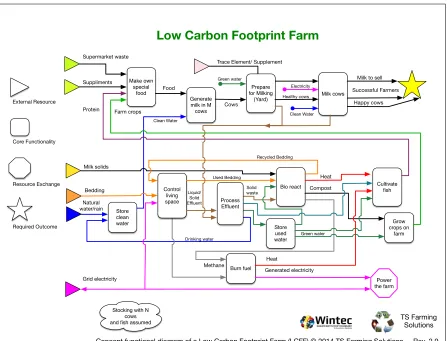
elements. These elements were pulled together through process inputs and outputs, shown in (Figure 5)
Figure 5. Conceptual functional diagram for sharing understanding.
Note that for commercial reasons some aspects are not shown here. However, the construct is populated adequately for discussion purposes.
It was decided early on to use model based design approaches. The reason for this is that models can capture and clarify common understanding; they can be used to
effectively document and explain the recursive nature of the process being followed (as each model must stand alone as an artifact during each structure-analyze-synthesize effort). As the models increase in complexity and domain reach, it is possible to start with what-if analysis to support investment and technical decision making.
The choice of the model framework was based on the level of the work required. Initially the knowledge and understanding would be at the level of systems interaction,
Generate milk in M cows Make own special food Store clean water Burn fuel Milk cows
Bio react Cultivate fish Grow crops on farm Store used water Power the farm Suppliments Supermarket waste
Milk to sell
Happy cows Trace Element/ Supplement
Healthy cows Farm crops Protein Food Clean Water Grid electricity Generated electricity Milk solids Natural water/rain Drinking water Methane Heat Compost Recycled Bedding Solid waste
Stocking with N cows and fish assumed
Concept functional diagram of a Low Carbon Footprint Farm (LCFF) © 2014 TS Farming Solutions
Control living space Bedding Used Bedding Liquid/ Solid Effluent Process Effluent Green water Heat Electricity Prepare for Milking (Yard) Cows Green water Rev. 2.9 Clean Water External Resource Core Functionality Resource Exchange Required Outcome
Low Carbon Footprint Farm
Successful Farmers
simple high level process logic and systems dynamics. In time adaptive elements
would need to be introduced in the form of agents. This would allow for the non-linearity of the system to be reflected properly. It is recognized that circular and recursive
causality would occur in the system. We must be able to model a system that supply services and consume services that it generated. A mixed-model approach is thus called for. AnyLogic2 is a commercial package that can cope with this type of complexity and allows for webcasting of developed models to stakeholders and co-creators.
A first iteration simulation model was built in AnyLogic (with the client having protected access to the model in a web portal) to reflect the information available during the initial structure-analyze-synthesize cycle. Each of the elements (as reflected in Figure 5) requires the focus of specific disciplines and experts to populate the model. During the phase discussed in this document some of the teams were already operational, and while not all stakeholders have been finalized, the initial models are useful already to enable discussion and knowledge sharing. It also allows for effective financial
estimation and discussion with investors.
8 The proposal for the next phase
The approach being followed is novel in the New Zealand context. This research project is fully externally driven with the requirement that it will deliver a working artifact at each stage of development. It is fair to expect that the client(s) will have an
expectation of a valuable deliverable, something that is considered important and that they are willing to pay for. In the case of transdisciplinarity, it is a challenge to decide up-front what will satisfy and delight the client, as the problem identification and
structuring is part and parcel of the methodology. “The client” is also a larger collective (stakeholders) that includes society in many cases. However, as was shown, the
agency requesting the inquiry becomes part of the iterative process towards co-development of the deliverable. This implies that part of the role of the research
manager will be to ensure the client and key stakeholders remain satisfied and have significant buy-in at every stage of the research project.
As part of the next phase of the project Lean Principles will be introduced. Considering Lean Principles as embodied in engineering of large systems of systems may be
beneficial and it is currently proposed that Lean Principles are adopted and adapted for the purpose of transdisciplinary research (TDR). In short, the adoption of Lean
Principles implies the following (derived from the requirements and goals of transdisciplinary research):
• Capture value through the rigorous documentation of the creative, iterative
(recursive) process of deliverables. TDR insists that the method, the road to discovery and the discovery are all equally important aspects of the action delivered in the real world.
• Map the value stream in research project plans commensurate with the level
of complexity of the research task.
• Follow the iterative flow of the TDR process and streamline the processes
required for interaction and communication by utilizing tried and tested methodologies like Design Thinking [22] and other appropriate process to ensure rigorous verification and validation of synthesis against analysis.
• The lean principle of customer pull is embodied in the requirement to ensure
appropriate diversity of scientific and societal views of the problem.
• Given the complexity of the type of problems under consideration, the pursuit
of perfection is reflected in the quality of the creative and reflective aspects of the TDR approach and how innovative approaches are woven (and
documented) into the TDR process.
• Finally, respect for people is part of the understanding that the knowledge
9 Final Remarks
10 References
[1] A. Montuori, "The Complexity of Transdisciplinary Literature Reviews," Complicity: An
International Journal of Complexity and Education, vol. 10, pp. 45-55, 2013.
[2] B. Mikaere, Māori in Aotearoa New Zealand - Understanding the culture, protocols and
customs. Auckland: New Holland Publishers, 2013.
[3] C. Barlow, Tikanga Whakaaro - Key concepts in Māori culture.: Oxford University Press,
1991.
[4] H. Sandhu and S. Wratten, "Ecosystem Services in Farmland and Cities," in Ecosystem
Services in Agricultural and Urban Landscapes, S. Wratten, H. Sandhu, R. Cullen, and R. Costanza, Eds., ed Hoboken, NJ: Wiley-Blackwell, 2013.
[5] P. Kaval and R. Baskaran, "Key Ideas and Concepts from Economics for understanding
the Roles and Value of Ecosystem Services," in Ecosystem Services in Agricultural and Urban Landscapes, S. Wratten, H. Sandhu, R. Cullen, and R. Costanza, Eds., ed Hoboken, NJ: Wiley-Blackwell, 2013.
[6] D. M. Buede, The Engineering Design of Systems - Models and Methods, 2nd Ed. ed.
Hoboken, New Jersey: Wiley & Sons, 2009.
[7] K. Forsberg and H. Mooz, "The Relationship of System Engineering to the Project Cycle,"
presented at the First Annual Symposium of NCOSE October 1991, Chattanooga, TN, 1991.
[8] R. Stevens, Engineering Mega-Systems: The Challenge of Systems Engineering in the
Information Age. Boca Raton: Auerbach Publications and CRC Press (Taylor and Francis Group), 2011.
[9] E. W. Aslaksen, Designing Complex Systems: Foundations of Design in the Functional
Domain. Boca Raton: Auerbach Publications and CRC Press (Taylor and Francis Group), 2009.
[10] E. Morin, "The Paradigm of Complexity," in On Complexity, ed Cresskill, NJ: Hampton Press, 2008.
[11] H. W. J. Rittel and M. M. Webber, "Dilemmas in a General Theory of Planning," Policy Sciences, vol. 4, pp. 155-169, 1973.
[12] M. Pidd, Tools for Thinking - Modelling in Management Science. New York: John Wiley & Sons, 1996.
[14] S. C. Banks. (2002, 2014). Tools and Techniques for Developing Policies for Complex and Uncertain Systems. Available:
http://emergentpublications.com/Members/Articles/Developing policies for complex and uncertain systems.pdf
[15] R. Schultz, "Adjacent Opportunities: The Failure of Simple Answers," E:CO, vol. 12, pp. 81-83, 2010.
[16] J. H. S. Roodt, "Non-quantitative modelling as a framework for the analysis of complex systems," in Explorations in Complexity Thinking: Pre-Proceedings of the 3rd International Workshop on Complexity and Philosophy, K. A. Richardson and P. Cilliers, Eds., ed Mansfield, MA: ISCE Publishing, 2007, pp. 213 - 222.
[17] J. Thompson Klein, "Interdisciplinarity and Complexity: An evolving relationship," E:CO, vol. 6, pp. 2-10, 2004.
[18] G. Hirsch Hadorn, Hoffmann-Riem, H., Biber-Klemm, S., Grossenbacher-Mansuy, W., Joye, D., Pohl, C., Wiesmann, U., Zemp, E, Handbook of Transdisciplinary Research: Springer, 2008.
[19] A. Montuori. (2005, 2014). Gregory Bateson and the Promise of Transdisciplinarity. Cybernetics and Human Knowing 12(1-2), 147-158. Available:
https://http://www.academia.edu/168671/Gregory_Bateson_and_the_Challenge_of_Trans
disciplinarity
[20] K. Pieters, "Patterns, Models, Complexity: Notes On Mapping Patterns In Analysis Of Complexity," Emergence: Complexity and Organisation E:CO, vol. 12, pp. 57-77, 2010.
[21] H. Roodt and H. Koen, "Engineering Design of an Environmental Management System: A Transdisciplinary Response to the Rhino Poaching Problem," in EMEASEC 2014,
Somerset West, South Africa, 2014.