ANALYTICAL STUDY OF SPRAY AND WAIT
ROUTING PROTOCOL IN DELAY TOLERANT
NETWORK
Supriya Dilip Tambe
1, Prof. Pramila M. Chawan
21
Student, Computer Engineering and Information Technology Department, VJTI, Mumbai, (India)
2
Computer Engineering and Information Technology Department, VJTI, Mumbai, (India)
ABSTRACT
Conventional TCP/IP fails if there is no end-to-end path available between source and destination i.e. there
exists intermittent connectivity or link failure then to establish communication, Delay Tolerant Network (DTN)
Architecture comes in a picture. Store-Carry and Forward strategy is a base for DTN. To propose optimal
routing protocol with proper resource utilization, achieving high message delivery, low latency and low
overhead ratio in DTN is one of the challenges. Spray and wait routing is one of the controlled flooding
protocol which does not use network’s knowledge for forwarding messages and also reduce network congestion.
In this paper, we will discuss Spray and Wait routing in details, analyze its performance by varying number of
copies of the message and compare it with other routing protocols on the basis of buffer size, number of nodes
in a network and message load i.e. number of messages created in a given interval. Results generated after
simulation will prove that Spray and Wait routing achieve high efficiency and it is simple and scalable among
other routing protocols.
Keywords - Delay Tolerant Network, Delivery Probability, Overhead Ratio, Routing, Store-Carry
and Forward Architecture
I. INTRODUCTION
The period of time in which communication can takes place between two DTN nodes is called a contact. There are various types of contacts called as Intermittent Scheduled (e.g. Space Communication), Intermittent Opportunistic, Persistent (always connection is available), On-Demand (e.g. Dial-up connection) and Intermittent Predicted (using Contact history information). Wireless sensor network, inter space communication, military network, underwater communication and networks where conventional TCP/IP communication fails uses the concept of DTN architecture. In recent days, Information Centric Network is also based on DTN. Routing in DTN is an emerging research topic nowadays. For bundle forwarding, resource management, security in DTN, various routing protocols are proposed till date and there are performance parameters to evaluate the performance. Some of these parameters are: message delivery probability, latency, overhead ratio, packets dropped, hop count in the network.
In this paper we have mainly studied Spray and wait routing protocol and its modes and its comparison with other routing protocols such as Direct Delivery, First Contact, Epidemic routing and Prophet routing based on performance parameters as delivery probability and overhead ratio.
This paper is organized as follows: First the detailed explanation of Routing protocol, routing issues in DTN, classification of protocols, Direct Delivery, First Contact, Epidemic and Prophet routing protocols are given in section II. In section III, we discussed the functioning of Spray and Wait routing protocols and its phase and modes. Simulation setup and result analysis is discussed in Section IV. Section V concludes this paper.
II. ROUTING IN DELAY TOLERANT NETWORK
Routing Protocol: It is the logic or a strategy or a procedure how node can decide to forward a bundle/packet to
other node. It can be flooding the network, using network’s knowledge or based on encounter history of node to
get best path. So, routing protocols are classified as flooding families and forwarding families. Based on number of copies of message in network, it can be classified single-copy scheme or multiple copy schemes. There are some routing issues in DTN such as limited resources i.e. buffer size of a node, node energy, receipt of acknowledgement from destination to source due to intermittent link, capacity of link etc.
Objectives of any routing protocol:
Message Delivery Probability:It is the ratio of number of messages received by destinations to number of messages created by sources in the network for a given time.
Delivery Latency: It is the sum of difference of delivered time and created time of each message in a network for a given time interval.
Overhead Ratio:It is the ratio of difference between total number of copies of all messages and total number of messages delivered to total number of message delivered in a network for a given time.
Efficient routing protocol should be simple, scalable and capable of working in low and high message load; it should have optimal delivery probability, low delay and low overhead ratio. Till date, various routing protocols are proposed. Here, we will discuss Direct Delivery, Epidemic, First Contact and Prophet routing and focus on every aspect of Spray and Wait routing protocol.
Routing Protocols:
A.Direct Delivery Routing:This routing is very simple and basic. It uses Single-copy scheme and does not
with other then only message is transferred. Messages are handled in First In First Out (FIFO) based queue. In this, overhead ratio will be always zero. But if source and destination are not in contact then message will not be delivered so it will impact on delivery probability.
B. Epidemic Routing:Epidemic routing is blind flooding based like virus spreading mechanism, does not use
network information while forwarding message [6]. In this routing scheme, when a node created or received a message it forwards a copy of it to all nodes it comes in contact. Thus, the unlimited message copies are spread throughout the network by mobile DTN nodes. This scheme uses best effort approach to increase delivery probability.
Each node stores summary vector which contains each message and its unique identifier in buffer. Whenever, two nodes come in transmission range with each other, they exchange and compare summary vectors available in their buffer to know which message they do not have and subsequently request them. Information about exchange of summary vector is kept in node’s cache to avoid multiple connections. This protocol explores
all available paths to forward messages leads to redundancy of messages in network. Due to flooding, there will be network congestion which leads to dropping of messages and also utilizes more resources like buffer and bandwidth.
C. First Contact Routing: This isa single copy routing protocol, i.e. only one copy of each messageexists in the
network. In First Contact node always forwards the messages to the first contact and remove from buffer but in Direct Delivery messages are only delivered to destination. Network information is not used to forward message. There is no message redundancy like in Epidemic routing.
D. Prophet Routing: PRO babilistic Protocol using History of Encounters and Transitivity (PROPHET) is aprobabilistic routing protocol [5]. It uses the encounter’s history to calculate the delivery predictability of the node. Each node has a list of the delivery predictability ofevery other node to reach the destination. When nodes come in contact each other, list is exchanged with other DTN node. In addition, it also gather information to decide DTN node to which message will be forwarded. This protocol is based on Epidemic routing which has FIFO for message queue and unlimited number of copies of message, but forwarding isbased on delivery predictability and it is thus history based, so PROPHET has a higher delivery ratio, less communicationoverhead than epidemic.
III. SPRAY AND WAIT ROUTING PROTOCOL
In section II, we discussed various routing protocols. Here, we discuss working of Spray and Wait routing protocol. To overcome blind flooding the network with uncontrolled message copies and to lower resource consumption in the epidemic routing, author [4] proposed the spray and wait mechanism.
The spray and wait routing protocol has two phases, spray and wait phase. In the spray phase, the source node forwards L copies of message to first L encountered nodes and then goes to wait phase till it get delivery confirmation of message from destination. In the wait phase all nodes that received a copy of the message wait to meet the destination node directly to forward message. Once data is delivered, acknowledgement is sent back using the same principle i.e. Spray phase is same as Epidemic routing and wait phase is same as Direct Delivery routing.
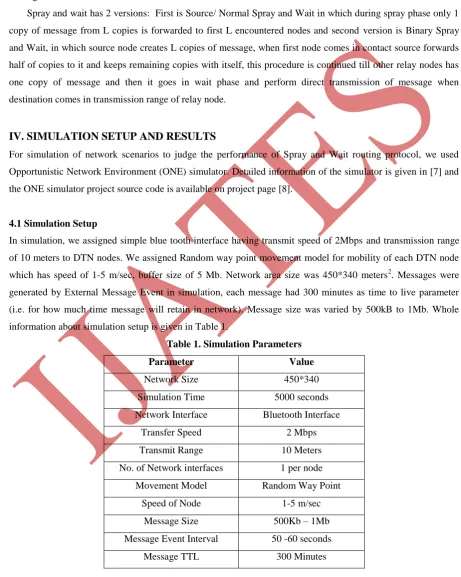
Spray and wait has 2 versions: First is Source/ Normal Spray and Wait in which during spray phase only 1 copy of message from L copies is forwarded to first L encountered nodes and second version is Binary Spray and Wait, in which source node creates L copies of message, when first node comes in contact source forwards half of copies to it and keeps remaining copies with itself, this procedure is continued till other relay nodes has one copy of message and then it goes in wait phase and perform direct transmission of message when destination comes in transmission range of relay node.
IV. SIMULATION SETUP AND RESULTS
For simulation of network scenarios to judge the performance of Spray and Wait routing protocol, we used Opportunistic Network Environment (ONE) simulator. Detailed information of the simulator is given in [7] and the ONE simulator project source code is available on project page [8].
4.1 Simulation Setup
In simulation, we assigned simple blue tooth interface having transmit speed of 2Mbps and transmission range of 10 meters to DTN nodes. We assigned Random way point movement model for mobility of each DTN node which has speed of 1-5 m/sec, buffer size of 5 Mb. Network area size was 450*340 meters2. Messages were generated by External Message Event in simulation, each message had 300 minutes as time to live parameter (i.e. for how much time message will retain in network). Message size was varied by 500kB to 1Mb. Whole information about simulation setup is given in Table 1.
Table 1. Simulation Parameters
Parameter Value
Network Size 450*340
Simulation Time 5000 seconds Network Interface Bluetooth Interface
Transfer Speed 2 Mbps
Transmit Range 10 Meters
No. of Network interfaces 1 per node Movement Model Random Way Point
Speed of Node 1-5 m/sec
Message Size 500Kb – 1Mb
Message Event Interval 50 -60 seconds
4.2 Simulation Results:
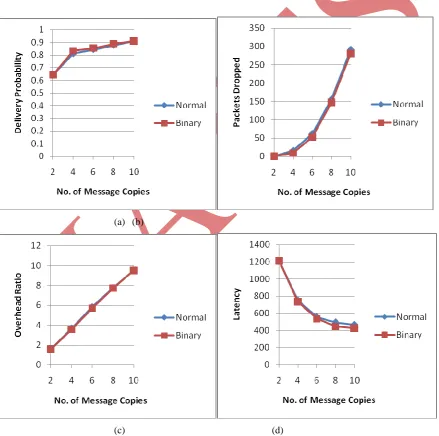
4.2.1 Impact of Number of Copies in Normal and Binary mode of Spray and Wait Routing Protocol Using simulator, we first studied the impact of number of copies on delivery probability, packets dropped, overhead ratio and latency in Normal mode and Binary mode of Spray and Wait routing protocol. In simulation, 100 DTN nodes were having above simulation parameter and Spray and wait routing as a routing protocol. We performed simulation for 2, 4, 6, 8 and 10 of copies of message.
Fig. 1 shows the impact on performance parameters of routing protocol. Results showed that as we go on increasing number of message copies then delivery probability due to slowly flooding network, packets dropped by nodes and overhead ratio were increased and latency of message to reach destination was decreased. For 2 number of copies, binary Spray and wait acts as same as normal mode. From graphs, we got that binary mode had excellent performance than normal mode of Spray and Wait routing.
(a) (b)
(c) (d)
Fig. 1Impact of no. of message copies in Normal and Binary mode of Spray and wait routing protocol on performance parameters as (a) Delivery Probability, (b) Packets Dropped, (c) Overhead Ratio and (d) Latency.
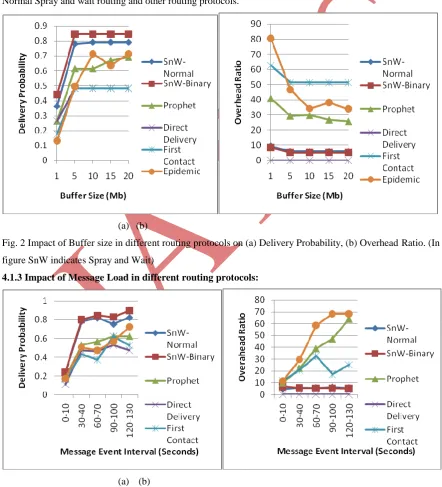
To check impact of buffer size, we varied buffer size as 1M, 5M, 10M, 15M and 20M. There were 50 DTN nodes and messages event interval was 50-60 seconds so 91 messages were created in 5000 seconds. Spray and wait routing protocol had 6 copies.
Fig. 2 shows the comparison of delivery probability and overhead ratio for Direct Delivery Routing, Epidemic Routing, First Contact Routing and binary and normal mode of Spray and Wait Routing. From the figure, it can be stated that as buffer size of node increases delivery probability increases and overhead ratio decreases for all routing protocols. Buffer provides space for messages while movement and messages will not be dropped due to buffer overflow as buffer size increases. In Direct Delivery message is only forwarded to destination so overhead ratio will be 0 for any buffer size. Binary Spray and wait routing has excellent performance than Normal Spray and wait routing and other routing protocols.
(a) (b)
Fig. 2 Impact of Buffer size in different routing protocols on (a) Delivery Probability, (b) Overhead Ratio. (In figure SnW indicates Spray and Wait)
4.1.3 Impact of Message Load in different routing protocols:
(a) (b)
Here we analyze the performance of different routing protocols under high and low message load by varying message event interval. Scenario contains 50 DTN nodes. Spray and wait routing protocol had 6 copies. Table 2 shows message event interval and messages created in particular interval.
Table 2. Messages Created per Message Event Interval in Seconds
Message Event Interval 0-10 30-40 60-70 90-100 120-130
Messages Created 1105 146 78 53 40
Fig. 3 shows the comparison how Direct Delivery Routing, Epidemic Routing, First Contact Routing and binary and normal mode of Spray and Wait Routing works in high and low load. From the figure, it can be observed that as under very high load all protocols shows low delivery probability and in normal and low load, all were performed well. Above figure shows that Spray and wait routing protocol works efficiently in high and low message load than other protocols.
4.1.3 Impact of Message Load on different routing protocols:
(a) (b)
Fig. 4 Impact of number of nodes in network in different routing protocols on (a) Delivery Probability, (b) Overhead Ratio.
V. CONCLUSION
In this paper, we studied DTN basics includes Store-carry-forward architecture, various DTN routing issues, routing approaches and performance parameters like delivery probability, overhead ratio etc. used in Delay Tolerant Network for forwarding of Bundles. Spray and wait routing protocol is a limited bound Epidemic routing protocol which has 2 modes- Normal mode and Binary Mode. We checked the impact of number of copies of messages on message delivery, overhead ratio, latency and messages dropped Spray and Wait routing protocol in both modes. With the help of extensive simulations in ONE Simulator, we compared routing protocols based on Delivery Probability and Overhead Ratio by varying buffer size, number of nodes and number of message creation interval and proved that Spray and Wait routing protocol is simple, scalable and efficient than other routing protocols such as Epidemic, First Contact, Direct Delivery and Prophet. Simulation results showed that Binary Spray and Wait performed efficiently in all conditions.
REFERENCES
[1] Cerf, V., Burleigh, S., Hooke, A., Torgerson, L., Durst, R., Scott, K., Fall, K., Weiss, H.: RFC 4838, Delay-Tolerant Networking Architecture. IRTF DTN Research Group (2007)
[2] RFC 5050 – Bundle Security Protocol Specification
[3] Routing Protocols in Delay Tolerant Networks: A Comparative Survey, 2008.
[4] T. Spyropoulos, K. Psounis, C. Raghavendra, “ Spray-and-Wait: Efficient routing scheme for intermittently connected mobile networks ”, in ACM SIGCOMM Workshop on Delay Tolerant Networking (WDTN), 2005.
[5] A. Lindgren, A. Doria, E. Davies, S. Grasic.: Probabilistic Routing Protocol for Intermittently Connected Networks draft-irtf-dtnrg-prophet-10 IRTF DTN Research Group (May 22, 2012).
[6] A. Vahdatand, D. Becker, “ Epidemic Routing for Partially Connected Ad Hoc Networks ”, Duke Technical
Report, CS-2000-06, July 2000. available at issg.cs.duke.edu/epidemic/epidemic.pdf.
[7] A. Keranen, J. Ott, and T. Karkkainen, “The ONE Simulator for DTN Protocol Evaluation,” in SIMUTools ’09: Proceedings of the 2nd International Conference on Simulation Tools and Techniques. New York, NY,
USA: ICST, 2009