236 JUDUL JURNAL MAHASISWA PROGRAM
STUDI FISIKA/PENDIDIKAN FISIKA FMIPA UNP JUDUL JURNAL MAHASISWA PROGRAM STUDI FISIKA/PENDIDIKAN FISIKA FMIPA UNP
Isi Abstract ejournal fisika/pendidikan Fisika Fakultas Matematika dan Ilmu Pengetahuan Alam, Universitas Negeri Padang Isi Abstract ejournal fisika/pendidikan Fisika Fakultas Matematika dan Ilmu Pengetahuan Alam, Universitas Negeri Padang,,
Isikan Keyword
1. INTRODUCTION
National education purposed for intelligence nation life[1].Based on this,the objectives of mathematics learning that taught at the school gain the critical thinking, logically, analytically, creatively, problem-solving skills, and the ability to communicate ideas and resilience and confidence in solving problems in everyday life[2].Learning begins with teachers giving problems in everyday life that the students have to solve.This can be done if the teacher designs an interesting learning activity and encourages students to find concepts and solve problems. To support learning activities like this then the teacher in learning can use learning media such as Student Worksheet (LKPD). Based on observations made on May 4th, 2016 at three senior high school on the Pesisir Selatanwhich is implements 2006 curriculum and Curriculum 2013 including SMAN 1 BatangKapas, SMAN 2 Painan and SMAN 3 Painanshowed mathematics learning tools that used by teacher in the school has not yet facilitated the students to be active.One example in the lesson plan explains that the teacher directly gives the concept of material instead of students who find the concept of the material through the guidance of teachers so that students are not active in learning activities. In the learning activities, the teacher explains examples of questions and students are asked to ask if there is material and examples of questions described are not understood by students and students are asked to do the exercises. In addition, teachers have not linked learning materials with the problems that exist in everyday life. One of the learning models that requiresstudents to find their own mathematical concepts and solve problems is the Discovery learning Models. Discovery learning suitable for mathematical learning.Discovery learning can improve the ability of mathematical representation and confident of students[3]. To apply the learning model of Discovery learning in the classroom, must follow the steps of learning model that is:1) Stimulationt he students is confronted with something that creates their confusion, and raises a desire to investigate on their own, 2) Problem statement students are given the opportunity to identify issues relevant to the subject matter, then formulated in hypothetical form, 3) Data collection students are asked to gather as much relevant information as possible to validate the hypothesis 4) Data processing is an activity to process data and information that has been obtained by students, 5)
Verification students do an examination to prove the truth of the hypothesis, 6) Generalization is the stage of making a conclusion[4]. Discovery learning is proven in improving the quality of learning compared to conventional methods, and students can improve their knowledge during the learning process [5]. Discovery learning modelsis a learning model that tries to lay the groundwork and develops a way of scientific thinking, the students is placed as a learning subject,the role of the teacher in this model is a learning coach and learning facilitator [6]. Discovery learning activities in general can help in understanding language skills and assist students in responding to a learning strategy[7]. Learning tools include lesson plan (RPP) and students worksheet (LKPD). Lesson plan (RPP) is a plan that describes the procedures and organizing of learning to achieve a basic competency set out in the Content Standards and has been elaborated in the syllabus [8]. In general, in developing RPP should be based on the principles of RPP development, ie: (1) the competencies planned in the RPP should be clear, concrete and easy to understand; (2) RPP must be simple and flexible; (3) RPP which is developed in a comprehensive, whole, and clear attainment; (4) should coordinate with the implementing components of school programs, so as not to interfere with other lessons [9]. LKPD is a learning tool as a complement or a means of supporting the implementation of RPP. The characteristics of LKPD are 1) Have all the instructions required by the student, 2) The written instructions are easy to understand[10]. The structure of LKPD generally consists of Title, learning guidance of competence to be achieved, supporting information, tasks and work steps, assessments[11]. In designing LKPD, teachers should know the things that must be considered in designing the development of LKPD is the suitability of materials, tasks and exercises with indicators of achievement of competence, so that the tools developed high quality. Learning tools developed should be validated with five experts who are competent in their field before being tested for trial.Trial done to know the practicality of learning tools. Practicality is known from trial results one-to-one, small group, andfield test[12]. The practicality of a teaching material can only be met if experts and practitioners state that what is developed is applicable. the tool is said to be practical if the tool can be applied in the field and the level of its implementation in the category of at least good. tools are
Practicality Of Mathematics Learning Tools Based
On Discovery Learning For Topic Sequence And
Series
NitiaRoza, I Made Arnawa, Yerizon
Abstract: Mathematics as a learning subject is widely used in everyday life should be liked by students. But, the fact showed that the implementation of mathematics learning is still not related to our daily life. One of the causes is learning tools that are not in accordance with the demands of the curriculum, one of which lies in the learning models. Discovery learning is a learning model matched the characteristics of mathematics learning. The aims of this research is developed the mathematics learning tools based on Discovery learning for topic sequence and series. The type of research is development research using Plomp Development Model. The result of preliminary research is required learning tools based on discovery learning. The results showed the practicality of learning tools is very practical.
Index Terms: Discovery learning Models
also said to be practical if it gets a positive response from teachers and students[13].
2. RESEARCH METHODS
Type of research is research and development (Research and Development) using Plomp model. This model consists of three stages:preliminary research, prototyping phase, evaluation phase[14]. Preliminary research is a preliminary analysis stage. At this stage do an analysis of the needs of learning tools mathematics.The analysis is a requirement analysis, curriculum analysis of competence standard and basic competence on sequence and series material. The analysis also needs to be done is the analysis of students through interviews with some students of SMAN 1 BatangKapas to know the characteristics of students, so that learning tools produced in accordance with the characteristics expected by students. Prototyping phase Learning toolss are designed in accordance with the results of the analysis that has been done. The design produced at this stage is called prototype 1.In this design, formative evaluation is conducted for the purpose of improvements being developed [15]. Beginning with evaluation is self-evaluation conducted by researchers and one friend.The goal is to make corrections to the completeness of the components contained in the learning tools that has been developed. The results of self-evaluation were analyzed, and revised. Furthermore, will be tested the validity of prototype I learning tools based on mathematics discovery learning.Validation is a test of validity, accuracy, and the truth of things. The validation process is performed by an expert or expert in accordance with the field of study [16]. Validation conducted 5 experts who are competent in their field, including 3 lecturers of mathematics education, one lecturer of educational technology, and one lecturer of Indosias language. Comments and suggestions from the validator become references to the revision of prorotype I learning tools which is developed. Development process can be continued if prototype I declared valid. Evaluation continued through product testing. The evaluation of the mathematics learning tool consists of three stages: one-to-one evaluation, small group evaluation and large group evaluation. The instruments used were questionnaires and interview guidelines. The type of data is a data taken from the validation of mathematical learning tools conducted by the validator, the data of practicality by teachers and students. Data collection instruments used are preliminary research stage instruments, instruments of validity and practicality. Data analysis techniques used are descriptive statistics and qualitative data analysis.
3. RESEARCH RESULT AND DISCUSSION
a. Research result
This research starts from the initial investigation stage, where at this stage done needs analysis, curriculum analysis, concept analysis and student analysis of mathematics learning tool that will be developed. Needs analysis results obtained conclusion that what is needed in implementing a learning is a learning tool for the learning process run systematically to achieve the desired goals.Learning tool needed is a lesson plan (RPP) and student worksheet (LKPD) that is able to direct students to find their own concept and build the problem solving ability of mathematics
238 LKPD IV meeting until LKPD VI meeting based on interviews
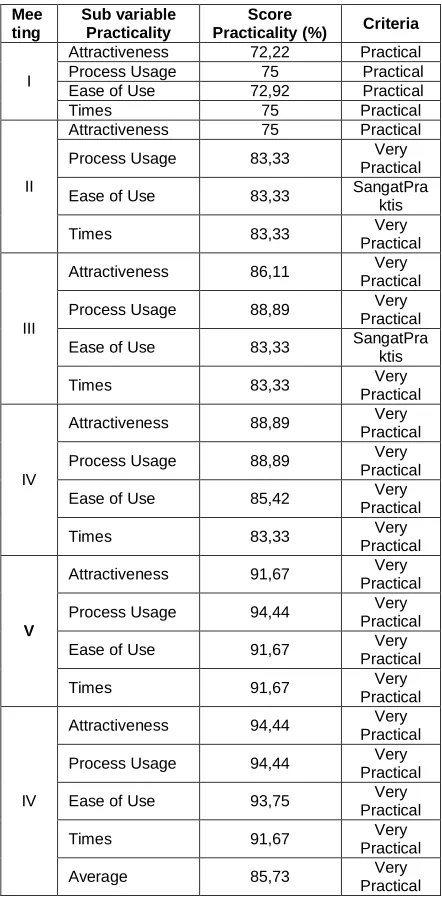
there is no suggestion about LKPD image there are only some wrong typing.The results of the one to one test by students are shown in Table 1.
Tabel 1.On to one test resul on LKPD
Mee ting
Sub variable Practicality
Score
Practicality (%) Criteria
I
Attractiveness 72,22 Practical Process Usage 75 Practical Ease of Use 72,92 Practical
Times 75 Practical
II
Attractiveness 75 Practical
Process Usage 83,33 Very Practical
Ease of Use 83,33 SangatPra ktis
Times 83,33 Very
Practical
III
Attractiveness 86,11 Very Practical
Process Usage 88,89 Very Practical
Ease of Use 83,33 SangatPra ktis
Times 83,33 Very
Practical
IV
Attractiveness 88,89 Practical Very
Process Usage 88,89 Very Practical
Ease of Use 85,42 Very
Practical
Times 83,33 Very
Practical
V
Attractiveness 91,67 Very Practical
Process Usage 94,44 Very Practical
Ease of Use 91,67 Very
Practical
Times 91,67 Very
Practical
IV
Attractiveness 94,44 Very Practical
Process Usage 94,44 Very Practical
Ease of Use 93,75 Very
Practical
Times 91,67 Practical Very
Average 85,73 Very
Practical
Subsequently, small group evaluations were performed. Small group evaluation is done after the evaluation is done one by one. Small group evaluation was conducted by 8 students. 2 high-skilled students, 4 medium-skilled students and 2 high-ability students. Students are given a questionnaire to assess the practicability of LKPD, which is based on Discovery learning. Practicality test results assessed by students in small groups of each statement are presented in Table 2.
Table2. Small Group Test Results on LKPD
Mee ting
Sub variable Practicality
Score of Practicality
(%)
Criteria
I
Attractiveness 79,17 Practical
Process Usage 81,25 Very Practical
Ease of Use 80,47 Very
Practical
Times 68,75 Practical
II
Attractiveness 83,33 Very Practical
Process Usage 85,00 Very Practical
Ease of Use 86,72 Very
Practical
Times 71,88 Practical
III
Attractiveness 83,33 Very Practical
Process Usage 85,42 Very Practical
Ease of Use 86,72 Very
Practical
Times 75 Practical
IV
Attractiveness 89,58 Very Practical
Process Usage 85,42 Very Practical
Ease of Use 88,28 Practical Very
Times 87,50 Very
Practical
V
Attractiveness 89,58 Very Practical
Process Usage 86,46 Very Practical
Ease of Use 92,71 Very
Practical
Times 90,63 Very
Practical
IV
Attractiveness 89,58 Very Practical
Process Usage 90,63 Very Practical
Ease of Use 95,31 Very
Practical
Times 90,63 Very
Practical
Average 82,53 Very
Practical
Table3. Field Test Results of Teachers’ Learning Tools
Mee ting
Sub variable of Practicality
Score of Practicalit y (%)
Criteria
I
Attractiveness 81,25 veryPractical Process Usage 75,00 Practical Ease of Use 81,25 Very Practical
Times 75,00 Practical
II
Attractiveness 87,50 Very Practical Process Usage 75,00 Very Practical Ease of Use 81,25 Very Practical
Times 75,00 Practical
III
Attractiveness 87,50 Very Practical Process Usage 75,00 Very Practical Ease of Use 87,50 Very Practical Times 87,50 Very Practical
IV
Attractiveness 87,50 Very Practical Process Usage 87,50 Very Practical Ease of Use 87,50 Very Practical Times 87,50 Very Practical
V
Attractiveness 87,50 Very Practical Process Usage 87,50 Very Practical Ease of Use 81,25 Very Practical Times 87,50 Very Practical
VI
Attractiveness 93,75 Very Practical Process Usage 87,50 Very Practical Ease of Use 87,50 Very Practical
Times 100 Very Practical
Score of Practicality
total 84,89 Very Practical
Based on Table 3 shows that the practicality level of the learning tool in the category is very practical with the value of 84.89. The results of the large group practice test by students are shown in Table 4.
Table 4.Practicality of Field Test of Learning Tools by
Students
No Sub variable Practicality
Score of Practicalit y (%)
Criteria
I
Attractiveness 81,99 Very Practical Process Usage 83,33 Very Practical
Ease of Use 78,63 Practical Times 76,61 Practical
II
Attractiveness 82,20 VeryPractical Process Usage 83,60 Very Practical Ease of Use 79,32 Practical
Times 77,42 Practical
III
Attractiveness 82,26 Very Practical Process Usage 84,14 Very Practical Ease of Use 82,06 Very Practical Times 79,03 Very Practical
IV
Attractiveness 84,56 Very Practical Process Usage 84,67 Very Practical Ease of Use 84,27 Very Practical
Times 79,03 Practical
V
Attractiveness 85,95 Very Practical Process Usage 85,22 Very Practical Ease of Use 84,67 Very Practical
Times 79,03 Practical
VI
Attractiveness 86,56 Very Practical Process Usage 88,71 Very Practical Ease of Use 88,11 Very Practical
Times 79,03 Practical
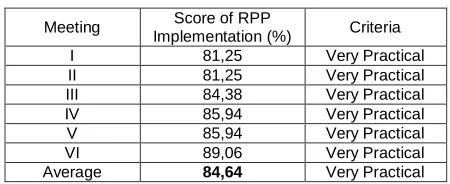
In addition, tested the implementation of learning tools. Implementation test of learning tool can be done by observing the implementation of the series of learning process presented in RPP[18]..The results of the implementation test of mathematical learning tools are shown in Table 5.
Table 5.Observation Results of RPP Based Discovery
learning by Teacher
Meeting Score of RPP
Implementation (%) Criteria
I 81,25 Very Practical
II 81,25 Very Practical
III 84,38 Very Practical
IV 85,94 Very Practical
V 85,94 Very Practical
VI 89,06 Very Practical
Average 84,64 Very Practical
Based on Table 5 it can be seen that the value of the implementation of the RPP, which is based on Discovery learning, in six meetings on the sequence material and each series gets the Very Practical criteria.
b. Discussion
240 propose hypotheses, test them like scientists in order to
improve the level of cognitive ability[23]. Discovery learning refers to a process whereby students discover an existing knowledge in the student itself through the learning process[24]. Learning using Discovery learning not only improves student learning, but also lowers their chances of leaving the learning process at an early stage[25]. Many teachers also recognize the potential of Discovery learning and in principle positively add this teaching approach to their repertoire[26]. Learning using Discovery learning can make learning more meaningful for students to understand the material being studied with the ability and relevance of the information it has [27]. Through Discovery learning students have the ability to monitor the processes they have learned to pay attention to what already exists [28]. Practicality test results for the convenience aspects show that the problem solving steps contained in LKPD can be understood because it uses simple language.In addition, the problems presented in accordance with the order of the material being studied.The pictures presented are clear and in accordance with the issues raised. Learning tools based on discovery learning allows students to be directed through questions. Teachers who implement Discovery learning must provide questions, problems and puzzling situations in which they must all be solved and encourage students to use intuition [29]. In terms of time, mathematics learning tools are considered very practical by students. This indicates that the use of LKPD is sufficient and in accordance with the available time allocation.
4. CONCLUSION
Based on the results of the study, it was concluded that the learning tools based on Discovery learning mathematics which is developed very practical based on one to one evaluation, small group test and field test, and based on observation of RPP (lesson plan) implementation.
5. REFERENCE
[1]. Tim Visi Yustisia. 2014. UUD 1945 dan Perubahannya. Depok. Visimedia
[2]. PeraturanMenteriPendidikandanKebudayaanRepubli k Indonesia Nomor 59 Tahun 2013 tentangKerangkaDasardanSrtukturKurikulumSekola hMenengahAtas/ Madrasa Aliyah.
[3]. Nurdin Muhamad.2016. Pengaruh Metode Discovery learning untuk Meningkatkan Representasi Matematis dan Percaya Diri Siswa Jurnal Pendidikan Universitas Garut Vol. 09; No. 01; 2016; 9-22.
[4]. Hosnan. 2014. Pendekatan Saintifik Dan Kontekstual Dalam Pembelajaran Abad 21. Jakarta :Ghalia Indonesia.
[5]. In’am, Akhsanul dan Siti Hajar. 2017. Learning Geometry through Discovery learning Using a Scientific Approach. International Journal of Instruction January 2017 Vol.10, No.1 e-ISSN: 1308-1470 www.e-iji.net.
[6]. Prasetyana, Septina Dwi. 2015.Pengembangan Model Pembelajaran Discovery learning yang Diintegrasikan dengan Group Investigation pada Materi Protista kelas X SMA Negeri Karang pandan. JURNAL INKUIRI ISSN: 2252-7893, Vol 4, No. 2, 2015 (hal 135-148).
[7]. Ögeyik, M. C. (2011). Form-focused discovery activities in English classes.The Reading Matrix, 11(2), 129-134.
[8]. Depdiknas. (2007). Permendiknas Nomor 41 Tahun 2007 Tentang Standar Proses. Jakarta: Departemen Pendidikan Nasional.
[9]. Trianto. 2010. Model Pembelajaran Terpadu. Bumi Aksara : Jakarta.
[10].Majid, Abdul. 2014. Implementasi Kurikulum 2013. Interes Media: Bandung.
[11].Prastowo, Andi. 2001. Panduan Kreatif Membuat Bahan Ajar Inovatif Menciptakan Metode Pembelajaran yang Menarik dan Menyenangkan. Yogyakarta: Diva Press.
[12].Rais, Damar. 2017. Pengembangan Perangkat Pembelajaran Matematika Berbasis Missouri Mathematics Project Untuk Meningkatkan Kemampuan Komunikasi Matematis Siswa Kelas X SMA/MA. JNPM (Jurnal Nasional Pendidikan Matematika) September 2017 Vol. 1, No. 2, Hal. 189.
[13].Rudyanto, Hendra Erik. 2014. Model Discovery learning dengan Pendekatan Saintifik Bermuatan Karakter untuk Meningkatkan Kemampuan Berpikir Kreatif. Premiere Educandum, Volume 4 Nomor 1, Juni 2014, 41-48.
[14].Plomp, T dan N. Nieveen. 2013. Educational Design Research. Enshede: Netherlands Institute For Curriculum Development (SLO).
[15].Arikunto, S. 2005. Dasar-dasar Evaluasi Pendidikan Edisi 2. Jakarta: Bumi Aksara.
[16].Revita Rena. 2017. Validitas Perangkat Pembelajaran Matematika Berbasis Penemuan Terbimbing. Suska Journal of Mathematics Education (p-ISSN: 2477-4758|e-ISSN: 2540-9670) Vol. 3, No. 1, 2017, Hal. 15 – 26.
[17].Widya. 2017. Kualitas Perangkat Pembelajaran Fisika Berbasis Model Creative Problem Solving dengan Pendekatan Open-Ended pada Materi Usaha Dan Energi Terintegrasi Energi Biomassa. Gravity: Jurnal Ilmiah Penelitian dan Pembelajaran Fisika, Vol. 3 No. 2 (2017).
Program Pascasarjana Universitas Pendidikan Ganesha. Volume 4 Tahun 2014.
[19]. Ika Nurul Sannah. 2015. Pengembangan LKS dengan Model Discovery learning pada Materi Teori Atom Bohr. Jurnal Pendidikan dan Pembelajaran Kimia, Vol. 4, No.1 Edisi April 2015, 184-196.
[20]. Azzahro Izzah Fatimah. 2014. Pengembangan Perangkat Pembelajaran Berbasis Discovery learning pada Sub Materi Respirasi dan Fotosintesis Kelas VII SMP Pendidikan SainsVol 2, NO 03, (2014).
[21]. Akinbobola dan Afolabi. 2010. Analysis Of Science Process Skills In West African Senior Secondary School Certificate Physics Practical Examinations In Nigeria. Bulgarian Journal of Science and Education Policy (BJSEP). 4 (1), 32-35.
[22]. Florentina indiastuti. 2016. Pengembangan Perangkat Model Discovery learning Berpendekatan Saintifik untuk Meningkatkan Berpikir Kreatif dan Rasa Ingin Tahu. Jurnal Pendidikan Matematika JPM RAFA Vol.2, No.1, September 2016.
[23]. Borthick, A.F. dan Jones, D.R. (2000). The Motivation for Collaborative Discovery learning Online and its Application in an Information Systems Assurance Course.Issues in ccounting Education. 15, (2), 181-210.
[24]. Balim, Ali gunay. 2009. The effect of Discovery learning on Student’s success and inquiry Learning Skills. Egitim Arastirmalari-Eurasian Journal of Educational Research. 35: 1-20.
[25]. Mayer, R. E. (2004). Should there be a three strike rule against pure discovery learning?—The case for guided methods of instruction. American Psychologist, 59, 14–19.
[26]. Davis, E. A., Petis, D., &Smithey, J. (2006). Challenges new science teachers face. Research of Educational Research, 76, 607–651. doi:10.3102/00346543076004607.
[27]. Keys, C., & Bryan, L. A. (2001).Co-constructing inquiry-based science with teachers: Essential research for lasting reform. Journal of Research in Science Education, 38, 641–654. doi:10.1002/tea.1023.
[28]. Case, R. (1998).The development of conceptual structures. In D. Kuhn & R. S. Siegler (Eds.), Handbook of child psychology: Cognition, perception, and language (Vol. 2). New York, NY: Wiley.