Patient Preference and Adherence
Lanthanum carbonate for the control
of hyperphosphatemia in chronic renal failure
patients: a new oral powder formulation –
safety, efficacy, and patient adherence
MªJesús Lloret César Ruiz-García Iara DaSilva Mónica Furlano Yaima Barreiro José Ballarín Jordi Bover
Nephrology Department, Fundació Puigvert, IIB Sant Pau, Barcelona, Spain; REDinREN, Instituto de Investigación Carlos III, Madrid, Spain
Correspondence: Jordi Bover Nephrology Department, Fundació Puigvert, C Cartagena 340-350, 08025 Barcelona, Spain Tel +34 93 416 97 00 Fax +34 93 416 97 30
Email [email protected]
Abstract: Chronic kidney disease (CKD) is associated with very high mortality rates, mainly of cardiovascular origin. The retention of phosphate (P) and increased fibroblast growth factor-23 levels are common, even at early stages of CKD, due to disturbances in normal P homeostasis. Later, hyperphosphatemia appears, which has also been strongly associated with high mortality rates linked to P-mediated cardiovascular and procalcifying effects. Treatment guidelines for these patients continue to be poorly implemented, at least partially due to the lack of adherence to a P-restricted diet and P-binder therapy. Calcium-free P binders, such as lanthanum carbonate, have been associated with a decreased progression of vascular calcification, rendering them an important therapeutic alternative for these high cardiovascular risk CKD patients. Lanthanum carbonate has typically been available as chewable tablets, and the new presentation as an oral powder may provide a useful alternative in the therapeutic armamentarium. This powder is a tasteless, odorless, and colorless semisolid compound miscible with food. In a recent study in healthy individuals, the safety and efficacy of this novel form were evaluated, and it was con-cluded that it is well tolerated and pharmacodynamically equivalent to the chewable form. In the long run, individualization of preferences and treatments seems an achievable goal prior to final demonstration of improvements in hard outcomes in wide clinical trials in CKD patients.
Keywords: chronic kidney disease, phosphate, phosphate binder
Introduction
Chronic kidney disease (CKD) is associated with high mortality rates, the main cause of death being cardiovascular disorders. The increased mortality risk of these patients cannot be attributed only to traditional risk factors; rather, many nonclas-sic risk factors, including disturbances of bone mineral metabolism, are probably involved. Hyperphosphatemia and, particularly, increased fibroblast growth factor-23 (FGF-23, a phosphaturic hormone) together with vitamin D status are the parameters most strongly associated with mortality, ie, those that bear the highest relative risk,1,2 higher even than the relative risk associated with parathyroid hormone (PTH), plasma calcium or alkaline phosphatase.1,3
Phosphate (P) regulation is primarily handled in the kidney by transporters located in the proximal tubule, which regulate P excretion/reabsorption in response to many metabolic factors and various hormones/phosphatonins such as PTH and the afore-mentioned FGF-23. When the kidney becomes dysfunctional, it is unable to maintain adequate P homeostasis; the consequence is progressive P retention and an early
Dove
press
R E V I E W
open access to scientific and medical research
Open Access Full Text Article
Patient Preference and Adherence downloaded from https://www.dovepress.com/ by 118.70.13.36 on 26-Aug-2020
For personal use only.
Number of times this article has been viewed
This article was published in the following Dove Press journal: Patient Preference and Adherence
increase in FGF-23 levels, even before hyperphosphatemia becomes evident. Since P is a direct inducer of PTH syn-thesis, secretion, and parathyroid growth and, on the other hand, blocks all potential counter-regulatory mechanisms,4–6 excessive P not only induces the most severe form of second-ary hyperparathyroidism but is also associated with other extraosseous effects that ultimately seem to be related to increased mortality.7 These effects include direct and indirect cardiovascular effects, its association with kidney disease progression, inflammation, oxidative stress, and a central role in coronary, vascular, valvular, and myocardial calcification via the upregulation of RUNX2 (Cbfα1), an “osteoblast” transcription factor.
Due to the increasing importance given to P control, in this article we will briefly summarize the evolution of different clinical guidelines and current recommendations, and provide an overview of treatment options and adherence problems inherently associated with P binders. We will then describe the main general characteristics of lanthanum car-bonate and present the available data on the recently released new oral powder formulation.
P retention versus
hyperphosphatemia: clinical
guidelines
In 2003, the American National Kidney Foundation issued the K/DOQI (Kidney Disease Outcomes Quality Initiative) clinical practice guidelines, which became the universal reference. These guidelines recommended target serum P levels between 2.7 and 4.6 mg/dL for stages 3–4, and between 3.5 and 5.5 mg/dL for stage 5 (including dialysis).8 Approximately 11%–15% of the American population suffer from CKD,9,10 and 60% of American patients on hemodialysis have P levels higher than those recommended by these guidelines. In the international DOPPS (Dialysis Outcomes and Practice Patterns Study) II, serum P levels were .5.5 mg/dL in 47% of patients with CKD undergoing dialysis from all over the world.11 In a Spanish study includ-ing 1,836 patients, Craver et al12 reported that the target P levels proposed by the K/DOQI were met for pre-dialysis stages 3, 4, and 5 CKD in 90.9%, 77.1%, and 70.3% of cases, respectively. These figures clearly reflect both progressive P retention and undertreatment. However, the greatest matter of concern was that control of all four classic parameters (Ca, P, PTH, and Ca × P) was achieved in only 34.9%, 18.4%, and 21.6% of patients with stage 3, 4, and 5 CKD, respectively, the low rates being primarily due to lack of control of PTH. These results drew attention to the difficulty of compliance
with clinical practice guidelines on bone mineral metabolism, even in stages of CKD prior to end-stage renal disease.
In 2008, the OSERCE I study (Epidemiologia de la Enfer-medad Ósea en la EnferEnfer-medad Renal Crónica en España, Epidemiology of Bone Disease in Chronic Kidney Disease in Spain) highlighted the poor implementation of guidelines after surveying 32 Spanish centers. In that study, we observed that the objectives for P were incorrectly reported in 50% of cases in stages 3 and 4, and in 60% of cases in nondialysis stage 5. We suspected that this was probably due not only to the limited availability of approved therapeutic agents for use in CKD before dialysis but also to the difficulty in achieving the suggested goals or a real lack of knowledge or belief in current recommendations.13
A second, multicenter part of the OSERCE I trial reevalu-ated the degree of compliance with guidelines. A total of 634 patients were analyzed, of whom 15% (only 1.8% using centralized analysis out of 409 patients) satisfied all four K/DOQI objectives. Regarding P, 22% had inadequate P levels (3% below and 19% above K/DOQI recommenda-tions), a percentage that agrees with data previously reported by other authors.12 In a recent Spanish observational cohort study, MERENA (Morbimortalidad en Enfermedad REnal en pacieNtes diAbéticos y no diabéticos), 1129 patients with CKD stage 3 or 4 were analyzed, revealing that 85.1% of the patients had P levels within the K/DOQI target. The objec-tives for all four parameters as per the K/DOQI guidelines were met in only 10.5% of the total cohort and 12.2% and 9% of those with stage 3 and 4 disease, respectively.14
Compared with the K/DOQI guidelines, the K/DIGO (Kidney Disease: Improving Global Outcomes) inter-national guidelines, published in 2009, are somewhat stricter, proposing maintenance of P in the normal range (2.7–4.6 mg/dL) in patients with stage 3–5 CKD; however, they also suggest lowering elevated phosphorus levels “toward the normal range” in dialysis patients.15 The ERBP (European Renal Best Practice) endorses the K/DIGO pro-posal regarding P control, whereas UK guidelines suggest that serum P in CKD 3–5 should be maintained in those mentioned levels, and in dialysis patients a goal between 3.4 and 5.2 mg/dL is suggested.16,17 More recently, the emerging role of P as an atherogenic and procalcifying factor, and its association with increased mortality, has driven some nephrology societies, among them the Spanish Society of Nephrology,18 to adopt in their clinical practice guidelines a suggestion favoring even the attainment of strictly normal serum P levels in CKD patients. This is independent of their stage and including also dialysis
Dovepress
Lloret et al
Patient Preference and Adherence downloaded from https://www.dovepress.com/ by 118.70.13.36 on 26-Aug-2020
patients, provided that the ways of attaining this objective are clinically reasonable.
Hyperphosphatemia is a belated consequence of P retention. In light of our new pathophysiologic knowledge, it is likely that initiation of therapy only after hyperphos-phatemia has already occurred may represent an outdated approach. In fact, it appears that the earliest possible inter-vention may be a simple and beneficial way to mitigate the deleterious systemic effects of P overload. The current restriction of non-calcium-containing P binders, reflected in the technical sheets accepting their use before end-stage renal disease only when P is .5.5 mg/dL (.1.78 mmol/L), represents an additional problem while we await the develop-ment of wider clinical indications or new therapeutic targets. It is probably advisable to monitor the fractional excretion of P,18,19 and it has been suggested that P binders might be considered when PTH increases, fractional excretion of P increases (ie, .15%–20%), or when P tubular reabsorp-tion is significantly diminished (ie, ,80%–85%).20 However, even though these suggestions sound reasonable, it has to be admitted that there are no results from prospective trials confirming the usefulness of this practice, and controversial studies have been published recently.21
Increasingly ambitious treatment guidelines may be rendered possible by the enrichment of the therapeutic arma-mentarium, especially with non-calcium-containing P binders and their different presentations. These approaches aim both to improve compliance with biochemical targets and to limit side-effects as much as possible.
Treatment of hyperphosphatemia:
diet, dialysis and P binders
Dietary P restriction is usually prescribed in patients with CKD in the presence of secondary hyperparathyroidism and/or hyperphosphatemia.15,18 It is biologically plausible15 that such diets are helpful in early CKD;15 however, there are insufficient data at present to strongly endorse dietary P restriction as the primary intervention for the management of CKD-mineral and bone disorder (MBD).15 Furthermore, prescribed dietary P restriction has not been associated with a survival benefit among prevalent hemodialysis patients, and increased level of restriction has even been associated with greater mortality, particularly in some subgroups.22 Since dietary restrictions to control serum P are usually related to a reduction of protein intake, the risk of unsupervised control of dietary P may outweigh the benefit of P control and may lead to protein-energy wasting and poor survival.22–25 Restriction of nonprotein sources of P such as additives or highly processed
convenience foods is currently underlined.26,27 Thus, dietary P restriction should probably be considered as an adjunct to P binders, and nutrition parameters should be closely monitored in this setting.15,18 Increased dialytic removal should also be considered in dialysis patients; nevertheless, it is not easy to implement.15,28 Consequently, treatment with oral P binders is still considered an important component of P management, especially for most patients undergoing dialysis,27,29 and a favorable survival effect of P binders on incident hemodi-alysis patients has been recently reported.30,31
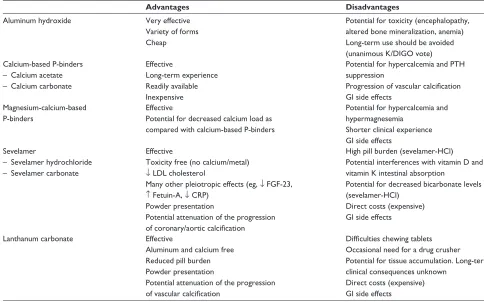
Ideally, a P binder should effectively bind most of dietary P with no side effects, regardless of intestinal pH, have mini-mal systemic absorption, good palatability, a low pill burden, and be available at a low cost.27,32,33 As described by the latest K/DIGO and Spanish Society of Nephrology guidelines,15,18 it is reasonable that the choice of P binder takes into account CKD stage, the presence of other components of CKD-MBD (ie, vascular calcification), concomitant therapies (ie, vitamin D compounds and calcimimetics), and the side-effect profile.15 Thus, classic calcium-based P binders are inexpen-sive, but it is recommended restricting the dose in the presence of persistent or recurrent hypercalcemia, and it is suggested restricting the dose in the presence of arterial calcification and/or adynamic bone disease and/or if serum PTH levels are persistently low.15,18 In Table 1,15 we present a brief comparison among the most frequently used P binders.
In this context, it seems important to obtain not only better drug tolerability but also greater patient adherence to treat-ments in order to attain the final objective, ie, to slow or halt the progression of vascular calcification, CKD progression, and ultimately, to improve patient survival (Figure 1).18,34,35
Lanthanum carbonate
Lanthanum carbonate is a resin-free, non-calcium-based P binder, with a high binding potential, available to date as a chewable tablet (Fosrenol®; Shire US Inc, Wayne, PA, USA). Preclinical trials have shown its efficacy indepen-dently of pH variability along the gastrointestinal tract, which represents an advantage over some of its homologues such as calcium carbonate.36,37 According to some com-parative trials, the potency of the different commercially available P binders is essentially comparable, with only small differences among them.38–41 A recent metabolic trial performed on 18 healthy volunteers, however, observed that with a standard phosphorus diet, 1000 mg of elementary lanthanum reduced P net absorption by 45% as compared with a reduction of only 21% with 2400 mg of sevelamer carbonate (P, 0.001).42
Dovepress Lanthanum carbonate for the control of hyperphosphatemia
Patient Preference and Adherence downloaded from https://www.dovepress.com/ by 118.70.13.36 on 26-Aug-2020
The main advantage of lanthanum carbonate is that it is a calcium-free P binder and so may satisfy the requirements of renal patients, who have a high cardiovascular calcification risk that seems to directly influence survival. As mentioned before, it is reasonable that the choice of P binder takes into account the presence of other components of CKD-MBD and that in the presence of vascular/valvular calcification, calcium restriction is advised. Toussaint et al43 carried out a randomized controlled trial on 30 patients who underwent hemodialysis and then followed them up for 18 months; this trial showed that lanthanum carbonate significantly diminished progression of aortocoronary calcification when compared with the use of calcium-based P binders. Wilson et al44 compared the effects of lanthanum carbonate and a calcium P binder on survival in a retrospective study with a 2-year follow-up. In this trial, the best results were seen in the subgroup of patients older than 65, who showed significantly longer survival after using lanthanum carbonate. Importantly, prospective trials have also been performed with other non-calcium-based P binders,40,45–47 which have proven a reduction of the progression of vascular calcification as compared with calcium-based P binders, with two
excep-Table 1 Comparison among most common phosphate binders
Advantages Disadvantages
Aluminum hydroxide Very effective Variety of forms Cheap
Potential for toxicity (encephalopathy, altered bone mineralization, anemia) Long-term use should be avoided (unanimous K/DIGO vote) Calcium-based P-binders
– Calcium acetate – Calcium carbonate
Effective
Long-term experience Readily available Inexpensive
Potential for hypercalcemia and PTH suppression
Progression of vascular calcification
GI side effects Magnesium-calcium-based
P-binders
Effective
Potential for decreased calcium load as compared with calcium-based P-binders
Potential for hypercalcemia and hypermagnesemia
Shorter clinical experience GI side effects
Sevelamer
– Sevelamer hydrochloride – Sevelamer carbonate
Effective
Toxicity free (no calcium/metal)
↓ LDL cholesterol
Many other pleiotropic effects (eg, ↓ FGF-23,
↑ Fetuin-A, ↓ CRP) Powder presentation
Potential attenuation of the progression
of coronary/aortic calcification
High pill burden (sevelamer-HCl) Potential interferences with vitamin D and vitamin K intestinal absorption
Potential for decreased bicarbonate levels (sevelamer-HCl)
Direct costs (expensive) GI side effects
Lanthanum carbonate Effective
Aluminum and calcium free Reduced pill burden Powder presentation
Potential attenuation of the progression
of vascular calcification
Difficulties chewing tablets Occasional need for a drug crusher Potential for tissue accumulation. Long-term clinical consequences unknown
Direct costs (expensive) GI side effects
Note: Adapted with permission from Kidney Disease: Improving Global Outcomes (KDIGO) CKD-MBD Work Group.15 Copyright © 2012 by KDIGO. All rights reserved. Abbreviations: CRP, C-reactive protein; FGF, fibroblast growth factor; GI, gastrointestinal; HCl, hydrochloride; LDL, low-density lipoprotein; P, phosphate; PTH,
parathyroid hormone.
↑PTH ↑CV and global
mortality ↑FGF-23(aging?) P retention
Hyperphosphatemia Guidelines
Unawareness Lack of belief Predialysis restriction of
prescription P-binders* Lack of evidence
P-binder adherence Number of pills
Intolerance Galenic forms Individual preference
Lack of knowledge
Other factors Poor diet (additives,
↑index P/protein ...) Poor dialysis
Figure 1 Causes and consequences of P retention and hyperphosphatemia beyond CKD itself. Beyond all the pathophysiological factors leading to P retention and hyperphosphatemia in CKD, we represent their additional causes and potential consequences. Several factors are related to equivocal or unproved guidelines, absence of adherence to prescriptions as well as other circumstances.
Notes: *Technical sheet restriction: non-calcium-based P binders are only indicated for P$ 1.78 mmol/L in nondialysis patients. PTH and FGF-23 are also interrelated. Low serum PTH and P levels have also been associated with mortality, maybe related to MIA syndrome. Excess FGF-23 and decreased Klotho have also been associated with the aging processes.
Abbreviations: CKD, chronic kidney disease; CV, cardiovascular; FGF-23,
fibroblast growth factor-23; MIA, malnutrition-inflammation and atheromatosis;
P, phosphate; PTH, parathyroid hormone.
Dovepress
Lloret et al
Patient Preference and Adherence downloaded from https://www.dovepress.com/ by 118.70.13.36 on 26-Aug-2020
tions.38,48,49 Nevertheless, these trials have not provided definitive evidence; rather they have only reported certain trends in respect of survival benefit, decreased hospitaliza-tion days, and reduced instituhospitaliza-tion of dialysis.15,45,50,51 Only one cross-sectional study in a French hemodialysis population has shown a favorable effect of a calcium-based P binder as compared with sevelamer.52
On the other hand, the new, recently commercialized powder galenical form of lanthanum carbonate offers renal patients a therapeutic alternative with the ultimate purpose of improving treatment adherence. The new formulation is an insoluble, odorless, tasteless, and colorless powder that is mixed with soft food as if it were a sort of seasoning (“salt for kidney patients”). It now comes in 750 and 1000 mg sachets, similar to the tablet form. Below, we analyze the main acceptability and adherence problems associated with P binders, as well as the potential advantages offered by the lanthanum carbonate powder in respect of treatment adherence. We shall also review the available data on the safety and efficacy of this new form.
Acceptability and adherence
Nonadherence to a treatment not only prevents the achieve-ment of control targets but may additionally represent a financial burden to the health system and pose a major obstacle to effective treatment.27 It has been estimated that the annual costs of therapeutic noncompliance in the USA amount to US$100 billion, with 10% of hospital admissions and 23% of nursing consultations being attributable to lack of adherence to treatment.53
Renal patients are typically chronically ill, have comorbid conditions, are on multiple medications, and are elderly, and several trials have highlighted lack of adherence to dif-ferent treatments in such patients. In an important analysis, Arenas et al54 carried out an observational study of 121 hemodialysis patients and detected lack of compliance with the prescribed drugs in up to 40% of patients; in 21% of cases, noncompliance specifically involved P binders, and it was independently associated with higher mean phospho-rus levels (.5.5 mg/dL) (odds ratio = 4.7; 95% confidence interval [CI], 1.07–6.5; P= 0.03). In a systematic review of 13 trials on nonadherence to P binders, Karamanidou et al55 reported a prevalence of between 22% and 74%, with a mean of 51%. Such a high prevalence could be explained by the fact that P binders have certain characteristics that make them different from other drugs and may complicate adherence as they necessitate a very strict dosing pattern. For instance, P binders must be taken with meals, and this proves difficult
especially in young people because it interferes with their lifestyles, including their social environment. Such were the conclusions of a Dutch trial that investigated adherence to antiretroviral drugs: the authors observed that the percent-age of noncompliant patients increased when the definition of compliance included dietary considerations, eg, when the drug had to be taken together with meals.56 Moreover, it is obvious and proven that the high number of tablets needed to treat hyperphosphatemia is a limiting factor for adherence. A higher pill number is also associated with lower quality of life and increasing the number of prescribed pills does not seem to improve control of hyperphosphatemia.57,58 Diagnosing lack of adherence to the treatment is the first step in attempting to solve the problem. Questionnaires are useful, simple, and cheap tools that, together with biochemi-cal results, help identify noncompliant patients. There are no P binder-specific questionnaires, but Arenas et al suggest that the SMAQ (Simplified Medication Adherence Questionnaire) displays adequate levels of sensitivity and specificity and that results are well correlated to P levels. More complex tools that provide some improvement in adherence have also been applied, eg, electronic devices.59 Lanthanum radio-opacity causes the appearance of a characteristic radiologic abdominal “starry sky” image, which could be exploited in controlling nonadherence to the drug.60
Once lack of adherence has been diagnosed, the caus-ative factors should be investigated. A good doctor–patient relationship has recently been identified as a key factor in improving therapeutic compliance. One element of this is fluent communication, which makes patients knowledgeable about the importance of the prescribed drug and enables them to participate in objective attainment and even in choice of their treatment. This is reflected in the current conceptual change that involves a shift from classic terms such as compliance to more modern terminology such as adherence. Compliance is defined as the degree to which patients take their doctor-prescribed medication or follow medical advice. Noncompliance with those instructions would entail disobedience, whereupon the possibility of punishment would be implicit. The term adher-ence has been suggested as an alternative to compliance, since it seems to reduce the doctor’s power within the doctor–patient relationship and also incorporates wider and more appropriate concepts such as consistency, cooperation, concordance, and partnership. The aim of this conceptual shift is to put aside the paternalistic relationship between doctor and patient and facilitate the development of an empathic attitude, with the focus on patient’s preferences, which permits the customiza-tion of treatment.61
Dovepress Lanthanum carbonate for the control of hyperphosphatemia
Patient Preference and Adherence downloaded from https://www.dovepress.com/ by 118.70.13.36 on 26-Aug-2020
Arenas et al have also researched patient preferences and their impact on treatment adherence and P control. In the abovementioned study, they observed that of the patients on lanthanum carbonate, 40% considered it their favorite binding agent, 24% considered it their least favorite drug, and 35% had no opinion. When patients were asked why they rejected the prescribed lanthanum carbonate, 17.7% said that the chewable form was not satisfactory; indeed, older patients found it difficult to manage, this being an even stronger reason for discontinuation than gastric intolerance (6.6%).54 In view of the drawbacks of the chewable form, patients were given drug crushers to facilitate consumption. How et al carried out a small randomized study that included eleven hemodialysis patients to determine the efficacy of the crushed drug versus the standard chewable form.62 The crushed form reduced P levels significantly, but differ-ences with the chewable form were not significant. Both chewed and crushed lanthanum carbonate were generally well tolerated. They introduced the concept that crushing lanthanum and mixing it with food might be an option for patients who are unable to chew or swallow whole tablets.62 Due to the insolubility of lanthanum carbonate, the entire pill could migrate along the intestinal tract without adequate P binding. Hence, Yamashita el al60 targeted subjects who did not chew lanthanum carbonate adequately for the purpose of studying the clinical efficacy of changing to crushed chewable prescriptions. A total of 18 out of 41 patients on maintenance hemodialysis were identified in the “insufficient mastication group” and a progressive significant lowering of P levels from 5.86 ± 1.31 mg/dL before pulverization to 5.12 ± 1.34 mg/dL after 6 weeks (P= 0.02) was observed. In this study, the residual images of lanthanum carbonate on the abdominal X-rays disappeared to the point where they could barely be confirmed.
Consequently, a new presentation of lanthanum carbon-ate powder has recently been approved; this new form could solve some of the problems presented by the classic form of presentation of the drug, especially in patients with reduced ability to chew, whose cognitive functions or medication compliance are poor, but also by decreasing the number of pills and increasing the currently available therapeutic pos-sibilities where patients may choose.
Safety
The safety of lanthanum carbonate was assessed by Hutchison et al in 2008, following analysis of 93 patients on treatment with lanthanum carbonate as single therapy for the preced-ing 6 years. Treatment-related side-effects had occurred in
25.8% of the patients, and their nature was primarily gastro-intestinal (nausea, diarrhea, and flatulence).63 More recently, Dellanna et al carried out a study to analyze lanthanum carbonate’s safety in 698 dialysis patients over a period of 6 months and with an average dose of 2,509 ± 936 mg/day. A total of 113 adverse events were recorded in 53 patients (7.6%), but only 23 (mostly gastrointestinal disorders: nau-sea, abdominal discomfort, vomiting, and abdominal disten-sion) in 14 patients (2.4%), were considered to be related to lanthanum carbonate treatment.64 Despite being a metal, a fact that raises concern over potential toxicity and accumulation in other tissues, the bioavailability of lanthanum carbonate is between 10 and 500 times lower than that of aluminum; in fact it is lower than 0.002%.65 Plasma monitoring of the drug enabled Hutchison et al to observe that the baseline median level of 0.0 ng/mL increased to 0.3 ng/mL following 6 months of treatment. The maximum value achieved over the 6 years of follow-up was 13.9 ng/mL (in an outlier). However, among a total 574 determinations, the 2 ng/mL level was exceeded by only 15 occasions, and the 4.0 ng/mL level was exceeded by just four.63
In 2008, Hutchison et al’s study found no evidence of adverse effects in the liver, bones, or central nervous system,63 although they were described in experimental trials on animals. 66–68 Thus, it has been described that oral administration of lanthanum carbonate to normal and/or uremic rats led to increased tissue lanthanum content in some organs, including lungs, kidneys, femur, and most strikingly in the liver.66,68 However, no evidence of adverse effects of lanthanum carbonate on the liver in patients who received treatment for up to 6 years was observed in a subset of four Phase III clinical trials and subsequent extension studies.69 In a recent postmarketing short observational study of efficacy and safety, it was stated that lanthanum carbonate is effective and well tolerated, provided that recipients do not have preexisting liver disease (in 2 out of 112 patients, an increase in transaminases was observed).70 The techni-cal sheet describes that the effect of hepatic impairment on lanthanum carbonate pharmacokinetics has not been assessed. Due to its mechanism of action and the lack of liver metabolism, doses in hepatic impairment should not be modified, but patients should be monitored carefully. Conditions resulting in a marked reduction of bile flow may be associated with incrementally slower elimination of lanthanum, which may result in higher plasma levels and increased tissue deposition of lanthanum. As the liver is the principal organ of elimination of absorbed lanthanum, monitoring of liver function tests is recommended.71
Dovepress
Lloret et al
Patient Preference and Adherence downloaded from https://www.dovepress.com/ by 118.70.13.36 on 26-Aug-2020
As far as bone is concerned, different studies found no evidence for adverse effects from lanthanum deposition;70,72,73 furthermore, the incidence of adynamic bone disease and osteomalacia was low as compared with the incidence after calcium carbonate treatment.72,74 It has even been described that non-calcium-based P binders such as sevelamer may increase the bone formation rate and improve trabecular architecture as compared with calcium carbonate.75 This highlights the fact that the behavior of lanthanum is quite different from that of aluminum, one of the first P-binding agents used in nephrology.
With regard to the central nervous system, a single case report of lanthanum-related encephalopathy has recently been published. Lanthanum levels in the cerebrospinal fluid were high, suggesting it can cross the blood–brain barrier. High plasma levels were also found, which could be explained by the presence of a portal-systemic shunt secondary to liver dis-ease that could have prevented the drug from being excreted by the bile. Also, the doses administered (3,750 mg/day) were higher than those used in standard clinical practice (1000–3000 mg). Moreover, this patient was undernourished, which could have increased the circulation of the drug-free fraction. The authors suggest that in specific cases in which there is high risk of increased drug plasma levels, lanthanum carbonate treatment should be used with caution.76
The safety of lanthanum carbonate powder was evaluated as a secondary objective in a recent study including 72 healthy incident individuals aged 18–55 years who were randomized to receive either chewable tablets or powder. The total study duration was 28 days.77 The dose administered was 3000 mg/ day. With both formulations, 41.7% of the subjects had $1 treatment-emergent adverse event, defined as any adverse event occurring at treatment initiation that was not present at baseline or that was present at the baseline and reemerged or worsened with treatment, to eventually disappear at the end of the treatment. Comparison of the two drug presentations revealed that adverse events appeared following consump-tion of chewable tables in 23% of cases and after taking the powder formulation in 32.4%. The sum of individuals report-ing adverse events after each treatment (oral powder plus chewable tablets) exceeds the overall number of individuals. This discrepancy is ascribed to individuals reporting separate treatment-emergent adverse events in each treatment period because of the crossover design of the study. The commonest adverse events with the powder were nausea (8.5%), headache (5.6%), and abdominal pain (4.2%). Less frequent adverse events were dyspepsia, gastroenteritis, vertigo, fatigue, and muscular spasms.65 The overall difference between the
formulations was basically due to gastrointestinal effects, which were observed in 18.3% of patients on the powder formulation and 6.6% of those on tablets. However, this differ-ence in respect of gastrointestinal effects was not considered clinically significant because the frequency of such effects following presentation as tablets was 20% in a Phase I trial, and the percentage of patients who had nausea was similar in both groups (8.5% for oral powder versus 4%–20% for tablets).78 Thus, the minor difference in respect of treatment-emergent adverse events is mainly due to mild side-effects; these were nonserious in nature and are recognized as com-mon or very comcom-mon in the European Summary of Product Characteristics.71 Consequently, it seems that lanthanum carbonate powder was well tolerated, with 67% of patients free of or having nonrelevant adverse events. Since these observations have been evaluated in healthy individuals, it should be emphasized that patients with CKD may differ in terms of gastrointestinal dynamics. Therefore, these initial positive results should be confirmed in regular clinical prac-tice in both predialysis and dialysis patients.
Efficacy
Pierce and coworkers performed a Phase I, single-center, randomized, open-label, two-period, crossover study designed to assess the pharmacodynamic equivalence of two formulations of lanthanum carbonate (tablets and pow-der) in 72 healthy subjects.77 P mean urinary excretion was determined over three treatment days. The urinary excretion of P is a consequence of the intestine’s ability to absorb its P content, which has been exploited in many pharmacody-namic studies. The least square mean of daily excreted P was 16.8 mmol for tablet administration and 15.2 mmol for pow-der formulation. The mean difference was −1.6 mmol (90% CI, −2.38 to −0.82), which is within the calculated critical reference range (−3.35 to 3.35); this enabled the authors to conclude that the two formulations showed pharmacody-namic equivalence. This conclusion was accepted by the European Medicines Agency, and commercialization of the new presentation in the European Union was approved.
This trial also assessed pharmacokinetic parameters as a secondary objective: the systemic exposure of both formula-tions was within the ranges verified in previous trials with lan-thanum carbonate tablets.78 However, the area under the curve was 34% wider with the powder formulation than with the tablets (13.11 ng ⋅ h/mL versus 9.80 ng ⋅ h/mL; ratio of geo-metric least square means [90% CI], 1.34 [1.26–1.42]). The maximal concentration (Cmax) was 26% higher using powder than using tablets, at 0.60 and 0.47 ng/mL, respectively. The
Dovepress Lanthanum carbonate for the control of hyperphosphatemia
Patient Preference and Adherence downloaded from https://www.dovepress.com/ by 118.70.13.36 on 26-Aug-2020
rate of absorption was also higher after administration of oral powder because the elevated Cmax observed after administra-tion of oral powder was reached within the same time as after administration of chewable tablets. On the other hand, the drug half-life was similar for both presentations: 21.9 and 22.3 hours for the powder and the tablets, respectively, with individual values within the 16.2–28.3-hour range. Thus, in this multiple dose study, the oral powder and tablet formula-tion were well tolerated and met the regulatory criteria for pharmacodynamic equivalence in these healthy volunteers.77 Although lanthanum route of excretion is biliary and not renal, future studies in CKD patients are guaranteed to definitely assume pharmacodynamic equivalency in these patients.
Conclusion
A large body of evidence shows a clear association between hyperphosphatemia, P retention, and mortality. Calcium-based P binders have some limitations related to the progression of cardiovascular calcification while non-calcium-based P bind-ers are limited by their technical sheet and cost. However, the poor implementation of guidelines and the multifactorial lack of adherence of patients to treatments remain important factors in the poor P control in CKD patients. Long-term P control using P binders could be improved considering new ways of improving patient adherence, even allowing patients a greater nutritional freedom. The new powder formulation of lanthanum carbonate is the first P binder that can be mixed directly with food, providing a new tasteless form of administration of P binders. It is considered pharmacologically equivalent to the chewable form, but it really remains to be definitely proven in CKD patients. We emphasize that in addition to new formula-tions, improved adherence will only be achieved when doctors share the clinical importance of P and their treatment goals with their patients. In the long run, individualization of treat-ments seems an achievable goal prior to final demonstration of improvements in hard outcomes in wide clinical trials.
Acknowledgments
The research group belongs to a Consolidated Research Catalan Group (AGAUR 2009/SGR-1116), Catalonia, Spain. The research group is also integrated in the Spanish Renal Network for Research (16/06 RETICS), Instituto de Inves-tigación Carlos III, Spain.
Disclosure
Jordi Bover lectured for SHIRE-sponsored scientific events on the importance of P and FGF-23 in CKD, but he did not lecture on the superiority of lanthanum carbonate as
compared with other P binders. The other authors have no conflicts of interest to declare.
References
1. Block GA, Klassen PS, Lazarus JM, Ofsthun N, Lowrie EG, Chertow GM. Mineral metabolism, mortality, and morbidity in main-tenance hemodialysis. J Am Soc Nephrol. 2004;15(8):2208–2218. 2. Nakano C, Hamano T, Fujii N, et al. Combined use of vitamin D status
and FGF23 for risk stratification of renal outcome. Clin J Am Soc
Nephrol. 2012;7(5):810–819.
3. Kalantar-Zadeh K, Shah A, Duong U, Hechter RC, Dukkipati R, Kovesdy CP. Kidney bone disease and mortality in CKD: revisiting the role of vitamin D, calcimimetics, alkaline phosphatase, and minerals.
Kidney Int Suppl. 2010;(117):S10–S21.
4. Bover J, Rodriguez M, Trinidad P, et al. Factors in the development of secondary hyperparathyroidism during graded renal failure in the rat.
Kidney Int. 1994;45(4):953–961.
5. Bover J, Jara A, Trinidad P, Rodriguez M, Martin-Malo A, Felsenfeld AJ. The calcemic response to PTH in the rat: effect of elevated PTH levels and uremia. Kidney Int. 1994;46(2):310–317.
6. Bover J, Jara A, Trinidad P, Rodriguez M, Felsenfeld AJ. Dynamics of skeletal resistance to parathyroid hormone in the rat: effect of renal failure and dietary phosphorus. Bone. 1999;25(3):279–285.
7. Fernandez GE. Silent murder kills at dawn. Nefrologia. 2003;23(5): 377–380. Spanish.
8. National Kidney Foundation. K/DOQI clinical practice guidelines for bone metabolism and disease in chronic kidney disease. Am J Kidney Dis. 2003;42(4 Suppl 3):S1–S201.
9. Foley RN, Parfrey PS, Sarnak MJ. Clinical epidemiology of cardio-vascular disease in chronic renal disease. Am J Kidney Dis. 1998; 32(5 Suppl 3):S112–S119.
10. London GM, Marchais SJ, Guerin AP, Metivier F, Adda H. Arte-rial structure and function in end-stage renal disease. Nephrol Dial
Transplant. 2002;17(10):1713–1724.
11. Port FK, Pisoni RL, Bommer J, et al. Improving outcomes for dialysis patients in the international Dialysis Outcomes and Practice Patterns Study. Clin J Am Soc Nephrol. 2006;1(2):246–255.
12. Craver L, Marco MP, Martinez I, et al. Mineral metabolism parameters throughout chronic kidney disease stages 1–5 – achievement of K/DOQI target ranges. Nephrol Dial Transplant. 2007;22(4):1171–1176. 13. Bover J, Gorriz JL, Martin de Francisco AL, Caravaca F, Barril G,
Molinero LM. Unawareness of the K/DOQI guidelines for bone and mineral metabolism in predialysis chronic kidney disease: results of the OSERCE Spanish multicenter-study survey. Nefrologia. 2008;28(6):637–643.
14. Martinez-Castelao A, Gorriz JL, Portoles JM, et al. Baseline charac-teristics of patients with chronic kidney disease stage 3 and stage 4 in Spain: the MERENA observational cohort study. BMC Nephrol. 2011;12:53.
15. Kidney Disease: Improving Global Outcomes (KDIGO) CKD-MBD Work Group. KDIGO clinical practice guideline for the diagnosis, evalu-ation, prevention, and treatment of Chronic Kidney Disease-Mineral and Bone Disorder (CKD-MBD). Kidney Int Suppl. 2009;(113):S1–S130. 16. Goldsmith DJ, Covic A, Fouque D, et al. Endorsement of the Kidney
Disease Improving Global Outcomes (KDIGO) Chronic Kidney Disease-Mineral and Bone Disorder (CKD-MBD) Guidelines: a European Renal Best Practice (ERBP) commentary statement. Nephrol
Dial Transplant. 2010;25(12):3823–3831.
17. Steddon S, Sharples E. Renal Association Clinical Practice Guideline in mineral and bone disorders in CKD. Nephron Clin Pract. 2011; 118 Suppl 1:c145–c152.
18. Torregrosa JV, Bover J, Cannata AJ, et al. Spanish Society of Nephrol-ogy recommendations for controlling mineral and bone disorder in chronic kidney disease patients (S.E.N.-M.B.D.). Nefrologia. 2011; 31 Suppl 1:3–32.
Dovepress
Lloret et al
Patient Preference and Adherence downloaded from https://www.dovepress.com/ by 118.70.13.36 on 26-Aug-2020
19. Dominguez JR, Shlipak MG, Whooley MA, Ix JH. Fractional excretion of phosphorus modifies the association between fibroblast growth factor-23 and outcomes. J Am Soc Nephrol. 2013;24(4):647–654. 20. Martin KJ, Gonzalez EA. Prevention and control of phosphate retention/
hyperphosphatemia in CKD-MBD: what is normal, when to start, and how to treat? Clin J Am Soc Nephrol. 2011;6(2):440–446.
21. Block GA, Wheeler DC, Persky MS, et al. Effects of phosphate binders in moderate CKD. J Am Soc Nephrol. 2012;23(8):1407–1415. 22. Lynch KE, Lynch R, Curhan GC, Brunelli SM. Prescribed dietary
phosphate restriction and survival among hemodialysis patients. Clin
J Am Soc Nephrol. 2011;6(3):620–629.
23. Shinaberger CS, Greenland S, Kopple JD, et al. Is controlling phos-phorus by decreasing dietary protein intake beneficial or harmful in persons with chronic kidney disease? Am J Clin Nutr. 2008;88(6): 1511–1518.
24. Shantouf R, Budoff MJ, Ahmadi N, Tiano J, Flores F, Kalantar-Zadeh K. Effects of sevelamer and calcium-based phosphate binders on lipid and inflammatory markers in hemodialysis patients. Am J Nephrol. 2008;28(2):275–279.
25. Heng A-E, Cano NJM. Nutritional problems in adult patients with stage 5 chronic kidney disease on dialysis (both haemodialysis and peritoneal dialysis). NDT Plus. 2010;3:109–117.
26. Uribarri J. Phosphorus homeostasis in normal health and in chronic kidney disease patients with special emphasis on dietary phosphorus intake. Semin Dial. 2007;20(4):295–301.
27. Ketteler M, Wüthrich RP, Floege J. Management of hyperphosphatae-mia in chronic kidney disease – challenges and solutions. Clin Kidney J. 2013;6:128–136.
28. Chertow GM, Levin NW, Beck GJ, et al. In-center hemodialysis six times per week versus three times per week. N Engl J Med. 2010;363(24):2287–2300.
29. Lloret MJ, Bover J, DaSilva I, et al. Papel del fósforo en la enfermedad renal crónica. [Role of phosphorus in chronic kidney disease].
Nefrol-ogía Sup Ext. 2013;4:2–10.
30. Fernandez-Martin JL, Carrero JJ, Benedik M, et al. COSMOS: the dialysis scenario of CKD-MBD in Europe. Nephrol Dial Transplant. Epub November 19, 2012.
31. Isakova T, Gutierrez OM, Chang Y, et al. Phosphorus binders and survival on hemodialysis. J Am Soc Nephrol. 2009;20(2):388–396. 32. Barreto FC, de Oliveira RA, Oliveira RB, Jorgetti V. Pharmacotherapy
of chronic kidney disease and mineral bone disorder. Expert Opin
Pharmacother. 2011;12(17):2627–2640.
33. Ketteler M. The control of hyperphosphatemia in chronic kidney disease: which phosphate binder? Int J Artif Organs. 2009;32(2):95–100. 34. Bover J, Andres E, Lloret MJ, Aguilar A, Ballarin J. Dietary and
phar-macological control of calcium and phosphate metabolism in dialysis patients. Blood Purif. 2009;27(4):369–386.
35. Bover J, Farre N, Andres E, et al. Update on the treatment of chronic kidney disease-mineral and bone disorder. J Ren Care. 2009;35 Suppl 1:19–27. 36. Autissier V, Damment SJ, Henderson RA. Relative in vitro efficacy of the
phosphate binders lanthanum carbonate and sevelamer hydrochloride.
J Pharm Sci. 2007;96(10):2818–2827.
37. Hutchison AJ. Improving phosphate-binder therapy as a way forward.
Nephrol Dial Transplant. 2004;19 Suppl 1:i19–i24.
38. Qunibi W, Moustafa M, Muenz LR, et al. A 1-year randomized trial of calcium acetate versus sevelamer on progression of coronary artery calcification in hemodialysis patients with comparable lipid control: the Calcium Acetate Renagel Evaluation-2 (CARE-2) study. Am J Kidney Dis. 2008;51(6):952–965.
39. de Francisco AL, Leidig M, Covic AC, et al. Evaluation of calcium acetate/magnesium carbonate as a phosphate binder compared with sevelamer hydrochloride in haemodialysis patients: a controlled ran-domized study (CALMAG study) assessing efficacy and tolerability.
Nephrol Dial Transplant. 2010;25(11):3707–3717.
40. Chertow GM, Burke SK, Raggi P. Sevelamer attenuates the progression of coronary and aortic calcification in hemodialysis patients. Kidney Int. 2002;62(1):245–252.
41. Hutchison AJ, Speake M, Al-Baaj F. Reducing high phosphate levels in patients with chronic renal failure undergoing dialysis: a 4-week, dose-finding, open-label study with lanthanum carbonate. Nephrol Dial
Transplant. 2004;19(7):1902–1906.
42. Martin P, Wang P, Robinson A, et al. Comparison of dietary phosphate absorption after single doses of lanthanum carbonate and sevelamer carbonate in healthy volunteers: a balance study. Am J Kidney Dis. 2011;57(5):700–706.
43. Toussaint ND, Lau KK, Polkinghorne KR, Kerr PG. Attenuation of aortic calcification with lanthanum carbonate versus calcium-based phosphate binders in haemodialysis: a pilot randomized controlled trial.
Nephrology (Carlton). 2011;16(3):290–298.
44. Wilson R, Zhang P, Smyth M, Pratt R. Assessment of survival in a 2-year comparative study of lanthanum carbonate versus standard therapy. Curr
Med Res Opin. 2009;25(12):3021–3028.
45. Suki WN, Zabaneh R, Cangiano JL, et al. Effects of sevelamer and calcium-based phosphate binders on mortality in hemodialysis patients.
Kidney Int. 2007;72(9):1130–1137.
46. Asmus HG, Braun J, Krause R, et al. Two year comparison of sevelamer and calcium carbonate effects on cardiovascular calcification and bone density. Nephrol Dial Transplant. 2005;20(8):1653–1661.
47. Block GA, Raggi P, Bellasi A, Kooienga L, Spiegel DM. Mortality effect of coronary calcification and phosphate binder choice in incident hemodialysis patients. Kidney Int. 2007;71(5):438–441.
48. Barreto DV, Barreto FC, de Carvalho AB, et al. Phosphate binder impact on bone remodeling and coronary calcification – results from the BRiC study. Nephron Clin Pract. 2008;110(4):c273–c283.
49. Floege J. Calcium-containing phosphate binders in dialysis patients with cardiovascular calcifications: should we CARE-2 avoid them? Nephrol
Dial Transplant. 2008;23(10):3050–3052.
50. Di Iorio, Bellasi A, Russo D. Mortality in kidney disease patients treated with phosphate binders: a randomized study. Clin J Am Soc Nephrol. 2012;7(3):487–493.
51. St Peter WL, Liu J, Weinhandl E, Fan Q. A comparison of sevelamer and calcium-based phosphate binders on mortality, hospitalization, and morbidity in hemodialysis: a secondary analysis of the Dialysis Clinical Outcomes Revisited (DCOR) randomized trial using claims data. Am J
Kidney Dis. 2008;51(3):445–454.
52. Jean G, Lataillade D, Genet L, et al. Calcium carbonate, but not seve-lamer, is associated with better outcomes in hemodialysis patients: results from the French ARNOS study. Hemodial Int. 2011;15(4): 485–492.
53. Morris LS, Schulz RM. Patient compliance – an overview. J Clin Pharm Ther. 1992;17(5):283–295.
54. Arenas MD, Malek T, Alvarez-Ude F, Gil MT, Moledous A, Reig-Ferrer A. Phosphorus binders: preferences of patients on haemodialy-sis and its impact on treatment compliance and phosphorus control.
Nefrologia. 2010;30(5):522–530. Spanish.
55. Karamanidou C, Clatworthy J, Weinman J, Horne R. A systematic review of the prevalence and determinants of nonadherence to phos-phate binding medication in patients with end-stage renal disease. BMC
Nephrol. 2008;9:2.
56. Nieuwkerk PT, Sprangers MA, Burger DM, et al. Limited patient adherence to highly active antiretroviral therapy for HIV-1 infection in an observational cohort study. Arch Intern Med. 2001;161(16): 1962–1968.
57. Chiu YW, Teitelbaum I, Misra M, de Leon EM, Adzize T, Mehrotra R. Pill burden, adherence, hyperphosphatemia, and quality of life in maintenance dialysis patients. Clin J Am Soc Nephrol. 2009;4(6): 1089–1096.
58. Arenas MD, Malek T, Gil MT, Moledous A, Alvarez-Ude F, Reig-Ferrer A. Challenge of phosphorus control in hemodialysis patients: a problem of adherence? J Nephrol. 2010;23(5):525–534.
59. Arenas MD, Perez-Garcia R, Bennouna M, et al. Improvement of therapeutic compliance in haemodialysis patients with poor phosphorus control and adherence to treatment with binders: COMQUELFOS study.
Nefrologia. 2013;33(2):196–203.
Dovepress Lanthanum carbonate for the control of hyperphosphatemia
Patient Preference and Adherence downloaded from https://www.dovepress.com/ by 118.70.13.36 on 26-Aug-2020
Patient Preference and Adherence
Publish your work in this journal
Submit your manuscript here: http://www.dovepress.com/patient-preference-and-adherence-journal
Patient Preference and Adherence is an international, peer-reviewed, open access journal focusing on the growing importance of patient preference and adherence throughout the therapeutic continuum. Patient satisfaction, acceptability, quality of life, compliance, persistence and their role in developing new therapeutic modalities and compounds to
optimize clinical outcomes for existing disease states are major areas of interest. This journal has been accepted for indexing on PubMed Central. The manuscript management system is completely online and includes a very quick and fair peer-review system. Visit http://www.dovepress.com/ testimonials.php to read real quotes from published authors.
60. Yamashita T, Ogawa T, Takahashi M, et al. Additional reduction in serum phosphorus levels by pulverized lanthanum carbonate chewable in hemodialysis patients. Ther Apher Dial. 2013;17 Suppl 1:54–59. 61. Vermeire E, Hearnshaw H, Van RP, Denekens J. Patient adherence to
treatment: three decades of research. A comprehensive review. J Clin
Pharm Ther. 2001;26(5):331–342.
62. How PP, Anattiwong P, Mason DL, Arruda JA, Lau AH. Phosphate-binding efficacy of crushed vs chewed lanthanum carbonate in hemo-dialysis patients. Hemodial Int. Epub December 7, 2010.
63. Hutchison AJ, Barnett ME, Krause R, Kwan JT, Siami GA. Long-term efficacy and safety profile of lanthanum carbonate: results for up to 6 years of treatment. Nephron Clin Pract. 2008;110(1):c15–c23. 64. Dellanna F, Reichel H, Seibt F. Efficacy and safety of lanthanum carbonate
in German patients on dialysis. Clin Nephrol. 2012;78(5):382–390. 65. Pennick M, Dennis K, Damment SJ. Absolute bioavailability and
dispo-sition of lanthanum in healthy human subjects administered lanthanum carbonate. J Clin Pharmacol. 2006;46(7):738–746.
66. Lacour B, Lucas A, Auchere D, Ruellan N, de Serre Patey NM, Drueke TB. Chronic renal failure is associated with increased tissue deposition of lanthanum after 28-day oral administration. Kidney Int. 2005;67(3):1062–1069.
67. Damment SJ, Pennick M. Clinical pharmacokinetics of the phos-phate binder lanthanum carbonate. Clin Pharmacokinet. 2008;47(9): 553–563.
68. Slatopolsky E, Liapis H, Finch J. Progressive accumulation of lantha-num in the liver of normal and uremic rats. Kidney Int. 2005;68(6): 2809–2813.
69. Hutchison AJ, Barnett ME, Krause RJ, Siami GA. Lanthanum carbon-ate treatment, for up to 6 years, is not associcarbon-ated with adverse effects on the liver in patients with chronic kidney disease Stage 5 receiving hemodialysis. Clin Nephrol. 2009;71(3):286–295.
70. Rombola G, Londrino F, Corbani V, Falqui V, Ardini M, Zattera T. Lanthanum carbonate: a postmarketing observational study of efficacy and safety. J Nephrol. 2012;25(4):490–496.
71. Shire Pharmaceuticals. Summary of products characteristics (FOSRENOL). Available from: http://www.medicines.org.uk/emc/ medicine/19617. Accessed June 6, 2013.
72. D’Haese PC, Spasovski GB, Sikole A, et al. A multicenter study on the effects of lanthanum carbonate (Fosrenol) and calcium carbonate on renal bone disease in dialysis patients. Kidney Int Suppl. 2003;(85): S73–S78.
73. Freemont AJ, Hoyland JA, Denton J. The effects of lanthanum carbonate and calcium carbonate on bone abnormalities in patients with end-stage renal disease. Clin Nephrol. 2005;64(6):428–437.
74. Malluche HH, Siami GA, Swanepoel C, et al. Improvements in renal osteodystrophy in patients treated with lanthanum carbonate for two years. Clin Nephrol. 2008;70(4):284–295.
75. Ferreira A, Frazao JM, Monier-Faugere MC, et al. Effects of sevelamer hydrochloride and calcium carbonate on renal osteodystrophy in hemo-dialysis patients. J Am Soc Nephrol. 2008;19(2):405–412.
76. Fraile P, Cacharro LM, García-Cosmes P, Rosado C, Tabernero JM. Encephalopathy caused by lanthanum carbonate. NDT Plus. 2011;4: 192–194.
77. Pierce D, Hossack S, Robinson A, Zhang P, Martin P. Assessment of pharmacodynamic equivalence and tolerability of lanthanum carbon-ate oral powder and tablet formulations: a single-center, randomized, open-label, 2-period crossover study in healthy subjects. Clin Ther. 2012;34(6):1290–1300.
78. Pennick M, Poole L, Dennis K, Smyth M. Lanthanum carbonate reduces urine phosphorus excretion: evidence of high-capacity phosphate binding. Ren Fail. 2012;34(3):263–270.
Dovepress
Dove
press
Lloret et al
Patient Preference and Adherence downloaded from https://www.dovepress.com/ by 118.70.13.36 on 26-Aug-2020