Language Problems in Children With ADHD:
A Community-Based Study
WHAT’S KNOWN ON THIS SUBJECT: Children with
attention-deficit/hyperactivity disorder (ADHD) have poorer academic and
social functioning and more language problems than typically developing peers. However, it is unknown how language problems impact the academic and social functioning of these children.
WHAT THIS STUDY ADDS: Language problems are common in children with ADHD and are associated with markedly poorer academic functioning independent of ADHD symptom severity and comorbidities. There was little evidence that language problems were associated with poorer social functioning for children with ADHD.
abstract
OBJECTIVES:To examine the prevalence of language problems in chil-dren with attention-deficit/hyperactivity disorder (ADHD) versus non-ADHD controls, and the impact of language problems on the social and academic functioning of children with ADHD.
METHODS:Children (6 to 8 years) with ADHD (n = 179) and controls
(n = 212) were recruited through 43 Melbourne schools. ADHD was assessed by using the Conners 3 ADHD Index and the Diagnostic Inter-view Schedule for Children IV. Oral language was assessed by using the Clinical Evaluation of Language Fundamentals, fourth edition, screener. Academic functioning was measured via direct assessment (Wide Range Achievement Test 4) and teacher report (Social Skills Improve-ment System). Social functioning was measured via parent and teacher report (Strengths and Difficulties Questionnaire; Social Skills Improvement System). Logistic and linear regression models were adjusted for sociodemographic factors and child comorbidities.
RESULTS:Children with ADHD had a higher prevalence of language prob-lems than controls after adjustment for sociodemographic factors and comorbidities (odds ratio, 2.8; 95% confidence interval [CI], 1.5 to 5.1). Compared with children with ADHD alone, those with language problems had poorer word reading (mean difference [MD],211.6; 95% CI,216.4 to26.9; effect size,20.7), math computation (MD,211.4; 95% CI,215.0 to27.7; effect size,20.8), and academic competence (MD,210.1; 95% CI, 214.0 to 26.1; effect size, 20.7). Language problems were not associated with poorer social functioning.
CONCLUSIONS:Children with ADHD had a higher prevalence of language problems than controls, and language problems in children with ADHD contributed to markedly poorer academic functioning. Pediatrics 2014;133:793–800
AUTHORS:Emma Sciberras, DPsych,a,bKathryn L. Mueller,
PhD,aDaryl Efron, FRACP, MD,a,b,cMatthew Bisset,
GDipPsych,aVicki Anderson, PhD,a,b,cElizabeth J.
Schilpzand, BPsychHons,a,cBrad Jongeling, FRACP, MBBS,d,e
and Jan M. Nicholson, PhDa,f
aMurdoch Childrens Research Institute, Parkville, Victoria, Australia;bThe Royal Children’s Hospital, Parkville, Victoria, Australia; cThe University of Melbourne, Parkville, Victoria, Australia;dChild Development Service, Joondalup, Western Australia;eThe University of Western Australia, Perth, Western Australia; and fParenting Research Centre, Melbourne, Victoria, Australia
KEY WORDS
attention-deficit/hyperactivity disorder, child, language,
comorbidities, social function, academic function
ABBREVIATIONS
ADHD—attention-deficit/hyperactivity disorder
ASD—autism spectrum disorder
CELF-4—Clinical Evaluation of Language Fundamentals, fourth
edition
CI—confidence interval
Conners 3AI—Conners 3 ADHD Index
DISC-IV—Diagnostic Interview Schedule for Children IV
MD—mean difference
OR—odds ratio
SSIS—Social Skills Improvement System
Dr Sciberras conceptualized and designed the study, carried out the analyses, and drafted the initial manuscript; Drs Mueller and Efron contributed to the conception and design of the study, reviewed and revised the manuscript, and provided critical input; Mr Bisset coordinated the study and collected study data, and contributed to the drafting of the manuscript; Professor Anderson contributed to the conception and design of the study, reviewed and revised the manuscript, and provided critical input; Ms Schilpzand coordinated the study and collected study data, and reviewed and revised the manuscript; Dr Jongeling contributed to the conception and design of the study, and reviewed and revised the manuscript; Professor Nicholson contributed to the conception and design of the study, reviewed and revised the manuscript, and provided critical input; and all
authors approved thefinal manuscript as submitted.
(Continued on last page)
ated with impairments in academic and social functioning.1,2 Individuals with ADHD may also be at risk for language problems3,4; however, the impact of language ability on academic and so-cial functioning for children with ADHD is unknown. Given that language problems are associated with poorer social and academic function in the general population,5,6 this study in-vestigated the prevalence and impact of language problems in a community-based sample of children with ADHD.
A small body of research has consis-tently reported an elevated prevalence of language problems among children with ADHD.3,7–9 Similarly, studies ex-amining the prevalence of ADHD in language-impaired samples also dem-onstrate that these conditions are highly comorbid.10However, estimates of this overlap vary considerably, and previous studies have relied on small, nonrepresentative clinical samples; underrepresentation of girls and those with ADHD-inattentive subtype; and failure to directly confirm ADHD di-agnosis.4 One community-based study revealed that 45% of children with ADHD had comorbid language prob-lems.9However, this study did not have a control group, and children with comorbid behavioral disorders were excluded.9
Despite the availability of pharmacologi-cal and behavioral treatments, children with ADHD continue to have poorer long-term academic and social outcomes.11 Furthermore, most children with ADHD have 1 or more comorbidities,12 which may also contribute to poorer out-comes.13 Thus, the identification of comorbidities is a critical element of ADHD management. Standardized lan-guage assessments are rarely included in assessment, and therefore language deficits may go unidentified or mis-diagnosed.14,15 Cohen et al16 reported
ment than children with ADHD alone; however, the sample with ADHD and language impairment was small (n= 36), and analyses did not adjust for comor-bidities or sociodemographic charac-teristics. If comorbid language problems contribute to poorer functioning for children with ADHD, these should be an additional target for intervention.
Using a community-ascertained sam-ple, we aimed to examine the:
1. Prevalence of language problems in children with ADHD and non-ADHD controls;
2. Frequency with which children with ADHD and controls access speech pathology services; and
3. Associations between language prob-lems and academic and social func-tioning in children with ADHD.
We hypothesized that children with ADHD would have a higher prevalence of lan-guage problems than controls, but that few of these children would have re-ceived speech pathology services. We predicted that language problems would be associated with poorer academic and social functioning in children with ADHD.
METHODS
Design and Setting
Data were collected as part of the Children’s Attention Project, a community-based longitudinal study of ADHD.17Ethics approval was obtained from The Royal Children’s Hospital (no. 31056) and the Victorian Department of Education and Early Childhood Development (no. 2011_001095). Parents provided con-sent for participation in each stage of the study.
Eligibility and Recruitment of Screening Sample
Participants were recruited from 43 mainstream (inclusive) elementary
grade were invited to complete the 10-item Conners 3 ADHD Index (Conners 3AI)18as an initial screener for ADHD. Parents also reported whether the child had been diagnosed with ADHD or any other developmental or medical conditions, and provided demographic information.
Children were classified as screening positive if their scores on both the parent and teacher ADHD indices were$75th percentile for age for boys, and$80th percentile for girls and/or they had been diagnosed with ADHD. Children were classified as screening negative if their scores on both parent and teacher ADHD indices were,75th percentile for boys and,80th percentile for girls, and they had no ADHD diagnosis. Exclusion criteria for both groups included parent-report of any of the following conditions in the screening survey: intellectual disability, serious medical condition, genetic dis-order, moderate to severe sensory im-pairment, or neurologic problem. Parents with insufficient English to complete assessments were also excluded. Each positively screened child was randomly matched on gender and school with a negatively screened child.
Diagnostic Confirmation and
Baseline Data Collection
Families of children screening positive and the matched children screening negative were invited into the study, involving ADHD case confirmation, de-tailed questionnaires, and direct child assessments. ADHD status was
Measures
ADHD and comorbid conditions were assessed by using the DISC-IV,19which assesses for mental health conditions according toDiagnostic and Statistical Manual of Mental Disorders, Fourth Editioncriteria. Version N (April 2007) algorithms were used to confirm ADHD status and assess internalizing (social phobia, separation anxiety disorder, gen-eralized anxiety disorder, obsessive com-pulsive disorder, posttraumatic stress disorder, major depression, dysthymic disorder, hypomania or manic epi-sode) and externalizing disorders (op-positional defiant disorder or conduct disorder).
Oral language was assessed by using the Clinical Evaluation of Language Funda-mentals, fourth edition, Screening Test (CELF-4 screener),20 which identifies children at risk for language disorder. The screener assesses expressive and receptive language ability. Children are regarded as being “at risk” for a lan-guage disorder when their total raw score (ranging from 0 to 28) is less than the criterion score for age (developed by using a large standardization sample;n= 1200).20 For simplicity, we refer to chil-dren screening in the at risk range as having“language problems”throughout the article. The measure has high sensi-tivity (0.88) and specificity (0.88), and excellent test-retest reliability (r= 0.89).20
Academic functioning was assessed by using the Word Reading and Math Com-putation subtests from the Wide Range Achievement Test 4.21Raw scores were converted to standard scores for the child’s age (mean = 100; SD = 15). Aca-demic competence was assessed by us-ing the 7-item teacher-rated Academic Competence scale (a= 0.96) from the Social Skills Improvement System (SSIS),22 and raw scores were again converted to standard scores based on age.
Social functioning was measured by us-ing the parent- and teacher-reported
peer problems (parent: a = 0.66; teacher:a= 0.69) and prosocial behav-ior (parent:a= 0.75; teacher:a= 0.85) subscales from the Strengths and Diffi -culties Questionnaire.23Higher scores on the peer problems scale indicate poorer functioning, whereas higher scores on the prosocial behavior scale indicate better functioning. Social skill domains were also assessed by using the parent-and/or teacher-reported subscales from the SSIS22: engagement (eg, participates in games or group activities; teacher:
a = 93), responsibility (eg, takes re-sponsibility for his/her actions; parent:
a= 0.89; teacher:a= 0.93), self-control (eg, uses appropriate language when upset; parent: a = 0.86; teacher: a = 0.94), and bullying (eg, is aggressive to-ward people or objects; parent:a= 0.77; teacher: a = 0.90). Lower scores in-dicated poorer functioning with the ex-ception of bullying where higher scores indicated more bullying.
Speech pathologist service use was assessed by using study-designed parent report questions:“Have you ever sought/ Are you currently seeking any pro-fessional help for any concerns about your child’s learning, behavior, or emo-tions?” Parents marked all that applied on a list, which included a speech pa-thologist.
A priori confounders included child age and gender, ADHD symptom severity (parent report, Conners 3AI), in-ternalizing disorder (yes/no: DISC-IV), externalizing disorder (yes/no: DISC-IV), autism spectrum disorder (ASD; yes/no: parent-reported diagnosis), parent age, parent high school com-pletion (yes/no), single parent status (yes/no), and parent mental health (Kessler 6, total score).24
Other sample characteristics included nonverbal IQ measured by using the Matrix Reasoning subtest from the Wechsler Abbreviated Scales of In-telligence.25 Similar to other studies examining neurodevelopmental
con-ditions,26we described but chose not to adjust for nonverbal IQ. Parents also reported whether their child was tak-ing any medications to assist with learning, behavior, or emotions. Medi-cation use was not included as a con-founder given its strong relationship with ADHD symptom severity.
Analyses
x2andttests were used to examine de-mographic differences between groups. Summary statistics were used to report the prevalence of language difficulties, and the proportion that had accessed a speech pathologist (aims 1 and 2). Logistic regression compared the like-lihood of a child in the ADHD group having a language problem, relative to controls (aim 1). Linear regression com-pared the mean difference (MD) on aca-demic and social outcomes in children with ADHD and language problems to those with ADHD alone (aim 3). All mo-dels controlled for school clustering.
For aims 1 and 3, analyses were rerun by using 2 adjusted regression models. Thefirst model accounted for child (age and gender) and family (parent age, parent high school completion, single parent status, and parent mental health) sociodemographic factors. The second model accounted for all child and family sociodemographic factors, as well as child comorbidities (in-ternalizing disorder, ex(in-ternalizing dis-order, and ASD). For aim 3, ADHD symptom severity was also accounted for in the second adjusted model. A sensitivity analysis was conducted ex-cluding children with comorbid ASD. Effect sizes were calculated by stan-dardizing outcome variables to have a mean of zero and an SD of 1. Analyses were conducted by using Stata 13.0 (Stata Corp, College Station, TX).
RESULTS
We received 3734 of 5922 completed parent and teacher screening surveys
gender between responders and non-responders, responders were from more socially advantaged areas, mea-sured by the census-based Socioeco-nomic Indexes for Areas Disadvantage Index for the child’s postcode of resi-dence.27 From complete and eligible screening data, we identified 412 chil-dren screening positive for ADHD and matched these children to 412 children screening negative.
Of the 412 children screening positive 267 were eligible and participated (response rate: 65%). Of these, 179 met criteria for ADHD on the DISC-IV and formed the ADHD group. Of the 412 children screening negative 231 par-ticipated (response rate: 56%). Of these, 212 did not meet criteria for ADHD on the DISC-IV and formed the control group. There were no differences in child age and gender between those who con-sented to participate or declined. Consenting positive screens were more likely to be from socially advantaged areas compared with positive screens who declined participation; however, there was no difference in social ad-vantage for negative screens.
Sample Characteristics
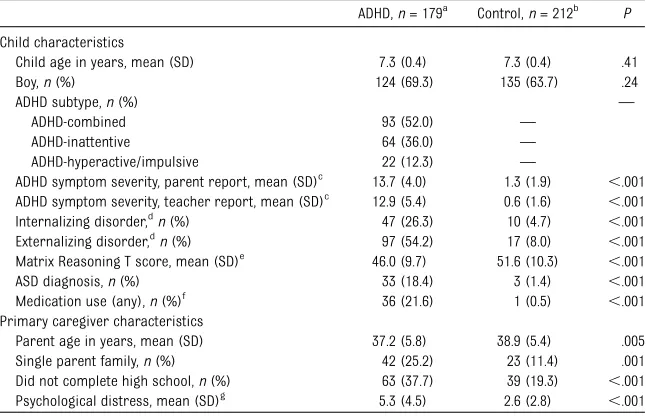
Children with ADHD were more likely to have an internalising and externalising disorder, were more likely to have been diagnosed with ADHD and were more likely to be taking medication than controls (Table 1). The primary care-givers in the ADHD group were younger, more likely to be single parents, less likely to have completed high school, and reported higher levels of psycho-logical distress.
Prevalence of Language Problems
Forty percent of children in the ADHD group had language problems (42% of girls versus 40% of boys), compared with 17% of controls. Although not
combined type (47%;n= 43), followed by ADHD-hyperactive/impulsive (36%; n = 8) and ADHD-inattentive (33%; n= 21). Medication use was similar for children with ADHD alone (42%) and children with ADHD and language prob-lems (38%).
After adjustment for confounders, chil-dren with ADHD remained more likely to have language problems than controls (odds ratio [OR], 2.8; 95% confidence interval [CI], 1.5 to 5.1;P,.001; Table 2). Confounding variables were not signifi -cantly associated with language prob-lems in the adjusted model; ADHD status was the only unique predictor of lan-guage problems.
Speech Pathology Service Use
Forty-two percent (n= 30) of children with ADHD and language problems had previously accessed speech pathology services. Of these, 57% (n= 17) were still seeing a speech pathologist. Only
accessed speech pathology services and of these, half were currently seeing a speech pathologist (50%;n= 3).
Association Between Language Problems and Academic and Social Functioning
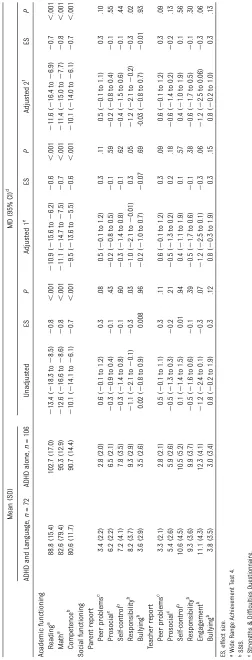
In unadjusted and adjusted analyses, children with ADHD and language problems had poorer academic func-tioning than those with ADHD alone (Table 3). After adjustment, they had poorer word reading (effect size, 20.7), math computation (effect size,20.8), and academic competence (effect size,20.7).
We found little evidence that language problems adversely affected social functioning in children with ADHD (Ta-ble 3). After adjustment, children with ADHD and language problems had lower scores on the parent-reported respon-sibility subscale compared with children with ADHD alone (effect size,20.3).
TABLE 1 Sample Characteristics for Children With ADHD and Non-ADHD Controls
ADHD,n= 179a Control,n= 212b P
Child characteristics
Child age in years, mean (SD) 7.3 (0.4) 7.3 (0.4) .41
Boy,n(%) 124 (69.3) 135 (63.7) .24
ADHD subtype,n(%) —
ADHD-combined 93 (52.0) —
ADHD-inattentive 64 (36.0) —
ADHD-hyperactive/impulsive 22 (12.3) —
ADHD symptom severity, parent report, mean (SD)c 13.7 (4.0) 1.3 (1.9) ,.001
ADHD symptom severity, teacher report, mean (SD)c 12.9 (5.4) 0.6 (1.6) ,.001
Internalizing disorder,dn(%) 47 (26.3) 10 (4.7) ,.001
Externalizing disorder,dn(%) 97 (54.2) 17 (8.0) ,.001
Matrix Reasoning T score, mean (SD)e 46.0 (9.7) 51.6 (10.3) ,.001
ASD diagnosis,n(%) 33 (18.4) 3 (1.4) ,.001
Medication use (any),n(%)f 36 (21.6) 1 (0.5) ,.001
Primary caregiver characteristics
Parent age in years, mean (SD) 37.2 (5.8) 38.9 (5.4) .005
Single parent family,n(%) 42 (25.2) 23 (11.4) .001
Did not complete high school,n(%) 63 (37.7) 39 (19.3) ,.001
Psychological distress, mean (SD)g
5.3 (4.5) 2.6 (2.8) ,.001
anranges between 167 and 179. bnranges between 202 and 212. cConners 3AI.
dDISC-IV.
eWechsler Abbreviated Scales of Intelligence.
fTwenty children (11%) in the ADHD group had taken medication for ADHD on the day of the assessment (dexamphetamine, methylphenidate, or atomoxetine).
Although those with ADHD and lan-guage problems had lower scores on the other parent- and teacher-reported measures of social functioning, differ-ences were not statistically significant.
Sensitivity Analysis Excluding Children With ASD
We reran all adjusted analyses excluding, rather than covarying for, children with ASD. Significantly elevated prevalence of language problems in children with ADHD relative to controls remained (38% vs 17%; OR, 3.1; 95% CI, 1.7 to 5.8;P,.001); language problems continued to be similar for girls and boys with ADHD (39% vs 38%). We did find that fewer children with ADHD without ASD had previously accessed speech pathology services (n= 18; 33%) compared with the entire ADHD sample (n= 30; 42%).
In adjusted analyses, we continued tofind that, compared with children with ADHD alone, children with ADHD and language problems had poorer word reading (MD,
211.9; 95% CI,217.1 to26.7;P,.001; effect size, 20.7), math computation (MD,211.5; 95% CI,215.5 to27.5;P, .001; effect size, 20.8), and academic competence (MD,210.0; 95% CI,214.5 to 25.6; P , .001; effect size, 20.7). Similarly there was weak evidence that language problems were associated with poorer social functioning.
DISCUSSION
In this study, children with ADHD were at much greater risk of language prob-lems than controls. There was strong evidence that language problems in children with ADHD were associated with
markedly poorer academic functioning. In contrast, there was little evidence that language problems adversely affected social functioning in children with ADHD. Fewer than half of children with ADHD and language problems had accessed speech pathology services and only one-quarter were currently seeing a speech pathol-ogist. All results held when excluding children with comorbid ASD.
The risk of language problems for chil-dren with ADHD was nearly 3 times higher than for controls, similar to that found in Tirosh and Cohen’s9 community-based study. Consistent with previous re-search, ADHD status was a unique pre-dictor of language problems.3 Our
findings suggest that the relationship between language problems and ADHD is not merely explained by other commonly occurring comorbidities (eg, ASD, in-ternalizing and exin-ternalizing disorders) or sociodemographic factors. Our study extends previous research by consider-ing multiple factors, which may have accounted for this relationship within an inclusive, community-ascertained ADHD sample. The mechanisms underlying comorbidity between ADHD and lan-guage impairment are likely complex and cannot be ascertained from this study. One possibility is that poor lan-guage ability may constitute a risk factor on the phenotypic pathway to ADHD, and/ or vice versa.4Another possibility is that the overlap between these conditions reflects shared biological etiology.
In contrast to the only other community-based study in this area, we found that the prevalence of language problems was similar in boys and girls with ADHD.
Tirosh and Cohen9found that girls with ADHD were more likely to have lan-guage problems than boys with ADHD. However, their study comprised a small sample of girls with ADHD, and ex-cluded children with behavioral comorbidities. This may have resulted in the ascertainment of a less severe sample of boys with ADHD.
Consistent with research examining language-impaired samples,5there was a strong relationship between language problems and academic functioning in children with ADHD. Large effect size differences were detected across all academic domains when comparing those with ADHD and language prob-lems to those with ADHD alone. Children with ADHD alone, as a group, had aca-demic functioning that fell within the average range, further highlighting the key relationship between language and academic functioning. Importantly, the strength of the relationship between academic and language functioning held after taking into account key con-founding variables, highlighting the unique contribution of children’s lan-guage to academic functioning.
Despite this association, fewer than half of children with ADHD and language problems had previously accessed speech pathology services, and only one-quarter were currently seeing a speech pathologist. This could be due to ADHD symptoms masking language problems in this population; however, speech pa-thology service use was even lower for control children. Routine assessments for ADHD do not generally include stan-dardized language assessments, and it
TABLE 2 Prevalence of Language Problems in Children With ADHD Versus Controls
OR (95% CI)c
ADHD,n= 178b Control,n= 212 Unadjusted P Adjusted 1d P Adjusted 2e P
Language problem,n(%)a
72 (40.4) 37 (17.4) 3.2 (2.0 to 5.1) ,.001 2.9 (1.7 to 4.9) ,.001 2.8 (1.5 to 5.1) .001
aMeasured by using the CELF-4 screener. bCELF-4 data unavailable for 1 participant with ADHD.
cAll unadjusted and adjusted models adjusted for school clustering.
dAdjusted for child (age and gender) and family (parent age, parent high school completion, single-parent status, and parent mental health) sociodemographic factors. eAdjusted for child and family sociodemographic factors in addition to child comorbidities (internalizing disorder, externalizing disorder, and ASD).
However, given the strong association between language and academic un-derachievement found in this study, if children with ADHD are falling signifi -cantly behind academically, they should be referred for a language assessment.
Contrary to expectations, language prob-lems had little adverse effect on so-cial functioning in children with ADHD. It is possible that children with ADHD already experience poorer social func-tioning due to factors aside from lan-guage ability including ADHD symptoms and associated comorbidities (eg, ASD).1 Alternatively, language problems may exert a greater influence on social functioning as peer relationships be-come more complex with age.28 We might see a different picture as children progress through elementary school.
To our knowledge, this is thefirst study to examine the association between lan-guage and both academic and social functioning in children with ADHD. Strengths of the study include the community-based design; rigorous case and control identification procedures; and representation of girls, all subtypes, and comorbidities. We assessed outcome variables by using blinded direct as-sessments and detailed parent and teacher reports. We adjusted for a num-ber of variables in our analyses that may have confounded the relationship be-tween ADHD and language problems.
However, although we directly assessed child language, we did so via a screen-ing measure, which did not yield in-formation of the type of language problem experienced (ie, receptive or expressive). Further research is needed to replicate thesefindings using a full assessment of language. The preva-lence of language problems in our con-trol group was however, similar to other population-based studies,29,30suggesting a screen may be sufficient for estimat-ing language problems. The participation
TABLE 3 Unadjusted and Adjusted MDs in Academic and Social Functioning for Childr en With ADHD and Language Pr oblems V ersus Those With ADHD-Alone Mean (SD) MD (95% CI) d ADHD and Langua ge, n = 72 ADHD alone, n = 106 Una djusted ES P Adjusted 1 e ES P Adj usted 2 f ES Ac ademi c functio ning Rea ding a 88.8 (15.4 ) 102.7 (17 .0) 2 13.4 ( 2 18.3 to 2 8.5) 2 0.8 , .001 2 10.9 ( 2 15.6 to 2 6.2) 2 0.6 , .001 2 11.6 ( 2 16.4 to 2 6.9) 2 0.7 Ma th a 82.6 (79.4 ) 95 .3 (12 .9) 2 12.6 ( 2 16.6 to 2 8.6) 2 0.8 , .001 2 11.1 ( 2 14.7 to 2 7.5) 2 0.7 , .001 2 11.4 ( 2 15.0 to 2 7.7) 2 0.8 Com petence b 80.6 (11.7 ) 90 .7 (14 .4) 2 10.1 ( 2 14.1 to 2 6.1) 2 0.7 , .001 2 9.5 ( 2 13.6 to 2 5.5) 2 0.6 , .001 2 10.1 ( 2 14.0 to 2 6.1) 2 0.7 Soc ial functioning P ar ent repor t P eer pr oblem s c 3.4 (2.2) 2.8 (2. 0) 0.6 ( 2 0.1 to 1.2) 0.3 .08 0.5 ( 2 0.1 to 1.2) 0.3 .11 0.5 ( 2 0.1 to 1.1) 0.3 Pr os ocial c 6.2 (2.2) 6.5 (2. 1) 2 0.3 ( 2 0.9 to 0.4) 2 0.1 .43 2 0.2 ( 2 0.8 to 0.5) 2 0.1 .59 2 0.2 ( 2 0.8 to 0.4) 2 0.1 Self-con tr ol b 7.2 (4.1) 7.8 (3. 5) 2 0.3 ( 2 1.4 to 0.8) 2 0.1 .60 2 0.3 ( 2 1.4 to 0.8) 2 0.1 .62 2 0.4 ( 2 1.5 to 0.6) 2 0.1 Respo nsibili ty b 8.2 (3.7) 9.3 (2. 9) 2 1.1 ( 2 2.1 to 2 0.1) 2 0.3 .03 2 1.0 ( 2 2.1 to 2 0.01) 0.3 .05 2 1.2 ( 2 2.1 to 2 0.2) 2 0.3 Bull ying b 3.6 (2.9) 3.5 (2. 6) 0.02 ( 2 0.8 to 0.9) 0.008 .96 2 0.2 ( 2 1.0 to 0.7) 2 0.07 .69 -0.03 ( 2 0.8 to 0.7) 2 0.01 Teacher repor t P eer pr oblem s c 3.3 (2.1) 2.8 (2. 1) 0.5 ( 2 0.1 to 1.1) 0.3 .11 0.6 ( 2 0.1 to 1.2) 0.3 .09 0.6 ( 2 0.1 to 1.2) 0.3 Pr os ocial c 5.4 (2.6) 5.9 (2. 6) 2 0.5 ( 2 1.3 to 0.3) 2 0.2 .21 2 0.5 ( 2 1.3 to 0.2) 0.2 .18 2 0.6 ( 2 1.4 to 0.2) 2 0.2 Self-con tr ol b 10.6 (4.5) 10 .5 (5. 2) 0.1 ( 2 1.4 to 1.5) 0.01 .94 0.4 ( 2 1.1 to 1.9) 0.1 .57 0.4 ( 2 1.0 to 1.9) 0.1 Respo nsibili ty b 9.3 (3.6) 9.9 (3. 7) 2 0.5 ( 2 1.6 to 0.6) 2 0.1 .39 2 0.5 ( 2 1.7 to 0.6) 2 0.1 .38 2 0.6 ( 2 1.7 to 0.5) 2 0.1 Engag ement b 11.1 (4.3) 12 .3 (4. 1) 2 1.2 ( 2 2.4 to 0.1) 2 0.3 .07 2 1.2 ( 2 2.5 to 0.1) 2 0.3 .06 2 1.2 ( 2 2.5 to 0.06) 2 0.3 Bull ying b 3.8 (3.5) 3.0 (3. 4) 0.8 ( 2 0.2 to 1.9) 0.3 .12 0.8 ( 2 0.3 to 1.9) 0.3 .15 0.8 ( 2 0.2 to 1.0) 0.3 ES , effect size. aWide Range Achievement Test 4.
bSSIS. cStreng
rate for our control group was lower than our ADHD group; however, we identified no evidence of participation bias for controls.
CONCLUSIONS
We found that both boys and girls with ADHD had elevated prevalence of lan-guage problems, and that lanlan-guage problems in children with ADHD were
associated with significantly poorer ac-ademic functioning. Given the strength of this association, future research should examine whether language-based inter-ventions are effective in improving aca-demic functioning for this vulnerable group of children.
ACKNOWLEDGMENTS
We thank all the research assistants, stu-dents, and interns who contributed to
data collection for this study. We also thank the many families, teachers, and schools for their participation in this study. Some study data were collected and managed by using Research Elec-tronic Data Capture (REDCap) elecElec-tronic data capture tools hosted at Murdoch Childrens Research Institute. REDCap is a secure, Web-based application designed to support data capture for research studies.
REFERENCES
1. McQuade JD, Hoza B. Peer problems in at-tention deficit hyperactivity disorder: cur-rent status and future directions. Dev
Disabil Res Rev. 2008;14(4):320–324
2. Langberg JM, Molina BSG, Arnold LE, et al. Patterns and predictors of adolescent ac-ademic achievement and performance in a sample of children with attention-deficit/ hyperactivity disorder.J Clin Child Adolesc
Psychol. 2011;40(4):519–531
3. Westby C, Watson S. Perspectives on at-tention deficit hyperactivity disorder: ex-ecutive functions, working memory, and language disabilities.Semin Speech Lang. 2004;25(3):241–254
4. Mueller KL, Tomblin JB. Examining the comorbidity of language impairment and attention-deficit/hyperactivity disorder.Top
Lang Disord. 2012;32:228–246
5. Stothard SE, Snowling MJ, Bishop DVM, Chipchase BB, Kaplan CA. Language-impaired preschoolers: a follow-up into adolescence. J Speech Lang Hear Res. 1998;41(2):407–418
6. Botting N, Conti-Ramsden G. Social and behavioural difficulties in children with language impairment. Child Lang Teach Ther. 2000;16:105–120
7. Gualtieri CT, Koriath U, Van Bourgondien M, Saleeby N. Language disorders in children referred for psychiatric services. J Am
Acad Child Psychiatry. 1983;22(2):165–171
8. Love AJ, Thompson MGG. Language dis-orders and attention deficit disorders in young children referred for psychiatric services: analysis of prevalence and a con-ceptual synthesis. Am J Orthopsychiatry. 1988;58(1):52–64
9. Tirosh E, Cohen A. Language deficit with attention-deficit disorder: a prevalent comorbidity. J Child Neurol. 1998;13(10): 493–497
10. Baker L, Cantwell DP. A prospective psy-chiatric follow-up of children with speech/ language disorders.J Am Acad Child
Ado-lesc Psychiatry. 1987;26(4):546–553
11. Langberg JM, Becker SP. Does long-term medication use improve the academic outcomes of youth with attention-deficit/ hyperactivity disorder? Clin Child Fam
Psychol Rev. 2012;15(3):215–233
12. Gillberg C, Gillberg IC, Rasmussen P, et al. Co-existing disorders in ADHD: implications for diagnosis and intervention.Eur Child
Adolesc Psychiatry. 2004;13(suppl 1):I80–
I92
13. Cherkasova M, Sulla EM, Dalena KL, Pondé MP, Hechtman L. Developmental course of attention deficit hyperactivity disorder and its predictors. J Can Acad Child Adolesc
Psychiatry. 2013;22(1):47–54
14. Cohen NJ, Barwick MA, Horodezky NB, Vallance DD, Im N. Language, achievement, and cognitive processing in psychiatrically disturbed children with previously identified and unsuspected language impairments.J
Child Psychol Psychiatry. 1998;39(6):865–
877
15. Redmond SM. The use of rating scales with children who have language impairments.
Am J Speech Lang Pathol. 2002;11:124–138
16. Cohen NJ, Vallance DD, Barwick M, et al. The interface between ADHD and language impairment: an examination of language, achievement, and cognitive processing. J
Child Psychol Psychiatry. 2000;41(3):353–
362
17. Sciberras E, Efron D, Schilpzand EJ, et al. The Children’s Attention Project: a community-based longitudinal study of children with ADHD and non-ADHD controls.BMC Psychiatry. 2013;13:18
18. Conners CK. Conners. 3rd ed. Toronto, Canada: Multi-Health Systems; 2008
19. Shaffer D, Fisher P, Lucas CP, Dulcan MK, Schwab-Stone ME. NIMH Diagnostic In-terview Schedule for Children Version IV (NIMH DISC-IV): description, differences from previous versions, and reliability of some common diagnoses.J Am Acad Child
Adolesc Psychiatry. 2000;39(1):28–38
20. Semel E, Wiig E, Secord W.Clinical Evalua-tion of Language Fundamentals, Fourth Edition, Screening Test, Australian & New Zealand Language Adapted Edition (CELF-4
Screener).Sydney, Australia: NCS Pearson;
2004
21. Wilkinson GS, Robertson GJ. Wide Range
Achievement Test 4 (WRAT 4). Lutz, FL:
Psy-chological Assessment Resources; 2006 22. Gresham FM, Elliott SN, Kettler RJ. Base
rates of social skills acquisition/performance deficits, strengths, and problem behaviors: an analysis of the Social Skills Improvement System—Rating Scales.Psychol Assess. 2010; 22(4):809–815
23. Goodman R. Psychometric properties of the strengths and difficulties questionnaire.J
Am Acad Child Adolesc Psychiatry. 2001;40
(11):1337–1345
24. Furukawa TA, Kessler RC, Slade T, Andrews G. The performance of the K6 and K10 screening scales for psychological distress in the Australian National Survey of Mental Health and Well-Being. Psychol Med. 2003; 33(2):357–362
25. Wechsler D.Wechsler Abbreviated Scale of
Intelligence. San Antonio, TX: Harcourt;
1999
26. Dennis M, Francis DJ, Cirino PT, Schachar RJ, Barnes MA, Fletcher JM. Why IQ is not a covariate in cognitive studies of neuro-developmental disorders. J Int
Neuro-psychol Soc. 2009;15(3):331–343
27. Australian Bureau of Statistics. Census of population and housing: socio-economic
AUSSTATS/[email protected]/DetailsPage/2033.0.55.00 12011?OpenDocument. Accessed April 5, 2013
28. Durkin K, Conti-Ramsden G. Young people with specific language impairment: a
re-26:107–123
29. Reilly S, Wake M, Ukoumunne OC, et al. Predicting language outcomes at 4 years of age: longitudinal findings from the Early Language in Victoria Study.
Pediat-30. Tomblin JB, Records NL, Zhang X. A system for the diagnosis of specific language impairment in kindergarten children.J Speech Hear Res. 1996;39(6): 1284–1294
(Continued fromfirst page)
www.pediatrics.org/cgi/doi/10.1542/peds.2013-3355
doi:10.1542/peds.2013-3355
Accepted for publication Feb 3, 2014
Address correspondence to Emma Sciberras, DPsych, Centre for Community Child Health, The Royal Children’s Hospital, Flemington Rd, Parkville 3052 Australia.
E-mail: [email protected]
PEDIATRICS (ISSN Numbers: Print, 0031-4005; Online, 1098-4275).
Copyright © 2014 by the American Academy of Pediatrics
FINANCIAL DISCLOSURE:The authors have indicated they have nofinancial relationships relevant to this article to disclose.
FUNDING:Funded by the Australian National Health and Medical Research Council (NHMRC; project grant 1008522), the Collier Foundation, and the Murdoch
Childrens Research Institute. Dr Sciberras’position is funded by an NHMRC Early Career Fellowship in Population Health 1037159 (2012–2015). Professor Anderson
is funded by an NHMRC Practitioner Fellowship 607333 (2010–2014). This work was supported by NHMRC Centre for Research Excellence funding (Professor
Nicholson and Drs Mueller and Sciberras: 1023493). This research was supported by the Victorian Government’s Operational Infrastructure Support Program to
the Murdoch Childrens Research Institute and the Victorian Government funding to the Parenting Research Centre.
DOI: 10.1542/peds.2013-3355 originally published online April 21, 2014;
2014;133;793
Pediatrics
Elizabeth J. Schilpzand, Brad Jongeling and Jan M. Nicholson
Emma Sciberras, Kathryn L. Mueller, Daryl Efron, Matthew Bisset, Vicki Anderson,
Language Problems in Children With ADHD: A Community-Based Study
Services
Updated Information &
http://pediatrics.aappublications.org/content/133/5/793 including high resolution figures, can be found at:
References
http://pediatrics.aappublications.org/content/133/5/793#BIBL This article cites 24 articles, 0 of which you can access for free at:
Subspecialty Collections
ub
http://www.aappublications.org/cgi/collection/psychosocial_issues_s
Psychosocial Issues
rning_disorders_sub
http://www.aappublications.org/cgi/collection/cognition:language:lea
Cognition/Language/Learning Disorders
activity_disorder_adhd_sub
http://www.aappublications.org/cgi/collection/attention-deficit:hyper
Attention-Deficit/Hyperactivity Disorder (ADHD)
al_issues_sub
http://www.aappublications.org/cgi/collection/development:behavior
Developmental/Behavioral Pediatrics
following collection(s):
This article, along with others on similar topics, appears in the
Permissions & Licensing
http://www.aappublications.org/site/misc/Permissions.xhtml in its entirety can be found online at:
Information about reproducing this article in parts (figures, tables) or
Reprints
DOI: 10.1542/peds.2013-3355 originally published online April 21, 2014;
2014;133;793
Pediatrics
Elizabeth J. Schilpzand, Brad Jongeling and Jan M. Nicholson
http://pediatrics.aappublications.org/content/133/5/793
located on the World Wide Web at:
The online version of this article, along with updated information and services, is
by the American Academy of Pediatrics. All rights reserved. Print ISSN: 1073-0397.